아마 유전자원의 농업적 특성 및 지방산 조성 평가
이영화
1,†
・ 배상목1
・ 박 원1
・ 김광수1
・ 장영석1
・ 이경보1
Evaluation of Agronomic Characteristics and Fatty Acid Composition of Flax Germplasms
Yong-Hwa Lee 1,† , Sang-Mok Bae 1 , Won Park 1 , Kwang-Soo Kim 1 , Young-Seok Jang 1 , Kyeong-Bo Lee 1
ABSTRACT In this study, agronomic characteristics and fatty acid composition of 121 flax (Linum usitatissimum L.) germplasms were analyzed. The flax germplasms had a fairly short growth period of 75-95 days. The plant height at maturity varied from 52 to 124 cm. The flower color varied from white to lilac and even purple. Early flowering flax germplasms had white flowers and were resistant to lodging. In early flowering flax germplasms, all agronomic characteristics, including growth period, plant height, branch number per plant, stem diameter, number of capsules per raceme, seed number per capsule, 1000-seed weight, and seed yield, were decreased. The average fatty acid composition of 121 flax germplasms comprised palmitic acid (5.3%), stearic acid (4.3%), oleic acid (29.7%), linoleic acid (13.1%) and linolenic acid (46.4%). The total content of unsaturated fatty acids ranged from 84~94% with an average of 88%. Among the fatty acids, linolenic acid (omega-3) content was the highest with a range of 36~54%. In five selected flax germplasms (Hollandia 1803, Red son, C & F Res Br 1767, Wiera, and Ireland 1657) with high linolenic acid ( ≥51%), total lipid and protein contents were 30~36% and 5.4~6.9%, respectively. Overall, flax can practically be adoptable into cropping systems in South Korea and utilized as a scenery crop, since flax has a short cultivation period with diverse flower colors.
Keywords : agronomic characteristics, fatty acid, flax, scenery crop
DOI : http://dx.doi.org/10.7740/kjcs.2016.61.2.124Original Research Article
ⓒ 본 학회지의 저작권은 한국작물학회지에 있으며, 이의 무단전재나 복제를 금합니다.
This is an Open-Access article distributed under the terms of the Creative Commons Attribution Non-Commercial License (http://creativecommons.org/licenses/by-nc/3.0) which permits unrestricted non-commercial use, distribution, and reproduction in any medium, provided the original work is properly cited.
1농촌진흥청 국립식량과학원 바이오에너지작물연구소 (Bioenergy Crop Research Institute, National Institute of Crop Science, Rural Development Administration, Muan 58545, Republic of Korea)
†
Corresponding author: Yong-Hwa Lee; (Phone) +82-61-450-0125; (E-mail) [email protected]
<Received 14 March, 2016; Revised 3 June, 2016; Accepted 9 June, 2016>
아마
(Linum usitatissimum L.)는 Linaceae과 Linum속에 포 함되어 있는 약 200종 중 한 종이다(Diederichsen and Richards, 2001). 아마는 자가수분을 하는 이배체 식물이며, 약 30개 의 염색체(2n=30)와 비교적 작은 게놈 크기(~700 Mbp)를 가진 1년생 작물이다(Cullis, 1981; Bennett and Leitch, 2004).
캐나다는 2014년 614,800톤의 아마씨를 생산하여 세계 최 고의 생산국 이고(Flax Statistics), 프랑스는 세계 최고의 아 마섬유 생산국이다(FAOSTAT, 2012).
아마씨는 식용 기름, 건강식품, 사료, 섬유, 페인트, 비누 및 의약 등 다양한 용도를 가지고 있다(Kajla et al., 2015;
Singh et al., 2011). 아마 줄기는 리넨(linen)과 같은 섬유 (textiles) 와 특수 목적의 용지(지폐, 친환경 단열재)로 이용 된다(Vaisey-Genser and Morris, 2001). 아마씨는 지방(~45%),
단백질(25%), 및 식이섬유(30%)가 풍부하여 영양적 가치 가 높은 식품으로 사용되고 있다. 아마인유는 오메가-3(ω-3) 계열의 지방산인 알파-리놀렌산(α-linolenic acid)이 50%
정도로 주요 식물성 유지인 유채유(11%)와 대두유(8%)에
비해 월등히 높게 함유되어 있다(Wang et al., 2008). 아마
인유의 알파-리놀렌산은 인체에서 대사과정을 거쳐 DHA
(docosadocosahexaenoic acid) 와 EPA (eicosapentaenoic acid)
로 전환 된다(Chen et al., 2006). 오메가-3 지방산은 영양적
장점뿐만 아니라, 인체에서 심혈관 질환, 비만, 당뇨, 염증,
및 여러 가지 신경계 질환의 위험을 감소시켜 건강을 개선
하는 것으로 보고되었다(Tou et al., 2011). 그러나 식품에
서 오메가-3 공급원으로서 아마인유의 사용은 기름의 산화
안정성이 떨어지기 때문에 그 사용이 제한된다(Kolanowski
et al., 2004; Choo et al., 2007). 한편 아마씨에는 SDG (secoisolariciresinol diglycoside) 가 풍부하고, 이것은 대장 의 미생물에 의해 포유류의 리그난(mammalian lignans)인 enterolactone (EL) 및 enterodiol (ED)로 변환되며, 이들 성 분들은 모두 항암 효과와 관계가 있는 것으로 보고되었다 (Thompson et al., 1991).
본 연구의 목적은 국립식량과학원 바이오에너지작물연 구소 보유 유전자원 중 임의 선발한 121점에 대해 봄파종 후 농업적 특성과 지방산 조성, 조지방 및 조단백질 함량을 분석하여 우리나라 농업 작부체계에 적합한 아마 유전자원 선발과 신규 경관작물로서 아마를 활용하기 위한 기초자료 를 얻고자 수행 하였다.
재료 및 방법
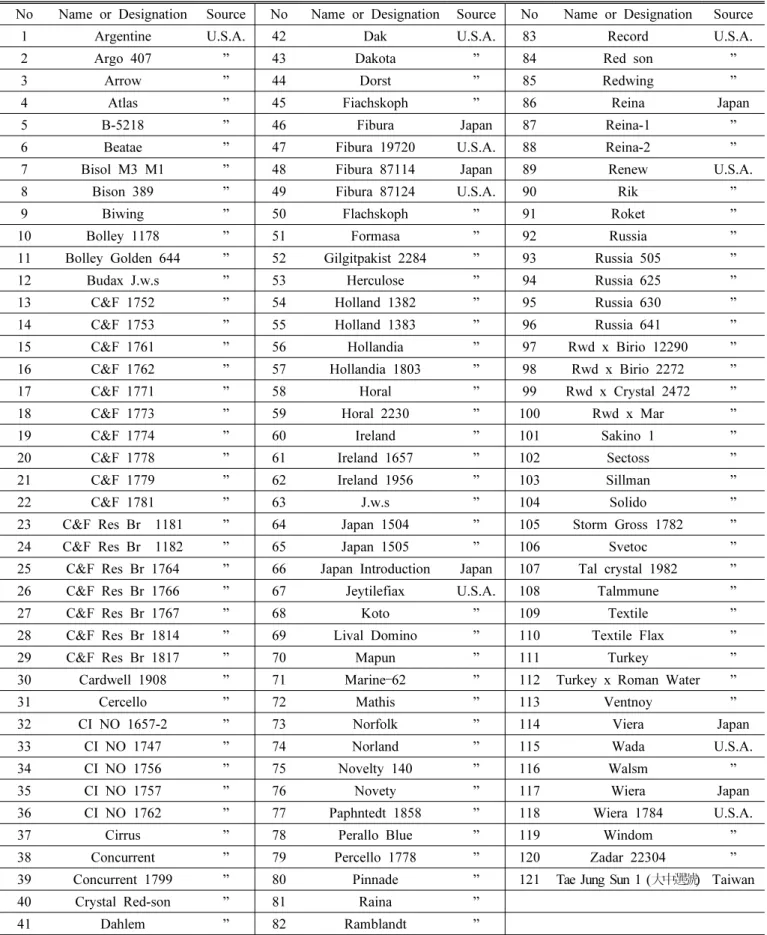
농촌진흥청 국립식량과학원 바이오에너지작물연구소에 서 보유중인 아마 유전자원 121점을 2015년 3월 27일(봄재 배)에 파종하였다. 파종방법은 평휴 광산파 하였고, 재식거 리는 조간거리 30 cm에 파폭 200 cm로 하였다. 파종량은 10a 당 3 kg의 아마씨를 파종하였다. 개화기, 등숙기 또는 수확 후에 농업적 특성(개화시, 개화기간, 생육기간, 초장, 주당분지수, 경태, 주당삭수, 삭당종실수, 천립중 및 종실수 량)을 조사하였다. 본 시험에서 공시한 아마 유전자원 121 점은 Table 1과 같다.
농업형질 조사
아마 유전자원의 농업형질은 개화시(처음 꽃이 핀 날), 꽃색(백색, 연보라, 보라, 진보라), 도복정도(1~3), 성숙기 ( 수확할 수 있는 시기(날)), 생육기간(파종일 부터 성숙기까 지의 총 일수), 초장(아마 주경의 높이), 주당분지수(1주당 옆가지의 수), 경태(아마주경의 굵기), 주당삭수(1주에 붙어 있는 삭의 총 개수), 삭당종실수(1삭 내에 들어있는 종자수) 및 천립중(한품종의 종자 천개의 무게)을 조사하였다. 종자 는 수분함량이 약 13% 이하로 건조한 후 성분분석에 이용 하였다.
조지방 함량 조사
아마종자의 기름 함량은 Soxtec
™2050 자동 지방 추출 시스템(Foss Tecator, Höganäs, Sweden)을 사용하여 석유 에테르를 용매로 이용하여 추출하였다.
지방산 조성 분석
아마씨 0.3 g을 막자사발에서 잘 마쇄한 후 Pear-shaped
flask 에 넣고, methanol (15 mL)과 sodium methoxide (1 mL) 을 넣은 후, 100°C에서 2시간 동안 반응시켰다. 반응물을 상온에서 냉각시킨 후, n-hexane (15 mL)을 첨가, 혼합한 후 추출하고 상층액을 여과한 후, 가스크로마토그래피(Agilent 7890) 를 이용하여 분석하였다(Lee et al., 2012). 지방산 조 성 분석 시 칼럼은 HP-Innowax (30 m x 0.32 mm x 0.25 um) 를 사용하였고, 주입부 및 검지부 온도는 200°C와 250°C로 하였으며, 오븐 온도는 150°C에서 1분간 유지한 후, 분당 5°C 씩 250°C까지 상승시키고, 250°C에서 20분간 유지하 였다.
조단백질 함량 조사
아마씨의 조단백질 함량 분석을 위해 0.2 g의 분쇄시료를 사용하였으며, Vario MAX CN cube (Elementar, Germany) 로 분석하고, 조단백질 함량은 질소계수 6.25를 곱하여 분 석하였다.
결과 및 고찰
아마 유전자원의 농업적 특성
아마 유전자원 121점을 국립식량과학원 바이오에너지작 물연구소(전남 무안 소재)에서 2015년 3월 27일에 파종하 여, 개화는 5월 17~31일에 시작되었고, 평균 개화소요일수 는 57일로 나타났다. 아마의 잎은 어긋나고 넓은 선형(線形) 이다(Fig. 1(a)). 열매는 삭과(蒴果: 여러 개의 씨방으로 된 열매)로 둥근 형태이고 종자는 평평한 긴 타원형이며 황갈 색이다. 아마의 꽃은 5개의 작은 꽃잎으로 구성되어 있으 며, 꽃색은 진보라색, 연보라색, 보라색 및 백색이 각각 20 점(13%), 17점(11%), 42점(28%), 및 67점(44%)으로 나타 났으며, 보라색 계열이 전체의 50% 이상을 차지하였다(Fig.
1(c), (d), (e)). 아마 유전자원들의 주요 농업형질을 조사한 결과, 개화시, 개화기간, 등숙기, 생육기간, 초장, 주당분지 수, 경태, 주당삭수, 삭당종실수 및 천립중에 대한 각각의 평균값은 5월 25일, 17일, 6월 27일, 85일, 95 cm, 3개, 3.4 mm, 74 개, 8개 및 4.5 g으로 나타났다(Table 2).
봄파종(3월 27일) 후, 개화시가 5월 17~20일로 빠른 유전
자원 10점(Novelty 140, Reina-1, Reina-2, CI NO 1657-2, CI
NO 1762, Sectoss, CI NO 1747, CI NO 1756, CI NO 1757,
Rwd x Birio 12290) 과 개화시가 5월 28~31일로 늦은 유전
자원 10점(Lival Domino, Pinnade, Budax J.w.s, Russia 641,
C&F 1774, Dak, Novety, Russia 505, Russia 625, Russia 630)
에 대해 농업형질을 상호비교 한 결과(Table 3), 개화시가
빠른 유전자원들은 모두 꽃색이 백색이고, 도복에도 강한
Table 1. Flax germplasms used in this experiment.
No Name or Designation Source No Name or Designation Source No Name or Designation Source
1 Argentine U.S.A. 42 Dak U.S.A. 83 Record U.S.A.
2 Argo 407 ” 43 Dakota ” 84 Red son ”
3 Arrow ” 44 Dorst ” 85 Redwing ”
4 Atlas ” 45 Fiachskoph ” 86 Reina Japan
5 B-5218 ” 46 Fibura Japan 87 Reina-1 ”
6 Beatae ” 47 Fibura 19720 U.S.A. 88 Reina-2 ”
7 Bisol M3 M1 ” 48 Fibura 87114 Japan 89 Renew U.S.A.
8 Bison 389 ” 49 Fibura 87124 U.S.A. 90 Rik ”
9 Biwing ” 50 Flachskoph ” 91 Roket ”
10 Bolley 1178 ” 51 Formasa ” 92 Russia ”
11 Bolley Golden 644 ” 52 Gilgitpakist 2284 ” 93 Russia 505 ”
12 Budax J.w.s ” 53 Herculose ” 94 Russia 625 ”
13 C&F 1752 ” 54 Holland 1382 ” 95 Russia 630 ”
14 C&F 1753 ” 55 Holland 1383 ” 96 Russia 641 ”
15 C&F 1761 ” 56 Hollandia ” 97 Rwd x Birio 12290 ”
16 C&F 1762 ” 57 Hollandia 1803 ” 98 Rwd x Birio 2272 ”
17 C&F 1771 ” 58 Horal ” 99 Rwd x Crystal 2472 ”
18 C&F 1773 ” 59 Horal 2230 ” 100 Rwd x Mar ”
19 C&F 1774 ” 60 Ireland ” 101 Sakino 1 ”
20 C&F 1778 ” 61 Ireland 1657 ” 102 Sectoss ”
21 C&F 1779 ” 62 Ireland 1956 ” 103 Sillman ”
22 C&F 1781 ” 63 J.w.s ” 104 Solido ”
23 C&F Res Br 1181 ” 64 Japan 1504 ” 105 Storm Gross 1782 ”
24 C&F Res Br 1182 ” 65 Japan 1505 ” 106 Svetoc ”
25 C&F Res Br 1764 ” 66 Japan Introduction Japan 107 Tal crystal 1982 ”
26 C&F Res Br 1766 ” 67 Jeytilefiax U.S.A. 108 Talmmune ”
27 C&F Res Br 1767 ” 68 Koto ” 109 Textile ”
28 C&F Res Br 1814 ” 69 Lival Domino ” 110 Textile Flax ”
29 C&F Res Br 1817 ” 70 Mapun ” 111 Turkey ”
30 Cardwell 1908 ” 71 Marine –62 ” 112 Turkey x Roman Water ”
31 Cercello ” 72 Mathis ” 113 Ventnoy ”
32 CI NO 1657-2 ” 73 Norfolk ” 114 Viera Japan
33 CI NO 1747 ” 74 Norland ” 115 Wada U.S.A.
34 CI NO 1756 ” 75 Novelty 140 ” 116 Walsm ”
35 CI NO 1757 ” 76 Novety ” 117 Wiera Japan
36 CI NO 1762 ” 77 Paphntedt 1858 ” 118 Wiera 1784 U.S.A.
37 Cirrus ” 78 Perallo Blue ” 119 Windom ”
38 Concurrent ” 79 Percello 1778 ” 120 Zadar 22304 ”
39 Concurrent 1799 ” 80 Pinnade ” 121 Tae Jung Sun 1 (大中選號) Taiwan
40 Crystal Red-son ” 81 Raina ”
41 Dahlem ” 82 Ramblandt ”
Fig. 1. Flax plant, capsules, and flowers. (a) Flax plants with three branches, (b) Flax seed capsules, (c) Dark purple flax flower, (d) Lilac flax flower, (e) White flax flower.
Table 2. Agronomic characteristics of 121 flax germplasms.
Statistics
Flowering date (month.day)
Flowering period
(day)
Ripening date (month.day)
Growth period
(day)
Plant height (cm)
No. of branches/P
lant
Stem diameter
(mm)
No. of capsules /Panicle
No. of seeds /Capsule
1000-seeds weight
(g)
Maximum 5.31 26 7.6 94 124 9 31.3 284 11 6.8
Mean 5.25 17 6.27 85 95 3 3.4 74 8 4.5
Minimum 5.17 10 6.11 75 52 1 1.6 19 5 3.1
Table 3. Comparison of agronomic characteristics between early and late flowering flax germplasms.
Flowering date (month.day)
Flower color
Lodging degree
(1-3)
Ripening date (month.day)
Growth period
(day)
Plant height (cm)
No. of branches/
Plant
Stem diameter
(mm)
No. of capsules /Panicle
No. of seeds /Capsule
1000-seeds weight
(g)
Seed yields (g)
5.17~20 White 1 6.2 76 72 2 2 26 7 3.5 40
5.28~31 Dark
purple 3 7.6 94 120 6 7 174 10 5.7 139
Table 4. Fatty acid composition of 121 flax germplasms.
Fatty acid compositions
Palmitic acid (C16:0)
Stearic acid (C18:0)
Oleic acid (C18:1)
Linoleic acid (C18:2)
Linolenic acid
(C18:3) Others Total
Maximum 7.1 7.6 40.4 15.9 54.1 1.8 -
Mean 5.3 4.3 29.7 13.1 46.4 0.8 100
Minimum 3.7 2.4 22.3 9.3 36.8 0.0 -
것으로 나타났다. 또한 개화시가 빠를수록 성숙기와 생육 기간이 짧고, 초장, 주당분지수, 경태, 주당삭수, 삭당종자 립수, 천립중, 및 종실수량은 감소하는 것으로 나타났다. 이
상의 결과에서 보듯이 아마의 재배기간이 75~94일(평균 85 일)로 매우 짧아 우리나라에서 봄재배(3월 하순~6월 하순) 와 여름재배(7월 하순~10월 하순/11월 초순), 즉 이기작 재 배가 가능할 것으로 판단된다. 또한 아마의 꽃색이 진보라 색, 연보라색 및 흰색으로 다양하고, 평균 개화기간도 17일 정도로 나타나, 여름철 경관작물로도 활용이 가능할 것으 로 판단된다.
아마 유전자원의 지방산 조성
아마 유전자원 121점의 지방산 조성은 Table 4와 같다.
팔미트산, 스테아린산, 올레산, 리놀레산, 및 리놀렌산에 대 한 각각의 평균값은 5.3, 4.3, 29.7, 13.1 및 46.4%이었고, 변이 정도는 각각 3.4, 5.2, 18.1, 6.6, 및 17.3%로 유전적으 로 변이가 큰 것으로 나타났다(Table 4). 변이계수로 볼 때 올레산의 함량 변이가 가장 컸고, 다음으로 리놀렌산 이었 고, 팔미트산의 변이는 가장 작았다.
아마 유전자원의 지방산 조성 분포는 Fig. 2와 같다. 팔
미트산의 분포는 4~5%와 5~6%가 92점으로 가장 많았고,
그 다음은 6~7%가 27점을 차지하였다. 스테아린산의 함량
은 3~4%가 27점, 5~6%가 22점 순이었다. 올레산의 함량은
Fig. 2. Frequency distribution of fatty acid composition in 121 flax germplasms.
Table 5. Correlation coefficients between fatty acid composition of 121 flax germplasms.
Correlation coefficient (r) Palmitic acid
(C16:0)
Stearic acid (C18:0)
Oleic acid (C18:1)
Linoleic acid (C18:2)
Linolenic acid
(C18:3) Others Palmitic acid
(C16:0) - -0.040 -0.134 -0.097 -0.039 0.035
Stearic acid
(C18:0) - - 0.104 0.125 -0.476** -0.214*
Oleic acid
(C18:1) - - - -0.323** -0.825** -0.132
Linoleic acid
(C18:2) - - - - -0.088 -0.066
Linolenic acid
(C18:3) - - - - - -0.066
Others - - - - - -
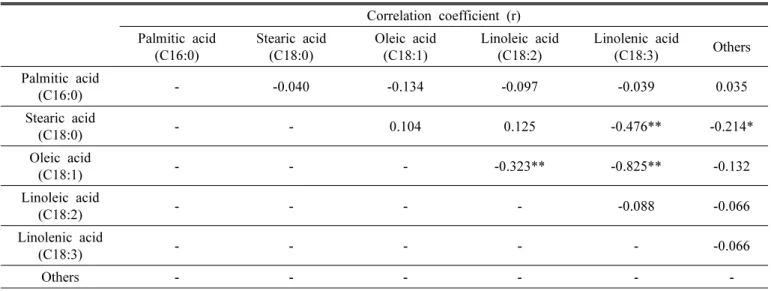
*,**represents not significant or significant at p ≤ 0.05 and p ≤ 0.01, respectively 28~31% 의 범위가 41점으로 가장 많았고, 다음으로 25~28%
가 33점으로 많았으며, 31~34%인 자원은 30점이었고, 34%
이상인 자원도 10점 이었다. 리놀레산 함량의 분포는 13~14%
의 범위가 36점으로 가장 많았고, 12~13%의 범위가 33점, 14~15% 인 자원도 27점 이었다. 리놀렌산은 42~44%, 44~46%, 46~48%, 및 48~50%가 각각 25, 26, 22, 및 19점으로 전체 자원의 76% (92점)를 차지하였고, 50% 이상인 자원도 23 점 이었다. 전체적으로 아마의 포화지방산 함량은 12%로 낮았으나, 불포화 지방산은 88%로 매우 높았다. 불포화지 방산 함량의 조성은 89~90%의 범위가 가장 많았고, 그 다 음인 88~89%와 90~91%가 각각 29점이었고, 91% 이상인 자원도 12점 이었다. 또한 아마 유전자원 121점의 지방산 조성 간에 상관관계를 분석한 결과, 올레산은 리놀레산과 리놀렌산 사이에서 부(-)의 상관관계가 뚜렷하게 나타났고.
스테아린산도 리놀렌산과 부(-)의 상관관계를 나타내었다.
그러나 전체적으로 다른 지방산 사이에서는 상관관계 지수 가 통계적으로 유의성이 없었다(Table 5). 본 연구의 결과 를 바탕으로 고 리놀렌산(High linolenic acid (≥51%)) 및 고 올레산(High oleic acid (≥34%)) 유전자원을 각각 10점 씩 선발한 결과는 Table 6과 같다.
아마 유전자원의 조지방 및 조단백질 함량
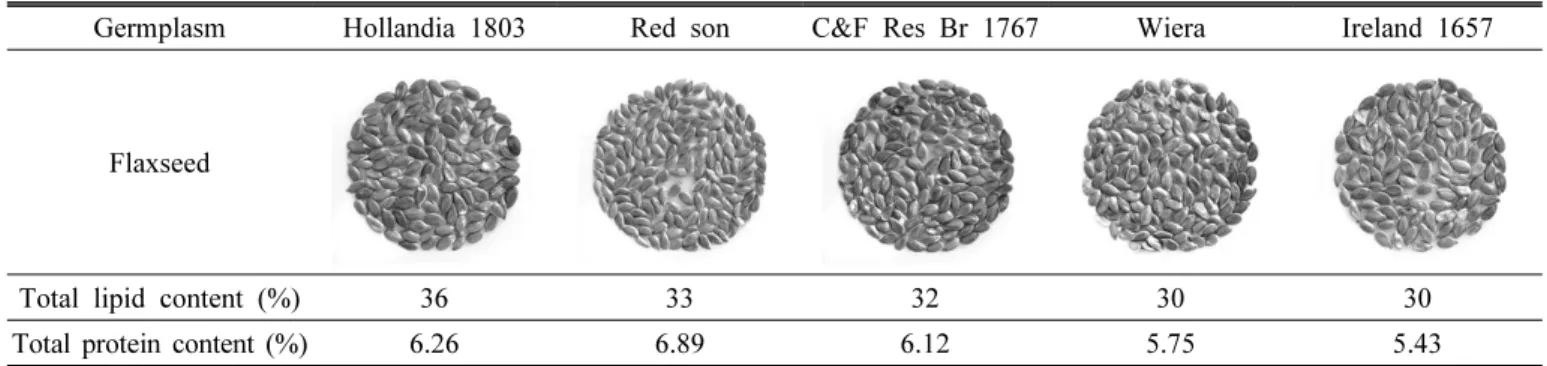
리놀렌산 함량이 51% 이상인 유망 유전자원 중에서 임
의로 선발한 5점(Hollandia 1803, Red son, C & F Res Br
1767, Wiera, Ireland 1657) 에 대한 조지방과 조단백질 함
량의 범위는 각각 30~36% 및 5.4~6.9%로 나타났다(Table
7). 이러한 아마 유전자원들은 식이에서 리놀렌산(오메가-3)
의 불균형을 해소하는데 큰 도움을 줄 수 있을 것으로 기대
된다.
Table 6. Selection of high linolenic and oleic acid in 121 flax germplasms.
Item Flax
germplasm
Fatty acid compositions Palmitic acid
(C16:0)
Stearic acid (C18:0)
Oleic acid (C18:1)
Linoleic acid (C18:2)
Linolenic
acid (C18:3) Others
High Linolenic acid (≥51%)
C&F Res Br 1766 6.4 2.9 24.0 11.1 54.1 1.5
Wiera 6.4 2.7 25.5 11.3 53.9 0.2
Ireland 1657 7.1 2.6 22.3 11.2 53.6 3.2
Textile 6.4 2.8 25.8 11.1 52.7 1.2
Ventnoy 6.7 2.5 24.3 12.8 52.4 1.3
Percello 1778 4.4 3.3 25.8 13.0 52.3 1.3
C&F 1762 5.7 3.4 24.8 12.9 51.8 1.4
Ireland 3.7 3.0 28.3 13.4 51.5 0.0
Beatae 4.6 3.2 26.5 13.3 51.4 1.1
Biwing 4.4 3.6 26.8 12.9 50.9 1.3
High Oleic acid
(≥34%)
Reina-1 4.5 6.8 40.4 10.3 37.3 0.8
Talmmune 4.7 3.5 37.0 10.9 42.0 1.8
Bisol M3 M1 4.6 3.5 36.7 9.9 44.3 1.0
Lival Domino 6.9 4.4 36.6 14.1 36.8 1.3
Russia 625 6.2 4.9 34.9 13.0 39.5 1.5
Marine-62 5.1 5.0 34.8 13.4 39.9 1.7
Svetoc 4.7 3.7 34.7 13.0 43.1 0.8
CI NO 1756 5.9 4.1 34.4 9.3 45.7 0.7
Holland 1383 4.8 3.6 34.2 12.6 43.6 1.1
Sillman 6.3 4.7 34.0 13.5 39.8 1.7
Table 7. Total lipid and protein content of five selected flax germplasms with high linolenic acid (≥51%).
Germplasm Hollandia 1803 Red son C&F Res Br 1767 Wiera Ireland 1657
Flaxseed
Total lipid content (%) 36 33 32 30 30
Total protein content (%) 6.26 6.89 6.12 5.75 5.43
적 요
아마(Linum usitatissimum L.)의 기름과 줄기섬유는 다양 한 용도를 가지고 있어 최근 들어 주목을 받고 있는 작물이 다. 본 연구는 아마의 활용도 제고를 위해 아마 유전자원 121 점에 대해 농업형질, 지방산 조성, 조지방 및 조단백질 함량을 분석하여 신규 경관작물 및 유지작물 개발의 기초
자료로 활용하고자 수행하였다. 아마는 재배기간이 75~95 일로 짧고, 키가 52~124 cm 정도 자라며, 꽃색이 흰색, 연 보라색, 진보라색, 및 보라색으로 크게 4종류로 나타났다.
개화시가 빠른 유전자원들은 모두 꽃색이 백색이고, 도복
에도 강하게 나타났을 뿐만 아니라 성숙기와 생육기간은
짧고, 초장, 주당분지수, 경태, 주당삭수, 삭당종자립수, 천
립중, 및 종실수량은 감소하는 것으로 나타났다. 아마의 지
방산 조성은 팔미트산(C16:0) 5.3%, 스테아린산(C18:0) 4.3%, 올레산(C18:1) 29.7%, 리놀레산(C18:2) 13.1 및 리놀렌산(C18:3) 46.4% 로 나타났다. 리놀렌산 함량이 51% 이상인 유망 유 전자원 10점 중에서 임의로 선발한 5점(Hollandia 1803, Red son, C & F Res Br 1767, Wiera, Ireland 1657) 에 대 한 조지방과 조단백질 함량의 범위는 각각 30~36% 및 5.4~6.9%
로 나타났다. 본 연구결과를 종합해 볼 때 아마는 재배기간 이 3~4개월로 짧아 기타 동·하계 작물과 작부체계상 매우 유리하고, 꽃색이 흰색, 연보라색 및 진보라색으로 다양하 여 경관작물로도 활용이 가능할 것으로 기대된다.
사 사
본 논문은 농촌진흥청 연구사업(세부과제번호: PJ01109801) 의 지원에 의해 이루어진 것임.
인용문헌(REFERENCES)