Due to the industrialization and changes of agricultural circumstances, arable land area in Korea is decreasing by 0.96% per year and arable land utilization rate is also being decreased from 140.4% in 1975 to 120.4% in 1985, 110.5% in 2000, and 106.7% in 2015 (KOSIS, 2016). Rice productivity has been increasing in Korea, but rice consumption has been declining to 65.1 kg per capita per year in 2014. Furthermore, self-sufficiency ratio of rice was maintaining more than 90 percent while other grain crops have very low self-sufficiency (23.8% in 2015).
Therefore, field crops have been encouraged to cultivate in paddy fields to control rice production and improve food self-sufficiency ratio in Korea.
Generally, paddy fields in Korea have high clay contents that result in high water holding capacity and poor drainage properties. Based on drainage conditions for Korean paddy
field areas (1,288 thousand ha), they were classified into
‘poor’ grade in 180 thousand ha and ‘somewhat poor’ class in 625 thousand ha, while the ‘somewhat good’ and ‘good’
classes are taken in 461 thousand ha and 20 thousand ha, respectively (RDA, 1992). Furthermore, due to the climate changes the numbers of both torrential rain events and drought periods have increased in frequency. Under these circumstances of climate changes and crop production conditions, the agricultural infrastructures are great impor- tance to reduce the crop damages and yield losses caused by flooding and excessive water stress.
In poorly drained fields, soil water management is an important way to increase crop yield by minimizing crop water stress. Many studies in Korea have been conducted to adjust the soil water table (WT) levels, which are focused on improving excessive water in poorly drained
Effects of Controlled Drainage Systems on Soybean (Glycine max L.) Growth and Soil Characteristics in Paddy Fields
Sanghun Lee 1,† , Ki-Yuol Jung 1 , Hyen Chung Chun 1 , and Young Dae Choi 1
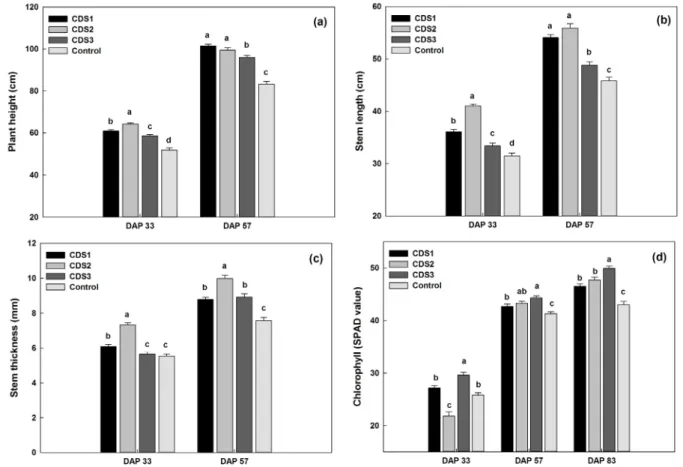
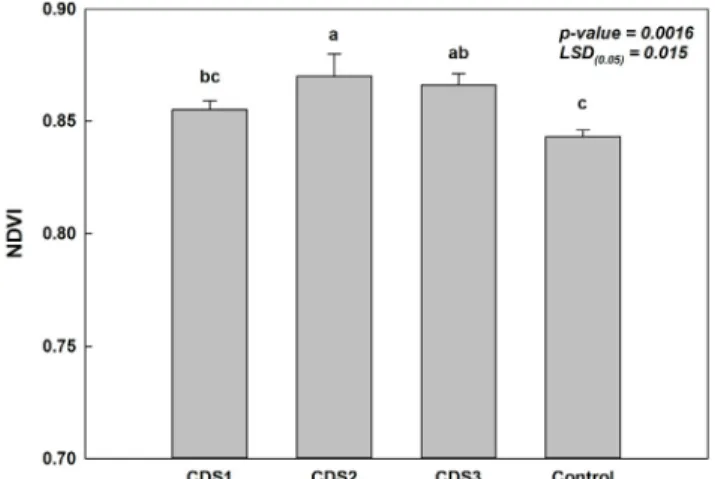
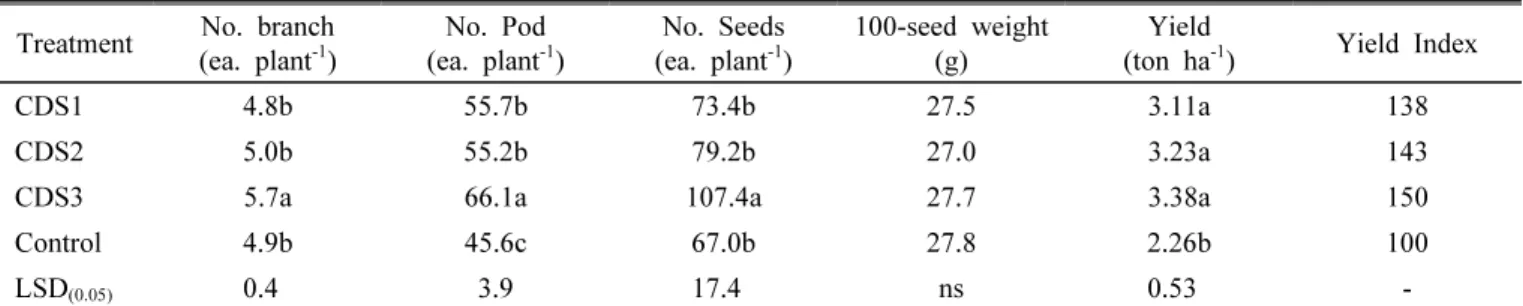
ABSTRACT Crop production in rice paddy fields is of great importance because of declining rice consumption and the low self-sufficiency ratio for field crops in Korea. A controlled drainage system (CDS) is recognized as an effective means to adjust water table (WT) levels as needed and control soil water content to improve the soil environment for optimum crop growth. The present study evaluated the effects of a CDS on soil characteristics, including soil water distribution and soybean development in paddy fields. The CDS was installed with two drain spacing (3 m and 6 m) at the experimental paddy field at the National Institute of Crop Science, Miryang, Korea. It was managed with two WT levels (0.3 m and 0.6 m) during the growing season. Soil water content, electrical conductivity and plant available nitrogen content in the soil were significantly greater in the 0.3 m WT management plots than in the 0.6 m plot and the control. At the vegetative stage, chlorophyll content was significantly lower with higher WT control because of excess soil moisture, but it recovered after the flowering stage. Soybean yield increased with WT management and the 0.6 m WT treatment produced the greatest grain yield, 3.38 ton ha
-1, which was 50% greater than that of the control. The CDS directly influenced outflow through the drains, which significantly delayed nutrient loss. The results of this study indicated that WT management by CDS can influence soil characteristics and it is an important practice for high yielding soybean production in paddy fields, which should be considered the crop growth stages for stable crop production.
Keywords : controlled drainage system, paddy field, soil water, subsurface drainage, water table
DOI : https://doi.org/10.7740/kjcs.2017.62.2.134Original Research Article
ⓒ 본 학회지의 저작권은 한국작물학회지에 있으며, 이의 무단전재나 복제를 금합니다.
This is an Open-Access article distributed under the terms of the Creative Commons Attribution Non-Commercial License (http://creativecommons.org/licenses/by-nc/3.0) which permits unrestricted non-commercial use, distribution, and reproduction in any medium, provided the original work is properly cited.
1)
Crop Production Technology Research Division, National Institute of Crop Science, RDA, Miryang 50424, Republic of Korea
†