Introduction
The natural environment of Korea had been suffered seriously during rapid industrialization from 1960s to the late 1980s, but due to ongoing restoration efforts, it has been improved. By 2000, more than 70% of the domestic wastewater generated nationally was collected and treated by public sewage systems. However, the water quality of many streams and lakes often does not meet the established standards. The periodic algal blooms in most reservoirs imply that further efforts to safeguard quality are still needed (Yoon et al., 2003).
It has recently been realized that water quality improvement is hardly achievable without proper control of nonpoint source pollution, which in turn is closely related to land use and rainfall events(Bang et al., 1997;
Lee et al., 1998). The land use in Korea includes about 65 percent of forest and 20 percent of farmland; runoff from forest areas is thought to be natural, but drainage water from farmland is suspected to be a key source of pollution. The rainfall of the Asian monsoon region, which includes Korea, is concentrated and intensive during the growing season for rice, potentially causing a high level of fertilizer runoff into rivers and lakes (Yoon et al., 2003). By estimating point source and nonpoint source pollutant loads into Lake Biwa in Japan, Kawara et al. (1996) showed that rice paddy fields contributed the largest amount of N and P load to the lake.
Recently, several studies have been conducted to determine nutrient losses by surface drainage from paddy fields in Korea, and various results have been reported (Han et al., 1999; Cho et al., 2000; Cho and Choi, 2001;
Cho and Han, 2002; Cho et al., 2002; Cho, 2003; Yoon et al., 2003). An explanation for the discrepancy in results is that the extent of agricultural nonpoint source pollutants
Received : 17 January 2007 Accepted : 5 February 2007*Corresponding author: Phone : +82312900221, E-mail : [email protected]
Effluent Characteristics of Nonpoint Source Pollutant Loads at Paddy Fields during Cropping Period
Kuk-Heon Han
1, Jin-Ho Kim
1,
*Kwang-Sik Yoon
2, Jae-Young Cho
3, Won-Il Kim
1, Sun-Gang Yun
4, and Jeong-Taek Lee
11
Division of Environment & Ecology, National Institute of Agricultural Science & Technology, Rural Development Administration, Suwon 441-707, Korea
2
College of Agricultural & Life Sciences, Chonnam National University, Gwangju, 500-757, Korea
3
Institute of Agricultural Science and Technology, Chonbuk National University, Jeonju, 561-756, Korea
4
Div. of Research Management, Rural Development Administration, Suwon 441-707, Korea
Paddy fields are apparently nonpoint source pollution and influence water environment. In order to improve water quality in rivers or lakes, to low nutrient load from paddy fields are required. To establish comprehensive plan to control agricultural non-point source pollution, it is imperative to get a quantitative evaluation on pollutants and pollution load from paddy fields. A field monitoring study was carried out to investigate the water balance and losses of nutrients from fields in Sumjin river basin. The size of paddy fields was 115 ha and the fields were irrigated from a pumping station. The observed total nitrogen loads from paddy fields were larger than those of the unit loads determined by Ministry of Environment data (MOE). It is because the nitrogen fertilization level at the studied field was higher than the recommended rate and the high irrigation and subsequent drainage amount. On the contrary, total phosphorus loads were less than those addressed by MOE since phosphorus fertilization level was lower than that of standard level. Therefore, it was found that fertilization, irrigation, and drainage management are key factors to determine nutrient losses from paddy fields. When the runoff losses of nutrients were compared to applied chemical fertilizer, it was found that 42 to 60% of nitrogen lost via runoff while runoff losses of phosphorus account for 1.3 to 7.6% of the total applied amount during the entire year.
Key words : Paddy field, Pumping station, NPS pollutant, Water balance, Nutrients balance
related to erratic climatic events and irrigation and drainage practices may differ greatly from place to place and year to year. Therefore, quantitative evaluation of the runoff nutrient losses from paddy fields under various climatic and management conditions are still important for nutrient management and environmental control.
The objectives of this study were to study the water balance of paddy fields irrigated from a pumping station during the cropping season in southern Korea as a means to investigate the water management practices of farmers, and to monitor N and P losses from rice paddy fields to provide insight into nonpoint source pollution control related to water management during paddy farming.
Materials and Methods
Description of Study area This study was conducted in a rice cultivation area located in Keumji-myun, Namwon-si, Jeonbuk, Korea (North latitude 35˚18' 30"~35˚19' 30") throughout the four cropping-season from 1 May 1999 to 30 September 2002. The longitudinal length of this area was 1.25 km, and the average width was 0.87 km. The slope of the paddy field located in a flat area was generally less than 0.2%.
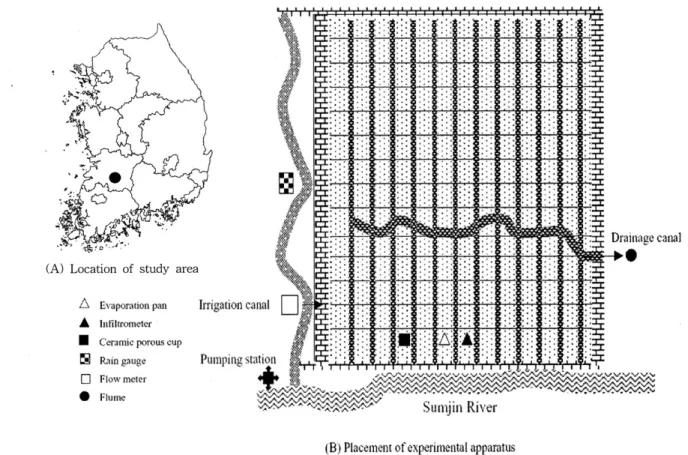
As determined in the land consolidation project, the study paddy field (i.e.,105 ha) was composed of several paddy plots (100 m by 50 m each) separated by main and lateral irrigation, lateral drainage, and a main drainage canal (Fig. 1). The series of the experimental field soil was Jisan (Silt loam, mixed mesic family of Fluventic Haplaguepts; National Institute of Agricultural Science and Technology, 2000).
The records of agricultural management practices and fertilization were summarized in table 1. The amount of fertilizer applied to the paddy fields was surveyed by interviews with farmers. Urea, fused magnesium phosphate, and potassium sulfate were used for N, P, and K fertilizer, respectively. The total amount of chemical fertilizer applied in this experimental paddy field was 110 to 120% for nitrogen and 40 to 50% for phosphorus, compared to the standard application rate of chemical fertilizer (N-P
2O
5-K
2O : 110-45-57 kg ha
-1) for rice cultivation in Korea (Korean Ministry of Agriculture and Forestry, 1998). Generally, the conventional fertilization rates tend to be varied from standard rates in Korea. N application rate is slightly higher than the standard rate while the P rate is lower. Such a different pattern between the N and P application rates is due to the likelihood of N
Fig. 1. Research site and water sampling site description.
being lost from the soils. P, however, is easily fixed by the soil matrix and tends to accumulate in the soils.
Precipitation and Flow Measurements In the investigation field, a set of rain gauges, flow meters, water level gauges, a flume, an infiltrometer, an evaporation pan, and ceramic porous cups were installed (Fig. 1). The rain gauge (Casella, U.K.) was set up adjacent to the irrigation canal of the experimental field for daily recording. The flow of irrigation water was measured by the flow meter attached in the pumping station. To determine the unused amount of irrigated water, a water level gauge (WL-14, USA) at the end of the main irrigation canal was used to automatically measure the water level during the study period, and the measured water level was checked by surveying staff readings.
A parshall flume with a water level gauge (WL-14, USA) was set up at the outlet of the main drainage canal to measure water drainage from the paddy fields. Flow velocity in the irrigation and drainage canal was measured by flow velocity meter (Swoffer 2000, USA).
The infiltrometer (Guelph permeameter, Model 2200 K1, USA) and a small evaporation pan (30 cm diameter) were set up to measure the infiltration depth and evaporation. Evapotranspiration was measured using a small lysimeter (30 cm diameter). Evapotranspiration was then determined by subtracting the infiltration rate and rainfall amount from the decrease in the water depth in the lysimeter. Four porous cups (Eijelkamp, NL) were installed to collect subsurface water at a depth of 90 cm.
The results of the study corresponded to conventional water management practices of rice paddy fields in Korea. The farmers controlled irrigation and drainage of each paddy plot. All measurements were carried out from 1 May 1999, to 30 September 2002.
Sampling and Analyses Samples of precipitation and irrigation water were taken for each event, and a drainage
water sample was simultaneously collected on a biweekly basis during non-storm periods. Drainage during storm periods was sampled by grab technique at the outlet of the main drainage canal whenever an event occurred. Bottles containing sample composites were placed in insulated chests, and crushed ice was then added to fill the chests. All samples taken for chemical analyses were refrigerated at 0 to 4℃ soon after collection until analysis. Water samples were shaken to obtain homogeneous aliquots for T-N and T-P analyses.
Ammonia-N (NH
3-N), nitrate-N (NO
3-N), and soluble P were determined in aliquots that were centrifuged and filtered through 0.45㎛ Millipore filters. Chemical analysis for T-N and NO
3-N (Ultraviolet spectrophotometric screening method), NH
3-N (titrimetric method), T-P, and soluble P (ascorbic acid method) were conducted using Korean standard methods for water quality by Ministry of Environment (2002). Basic statistical parameters such as mean, maximum, minimum, and standard deviation of N and P constituents were computed for rainfall, irrigation water, drainage water, and infiltration water.
Unequal size t-test (Snedecor and Cochran, 1967) was conducted to compare means of concentrations.
Calculation of N and P loads Mass loads of nitrogen and phosphorous by rainfall and irrigation were calculated by multiplying water volume and corresponding concentration. Nitrogen and phosphorous input were then adjusted to a per hectare basis. To estimate N and P losses, the drainage hydrograph flow volume time series were calculated. These time series were then multiplied by the N and P concentrations of drainage water over time to yield losses from the paddy field.
By multiplying the amount of water infiltration measured and the concentration of N or P of the water collected in the ceramic porous cups, we calculated the N and P losses via infiltration. The N and P concentrations
Date
Urea, fused magnesium phosphate, potassium sulfate were applied for N and P fertilizer, respectively.
Mar. 15 to Mar. 30 May 20 to May 30 May 25 to Jun. 10 Jun. 10 to Jun. 25 Jul. 25 to Aug. 5 Sep. 25 to Oct. 10
Spring plowing and silicate fertilization 1stplowing and basal fertilization
Rice transplanting Tillering fertilization
Panicle fertilization Harvest
1,500 kg ha-1
79~85 kg N ha-1, 32~40 kg P2O5ha-1 Transplanting distance 15 cm × 30 cm, three seedings
18~25 kg N ha-1 18~22 kg N ha-1
Management Practices Fertilization
Table 1. Management and fertilization in the experimental paddy fields.
were determined every two weeks, and these values were assumed to be the average concentrations during the two weeks. Losses by surface drainage and infiltration from the fields were then adjusted to a per hectare basis.
Water Balance at paddy fields The water balance of a paddy field consists of the precipitation, irrigation, drainage, evapotranspiration, and infiltration. Equation 1 shows the water balance of the experimental paddy field.
Daily water balance in the paddy field can be represented by
W
t= W
t-1+ I
t+ P
t- (D
t+ E
t+ F
t) (Equation 1) where W = flooding depth
I = amount of irrigation water P = precipitation
D = amount of drainage
E = amount of evapotranspiration F = amount of infiltration water t = day
Results and Discussion
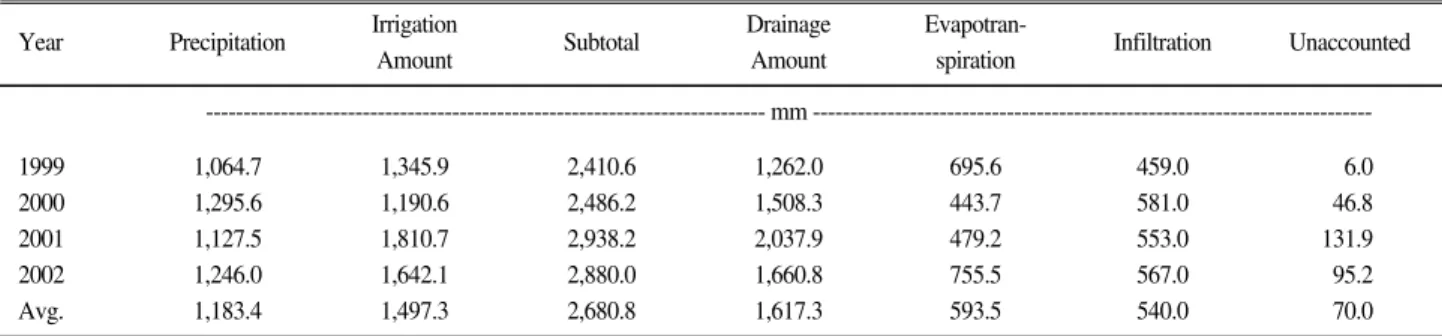
Water Balance Table 2 shows the water balance of the experimental field observed from May 1, 1999 to September 30, 2002. The monitoring results showed precipitation of 1,065 to 1,296 mm (average 1,183 mm), irrigation 1,191 to 1,811 mm (average 1,497 mm), and drainage 1,262 to 2,038 mm. Inflow (precipitation plus irrigation) to the paddy field ranged 2,411 to 2,938 mm, and 52 to 69.3% of this was lost to surface drainage. The unmeasured amount of inflow water was from 6 to 132 mm when the water balance was calculated during the study period.
De Datta et al., (1973) and Hukkrei and Sharma (1980) reported that paddy field water input during a growing season varied from 500 to 800 mm and reach more than 3,000 mm. Despite higher amount of rainfall than those of other regions in Korea, the amount of irrigation in the
study fields was higher than other regions of 490 mm, (Cho et al., 2002), 670mm, (Yoon et al., 2003) and 1,250 mm (Cho and Choi, 2001). Therefore, the average drainage amount from the study fields (1,617 mm) was also greater than those of other fields ranged from 490 to 1,250 mm (Cho and Choi, 2001; Cho et al. 2002; Yoon et al., 2003).
Changes in Nitrogen and Phosphorus Concentrations of Water Samples Statistical results of observed nutrient concentrations are summarized in Table 3. The observed mean concentrations of T-N in precipitation, irrigation water, and drainage water are 2.2, 2.0, and 3.9 mg L
-1, respectively. The mean concentration of drainage water was higher than those of precipitation and irrigation water (P < 0.01).
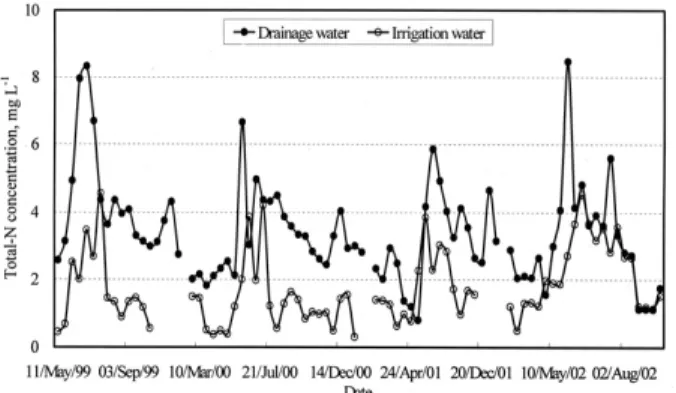
Figure 2 shows temporal variation of the concentration of T-N in irrigation water and drainage water. Annual changes in concentration of T-N showed a similar trend.
Regarding irrigation water, the nutrient concentrations were high in the early stages of rice growth but subsequently decreased from mid-June to mid-July because of the high rate of precipitation which affects stream water quality. This is similar to the results obtained by Cho and Choi (2001). The observed concentrations of T-N in drainage water ranged from 0.8 to 8.5 mg L
-1. This is quite a high concentration, according to Korean Water Quality Standards for streams and lakes.
Figure 3 shows temporal variation of the concentration of T-P in irrigation water and drainage water. The concentration of T-P in drainage water ranged from 0.02 to 0.21 mg L
-1(average: 0.09 mg L
-1). The T-P concentrations were high during the early stages of rice growth after fertilizer application and reduced afterward.
Because phosphorous is a limiting factor for algal blooming in many lakes in Korea, water quality data presented in this study indicate that drainage from paddy
Year
1999 2000 2001 2002 Avg.
1,064.7 1,295.6 1,127.5 1,246.0 1,183.4
1,345.9 1,190.6 1,810.7 1,642.1 1,497.3
2,410.6 2,486.2 2,938.2 2,880.0 2,680.8
1,262.0 1,508.3 2,037.9 1,660.8 1,617.3
695.6 443.7 479.2 755.5 593.5
459.0 581.0 553.0 567.0 540.0
6.0 46.8 131.9 95.2 70.0 Unaccounted Infiltration
Evapotran- spiration Drainage
Amount Subtotal
Irrigation Amount Precipitation
--- mm --- Table 2. Water balance of the experimental paddy fields.
fields could degrade recipient water environments.
The changes were measured in the concentrations of nitrogen and phosphorus in the leachate water that moved through the buried ceramic porous cups (90 cm) in the experimental field. The concentrations of T-N and T-P in the leachate were 1.4 to 4.3 mg L
-1(average: 2.4 mg L
-1) and 0.01 to 0.04 mg L
-1(average: 0.03 mg L
-1), respectively (Table 3).
In the infiltration water, NO
3-N concentration was two fold higher than NH
3-N concentration, reflecting that NO
3-N can be easily leached downward without adsorption to negatively charged soil particles. On the
other hand, NH
3-N concentration was higher in surface runoff than in subsurface infiltration water, suggesting that downward movement of NH
3-N was retarded by adsorption onto soil particles (Seol et al., 2000).
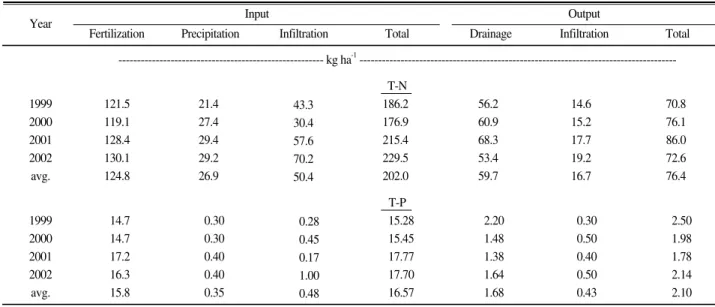
The losses of T-N and T-P in drainage water were 53.4 to 68.3 kg ha
-1(average 59.7 kg ha
-1) and 0.4 to 2.2 kg ha
-1(average 1.43 kg ha
-1), respectively. The nutrient losses were highest in July and August due to the high rainfall characteristic of the monsoon season. This was contrary to the common belief that losses may be the highest in June because of the higher concentrations of chemical components due to the application of fertilizer.
Statistics
"
Standard deviation
T-P NO3-N
NH3-N T-N
2.2 3.5 1.4 0.8
2.0 4.6 0.4 1.1
3.9 8.5 0.8 1.6
2.4 4.3 1.4 1.1
1.1 2.9 0.6 0.7
1.2 3.3 0.3 1.0
2.1 4.9 1.2 1.4
0.9 1.5 0.2 0.2
0.9 1.8 0.6 0.5
0.9 2.6 0.4 0.6
1.9 3.6 0.9 0.5
2.1 3.9 1.2 1.2
0.03 0.08 0.02 0.01
0.01 0.03 0.01 0.01
0.09 0.21 0.02 0.04
0.03 0.04 0.01 0.01 avg.
max.
min.
SD"
avg.
max.
min.
SD
avg.
max.
min.
SD
avg.
max.
min.
SD
Table 3. Water quality parameters.
--- mg L-1--- Rainfall (n=54)
Irrigation water (n=55)
Drainage water (n=60)
Infiltration water (n=32)
Fig. 2. Change in the concentrations of T-N in irrigation and drainage water.
Fig. 3. Change in the concentrations of T-P in irrigation and drainage water.
The infiltration-related nutrient losses for the irrigation period of the years 1999 to 2002 were also estimated. The infiltration losses of T-N were 14.6 to 19.2 kg ha
-1(average 16.7 kg ha
-1) and T-P were 0.3 to 0.5 kg ha
-1(average 0.43 kg ha
-1), respectively. It is noted that the amount of loss was highest in June, since nutrient concentrations in the flooding water of paddy fields was very high initially, and flooding depth was maintained at the level of 40 to 50 mm.
The field study results revealed that a significant amount of T-N could be lost via surface drainage and infiltration from paddy fields. Improvements in the methods of fertilizer application and water management are necessary to decrease runoff loading of nutrients from paddy fields during the rice cultivation period.
Conclusion
The water supplied by precipitation in addition to irrigation to paddy fields and surface drainage from paddy fields in this study was greater than those in previous studies conducted. Field data showed that neither rainfall nor irrigation was used efficiently in the investigated paddy fields. The amount of drainage during non-storm periods was significantly high, which confirmed that farmers have little incentive to effectively use both rainfall and irrigation for paddy rice cultivation because they can use irrigation at no charge.
These poor water management practices and the fine texture of soil in rice paddy resulted in significant losses of T-N and T-P through surface drainage during both storm and non-storm periods. Even under similar
fertilization conditions, nutrient losses could be high when water management was not conducted effectively.
The results indicate that paddy fields would be potential nonpoint source pollution of nitrogen and phosphorous, which can contribute to the nutrient enrichment of surface water ecosystems.
Reduction of nutrient losses through surface drainage could be achieved by proper water management, such as minimum irrigation, effective use of rainfall, adoption of judicious drainage outlet structures, and minimization of forced surface drainage. These practices might suggest to reduce surface drainage outflow and could save water and protect downstream water quality. Further investigations on diverse cultivation conditions over a longer period are recommended.
Reference
Bang, K. W., J. H. Lee, and M. J. Yu. 1997. A study on the runoff characteristics of nonpoint sources in small urban watersheds. J.
KSWQ MAR. 13(1):79-99.
Cho, J. Y. 2003. Seasonal runoff estimation of N and P in a paddy field of central Korea. Nutrient Cycling in Agroecosystems. 65:
43-52.
Cho, J. Y. and J. K. Choi. 2001. Nitrogen and phosphorus losses from a broad paddy field in central Korea. Communication in Soil Sci. and Plant Analysis. 32(15&16): 2395-2410.
Cho, J. Y., K. W. Han, and J. K. Choi. 2000. Balance of nitrogen and phosphorus in a paddy filed of central Korea. Soil Sci. Plant Nutr. 46(2): 343-354.
Cho, J. Y. and K. W. Han. 2002. Nutrient losses from a paddy field in central Korea. Water Air and Soil Pollution. 134:215-228.
Cho, J. Y., K. W. Han, J. K. Choi, Y. J. Kim, and K. S. Yoon. 2002.
N and P losses from paddy field plot in central Korea. Soil Sci.
Year
1999 2000 2001 2002 avg.
1999 2000 2001 2002 avg.
121.5 119.1 128.4 130.1 124.8
14.7 14.7 17.2 16.3 15.8
21.44 27.44 29.44 29.24 26.94
0.30 0.30 0.40 0.40 0.35
43.34 30.44 57.64 70.24 50.44
0.28 0.45 0.17 1.00 0.48
186.24 176.94 215.44 229.54 202.04
15.28 15.45 17.77 17.70 16.57
56.24 60.94 68.34 53.44 59.74
2.20 1.48 1.38 1.64 1.68
14.64 15.24 17.74 19.24 16.74
0.30 0.50 0.40 0.50 0.43
70.84 76.14 86.04 72.64 76.44
2.50 1.98 1.78 2.14 2.10 Total Infiltration
Drainage Total
Infiltration Precipitation
Fertilization
Input
--- kg ha-1--- Output
Table 4. Nutrients balance in the paddy fields.
T-N
T-P
Plant Nutr. 48(3):301-306.
De Datta S. K., W. P. Abilay, and G. N. Kalwar. 1973. Water Stress Effects in Flooded Tropical Rice. In: Water Management in Philippine Irrigation Systems: Research and Operations.
International Rice Research Institute, Los Banos, Philippines. 19- 36.
Han K. W., J. Y. Cho, and J. K. Choi. 1999. Annual runoff loading of nitrogen and phosphorus from a paddy field. Agric. Chem.
Biotechnol. 42(1):29-33.
Hukkeri S. B. and A. K. Sharma. 1980. Water-Use Efficiency of Transplanted and Direct-Sown Rice Under Different Water Management Practices. Indian J Agric. Sci. 50:240-243.
Kawara, O., K. Hirayama, and T. Kunimatsu. 1996. A study on contaminant loads from the forest and rice paddy fields. Water Sci.
Technology. 33:159-168.
Ministry of Environment. 2002. The Korean standard method for water analysis. Ministry of Environment Republic, Seoul (in
Korean).
Lee, J. H., H. Y. Lee, J. K. Lee, D. K. Lee, and H. H. Kim. 1998. A study on the conservation, rehabilitation and creation of naturality of rivers(Ⅰ) - The correlation of the degree of pollution on a river and the land use in rural area -. J. Korean Env. Res. & Reveg.
Tech. 1(1):84-94.
National Institute of Agricultural Science and Technology. 2000, Taxanomical classification of Korean Soils. NIAST, Suwon, Korea, 464-465.
Seol, S. I., S. M. Lee, G. H. Han, W. J. Choi, and S. H. Yoo. 2000.
Urea transformation and nitrogen loss in waterlogged soil column.
Agric. Chemistry & Biotechnology. 43(2):86-93.
Snedecor, G. W. and W. G. Cochran. 1967. Statistical methods.
Iowa State University Press, Ames, Iowa, USA.
Yoon, C. G., J. H. Ham, and J. H. Jeon. 2003. Mass balance analysis in Korean paddy rice culture. Paddy and Water Environment.
1(2):99-106.
본 연구는 1999년 5월부터 2002년까지 광역 논에서 영농기간 동안 비점원오염의 유출부하량을 산정하기 위하여 수행되었다. 시험유역은 전북 남원시 금지면 금풍지구에 위치한 115 ha(논 면적 95 ha)의 양수장 관개 논에서 수문 및 수질 모니터링을 실시하였다.
시험유역의 물수지를 산정한 결과, 연도별 유입량은 1999년 2,410 mm, 2000년 2,486 mm, 2001년 2,938 mm, 2002년 2,880 mm로 4개년 평균 유입량은 2,680 mm로 조사되었으며, 유출량은 1999년 2,416 mm, 2000년 2,533 mm, 2001년 3,070 mm, 2002년 2,983 mm로 4개년 평균 유출량은 2,750 mm로 조사되었다. 물수지에 있어 유출 량이 유입량보다 크게 나타났는데, 이는 양수장에서 관개를 실시하지 않을 경우 지하수 관개를 실시하는 논들 이 있어 이들 지하수 관개량의 미측정에 의해 물수지의 차이가 있는 것으로 판단된다.
T-N과 T-P를 대상으로 4개년동안 물질수지를 조사한 결과, 영농기간 영양물질의 평균 유입량은 화학비료에 의해 T-N 124.8 kg ha-1, T-P 15.8 kg ha-1, 강우에 의해 T-N 26.9 kg ha-1, T-P 0.35 kg ha-1, 관개수에 의해 T-N 50.4 kg ha-1, T-P 0.48 kg ha-1가 유입된 것으로 조사되었다. 영농기간 동안 유출수에 의한 영양물질의 유 출량은 T-N의 경우 53.4∼68.3 kg ha-1, T-P의 경우는 1.38∼2.20 kg ha-1로 나타났다.
논에서 적절한 물관리를 통해 유출수를 최소화하면 영양물질 손실의 경감, 농업용수 사용의 경감을 통한 수자 원 확보, 그리고 하천의 수질보전에 기여할 것으로 판단된다. 향후 비점원오염에 관한 연구는 다양한 영농조건 에 대해 장기적이고 꾸준한 연구가 수행되어야 할 것으로 판단된다.
영농기 광역논으로부터 비점오염물질 유출 특성
한국헌1·김진호1,*·윤광식2·조재영3·김원일1·윤순강4·이정택1
1농업과학기술원 환경생태과, 2전남대학교 생물산업공학과, 3전북대학교 농업기술연구소, 4농촌진흥청 연구관리과