DOI 10.17480/psk.2020.64.5.343
종 설(Review)
Resveratrol과 관련 유도체 합성 및 효능에 관한 고찰
김초롱·이상협#
덕성여자대학교 약학대학
Review on the Synthesis and Biological Activities of Resveratrol and Its Derivatives
Cho-rong Kim and Sang Hyup Lee#
College of Pharmacy, Duksung Women’s University (Received July 9, 2020; Accepted August 20, 2020)
Abstract Resveratrol, a type of phytoalexin found in many plants, is known to be a useful component for human health.
It is found in vegetables, fruits, wines and teas, and especially in grapes. Resveratrol has been reported to have various medicinal effects, such as anti-inflammatory, anti-cancer and anti-aging effects. In particular, anti-cancer effects are believed to be achieved by suppressing the growth of cancer cells and therefore, decreasing cancer organisms. Based on this usefulness, extensive efforts to synthesize resveratrol have been continued. Some of the typical methods using Heck reaction, Perkin reaction and Wittig reaction have been reported, and further studies for improvement are still in progress.
Derivative syntheses by substituting hydroxy groups of resveratrol with alkyl or halogen groups were also performed along with investigation of biological properties of the related compounds. As a result, synthesis and biological evaluation of resveratrol and its derivatives were discussed to assess and enhance the potential of resveratrol as a medicinal component and/or a dietary supplement.
Keywords Resveratrol, polyphenol, trihydroxystilbene, antioxidant, anticancer
서 론(Introduction)
Resveratrol (3,4',5-trihydroxy-trans-stilbene) 은 1939년 Takaoka, M.
에 의해 처음 밝혀진 물질로, Veratrum grandiflorum O. Loes 뿌 리에서 추출되었다. Resveratrol이라는 이름은 Veratrum 종으로부 터 유래된 resorcinol의 유도체이기 때문에 명명된 것으로 알려 져 있다.
1)Resveratrol 은 식물체에서 박테리아를 포함한 다양한 외부 환경 변화에 식물체 스스로가 자신을 보호하기 위해 만드 는 phytoalexin의 일종으로서 폴리페놀 구조를 가지고 있다. 폴 리페놀 화합물들은 일반적으로 강력한 항산화 작용을 가지고 있 어 다양한 건강보조식품으로서 활용되기도 한다. Resveratrol은 야채, 과일, 와인 및 차에 풍부하게 들어있는데, 과일 중 특히 당도가 높은 포도에서 상대적으로 많은 양이 함유되어 있다. 포 도 껍질에는 g 당 50-60 μg이 함유되어 있으며,
2)이로 인해 포 도주에도 포함되어 있는데, 백포도주에는 100 mL 당 0.01 mg이
함유된 반면 포도 껍질채 발효시키는 적포도주에는 100 mL당 3.02 mg 과 같은 높은 함유량이 나타난다.
3,4)Resveratrol 은 trans-resveratrol과 cis-resveratrol의 두 가지 iso- mer 로 존재하는데(Fig. 1) 이중 trans-resveratrol이 효능 면에서 우수한 것으로 알려져 있다. Resveratrol은 수명 연장,
5)항염증 효과,
6)심장질환의 예방 및 혈소판의 응고 억제 효과
7)가 있는 것으로 보고되어 왔다. 이와 같은 이유로 다량의 콜레스테롤과 포화지방이 함유된 식사를 하는 프랑스인에게서 현저히 낮은 심 혈관계 질환 발병률을 보이는 현상을 뜻하는 ‘French paradox’
가 나오게 되었다. Resveratrol의 항암작용에 관한 초기 연구는 1997 년에 Jang, M. 그룹에 의해 발표되었으며,
8)후속적으로 다 양한 연구 결과가 나오고 있으나, 정확한 기전에 대해서는 여전 히 많은 연구들이 진행 중에 있다. 혈소판 응집 억제 및 항암작 용 외에도 다양한 생물학적, 약리학적 기능을 보이는 resveratrol 은 특히 심혈관 질환
9)과 cellular health에 유용한 건강보조식품 으로 널리 사용되고 있다. 최근에는 cis-resveratrol 유도체의 항 암 효과에 대한 연구 또한 활발히 진행되고 있는 추세이다.
10)본 논문은 resveratrol과 관련된 고찰 논문으로써, resveratrol의 효능 및 작용기작을 살펴보고 이러한 특이 구조를 가진 resveratrol 의 전합성과 관련 유도체에 관한 합성 방법 등의 내용을 서술
#
Corresponding author
Sang Hyup Lee, College of Pharmacy, Duksung Women’s University, Seoul 01369, Korea
Tel: +82-2-901-8393, Fax: +82-2-901-8386
E-mail: [email protected]
능성과 건강 기능식품으로서의 유용성을 탐색해보고자 한다.
Resveratrol의 효능 및 기작
Resveratrol 은 바이러스, 염증, 노화, 혈관질병, 그리고 암 등과 관련하여 다양한 효능을 가지고 있다. 한 예로서, 전술한 French paradox 와 관련하여 resveratrol과 식물성 에스트로겐의 구조가 비 슷하기 때문에 심장 보호 효과가 나타난다는 연구 결과가 있다.
3,11)그 외에도, resveratrol과 플라보노이드가 풍부한 음식을 섭취할 경우 ROS 생성억제 뿐 아니라 세포 내 글루타치온의 고갈을 예 방할 수 있다는 결과가 나옴으로써
12)resveratrol 이 노화 관련 신 경 퇴행성 질환에 대한 예방 효과가 있는 것도 확인되었다.
13,14)Resveratrol 은 특히 항암 효과와 관련된 연구가 많이 진행되었 다. Jang, M. 그룹은 in vivo에서 resveratrol과 암예방 및 항암작 용에 관한 연구 결과를 발표하였는데,
8)이를 기점으로 resveratrol 의 암세포 증식억제 기전에 관한 많은 연구가 이루어졌으며 현 재까지 간암, 위암, 유방암 및 대장암 등 여러 종류의 암 예방 과 항암 효과가 있음이 밝혀져 있는 상태이다. 여러 종류의 암 세포주에 resveratrol을 처리한 결과 암세포 성장 중 특히 cyclin- dependent kinases (Cdks) 를 조절함으로써 G0기와 G1기의 진행 저해를 나타내는 것으로 알려졌다.
15)일부 연구에서는 암세포주 의 세포주기와 resveratrol의 농도가 높은 연관성을 보여주었는데, 고농도의 resveratrol을 사람의 조직구성 림프종인 U937 세포에 처리한 결과, G2기, M기 및 S기의 진행도 조절되는 흥미로운 결과도 보고되었다.
16,17)사람의 암세포에서 resveratrol이 apoptosis를 유발할 수 있다는 연구는 Clement, M. 그룹이 초기에 수행한 바 있다. 이들은 백 혈병을 유발하는 세포 (HL-60)에서 resveratrol로 인해 apoptosis 가 유발될 수 있다는 다양한 증거를 제시하였는데, cluster of differentiation 95 (CD95)/cluster of differentiation 95 ligand (CD95L) 신호 전달 경로가 관여하고 있음을 밝혀내었다. Res- veratrol이 인체에 투여되면 CD95L의 발현이 증가하여 receptor 인 CD95가 HL-60에 대해 신호의존성 apoptosis를 유도한다는 결과를 보여주었다.
16)이처럼 apoptosis와 연관 있는 pathway를 토대로 또다른 연구에서도 전립선암, 대장암, 그리고 폐암 등을 포함한 여러 암세포주에서 resveratrol이 apoptosis를 유발한다는 결과가 도출되었다.
18-20)또한 Resveratrol은 암세포 발생과 연관 된 변이 경로인 epidermal growth factor receptor (EGFR), mam-
이터의 보강이 필요한 상황이라고 여겨진다. 따라서 향후 신의 약으로서의 가능성과 건강기능식품으로서의 유용성이 확보되기 위해서는 무엇보다 임상관련 연구가 집중적으로 진행되어야 할 필요성을 강조하고자 한다.
Resveratrol의 합성 및 관련 유도체화
Resveratrol 의 효능과 작용기작에 관한 연구를 통해 그 유용성 이 부각되면서 resveratrol과 그 유도체들의 합성에 대한 관심도 증가되어 왔다. Resveratrol은 다양한 생물학적
22)및 화학적 합성 법
23)이 있는데 특히 화학적 합성법 중, 합성과정의 핵심 반응으 로 Heck reaction, Perkin reaction 및 Wittig reaction을 이용하는 방법이 소개되었다.
먼저, Heck reaction은 aromatic halide와 알켄이 염기와 palla-
dium (Pd) 촉매 하에서 치환된 알켄을 합성하는 반응으로 C-C
결합을 형성하게 된다. 특히 resveratrol 합성 과정에서는 benzoyl
chloride 에 styrene을 반응하여 C-C 결합을 형성하는 과정 등에
서 이용되고 있다. 2002년에 Guiso, M.은 이 반응을 통해 acety-
lated resveratrol 을 70%의 수율로 얻기 위한 효율적인 방법을 개
발하였다.
24)Farina, A. 그룹은 기존 반응에서 합성 효율을 개선
하여 총 수율을 22%에서 71%로 향상시킨 결과를 얻었다.
25)또
한 Resveratrol 유도체를 합성하기 위해 decarbonylative Heck
reaction 을 이용한 연구도 진행되었다.
26,27)Andrus, B. M. 그룹은
Scheme 1에 제시된 바와 같이 3,5-dihydroxybenzoic acid (2)를
pyridine 용매 하에서 acetic anhydride와 반응시킨 뒤 재결정화하
였고, 이때 생성된 중간체에 thionyl chloride를 첨가하여 diace-
toxybenzoyl chloride ( 3)를 합성하였다. 합성한 화합물 3을 4-
acetoxystyrene (4)과 coupling 하는 단계에서 Heck reaction이 적
용되었다. 즉 palladium acetate 촉매와 N,N-bis-(2,6-diisopropy-
lphenyl)dihydroimidazolium chloride (NEM) 을 사용하여 반응을 수
행함으로써 화합물 5을 얻은 후, acetyl group을 deprotection하기
위해 THF 용매하에서 sodium hydroxide와 반응시켜 최종적으로
trans-resveratrol ( 1)을 88%의 수율로 합성하였다. 이 합성법은 총
세 단계의 반응으로, 최종 수율은 53%로 나타났다. 이 외에도
Heck reaction을 이용하여 관련 유도체를 합성한 방법이 소개되
기도 하였다.
26)최근 새로운 촉매 연구와 반응 조건의 개선
28,29)으로 인해 Heck reaction의 활용 범위가 확대된 이유로 더욱 다
양한 접근법이 탐색되고 있는 추세이다.
다음, Perkin reaction은 sodium acetate, 염기 및 산에 의해 방 향족 알데히드와 그 무수물을 α,β-unsaturated carboxylic acid로 전환시키는 반응으로 널리 알려졌는데, benzaldehyde와 p-anisy- lacetic acid 두 그룹을 coupling하여 resveratrol을 합성하는 단계 에서 이용되고 있다. 이 방법은 최종 반응 생성물에 위치-선택 성이 있다는 장점이 있다. Spath, E.와 Kromp, K.는 최초로 Perkin reaction 을 이용하여 resveratrol을 합성하였다. Acetic anhy- dride 존재 하에서 p-anisylacetic acid sodium salt와 1,3-dimethoxy benzaldehyde 를 사용하여 합성이 진행되었으나 여전히 추가 개 선 사항이 요구되는 한계점을 드러내었다.
30)Perkin reaction 을 이 용할 경우 여러 단계의 반응이 요구되거나, 일부 단계에서는 극 단적 반응 조건이 필요하다는 단점이 있는데, 이러한 한계점을 극복하기 위해 Solladie, G.가 Scheme 2와 같은 개선된 합성 방 법을 제시하였다. 즉, 3,5-diisopropoxybenzaldehyde (6)와 4-iso- propoxyphenylacetic acid (7)를 acetic anhydride와 TEA 하에서 110
oC 로 12시간 동안 반응시켜 화합물 8을 얻었는데, 이 과정에 서 Perkin reaction이 사용되었다. 합성된 화합물 8에 quinoline과 copper chromite를 첨가하여 230
oC 로 1시간 동안 반응시킨 뒤, diphenyl disulfide 를 첨가한 다음 THF 용매 하에서 환류반응으 로 화합물 9를 얻었다. Protection 된 isopropyl을 deprotection하
기 위하여 boron trichloride를 DCM 용매 하에 첨가하였다. −78
o
C에서 0
oC로 1시간 동안 온도를 상승시킨 뒤 반응을 종료하고 정제 과정을 거쳐 trans-resveratrol (1)을 85%의 수율로 얻었다.
이 합성법은 총 네 단계의 반응으로, 최종 수율은 56%로 나타 났다. trans-Resveratrol을 합성하는 마지막 단계에서 NMR을 이 용하여 cis-:trans-isomer 비율을 규명하는 의미있는 연구결과도 보고 되었다. 반응 초기에 cis-:trans-isomer 비율이 72:28로 관찰 되었으나, 12시간 뒤에는 59:41, 26시간 뒤에는 55:45, 그리고 최 종적으로 3일뒤에는 그 비율이 26:74로 역전됨을 보고하였는데 이는 결과적으로 반응 시간과 trans-resveratrol의 생성 비율이 비 례함을 나타내었다.
31)Perkin reaction 은 여전히 특정 단계에서 고 온 조건 및 고반응성 금속 촉매가 요구되는 점을 보완해야만 보 편적인 이용이 가능할 것으로 판단된다.
마지막으로 Wittig reaction은 aldehyde 혹은 ketone이 wittig reagent로 불리는 triphenyl phosphonium ylide와 반응하여 알켄과 부산물인 triphenylphosphine oxide을 형성하는 반응이다.
32,33)Res- veratrol 합성 시 benzyl alcohol과 phosphonium ylide를 coupling 하여 알켄을 합성할 때 이 반응을 사용한다. 1991년, Jeandet, P.
그룹은 Wittig reaction을 이용하여 최초로 trans-resveratrol을 합 성한 뒤, 포도에서 생성된 resveratrol과 비교분석하였다. 또한, 포 Scheme 1. Synthesis of resveratrol by Heck reaction. Reagents and condition: (a) Ac
2O/pyr., 90% then SOCl
2/80
oC, 91%; (b) Pd(OAc)
2/N,N- bis-(2,6-diisopropylphenyl) dihydroimidazolium chloride (NEM)/120
oC, 73%; (c) NaOH/THF, 88%.
Scheme 2. Synthesis of resveratrol by Perkin reacion. Reagents and condition: (a) Ac
2O/TEA/110
oC/12 h, 72%; (b) CuCr
2O/quinoline/230
oC,
96%; (c) (PhS)
2/THF/reflux/4 h, 96%; (d) BCl
3/ CH
2Cl
2/-78
oC to 0
oC, 85%.
도의 성장 과정 중 어떤 단계에서 resveratrol이 만들어지는지에 대한 연구도 병행하였다.
2)이후로 Goldberg, D. 그룹이 Wittig reaction 을 이용하여 trans-resveratrol을 합성하고, 질량분석 결과 및 물성 등을 보고하였다.
34)Francisco, A. 그룹은 Scheme 3과 같이 Wittig reagent와 benzyl alcohol을 사용하여 one-pot Wittig reaction 을 진행하였다. 3,5-Dimethoxybenzyl bromide (10)에 triph- enyl phosphine 를 첨가하여 toluene 용매 하에 6시간 동안 reflux 시켰다. 생성된 화합물을 n-BuLi으로 deprotonation하여 3,5- dimethoxybenzylidene triphenylphosphorane (11)을 90%의 수율로 합성하였다. 합성된 화합물 11을 4-methoxybenzyl alcohol (12)와 반응시키기 위해 Ni nanoparticles (NiNPs) 1 equivalent를 첨가하 여 THF 용매 하에 12시간 동안 reflux 시켜 methylated resvera- trol (13)을 81%의 수율로 합성하였다. 화합물 13에 diphenyl disulfide 와 촉매인 azobisisobutyronitrile (AIBN)을 첨가하여 THF 하에 8시간 동안 reflux 시켜 중간체를 생성하였고, 이 화합물에 boron tribromide를 DCM 용매 하에 첨가하여 5시간 동안 반응 시킨 결과 trans-resveratrol (1)이 70%의 수율로 합성되었다. 이 합성법은 총 세 단계의 반응으로, 전체 수율은 51%로 나타났다.
35)Wittig reaction은 반응상의 수율은 무난하지만 cis-/trans-isomer 선택성이 낮으며 동시에 trans-resveratrol의 생성비율이 낮은 한 계점이 있었다. 따라서 resveratrol의 합성을 위해 이 반응을 이 용할 경우에는 이러한 한계점을 극복하고 수율을 향상시킬 수 있는 효율적인 촉매의 개발이 추가 보완되어야 할 것이다.
종합적으로 위의 세가지 방법을 비교해보았다. Heck reaction 을 이용한 합성법 중에서 Andrus, B. M. 그룹의 연구는 3,5- dihydroxybenzoic acid를 palladium acetate 촉매와 NEM을 사용 하여 총 세 단계를 거쳐 53%의 수율로 trans-resveratrol (1)을 합 성하는 결과를 나타내었다. 이 합성법은 위에서 기술한 세 가지 방법 중 반응메카니즘 및 반응과정에 대한 연구가 가장 많이 진 행되었고 또한 실제적으로도 합성에 많이 사용되는 방법이다.
Perkin reaction 을 이용한 합성법은 효능이 좋은 trans-resveratrol (1)을 선택적으로 합성할 수 있다는 장점이 있으나, 격렬한 반 응 조건과 반응성이 높은 금속 촉매가 요구된다는 점에서 보완
이 불가피하다고 판단되었다. Solladie, G.는 네 단계의 합성을 통해 56%의 수율로 trans-resveratrol (1)을 합성하였으나, Perkin reaction 의 단점인 격렬한 반응 조건이 여전히 하나의 한계로 지 적되고 있다. 마지막으로 Wittig reaction을 이용한 합성법 중, Francisco, A. 그룹이 진행한 연구에서는 세 단계를 거쳐 51%의 수율로 trans-resveratol (1)을 합성하게 되었는데 반응상의 수율 은 무난하나 cis-/trans-isomer 선택성이 낮은 문제점이 있었다.
또한 resveratrol의 유도체화 연구도 진행되어 왔는데,
36)structure- activity relationship (SAR) 연구에 따르면 resveratrol의 기본 구 조 자체가 특정 효능에 대부분 필수적임이 밝혀졌다.
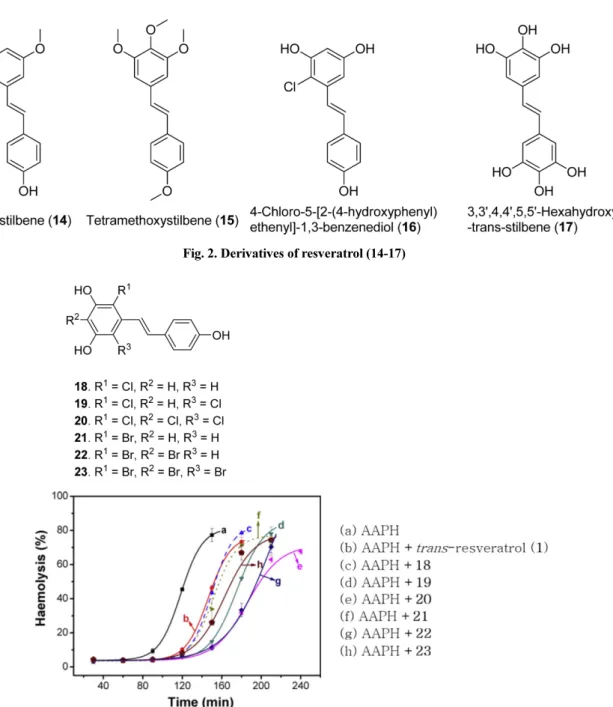
37)유도체 화 연구는 벤젠고리에 결합된 hydroxy group에 변형을 가함으로 써 다양한 유도체를 창출하고자 하였다. Fig. 2에 나타난 것처 럼, 기존의 hydroxy group을 alkoxy group 으로 치환하거나 할 로젠 원소를 벤젠고리에 치환해 물성을 변화시켜 약동학적 측 면을 개선하고자 하였다. Resveratrol의 hydroxy group을 methoxy group 이나 halide group으로 치환(14-16)할 경우, 암세포주에 대 한 세포 독성이 증가한다는 결과가 보고되었다.
38)또한 Fig. 2에 소개된 trans-resveratrol (1)의 3,3',4,4',5,5' 위치에 hydroxy group 이 치환된 구조를 가진 유도체(17)은 골수성 백혈병 세포인 HL- 60 에 대해 높은 세포 독성을 보여주게 되었다.
39)그 외에도 trans- resveratrol (1)에 할로젠 원소를 치환환 화합물(18-23)의 경우, Fig.
3 와 같이 용혈 생성을 억제할 수 있다는 결과가 나타났다.
40)이 중 화합물 20과 22는 시간에 따른 용혈생성을 매우 효과적으로 억제함을 알 수 있다. 상기한 바와 같이 resveratrol의 유도체화 (methoxylation, hydroxylation 및 halogenation 등) 연구는 다양한 치료 효능을 염두에 두고 활발히 진행되어 오고 있는 실정이다.
결 론(Conclusion)
Phytoalexin 의 일종이자 Veratrum grandiflorum O. Loes 뿌리에
서 추출된 물질인 resveratrol에 대하여 여러가지 효능 및 기작
과 합성 방법 및 유도체에 대해 기술하였다. Resveratrol은 폴리
페놀 화합물로써 trans-form과 cis-form을 가지고 있는데 특히
Scheme 3. Synthesis of resveratrol through a Wittig type olefination promoted by nickel nanoparticles. Reagents and condition: (a) PPh
3/
PhMe/reflux/6 h then n-BuLi/THF/0
oC/20 min, 90%; (b) NiNPs/THF/reflux/8 h, 81%; (c) (PhS)
2/AIBN/THF/reflux/8 h then BBr
3/CH
2Cl
2/0
oC
to rt./5 h, 70%.
trasns-resveratrol 이 cis-resveratrol에 비해 뛰어난 효능을 지니고 있다는 것이 많은 연구를 통해 밝혀진 결과이다. 강력한 항암 효과, 항산화 효과, 항염증 효과, 심장질환의 예방, 그리고 혈소 판 응고억제 효과가 있는 것이 밝혀졌는데, 특히 resveratrol의 항 암효과에 대해 많은 관심이 집중되고 있다.
Resveratrol 의 화학적 합성 중 핵심 반응으로 Heck reaction, Perkin reaction 및 Wittig reaction을 이용한 합성법들에 대해 소 개하였고, 각 방법의 장단점과 대략적 결과를 정리하였다. Andrus, B. M. 그룹의 연구는 Heck reaction을 이용한 합성법을 통해 총
세 단계를 거쳐 53%의 수율로 trans-resveratrol (1)을 합성하였 다. Heck reaction을 이용한 합성법은 resveratrol을 합성하는 방 법 중 보편적으로 사용되는 방법으로, 다른 reaction을 이용한 합 성에 비해 반응 조건이 순하다(mild)는 장점이 있음을 알 수 있 었다. Solladie, G. 는 Perkin reaction을 이용하여 총 네 단계의 합성을 통해 56%의 수율로 trans-resveratrol (1)을 합성했으나, 격렬한 반응 조건이 하나의 한계점으로 드러나게 되었다. Wittig reaction 을 이용한 Francisco, A. 그룹의 연구에서는 세 단계를 거 쳐 51%의 수율로 trans-resveratol (1)을 합성하게 되었는데 반응 Fig. 2. Derivatives of resveratrol (14-17)
Fig. 3. The effects of haemolysis inhibition of resveratrol derivatives. Haemolysis inhibition were measured by time in the conditions of
20 µM, 37
oC, 0.15 M phosphate-buffered saline, 5% RBC, and 50 mM 2,2'-azobis(2-amidinopropane hydrochloride) (AAPH): (a) AAPH; (b)
AAPH +trans-resveratrol (1); (c) AAPH +18; (d) AAPH +19; (e) AAPH +20; (f) AAPH +21; (g) AAPH +22; (h) AAPH +23. Courtesy to Xiu,
Z. L. et al.
40)의약 가능성을 탐색하는 지속적 연구의 필요성을 강조하고자 한다.
감사의 말씀(Acknowledgment)
본 연구는 덕성여자대학교 2019년도 교내연구비 지원에 의해 수행되었음.
Conflict of Interest
모든 저자는 이해 상충을 가지고 있지 않음을 선언한다.
References