초임계 PGSS 공정을 이용한 Coriander 정유 함유 PEG 미세입자 제조
최진아 ․ 임교빈* ․ 유종훈*
수원대학교 화학공학과
Preparation of PEG Microparticles Containing Coriander Essential Oil Using Supercritical
PGSS Process
Jin-Ah Choi, Giobin Lim*, and Jong-Hoon Ryu*
Department of Chemical Engineering, The University of Suwon, Gyeonggi 445-743, Korea
Abstract
In the present study, biocompatible poly (ethylene glycol) (PEG) microparticles containing coriander essential oil were prepared using a supercritical particles from gas saturated solution (PGSS) process to improve the stability of the coriander oil. The effects of various process parameters such as temperature, pressure, and nozzle diameter on the morphology and entrapment efficiency of coriander oil loaded PEG microparticles were then investigated.A positive influence on the formation of spherical microparticles was observed with increasing temperature and decreasing pressure. Furthermore, somewhat more porous microparticles were produced with an increase in pressure. At a given temperature, the highest entrapment efficiency of coriander essential oil in PEG microparticles was observed under the lowest experimental pressure condition.
Keywords: PGSS, coriander essential oil, supercritical fluid, microparticle
서 론
1)
미세입자 제조 기술은 식품, 고분자, 화장품, 의약품 제조 등의 분야에서 핵심기술로 오랫동안 사용되어져 왔으며, 이러한 미세입자 제조 기술로는 에멀젼 (emulsion), 용융, 분무건조, 동결건조, 분쇄 (grinding), 제분 (milling)법 등이 대표적이다. 그러나 이들 방법들은 기계적 처리로 인한 약 물의 손상, 입자 크기의 불균일, 제품 내 잔존용매, 그리고 다단계 공정으로 인한 시간, 비용의 제약 등의 문제를 가지 고 있다. 따라서 이와 같은 문제점을 해결할 수 있는 대체 기술로서 최근 초임계 유체 (supercritical fluid) 공정을 이 용한 미세입자의 설계 및 제조 기술에 대한 연구가 활발히
*Corresponding author
Tel: +82-31-223-2912, Fax: +82-31-220-2528 e-mail: [email protected]; [email protected]
진행되고 있다 [1-3].
초임계 유체는 어떤 물질의 임계점 (critical point) 이상의 온도와 압력 조건에서 존재하는 유체로 정의되며, 액체와 기 체의 중간적 성질을 가지고 단일상으로 존재 한다 (Fig. 1).
초임계 유체는 미세입자 제조에 매우 적합한 열역학적 특 성 (높은 용해도, 선택도, 압축성, 감압에 따른 자발적 분리 성)과 이동특성 (낮은 표면장력과 점도, 높은 확산계수와 열전도도)을 갖고 있다 [3-6]. 특히, 임계점 부근에서는 좁 은 범위의 온도 또는 압력 조절을 통해 쉽게 초임계 유체 의 용해도 및 확산계수 등의 특성을 기체에 가까운 상태로 부터 액체에 가까운 상태까지 연속적으로 변화시킬 수 있 다. 초임계 유체 중 이산화탄소의 경우 상온에 가까운 임 계온도 (31.1℃)와 비교적 낮은 임계압력 (73.8 bar)을 가 지며, 독성이 없어 인체에 무해하고 환경 친화적일 뿐만 아 니라 가격이 저렴하고 폭발성 및 발화성이 없으며, 감압에 의해 쉽게 회수가 가능하기 때문에 미세입자의 제조공정에
적합하다 [3-10].
Fig. 1. Phase diagram of a pure substance.
초임계 유체를 이용한 미세입자 제조공정은 크게 RESS (rapid expansion of supercritical solutions), SAS (supercritical fluid anti-solvent), PGSS (particles from gas saturated solution) 공정으로 나눌 수 있다. RESS 공정은 초임계 유체를 용매 (solvent)로 사용한 공정으로서 용질에 대한 초임계 유체의 용해도가 높을 때 이용된다. 반면 SAS 공정은 초임계 유체 를 역용매 (anti-solvent)로 사용한 공정으로서 초임계 유체가 가지는 용질에 대한 용해도가 매우 낮을 때 이용된다. PGSS 공정은 초임계 유체가 고체 구조체내에 용해되어 그 물질을 가소화시키는 특성을 이용한 공정으로 초임계 유체가 용질 로서 사용된다. 특히, PGSS 공정에서는 초임계 유체가 어떤 물질을 용해시킬 필요가 없기 때문에 RESS 공정에 비해 적 은 양의 초임계 유체가 사용되며, 더 낮은 공정 온도와 압력 에서 공정이 가능하다 [1,6-11].
정유 (essential oils)는 약 20-60가지 종류의 특유한 향을 내는 천연 혼합물로 이루어진 휘발성 액체로 식물의 꽃잎, 꽃, 줄기, 씨앗, 과일, 뿌리 등의 부위에서 추출이 가능하다.
오늘날 정유의 특유한 향과 뛰어난 항염, 항균 효과 때문 에 향수, 화장품, 식품 및 의료 산업에서의 이용이 확대되고 있으며, 특히 최근 의학 분야에서는 미생물에 대한 항생물 질의 내성이 증가함에 따라 대체 약물로서 정유의 중요성이 증대되고 있다. 현재 여러 미생물에 대한 정유의 항진균, 항균, 항박테리아, 항바이러스 활성의 높은 효능이 확인되었 으며 [12-20], 그 중에서도 coriander (Coriandrum sativum) 의 정유는 소화불량, 식욕부진, 경련, 불면증, 류머티즘 관절 염, 암 등의 치료에 이용되고 있다 [21-25].
고분자를 이용한 약물전달시스템 (drug delivery system) 에 가장 널리 이용되는 생분해성 또는 생체적합성 합성 고 분자로는 poly (ethylene glycol) (PEG), poly (lactic acid) (PLA), poly (glycolic acid) (PGA), poly (lactic-co-glycolic
acid) (PLGA), poly (ε-caprolactone) (PCL), polyanhydride, poly (ortho ester) 등이 대표적이며, 이들 고분자를 이용한 새로운 약물전달시스템 개발을 위한 많은 연구가 진행되고 있 다 [26-28]. 이 중 PEG는 FDA (food and drug administration) 의 승인을 받은 고분자로서 독성이 없고 체내에서 항원성이 나 항염증성 등을 나타내지 않는 특성을 가지고 있다. PEG 는 물 뿐만 아니라 methylene chloride, ethanol, acetone, chloroform과 같은 유기용매에 쉽게 용해되며 다양한 분자량 과 다양한 작용기를 갖는 PEG를 쉽게 이용 할 수 있다. 또 한 PEG는 약물 입자가 대식세포들에 의해 제거되는 현상 (식균작용, phagocytosis)을 효과적으로 방어할 수 있다고 알려져 있으며, 이를 ‘스텔스 (stealth)’ 효과라고도 한다. 이 스텔스 효과를 통해 약물 입자는 생체 내에서 원하는 치료 부위에 효과적으로 도달할 수 있으며 치료부위에 오랜 시간 체류하여 약의 효율을 높일 수 있다 [27-30].
본 연구에서는 PGSS 공정을 이용하여 coriander 정유의 안 정성 향상을 위해 coriander 정유가 봉입된 PEG 미세입자를 제조하였으며, 이때 온도, 압력, 노즐 크기의 공정변수가 입 자의 제조 특성과 봉입 효율에 미치는 영향을 조사하였다.
재료 및 방법
실험 재료
본 연구에서는 대상약물로 coriander 정유 (Pacific Institute of Aromatherapy, USA)를 사용하였고, coriander 정유를 봉입하기 위해 무게평균 분자량 3350 Da의 poly (ethylene glycol) (PEG) (Sigma, USA)를 사용하였다. Coriander 정유 의 조성은 alkane (C8-C20) (Fluka, Switzerland)을 이용한 retention index값 비교를 통하여 확인하였으며, 내부표준물 질 (internal standard)로는 butylbenzene (Tokyo Chemical Industry, Japan)을 사용하였다. 초임계 유체로는 99.5% 순도 의 이산화탄소 (동민특수가스, 대한민국)를 더 이상 정제 없 이 사용하였다.
실험
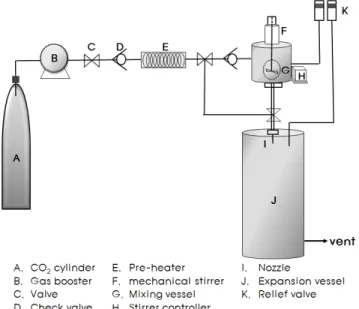
Coriander 정유가 봉입된 고분자 미세입자의 제조에 사용 된 PGSS 실험 장치는 자체적으로 설계 제작하여 사용하 였으며, 이 장치는 이산화탄소 주입부, 혼합부 및 채집부로 구성되어져 있다. 본 연구에 사용된 PGSS 장치의 개략도는 Fig. 2에 나타내었다. 이산화탄소는 가스부스터 (Gas Booster, model AGD-75, Haskel)를 이용하여 가압하였으며, 가압된 이산화탄소는 예열기를 통해 공정온도로 예열된 후 정유와 PEG가 들어있는 혼합용기 (SUS 재질, 부피 80 mL)에 공급 되었다. 이 혼합용기는 관찰 창 (view cell)이 장착되어 내부 관찰이 가능하도록 설계되었다. 입자 제조 및 회수를 위한 채집부 (아크릴 재질, 부피 7.9 L) 상단에는 혼합용액의 분무
를 위한 노즐이 장착되었으며, 장치의 모든 라인은 외경 1/4 또는 1/8 inch의 고압용 튜빙을 사용하였고 실험이 진행되는 동안에 장치의 온도와 압력은 일정하게 유지되었다.
Fig. 2. Schematic diagram of the PGSS apparatus used in this study.
결정성 고분자인 PEG는 초임계 이산화탄소의 가압에 의 해 상압에서의 녹는점 보다 낮은 온도에서 용융되며, 초임계 이산화탄소의 압력이 증가함에 따라 더 낮은 온도에서 용융 된다. 본 실험에서는 E. Weidner 등 [31]에 의해 연구된 PEG 와 초임계 이산화탄소의 상평형 연구를 기초로 하여 공정조 건을 설정하였다. 위의 연구 자료를 토대로 45, 50, 60℃의 공정 온도와 75, 100, 150, 250 bar의 공정 압력 조건에서 100, 200, 250 μm의 노즐을 사용하여 실험을 수행하였다.
공정 온도로 예열된 혼합용기 내에 PEG와 coriander 정유 를 10:1의 질량비로 혼합하여 넣은 후 예열된 이산화탄소 를 공정 압력으로 가압하여 2시간 동안 교반하여 혼합하였 으며, 이 때 공정 온도와 압력 조건은 일정하게 유지되도록 하였다. 내부 관찰이 가능한 관찰 창을 통해 혼합물의 용융 상태를 확인한 후, 노즐을 통해 상온, 상압의 채집부로 분사 시켜 미세입자를 제조하였다. 미세입자 제조는 노즐 분사에 의해 형성된 미세 액적 (droplet) 내 이산화탄소가 빠르게 팽창하면서 액적으로부터 신속하게 열을 제거하기 때문에 이루어진다.
SEM 분석
Coriander 정유가 봉입된 PEG 미세입자의 입자크기와 형태 는 전계방사주사전자현미경 (field emission scanning electron microscope, FE-SEM, JSM6700F)을 사용하여 분석하였다.
탄소 테이프 (carbon tape)를 붙인 금속판 위에 시료를 채취 하여 부착시키고 100초간 Au-Pd 코팅 후 분석하였다.
가스 크로마토그래피 분석
Coriander 정유의 주요성분 분석은 불꽃 이온화 검출기 (flame ionization detector, FID)가 장착된 가스 크로마토그 래피 (gas chromatography, GC, HP-5890 Series Ⅱ)를 이용하 였으며, 정유의 봉입 효율은 질량분석기 (mass spectrometry, MS, Agilent 5973)가 연결된 가스 크로마토그래피 (gas chromatograph, GC, Agilent 6890)를 이용하여 분석하였다.
이 때 컬럼으로는 비극성 컬럼인 DB-WAX (30 m × 0.25 mm
× 0.25 μm, J&W)를 사용하였다. GC/FID의 경우 온도 프로 그램은 50℃에서 230℃까지 20℃/min의 속도로 상승시키고 230℃에서 8분간 온도가 유지되도록 설정하였다. 운반가스 로는 수소 (H2)를 사용하였고 시료는 1 μL를 30:1의 split 으로 주입하였으며 주입부의 온도와 검출기의 온도는 250℃
로 유지하였다. GC/MS의 경우 온도 프로그램은 60℃에서 240℃까지 3℃/min의 상승 속도로 설정하였다. 주입구의 온도는 250℃, line 온도는 260℃로 유지하였고 ionization voltage와 ion source의 온도는 각각 70 eV와 230℃로 설정 하였다. 시료는 1 μL를 30:1의 split으로 주입하였으며 운 반가스로는 헬륨 (He)을 1 mL/min의 유속으로 사용하였다.
시료의 정량분석을 위해 내부표준물질로 butylbenzene을 이용하였으며, GC/MS에 의해 분리된 각 peak의 성분은 mass spectrum library (NIST, WILEY)와 비교를 통해 분석하였다.
정성분석 및 정량분석
Coriander 정유의 주요 성분 분석은 표준용액으로 alkanes (C8-C20)을 사용하여 retention index와 비교하여 확인하였다.
컬럼은 DB-WAX를 사용하였고 분석조건은 GC-FID 분석 방법과 동일하게 수행되었다. 각 성분의 retention index값 은 다음의 주어진 식을 이용하여 계산하였다.
′
′′ ′
위의 식에서 I는 retention index를, n은 Cn의 탄소 수 를, N은 Cn+1의 탄소 수를,
′은 Cn의 retention time을,
′
은 Cn+1의 retention time을, ′은 미지 성분 peak의 retention time을 나타낸다. 계산된 retention index는 문헌상의 retention index와 mass spectrum library (NIST, WILEY)와 비교하여 성분을 확인하였다 [19,32-36].PEG에 봉입된 coriander 정유의 함량과 봉입 효율 (entrapment efficiency)은 아래의 식을 이용하여 계산하였다.
정유함량 (%) = 제조된 미세입자중 coriander정유의 양 회수된 미세입자의 양 × 100 봉입효율 (%) =
제조된 미세입자중 세척후 남은 coriander정유의 양 제조된 미세입자중 coriander정유의 양 × 100
결과 및 고찰
온도와 압력의 영향
초임계 유체를 이용한 미세입자 제조공정에서 공정변수 로서 온도와 압력은 미세입자의 형태와 약물의 봉입효율에 큰 영향을 미치는 것으로 알려져 있다. PGSS 공정을 이용 하여 PEG의 미세입자를 제조하기 위해 100 μm의 노즐과 50℃, 250 bar의 온도, 압력 조건에서 실험을 수행하였다.
Fig. 3에서는 공정 전 PEG과 PGSS 공정 후 PEG 입자의 SEM 분석 결과를 나타내고 있다. 공정 전 PEG는 불규칙 한 입자 형태를 보이고 있으나 PGSS 공정을 통해 제조된 PEG의 경우 구형의 입자 형태를 가짐을 알 수 있었다.
(a) (b)
Fig. 3. SEM micrographs of (a) unprocessed PEG and (b) PEG microparticles prepared at 50℃ and 250 bar with 100 μm nozzle.
Fig. 4. SEM micrographs of the essential oil loaded PEG microparticles prepared with 100 μm nozzle at various temperatures and pressures.
PGSS 공정을 이용한 입자 제조에 있어 입자의 크기와 형태는 분사된 액적의 고형화 속도에 의존한다. 고형화 속도 는 공정 온도와 압력에 가장 크게 의존하며, 일정압력 조건 에서 온도가 증가할수록, 일정온도 조건에서 압력이 감소 할수록 고형화 속도는 느려진다. 이러한 느린 고형화 속도 는 열역학적으로 안정한 구형 입자 형성에 충분한 시간을 제공한다 [8-9].
Fig. 4에서는 온도와 압력 변화에 따라 제조된 coriander 정유가 봉입된 PEG 미세입자의 형태를 보여주고 있다. 그림 에 나타낸 바와 같이 일정압력 조건에서 온도가 증가할수록 상대적으로 더 구형인 입자가 생성되었으며 (Fig. 4(a)-(c)), 일정온도 조건에서는 압력이 감소함에 따라 더 구형인 입자 가 생성되었다 (Fig. 4(d)-(f)). 이는 앞서 언급한 것과 같이 더 느린 고형화 속도를 가질수록 구형의 미세입자가 생성 되기 때문이다.
그러나 일정온도에서 압력이 변화함에 따라 입자의 크 기에는 큰 차이가 없음을 보였으며, 이와 같은 결과는 M.
Rodrigues 등 [1], P. Sameer 등 [8] 및 J. Hao 등 [9]의 연구 결과에서도 확인할 수 있다. 일반적으로 일정온도에서 압력 이 증가함에 따라 고분자와 정유 혼합물의 점도가 낮아지고, 혼합물 분사 시 압력강하가 증가하기 때문에 입자의 크기는 작아진다. 반면, 압력이 증가하면 분사된 액적 내에서 핵 생 성 전에 빠르게 액적이 고형화되기 때문에 입자 크기가 증 가할 수 있다. 따라서 Fig. 4에서 보여주는 것처럼 일정온도 에서 압력 변화가 입자 크기에 미치는 영향이 거의 나타나지 않은 이유는 위에서 설명한 두 요인이 서로 상충되어 작용 했기 때문으로 사료된다.
(a) (b)
(c) (d)
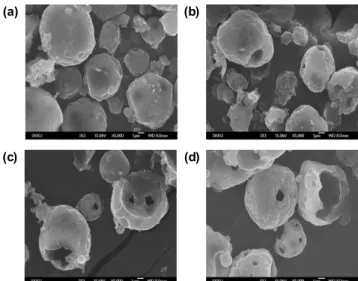
Fig. 5. SEM micrographs of the essential oil loaded PEG microparticles prepared with 100 μm nozzle at 45℃ and different pressure: (a) 75 bar, (b) 100 bar, (c) 150 bar, and (d) 250 bar.
PGSS 공정을 이용한 미세입자 제조의 선행연구에 따르면, 일정 압력 조건에서 온도가 증가함에 따라 고형화 속도가
느려져 응집 (agglomeration)된 입자가 형성되고 입자의 크기 는 증가하였다 [1,8-9]. 그러나 본 연구에서는 일정 압력 조건에서 공정 온도 변화 또한 입자 크기에 큰 영향을 미치 지 않음을 확인하였다. 이는 본 연구에서 이용한 공정 조건 이 입자의 응집을 유도할 만큼 충분히 높은 온도 조건에서 수행되지 않았기 때문으로 생각되어진다.
Fig. 5는 45℃의 온도조건에서 압력 증가에 따라 제조된 입자의 확대 사진을 보여주고 있다. 그림에서 보는 바와 같 이 일정온도 조건에서 압력이 증가함에 따라 더 많은 기공 (pore)을 가지는 입자가 제조됨을 알 수 있었다. 이러한 결 과는 압력이 증가함에 따라 빠른 고형화 속도를 가지며, 액적 내 팽창되어 방출되는 이산화탄소의 양이 상대적으로 많기 때문으로 사료된다 [8,37].
노즐 크기의 영향
Fig. 6은 분사 노즐 직경 증가에 따라 제조된 입자 형태 의 SEM 분석 결과를 보여주고 있다. 가장 작은 크기의 직 경을 가지는 100 μm 노즐을 사용했을 경우 더 큰 크기의 직경을 가지는 노즐에 비해 형성된 입자 내 구형입자 비율 이 더 많았으며, 200 μm 이상의 노즐을 사용한 경우 덩어 리진 입자가 형성되었다. 이러한 결과는 노즐의 직경이 증 가함에 따라 더 큰 액적이 형성되고, 더 빠른 분사 속도를 가지기 때문에 액적이 빠르게 고형화되지 못하고 액적끼리 의 상호 충돌로 인해 덩어리지고 불규칙한 입자가 형성되 는 것으로 사료된다.
(a) (b)
(c)
Fig. 6. SEM micrographs of essential oil loaded PEG microparticles prepared at 50℃ and 250 bar with different nozzle sizes:
(a) 100 μm, (b) 200 μm, and (c) 300 μm.
Coriander 정유의 함량과 봉입률
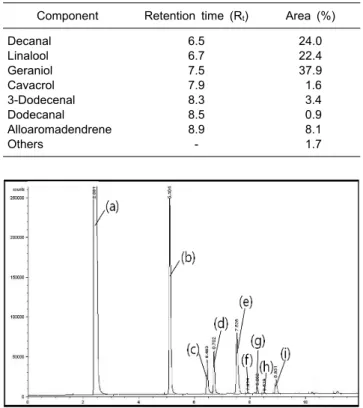
GC-MS 분석을 통해 decanal, linalool, geraniol, 3-dodecenal, alloaromadendrene 등이 coriander 정유의 주요 성분임을 확
인하였으며, Fig. 7과 Table 1에 coriander 정유의 주요 성분 과 함량을 나타내었다. PGSS 공정으로 제조된 미세입자 내 봉입된 coriander 정유의 성분 분석 결과 순수한 cordiander 정유에 비해 linalool과 geraniol 성분은 감소하는 반면 3-dodecenal 및 alloaromadendrene 등의 성분은 상대적으로 증가하는 것을 확인하였다 (Fig 7).
Table 1. Major chemical composition of coriander essential oil as determined by GC analysis
Component Retention time (R
t) Area (%) Decanal
Linalool Geraniol Cavacrol 3-Dodecenal Dodecanal Alloaromadendrene Others
6.5 6.7 7.5 7.9 8.3 8.5 8.9 -
24.0 22.4 37.9 1.6 3.4 0.9 8.1 1.7
Fig. 7. GC analysis of coriander essential oil: (a) hexane (solvent), (b) butylbenzene (internal standard), (c) decanal, (d) linalool, (e) geraniol, (f) cavacrol, (g) 3- dodecenal, (h) dodecanal, and (i) alloaromadendrene.
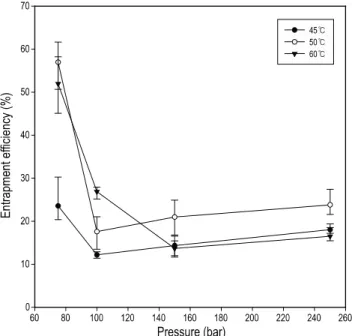
PGSS 공정을 통해 제조된 입자 내 coriander 정유의 함량 은 1.0-3.0%로 모든 공정 조건에서 큰 차이를 보이지 않았 으며 coriander 정유의 봉입률 측정 결과 모든 온도 조건에 서 압력이 가장 낮은 75 bar일 때 가장 높은 봉입률을 보였 다 (Fig. 8). 반면 압력이 증가함에 따라 봉입률은 감소하다 가 다시 증가하는 경향을 보였으며, 이는 초임계 이산화탄소 의 온도, 압력에 따라 coriander 정유의 용해도와 PEG의 고형 화 속도 등의 차이가 복잡하게 나타나기 때문으로 사료된다.
일반적으로 초임계 이산화탄소의 정유에 대한 용해도는 초임계 이산화탄소 밀도 증가에 따라 증가하게 된다 [38-39].
초임계 이산화탄소의 밀도는 일정온도 조건에서 압력이 증 가함에 따라 증가하게 되며, 이에 따라 정유에 대한 용해력 이 증가하게 된다. 그로인해 미세입자 제조 시 초임계 이산 화탄소에 용해되어 소실되는 coriander 정유의 양이 증가 하게 되며 PEG에 봉입되는 coriander 정유의 양은 낮아지
게 된다. 반면 압력이 증가함에 따라 PEG의 고형화 속도가 빨라지기 때문에 액적 내에서 이산화탄소와 함께 확산되어 손실되는 정유의 양은 감소하게 된다. 위에서 설명한 것처럼 미세입자 제조 시 두 가지의 현상이 서로 상충되어 작용하기 때문에 어떤 특정 압력이상에서는 압력이 증가함에 따라 봉입률이 증가하는 현상을 보이는 것으로 사료된다.
Fig. 8. The effect of temperature and pressure on the entrapment efficiency of coriander essential oil in PEG microparticles.
노즐 직경에 따른 봉입률 변화를 측정한 결과 큰 차이가 없는 것을 확인하였고 (Fig. 9), 이상의 결과로부터 coriander 정유의 봉입률은 노즐의 직경을 제외한 온도와 압력에 가장 큰 영향을 받음을 알 수 있다.
Fig. 9. The effect of nozzle size on the entrapment efficiency of coriander essential oil in PEG micropaticles.
요 약
본 연구에서는 coriander 정유의 안정성 향상을 위해 초 임계 PGSS 공정을 이용하여 coriander 정유가 봉입된 PEG 미세입자를 제조하였으며 공정 온도와 압력, 노즐 크 기가 미세입자의 크기, 형태 및 정유의 봉입률에 미치는 영향에 대하여 조사하였다. 100 μm 노즐을 사용하여 얻어 진 미세입자의 형상을 분석한 결과 1-10 μm 크기의 구형 입자 형태를 나타내었으나 노즐의 크기가 증가한 경우에는 덩어리진 입자가 얻어짐을 확인하였다. 온도, 압력 변화에 따라 얻어진 미세입자의 경우 일정 압력 조건에서 공정 온 도가 높아짐에 따라, 일정 온도 조건에서 공정 압력이 낮 아짐에 따라 구형입자 비율이 증가함을 보였으며, 일정 온 도 조건에서는 공정 압력이 높아짐에 따라 더 많은 기공을 가지는 입자가 생성됨을 확인하였다. 제조된 PEG 미세입 자 내 coriander 정유의 봉입률은 모든 온도 조건에서 가장 낮은 압력인 75 bar일 때 가장 높은 값을 보였다.
감 사
본 연구는 차세대 성장 동력 바이오신약장기사업단의 연구비지원에 의해 수행되었으며, 이에 감사드립니다.
접수:2010년 7월 14일, 게재승인:2010년 8월 24일
REFERENCES
1. Rodrigues, M., N. Peirico, H. Matos, E. G. de Azevedo, M. R. Lobato, and A. J. Almeida (2004) Microcomposites theophylline/hydrogenated palm oil from a PGSS process for controlled drug delivery systems. J. Supercrit. Fluids 29: 175-184.
2. Stefano, S., N. Elvassore, A. Bertucco and P. Caliceti (2009) Production of solid lipid submicron particles for protein delivery using a novel supercritical gas- assisted melting atomization process. J. Pharm. Sci.
98: 640-650.
3. Jung, J. H., I. I. Jung, H. J. Joo, J. R. Shin, G. B. Lim and J. H. Ryu (2008) Preparation of biodegradable polymer microparticles containing 5-FU using supercritical carbon dioxide. KSBB J. 23: 452-459.
4. York, P. (1999) Strategies for particle design using supercritical fluids. Pharm. Sci. Technol. Today 2:
430-440.
5. Kim, D. H., H. J. Park, S. H. Kang, S. W. Jun, M.
S. Kim, S. B. Lee, J. S. Park, and S. J. Hwang (2005) Preparation and characterization of lysozyme nanoparticles
using solution enhanced dispersion by supercritical fluid (SEDS) Process. J. Kor. Pharma. Sci. 35: 89-94.
6. Lee, Y. W. (2003) Design of particles using supercritical fluids. HWAHAK KONGHAK 41: 679-688.
7. Tandya, A., F. Dehghani, and N. R. Foster (2006) Micronization of cyclosporine using dense gas techniques.
J. Supercrit. Fluids 37: 272-278.
8. Nalawade, S., P. F. Picchion, and L. P. B. M. Janssen (2007) Batch production of micron size particles from poly(ethylene glycol) using supercritical CO2 as a processing solvent. Chem. Eng. Sci. 62: 1712-1720.
9. Hao, J., M . J. W hitaker, G. Serhatkulu, K. M . Shakesheff, and S. M. Howdle (2005) Supercritical fluid assisted melting of poly(ethylene glycol): a new solvent free route to microparticles. J. Mater. Chem.
15: 1148-1153.
10. Byrappa, K., S. Ohara, and T. Adschiri (2008) Nanoparticles synthesis using supercritical fluid technology-towards biomedical applications. Adv. Drug
Deliv. Rev. 60: 299-327.
11. Song, E. S., H. S. Jung, H. H. Lee, J. D. Kim, H.
Y. Kim, and Y. W. Lee (2006) The Production of protein-loaded poly(lactide-co-glycolide) microparticles using supercritical carbon dioxide. Clean Technology 12: 53-61.
12. Bakkali, F., S. Averbeck, D. Averbeck, and M. Idaomar (2008) Biological effects of essential oils - A review.
Food Chem. Toxicol. 46: 466-475.
13. Shigeharu, I., T. Toshio, and Y. Hidetyo (2001) Antibacterial activity of essential oils and their major constituents against respiratory tract pathogens by gaseous contact. J. Antimicrob. Chemother. 47: 565-573.
14. Shittu, L. A. J., M. A. Bankole, T. Ahmed, M. N.
Bankole, R. K. Shittu, C. L. Saalu, and O.A. Ashiru (2007) Antibacterial and antifungal activities of essential oils of crude extracts of sesame radiatum against some common pathogenic micro-organisms. IJPT 6: 165-170.
15. Hong, E. J., K. J. Na, I. G. Choi, K. C. Choi, and E.
B. Jeung (2004) Antibacterial and antifungal effects of essential oils from coniferous trees. Biol. Pharm.
Bull. 27: 863-866.
16. Lee, S. O., G. J. Choi, K. S. Jang, H. K. Lim, K. Y.
Cho, and J. C. Kim (2007) Antifungal activity of five plant essential oils as fumigant against postharvest and soilborne plant pathogenic fungi. Plant Pathol.
J. 23: 97-102.
17. Svoboda, K. P., and J. B. Hampson (1999) Bioactivity of essential oils of selected temperate aromatic plants:
antibacterial, antioxidant, antiinflammatory and other related pharmacological activities. In: Special Chemicals
for the 21st Century. ADEME/IENICA International Seminar. September 16-17. Paris, France.
18. Prabuseenivasan, S., M. Jayakumar, and S. Ignacimuthu (2006) In vitro antibacterial activity of some plant essential oils. BMC Complementary and Alternative
Medicine 30: 6-39.
19. Randrianarivelo, R., S. Sarter, E. Odoux, P. Brat, M.
Lebrun, B. Romestand, C. Menut, H. S. Andrianoelisoa, M. Raherimandimby, and P. Danthu (2009) Composition and antimicrobial activity of essential oils of Cinnamosma
fragrans. Food Chem. 114: 680-684.
20. Ebrahimi, S. N., J. Hadian, M. H. Mirjalili, A. Sonboli, and M. Yousefzadi (2008) Essential oil composition and antibacterial activity of Thymus caramanicus at different phenological stages. Food Chem. 110: 927-931.
21. Emamghoreishi, M., M. Khasaki, and M. F. Aazam (2005) Coriandrum sativum: evaluation of its anxiolytic effect in the elevated plus-maze. J. Ethnopharmacol.
96: 365-370.
22. Msaada, K., K. Hosni, M. B. Taarit, T. Chaged, M. E.
Kchouk, and B. Marzouk (2007) Changes on essential oil composition of coriander (Coriandrum sativum L.) fruits during three stages of maturity. Food Chem.
102: 1131-1134.
23. Wangensteen, H., A. B. Samuelsen, and K. E. Malterud (2004) Antioxidant activity in extracts from coriander.
Food Chem. 88: 293-297.
24. Chithra, V. and S. Leelamma (2000) Coriandrum
sativum - effect on lipid metabolism in 1,2-dimethyl
hydrazine induced colon cancer. J. Ethnopharmacol.71: 457-463.
25. Gallagher, A. M., P. R. Flatt, G. Duffy, and Y. H.
A. Abdel-Wahab (2003) The effects of traditional antidiabetic plants on in vitro glucose diffusion. Nutr.
Res. 23: 413-424.
26. Park, K. K. and D. W. Pack (2005) Biodegradable polymers for microencapsulation of drugs. Molecules 10: 146-161.
27. Jamie, L. O. (2006) PEG-based degradable networks
for drug delivery applications. Ph. D. Thesis. Drexel
University, Philadelphia. USA.28. Kim, S. H., and S. H. Kim (2007) Biofunctional biodegradable polymers. Polym. Sci. Technol. 18:
450-457.
29. Fuertges, F. and A. Abuchowski (2009) The clinical efficacy of poly(ethylene glycol)-modified proteins.
J. Control. Release 11: 139-148.
30. Yoo, M. K., J. H. Park, and S. Y. Jeon (2008) Magnetic resonance imaging nano-agents for cancer imaging. Polym. Sci. Technol. 19: 116-124.
31. Weidner, E., V. Wiesmet, Ž. Knez, and M. Šerget (1997) Phase equilibrium (solid-liquid-gas) in polyethyleneglycol- carbon dioxide systems. J. Supercrit. Fluids 10:
139-147.
32. Goodner, K. L. (2008) Practical retention index models
of OV-101, DB-1, DB-5, and DB-Wax for flavor and fragrance compounds. LWT - Food Sci. Technol. 41:
951-958.
33. Choi, H. S. and M, Sawamura (2001) Volatile flavor components of ripe and overripe ki-mikans (Citrus
flaviculpus Hort. ex Tanaka) in comparison with
hyuganatsu (Citrus tamurana Hort. ex Tanaka). Biosci.Biotechnol. Biochem. 65: 48-55.
34. Seo, H. Y., K. M. No, S. L. Shim, K. Y. Ryu, K. J.
Han, R. Gyawali, and K. S. Kim (2006) Analysis of enantiomeric composition of chiral flavor components from dried ginger (Zingiber officinale Roscoe). J.
Korean Soc. Food Sci. Nutr. 35: 874-880.
35. Menichini, F., F. Conforti, D. Rogano, C. Formisano,
F. Piozzi, and F. Senatore (2009) Phytochemical composition, anti-inflammatory and antitumour activities of four Teucrium essential oils from Greece. FoodChem. 115: 679-686.
36. Babushok, V. I. and L. G (2009) Zenkevich, Retention indices for most frequently reported essential oil compounds in GC. Chromatographia 69: 257-269.
37. Wendt, T., G. Brandin, E. Weidner, and M. Petermann (2007) PGSS - The innovative production of fluid-filled microcapsules for the food industry. Proceedings of
European Congress of Chemical Engineering (ECCE-6).
September 16-20. Copenhagen, Denmark.
38. Illés, V., H. G. Daood, S. Perneczki, L. Szokonya, and M. Then (2000) Extraction of coriander seed oil by CO2 and propane at super- and subcritical conditions.
J. Supercrit. Fluids 17: 177-186.
39. Heikki, K. and K. Kerrola (1992) Application of liquid carbon dioxide to the extraction of essential oil of coriander (Coriandrum sativum L.) fruits. Z Lebensm