pISSN 1598-2033 eISSN 2233-5706
Journal of the Korea Institute of Building Construction, Vol. 12, No. 6
http://dx.doi.org/10.5345/JKIBC.2012.12.6.636 www.jkibc.org
Quantified Impact Analysis of Construction Delay Factors on Steel Staircase Systems
Kim, Hyun-Mi
1Kim, Tae-Hyung
2Shin, Young-Keun
3Kim, Young-Suk
4Han, Seungwoo
4*1)HanmiGlobal, Samsung-dong, Kangnam-gu, Seoul, 135-973, Korea
1DAEWOO E& C, Kyungse-Dong, Seo-Gu, Incheon, 404-170, Korea
2POSCO E& C, Songdo-Dong, Yeonsu-Gu, 406-840, Korea
3Department of Architecture Engineering, Inha University, Nam-Gu, Incheon, 402-751, Korea
4Abstract
Construction projects have become so large, complicated and incredibly high-tech that process management is currently considered one of the most important issues. Unlike typical manufacturing industries, most major construction activities are performed in the open air and thus are exposed to various environmental factors. Many studies have been conducted with the goal of establishing efficient techniques and tools for overcoming these limitations. Productivity analysis and prediction, one of the related research subjects, must be considered when evaluating approaches to reducing construction duration and costs. The aim of this research is to present a quantified impact analysis of construction delay factors on construction productivity of a steel staircase system, which has been widely applied to high rise building construction. It is also expected to improve the process by managing the factors, ultimately achieving an improvement in construction productivity. To achieve the research objectives, this paper analyzed different delay factors affecting construction duration by means of multiple regression analysis focusing on steel staircase systems, which have critical effects on the preceding and subsequent processes in structure construction. Statistical analysis on the multiple linear regression model indicated that the environment, labor and material delay factors were statistically significant, with 0.293, 0.491, and 0.203 as the respective quantified impacts on productivity.
Keywords : delay factor, productivity, multiple linear regression, steel staircase, high-rise building
1. Introduction
1.1 Research background and objective
As the construction process, unlike other forms of manufacturing and production, is usually done in an open space or outdoors, it has been subject to many limitations in terms of predicting results such as productivity and cost in advance. In particular, there are many variables and risks that should be considered in analyzing and predicting
Received : September 13, 2012 Revision received : October 17, 2012 Accepted : October 23, 2012
* Corresponding author : Han, Seungwoo [Tel: 82-32-860-7595, E-mail: [email protected]]
ⓒ2012 The Korea Institute of Building Construction, All rights reserved.
productivity, one of the major indicators utilized
for assessing the performance of the construction
process[1,2]. As construction projects become larger
and more complex, construction delays can bring
huge losses to the sectors involved. To prevent
such losses, it is critical that the preliminary plan
for the construction process be established in a
more accurate and precise manner. The analysis
and prediction of construction productivity is one
of the factors required to establish a more
effective and reliable preliminary plan for the
construction process[1]. For this reason,
construction specialists, including construction
managers, should strive to establish a reasonable
plan for the construction process. To do this, an
accurate analysis and precise prediction of
construction productivity is required[3].
The need for an analysis of construction productivity is closely related with construction duration. Other than quality, cost and safety, construction duration is one of key managerial factors that have a great impact on a construction project, and a more effective plan should be prepared to improve construction productivity as well as construction technologies in order to meet the construction deadline and reduce the construction duration[4].
Working ratio, one of the productivity measurement factors, indicates a linear relationship with construction productivity. For this reason, to improve working ratio, the construction delay factors should be comprehensively analyzed, and direct and indirect interdependence between works should be examined as well[5].
Therefore, this research aims to analyze interrelations with construction productivity through an analysis of construction delay factors, the substructure in construction productivity analysis, required for the improvement of construction performance. This paper presents a quantified impact analysis of construction delay factors on construction productivity, which makes it possible to understand the specific construction delay factors to be intensively managed, and this is expected to improve the process by managing the factors and ultimately achieving an improvement in construction productivity.
1.2 Research method and scope
The staircase installation work currently adopted in high-rise building construction in Korea was selected, in order to select an appropriate research subject in consideration of the keen interest in high-rise building construction projects in Korea and overseas. In particular, of the structural works
considered as major works in a high-rise building construction project, staircase installation work was selected because of its great influence on the other works connected, including the preceding and following work processes. Another reason for selecting staircase installation work was that all specific events in this work were conducted in a sufficiently separate manner to be easily observed[7,8]. The construction techniques related to staircase installation work applied in high-rise building construction projects in Korea largely fall into RC (reinforced concrete) staircase and steel staircase systems[7,8,9]. The steel staircase system was selected to specifically study construction delay factors and measurement of construction productivity, as it has gained in popularity in high-rise building construction sites due to its advantages, including its capacity to secure a higher level of safety and a reduced construction duration compared to the conventional RC staircase system[7,8].
Two research approaches were presented in this study. One is the evaluation of construction delay factors by observers, including construction managers. The other is the application of the multiple linear regression model, one of the statistical methods used to analyze correlations between independent and dependent variables.
In detail, this study was composed of a total four steps, as follows.
Step 1: Determination of construction delay factors through literature review
Step 2: Evaluation by interval scale based on construction delay factors
Step 3: Determination of correlation equation using
the multiple linear regression model
Step 4: Suggestion of quantified impact of
construction productivity by factor
In Step 1, the literature was reviewed to derive construction delay factors, and the representative construction delay factors used in MPDM (Method Productivity Delay Model) presented and studied by Adrian were selected, since the delay factors were clear and concrete, and were appropriate to be quantified[10,11,12].
In Step 2, delay factors selected in Step 1 were evaluated by construction personnel and site visitors using a Likert Scale, which is widely used not only in the social sciences but also in engineering science.
In Step 3, a multiple linear regression model analysis was conducted by setting the results of the Likert Scale evaluation by professionals as independent variables and the productivity values measured at an actual site as independent variables. The result was drawn as a correlation equation between dependent variable y and multiple independent variables x .
In Step 4, the impact on the productivity of each factor was quantified and analyzed based on the multiple linear regression model drawn in Step 3.
2. Review of previous studies
2.1 Multiple linear regression model analysis A regression model analysis is a statistical analysis method that explains the relationship between variables by assuming some of the variables as causes and the others as results on the premise that diverse continuous variables are correlated. The variables set as causes are termed as explanatory variables or independent variables, while the variables set as results are termed as response variables or dependent variables. The multiple linear regression analysis provides a one-dimensional explanation for one response variable with various explanatory variables[13].
The multiple linear regression model is expressed as in Eq.(1)[13].
···
Multiple linear regression models provide a
numerical equation as a result, and have been
widely used as a methodology for predicting similar
phenomena based on existing data. The regression
model analysis has been used as a prediction
technique in the social sciences to perform a factor
analysis has been applied in the construction field
since the 1980s, and is widely applied to predict
result values to this day. Focusing on the
construction area, the multiple linear regression
model is used in wide range of fields, such as for
earthmoving productivity estimation based on
actual quantities[14,15], performance analysis and
prediction of new technologies based on
simulation[16,17], and construction cost estimation
for 42 apartment buildings[18]. Most of the studies
mentioned above presented a result value using the
regression analysis model, but they have some
restrictions in terms of statistical verification for
each independent variable and presentation of
quantified impact. Accordingly, this research put
an emphasis on the presentation of a quantified
impact of each of the construction delay factors
that affect the construction productivity, the result
value, rather than prediction of the result value
using the multiple linear regression model. The
validity of the multiple linear regression equation
drawn in this research was examined through a
comparison between the expected values and the
result values of test data.
2.2 Construction delay factors in the MPDM
Many methods for estimating and assessing construction productivity have been presented by many researchers. Since a quantified method for productivity measurement was accepted as a method to raise efficiency in construction sites, it has been widely studied in academia and industry[12,19]. Of the diverse methods presented, the MPDM is a method for measuring the working time of each cycle for a small-scale work process directly carried out at a site while simultaneously analyzing the factors causing a delay in working time. The MPDM is different from other productivity measurement methods in that it not only sets and analyzes the delay factors but can also indirectly express the impact of delay factors on productivity in an numerical manner by separately expressing the expected productivity:
overall productivity under a delayed condition and ideal productivity under no delay condition[12,19].
Table 1. Definitions of construction delay factors [12]
Name of
delay factors Example
Environment Delay caused by environmental issues such as heavy rain, snow or strong wind Labor Delay caused by labor issues such as idle
attitude, fatigue
Equipment Delay caused by equipment issues such as stationary, malfunctions
Material Delay caused by material issues such as supply, defects
Management Delay caused by managerial issues such as plan, control, communications
Table 1 indicates five delay factors generally used in the MPDM. The five factors presented in the MPDM were applied to the steel staircase system in this research.
3. Analysis of the working process of steel staircase system
3.1 Outline of the target project
The major activities involved in the installation of the steel staircase system selected as the research subject are as follows. The steel staircase system is first prefabricated in a factory, and then is delivered to the site. Next, the mold of the RC stair landing is installed and connects the steel stairs with the stair landing using a stair anchor.
The steel staircase system reduces construction duration because of its simple installation process, guarantees quality due to its prefabrication in a factory, and prevents safety accidents by securing sufficient work spaces while installing, which are recognized as relative advantages compared to the conventional RC staircase system[7,8,20].
To collect the actual quantities of the steel staircase system, preliminary research was conducted including a visit to a manufacturer of steel staircase systems, a review of the related literature, and an interview with personnel.
Through the preliminary research, candidate sites
appropriate for the objective of this research were
selected. The target site was selected based on the
criteria that the work process would be clear and
the process could be easily measured. We visited
the target site to collect the data of process
measurement, workload, and the composition of
workers by videotaping the work process and
conducting interviews with persons concerned. The
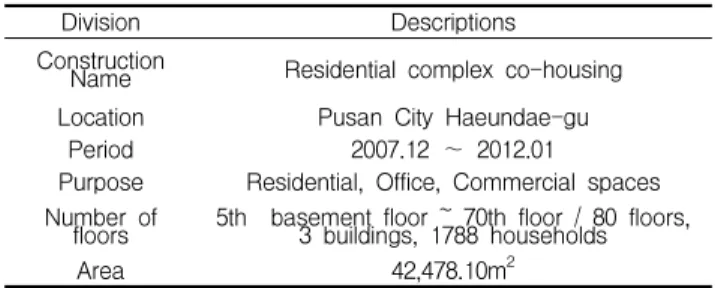
target site was located in Haewundae-gu, Busan,
where three high-rise residential buildings were
built, which had 70, 75 and 80 floors above ground
and five underground. The structural works in 8-9
stories were in progress during the visit. The
outline of the target site is indicated in Table 2.
Work Labor Equipment
Time(hr.) WorkLabor
Equipment
1 2 3 4 5 6 7
Direction C, L1, L2 - 0.2 0.1 0.1 0.1 0.0 0.1 0.2
Moving L1, L2 - 0.8 1.4 1.7 1.3 1.5 0.7 1.1
Scaffolding installation L1, L2 - 0.5 0.3 0.4 0.4 0.8 0.7 0.6
Space formwork
landing L1, L2 - 1.4 1.6 1.7 1.5 1.8 1.3 1.8
Stair anchor
installation L1 - 0.4 0.5 0.6 0.2 0.2 0.3 0.3
Queuing crane - - 1.0 0.3 0.5 0.8 0.5 0.2 1.8
Temporary staircase
installation L1, L2 Crane 1.2 0.9 1.0 0.9 0.8 1.0 1.1
Checking C, L1 - 0.2 0.2 0.2 0.1 0.1 0.2 0.1
Queuing crane - Crane 0.6 1.0 0.4 1.4 0.4 0.3 1.2
Moving steel L3 Crane 0.5 0.3 0.4 0.3 0.4 0.5 0.4
Reinforcement L3 - 2.0 1.7 3.9 1.9 2.3 1.8 2.0
Checking C, L3 - 0.2 0.1 0.1 0.1 0.1 0.1 0.1
Queing crane - Truck mixer 1.1 0.5 0.2 0.3 0.8 1.4 0.9
Pumping preparation - Truck mixer,
concrete pump 0.1 0.2 0.1 0.1 0.1 0.1 0.1
Placing preparation L4 - 0.1 0.1 0.1 0.1 0.1 0.1 0.1
Landing space
concrete placing L4, L5 Truck mixer,
concrete pump 0.8 0.6 0.3 0.8 0.6 0.7 0.7
Checking C, L4 - 0.2 0.1 0.1 0.1 0.1 0.1 0.1
Queuing crane - - 0.2 0.5 0.6 0.1 0.6 0.8 0.9
Disassembling
temporary staircase L1, L2 Crane 0.6 0.5 0.4 0.5 0.5 0.8 0.3
Staircase installation L1, L2 Crane 0.8 0.9 0.8 0.7 0.7 1.4 0.8
Checking C, L1 - 0.1 0.1 0.1 0.1 0.1 0.1 0.1
Formwork Separation L1 - 1.4 1.8 1.5 1.7 1.8 1.3 1.1
Concrete Exposure L6 - 0.4 0.5 0.6 0.5 0.8 0.5 0.5
Checking C - 0.3 0.3 0.5 0.3 0.4 0.5 0.3
Overall 14.9 14.5 16.1 14.1 15.1 14.6 16.3
Productivity(cycle/hr.) 0.06696 0.06912 0.06205 0.07092 0.06615 0.06857 0.06141 Note: C(foreman); L1, L2(carpenters); L3(rodman); L4, L5(laborers); L6(cement finisher)
Table 4. Actual data by site observation and measurement of construction operation steel staircase systems Table 2. Construction site outline [7,8,20]
Division Descriptions
Construction
Name Residential complex co-housing
Location Pusan City Haeundae-gu
Period 2007.12 ~ 2012.01
Purpose Residential, Office, Commercial spaces Number of
floors 5th basement floor ~ 70th floor / 80 floors, 3 buildings, 1788 households
Area 42,478.10m
23.2. Work process of the steel staircase system Through the site observation and interviews with people at the site, the equipment used in the work for the steel staircase system was found to be crane for material lifting, truck mixer for concrete placement on the landing and concrete conveying pipes. In addition, 7 workers were required for the work: two carpenters, one rodman for rebar placement, two laborers for concrete placement, one
cement finisher and one foreman. Pictures of the detailed work process for the steel staircase system are presented in Table 3[7,8,20].
Table 3. Installation process of steel staircase systems [7,8,20]
① Preparation ② Formwork installation of landing
area
③ Installation of stair anchor
④ Installation of temporary
staircase
⑤ Steel reinforcement of
landing space
⑥ Concrete placing of landing
area
⑦ Staircase
installation ⑧ Staircase
installation ⑨ Finish
4. Data collection
4.1 Productivity measurement
The process data cluster was collected 7 times for 1 month from October 1 through October 31, 2011 to analyze the construction delay factors of the steel staircase system, the research subject, as shown in Table 4. The entire process of installing the steel staircase system was divided into observable minimum work units, which are shown in Table 5. The information of workers and equipment is expressed with the type and number of equipment used and the type and the number of workers input in each unit. In the process data cluster collected 7 times, the time taken for each work unit was listed and productivity by time expressed with the total time taken for the work and the number of cycles per hour was also presented. The average time of 7 cycles was 15.09 hours, and 2 days were usually spent finishing a cycle of a work unit. To measure the time taken for a cycle in an accurate manner, a team was composed of three members to make cohesive judgments and measurements. The team measured the time taken for the cycles[9].
4.2 Analysis of construction delay factors
The information on the time taken for each cycle and productivity per hour presented in Table 4 is used as dependent variables in a statistical method to analyze the quantified impact of factors influencing productivity presented in this chapter.
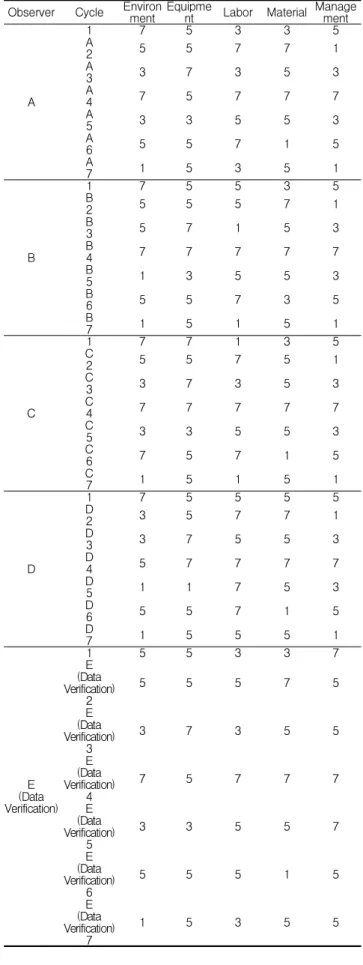
The observance group that consisted of 3 observers (researchers), 1 supervisor and 1 manager for the work unit conducted an analysis of the factors influencing productivity presented in 2.2 using the Likert scale (1 very poor; 2 poor; 3 fair; 4 favorable; 5 very favorable) during each cycle. The results are shown in Table 5. Of the analyses of
Observer Cycle Environ ment Equipme
nt Labor Material Manage ment
A
1 7 5 3 3 5
A 2 5 5 7 7 1
A 3 3 7 3 5 3
A 4 7 5 7 7 7
A 5 3 3 5 5 3
A 6 5 5 7 1 5
A 7 1 5 3 5 1
B
1 7 5 5 3 5
B 2 5 5 5 7 1
B 3 5 7 1 5 3
B 4 7 7 7 7 7
B 5 1 3 5 5 3
B 6 5 5 7 3 5
B 7 1 5 1 5 1
C
1 7 7 1 3 5
C 2 5 5 7 5 1
C 3 3 7 3 5 3
C 4 7 7 7 7 7
C 5 3 3 5 5 3
C 6 7 5 7 1 5
C 7 1 5 1 5 1
D
1 7 5 5 5 5
D 2 3 5 7 7 1
D 3 3 7 5 5 3
D 4 5 7 7 7 7
D 5 1 1 7 5 3
D 6 5 5 7 1 5
D 7 1 5 5 5 1
(Data E Verification)
1 5 5 3 3 7
(Data E Verification)
2
5 5 5 7 5
(Data E Verification)
3
3 7 3 5 5
(Data E Verification)
4
7 5 7 7 7
(Data E Verification)
5
3 3 5 5 7
(Data E Verification)
6
5 5 5 1 5
(Data E Verification)
7
1 5 3 5 5
Table 5. Analytic data collected by site observers
the 7 cycles by five people, one analysis by one person was kept as test data for verification of the multiple linear regression model. Therefore, a total of 28 input data evaluating delay factors for the 7 cycles by 4 people was used as a data set for the multiple linear regression model[9].
5. Deduction and analysis of a multiple linear regression model
5.1 Selection of variables
The values of the factors influencing productivity evaluated by the observance group were set as independent variables in the composition of the multiple linear regression model ( x 1 … x 5 ), consisting of a total of 5 factors: environment, equipment, labor, material and management. More specifically, the environment factor ( x 1 ) encompasses delay factors related with weather, etc.; the equipment factor ( x 2 ) encompasses delay factors related with inappropriate use or breakdown of equipment including crane; the labor factor ( x 3 ) encompasses delay factors related with activities of the workers other than work; the material factor ( x 4 ) encompasses delay factors related with damage to defects in the material including any damage to steel stairs or delivery problem of the material (not delivered on time);
and the management factor ( x 5 ) encompasses delay factors arising from interference by other works or work plan[9].
The dependent variable ( y ) that corresponded to the independent variables was the productivity per hour actually measured at site.
5.2 Deduction of a multiple linear regression model To analyze the quantified impact of each independent variable by deducing a multiple linear regression model, the process below and result
values should be statistically estimated.
First, regression coefficient ß 0 (a constant) and ß k ( k = 1 ,... n ; correlation coefficient between independent variable and dependent variable) should be estimated. The value is estimated using the least squares method, as shown below[13].
--- (2)
ß 0 and ß k that make Q minimized in Eq,(2) above are presented as estimated values using a partial differential, on which basis the relation of the partition of sum of squares is drawn[13].
![Table 1. Definitions of construction delay factors [12]](https://thumb-ap.123doks.com/thumbv2/123dokinfo/5126236.579472/4.892.80.431.655.920/table-definitions-of-construction-delay-factors.webp)