Introduction Introduction
Fusobacterium nucleatum은 그람 음성이면서 절대 혐기성인 방추 형(fusiforme) 세균으로, 구강에서 생체막(biofilm) 형성 및 치주질환 발병에 중요한 역할을 하는 것으로 알려져 있다[1,2]. F. nucleatum은 DNA-DNA hybridization (DDH)과 세균 전체 단백질의 폴리아크릴아 마드 젤 전기영동 패턴 분석에 의해 3개의 아종(F. nucleatum subsp.
nucleatum, F. nucleatum subsp. polymorphum 및 F. nucleatum subsp. vincentii)으로 분류되었다[3]. 비슷한 시기에 F. nucleatum 은 glutamate dehydrogenase와 2-oxoglutarate reductase 단백 질의 전기영동 패턴과 DDH 분석에 의해 4가지 아종(F. nucleatum subsp. nucleatum, F. nucleatum subsp. polymorphum, F. nu- cleatum subsp. fusiforme 및 F. nucleatum subsp. animalis)으
로도 분류되었다[2,4,5]. F. nucleatum subsp. fusiforme과 F. nu- cleatum subsp. vincentii는 22개의 유전자들을 이용한 다좌위 서열 분석(multilocus sequence analysis)에 의해 F. nucleatum subsp.
vincentii로 통합되어 재분류되었다[6].
16S ribosomal RNA 유전자(16S rDNA) 염기서열비교분석법과 DDH는 세균의 종-수준에서 동정하는 데 황금 기준(gold standard) 으로 이용되었다[7,8]. 즉, 이미 알려진 세균 종의 표준균주와 종-수준 으로 동정을 원하는 균주 간의 16S rDNA 핵산염기서열의 상동성이 97–98% 이상이고, DDH 값이 70% 이상인 경우에만 두 균주는 같은 종에 속하는 것으로 판정하였다[7,8]. 이들 중 DDH는 매우 까다롭고, 연구자 및 방법에 따라 편차가 크다는 단점이 있었다[9]. 최근 핵산염기 서열 결정법의 눈부신 발전과 세균 지놈 핵산염기서열 전체를 이용한 균주들 간의 상동성을 분석하는 프로그램이 개발되면서, DDH를 보완
Int J Oral Biol 45:70-75, 2020
pISSN: 1226-7155 • eISSN: 2287-6618 https://doi.org/10.11620/IJOB.2020.45.2.70
Genome-based identification of strain KCOM 1265 isolated from subgingival plaque at the species level
Soon-Nang Park 1,2 , Yun Kyong Lim 1,2 , and Joong-Ki Kook 1,2,3 *
1 Korean Collection for Oral Microbiology, Chosun University, Gwangju 61452, Republic of Korea
2 Department of Oral Biochemistry, School of Dentistry, Chosun University, Gwangju 61452, Republic of Korea
3 Institute of Dental Science, Chosun University, Gwangju 61452, Republic of Korea
The aim of this study was to identify strain KCOM 1265 isolated from subgingival plaque at the species level by comparing 16S ribosomal RNA gene (16S rDNA) and genome sequences. The whole genome of strain KCOM 1265 was extracted using the phenol–chloroform extraction method. 16S rDNA was amplified using polymerase chain reaction and sequenced using the dideoxy chain termination method. Pairwise genome comparison was performed using average nucleotide identity (ANI) and genome-to-genome distance (GGD) analyses. The data showed that the percent similarity of 16S rDNA sequence of strain KCOM 1265 was 99.6% as compared with those of Fusobacterium polymorphum ATCC 10953 T and Fusobacterium hwasookii KCOM 1249 T . The ANI values of strain KCOM 1265 with F. polymorphum ATCC 10953 T and F. hwasookii KCOM 1249 T were 95.8% and 93.0%, respectively. The GGD values of strain KCOM 1265 with F. polymorphum ATCC 10953 T and F. hwasookii KCOM 1249 T were 63.9% and 49.6%, respectively. These results indicate that strain KCOM 1265 belongs to F. polymorphum.
Keywords: Fusobacterium polymorphum, 16S ribosomal RNA gene, Average nucleotide identity, Genome-to-genome distance
Received April 2, 2020; Revised April 21, 2020; Accepted April 21, 2020
*Correspondence to: Joong-Ki Kook, E-mail: [email protected] https://orcid.org/0000-0003-2628-2870 Copyright © The Korean Academy of Oral Biology
CC
This is an open-access article distributed under the terms of the Creative Commons Attribution Non-Commercial License (http://creativecommons.org/licenses/by- nc/4.0/), which permits unrestricted non-commercial use, distribution, and reproduction in any medium, provided the original work is properly cited.
Original Article IJOB
하는 average nucleotide identity (ANI) 및 genome-to-genome distance (GGD) 분석법들이 DDH 분석법을 대체하게 되었다[9-13].
최근 세균 지놈 핵산염기서열을 이용하여 신종 분류 연구에 이용할 경 우, 신종 후보 균주의 16S rDNA 핵산염기서열의 상동성이 표적 세균 종의 표준균주의 것과 98.7% 이상일 경우, ANI 또는 GGD 분석법을 이용해야 한다는 제안이 발표되었다[14]. 최근 F. nucleatum의 4가 지 아종들(F. nucleatum subsp. nucleatum, F. nucleatum subsp.
polymorphum, F. nucleatum subsp. vincentii, F. nucleatum subsp. animalis)은 ANI 및 GGD 분석법에 의해 종-수준(F. nuclea- tum, F. polymorphum, F. vincentii, F. animalis)으로 재분류되었다 [15].
KCOM 1265 (= ChDC F288) 균주는 한국인 치은염 부위의 치면세 균막으로부터 분리되어 16S rDNA 핵산염기서열 비교분석법에 따라 F.
nucleatum으로 동정되어 한국구강미생물자원은행에 기탁되었다. 하 지만, KCOM 1265 균주의 16S rDNA 핵산염기서열은 Fusobacte- rium hwasookii 표준균주(KCOM 1249
T
)와 F. polymorphum (이전 에 F. nucleatum subsp. polymorphum) 표준균주(ATCC 10953T
) 의 것과 모두 99.6%의 상동성을 보여 종-수준으로 동정이 필요하였다.그러므로, 본 연구는 KCOM 1265 균주의 지놈 핵산염기서열을 바탕으 로 종-수준으로 동정하기 위하여 시행되었다.
Materials and Methods Materials and Methods
1. 세균 및 배양
본 연구에서 사용한 KCOM 1265 균주는 한국구강미생물자원은 행(Korean Collection for Oral Microbiology [KCOM], Gwangju, Korea)에서 분양받아 사용하였다. KCOM 1265 균주는 tryptic soy agar (TSA; BD Difco Laboratories, Franklin Lakes, NJ, USA)에 yeast extract (최종 농도, 0.5% ), hemin (0.5 mg/mL), cysteine HCl-H
2
O (0.05%) 및 vitamin K1
(2 mg/mL)를 첨가한 배지를 사용 하여 배양하였다. 이때 혼합 가스(10% H2
, 5% CO2
및 85% N2
)를 주 입한 혐기성 배양기(BACTRONEZ; Sheldon Manufacturing Inc., Cornelius, OR, USA)에서 37℃ 조건에서 배양하여 본 실험에 사용하 였다.2. 16S rDNA 염기서열을 이용한 계통분류학적 분석
KCOM 1265 균주의 지놈 DNA는 Cho 등[16]이 제시한 페놀:클로 로폼 추출법으로 추출하여 사용하였다.
KCOM 1265 균주의 16S rDNA는 universal primers인 27F (5’
-AGA GTT TGA TC[A/C] TGG CTC AG-3’) 및 1492R (5’-TAG GG[C/T] TAC CTT GTT ACG ACT T-3’) [17]을 이용하여 pGEM- T easy 벡터(Promega Corp., Madison, WI, USA)에 클로닝하고 [18], 솔젠트 사(Daejeon, Korea)에 의뢰하여 염기서열을 결정하였다.
KCOM 1265 균주의 16S rDNA 핵산염기서열은 GenBank에 기탁하
였다(Table 1). KCOM 1265의 계통분류학적 분석에 함께 사용될 세 균 종의 표준균주와 그들의 16S rDNA 핵산염기서열의 GenBank ac- cession number들은 Table 1에 정리하였다.
KCOM 1265 균주 및 이와 유전학적으로 가장 가까운 Fusobacteri- um 종들의 16S rDNA 핵산염기서열의 상동성은 MegAlign program (DNAStar Lasergene
TM
8.0; DNAStar Inc., Madison, WI, USA) 을 이용하여 구하였으며, 이때 CLUSTAL W algorithm을 사용하였다 [16]. 또한, MEGA 6.06 프로그램을 이용하여[19], 계통수(phyloge- netic tree)는 neighbor-joining method [20]을 이용하여 얻었다. 이 때 계통수의 안정성은 1,000 반복에 의한 bootstrap 분석법[21]으로 측정하였다.3. 세균 지놈 핵산염기서열 결정
KCOM 1265 균주의 지놈 핵산염기서열은 PacBio RSII platform 과 Hiseq platform (에러 수정을 위함)을 이용하여 결정하였으며, 이 는 Macrogen 사(Seoul, Korea)에 의뢰하였다. 이때 DNA library는 20 kb SMRTbell templates와 Truseq DNA PCR free (350) 타입 을 이용하였다. 각각의 DNA library에서 얻어진 핵산염기서열들은 RS HGAP Assembly 3.0 [22] 프로그램의 기본 옵션(default option) 을 이용하여, 새로운 조합(de novo assembly) 방법으로 최종 KCOM 1265 균주 지놈 핵산염기서열을 결정하였으며, 이를 GenBank에 기탁하였다(GenBank accession number; PEQW00000000).
KCOM 1265 균주의 지놈 핵산염기서열을 바탕으로 한 지놈 주석달기 (genome annotation)는 NCBI Prokaryotic Genome Annotation
Table 1. GenBank accession numbers of nucleotide sequences of genomes for strain KCOM 1265 and closely related type strains of Fusobacterium spp.
Species and strain
GenBank accession number 16S
ribosomal
RNA gene Genome
KCOM 1265 MK788222 PEQW00000000
Fusobacterium polymorphum
ATCC 10953 T GQ301039 NZ_CM000440
Fusobacterium hwasookii KCOM 1249 T FJ471641 ALVD00000000 Fusobacterium nucleatum ATCC 25586 T GQ301038 NC_003454 Fusobacterium vincentii ATCC 49256 T GQ301040 AABF00000000 Fusobacterium animalis ATCC 51191 T GQ301042 AFQD00000000 Fusobacterium periodonticum
ATCC 33693 T GQ301043 ACJY00000000
Fusobacterium pseudoperiodonticum
KCOM 1259 T FJ471665 PEQY00000000
Fusobacterium simiae ATCC 33568 T M58685 -
Fusobacterium naviforme DSM 20699 T AJ006965 -
Fusobacterium canifelinum RMA 1036 T AY162221 -
Pipeline (NCBI Genome Submission Portal; https://submit.
ncbi.nlm.nih.gov/subs/genome)을 이용하였다[23].
4. 세균 지놈 핵산염기서열 비교분석법에 의한 종-수준에서의 동정
KCOM 1265 균주 지놈 핵산염기서열을 이용한 종-수준에서 의 동정을 위해, ANI 분석법(http://www.ezbiocloud.net/tools/
ani; ChunLab, Seoul, Korea) [24] 및 GGD 분석법(http://ggdc.
dsmz; German Collection of Microorganisms and Cell Cultures, Braunschweig, Germany) [25]을 이용하였다. 본 연구에서 사용 된 KCOM 1265 균주와 유전학적으로 가까운 Fusobacterium 종들 의 표준균주 지놈 핵산염기서열은 GenBank 데이터베이스(https://
www.ncbi.nlm.nih.gov/genome/?term=fusobacterium+period onticum)에 등록된 것을 사용하였으며, 이들의 GenBank accession number들은 Table 1에 정리하였다.
Results Results
KCOM 1265 균주와 10개 Fusobacterium 종 표준균주 간의 16S rDNA 핵산염기서열 상동성을 분석한 결과, KCOM 1265 균주 16S rDNA 핵산염기서열은 F. hwasookii KCOM 1249
T
와 F. polymor- phum ATCC 10953T
의 것과 가장 높은 상동성(99.6%)을 보였다(Fig.1). 또한, Fusobacterium canifelinum RMA 1036
T
의 16S rDNA 핵 산염기서열과도 99.2%의 높은 상동성을 보였다(Fig. 1). KCOM 1265 균주 및 본 연구에서 이용한 10개 Fusobacterium 종 표준균주들의 16S rDNA 핵산염기서열을 바탕으로 계통분류학적 분석 결과, KCOM 1265 균주는 F. polymorphum ATCC 10953T
와 같은 분지(cluster)를 형성하였다(Fig. 2).
KCOM 1265 지놈 핵산염기서열을 결정한 결과, 2개의 contigs를 얻었다. 그중 하나는 2,541,594 bp로 구성되어 있으며, 환형 구조를 가져 염색체(chromosome)인 것으로 보였다(https://www.ncbi.
nlm.nih.gov/nuccore/NZ_PEQW01000001.1). 여기에는 2,337개 단백질, 5개씩의 5S, 16S 및 23S rDNA가 암호화되어 있었다. 다른 하나는 13,120 bp로 구성된 환형 구조를 이루었고, 11개의 단백질이 암호화되어 있었다(https://www.ncbi.nlm.nih.gov/nuccore/NZ_
PEQW01000002.1).
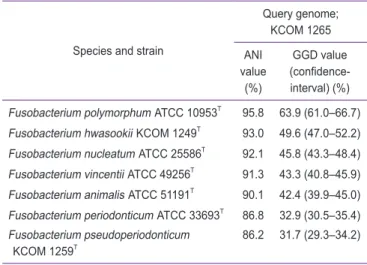
KCOM 1265 균주 지놈 핵산염기서열을 바탕으로 종-수준으로 동정 하기 위해 ANI와 GGD 분석을 한 결과, KCOM 1265 지놈과 F. poly- morphum ATCC 10953
T
지놈 간의 ANI 값이 95.8%였으며, GGD 값은 63.9% (61.0–66.7%)였다. 반면에 KCOM 1265 균주와 다른 Fusobacterium 종들의 표준균주들과의 ANI 또는 GGD 값들이 각각 93.0% 이하 및 49% (47.0–52.2%) 이하였다(Table 2).Discussion Discussion
본 연구 결과, KCOM 1265 균주는 16S rDNA 염기서열비교법 및 지놈 핵산염기서열 상동성 분석법인 ANI와 GGD 분석법에 의해 F.
polymorphum인 것으로 동정되었다.
세균의 종-수준에서의 동정에 있어서 16S rDNA 염기서열비교법 분 석에서 대상 세균 종의 표준균주의 것과 상동성도 중요하지만, 계통수 (phylogenetic tree)에서 같은 분지에 속하고, 분지간의 브스트랩 값 (bootstrap value)도 중요하다. 본 연구에서 KCOM 1265 균주의 16S rDNA 핵산염기서열은 F. polymorphum ATCC 10953
T
와 같은 분지 (cluster)를 형성하면서, 브스트랩 값이 64였다. 이러한 브스트랩 값 은 1,000번(브스트랩 값 구할 때 설정함) 반복하여 계통수를 만들 때,Strain 1 2 3 4 5 6 7 8 9 10 11
1 2 3 4 5 6 7 8 9 10 11
98.7 98.8 99.6 98.8 99.6 98.5 98.2 99.2 98.7 97.8 100 97.3 97.4 98.0 98.3 97.9 98.0 98.1 98.0 98.0 100 98.1 98.3 98.7 98.8 98.7 99.4 98.4 98.8 100 98.4 98.6 99.1 99.2 99.0 98.6 98.3 100 97.8 97.9 98.4 98.5 98.1 98.4 100 98.0 98.1 98.6 98.6 98.5 100 98.9 98.9 99.4 98.8 100 98.5 98.5 98.9 100 99.0 99.1 100 99.5 100
100 Fig. 1. Percent similarity of 16S ribosomal
RNA genes between among strain KCOM 1265 and closely related type strains of Fu- sobacterium spp. Multiple sequences were aligned using the CLUSTAL W algorithm and sequence similarities were calculated using the MegAlign program (DNAStar Lasergene TM 8.0; DNAStar Inc., Madison, WI, USA) [16].
Strains: 1, Fusobacterium pseudoperiodon-
ticum KCOM 1259 T ; 2, Fusobacterium peri-
odonticum ATCC 33693 T ; 3, Fusobacterium
hwasookii KCOM 1249 T ; 4, Fusobacterium
nucleatum ATCC 25586 T ; 5, Fusobacterium
polymorphum ATCC 10953 T ; 6, Fusobacte-
rium vincentii ATCC 49256 T ; 7, Fusobacterium
animalis ATCC 51191 T ; 8, Fusobacterium
canifelinum RMA 1036 T ; 9, Fusobacterium
naviforme DSM 20699 T ; 10, Fusobacterium
simiae ATCC 33568 T ; 11, strain KCOM 1265.
KCOM 1265 균주와 F. polymorphum ATCC 10953
T
균주가 같은 분 지를 형성을 확률이 64%라는 의미이며, 이는 계통수가 얼마나 안정한 가를 의미한다. 통상 브스트랩 값이 60% 이상인 분지는 안정하다고 판 정된다. 하지만, 이러한 KCOM 1265의 16S rDNA 핵산염기서열이 F.hwasookii KCOM 1249
T
와 F. polymorphum ATCC 10953T
균주들 의 것과 모두 99.6%라는 높은 상동성을 보이기 때문에, 16S rDNA 핵 산염기서열 비교분석만으로는 KCOM 1265를 종-수준으로 동정할 수 는 없다고 판단되었다.위와 같은 이유로, 균주 지놈 핵산염기서열 상동성 분석법인 ANI와 GGD 분석법을 이용하여 KCOM 1265 균주의 종-수준에서의 동정을 시도하였다. 어떤 균주와 특정 표적 세균 종 표준균주 간의 ANI 또는 GGD 값이 각각 95–96% 및 70% 이상이면, 그 균주는 표적 세균 종 으로 판정이 된다[24,25]. 본 연구 결과 KCOM 1265와 F. polymor- phum ATCC 10953
T
균주 간의 ANI 값은 같은 종으로 분류하는 기준점에 합당하였지만, GGD 값은 이에 약 6.1% 미치지 못하였다. 이런 경우, 두 균주 간의 16S rDNA 핵산염기서열의 상동성이 98.7% 이상 이면 같은 종으로 판단된다[26]. 최근 16S rDNA 핵산염기서열 비교 분석법에 따라 Fusobacterium periodonticum으로 분류되었던 14 개 균주가 ANI 또는 GGD 분석을 통해 Fusobacterium pseudoperi- odonticum으로 재분류 되었던 연구에서 그 예를 찾아볼 수 있다[26].
그 연구에서 14개 균주의 16S rDNA 상동성은 99.3–100%였으며, ANI 값은 95.3–96.3%였지만, GGD 값은 61.6–72.5%였다[26].
세균 종-수준에서의 분류에 있어서 16S rDNA 핵산염기서열은 약 1.5 kpb 정도여서 지놈 핵산염기서열(약 2,000 kpb 이상)에 비해 핵 산염기서열 크기가 매우 작고, ANI 및 GGD 분석법도 핵산염기서열 의 상동성 분석이 기반인 점을 감안할 때, 16S rDNA 핵산염기서열 비 교분석법이 무시될 수 있다. 하지만, 16S rDNA 핵산염기서열 비교분 석법은 아직 세균 종 분류에 있어서 황금 기준의 하나로 사용되고 있 다. 그 이유 중 하나는 세균의 진화 과정에 있어서, 16S rDNA 핵산염 기서열이 같은 세균 종 간에 보존성이 매우 뛰어나기 때문이다. 그러므 로, 두 세균 균주 간의 ANI 또는 GGD 값이 각각의 종-수준으로 분류 하는 기준값보다 크다고 하더라도, 16S rDNA 핵산염기서열의 상동성 이 97% 이하라면, 같은 종이라 할 수 없다[27]. 이해 해당하는 세균 종 이 Streptococcus periodonticum이다[27]. 한국인의 구강에서 분리 된 ChDC F135 (= KCOM 2412) 균주는 Streptococcus anginosus 표준균주(NCTC 10713
T
)의 지놈 핵산염기서열과 ANI 값이 95.6%였 지만, 16S rDNA 핵산염기서열과의 상동성이 95.7%였기 때문에 신종 (Streptococcus periodonticum)으로 분류되었다. 즉, 세균의 종-수 준으로의 동정에 있어서, 두 균주 간의 16S rDNA 핵산염기서열 비교 분석법과 지놈 핵산염기서열을 이용한 ANI 또는 GGD 분석법 결과가 모두 일치하여만, 그들이 같은 세균 종이라고 판정할 수 있다.이상의 결과를 요약하면, KCOM 1265 균주는 F. polymorphum ATCC 10953
T
의 16S rDNA 핵산염기서열과 99.6%의 상동성을, F.polymorphum ATCC 10953
T
의 지놈 핵산염기서열과 95.8%의 ANI 값을 보였기에 F. polymorphum인 것으로 판단된다.F. pseudoperiodonticum KCOM 1259 (FJ471665)
TF. periodonticum ATCC 33693 (GQ301043)
TF. hwasookii KCOM 1249 (FJ471641)
TKCOM 1265 (MK788222)
F. polymorphum ATCC 10953 (GQ301039)
TF. canifelinum RMA 1036 (AY162221)
TF. nucleatum ATCC 25586 (GQ301038)
TF. vincentii ATCC 49256 (GQ301040)
TF. naviforme DSM 20699 (AJ006965)
TF. animalis ATCC 51191 (GQ301042)
TF. simiae ATCC 33568 (M58685)
T77
54
53
64
87
41
100
0.002
99
Fig. 2. Neighbor-joining phylogenetic tree based on 16S ribosomal RNA genes (16S rDNA) of strain KCOM 1265 and closely related type strains of Fusobacterium spp.
GenBank accession numbers of 16S rDNA of strains were written in parentheses. Stabil- ity of phylogenetic trees was assessed by bootstrap analysis of 1,000 replicates using MEGA version 6.06 [19]. Bar indicates 0.002 changes per nucleotide position.
Table 2. Results of average nucleotide identity (ANI) and genome- to-genome distance (GGD) analyses of strain KCOM 1265 and closely related type strains of Fusobacterium spp.
Species and strain
Query genome;
KCOM 1265 ANI
value (%)
GGD value (confidence- interval) (%) Fusobacterium polymorphum ATCC 10953 T 95.8 63.9 (61.0–66.7) Fusobacterium hwasookii KCOM 1249 T 93.0 49.6 (47.0–52.2) Fusobacterium nucleatum ATCC 25586 T 92.1 45.8 (43.3–48.4) Fusobacterium vincentii ATCC 49256 T 91.3 43.3 (40.8–45.9) Fusobacterium animalis ATCC 51191 T 90.1 42.4 (39.9–45.0) Fusobacterium periodonticum ATCC 33693 T 86.8 32.9 (30.5–35.4) Fusobacterium pseudoperiodonticum
KCOM 1259 T 86.2 31.7 (29.3–34.2)
Acknowledgements Acknowledgements
This study was supported by research fund from Chosun University (2019).
Conflicts of Interest Conflicts of Interest
No potential conflict of interest relevant to this article was reported.