우리나라 천문동 개체군의 생태 특성
추병길·지윤의·문병철·윤태숙·이아영·천진미·김호경†
한국한의학연구원
Ecological Characteristics of the Asparagus cochinchinensis (Lour.) Merr.
Population in South Korea
Byung Kil Choo, Yunui Ji, Byeong Cheol Moon, Tae Sook Yoon, A Yeong Lee, Jin Mi Chun, and Ho Kyoung Kim
†Korea Institute of Oriental Medicine, Daejeon Expo street 483, Korea.
ABSTRACT : This study was carried out to investigate the distribution of native Asparagus cochinchinensis and ecological characteristic in South Korea. Natural vegetative areas were investigated at 5 areas; Taean, Buan, Geoje, Namhae and Jindo. In this study, the 5 m × 5 m quadrat was established for recording coverage and appearance species by phytosocio- logical method. The flora of the studied area in native habitats were listed as 130 species. The native habitats was classified into Pinus thunbergii community and typical community . Two communities were located in a coastal cliff and have been destroyed. Therefore Asparagus cochinchinensis native habitats must be protected by regulation. In the studied sites, soil pH, organic matter, nitrogen, available phosphorus, exchangeable K, exchangeable Ca, exchangeable Mg and cation exchange capacity were ranged from 5.1~5.7%, 1.77~3.59%, 0.19~0.54%, 5.4~18.7 ( ㎎ / ㎏ ), 0.24~0.48 (c ㏖ +/ ㎏ ) 0.76~2.83 (c ㏖ +/ ㎏ ), 3.11~6.22 (c ㏖ +/ ㎏ ) and 8.7~24.5 (c ㏖ +/ ㎏ ), respectively.
Key Words : Asparagus cochinchinensis, Ecological Characteristic.
서 론
한약재 천문동 ( 天門冬 , Asparagi Tuber) 은 백합과 (Liliaceae)
비짜루속 ( Asparagus ) 에 속하는 다년생 초본인 천문동
( Asparagus cochinchinensis (Lour.) Merr.) 의 괴근으로 , 대한 약전에 수재된 한약으로써 자음 ( 滋陰 ), 윤조 ( 潤燥 ), 청폐 ( 淸
肺 ), 생진 ( 生津 ) 등의 효능이 있어 호흡기질환과 피부질환에
주로 사용되고 (Cooperation teaching materials compilation committee, 2005), 민속주 ( 民俗酒 ) 의 부원료로도 이용이 가능 한 약재이다 (Park and Lee , 2000). 원산지는 중국이며 한반 도 중부 이남의 바닷가에 분포하는데 , 중국 자생종의 종자가 해류에 밀려와 우리나라의 해안가에 군락을 이루는 것으로 추 정되며 (Kim et al. , 2003), 분자생물학적 실험에 의해 간접적
으로 입증되고 있다 (Moon et al ., 2008; Kang et al ., 2002).
천문동은 중국에서는 한자로 ‘ 天 冬 ’ 으로 , 가시가 있는 외 형에서 붙여진 이름인데 (Chinese medicinal plants compi- lation committee, 1999), 이것이 민간에서 ‘ 하늘의 문을 열어 주는 약초 ’ 로 와전되어 신비의 영약인 것처럼 잘못 알려지게 되었다 . 현재 무분별한 채취로 인해 국내 자생지는 거의 사라
지다시피 하여 멸종위기에 처해 있다 . 한편 한방의료기관에서 의 사용량은 비슷한 약효를 가진 맥문동 ( 麥門冬 ) 에 비해 적 은편이며 (Ju, 2004), 국내 재배 실적이 없어 전량을 중국에서 수입하고 있다 .
식물은 종류에 따라 생육에 적합한 환경조건 , 즉 해발고 , 방 위 , 경사 , 주변식생과 같은 생육환경이 적절한 장소에서만 자
생하기 때문에 , 약재 채취로 인해 점차 줄어드는 천문동 자생
지에 대한 관심과 보호가 필요하다 . 따라서 문화적 , 경제적 , 보 건적인 가치가 큰 유용한 식물인 천문동 자생지의 보전 및 지 속적 이용을 위해서는 자생지 환경조건의 생태적 특성을 이해 하는 것이 무엇보다 중요하다 . 그러므로 천문동 자생지의 분 포 실태와 생태적인 특성 연구를 통해 천문동 보전 및 약용작 물로 재배를 위한 과학적인 정보를 제공하고자 본 연구를 수 행하였다 .
재료 및 방법
1. 조사지 선정
천문동의 자생지 조사는 기존의 문헌과 국가식물종지식정보
†
Corresponding author: (Phone) +82-42-868-9502 (E-mail) [email protected]
Received February 5, 2009 / Revised February 24, 2009 / Accepted March 24, 2009
시스템의 표본정보를 토대로 천문동 자생 가능 지역의 현지답 사를 통하여 내륙의 해안선을 위주로 2007 년 6 월부터 11 월까
지 조사를 실시하였다 . 총 11 개 지역에서 분포를 확인하였으 나 단생하거나 군도가 낮아 조사대상에서 제외하였고 , 5 개 지 역의 우량군집에서 조사구를 선정하여 조사하였다 (Fig. 1).
2. 식생조사
5 m × 5 m 크기의 방형구 총 21 개를 설치하여 Braun- Blanquet (1964) 의 7 단계 구분을 변형한 9 단계 구분 (Dierssen, 1990) 을 적용하여 조사하였다 . 식물사회학적 조사를 위해 방 형구 내의 식생을 교목층 , 아교목층 , 관목층 , 초본층으로 나누 어 출현종과 피도를 기록하였고 , 상층목의 평균수고를 측정하 였다 . 또한 환경요인인 해발고 , 방위 , 경사를 측정하였다 . 식생 조사에서 얻어진 자료는 Ellenberg (1956) 의 표작성법에 따라 식생단위를 분류하였고 , 2 개 지역에서의 군락 종단면도를 작
성하였다 . 식물종에 대한 식물명과 학명의 기재는 대한식물도
감에 준했다 (Lee, 2003).
3. 토양분석
자생지 군락에서 각 1 개씩 총 5 개의 토양을 깊이 0~20 ㎝
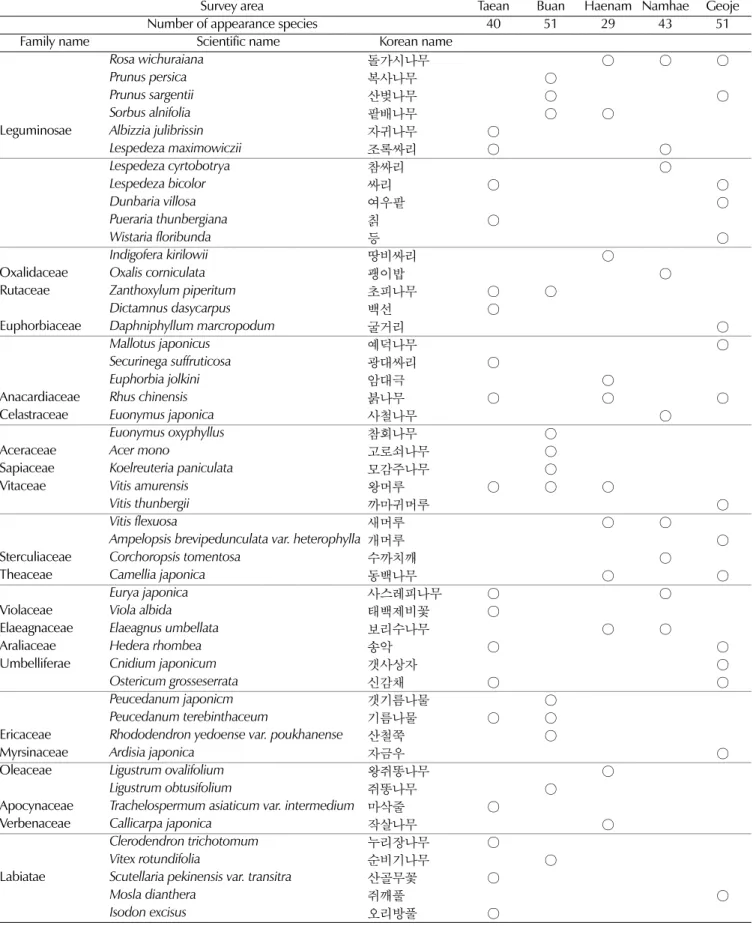
Table 1.Vegetation table of native habitate Asparagus cochinchinensis.
Survey area Taean Buan Haenam Namhae Geoje
Number of appearance species 40 51 29 43 51
Family name Scientific name Korean name
Pteridaceae Pteridium aquilinum var. latiusculum
고사리 ○Pinaceae Pinus koraiensis
잣나무 ○Pinus thunbergii
곰솔 ○ ○ ○ ○Juglandaceae Platycarya strobilacea
굴피나무 ○Betulaceae Carpinus turczaninowii
소사나무 ○ ○ ○Fagaceae Quercus variabilis
굴참나무 ○ ○ ○Quercus dentata
떡갈나무 ○ ○Quercus mongolica
신갈나무 ○ ○Quercus serrata
졸참나무 ○ ○ ○Moraceae Cudrania tricuspidata
꾸지뽕나무 ○ ○Morus alba
뽕나무 ○Urticaceae Boehmeria pannosa
왕모시풀 ○Polygonales Fallopia dumetora
닭의덩굴 ○Persicaria senticosa
며느리밑씻게 ○Chenopodiaceae Chenopodium album var. centrorubrum
명아주 ○Phytolaccaceae Phytolacca americana
미국자리공 ○Ranunculaceae Clematis mandshurica
으아리 ○ ○ ○Thalictrum filamentosum
산꿩의다리 ○Menispermaceae Cocculus triobus
댕댕이덩굴 ○ ○ ○ ○Lauraceae Lindera obtusiloba
생강나무 ○Crassulaceae Sedium erythrostichum
꿩의비름 ○Pittosporaceae Pittosporum tobira
돈나무 ○ ○Rosaceae Rubus parvifolius
멍석딸기 ○ ○ ○Rubus oldhamii
줄딸기 ○Rosa multiflora
찔레 ○ ○Fig. 1.
Survey area of native habitate
Asparagus cochinchinensis.
Table 1.
Continued.
Survey area Taean Buan Haenam Namhae Geoje
Number of appearance species 40 51 29 43 51
Family name Scientific name Korean name
Rosa wichuraiana
돌가시나무 ○ ○ ○Prunus persica
복사나무 ○Prunus sargentii
산벚나무 ○ ○Sorbus alnifolia
팥배나무 ○ ○Leguminosae Albizzia julibrissin
자귀나무 ○Lespedeza maximowiczii
조록싸리 ○ ○Lespedeza cyrtobotrya
참싸리 ○Lespedeza bicolor
싸리 ○ ○Dunbaria villosa
여우팥 ○Pueraria thunbergiana
칡 ○Wistaria floribunda
등 ○Indigofera kirilowii
땅비싸리 ○Oxalidaceae Oxalis corniculata
괭이밥 ○Rutaceae Zanthoxylum piperitum
초피나무 ○ ○Dictamnus dasycarpus
백선 ○Euphorbiaceae Daphniphyllum marcropodum
굴거리 ○Mallotus japonicus
예덕나무 ○Securinega suffruticosa
광대싸리 ○Euphorbia jolkini
암대극 ○Anacardiaceae Rhus chinensis
붉나무 ○ ○ ○Celastraceae Euonymus japonica
사철나무 ○Euonymus oxyphyllus
참회나무 ○Aceraceae Acer mono
고로쇠나무 ○Sapiaceae Koelreuteria paniculata
모감주나무 ○Vitaceae Vitis amurensis
왕머루 ○ ○ ○Vitis thunbergii
까마귀머루 ○Vitis flexuosa
새머루 ○ ○Ampelopsis brevipedunculata var. heterophylla
개머루 ○Sterculiaceae Corchoropsis tomentosa
수까치깨 ○Theaceae Camellia japonica
동백나무 ○ ○Eurya japonica
사스레피나무 ○ ○Violaceae Viola albida
태백제비꽃 ○Elaeagnaceae Elaeagnus umbellata
보리수나무 ○ ○Araliaceae Hedera rhombea
송악 ○ ○Umbelliferae Cnidium japonicum
갯사상자 ○Ostericum grosseserrata
신감채 ○ ○Peucedanum japonicm
갯기름나물 ○Peucedanum terebinthaceum
기름나물 ○ ○Ericaceae Rhododendron yedoense var. poukhanense
산철쭉 ○Myrsinaceae Ardisia japonica
자금우 ○Oleaceae Ligustrum ovalifolium
왕쥐똥나무 ○Ligustrum obtusifolium
쥐똥나무 ○Apocynaceae Trachelospermum asiaticum var. intermedium
마삭줄 ○Verbenaceae Callicarpa japonica
작살나무 ○Clerodendron trichotomum
누리장나무 ○Vitex rotundifolia
순비기나무 ○Labiatae Scutellaria pekinensis var. transitra
산골무꽃 ○Mosla dianthera
쥐깨풀 ○Isodon excisus
오리방풀 ○Table 1.
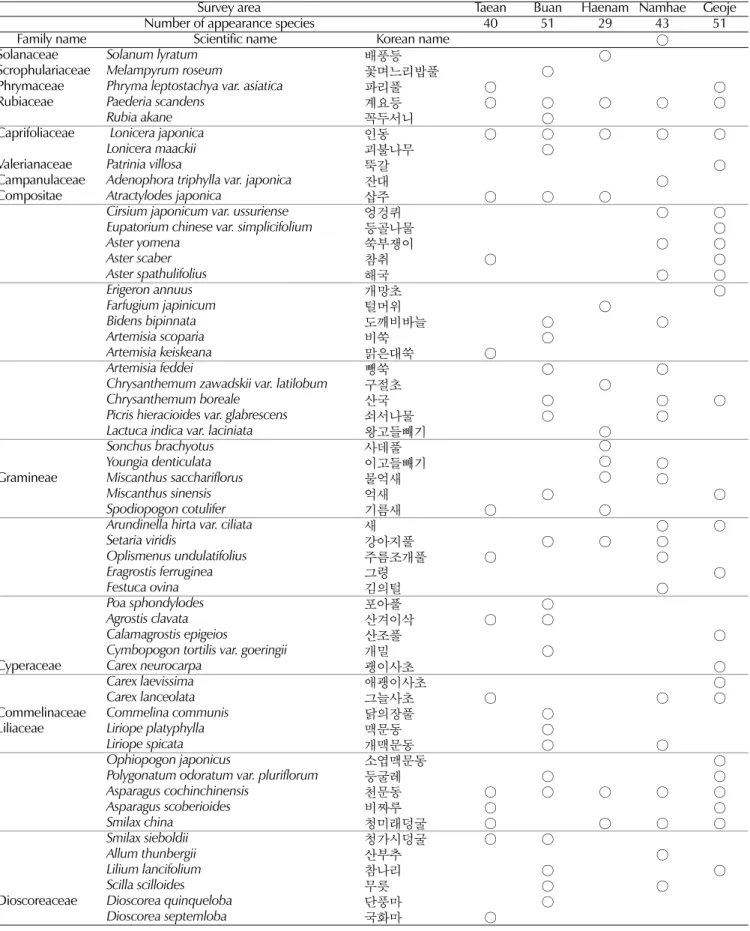
Continued.
Survey area Taean Buan Haenam Namhae Geoje
Number of appearance species 40 51 29 43 51
Family name Scientific name Korean name
○Solanaceae Solanum lyratum
배풍등 ○Scrophulariaceae Melampyrum roseum
꽃며느리밥풀 ○Phrymaceae Phryma leptostachya var. asiatica
파리풀 ○ ○Rubiaceae Paederia scandens
계요등 ○ ○ ○ ○ ○Rubia akane
꼭두서니 ○Caprifoliaceae Lonicera japonica
인동 ○ ○ ○ ○ ○Lonicera maackii
괴불나무 ○Valerianaceae Patrinia villosa
뚝갈 ○Campanulaceae Adenophora triphylla var. japonica
잔대 ○Compositae Atractylodes japonica
삽주 ○ ○ ○Cirsium japonicum var. ussuriense
엉겅퀴 ○ ○Eupatorium chinese var. simplicifolium
등골나물 ○Aster yomena
쑥부쟁이 ○ ○Aster scaber
참취 ○ ○Aster spathulifolius
해국 ○ ○Erigeron annuus
개망초 ○Farfugium japinicum
털머위 ○Bidens bipinnata
도깨비바늘 ○ ○Artemisia scoparia
비쑥 ○Artemisia keiskeana
맑은대쑥 ○Artemisia feddei
뺑쑥 ○ ○Chrysanthemum zawadskii var. latilobum
구절초 ○Chrysanthemum boreale
산국 ○ ○ ○Picris hieracioides var. glabrescens
쇠서나물 ○ ○Lactuca indica var. laciniata
왕고들빼기 ○Sonchus brachyotus
사데풀 ○Youngia denticulata
이고들빼기 ○ ○Gramineae Miscanthus sacchariflorus
물억새 ○ ○Miscanthus sinensis
억새 ○ ○Spodiopogon cotulifer
기름새 ○ ○Arundinella hirta var. ciliata
새 ○ ○Setaria viridis
강아지풀 ○ ○ ○Oplismenus undulatifolius
주름조개풀 ○ ○Eragrostis ferruginea
그령 ○Festuca ovina
김의털 ○Poa sphondylodes
포아풀 ○Agrostis clavata
산겨이삭 ○ ○Calamagrostis epigeios
산조풀 ○Cymbopogon tortilis var. goeringii
개밀 ○Cyperaceae Carex neurocarpa
괭이사초 ○Carex laevissima
애괭이사초 ○Carex lanceolata
그늘사초 ○ ○ ○Commelinaceae Commelina communis
닭의장풀 ○Liliaceae Liriope platyphylla
맥문동 ○Liriope spicata
개맥문동 ○ ○Ophiopogon japonicus
소엽맥문동 ○Polygonatum odoratum var. pluriflorum
둥굴레 ○ ○Asparagus cochinchinensis
천문동 ○ ○ ○ ○ ○Asparagus scoberioides
비짜루 ○ ○Smilax china
청미래덩굴 ○ ○ ○ ○Smilax sieboldii
청가시덩굴 ○ ○Allum thunbergii
산부추 ○Lilium lancifolium
참나리 ○ ○Scilla scilloides
무릇 ○ ○Dioscoreaceae Dioscorea quinqueloba
단풍마 ○Dioscorea septemloba
국화마 ○에서 채취하였으며 , 채취한 토양은 자연건조한 후 토양의 화
학적 특성을 분석하였다 (Rural Development Administration, 2000). 토양 중 유기물 함량은 Wakely-Black wet oxidation 법 으로 분석하였고 토성은 hydrometer 법을 이용하여 sand, silt, clay 의 비율을 구한 후 미농무성법에 의해 분류하였다 . 토양
pH 는 1 : 5 로 분석하였고 , 전질소함량은 micro-kjeldahl 법으로 ,
치환성 K, Ca, Mg 그리고 Na 는 1 M ammonium acetate 로 침출시킨 후 ICP 를 이용하여 분석한 후 치환성산도와 함께 양
이온치환용량 (CEC) 을 구하였다 . 유효인산은 Lancaster 법으로
분석하였다 .
결과 및 고찰
1. 식물상
천문동군락이 분포하는 지역의 식물상을 조사한 결과 , 50 과 104 속 116 종 14 변종으로 총 130 종이 출현하였다 (Table 1).
출현종 중 목본식물 (Woody plants) 은 곰솔나무 , 굴참나무 , 신 갈나무 , 소사나무 등 47 종이었고 , 초본식물 (Herbaceous plants) 은 83 종이 조사되었다 . 초본식물 중 약용식물로 이용 되 는 삽주 , 백선 , 구절초 등이 출현하였고 , 해식애 (sea cliff) 에 군락을 이루며 자라는 갯기름나물 (Kim et al ., 2006) 은 부안 지역에서만 출현하였다 . 천문동 자생지에 대한 기존의 연구 (Kim et al. , 2003) 에서 북한계는 충남 보령군 남포면 월전리 죽도 , 동한계는 경남 사천시 실안동 강포 (Kim and Shin ,
1992) 였고 , 동해안에서는 발견할 수 없다고 하였다 . 그러나 본 조사 결과 서해안의 충남 태안군 안면읍 승언리 , 남해안의 경 남 거제시 남부면 갈곶리에서 군락지를 발견하였으며 , 동해안 에서는 기존의 연구와 마찬가지로 발견하지 못하였다 . 본 조 사지역 중 전북 부안군 계화면 계화리에서 군락지가 많이 발 견되었고 , 분포면적이 가장 넓었으며 , 경남 남해군 자생지에서
는 다른 지역의 자생지에 비하여 군도가 높게 조사되었다
(Table 2).
2. 군락분류
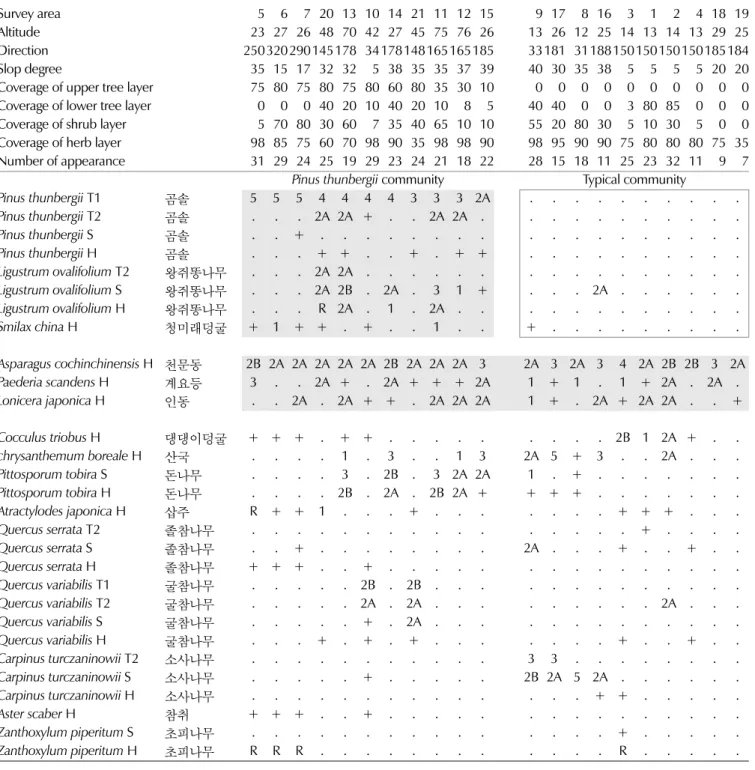
태안 , 부안 , 진도 , 남해 , 거제 지역의 5 개 조사지역에서 총
21 개 방형구를 가지고 표조작법에 의하여 천문동 자생지의 군
락을 분류한 결과 , 내륙해안에 분포하는 천문동은 해안절벽의 곰솔군락 ( Pinus thunbergii community) 에서 자생하거나 상층 임관이 형성되지 않은 해안절벽 및 급경사 암각지의 전형군락
(Typical community) 에 분포하는 것으로 나타났고 (Table 3),
대부분의 조사구에서 계요등과 인동덩굴이 출현하였다 . 곰솔
군락에서 수반종으로 왕쥐똥나무와 청미래덩굴이 출현하였고 ,
평균해발고 44 m, 방위 187
o해발고가 낮은 남사면에 주로 군 락을 형성하고 있었다 . 각 층위별 평균피도율을 살펴보면 교 목층에서 62%, 아교목층에서 14%, 관목층에서 37% 로 천문동 이 곰솔 군락 내에 있다고 하더라도 율폐도가 낮은 지역에 분 포하고 있었다 . 반면 초본층의 피도율은 82% 로 비교적 높아 다른 종들과의 경쟁관계에 있는 것으로 사료되며 , 차후 교목
층 및 아교목층의 피도가 높아 임내로 들어오는 광량이 줄어 들면 천문동은 경쟁에서 도태될 것으로 판단된다 . 전형군락에 서 평균해발고는 20 m 로 곰솔군락보다 낮았고 , 방위는 진도의 북사면에 위치하는 자생지를 제외하고는 남사면에 분포하고 있었다 . 층위별 평균피도율은 아교목층에서 25%, 관목층에서
24%, 초본층에서 80% 로 조사되었다 .
3. 군락분포
천문동은 중국이 분포의 중심지로 알려져 있으며 , 중국본초 도감 (1999) 에서는 분포지역을 중국의 하북성 , 산서성 , 섬서성 ,
감숙성과 대만 등에서 자생하고 있으며 , 귀주성 , 광서성 및 운 남성에서 재배되고 있다고 명시되어 있다 . 우리나라에서는 서 해안과 남해안에 분포하고 동해안에는 군락지를 발견하지 못 하였다 . 천문동이 자생하는 곰솔군락은 방풍림 조성수종으로 1973 년에 시작된 치산녹화사업으로 조림되었고 , 현재 30 년이 넘는 장령림에 속한다 . 즉 , 천문동이 곰솔군락내에 정착하는 데는 30 년이 안 되는 비교적 짧은 시간이라는 것을 추정할 수 있다 . 정상천이의 생태천이 과정을 보면 , 민들레 , 엉겅퀴 , 털머 위와 같은 풍산포 종자를 가지고 있는 식물이 먼저 정착하고 후에 중력형 종자를 가지고 있는 천문동이나 , 계요등과 같은 식물이 정착하게 된다 (Jang, 2002). 또한 천문동은 생육특성
상 발아한 후 수년이 지나야 결실을 하게 되며 , 천문동 신초
의 경우 23~25 ℃의 따뜻한 온도에서 기내생장이 양호하였다
고 보고하였는데 (Choo et al ., 2005), 본 조사에서도 숲에 있 는 천문동보다는 온도조건이 유리한 해발이 낮고 , 해안에 더 가까이 있는 단애지의 초본군락에 분포하는 천문동이 개화·
결실한 식물체의 수가 많은 것을 확인 할 수 있었다 . 이를 종 합하여 보면 , 중국 내륙에서 자생하고 있는 천문동의 종자가
해류에 밀려와 우리나라의 서해와 남해의 해안가 암석지에 군 락을 형성하게 되고 , 토양환경이 비교적 양호한 숲 내로 이동 정착하는 것으로 판단된다 .
한국식생분류유형은 49 개 상관식생형으로 구분하였는데
Table 2.Distribution area and sociability of survey area
.(Unit : ha)
Taean Buan Jindo Namhae Geoje
Distribution area 0.08 1.09 0.01 0.30 0.01
Sociability 2 2 1 3 1
(Kim and Lee, 2006), 천문동 자생지는 해안단애지초본군락
(Annual communities on coastal cliff) 형과 , 해안단애지산림식
생 (Forest vegetation on coastal cliff) 형으로 분류할 수 있으 며 (Fig. 2), 태안을 제외한 조사지역에서 각각 두 가지 상관 식생형이 모두 나타났다 .
천문동은 해류에 의한 식물전파경로를 아는 데 매우 중요한
지표식물이며 , 약용식물로도 이용 가치가 높다고 판단된다 . 그 러나 재배농가의 부재로 자생 천문동 뿌리가 대량으로 남획·
유통되고 있고 해안가의 개발로 자생지가 소멸되어가고 있는 실정이다 . 따라서 약용식물로 이용 가능성이 큰 천문동의 지 속적 이용을 위해서는 심하게 훼손된 자생지를 복원하거나 현 존하는 자생지를 보전 할 필요성이 있다고 판단된다 .
Table 3.
Vegetation table of plant community in native habitate Asparagus cochinchinensis.
Survey area 5 6 7 20 13 10 14 21 11 12 15 9 17 8 16 3 1 2 4 18 19
Altitude 23 27 26 48 70 42 27 45 75 76 26 13 26 12 25 14 13 14 13 29 25
Direction 250320290145178 34178148165165185 33181 31188150150150150185184
Slop degree 35 15 17 32 32 5 38 35 35 37 39 40 30 35 38 5 5 5 5 20 20
Coverage of upper tree layer 75 80 75 80 75 80 60 80 35 30 10 0 0 0 0 0 0 0 0 0 0 Coverage of lower tree layer 0 0 0 40 20 10 40 20 10 8 5 40 40 0 0 3 80 85 0 0 0 Coverage of shrub layer 5 70 80 30 60 7 35 40 65 10 10 55 20 80 30 5 10 30 5 0 0 Coverage of herb layer 98 85 75 60 70 98 90 35 98 98 90 98 95 90 90 75 80 80 80 75 35 Number of appearance 31 29 24 25 19 29 23 24 21 18 22 28 15 18 11 25 23 32 11 9 7
Pinus thunbergii community Typical community
Pinus thunbergii T1
곰솔5 5 5 4 4 4 4 3 3 3 2A . . . .
Pinus thunbergii T2
곰솔. . . 2A 2A + . . 2A 2A . . . . .
Pinus thunbergii S
곰솔. . + . . . . . . . .
Pinus thunbergii H
곰솔. . . + + . . + . + + . . . .
Ligustrum ovalifolium T2
왕쥐똥나무. . . 2A 2A . . . . . . . .
Ligustrum ovalifolium S
왕쥐똥나무. . . 2A 2B . 2A . 3 1 + . . . 2A . . . .
Ligustrum ovalifolium H
왕쥐똥나무. . . R 2A . 1 . 2A . . . . . .
Smilax china H
청미래덩굴+ 1 + + . + . . 1 . . + . . . .
Asparagus cochinchinensis H
천문동2B 2A 2A 2A 2A 2A 2B 2A 2A 2A 3 2A 3 2A 3 4 2A 2B 2B 3 2A
Paederia scandens H
계요등3 . . 2A + . 2A + + + 2A 1 + 1 . 1 + 2A . 2A .
Lonicera japonica H
인동. . 2A . 2A + + . 2A 2A 2A 1 + . 2A + 2A 2A . . +
Cocculus triobus H
댕댕이덩굴+ + + . + + . . . . . . . . . 2B 1 2A + . .
chrysanthemum boreale H
산국. . . . 1 . 3 . . 1 3 2A 5 + 3 . . 2A . . .
Pittosporum tobira S
돈나무. . . . 3 . 2B . 3 2A 2A 1 . + . . . .
Pittosporum tobira H
돈나무. . . . 2B . 2A . 2B 2A + + + + . . . .
Atractylodes japonica H
삽주R + + 1 . . . + . . . . . . . + + + . . .
Quercus serrata T2
졸참나무. . . . . . . + . . . .
Quercus serrata S
졸참나무. . + . . . . 2A . . . + . . + . .
Quercus serrata H
졸참나무+ + + . . + . . . . . . . . .
Quercus variabilis T1
굴참나무. . . 2B . 2B . . . . . . .
Quercus variabilis T2
굴참나무. . . 2A . 2A . . . . . . 2A . . .
Quercus variabilis S
굴참나무. . . + . 2A . . . . . . .
Quercus variabilis H
굴참나무. . . + . + . + . . . . . . . + . . + . .
Carpinus turczaninowii T2
소사나무. . . . 3 3 . . . .
Carpinus turczaninowii S
소사나무. . . + . . . . . 2B 2A 5 2A . . . .
Carpinus turczaninowii H
소사나무. . . . . . . + + . . . . .
Aster scaber H
참취+ + + . . + . . . . . . . . .
Zanthoxylum piperitum S
초피나무. . . . . . . . + . . . . .
Zanthoxylum piperitum H
초피나무R R R . . . . . . . . R . . . . .
4. 토양분석
천문동 자생지에서 토양 pH 는 5.1~5.7% 로 자생지별 유의적 인 차가 나타나지 않았으며 우리나라 산림토양의 평균값인
5.48 (Jeong et al., 2002) 과 비슷한 약산성토양으로 조사되었 다 . 유기물함량은 식물이 필요한 대부분의 질소와 , 유효인산
50~60% 를 공급 및 양이온치환용량의 개선 등 토양특성에 가
장 영향을 미치는 요인이다 (Brand, 1990). 자생지별 유기물 함량은 1.77~3.59% 로 우리나라 일반적인 산림토양의 4.49%
(Jeong et al., 2002) 에 비해 낮은 편이었으며 이는 자생지가 해안절벽의 곰솔군락 ( Pinus thunbergii community) 이나 상층 임관이 형성되지 않은 해안절벽 및 급경사 암각지에 분포하고 있는 비교적 척박한 토양환경 때문이라고 판단되는데 곰솔군 락지인 부안이 유기물함량이 3.59% 로 가장 높았고 자생지가 척박한 해안 암각지에 위치한 진도와 거제가 1.77%, 1.92% 로 낮은 수준이었다 . 전질소는 자생지별로 0.19~0.54%, 유효인산 은 5.4~18.7 ㎎ / ㎏으로 우리나라 산림토양의 평균값인 0.19%, 25.6 ㎎ / ㎏ (Jeong et al., 2002) 보다 낮았고 , 양이온치환용량 은 8.7~24.5 c ㏖ +/ ㎏으로 나타났다 . 토양 pH 와 상관관계가 있 는 치환성 양이온인 K, Na, Mg, Ca 의 양은 Ca > Mg > K >
Na 순이었다 . 토성은 사토 , 미사토 , 점토의 상대비율로 나타내 는 토성은 사양토 , 양토 , 식양토 등 자생지별로 차이를 보였다 .
자생지별 토양환경특성을 분석한 결과 전반적으로 우리나라
산림토양보다 비옥도가 낮은 곳에서 서식하고 있는 천문동은 우리나라 농가의 밭토양에서 약용작물로 재배하는데 어려움이 없을 것으로 판단된다 .
사 사
본 연구는 문화재청 국립문화재연구소의 ‘ 문화재보존기술연 구개발 (R&D) 사업 ( 과제번호 07F012Y-00110-2007)’ 의 지원 을 받았으며 , 일부는 교육과학기술부 ‘ 한의본초활용기반구축사 업 ’ 의 지원을 받아 수행되었습니다 .
LITERATURE CITED
Brand NC. (1990). The nature properties of soil. Macmillan Press.
New York. America. p. 621.
Braun-Blanquet J. ( 1964). Pflanzensoziologie : Grundzuge der Vegetationskunde. Springer-Verlag Press. New York. America.
p. 631.
Chinese medicinal plants compilation committee. (1999).
Chinese medicinal plants(8). Shanghai Scientific Technique Press. Shanghai, China. p. 63-69.
Choo BK, Kim DH, Jeong JR, Lim JR, Park CB, Ko BS and Ryu JH. (2005). In vitro growth of shoot derived from shoot tip in
Asparagus cochinchinensis(Lour.) Merr. Korean Journal
Fig. 2.
Profile diagram of native habitate
Asparagus cochinchinensis.Table 4.