[논 문] 한국재료학회지 DOI: 10.3740/MRSK.2010.20.7.370 Kor. J. Mater. Res.
Vol. 20, No. 7 (2010)
370
†Corresponding author
E-Mail : [email protected] (H. Kim)
Effect of Additives on the Refractive Index of B
2O
3-SiO
2-Al
2O
3Glasses for Photolithographic Process in Electronic Micro Devices
Juyeon Won*, Seongjin Hwang, Jungki Lee and Hyungsun Kim
†School of Materials Engineering, Inha University, 253 Younyun-dong, Nam-gu, Incheon 402-751, Korea
*Now she works at SSCP Co., Seongnam, Korea
(Received June 16, 2010 : Received in revised form June 28, 2010 : Accepted June 29, 2010)
Abstract In fabricating plasma display panels, the photolithographic process is used to form patterns of barrier ribs with high accuracy and high aspect ratio. It is important in the photolithographic process to control the refractive index of the photosensitive paste. The composition of this paste for photolithography is based on the B2O3-SiO2-Al2O3 glass system, including additives of alkali oxides and rare earth oxides. In this work, we investigated the density, structure and refractive index of glasses based on the B2O3-SiO2-Al2O3 system with the addition of Li2O, K2O, Na2O, CaO, SrO, and MgO. The refractive index of the glasses containing K2O, Na2O and CaO was similar to that of the [BO3] fraction while that of the SrO, MgO and Li2O containing glasses were not correlated with the coordination fraction. The coordination number of the boron atoms was measured by MAS NMR. The refractive index increased with a decrease of molar volume due to the increase in the number of non-bridging oxygen atoms and the polarizability. The lowest refractive index (1.485) in this study was that of the B2O3- SiO2-Al2O3-K2O glass system due to the larger ionic radius of K+. Based on our results, it has been determined that the refractive index of the B2O3-SiO2-Al2O3 system should be controlled by the addition of alkali oxides and alkali earth oxides for proper formation of the photosensitive paste.
Key words borosilicate glass, nuclear magnetic resonance, refractive index.
1. Introduction
In the display industry, many studies have recently been conducted to achieve full-high definition (HD) with plasma display panels (PDPs). Since the barrier ribs prevent crosstalk among the phosphors (RGB) and maintain the discharge space in PDPs. It is necessary for the barrier ribs to have a pattern with a high aspect ratio.2-3) The photolithographic process can be used to form patterns of barrier ribs with high accuracy and a high aspect ratio.
For the photolithographic process, it is necessary for the glass frits and organic components to have a similar refractive index. The refractive index of the glass frit should be in the range of 1.4~1.7 because the refractive index of the organic components is commonly in the range of 1.4~1.7. Therefore, it is important to make the glass frit have a lower refractive index, because most glasses have a high refractive index of more than 1.7.3) Moreover in photolithographic process the refractive index of the photosensitive paste is a significant factor for achieving high accuracy and a high aspect ratio because in order to reduce the degree of reflection and scattering during the exposure process.
The general composition used for the photolithographic process is based on the B2O3-SiO2-Al2O3 glass system, including additives such as alkali oxides (Li2O, Na2O, K2O) and alkali earth oxides (SrO, MgO, CaO).3) The refractive index and thermal properties of the glass system are changed by the addition of the alkali oxides and alkali earth oxides. These additives produce non-bridging oxygen in the glass network, causing its density to change. In addition to the change of the structural cross-link density, the refractive index, dielectric and thermal properties of the glass are correlated with the ionic radius and polarizability of the cations. There have been several studies of the B2O3- SiO2-Al2O3 glass system.4-7) As recently reported, the pro- perties of the glasses in the Na2O-Al2O3-B2O3-SiO2 system are also strongly affected by the concentrations of the main glass components.4) It has been shown that the chemical durability and activation energy are increased and the ionic conductivity decreased by the addition of MgO, CaO, BaO or ZnO to the Na2O-Al2O3-B2O3-SiO2 glass system.5) This is due to the strengthening of the glass network by the R2+
cations.6) Also, with increasing BaO content in the B2O3- Al2O3-SiO2 glass system, [BO3] gradually changes to [BO4], and [AlO5] and [AlO6] change to [AlO4].7) However, the relation between the network and structure of the glasses and their refractive index remains unclear, because previous studies were focused on the effect of the com-
Effect of Additives on the Refractive Index of BorateGlasses for Photolithographic Process 371
position on the individual properties.
In this work, we investigated the effect of the compos- ition of the B2O3-Al2O3-SiO2 glass system containing alkali and alkali earth oxides on its network and structure. We measured the density, and refractive index of this glass system, as well as the coordination number of boron atoms by MAS NMR, in order to show that the refractive index of the glass is correlated with the composition of the in glass, especially the amount of additives.
2. Experimental Procedure
In order to prepare the various batches of glass, high purity powders of B2O3, Al2O3, SiO2, Li2O, Na2O, K2O, MgO, CaO and SrO (99.9%, Aldrich, USA) were mixed.
We prepared six series of glass samples with various amounts of alkali and alkali earth oxides, which are referred to herein as BS, BK, BN, BC, BM and BL, respectively.
The compositions of the studied glasses are presented in Table 1. The raw materials were melted in a platinum crucible at 1200-1500oC. After heating them for 30 min in an electric furnace, the glass melts were quenched into a stainless roller to make glass cullets. To make bulk samples, the cullets were remelted in an electric furnace and then put into a square graphite mold and annealed for 1h at 465- 660oC. The density of the samples was measured using the Archimedes method at room temperature. In order to take into account the effect of the sample size and surface condition, the density was measured 5 times to obtain a mean value.
Using a multi-wavelength Abbe refractometer (DR-M2, ATAGO, Tokyo, Japan), the refractive index was measured 5 times at wavelengths of 480 nm, 546 nm and 589 nm with samples having dimensions of (15-40)× (6-8) × (1-10) mm. Also, the refractive index of glasses was predicted by the Demkina-76 (Si-I) equation (1).7-8)
(1)
Where K is the calculated value of the refractive index.
a1,a2,a3,...,ai, the wt. percentages of oxides in the glass,
S1,S2,S3,...,Si, the structural factors for the individual oxides, viz the coefficient giving the con- version of the mass units to units of volume, for which linearity remains valid in a wide range of the composition,
k1,k2,k3,...,ki, the factors for the index of refraction value of the individual oxides.
The 11B MAS NMR spectra were obtained on an FT- NMR spectrometer (Varian unitynova 400, Varian, Palo Alto, CA) operating at 400MHz.
3. Results and Discussion
The calculated and measured refractive indexes were shown in Fig. 1. When R2O and RO were added to the B2O3-SiO2-Al2O3 glass, the calculated and experimentally measured refractive indices were found to be similar up to 17 mol% of R2O and RO, and then to increasingly deviate from each other (± 0.02~0.04). It is expected that change of the composition have influence on the refractive index in glasses.
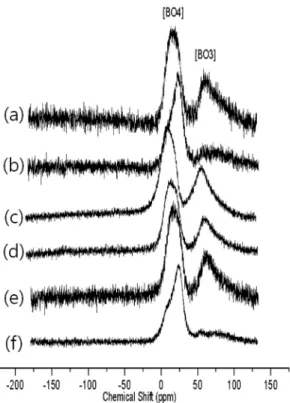
The obtained spectra by the 11B MAS NMR are pre- sented in Fig. 2. The [BO3] and [BO4] peaks are observed at about 25 and 75ppm. It shows a large, relatively narrow peak from [BO4] and a small broader peak from [BO3]
being representative of the 11B MAS NMR spectra for all
K a1 S1 ---k1 a2
S2
---k2 ... ai Si + + + k---- i a1
S1 --- a2
S2
--- ... ai Si + + +---- ---
=
Table 1. Experimental compositions (in mol%).
B2O SiO2 Al2O3 SrO K2O Na2O CaO MgO Li2O
BS 44.3 25.7 18.9 11.2
BK 41.6 24.1 17.8 16.5
BN 41.2 23.9 17.6 17.4
BC 40.5 23.4 17.3 18.8
BM 37.7 21.8 16.1 24.4
BL 34.7 20.1 14.8 30.3
Fig. 1. Calculated and experimentally measured refractive indices for the different kinds of additives.
372 Juyeon Won, Seongjin Hwang, Jungki Lee and Hyungsun Kim
glasses system.9-12)
In order to characterize the relationship between the re- fractive index and the polarizability in glasses, we calcu- lated the fraction of four-coordinated boron atoms, N4, by quantitative analysis using the NMR technique. Table 2 shows the calculated coordination fractions of boron atoms determined by NMR. It is known that the refractive index increases with increasing polarizability of the glass, because the polarizability increased by increasing the amount of non-bridging oxides with adding the alkali and alkali earth oxides.13) Therefore, the NMR spectra of this glass system enabled us to identify the relationship between the refractive index and polarizability.
With increasing content of alkali and alkali earth, the shift of the coordination occurs from [BO3] to [BO4] and non-bridging oxides are not formed by the [BO4] tetra- hedron. The structure is strengthened, because the number of points of linkage of the polyhedrons increases from three to four. When the fraction of [BO4] to the total number of boron exceeds the maximum value, the opposite coordination shift of [BO4]→ [BO3] occurs at higher alkali and alkali earth contents and the structure of the glasses is weakened by the formation of [BO3] groups with non-bridging oxygens.9,14-15)
In Table 2, the [BO3] fraction shows a similar tendency to the refractive index of the B2O3-SiO2-Al2O3 glass system to which K2O, Na2O and CaO are added. However, the variation of the refractive index of the glass system to which SrO, MgO and Li2O are added is not correlated with the coordination fraction. This is attributed to the difference in the amount of B2O3.
The density is not a suitable parameter to use to deter- mine the correlation between the properties of the glass system and its composition, as shown in Fig. 3. Therefore, the molar volume (VM) was used, which was calculated from the experimental density (ρ) using the equation (2)
(2) where MT is the total molecular weight of the com- ponents in the glass and it is given by equation (3)
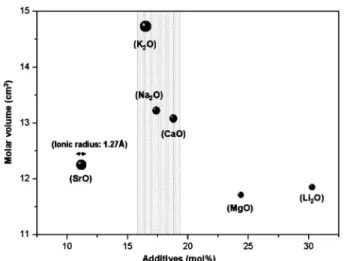
MT=x1Z1+x2Z2+ ... +xiZi (3) where xi is the mole fraction of the constituent oxide and Zi is the molecular weight of the constituent oxide.15) The refractive index is not dependent on the polarizability, but is related to the molar volume. As shown in Fig. 1 and Fig. 4, the refractive index and molar volume are
VM MT ---ρ
= Table 2. Composition and relative concentration of [BO4] and [BO3]
determined by calculating the coordination fraction of the NMR spectra for all of the glass systems.
Sample B2O3 (mol%)
Additive (mol%)
[BO4]
(%)
[BO3]
(%)
BS 44.3 11.2 94 6
BK 41.6 16.5 72 28
BN 41.2 17.4 66 34
BC 40.5 18.8 63 37
BM 37.7 24.4 93 7
BL 34.7 30.3 67 33
Fig. 2. 11B MAS NMR spectra for B2O3-SiO2-Al2O3-(RO or R2O) with various content of additives: (a) 30.3 of Li2O, (b) 24.4 of MgO, (c) 18.8 of CaO, (d) 17.4 of Na2O, (e) 16.5 of K2O and (f) 11.2 of SrO in mol%, respectively.
Fig. 3. Density of the B2O3-SiO2-Al2O3 glasseswith R2O and RO.
Effect of Additives on the Refractive Index of BorateGlasses for Photolithographic Process 373
correlated with each other. The molar volume determines the refractive index behavior of the glass. The refractive index increases with decreasing molar volume due to the increase in the number of non-bridging oxygen. In this case, the effect of the molar volume is relatively strong.
The refractive index was observed to be in inverse pro- portion to the molar volume. The B2O3-SiO2-Al2O-K2O glass system was observed to have a higher molar volume than the B2O3-SiO2-Al2O3-(K2O, Na2O or CaO) system with a similar alkali (K2O, Na2O, CaO) content. It is thought that the network is expanded by the larger ionic radius of K+.13) Therefore, the glass system with K2O has the lowest refractive index.
4. Conclusion
We investigated the density, structure and refractive index of glasses based on the B2O3-Al2O3-SiO2 system with the addition of R2O and RO. The refractive index was found to depend on the molar volume and four- coordination fraction of boron atoms. It was examined determined by NMR analysis that the refractive index is related to the molar volume of the glass as well as the polarizability of the ions. When the glasses have a similar
content of composition, the refractive index depends on the polarizability which is determined by the amount of non- bridging oxygen’s. However, the molar volume is correlated with the refractive index irrespective of the composition.
Acknowledgements
This study was supported by the Energy · Resources Technology Development Program of Ministry of Know- ledge Economy.
Reference
1. B. H. Jung and H. S. Kim, Kor. J. Mater. Res., 13(1), 53 (2003) (in Korean).
2. S. W. Jeong, W. S. Kim, D. H. Lee, K. E. Min, K. H. Seo, I. K. Kang and L. S. Park, J. Appl. Polym. Sci., 85(10), 2092 (2002).
3. Y. Iguchi, T. Masaki and K. Iwanaga, United States Patent, US 6 197 480 B1.
4. S. Hornschuh, B. Messerschmidt, T. Possner, U. Prossner and C. Russel, J. Non-Cryst. Solids, 347, 121 (2004).
5. S. Hornschuh, B. Messerschmidt, T. Possner, U. Prossner and C. Russel, J. Non-Cryst. Solids, 352, 4076 (2006).
6. L. Chunhua, N. Yaru, Z. Qitu and X. Zhongzi, J. Rare Earths., 24, 413 (2006).
7. I. Fanderlik, Optical Properties of Glass, p. 120, Elsevier Science Publishing, New York (1983).
8. J. Eales, Manual and Databook of Glass Technology Calculations, p. 104, Ordentlich, Israel (1977).
9. P. Zhao, S. Kroeker and J. F. Stebbins, J. Non-Cryst.
Solids, 276(1-3), 122 (2000).
10. B. G. Parkinson, D. Holland, M. E. Smith, A. P. Howes and C. R. Scales, J. Non-Cryst. Solids, 353, 4076 (2007).
11. A. Grandjean, M. Malki, V. Montouillout, F. Debruycker and D. Massiot, J. Non-Cryst. Solids, 354, 1664 (2008).
12. D. Mao and G. Lu, J. Solid State Chem., 180, 484 (2007).
13. H. Sholze, Glass (Nature, Structure and Properties), p.153, Springer-Verlag, New York (1990).
14. Y. H. Yun, S. A. Feller and P. J. Bray, J. Non-Cryst.
Solids, 33(2), 273 (1979).
15. P. Chimalawong, J. Kaewkhao, C. Kedkaew and P.
Limsuwan, J. Phys. Chem. Solids, 71, 965 (2010).
Fig. 4. Molar volume of the B2O3-SiO2-Al2O3 glasseswith R2O and RO.