Korean Journal of Environmental Agriculture
Korean J Environ Agric (2013) Online ISSN: 2233-4173
Vol. 32, No. 4, pp. 366-368 http://dx.doi.org/10.5338/KJEA.2013.32.4.366 Print ISSN: 1225-3537
돈분뇨의 호기적 액비화 과정에서 암모니아 휘산량 평가
김태영,1 김송엽,1 장홍희,2 윤홍배,3 이용복1,2*
1경상대학교 응용생명과학부, 2경상대학교 농업생명과학연구원, 3국립농업과학원
Evaluation of Ammonia Emission from Liquid Pig Manure Composting System with Forced Aeration
Tae-Young Kim,1 Song-Yeob Kim,1 Hong-Hee Chang,2 Hong-Bae Yun3 and Yong-Bok Lee1,2* (1Division of Applied Life Science, Gyeonsang National University, Jinju 660-701, Korea, 2Research Institute of Life Science, Gyeongsang National University, Jinju 660-701, Korea, 3National Academy of Agricultural Science, RDA, Suwon-si, Gyeonggi- do, Korea)
Received: 7 November 2013 / Revised: 18 November 2013 / Accepted: 16 December 2013
ⓒ 2013 The Korean Society of Environmental Agriculture
This is an Open-Access article distributed under the terms of the Creative Commons Attribution Non-Commercial License (http://creativecommons.org/licenses/by-nc/3.0) which permits unrestricted non-commercial use, distribution, and reproduction in any medium, provided the original work is properly cited.
*교신저자(Corresponding author),
Phone: +82-55-772-1967; Fax: +82-772-1969;
Email: [email protected]
366
Abstract
BACKGROUND: Composting is the most frequently used waste management process for animal manure in Korea’s livestock industry. In the composting process, a large amount of nitrogen (N) is volatilized to the atmosphere as amonia (NH3). However, quantitative information of NH3
emission from composting of liquid manure is required to obtain emission factors for management of livestock manure in Korea.
METHODS AND RESULTS: To evaluate the NH3 emission from composting of liquid manure affected by aeration, we conducted composting of liquid pig manure with three forced aeration systems. The aeration conditions were continuous (A60), cycle of 30 min aeration and 30 min pause (A30S30) and without aeration(A0). All treatments were aerated 12 hour per day with these aeration systems.
The total ratio of NH3 volatilization loss to total N content in liquid manure throughout composting period was estimated to 19.9% for A0 treatment, 25.9% for A30S30
treatment and 36.3% for A60 treatment. The A30S30 and A60 aeration systems increased NH3 volatilization by 30.2 and 82.3% compared with systems without forced aeration.
CONCLUSION(S): Ammonia emission during liquid pig manure composting was highly affected by forced aeration.
The development of liquid pig manure composting systems with forced aeration would be considered both reducing ammonia emission and efficiency of composting.
Key words: Aeration, Ammonia emission, Composting, Liquid pig manure
서 론
퇴비 및 액비화는 우리나라에서 가장 널리 이용되고 있는 가축분뇨의 처리 방법이다. 가축분뇨의 퇴⋅액비화는 부피감 소(Larney et al., 2000), 유해미생물(Van Herk et al., 2004) 및 잡초 종자 사멸 등의 여러 가지 이점을 가지고 있지 만 다량의 암모니아를 대기 중으로 휘산 시켜 악취 및 수계 부영양화를 유발시킨다(Fangmeire et al., 1994). 2010년 우 리나라의 연간 가축분뇨 발생량은 46,500천톤이며 이중 약 80%는 퇴비화 과정, 그리고 약 6%는 액비화 과정을 거쳐 농 경지로 환원되고 있다(Kwon et al., 2010). 현재 국내에서
Open Access Short Communication
Evaluation of Ammonia Emission from Liquid Pig Manure Composting System with Forced Aeration 367
발생되는 가축분뇨는 대부분 퇴비화를 거쳐 이용되고 있지만, 수분조절제인 톱밥가격 상승, 가축분뇨의 해양 투기지 금지 등으로 인해 액비화 과정의 비율이 점점 증가될 전망이다.
지금까지 다수의 연구에서 퇴비화 과정 중 휘산되는 암모 니아는 전체 질소의 약 30-50%로 보고 된 바 있다(Witter and Lopez-Real, 1988; Lee et al., 2008). 퇴비화 과정에서 휘산되는 암모니아는 질소 손실과 더불어 환경 부하량을 증 가 시키므로 이를 저감하기 위한 노력을 하고 있다(Witter and Kirchmann, 1989; Lee et al., 2008). 가축분뇨의 액비 화는 크게 호기적 및 혐기적으로 구분할 수 있다. 혐기적 액 비화는 많은 시간이 소요되기 때문에 대부분의 축산농가에서 는 호기적 액비화를 선호하고 있는 실정이다. 특히, 호기적 액비화는 강제로 공기를 불어 넣어 유기물 분해를 촉진시키 지만, 암모니아 휘산을 조장 할 수 있는 조건이다. 하지만 아 직까지 호기적 액비화 과정에서 암모니아 휘산량 평가에 대 한 국내 연구는 미미한 실정이다. 이에 본 연구는 돈분의 호 기적 액비화 과정에서 암모니아 휘산양을 평가하여 앞으로 가축분뇨 처리과정의 암모니아 휘산량 저감 연구에 대한 기 초자료로 활용하고자 한다.
재료 및 방법
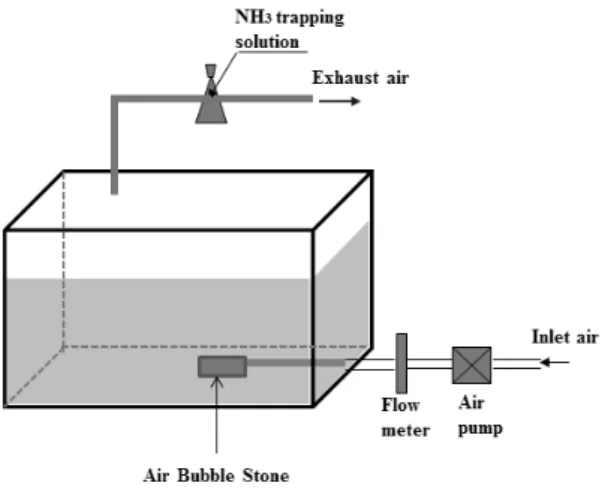
본 시험에 사용된 돈분뇨는 경상남도 고성군 소재 돈사에 서 고액분리 후 액상을 채취하여 사용하였고, 공시재료의 이 화학적 특징은 Table 1에서 보는 바와 같다. 돈분뇨의 호기 적 액비화는 Fig. 1에서 보는 장치에 15L의 돈분뇨를 채우고 실시하였으며, 이때 공기는 하루 중 12시간만 펌프를 이용하 여 주입하였다. 이는 현재 축산 농가에서 밤에는 공기를 주입 하지 않는 관행과 동일한 조건이다. 공기를 주입하는 12기간 동안 공기 주입조건은 자동 타이머를 이용하여 무작동(A0), 30분 작동-30분 무작동(A30S30), 연속작동(A60)로 설정하였고, 공구 주입량은 flow meter를 이용하여 2 L/min/chamber로 동일하게 하였다. 호기적 액비화 과정에서 휘산되는 암모니아 는 포집용 수기에 0.5N-H2SO4 용액을 이용하여 포집하였으 며, 황산용액은 매일 교환하였다. 그리고 포집된 암모니아는 Automatic ion analyzer(BRAN RUEBBE. CO)를 이용해 서 분석하였다. 돈분뇨의 이화학적 특성은 농촌진흥청 분석법 에 준하여 분석하였다(NIAST, 2000).
Solid
(g/kg) pH EC
(dS/m) T-N (g/kg)
NH4-N (mg/kg)
T-P (g/kg)
62.5 8.9 22.7 9.3 2400 0.32
Table. 1. Characteristic of liquid pig manure used in this study.
Fig. 1. Diagram of ammonia trapping systems and liquid pig manure composting facility.
결과 및 고찰
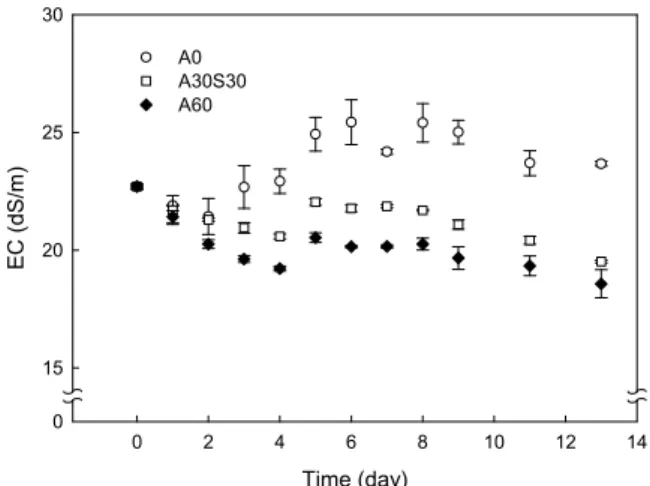
액상 돈분뇨 액비화 과정에서 공기 주입량은 암모니아태 질소 농도 변화 큰 영향을 미쳤다(Fig. 2). 공기 주입량에 관 계없이 모든 처리에서 처리 후 4-5일째 암모니아태 질소 농도 가 가장 높게 나타났으며, 이는 액비화 과정의 무기화 작용에 의한 것으로 판단된다. Li 등(2013)은 우분의 퇴비화 과정에 서 암모니아태 질소농도는 처리후 5일째 가장 높았다고 보고 하였다. 비록 본 시험에서 질산태 질소 농도를 측정하지 않았 지만 암모니아태 질소 농도가 정점에 도달한 후 감소하는 것 은 암모니아태 질소가 질산태 질소로 전환된 것과 암모니아 휘산량 증가에서 나타난 현상으로 판단된다. 특히, 액상 돈분 퇴비화시 공기 주입은 암모니아태 질소가 질산태 질소로 전 환되는 것을 촉진하는 것으로 잘 알려져 있다. 그리고 질산태 질소의 농도 증가는 EC 값의 상승을 수반하는 것으로 알려져 있다. 하지만 본 시험에서 공기 주입량 증가는 오히려 EC 값 이 낮게 나타났다(Fig. 3) 따라서 공기 주입량 증가에 따른 액상 돈분의 암모니아태 질소 농도가 낮아지는 것은 암모니 아태 질소의 질산태 질소 전환 보다는 암모니아 휘산량 증가 가 더 영향을 미친 것으로 판단된다.
Time (day)
0 2 4 6 8 10 12 14
NH4-N concentration (mg/L) 0 1000 2000 3000 4000 5000 6000
A0 A30S30 A60
Fig. 2. Changes of NH4-N concentration during liquid pig manure composting with forced aeration.
KIM et al.
368
Time (day)
0 2 4 6 8 10 12 14
EC (dS/m)
0 15 20 25 30
A0 A30S30 A60
Fig. 3. Changes of electrical conductivity (EC) during liquid pig manure composting with forced aeration.
Time (day)
0 2 4 6 8 10 12 14 16
Cumulative NH3-N emission (mg/chamber) 0 10000 20000 30000 40000 50000 60000
A0 A30S30 A60
Fig. 3. Cumulative emission of ammonia during liquid pig manure composting with forced aeration.
돈분 액비화 과정에서 공기 주입량은 암모니아 휘산량에 큰 영향을 미치는 것으로 나타났다. 공기 투입량에 따른 암모 니아 휘산량은 무공기 투입(A0)에 비해 30분 투입-30분 정지 (A30S30)에서 30.2%, 연속투입(A60)에서 82.3%의 증가가 있었다. 그리고 시험전 전질소 함량 대비 A0 처리에서 19.9%, A30S30 처리에서 25.9%, 그리고 A60에서 36.3%
가 암모니아로 휘산된 것으로 나타났다. 이는 이 등(2009, 농 과원)이 발표한 호기적 돈분 액비화 과정에서 약 50% 암모니 아 휘산량이 있다는 결과와 비슷한 결과이다. Dewes (1999) 는 퇴비화 과정에서 누적 암모니아 휘산량은 고온기 이후 급 격히 감소하는 패턴을 보인 반면 액비화 과정에서는 일차직 선의 패턴을 보인다고 하였다. 그리고 이는 암모니아 휘산이 온도 증가에 따라 증가하기 때문이라고 설명하였다. 따라서 앞으로 호기적 돈분 액비화 기술의 발달은 액비화 효율 증진 과 암모니아 휘산량 감소의 두 가지 측면을 모두 고려하여야
될 것으로 판단된다.
Acknowledgement
This study was supported by Rural Development Administration, Republic of Korea (Project No. PJ008277).
References
Dewes, T., 1999. Ammonia emissins during the initial phase of microbial degradation of soilid and liquid cattle manure, Bioresour. Techno. 70, 245-248
Fangmeier, A., Hadwigerfangmeier, A., Vandereerden, L., Jager, H.J., 1994. Effects of atmospheric ammonia on vegetation-A review, Environ. Pollut. 86, 43-82.
Kwon, Y.R., Kim, J., Ahn, B.K., Lee, S.B., 2010. Effect of liquid pig manure and synthetic fertilizer on rice growth, yield, and quality, Korean J. Environ. Agri. 29(1), 54-60.
Larney, F.J., Olson, A.F., Carcamo, A.A., Chang, C., 2000.
Physical changes during active and passive composting of beef cattle manure in winter and summer, Bioresour. Tchnol. 75, 139-148.
Lee, Y.B., Lee, H.B., Yun, H.B., Lee, Y., 2008. Alum as a chemical amendment for reducing ammonia emission and stabilizing pig manure phosphorus during composting, Korean J. Environ. Agri. 27(4), 368-372.
Li, Y., Li, W., Wu, C., Wang, K., 2013. New insights into the interactions between carbon dioxide and ammonia emission during sewage sludge composting, Bioresour.
Techno. 136, 385-393.
NIAST, 2000. Method of soil and plant analysis, National Institute of Agriculture Science and Technology, RDA, Suwon, Korea.
Witter, E., H. Kirchmann, 1989. Peat, zeolite, and basalts as adsorbent salts on ammonia volatilization during manure composting, Plant and Soil 115, 53-58.
Witter, E., Lopez-Real, J.M., 1988. Nitrogen loses during the composting of sewage sludge and the effectiveness of clay soil, zeolite, and compost in adsorbing the volatilized ammonia, Biological Wastes 23, 279-294.
Van Herk, F.H., McAllister, T.A., Cockwill, C.L., Gusselle, N., Larney F.J., Miller, J.J., Olson, M.E., 2004.
Inactivation of Giardia cysts and Cryptosporidium ooxysts in beef feedlot manure by thermophilic windrow composting, Compost Sci. Util. 12, 235-241.