ORIGINAL ARTICLE
Water Quality Simulation of the Reservoir Using Ecological Model
Dong-Myung KIM
1)*, Ji-Won SUK
1), Sun-Young KIM
1), Sang-Ik SHIN
2), Kyong-Joon ROH
3)1)
Department of Ecological Engineering, Pukyong National University, Busan 608-737, Republic of Korea
2)
College of Marine Science, University of South Florida, St. Petersburg, Florida 33701, USA
3)
Department of Environmental Engineering, Pukyong National University, Busan 608-737, Republic of Korea
Abstract
Water quality of the Koejong-reservoir was estimated by using the ecological model to evaluate the effects of industrial sewage discharge. State variables consist of POC, DOC, phytoplankton, DIP, DIN, DO and COD. Initial conditions for the compartment are applied to the model based on the observed results. The reproducibility was found to be satisfactory with the relative error ranging between the calculated value and the observed value. Water quality simulation was conducted by applying additional industrial sewage discharge into the Koejong-reservoir. The concentrations of COD, Chl.a, DIP and COD showed fluctuations of a narrow range. The increment percentages of Chl.a, COD and DIP were 26.6%, 20.2% and 18.2%, respectively. In the case of DO, the concentration decreased 4.8%.
Key words : Ecological model, Reservoir, Water quality, Pollution, Simulation
1)
1. Introduction
Except for the man-made lakes or reservoirs nearby the big rivers, the ecosystem of lakes and reservoirs in Korea consist mostly of small lakes and reservoirs with shallow depth, which are easily influenced by the pollution sources in the basin zone.
Since 1990, the majority of agricultural reservoirs have been showing eutrophication cause by the inflow of phosphorus and nitrogen from the watershed.
The reservoir ecosystem has been disturbed by the increased productivity and bloom of phytoplanktons.
Especially, the ecosystem of the man-made lakes and agricultural reservoir ecosystem in southwestern region of Korea is influenced by intensive farming
and changes in of the waterside habitual environment accelerated by industrialization (Seo, 1978; La et al., 2008).
The natural phenomena taking place in the environment are extremely complicated, it is difficult to figure them all out exactly by research concentrated in a single field of study. The interdisciplinary model plays an important role as a tool to study, investigate and combine various information collected from a number of disciplines. The modeling process enables us to grasp the phenomena taking place in the study area, prioritize the research procedures, and plan the necessary data collecting. Prediction is another useful role of the model. When it is impossible to experiment on the natural environment directly, the model can be
Received 1 September, 2014; Revised 16 October, 2014;
Accepted 22 October, 2014
*Corresponding author : Dong-Myung KIM, Department of Ecological Engineering, Pukyong National University, Busan 608-737, Republic of Korea
Phone: +82-51-629-6545 E-mail: [email protected]
ⓒ The Korean Environmental Sciences Society. All rights reserved.
This is an Open-Access article distributed under the terms of the Creative Commons Attribution Non-Commercial License (http://
creativecommons.org/licenses/by-nc/3.0) which permits unrestricted non-commercial use, distribution, and reproduction in any medium, provided the original work is properly cited.
a useful tool.
Since it is very difficult to predict the advection and diffusion of contaminants in the reservoir, we use an ecological model in this study of Koejong-reservoir, which is capable of presenting the mechanism of biochemical reactions as well as the macroscopic cycle of nutrients in the reservoir. Ecological model is comprehensive analysis of ecology study and has different character from the model which is based on physical principle as a hydrodynamic model.
Koejong-reservoir is located in Goseong-gun, Gyeongsangnam-do, Korea. The runoff from the mountains flows into this reservoir, which is linked to Jangjeon-reservoir with a water channel. Wastewater discharge from industrial facilities, plants and houses surrounding the reservoir is the major input sources to the reservoir. Additional discharge of wastewater from the recently developed industrial complex in the vicinity of Koejong-reservoir is aggravating the freshwater region pollution, raising a concern for the reservoir ecosystem. We need to evaluate the water quality and the environmental changes caused by the water pollution.
Therefore, the purpose of this study is to measure the effect of the pollution load by additional discharge on the reservoir by using the ecological model.
2. Materials and Methods
2.1 Modeling system
For the total approach to the ecosystem, it is necessary to use the ecological model including the cycle of phosphorus and nitrogen which determine the photosynthesis of phytoplanktons in the aquatic ecosystem. The ecological model was developed by Kremer and Nixon(1978), and it was improved for the coast environment by Choi et al.(1994) and Kim et al.(1994). It has been used to estimate the environmental capacity and primary production ecosystem in Jinhae Bay and Masan Bay, Korea.
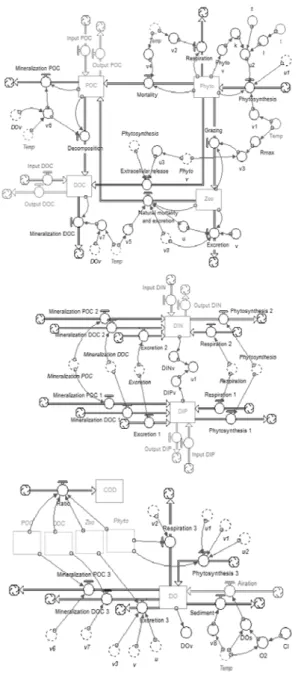
Fig. 1 presents a model written by using numerical modeling program. The cycles of carbon, nitrogen and phosphorus and the connection of phytoplanktons and dissolved oxygen in the ecological model are presented.
Fig. 1. The simulation diagram in the model.
Phyto(t) = Phyto(t-dt)
+ Photosynthesis - Extracellular release Respiration - Grazing Mortality1 Zoo(t) = Zoo(t-dt)
+ Grazing - Mortality and excretion(scat) - Excretion(urine) POC(t) = POC(t-dt)
+ Mortality 1 + Mortality 2 + Excretion Z1
- Mineralization of POC - Decomposition + (Input loads Output loads) DOC(t) = DOC(t-dt)
+ Decomposition + Extracellular release - Mineralization + (Input loads Output loads) DIP(t) = DIP(t-dt)
- Photosynthesis 1 + Respiration 1 + Excretion 1 + Mineralization POC 1 + Mineralization DOC 1 DIN(t) = DIN(t-dt)
- Photosynthesis 2 + Respiration 2 + Excretion 2 + Mineralization POC 2 + Mineralization DOC 2 DO(t) = DO(t-dt)
+ Photosynthesis 3 + Aeration - Respiration 3 Excretion 3 - Mineralization POC 3 - Mineralization DOC 3 - Sediment COD(t) = [COD : Cp]*(dP/dt) + [COD : Cz]*(dZ/dt) + [COD : Cpom]*(dPOC/dt) + [COD : Cdom]*(dDOC/dt) Table 1. The numerical formulation of the simulation
2.2 Ecological model
This model system was constructed as a box model based on the model which has been applied by Nakata et al.(2000), Taguchi et al.(1998; 2009) for the lake ecosystems, and it has also been applied to the marine ecosystems by Sohma et. al.(2008), Choi et al.(1994), Kim et al.(2002), Hong et al.(2007), Kim et al.(2007), Hong et al.(2008).
The ecological model consists of phytoplankton (P), detritus(POM), dissolved organic matter(DOM), dissolved inorganic phosphorus(DIP), dissolved inorganic nitrogen(DIN), dissolved oxygen(DO) and chemical oxygen demand(COD).
Equation (1) describes the biomass B of compositions at a random site of the lake in the ecological model.
t
B u x
B vy
B wz
B
the term describing the transport by the tide and residual flow
x
Kxx
B
y
Kyy
B
z
Kz z
B
the term describing the mixture by turbulent diffusion
dt dB
the term describing the biological and chemical process Equation (1)
Here, x, y and z are coordinates, t is time, u, v and
w are the velocity components of x, y and z direction,
Kx, Ky and Kz are eddy diffusivity of x, y and z
direction, B is the biomass of components, dB/dt is
the variation of components per time unit by
biochemical process. Also, the calculating section of
substance transport by advection is included in the
diffusion equation. The velocity was applied to the
ecological model to calculate the changes in the
biomass B.
Initial condition for compartments
Temp DO COD DIP DIN POC DOC PHYTO
( /L ) ( -C/ )
7.67 8.88 3.47 0.011 0.827 1403.0 2104.5 613.7
Table 2. Initial condition for compartments in the ecological model
Sewage flow rate (m3/day) Discharge loads(kg/day)
BOD T-P
Original loads 30.1 0.61 0.123
Additional loads 22.0 0.11 0.044
Total 52.1 0.72 0.167
Table 3. Estimated discharge of wastewater
State variables consist of phytoplankton(P), zooplankton(Z), particulate organic carbon(POC), dissolved organic carbon(DOC), dissolved inorganic phosphorus(DIP), dissolved inorganic nitrogen(DIN), dissolved oxygen(DO) and chemical oxygen demand (COD). Table 1 presents the numerical formulation of the process in this model.
3. Results and discussion
3.1 Study area and input data
The study area is Koejong-reservoir located in Goseong-gun, Gyeongsangnam-do, Korea (Fig. 2).
This study area is surrounded by warehouses, plants and houses, and construction of a new industrial facility is being planned. Thus, wastewater discharged from the new industry facility can be an additional input pollution source to the study area. Therefore, analysis of the water quality of the study area was conducted by using the ecological model. The initial condition for the compartments in the ecological model was based on the observed value at the study area (Table 2).
The total flux was estimated from the original sources of pollution that flows into the reservoir from
Fig. 2. The site map of the study area.
the warehouses, plants and houses. The BOD discharge concentration was assumed to be 20mg/L of discharge water quality standard. Thus, in the original discharge loads, BOD is estimated at 0.61kg/day and T-P is 0.123kg/day. The additional input pollution source to the study area is the sewage discharge from the industry facility, and the sewage flow rate was estimated at 22.0m
3/day. BOD discharge loads were estimated at 0.11kg/day, and for T-P, 0.044kg/day (Table 3).
The parameters used in the model are derived from the thesis of Jorgensen et al.(2000), Nakata et al.
(2000), Sohma et al.(2008), Taguchi et al.(1998) and
No. Symbol Definition Unit Values
1 α1 Maximum growth rate of phytoplankton at 0 /day 0.29
2 α2 Respiration rate of phytoplankton at 0 /day 0.05
3 α3 Maximum grazing rate of zooplankton at 0 /day 0.04
4 α4 Mortality rate of phytoplankton at 0 /day 0.0655
5 α5 Natural death rate of zooplankton at 0 /day 0.01
6 α6 Mineralization rate of POC at 0 /day 0.0306
7 α7 Mineralization rate of DOC at 0 /day 0.0245
8 KSP Half saturation constant for uptake of DIP at 0 -at/L 0.25
9 KSN Half saturation constant for uptake of DIN at 0 -at/L 5.00
10 P* Function of grazing C/ 75
11 μ Digestion efficiency of zooplankton % 70
12 ν Total growth efficiency of zooplankton % 30
13 λ Ivlev index for grazing /( C/ ) 0.01
14 κ Percentage of the quantity decomposed from POC to DOC % 20
15 K1DO Half concentration of DO for mineralization of POC /L 1.00
16 K2DO Half concentration of DO for mineralization of DOC /L 1.00
17 Ka Reaeration coefficient at water surface /day 0.016
Table 4. The biological parameters used in the ecological model
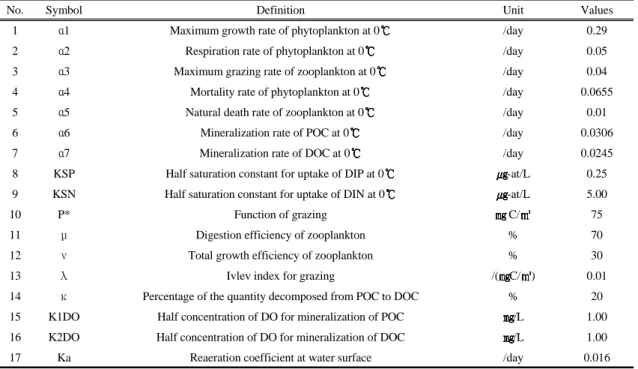
Taguchi et al.(2009) and literature of Kim et al.(2002), Kim et al.(2007), Hong et al.(2007), Eom(2007), and Hong et al.(2008) (Table 4).
3.2 Reproducibility of ecological model
Simulation was conducted until 6 of state variables showed the steady states to reproduce the water quality of the reservoir. We confirmed the applicability of the model to the study area by comparing the observed data and the estimated data. To check the reproducibility, DO, COD, Nutrient and Chl.a were simulated because DO is necessary for living things to survive, COD is an indicator of oxygen consumption waste in the aquatic ecosystem, and Nutrient and Chl.a show the primary production of phytoplankton.
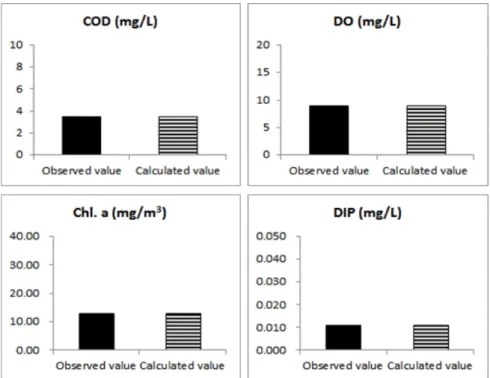
The result of the simulation was applied in estimating the relative error between the calculated value and observed value. The observed and simulated COD were the same at 3.47mg/L. The observed DO was 8.87mg/L whereas the simulated DO was 8.88
mg/L. In the case of DIP, the observed and the calculated value were the same at 0.011mg/L. In the case of POC and DOC, the observed values were 1403.00mg/L and 2104.50 and the calculated values were 1402.66mg/L and 2104.40mg/L, respectively.
In the case of Chl.a, 12.89mg/m
3was observed whereas 12.86mg/m3 was the simulated value.
The relative error of Chl.a and DO were 0.23%
and -0.11%, respectively, and in the case of POC and DOC, 0.02% and 0.01%, respectively. Therefore, the relative errors of state variable were good enough to be applied.
The reproducibility of the model was satisfactory with the relative error ranging between the calculated value and the observed value (Fig. 3).
3.3 Results of simulation
After applying the additional wastewater discharge
from the industrial complex, the water quality on
reservoir was estimated. The original load was 30.1
Fig. 3. Comparison of the observed value and the calculated value.
Fig. 4. Comparison of the observed value and the simulated value after applying the additional loads.