Journal of Environmental Science International pISSN: 1225-4517 eISSN: 2287-3503
30(2); 191~194; February 2021 https://doi.org/10.5322/JESI.2021.30.2.191
1)1. 서 론
곤충은 식용과 약용 개념이 포함된 식량자원이라고 보고됨에 따라 곤충 산업에 대한 전반적인 변화를 가져 오게 되었다(Sim et al., 2018). 이는 곤충의 활용범위가 매우 다양한 패턴으로 소비자들에게 전달되어 곤충산업 과 우리 생활에 정착되도록 많은 연구가 진행되고 있다 (Choi et al., 2015). 따라서, 유용곤충 산업화를 위해서 는 우선적으로 국내 곤충의 유전적 자원의 확보를 통해
곤충산업의 생태계를 조기정착 시키는 것이 무엇보다 중 요하다고 할 수 있다(Nam et al., 2013). 그러나, 곤충과 관련된 품목, 제품, 기술 등의 문제점은 제조·가공기술의 미흡과 위생 및 안전성 여부로 인한 제품에 대한 소비자 의 신뢰 부족, 외형적인 이질감과 거부감, 개별유효인증 지표 부재로 인한 판매 브랜드의 시장 경쟁력 부재 등을 들 수 있다. 이러한 이유 때문에 유용곤충 가운데 흰점박 이꽃무지(Protaetia brevitarsis)가 주요 산업화 곤충으 로 개발되고 있다(Yun and Hwang, 2016; Lee et al.,
Received 3 January, 2021; Revised 30 January, 2021;
Accepted 5 February, 2021
*Corresponding author: Tae-Ho, Chung, Department of Companion Animal & Animal Resource, Joongbu Univeristy, Geumsan 32713, Korea
Phone: +82-41-750-6283 E-mail: [email protected].
ⓒ The Korean Environmental Sciences Society. All rights reserved.
This is an Open-Access article distributed under the terms of the Creative Commons Attribution Non-Commercial License (http://
creativecommons.org/licenses/by-nc/3.0) which permits unrestricted non-commercial use, distribution, and reproduction in any medium, provided the original work is properly cited.
SHORT COMMUNICATION
흰점박이꽃무지(Protaetia brevitarsis)의 유충사육 시 적정밀도 규명
최성업 최인학 손진성1) 정태호*
중부대학교 바이오융합학부, 1)HMO Health Dream Agricultural Association Corporation
Investigation of the Proper Density for Rearing Protaetia brevitarsis Larvae
Sung-Up Choi, In-Hag Choi, Jin-Sung Son1), Tae-Ho Chung*
Department of Companion Animal & Animal Resource, Joongbu Univeristy, Geumsan 32713, Korea
1)HMO Health Dream Agricultural Association Corporation, Chungnam 32146, Korea
Abstract
This study aimed to provide information and data for the management of insect breeding farms by identifying the appropriate density when rearing Protaetia brevitarsis larvae. The breeding box of the insects was filled with 2 L of fermented sawdust on a 50 × 35 × 15 cm sheet of plastic, and the density of the treatments was 200, 300 and 400 P.
brevitarsis in the first, second, and third larval stages. Each treatment was repeated five times, and the sawdust medium was replaced three times (10 intervals). The experiments were conducted for a total of 30 days from March 1, 2020. Overall, 200 P.brevitarsis in the first, second, and third larval stages reared in the breeding box had a higher average survival rate and lower average mortality rate, thereby contributing to efficient production. In conclusion, this result suggests a way to increase production efficiency through the environmental management of insect breeding farms.
Key words : Average mortality rate, Average survival rate, Density, Protaetia brevitarsis larvae
192 최성업 최인학 손진성 정태호
2017). 최근에는 흰점박이꽃무지의 종충사육 표준관리 기초연구로 원료에 대한 불안감 해소, 대량 제조 가공공 정의 표준화 개발 및 제품의 안정성이 확보되었다. 그리 고 유용곤충산업을 지역 특산품으로 만들어 식용곤충산 업과 제조산업의 융합을 통한 6차 산업의 새로운 신성장 동력산업 확대 등으로 이 곤충의 활용범위를 넓히고 있 다. 따라서 이와 같은 다양한 용도로 확대하기 위해서는 무엇보다 흰점박이꽃무지를 대량으로 생산하는 것이 필 요하다. 그러나 유충의 생산량은 령별 밀도에 의해 동종 포식 및 질병폐사를 막고, 먹이활동을 활발하게 하여 짧 은 기간 내에 증체율과생산량을 증가시켜 우수한 고품질 의 유충을 생산하는데 있다. 따라서 본 연구에서는 흰점 박이꽃무지 유충 사육 시 적정밀도 규명하여 유충의 생 산량을 향상시키는데 목적을 두고 있다.
2. 재료 및 방법
본 연구에 이용된 흰점박이꽃무지 유충은 충남 태안 에 위치한 HMO건강드림 영농조합법인으로부터 분양 받아 사용하였다. 공시충의 사육 상자는 플라스틱 재질 의 50 × 35 × 15 cm크기에 발효톱밥 2 L를 채웠으며,
처리구 별 밀도는 흰점박이 꽃무지 유충 100마리, 150마 리 및 300마리로 하여 령별(1령, 2령 그리고 3령)로 구분 하였다. 각 처리구마다 5반복, 3회(10일 간격)에 걸쳐 톱 밥배지를 교체하여 주었으며, 2020년 3월 1일에서부터 2020년 3월 30일까지 총 30일간 실험을 실시하였다. 사 육 조건은 온도의 경우 25±1℃, 습도는 65±10%, 조명은 L:D = 8:16 조건에서 실시하였다.
3. 결과 및 고찰
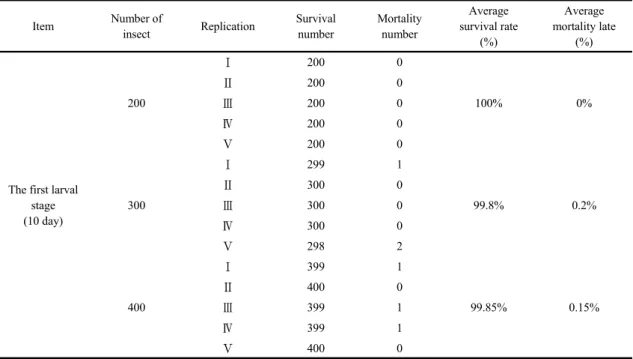
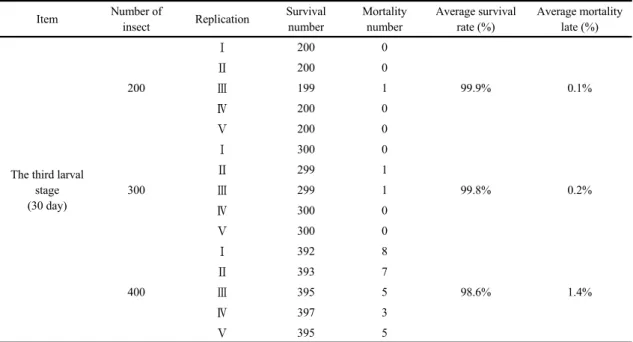
Table 1, 2 및 3은 흰점박이꽃무지 유충 사육 시 적정 밀도와 관련된 평균 생존율및 평균 폐사율에 미치는 영 향을 조사한 결과를 나타내었다. 전체적으로 1령, 2령, 3 령의 흰점박이꽃무지 유충은 사육상자 안에 200마리씩 넣고 사육하는 것이 평균 생존율을 높이고 평균 폐사율 을 낮추어 주기 때문에 증체율과 생산성 증가에 기여할 것으로 판단된다. 특히, 2령에서 400마리씩 사육했을 경 우 평균 생존률이 가장 낮았고, 평균 폐사율이 가장 높았 다. 이는 400마리씩 사육할 경우, 령별에 따라 평균 생존 율은 낮고 평균 폐사율이 높은 이유는 유충 개체간 높은 카니발리즘(cannibalism)의 빈도로 설명할 수 있다
Item Number of
insect Replication Survival number
Mortality number
Average survival rate
(%)
Average mortality late
(%)
The first larval stage (10 day)
200
Ⅰ 200 0
100% 0%
Ⅱ 200 0
Ⅲ 200 0
Ⅳ 200 0
Ⅴ 200 0
300
Ⅰ 299 1
99.8% 0.2%
Ⅱ 300 0
Ⅲ 300 0
Ⅳ 300 0
Ⅴ 298 2
400
Ⅰ 399 1
99.85% 0.15%
Ⅱ 400 0
Ⅲ 399 1
Ⅳ 399 1
Ⅴ 400 0
Table 1. Effect of breeding density on average survival and mortality of Protaetia brevitarsis at the first larval stage
193
흰점박이꽃무지(Protaetia brevitarsis)의 유충사육 시 적정밀도 규명
(Weaver and McFarlane, 1990; Kim et al., 2016). 이 러한 결과는 Kim et al.(2016)의 연구와 유사한 패턴을 보여주었다. 이 연구에서는 30마리 갈색거저리 유충을
면적이 90 mm에서 사육할 경우, 개체의 생육 안정성이 확보된다는 것을 보고하였다. 따라서 우리의 연구에서 대 량 사육을 목적으로 한다면 개체의 적정밀도를 200마리
Item Number of
insect Replication Survival number
Mortality number
Average survival rate (%)
Average mortality late (%)
The second larval stage (20 day)
200
Ⅰ 200 0
99.9% 0.1%
Ⅱ 200 0
Ⅲ 200 0
Ⅳ 200 0
Ⅴ 199 1
300
Ⅰ 297 3
98.5% 1.5%
Ⅱ 295 5
Ⅲ 294 6
Ⅳ 297 3
Ⅴ 295 5
400
Ⅰ 290 110
72.6% 27.4%
Ⅱ 291 109
Ⅲ 291 109
Ⅳ 292 108
Ⅴ 289 111
Table 2. Effect of breeding density on average survival and mortality of Protaetia brevitarsis at the second larval stage
Item Number of
insect Replication Survival number
Mortality number
Average survival rate (%)
Average mortality late (%)
The third larval stage (30 day)
200
Ⅰ 200 0
99.9% 0.1%
Ⅱ 200 0
Ⅲ 199 1
Ⅳ 200 0
Ⅴ 200 0
300
Ⅰ 300 0
99.8% 0.2%
Ⅱ 299 1
Ⅲ 299 1
Ⅳ 300 0
Ⅴ 300 0
400
Ⅰ 392 8
98.6% 1.4%
Ⅱ 393 7
Ⅲ 395 5
Ⅳ 397 3
Ⅴ 395 5
Table 3. Effect of breeding density on average survival and mortality of Protaetia brevitarsis at the third larval stage
194 최성업 최인학 손진성 정태호
수준에서 조절해야만 성장이 안정적으로 진행되어 효율 적인 흰점박이꽃무지 유충을 생산할 수 있음을 시사한다. 예를 들면, 우리의 실험에서 흰점박이꽃무지 유충 1령과 2령에서는 200마리 정도로 50 × 35 × 15 cm 사육상자 에 톱밥 2 L를 넣고 키우면, 처리 밀도 모두에서 우수한 생존율을 보여 먹이량과 공간적 면에서 문제가 없는 것 을 확인할 수 있었다. 추가적으로 흰점박이꽃무지 유충 3 령 때만 사육상자에 톱밥 1 L씩 넣어 사육하거나 톱밥 2 L에서 유충 150마리로 키우는 것이 3.5 g 정도의 우수한 유충으로 생육시켜 증체율을 증가시킬수 있을 뿐만 아니 라 경제성과 생산성을 동시에 높이는데 효과적임을 확인 하였다. 이 실험을 위한 유충 적정밀도 시험을 위해 2018 년 자체 결과에서는 약 1만마리 유충을 밀도 구분 없이 한 곳에서 사육 하였을 때 약 30 kg의 유충이 생산되어 야 했지만 약 10 kg 즉 3,500마리의 흰점박이꽃무지 3령 유충이 생산되어 폐사율이 약 65%로 확인되었다. 따라 서 이를 개선하고자 하는 것이 현재 연구 목적이기도 하 다. 참고로 Kim et al.(2019)은 플라스틱 사육 용기 150
× 60 × 50 cm에서 쌍별귀뚜라미를 5주간 사육한 결과 성충으로 우화할 경우 생존 개체는 약 95~97%라고 하 였다. 그들은 사육 밀도와 체중의 관계는 평균 개체 무게 가 증가할수록 사육 밀도가 낮을수록 개체 평균 무게가 높게 나타났으며 생존율도 증가한다고 하였다(Kim et al., 2019)
4. 결 론
흰점박이꽃무지의 대량생산을 위해서는 반드시 유충 사육 시 적정밀도 규명해야 한다. 이 결과에서는 1령, 2 령 그리고 3령의 흰점박이꽃무지 유충은 사육상자 안에 200마리씩 넣고 사육하는 것이 평균 생존율을 높이고 평 균 폐사율을 낮추어 효율적인 생산에 기여 할 것으로 판 단된다. 이는 곤충사육농가의 환경경영을 통해 생산효율 을 높여 생산량 향상과 경제성을 갖출 수 있는 방법으로 제시할 수 있다.
감사의 글
본 연구는 산업통상자원부와 한국산업기술진흥원이 지원하는 경제협력권산업육성사업으로 수행된 연구결과 입니다.
REFERENCES
Choi, H. S., Kim, S. A., Shin, H. J., 2015, Present and perspective on insect biotechnology, Kor. Soc.
Biotechnol. Bioeng. J., 30, 257-267.
Kim, C. H., Park, S. Y., Lee, Y. C., Kim, J. H., Byun, B. K., 2019, Mass rearing conditions for the production of Gryllus bimaculatus De Geer (Orthoptera: Gryllidae), Korean J. Appl. Entomol., 58, 69-76.
Kim, S. H., Kim, J. C., Lee, S. J., Kim, J. S., 2016, Establishment of optimal rearing conditions for the production of Tenebrio molitor larvae, Korean J. Appl.
Entomol., 55, 421-429.
Lee, H. S., Ryu, H. J., Song, H. J., Lee, S. O., 2017, Enzymatic preparation and antioxidant activities of protein hydrolysates from Protaetia brevitarsis larvae, J Korean Soc. Food. Sci. Nutr., 46, 1164-1170.
Nam, S. H., Hwang, S. J., Park, H. C., Choi, Y. C., 2013, Collection of edible, medical insects and seek of medicinal effect, and development of rearing methods of major useful insect, Annual Report, Rural Development Administration.
Sim, S. Y., Ahn, H. Y., Seo, K. I., Cho, Y. S., 2018, Physicochemical properties and biological activities of Protaetia brevitarsis seulensis larvae fermented by several kinds of micro-organisms, J. Life. Sci., 28, 827-834.
Weaver, D. K., McFarlane, J. E., 1990, The effect of larval density on growth and development of Tenebrio molitor, J. Insect. Physiol., 36, 531-536.
Yun, E. Y., Hwang, J. S., 2016, Status and prospect for development of insect foods, Food Sci. Industry., 49, 31-39.
Professor. Sung-Up Choi
Division of Integrated Biotechnology, Joongbu University [email protected]
Professor. In-Hag Choi
Division of Integrated Biotechnology, Joongbu University [email protected]
President. Jin-Sung Son
HMO Health Dream Agricultural Association Corporation [email protected]
Professor. Tae-Ho Chung
Division of Integrated Biotechnology, Joongbu University [email protected]