pISSN 1738-6640 eISSN 2234-4020 http://dx.doi.org/10.6114/jkood.2017.30.1.106
Original Article / 원저
Study on the Moisturizing Effects of Puerariae Radix Ethanol Extract
Chul-Hee Hong·Sung-Jin Lee*
Dept. of Ophthalmology and Otolaryngology and Dermatology, College of Korean Medicine, Sangji University
갈근 에탄올 추출물의 피부 보습 효과에 대한 연구
홍철희·이성진*
상지대학교 한의과대학 한방안이비인후피부과학교실
Abstract
Objectives : 갈근의 피부 보습 효과에 대해 알아보기 위해 본 연구를 진행하였다.
Methods : HaCaT 세포주에 갈근 에탄올 추출물을 처리하였고 Retinoic Acid 1 μM을 양성 대조군으로 사용하였다.
MTT assay, RT-PCR, Hyaluronidase enzyme assay, HA-ELISA kit를 통해 Hyaluronic Acid의 합성량, Hyaluronidase 저 해율, 농도별 Hyaluronic Acid 생성량을 측정하였다. 더불어 실제로 피부에 도포 시 보습 능력이 있는지 등에 대하여 확인 하였다.
Results : 갈근 에탄올 추출물은 뚜렷한 세포독성을 나타내지는 않았고, 모든 농도에서 Hyaluronic Acid 합성과 관련된 hyaluronic acid synthase 2 유전자가 발현되었고, 실제로 Hyaluronic Acid가 생성되는 것을 확인하였다. 임상 효능 평가에 서는 유의성 있는 결과를 얻을 수는 없었다.
Conclusions : 갈근을 한방 외용제로 사용할 때 유의성 있는 효과를 나타낼 수 있을 것으로 기대할 수 있으며, 실험 결과 를 토대로 갈근의 최적 사용 농도를 결정하기 위한 추가적 연구와 복합 처방으로 사용했을 경우에 대한 연구가 추가적으로 진행된다면 한방 외용제로서 잠재적인 가치가 있을 것으로 사료된다.
Key words : Pueraiae radix; Hyaluronic acid(HA); Moisturizing; External herbal application; Skin aging
ⓒ 2017 the Society of Korean Medicine Ophthalmology & Otolaryngology & Dermatology
This is an Open Access journal distributed under the terms of the Creative Commons Attribution Non-Commercial License (http://creativecommons.org/license/by-nc/3.0/) which permits unrestricted non-commercial use, distribution, and reproduction in any medium, provided the original work is properly cited.
Ⅰ. Introduction
For people, a healthy and beautiful appearance is an important individual evaluation factor in their social life and interpersonal relationships1). The desire to look good has increased owing to competitiveness in society2). Personal appearance is largely influenced by the media3) and the desire to look young has changed people’s attitude towards beauty4). Furthermore, an obsession with beauty is known to affect the mental state of a person5).
The human skin covers the entire external surface of the body including the face is exposed to many different stimuli from the external environment. The skin is a dynamic structure that reflects the internal state of health and its characteristics changes with changes in emotion6). Skin health is influenced by the moisture content of the stratum corneum, the outermost layer of the skin epidermis7). In general, the stratum corneum contains 10 to 20% water8). Hyaluronic acid (HA), a type of glycosaminoglycan (GAG), is mainly distributed in the extracellular matrix of skin tissue. It bonds strongly with moisture and plays an important role in skin moisture retention9). Therefore, various studies have focused on suppressing skin wrinkling and aging by promoting HA generation or inhibiting HA reduction10) for enhancing the elasticity and moisture content of the skin11).
To determine treatments for skin diseases,
number of studies on external applications containing single or multiple herbal extracts are increasing in Korean medicine12). In particular, studies have been carried out to evaluate the antioxidant effect of leguminous plants, which are known to contain ingredients that delay skin aging13).
Galgeun-tang (gegen-tang) was used for pain treatment, some patients with dry skin have noted an improvement in their skin condition after taking the same. Puerariae radix is sovereign medicinal (君藥) of Galgeun-tang (gegen-tang) and it has remedial effects on engendering fluid (生 津)14) and releasing the flesh (解肌)15) in Korean medicine. Therefore, Puerariae radix could have moisturizing effects.
Puerariae radix is obtained by drying the roots of Puerariae lobata Ohwi, a perennial plant belonging to the family leguminosae. In Korean medicine, Puerariae radix is known to have remedial effects on engendering fluid (生津)14), releasing the flesh (解肌)15), opening interstices (開 腠理)15) and outthrusting rashes (透疹)14,16).
“Releasing the flesh”, “opening interstices” and
“outthrusting rashes” are effects on the skin and
“engendering fluid” is an effect that nourishes the skin.
In order to evaluate the moisturizing effect of Puerariae radix, HA production was measured and a pilot study were performed. HA content is regulated by continuous synthesis by hyaluronic acid synthase 2 (HAS2) and degradation by hyaluronidase (HYAL)17). Therefore, skin hydration may be enhanced by using a herbal medicine that upregulates HAS2 gene expression or downregulates HYAL activity in the skin18).
Corresponding author : Sung-Jin Lee, School of Korean Medicine, 83, Sangjidae-gil, Wonju-city, Gangwon-do, Republic of Korea.
(E-mail : [email protected], TEL : 010-9369-6070) Recieved 2017/1/11 Revised 2017/2/11 Accepted 2017/2/18
After treating the cells with Puerariae radix ethanol extract (PREE), its cytotoxicity was measured via 3-(4,5-dimethyl-2-thiazolyl)-2, 5-diphenyl-2H-tetrazolium bromide (MTT) assay.
HAS2 gene expression for the synthesis of HA was determined via Reverse transcription polymerase chain reaction (RT-PCR) while HYAL inhibition rate was determined via hyaluronidase enzyme assay and the amount of HA was measured via an HA ELISA kit. In addition, a pilot study was performed to confirm the moisturizing effects of PREE when applied on normal human skin. If PREE was found to be non-cytotoxic and the amount of HA produced significant, Puerariae radix could be a good raw material for external herbal applications.
Ⅱ. Materials and Methods
1. Materials for Experiments
1) Preparation of Puerariae radix ethanol extract
Puerariae radix was purchased from Pure Mind Co. (Yongchoen, Korea) through Korean Medicine Hospital, Semyeong University and samples were stored at the Joint Laboratory, School of Pharmaceutical Science and Engineering, Semyeong University. For the experiment, 100 g Puerariae radix was immersed in 70% (v / v) ethanol solution and repeated three times during 72 hours. This solution was filtered through a filter paper into a collection bottle. Later it was concentrated in a vacuum evaporator followed by lyophilization for three days. The extraction yield
was 18.4%.
2) Cell culturing
HaCaT cell lines used in this study were purchased from American Type Culture Collection (ATCC, VA, USA). HaCaT cells were cultured in Dulbecco’s Modified Eagle’s Medium (DMEM, Gibco BRL, NY, USA) containing 10% fetal bovine serum (FBS, Gibco BRL, NY, USA) and 1% penicillin-streptomycin (PS, Gibco BRL, NY, USA) in 5% CO2 atmosphere at 37℃.
2. Experiments methods 1) MTT assay
MTT assay was performed to valuate confirm the cytotoxicity of PREE. Cells were seeded in a 96-well plate at a concentration of 2 × 10⁵/㎖.
After 24 hours and replacing the medium with serum-free DMEM, the cells were treated with PREE. The cells were cultured for 24 hours, followed by removal of the medium. Next, 20 ㎕ MTT (5 ㎎/㎖) was added and the cells were cultured for 2 hours in the CO2 incubator. The resulting crystals were dissolved in 100 ㎕ of dimethyl sulfoxide (DMSO) and absorbance was measured at 570 ㎚ (UV). Viability was expressed in percentage (%) compared with the control. The DMSO concentration of the treated cells was adjusted to a final concentration of 0.1%. Retinoic acid (RA, 1 μM, Sigma Chemical Co., St. Louis, Mo, USA)19), which is widely used as a skin care product, was used as a positive control.
2) RT-PCR
Cells were seeded in a 6-well plate at a
concentration of 2 × 10⁵/㎖. After 24 hours, the medium was replaced with serum-free DMEM, and the cells were treated with PREE, and the final DMSO concentration was adjusted to 0.1%.
The cells were cultured for 24 hours and RNA was extracted with easy BLUE™ (Intron, Korea).
After measuring RNA concentration and purity (OD260 / OD280), cDNA was synthesized using a Power cDNA Synthesis kit (Intron, Korea) with 2
㎍ RNA. PCR was performed using a premix PCR kit (Solgent, Korea) and the PCR product was confirmed by electrophoresis on a 1.5%
agarose gel. RA 1 μM was used as a positive control. The primers used were as reported previously(Table 1)20).
3) Hyaluronidase enzyme assay
Hyaluronidase enzyme assay was performed to measure HYAL inhibition rate, using the Morgan-Elson method21). In brief, 50 ㎕ of bovine hyaluronidase (8 ㎎/㎖, 0.1 M acetate buffer, pH 3.6) and 50 ㎕ of PREE were combined and incubated at 37℃ for 20 minutes. Next 200 ㎕ of Calcium chloride (CaCl2, 12.5 mM) was added and the mixture was incubated at 37℃ for 20 minutes. Then, 250 ㎕ of sodium hyaluronate (dissolved in acetate buffer at a concentration of
Gene Direction Sequence (5' → 3') Size (bp)
HAS2 Forward GCT ACC AGT TTA TCC AAA CG (20 mer) Reverse GTG ACT CAT CTG TCT CAC CG (20 mer) 393 GAPDH Forward ATT GTT GCC ATC AAT GAC CC (20 mer) Reverse AGT AGA GGC AGG GAT GAT GT (20 mer) 546 Table 1. Primers Sequence of Target Genes Used in PCR
12 ㎎ / 5 ㎖) was added and the mixture was incubated for 40 minutes at 37℃. Finally 100 ㎕ of sodium hydroxide (NaOH, 0.4 M) and 100 ㎕ of potassium tetraborate were added. The mixture was heated in boiling water for 3 minutes and cooled to 22 ± 2℃, then dimethylamine borane (DMAB) solution (1.5 ㎖) was added and the mixture incubated at 37℃ for 20 minutes.
Absorbance was measured at 585 ㎚ (UV). The result was compared with glycyrrhizin, a known HYAL inhibitor. We calculated the inhibition rate as [(ODc**- ODs****) / ODc] × 100 (%).
4) HA ELISA
To measure the production of HA, HA ELISA was performed. The cells were seeded in a 6-well plate at a concentration of 2 × 10⁵/㎖. After 24 hours, the cells were washed with serum-free DMEM twice, the medium replaced with new serum-free DMEM and DMSO concentration was adjusted to 0.1%. After 24 hours of sample processing, 350 ㎕ of media was removed. The same amount of media was removed again after 15 and 30 minutes. Centrifugation was performed for 5 minutes at 15,000 rpm. The supernatant was collected and stored at –20℃ until HA ELISA was performed. The HA ELISA kit (Echelon,
* ODc: Absorbance of control
** ODs: Absorbance of sample
USA) was used according to the manufacturers protocol. The cells were treated with 50, 100, and 200 ㎍/㎖ PREE for 24 hours. After 30 minutes using a HA ELISA kit, the amount of HA produced was measured in each sample. RA 1 μ M was used as a positive control.
5) Pilot study
A pilot study was performed to measure the skin moisturizing effect of Puerariae radix on human skin. Approval for the experiment was obtained from the Institutional Review Board (IRB No. SMCTC-48-16-01) of the Chemical Trial Center for Bio-industry at Semyeong University.
The study was conducted from September 22 to september 23, 2016. The subjects were 12 adult women with normal skin aged 20 to 55 years.
The skin moisture of the forearm was measured.
Documented information was provided to the subjects and after detailed explanations in verbal and written form, subjects by their free will agreed in writing. Subjects kept the sites to be measured clean and dry to ensure uniform measurement conditions. The skin was stabilized at constant temperature and humidity (22 ± 2℃, R.H. 40 – 60%) for at least 30 minutes. PREE was dissolved in HPLC-grade water. The two selected test sites (1.5 ㎝ x 1.5 ㎝) of the forearm were treated with 2 ㎕/㎠ PREE using a micro pipette. Moisture of the forearm area was measured using a corneometer (CM825, Courage and Khazaka Electronic Co., Germany) and Arbitrary Unit (AU) was used as the unit22). Before and 10 minutes after application, the application site and the non-application site were measured three times each and the values were averaged.
6) Statistical analysis
Statistical analysis was performed using the ANOVA and t-test. Significance was set as p-value < 0.05.
Ⅲ. Results
1. Cytotoxicity
The viability after treatment with 10, 50, 100, and 200 ㎍/㎖ extract was 90.57, 85.39, 87.51, and 77.67%, respectively. Although the cell viability decreased slightly, no apparent cytotoxicity was observed compared to that of the positive control RA(Fig. 1).
It was confirmed that Puerariae radix is a relatively safe substance at a certain concentration, because it did not exhibit any toxic effects on human keratinocytes derived. This is useful information to determine the blending ratio to evaluate the efficacy and commercialization of Puerariae radix.
Fig. 1. Effect of PREE on viability of human keratinocytes.
Viability of human keratinocytes treated with test compounds (10 - 200 ㎍/㎖) for 24 hours was analyzed by MTT assay. Values represent the mean ± SD of three independent measurements (p < 0.05).
2. Expression of the HAS2 gene
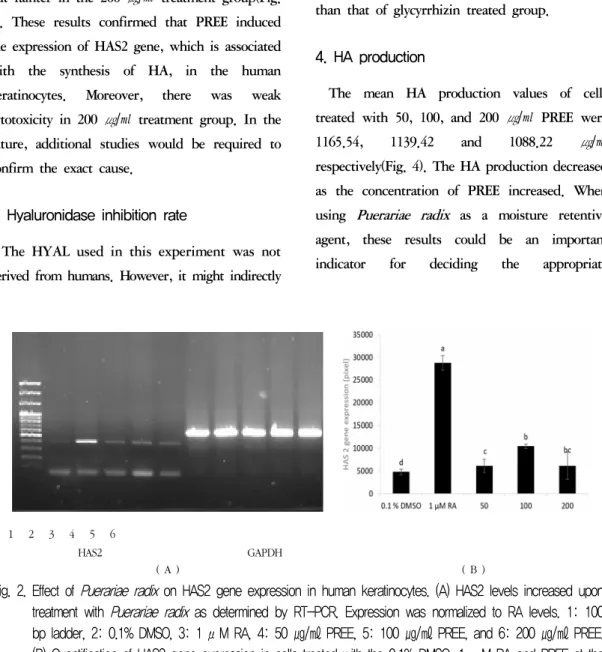
Induction of HAS2 gene expression by PREE was verified by RT-PCR. It was confirmed that HAS2 gene expression was induced by PREE at all concentrations. In particular, the band was most prominent in the 100 ㎍/㎖ treatment group, but fainter in the 200 ㎍/㎖ treatment group(Fig.
2). These results confirmed that PREE induced the expression of HAS2 gene, which is associated with the synthesis of HA, in the human keratinocytes. Moreover, there was weak cytotoxicity in 200 ㎍/㎖ treatment group. In the future, additional studies would be required to confirm the exact cause.
3. Hyaluronidase inhibition rate
The HYAL used in this experiment was not derived from humans. However, it might indirectly
1 2 3 4 5 6
HAS2 GAPDH
( A ) ( B )
Fig. 2. Effect of Puerariae radix on HAS2 gene expression in human keratinocytes. (A) HAS2 levels increased upon treatment with Puerariae radix as determined by RT-PCR. Expression was normalized to RA levels. 1: 100 bp ladder, 2: 0.1% DMSO, 3: 1 μM RA, 4: 50 ㎍/㎖ PREE, 5: 100 ㎍/㎖ PREE, and 6: 200 ㎍/㎖ PREE.
(B) Quantification of HAS2 gene expression in cells treated with the 0.1% DMSO, 1 μM RA and PREE at the indicated concentrations (50 - 200 ㎍/㎖). Values represent the mean ± SD of three independent measurements. Values with different superscripts are significantly different (p < 0.05) by ANOVA.
confirm the inhibition of HYAL in human skin.
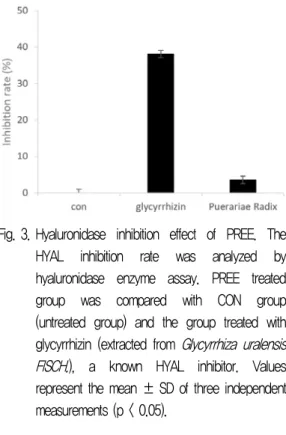
When cells treated with 200 ㎍/㎖ PREE, HYAL inhibition rate was 3.56% and when treated with glycyrrhizin, the inhibition rate was 38.08%(Fig.
3). Compared to the control group, PREE treated group exhibited increased inhibition of HYAL activity. However, the inhibition rate was lower than that of glycyrrhizin treated group.
4. HA production
The mean HA production values of cells treated with 50, 100, and 200 ㎍/㎖ PREE were 1165.54, 1139.42 and 1088.22 ㎍/㎖
respectively(Fig. 4). The HA production decreased as the concentration of PREE increased. When using Puerariae radix as a moisture retentive agent, these results could be an important indicator for deciding the appropriate
Fig. 3. Hyaluronidase inhibition effect of PREE. The HYAL inhibition rate was analyzed by hyaluronidase enzyme assay. PREE treated group was compared with CON group (untreated group) and the group treated with glycyrrhizin (extracted from Glycyrrhiza uralensis FISCH.), a known HYAL inhibitor. Values represent the mean ± SD of three independent measurements (p < 0.05).
Fig. 4. Effect of PREE on HA production in human keratinocytes. The cells were treated with the DMSO, 1 μM RA, and PREE at the indicated concentrations (50 - 200 ㎍/㎖) and amount of HA was measured by ELISA reader.
Values represent the mean ± SD of three independent measurements. Values with different superscripts are significantly different (p < 0.05) by ANOVA.
Fig. 5. Pilot study for moisturizing ability of PREE. The study was conducted on 12 normal women subjects. Before and 10 minutes after application, the application site and the non-application site were measured three times each and the values averaged. Moisture of the forearm area was measured using a corneometer and AU was used as the unit.
concentration. As the concentration increases, the expression of HA decreases. Therefore further studies are needed to determine the optimal concentration.
5. Pilot study
The study was conducted on 12 normal women subjects. Before and 10 minutes after application, the application site and the non-application site were measured three times each and the values averaged. At the non-application site, moisture levels were 34.32 AU before application and 34.33 AU 10 minutes after application. At the application site, moisture levels were 34.65 AU before application and 34.66 AU after 10 minutes after application(Fig. 5). There was almost no difference between before application and 10 minutes after application at either site. Thus, further studies with detailed experimental design
would be required.
Ⅳ. Discussion
In Korean medicine, the effect of Puerariae radix on skin includes engendering fluid (生津)14), releasing the flesh (解肌)15), opening interstices (開 腠理)15), and outthrusting rashes (透疹)14,16). Because of these effects, it has been reported that prescriptions containing Puerariae radix have been effective in treating skin diseases such as atopic dermatitis23), allergic contact dermatitis24), purpura25), and erysipelas26). According to Huangdineijing (黃帝內經), a classic of Korean medicine, if the operation of nutrient qi (榮氣) and defense qi (衛氣) is blocked and the blood circulation does not work, the skin will not be nourished (痛者, 寒氣多也, 有寒故痛也. 其不痛不仁 者, 病久入深, 榮衛之行濇, 經絡時踈, 故不通, 皮膚不 營, 故爲不仁)27). If fluid-humor (津液) is not supplied to the skin, the skin will be dry (皮毛焦 則津液去皮節, 津液去皮節者則爪枯毛折)28). Yin et al29) have stated that Puerariae radix can engender fluid by making the qi and blood circulation.
Puerariae radix like other legumes contains many isoflavones, in particular, the O-glucoside family daidzin and C-glucoside family puerarin(daidzein-8-C-glucoside)30). Both compounds have hypotensive31), anti-inflammatory32), bone-density increasing33), anticancer34), hepatoprotective35) and anti-depressant effects36). Although many studies have reported the antioxidant properties37,38) of Puerariae radix, few studies have focused on its moisturizing effects. Therefore, the purpose of this study was to evaluate the efficacy of
Puerariae radix as a moisturizing agent.
HA is a polysaccharide, classified as non-animal-derived stabilized hyaluronic acid (NASHA) and stabilized through bacterial fermentation and animal-derived product (extracted from chicken crust)39). It is produced by fibroblasts and keratinocytes. In mammals, its circulation period is known as 2 – 4.5 days. It is also present in the dermal and epidermal cell spaces (between the prickle-cell layer and the stratum corneum), but absent in the stratum corneum and granular layer. HA has excellent ability to absorb moisture and has a strong skin moisturizing effect. Therefore, it can aide in the skins function as a barrier. As aging progresses, the moisture content and elasticity of the skin decreases, and the changes are noticeable by the naked eye39). HA concentration tends to decrease with age or continuous exposure to ultraviolet rays or reduced humidity40). Decrease in HA concentration in the skin tissue reduces the skin elasticity, which causes wrinkles and roughness of skin19). With decrease in HA and moisture content of the skin stratum corneum, the balance of sebum and moisture level is lost. In severe cases, it can cause dermatitis41).
In the pilot study performed at the Chemical Trial Center for Bio-industry at Semyeong University, the moisturizing effect of PREE was not significant. This means that although PREE could possibly enhance HA synthesis in vitro, its penetration into the skin on application is limited.
Kim38) has experimentally demonstrated that Puerariae radix has an ultraviolet blocking effect.
In this study, HA synthesis activity of PREE was confirmed. However if additional studies to
determine the optimal concentration of PREE and studies related to multiple formulations containing Puerariae radix are conducted, Puerariae radix may have potential value in external herbal applications.
Ⅴ. Conclusions
In this study, to evaluate the moisturizing effect of Puerariae radix, a 70% (v/v) ethanol solution of the same was prepared, and MTT assay, RT-PCR, hyaluronidase enzyme assay, HA ELISA and a pilot study were conducted.
1. In the MTT assay, no apparent cytotoxicity was observed.
2. By RT-PCR, HAS2 gene expression was confirmed at all concentrations.
3. In the hyaluronidase enzyme assay, PREE inhibited HYAL activity.
4. Evaluation of HA synthesis by HA ELISA kit showed that 50 ㎍/㎖ treatment group was the highest concentration and its average value was 1165.54 ㎍/㎖.
5. In the pilot study, the site of application of PREE differed from the site of non-application.
However, there were no significant differences.
These results show that Puerariae radix could have significant effects when used alone or with multiple natural products in external herbal applications. Based on these results and additional studies, Puerariae radix could be a good raw material for external herbal applications.
References
1. Lee JC, Kim YR. The Effect of Beauty Therapy on the Self-esteem. Journal of Investigative Cosmetology. 2010;6(1):57-62.
2. Kim SW, Lee YR. What is Beauty? The Aesthetic Cognition of Korean Women in Their 20s and 30s. Journal of Marketing Research. 2012;23(2):351-82.
3. Yamamiya Y, Cash TF, Melnyk SE, Posavac HD, Posavac SS. Women's exposure to thin-and-beautiful media images: Body image effects of media-ideal internalization and impact-reduction interventions. Body image.
2005;2(1):74-80.
4. Jun JH. Influence of Youth-Pursuing on Appearance Concern and Appearance Management Behavior -Focus on Middle-Aged Women. Journal of the Korean Society of Clothing and Textiles. 2014;38(5):705-17.
5. Buhlmann U, Teachman BA, Naumann E, Fehlinger T, Rief W. The meaning of beauty:
Implicit and explicit self-esteem and attractiveness beliefs in body dysmorphic disorder. Journal of Anxiety Disorders.
2009;23(5):694-702.
6. Korean Dermatological Association Textbook Editing Board. Textbook of Dermatology. 6th ed. Seoul:Medbook. 2014:958, 970.
7. Biniek K, Kaczvinsky J, Matts P, Dauskardt RH. Understanding age-induced alterations to the biomechanical barrier function of human stratum corneum. Journal of dermatological science. 2015;80(2):94-101.
8. Kwon SB, Lee GT, Choi SJ, Lee NK, Park
HW, Lee KS, et al. The Effect of Glycerin, Hyaluronic Acid and Silicone Oil on the Hydration, Moisturization and Transepidermal Water Loss in Human Skin. Asian Journal of Beauty and Cosmetology. 2013;11(4):761-8.
9. J Necas, L Bartosikova, P Brauner, J Kolar.
Hyaluronic acid (hyaluronan): a review.
Veterinarni Medicina. 2008;53(8):397–411.
10. Song HJ, Jin MH, Lee SH. Effect of ferulic acid isolated from Cnidium officinale on the synthesis of hyaluronic acid. J Soc Cosmet Scientists Korea. 2013;39(4):281-8.
11. Kong HK, Whang IC. Evaluation of skin moisture, sebum, and skin elasticity in dry and oily skin types after glycolic acid peel.
Korean Journal of Aesthetic Society.
2010;8(3):1-10.
12. Min DL, Park EJ, Kang KH. Review of clinical and experimental studies on external application treatment for atopic dermatitis in the Korean literature. J Pediatrics of Korean Medicine. 2013;27(1):36-49.
13. Hwang CE, Lee BW, An MJ, Lee HY, Kim HT, Ko JM, et al. Changes of Phytochemicals and Antioxidant Activity during Fermentation of Brown Soymilk. Journal of Agriculture &
Life Science. 2016;50(4):157-67.
14. The Bonchohak compilation committee of the national College of Korean Medicine.
Bonchohak. Seoul:Yeonglimsa. 2006:186.
15. Heo J. Donguibogam. Seoul:Beobinbooks.
2002:271, 938.
16. Hwang DY. Bangyakhappyeon. Seoul:
Yeonglimsa. 2007:478, 479.
17. Stern R, Maibach HI. Hyaluronan in skin:aspects of aging and its pharmacologic
modulation. Clin Dermatol. 2008;26(2):106-22.
18. Lee PJ, Kim HT, Yoon KS, Park HC, Ha HY. The effect of Astragalus membranaceus methanol extract on hyaluronic acid production in HaCaT cells. J Kor Med Ophthalmol Otolaryngol Dermatol.
2013;26(1):75-81.
19. Kong R, Cui Y, Fisher GJ, Wang X, Chen Y, Schneider LM, et al. A comparative study of the effects of retinol and retinoic acid on histological, molecular, and clinical properties of human skin. Journal of cosmetic dermatology. 2015;15(1):49-57.
20. Sim GS, Lee DH, Kim JH, An SK, Choe TB, Kwon TJ, et al. Black rice (Oryza sativa L.
var. japonica) hydrolyzed peptides induce expression of hyaluronan synthase 2 gene in HaCaT keratinocytes. J Microbiol Biotechnol.
2007;17(2):271-9.
21. Takahashi T, Ikegami-Kawai M, Okuda R, Suzuki K. A fluorimetric Morgan–Elson assay method for hyaluronidase activity. Analytical biochemistry. 2003;322(2):257-63.
22. Lee SH, Chung J, Ahn SK, Kang JS, Kwon OK. Comparative Measurement of Skin Surface Hydration Using a Hydrometer and Corneometer. Korean Journal of Dermatology.
1994;32(4):599-608.
23. Hwang CH, Yun CS, Song SH, Weon YH, Hwang CY. Effects of Galgeunhaegitang- gamibang Administration along with Samhwangseze-gamibang on Atopic Dermatitis of NC/Nga Mice. J Kor Med Ophthalmol Otolaryngol Dermatol. 2008;21 (2):1-18.
24. Lim TH, Park HS. The Effects of
GalGunSeunggi-tang (GST) on Mice Induced Allergic Contact Dermatitis (ACD) by DNCB.
J Sasang Constitut Med. 2015;27(2):240-53.
25. Kim HS, Kim IH. A Case Study of Taeumin Yangdokbalban Patient diagnosed as Allergic Purpura. J Sasang Constitut Med. 2003;15 (3):139-46.
26. Bae JS, Kim JH, Wei TS. A Case Report of Galgunhaegui-tang Applied on Erysipelas.
Korean J Oriental Medical Physiology &
Pathology. 2001;15(4):571-3.
27. Kim KU, Mun JG. Jang JS. Huangdineijing Suwen. Seoul:Beobinbooks. 2014:242.
28. Kim KU, Mun JG. Jang JS. Huangdineijing Lingshu. Seoul:Beobinbooks. 2014:100.
29. Yin ZH, Gu XH, Zhao YS. On actions of engendering fluid and upraising fluid of Gegen (Radix Puerariae). Modern Chinese.
2014;1:18.
30. Zhang L, Pan Siu AK, Lin G, Zuo Z.
Intestinal absorbability of three Radix Puerariae isoflavones including daidzein, daidzin and puerarin. Chin Med. 2011;23 (6):41.
31. Choo MK, Park EK, Yoon HK, Kim DH.
Antithrombotic and Antiallergic Activities of Daidzein, a Metabolite of Puerarin and Daidzin Produced by Human Intestinal Microfiora. Biol Pharm Bull. 2002;25(10):
1328-32.
32. Wu H, Zhao G, Jiang K, Chen X, Zhu Z, Qiu C, et al. Puerarin Exerts an Antiinflammatory Effect by Inhibiting NF-kB and MAPK Activation in Staphylococcus aureus-Induced Mastitis. Phytother Res.
2016;30(10):1658-64.
33. Yuan SY, Sheng T, Liu LQ, Zhang YL, Liu XM, Ma T, et al. Puerarin prevents bone loss in ovariectomized mice and inhibits osteoclast formation in vitro. Chinese Journal of Natural Medicines. 2016;14(4):265-9.
34. Jarred RA, Keikha M, Dowling C, McPherson SJ, Clare AM, Husband AJ, et al. Induction of apoptosis in low to moderate-grade human prostate carcinoma by red clover-derived dietary isoflavones. Cancer Epidemiol Biomarkers Prev. 2002;11(12):1689-96.
35. Cho SY, Jang JY, Kim MJ. Effects of Pueraria flos and radix Water-extracts on Levels of Several Serum Biomarkers in Ethanol-treated Rats. J Korean Soc Food Sci Nutr.
2001;30(1):92-6.
36. Yan Bin, Wang DY, Xing DM, Ding Y, Wang RF, Lei F, et al. The antidepressant effect of ethanol extract of radix puerariae in mice exposed to cerebral ischemia reperfusion. Pharmacology, biochemistry, and behavior. 2004;78(2):319-25.
37. Eun YJ, Kwon KR, Rhim TJ, Song YK, Lim HH. Effects of Puerariae Radix extract on the activity of antioxidant. Journal of Pharmacopuncture. 2007;10(3):1-14.
38. Kim IC. Antioxidative Property and Whitening Effect of the Pueraria Radix, Poria Cocos and Coptidis Rhizoma. J. of The Korean Oil Chemists' Soc. 2008:25(2):219-25.
39. Korean Dermatological Association Textbook Editing Board. Textbook of Dermatology 6th ed. Seoul:Medbook. 2014:934, 960-1, 969.
40. Dai G, Freudenberger T, Zipper P, Melchior A, Grether-Beck S, Rabausch B, et al.
Chronic ultraviolet B irradiation causes loss of
hyaluronic acid from mouse dermis because of down-regulation of hyaluronic acid synthases. Am J Pathol. 2007;171(5):1451-61.
41. Lee SJ, Ahn SK, Lee SH. Medical Skin Care.
Professional Edition. Seoul:Yeomungak. 2009:
55-6.