Print ISSN: 2288-4637 / Online ISSN 2288-4645 doi:10.13106/jafeb.2021.vol8.no6.0255
The Relationship between Risk Disclosure and
Firm Performance: Empirical Evidence from Saudi Arabia*
Shehabaddin Abdullah A. AL-DUBAI1, Abeer M. M. ABDELHALIM2Received: September 15, 2020 Revised: April 20, 2021 Accepted: May 02, 2021
Abstract
This study aims to examine the moderating effect of risk management disclosure on the relationship between risk disclosure and firm performance as an attempt to contribute to the increasing body of literature concerning risk management disclosure by extracting new evidence from a fast-growing economic environment in Saudi Arabia. We used content analysis of cross-sectional data extracted from the audited annual reports of 72 non-financial Saudi listed firms in various non-financial sectors for the year 2018. Research hypotheses have been tested by using two robust statistical models (MM-Estimator Model and Robust Regression Model). The findings showed no evidence that risk disclosure and risk management disclosure matter concerning firm performance measured by the average of earning per share EPS when they are examined individually. However, when the moderating effect of risk management disclosure is considered, the results become significantly positive. These outcomes could explain one of the main reasons of the different and dissimilar findings of previous studies, which investigate the impact of risk disclosure and risk management disclosure on firm performance individually. Also, the results of this paper will help practitioners to reconsider the interacting relations of their risk disclosure and risk management disclosure actions on firm’s performance.
Keywords: Risk Disclosure, Risk Management Disclosure, Firm Performance, Saudi Arabia JEL Classification Code: D81, D84, G32, M41, M48
become increasingly demanding companies to disclose risk information and provide reliable data about their practices to decrease such uncertainties.
Risk disclosure (RD) and how these risks are managed have increasing importance and a critical role in investigators’ decision-making (Bao & Datta, 2014; Baimukhamedova, Baimukhamedova, & Luchaninova, 2017), which made RD becomes an important requirement of corporate disclosure practice, especially, in a business environment, which is increasingly affected by many successive variables and tangle complexities (Mazumder & Hossain, 2018).
Numerous studies have focused on measuring and evaluating the impact of risk and uncertainty on the corporations’ performance and its value. Several concepts and mechanisms have been developed in this context such as enterprise risk management (ERM), environmental, social, and governance related risks (ESGR), etc., aimed to monitor, assessing and managing the risks that may affect the firms’ performance. In the field of accounting disclosure, attention has recently focused on how to disclose these risks to stakeholders and provide them with objective and reliable information about the risk factors, how they affect the financial performance and how companies respond to them.
*Acknowledgements:
The authors acknowledge the Deanship of Scientific Research at King Faisal University for the financial support under Nasher Track (Grant No. 206080).
1 First Author and Corresponding Author. Assistant Professor, Department of Accounting, School of Business, King Faisal University, Saudi Arabia [Postal Address: P.O. Box 400, Al-Ahsa, 31982, Saudi Arabia] Email: [email protected]
2 [1]Assistant Professor, Applied Studies and Community Service, King Faisal University, Saudi Arabia. [2] Poet Said University, Egypt. Email: [email protected]
© Copyright: The Author(s)
This is an Open Access article distributed under the terms of the Creative Commons Attribution Non-Commercial License (https://creativecommons.org/licenses/by-nc/4.0/) which permits unrestricted non-commercial use, distribution, and reproduction in any medium, provided the original work is properly cited.
1. Introduction
Due to the global financial crisis, uncertainties and risks in the stock investment market have been increasing. Risk factors and uncertainty are mostly associated with non-financial conditions and information (environmental, social, legal, etc.) that may affect the value of the firm, and its ability to generate profits and achieve its strategic objectives. As a result, shareholders and regulators have sequentially
Most of the recent literature on RD focuses on cases and practices adopted in the developed countries (Callahan & Soileau, 2017; Linsmeier, Thornton, Venkatachalam, & Welker, 2002) with limitations associated with incomplete evidence by focusing on specific financial disclosure items, such as market risk disclosure, and voluntary risk disclosure (Al-Maghzom, Hussainey, & Aly, 2016; Elzahar & Hussainey, 2012; Abraham & Cox, 2007). However, many of these studies have only conducted a limited analysis of the impact of the firm’s risk levels on the risk disclosure type (Louhichi & Zreik, 2015; Elshandidy, Fraser, & Hussainey, 2013; Mokhtar & Mellett, 2013). Other studies focused on the associations between corporate governance and risk disclosure levels (Ibrahim & Ismail, 2011; Al-Maghzom et al., 2016).
Differently from others, this study attempts to responds to calls of previous studies that recommend investigating the relationships between RD and risk management disclosure (RMD) practices in emerging economies. Therefore, the current study tries to fill the gap in the literature by examining the moderating impact of RMD on the relationship between RM and the performance of non-financial publicly listed firms in Saudi Arabia using content analysis approach with not only mandatory risk disclosure but also any other voluntary information could that be useful for meeting the potential shareholders’ and investors’ needs.
With regards to the findings of this study, we expect to contribute to the practice and theory by providing new and different insights about the interaction of RD and RMD practices and their effect on the firms’ performance in an emerging and progressing market ranked 19th and accounting
for 25% of the total GDP of Arab economies (Solomon, 2012) that has an ambitious economic plan announced in the Saudi Vision 2030, which intended to create huge investment opportunities to attract domestic and foreign funds, which requires consequently best practices of transparency and accountability to protect investors’ rights. The outcome of this paper will help the regulatory bodies in Saudi Arabia to consider the importance of disclosing risk management for each risk type reported to provide a clear image on firm’ risks that help financial statements users to assess the risks factors, which firm exposed to and its impact on its performance.
As the current study focuses on non-financial PLCs, the findings many not be generalized to the financial sector and other settings. Also, as the board of directors and external auditor are the key responsible to apply and oversee risk management practices, it is suggested to investigate in depth the direct and moderating effect of their characteristics.
2. Literature Review and
Hypothesis Development
Definition of risk is one of the perplexing issues when studying risk disclosure practices, as different risk definitions
may lead to different visions and types of risk to be reported (Linsley, Shrives, & Crumpton, 2006). Different perspectives regarding the risk concept and risk disclosure definition have been documented in previous literature. Despite the absence of standard definition of RD, it can be categorized into two main definitions of risk (Hassan, 2011). The first is the pre-modern risk definition (one sided-risk definition) that only represents the negative effects of risk factors on the firm performance, and the second definition is the modern risk (two sided-risk definition) that represents both the negative and the positive impacts of risk factors. The pre-modern risk definition, for example, is in line with the definition of risk by Securities and Exchange Commission (SEC) Financial Reporting Release No.48, which requires listed companies to report qualitatively and quantitatively about market risks including potential losses from negative changes in interest rates, foreign exchange rates, and commodity and equity prices.
Most of the risk analytics and studies are dominated by the modern definition, a comprehensive understanding of the risks surrounding the company (Holton, 2004), including both the potential for profit and loss. For example, Solomon, Solomon, Norton, and Joseph (2000) defined risk as “the uncertainty associated with both a potential gain and loss” (p. 605). Beretta and Bozzolan (2004) defined risk disclosure as “the communication of information concerning firm’s strategies, operations, and other external factors that have the potential to affect expected results” (p. 269). Also, there is a two-sided definition that provide a definition to the Board of Directors to report risks as those disclosures that: “… inform the reader of any opportunity or possibility, or of any hazard, risk, damage, threat or exposure, which has already affected the Company or may affect the Company in the future”. This definition has been widely adopted by RD (Vandemaele, Vergauwen, & Michiels, 2009; Dobler, Lajili, & Zéghal, 2011; Mokhtar & Mellett, 2013; Nur Probohudono, Tower, & Rusmin, 2013; Zhang, Taylor, Qu, & Oliver, 2013).
Certain types of risk disclosures are mandatory and others are voluntary. Mandatory disclosure includes financial reports whose scope and coverage are prepared following the national reporting standards or IASB standards. Publicly-listed companies are also required to make disclosures dedicated to material events, directors share purchases and sales, and other information relevant to investment decisions. Although requirements vary from country to country, the required reports generally include financial statements that contain footnotes and director-level, management and corporate governance reports (UNCTAD, 2017).
Risk disclosure is expected to be convenient for investors, as it points out the magnitude of expected losses – possible and potential – of any business, and discloses management actions to reduce their, expected negative effects (Santos & Coelho, 2018). Risk reporting can explain unexpected changes in stock prices, due to the market’s
perception of continuing corporate profits that are fairly vulnerable to certain risk factors (Jorion, 2002; Lim & Tan, 2007). According to Elshandidy et al. (2013), the disclosure of risk information is critical to assessing future cash flow generation by the company, as investors determine the effects of uncertainty factors in the company’s value.
Two main approaches of theories have been employed to explain why a firm should disclose risk information (Abdel Razek, 2014) – the economic theory approach and the social and political theory approach. The economic theory approach relies on economic agents’ interest and profit maximization using the agency theory, signal theory, and cost theories. While the social and political approach focuses on the relationship linking the firm to its stakeholders in order to understand the motives of risk disclosure (Khlif & Hussainey, 2014). Those theories altogether have implications for financial risk disclosure concerning to practices of assessment, management, and disclosure to shareholders, in order to reduce the information asymmetry and agent conflicts between corporate’s management and the stakeholders
Despite the relevance of all the mentioned theories to our current study, we have chosen signaling theory, as we see that it works to involve the stakeholders in firm performance assessment and interpretation of the drivers and relationships between risk disclosure, risk management disclosure and company performance (Tabash, 2019; Dey, Hossain, & Rezaee, 2018).
RD studies by Dey et al. (2018) and Solomon et al. (2000) stated that risk disclosures and its management became an urgent requirement to improve the quality of the financial statements and performance indicators, therefore, enhancing the stakeholders’ abilities of estimating future cash flows. Further, it has been noted from previous literature that risk disclosure supports both agency theory and information asymmetry (Elshandidy et al., 2013; Vandemaele et al., 2009; Abraham & Cox, 2007; Lopes & Rodrigues, 2007) as it plays a significant role to decrease agency conflicts; this culminates in reducing information inconsistencies between the parties. However, business management might decide to report about some risk factors and their expected impacts to signal its efficiency and capability to handle risks, to differentiate itself from other corporates and achieve a competitive advantage, which might reflex into an improved reputation (market share) and therefore growing profitability, which is known as signal theory. Oluwagbemiga, Isaiah, and Esiemogie (2014) confirmed that the operational, financial and strategic risks disclosure can help stakeholders in interpreting performance indicators of listed companies in Nigeria. Based on the previous findings, we formulate the first hypothesis as follows:
H1: Risk disclosure has a positive impact on firm
performance.
Risk management is a set of procedures that help to maintain continuous improvement in the decision-making process, which in turn contributes to preserving the assets and reputation of the organization and thus achieving the highest levels of profitability.
Although there is excessive interest in risk management practices in the financial service sector (Callahan & Soileau, 2017), such practices have notably increased in nonfinancial context as well. The increased interest in risk management today is due to the high levels of competition and the accelerated pace of changes that occur that almost eliminated companies ’ability to predict, which implies higher levels of risk faced by companies. It can also be said that competitive, technological, social and political conditions have maximized the potential impact of operations-related failures, as well as the dividing changes in society, technology, science, and communication between society at the global level and businesses have made risk management an issue of special and great importance more than before.
There is much evidence of a significant relationship between risk management practices and the firm’s performance. There is evidence from Malaysia that there is a significant influence on firm performance through risk management implementation. Callahan and Soileau (2017) confirmed the linkage between enhanced operating performance and the maturity of RM processes.
Although there is evidence regarding the positive relationship between risk management and firm performance, other studies confirmed the absence and weakness of the relationship. For example, Agustina and Baroroh (2016) examined the mediation effect of financial performance on the relationship between RM and firm value, they found that RM has no significant impact on the firm value and profitability. Also, the analysis confirmed the insignificant mediation effect of financial performance. They suggest further researches to examine RM implementation from other perspectives, which can lead to different results.
Also, Laisasikorn and Rompho (2014) indicate that there is a weak positive correlation between success of the risk management system and performance measurement system in one side, with the financial performance of the firm as measured by return on assets (ROA), return on equity (ROE) and earnings per share (EPS) on the other side. However, it does prove to be essential that managers develop, enhance and utilize both systems to gain a competitive advantage and sustain the growth of the firm. Based on the previous findings we formulate the second hypothesis as follows:
H2: Risk management disclosure has a positive impact
on firm performance.
Signaling theory – as we mentioned earlier - can explain why companies voluntarily disclose information in their
annual reports (Haniffa & Cooke, 2002). In accordance with signaling theory, a firm’s information disclosure can be considered a signal to capital markets, directed to reduce information asymmetry that often exists between management and stakeholders, as well as to increase the firm’s value (Connelly, Certo, Ireland, & Reutzel, 2011; Rezaee, 2017).
Risk disclosure became in the recent business context a vital requirement to achieve the transparency and credibility of reporting, especially to the investors as the need to assess the risks which the firm exposed to, the potential harmful impacts of these risks on the financial performance , risk information acts duel critical role as it helps corporations to manage the threatens and uncertainty, and decreases the cost of capital, while for investors, it helps to evaluate the risk profile of a firm, assessment the market value and accuracy of security price prediction (Linsley et al., 2006; Habtoor et al., 2018).
However, there are many issues concerning the value relevance of risk disclosure represented in lack of correlation between risk disclosures and potential financial impacts; the appropriate quantity and quality of disclosures; disclosures often use generic language; and the problems of measurement and materiality of risk disclosures. These issues can be the major clues of the insignificance between the risk disclosure and corporate financial performance measured by the stock profitability (the direct reflection of investors’ decision making).
We can argue that the disclosed strategies or actions the management should take to reduce these negative effects can enhance the quality of reporting by increasing the materiality of risk information in the annual reports. Therefore, it can reduce the investors’ concerns about the corporate long-term performance in the context of risk and its changes and threatens.
However, and as can be concluded from prior studies, there is a large difference between the findings related to the impact of risk disclosure as well as risk management on firm performance. We can refer this disparity in the prior findings to the differences in the types or practice’s levels of risk disclosure and risk management disclosure, different environments of application, or the type and characteristics of sampled firms (financial or nonfinancial). These possible reasons were mentioned as the limitations of research in the previous studies, for example, Alzead and Hussainey (2017) and Dey et al. (2018).
From different point of view, we can assume that these differences can be due to focusing on examining the impact of risk disclosure as well as risk management on the firm performance individually and independently. Accordingly, based on the previous argument we formulate the third hypothesis as follows:
H3: Risk management disclosure positively moderates the
relationship between risk disclosure and firm performance.
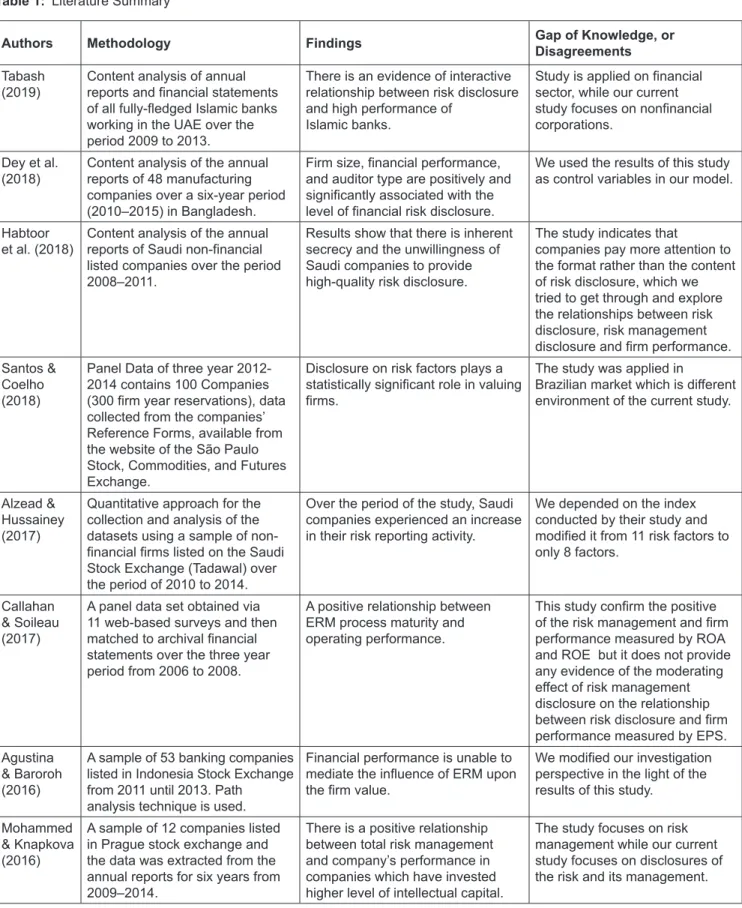
Table 1 summarizes the previous studies:
3. Research Methods and Data
This study adopted a quantitative research approach using a cross-sectional data model where data of dependent and independent variables were collected by using content analysis methods that mainly depend on the audited financial statement and board reports for the year 2018 available on the Saudi Stock Exchange Tadawul website. The study used a sample of 72 non-financial publicly-listed companies using a purposive sampling technique. This sample was chosen from 10 sectors, namely, Materials, Food and Beverages, Capital Goods, Consumer Durables and Apparel, Transportation, Telecommunication Services, Energy, Commercial and Professional Services, Utilities, and Pharma, Biotech and Life Science.
To quantify risk reporting and risk management reporting, different discourse indexes have been adopted (Mokhtar & Mellett, 2013; Alzead & Hussainey, 2017). For example, while Mokhtar and Mellett, (2013) used a disclosure index consists of six risk categories, Alzead and Hussainey (20170 used an index with 11 risk categories. However, the current study uses a constructed unweighted index consist of eight risk categories, the most common risk types reported in the annual reports of the sample firms, namely, credit risk, liquidity risk, interest rate risk, foreign currency risk, capital risk, commodity price risk, equity price risk, and other risks.
For eliminating the subjectivity, a dichotomous scoring scheme is used. Such approach facilitates independent analysis without relying on the perceptions of a particular user group (Mokhtar & Mellett, 2013). Companies that disclose any risk factor receive a ‘1’ score. Non-disclosed factor earns a firm a score of ‘0’. Once the assessment is complete, a single composite score for disclosure is calculated by taking the sum scores. The same approach is also used for scoring risk management disclosure. A number ‘1’ is given to companies that disclose its management of any risk factor and a ‘0’ is given for no management disclosure. Once the assessment is complete, a single composite score for disclosure is calculated by taking the sum scores.
The dependent variable of this study is the firm performance measured by the average of earning per share EPS for 2017 and 2018. The independent variables are risk disclosure and risk management disclosure. A multiplicative term of risk disclosure and risk management disclosure was included to examine the moderation effect of risk management. Following previous studies, several control variables were taken into account, namely, firm size, firm age, board of director’s size, external auditing quality and sectors (Alkurdi, Hussainey, Tahat, & Aladwan, 2019; Elzahar & Hussainey, 2012; Li, Wu, Ojiako, Marshall, & Chipulu, 2014; Tahir & Razali, 2011; Abraham & Cox, 2007).
Table 1: Literature Summary
Authors Methodology Findings Gap of Knowledge, or Disagreements
Tabash
(2019) Content analysis of annual reports and financial statements of all fully-fledged Islamic banks working in the UAE over the period 2009 to 2013.
There is an evidence of interactive relationship between risk disclosure and high performance of
Islamic banks.
Study is applied on financial sector, while our current study focuses on nonfinancial corporations.
Dey et al.
(2018) Content analysis of the annual reports of 48 manufacturing companies over a six-year period (2010–2015) in Bangladesh.
Firm size, financial performance, and auditor type are positively and significantly associated with the level of financial risk disclosure.
We used the results of this study as control variables in our model. Habtoor
et al. (2018) Content analysis of the annual reports of Saudi non-financial listed companies over the period 2008–2011.
Results show that there is inherent secrecy and the unwillingness of Saudi companies to provide high-quality risk disclosure.
The study indicates that
companies pay more attention to the format rather than the content of risk disclosure, which we tried to get through and explore the relationships between risk disclosure, risk management disclosure and firm performance. Santos &
Coelho (2018)
Panel Data of three year 2012-2014 contains 100 Companies (300 firm year reservations), data collected from the companies’ Reference Forms, available from the website of the São Paulo Stock, Commodities, and Futures Exchange.
Disclosure on risk factors plays a statistically significant role in valuing firms.
The study was applied in
Brazilian market which is different environment of the current study.
Alzead & Hussainey (2017)
Quantitative approach for the collection and analysis of the datasets using a sample of non-financial firms listed on the Saudi Stock Exchange (Tadawal) over the period of 2010 to 2014.
Over the period of the study, Saudi companies experienced an increase in their risk reporting activity.
We depended on the index conducted by their study and modified it from 11 risk factors to only 8 factors.
Callahan & Soileau (2017)
A panel data set obtained via 11 web-based surveys and then matched to archival financial statements over the three year period from 2006 to 2008.
A positive relationship between ERM process maturity and operating performance.
This study confirm the positive of the risk management and firm performance measured by ROA and ROE but it does not provide any evidence of the moderating effect of risk management disclosure on the relationship between risk disclosure and firm performance measured by EPS. Agustina
& Baroroh (2016)
A sample of 53 banking companies listed in Indonesia Stock Exchange from 2011 until 2013. Path
analysis technique is used.
Financial performance is unable to mediate the influence of ERM upon the firm value.
We modified our investigation perspective in the light of the results of this study.
Mohammed & Knapkova (2016)
A sample of 12 companies listed in Prague stock exchange and the data was extracted from the annual reports for six years from 2009–2014.
There is a positive relationship between total risk management and company’s performance in companies which have invested higher level of intellectual capital.
The study focuses on risk management while our current study focuses on disclosures of the risk and its management.
Authors Methodology Findings Gap of Knowledge, or Disagreements
Li et al.
(2014) A sample of 135 Chinese insurance companies in 2010. A regression mode is used.
No significant positive relationship between risk management and firm value.
The study focuses on the relationship between risk management and firm value whereby our current study focuses on the relationship between risk disclosures and firm performance with taking into account the moderating effect of risk management disclosures. Said et al.
(2013) A sample of 105 Egyptian non-financial listed in2007. Disclosure index and content analysis have been used.
Findings evidenced that
competition, role duality, board size, ownership concentration and auditor type are key determinants of risk reporting practices in Egypt.
The study investigates the determinants of the mandatory risk reporting and didn’t consider the relationships of the current study.
Hassan
(2011) A sample of 36 Egyptian listed banks. Questionnaire technique is used.
Credit and liquidity risks were found as the most challenging types of risks. Conventional banks outperform Islamic ones in dealing with risks using more sophisticated techniques and practices.
The study is applied on financial sector and to explore the differences between Islamic and non-Islamic banks in risk management practices. Jafari et al.
(2011) A sample of 52 companies listed in Tehran Stock Exchange and the data was extracted from the annual reports for six years from 2003 to 2008.
A significant positive association between total risk management and company’s performance is confirmed.
The study examine the association of total risk management (not risk management disclosure) and company’s performance in different environment.
Abraham &
Cox (2007) A sample of non-financial companies includes in UK FTSE 100 index. Data was extracted from the annual reports for year 2002 and analyzed using content analysis method.
A negative relationship between share ownership by long-term institutions and corporate risk reporting.
A positive relationship between both IVs (i.e. number of executive and the number of independent directors) and corporate risk reporting.
Studying risk disclosure from the perspective of the corporate governance and the ownership characteristics
Linsley et al. (2006)
An exploratory comparative study includes a sample of 18 Canadian and UK banks. Data was
extracted from the annual.
No difference in disclosure between Canadian banks and their UK counterparts.
A positive association between two IVs (i.e. bank size and number of risk definitions) and total quantity of risk disclosures.
No positive association between two IVs (i.e. bank profitability and level of risk) and total quantity of risk disclosures.
Study is applied on financial sector and examined the association between risk disclosures with different factors.
Table 1: (Continued)
As there is no single agreed approach on disclosing risks among companies (Abraham & Cox, 2007), researchers adopt different methods to classify risks. Dey et al. (2018) suggest examining the annual reports of the company in beginning before creating risk disclosure index.
Following Dey et al. (2018) method and given our research objectives to define the related risk types, we conducted an exploratory investigation of a sample of 35 Saudi non-financial companies. We found that the most common risk types reported in the annual reports of the sample firms
Table 3: T-test Analysis
Group Obs Mean Std. Err. Std. Dev
Firms with Risk
Disclosure Upper Average 42 1.08 0.25 1.63 Firms with Risk
Disclosure Lower Average 30 -0.37 0.85 4.65
Difference -1.44 0.78
Diff = mean(0) - mean(1)
T-value -1.8599
Degrees of freedom 70
Ha: diff < 0 Pr(T < t) = 0.0335
are grouped in eight factors, namely, Credit risk, Liquidity risk, Interest rate risk, Foreign currency risk, Capital risk, Commodity price risk, Equity price risk, and other risks. These risk types are well known in the field and previously captured by number of empirical studies (e.g., Dey et al., 2018; Lopes & Rodrigues, 2007; Linsmeier et al., 2002). The model of this study is as stated below:
EPS = α + β1 Risk Disclosure + β2 Risk Management
Disclosure + β3 Risk Disclosure × Risk Management Disclosure + β4 Firm Size
+ β5 Firm Age + β6 BOD Size + β7 Big4
+ β8 Sector + ɛ
Where:
EPS = (Net Income – Dividends on preferred stock) / Outstanding shares
Risk Disclosure = Sum of risk types disclosed. Risk disclosure checklist items consisted of eight risk types (Credit risk, Liquidity risk, Interest rate risk, foreign currency risk, Capital risk, Commodity price risk, Equity price risk, and other risks). Each risk type assigned a score of 1 if disclosed and 0 if not. Afterward, scores are added up to produce the sum of all risks disclosed. For example, if a company discloses all the eight groups then it gives the value 8, while a company discloses four groups then it gives the value 4.
Risk Management Disclosure = Sum of risk management strategies disclosed for the disclosed risks. For each risk management strategy disclosed a score of 1 is assigned and 0 if not. Afterward, scores are added up to produce the sum of all risk management strategies disclosed.
Risk Disclosure × Risk Management Disclosure = A multiplicative term of Risk disclosure and Risk Management variables.
Firm Size = Natural logarithm of total assets.
Firm Age = Number of years since the firm’s inception BOD Size = Total number of directors on the board. Big4 = A dummy variable that takes the value of
1 if the external auditor is among the big four audit companies, otherwise 0.
Sector = Industry dummies include nine dummies representing the ten sectors mentioned above.
4. Results and Discussion
In the model estimation, Breusch-Pagan/Cook-Weisberg test for the heteroscedasticity was performed using STATA software. Based on heteroscedasticity test results, the null hypothesis of constant variance were rejected (χ2 = 100.62,
p < 0.0000), which indicates that data is heteroscedastic.
Thus, to obtain a robust estimation against the heteroscedasticity problem, the MM-estimator of regression is used. “In recent years, it seems that a consensus has emerged to recommend the MM estimators as the best-suited estimation method, because they combine a high resistance to outliers and high efficiency for regression models with normal errors.” (Verardi & Croux, 2009, p. 451)
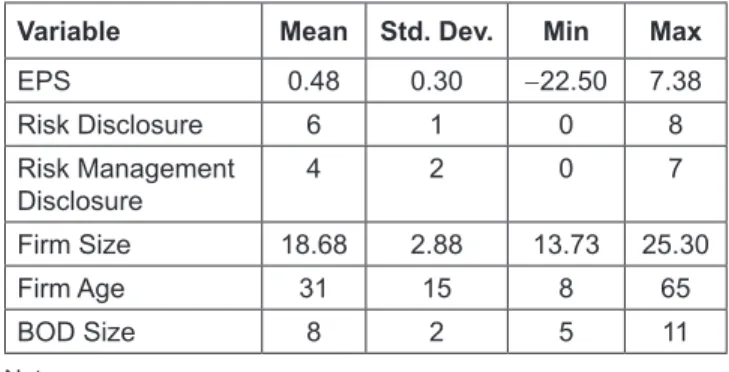
The descriptive statistics of the continuous variables are shown in Table 2.
Firms were categorized into two groups: firms with risk disclosure upper average and firms with risk disclosure lower average as can be shown from Table 3. The alternative hypothesis that the difference between the means of the two groups is greater than 0 is significant at 0.05 level. This indicates that firms that disclose more risks perform better than those whose risk disclosure level is less in terms of profitability (i.e., EPS).
As can be seen from Table 4, firms with risk disclosure upper average have lower total assets older than firms
Table 2: Variables Descriptive Analyses
Variable Mean Std. Dev. Min Max
EPS 0.48 0.30 -22.50 7.38 Risk Disclosure 6 1 0 8 Risk Management Disclosure 4 2 0 7 Firm Size 18.68 2.88 13.73 25.30 Firm Age 31 15 8 65 BOD Size 8 2 5 11 Notes:
1. Observations are 72 Firms.
with risk disclosure lower average, which is gong with the findings of Jafari, Chadegani, and Biglari (2011) and Mohammed and Knapkova (2016). In terms of the board of directors’ size, both have the same number of directors in average. However, in terms of audit quality, we found that firms with risk disclosure upper average are more clients with big four audit firms as their original auditor than their counterparts. Literally, the board of directors and the external auditor play an important role in the process of accounting disclosure of the risks facing the company. Not only just disclosure, but also it exceeds that by disclosing risk management policies and giving investors and
stakeholders sufficient information through which they can make decisions about the companies under investigation (Maingot, Quon, & Zeghal, 2013).
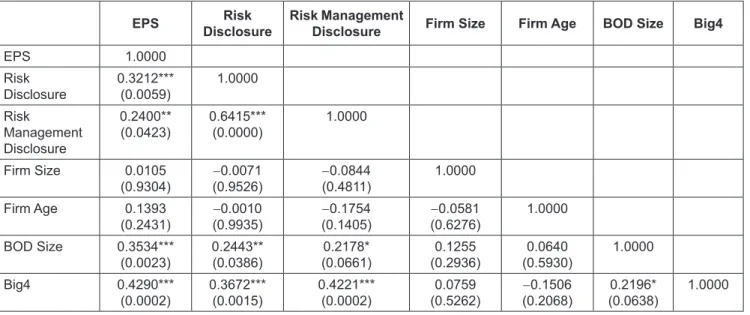
Table 5 shows the Spearman’s rank correlation coefficients of the variables. It shows that multicollinearity is not a concern in this study. To confirm the absence of a multi-collinearity problem, variance inflation factors were computed. The highest observed variance inflation index (VIF) is 2.02, which is far below the value of 10 that would suggest multi-collinearity (e.g., Hair, Black, Babin, & Anderson, 2010). The table shows that EPS is positively correlated to both risk disclosure and risk
Table 4: Groups Descriptive Analyses
Groups Obs. Mean Std. Dev Min Max
Firms with Risk Disclosure Upper Average Firm Size 42 18.5 3.18 13.73 25.30
Firms with Risk Disclosure Lower Average 30 18.9 2.45 14.31 22.10
Firms with Risk Disclosure Upper Average Firm Age 42 31.4 14.67 10 65
Firms with Risk Disclosure Lower Average 30 30.3 14.86 8 61
Firms with Risk Disclosure Upper Average BOD Size 42 8 1 5 11
Firms with Risk Disclosure Lower Average 30 8 2 5 11
Firms with Risk Disclosure Upper Average Big4 23 Not Big4 19 Firms with Risk Disclosure Lower Average Big4 7
Not Big4 23
Table 5: Spearman’s Rank Correlation Matrix
EPS DisclosureRisk Risk Management Disclosure Firm Size Firm Age BOD Size Big4
EPS 1.0000 Risk Disclosure 0.3212***(0.0059) 1.0000 Risk Management Disclosure 0.2400** (0.0423) 0.6415***(0.0000) 1.0000 Firm Size 0.0105 (0.9304) (0.9526)-0.0071 -0.0844(0.4811) 1.0000 Firm Age 0.1393 (0.2431) (0.9935)-0.0010 (0.1405)-0.1754 -0.0581(0.6276) 1.0000 BOD Size 0.3534*** (0.0023) 0.2443**(0.0386) (0.0661)0.2178* (0.2936)0.1255 (0.5930)0.0640 1.0000 Big4 0.4290*** (0.0002) 0.3672***(0.0015) 0.4221***(0.0002) (0.5262)0.0759 -0.1506(0.2068) (0.0638)0.2196* 1.0000 *p < 0.1, **p < 0.05, ***p < 0.01.
management disclosure variables at 0.01 and 0.05 significant level.
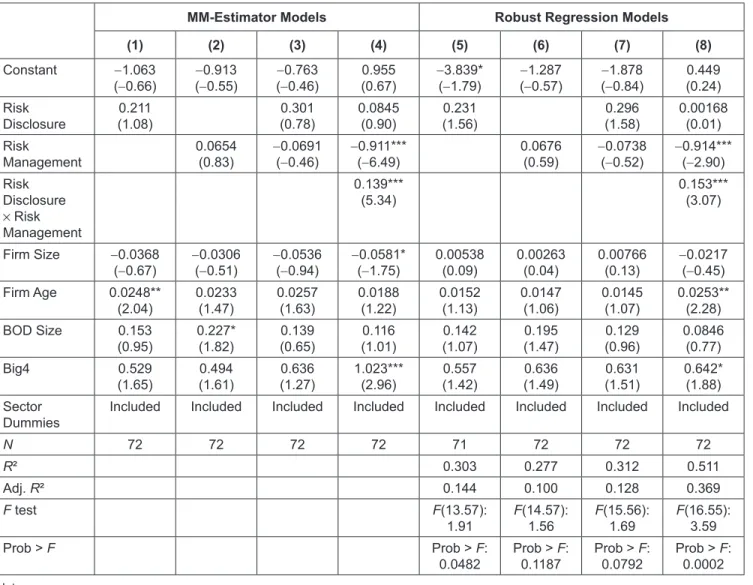
The hypotheses are tested in four models in Table 6 (i.e., Model 1, 2, 3 and 4) using MM-estimator by implying mm regress STATA command, which was developed by Verardi and Croux (2009). It became recently one of the most widespread robust statistical methods “because they combine a high resistance to outliers and high efficiency for regression models with normal errors.” (Verardi & Croux, 2009, p. 451)
MM-estimator Model 1 and Robust Regression Model 5 show the results of risk disclosure and firm performance as
measured by average EPS. The hypothesis predicts a positive impact of risk disclosure on firm performance, the coefficient is positive, but insignificant in both models (β = 0.211 with
t = 1.08) and (β = 0.231 with t = 1.56), respectively. Even
when the variable (i.e., risk disclosure) was collectively tested with risk management in MM-estimator Model 3 and Robust Regression Model 7, the results did not change and, thus, the hypothesis (1) is not supported. This implies that disclosing risk information relates to business operations and other potential external factors do not affect the expected results of the listed Saudi companies itself.
Table 6: Results of Regression Analyses
MM-Estimator Models Robust Regression Models
(1) (2) (3) (4) (5) (6) (7) (8) Constant -1.063 (-0.66) (-0.55)-0.913 -0.763 (-0.46) 0.955 (0.67) -3.839* (-1.79) (-0.57)-1.287 (-0.84)-1.878 (0.24)0.449 Risk Disclosure (1.08)0.211 (0.78)0.301 0.0845 (0.90) (1.56)0.231 (1.58)0.296 0.00168 (0.01) Risk Management 0.0654 (0.83) -0.0691 (-0.46) -0.911*** (-6.49) 0.0676 (0.59) -0.0738 (-0.52) -0.914*** (-2.90) Risk Disclosure × Risk Management 0.139*** (5.34) 0.153*** (3.07) Firm Size -0.0368 (-0.67) -0.0306 (-0.51) -0.0536 (-0.94) -0.0581* (-1.75) 0.00538 (0.09) 0.00263 (0.04) 0.00766 (0.13) -0.0217 (-0.45) Firm Age 0.0248** (2.04) 0.0233 (1.47) 0.0257 (1.63) 0.0188 (1.22) 0.0152 (1.13) 0.0147 (1.06) 0.0145 (1.07) 0.0253** (2.28) BOD Size 0.153 (0.95) 0.227* (1.82) (0.65)0.139 (1.01) 0.116 (1.07) 0.142 (1.47)0.195 (0.96)0.129 0.0846 (0.77) Big4 0.529 (1.65) (1.61)0.494 (1.27)0.636 1.023*** (2.96) (1.42)0.557 (1.49)0.636 (1.51)0.631 0.642* (1.88) Sector
Dummies Included Included Included Included Included Included Included Included
N 72 72 72 72 71 72 72 72 R² 0.303 0.277 0.312 0.511 Adj. R² 0.144 0.100 0.128 0.369 F test F(13.57): 1.91 F(14.57): 1.56 F(15.56): 1.69 F(16.55): 3.59 Prob > F Prob > F:
0.0482 Prob > F: 0.1187 Prob > F: 0.0792 Prob > F: 0.0002 Notes:
1. t-statistics in parentheses, *p < 0.1, **p < 0.05, ***p < 0.01.
2. Sector Dummies included: Sec 01 = Materials, Sec 02 = Food and Beverages, Sec 03 = Capital Goods, Sec 04 = Consumer Durables and Apparel, Sec 05 = Transportation, Sec 06 = Telecommunication Services, Sec 07 = Energy, Sec 08 = Commercial and Professional Svc, Sec 09 = Utilities.
For testing hypothesis 2, MM-estimator Model 2 and Robust Regression Model 6 were tested. The coefficients are positive, but insignificant in both models at (β = 0.0654 with t = 0.83) and (β = 0.0676 with t = 0.59), respectively. The signs of the coefficients turned to be negative when the variable was collectively tested with risk disclosure and remains insignificant in MM-estimator Model 3 and Robust Regression Model 7. This suggests that the hypothesis that presumes a positive impact of risk management disclosure on firm performance was not supported. Even though, this finding does not agree with most of the previous empirical studies (Mohammed & Knapkova, 2016; Ai Ping & Muthuveloo, 2015; Callahan & Soileau, 2017), it still agrees with some (Li et al., 2014; Otieno, 2012; Tahir & Razali, 2011).
The findings of these analyses could be attributed to a variety of causes. Firstly, the data used in this study is a cross-sectional data and not time series one, which hinders to extract the long run effects of risk management adoption. Secondly, this study implemented two robust estimation models (i.e., MM-estimator Model and Robust Regression Model), which outperform all estimations that have been used in the previous studies. Nonetheless, failing to find a significant result does not mean that adopting risk management procedures by Saudi firms has no advantages, rather it means that the moderation effect between risk disclosure and risk management is worthy of study and supports the main objective of this study.
Concerning hypothesis 3, MM-estimator Model 4 and Robust Regression Model 8 of Table 6 have been utilized to examine the moderation effect of risk management disclosure on the relationship between risk disclosure and firm performance, controlling for firm’s size, firm’s age, board of director size, auditing quality, and industry sectors. The results show that interaction term Risk Disclosure × Risk Management Disclosure has a positive and significant coefficient, at the 99% confidence level, in both models (at β = 0.139 with t = 5.34 and β = 0.153with t = 3.07, respectively). Thus, the performance of the firms has not been affected by the level of risk disclosure itself, but it does when the management discloses adopting a variety of strategies to manage those disclosed risks to maximize shareholder value. This is in line with earlier studies that confirmed the effective role of risk management in improving firms’ ability to achieve its strategic objectives and, thus, enhancing firm value (Callahan & Soileau, 2017; Ai Ping & Muthuveloo, 2015).
5. Conclusion
In a rapidly growing economy, such as Saudi Arabia, with continuous claims by the official authorities for companies by improving its risk disclosure practices to
provide reasonable assurance of supporting potential investors and market participants with reliable information of the firm’s performance. This study examined the moderation effect of risk management disclosure on the relationship between risk disclosure and firm performance of 72 non-financial public listed companies in Saudi Arabia for the year of 2018.
By using two robust statistical models (i.e., MM-estimator model and Robust Regression Model), the study finds no evidence that risk disclosure and risk management disclosure matter concerning to firm performance when they examine individually for this Saudi dataset. However, when the moderation effect of risk management disclosure on the relationship between risk disclosure and firm performance was tested, the results become significantly positive. Such results indicate that the performance of the firms is not affected by how many risks have been disclosed by the company, but the most important thing is to show the potential investors how such risks are effectively managed for maximizing its shareholders’ values through adopting various risk management strategies.
The outcome of this paper will help the regulatory bodies in Saudi Arabia to consider the importance of disclosing risk management for each risk type disclosed to provide a clear picture on firms’ risks that help financial statements users to assess the extent of risk and its impact on its performance. Such results open a door to the future studies to examine any moderation effect of other related variables to capture the accurate picture of the relationship between risk disclosure, risk management and, firm performance.
References
Abdel Razek, M. (2014). The association between corporate social responsibility disclosure and corporate governance – a survey of Egypt. Research Journal of Finance and Accounting, 5, 93–98. https://www.iiste.org/Journals/index.php/RJFA/article/ view/10457
Abraham, S., & Cox, P. (2007). Analysing the determinants of narrative risk information in UK FTSE 100 annual reports.
The British Accounting Review, 39(3), 227–248. https://doi.
org/10.1016/j.bar.2007.06.002
Agustina, L., & Baroroh, N. (2016). The Relationship Between En-terprise Risk Management (ERM) And Firm Value Mediated Through The Financial Performance. Review of Integrative
Busi-ness and Economics Research, 5(1), 128–138. https://sibresearch.
org/uploads/3/4/0/9/34097180/riber_h15-081_128-138.pdf Ai Ping, T., & Muthuveloo, R. (2015). The Impact of Enterprise
Risk Management on Firm Performance: Evidence from Malaysia. Asian Social Science, 11(22), 149–159. https://doi. org/10.5539/ass.v11n22p149
Alkurdi, A., Hussainey, K., Tahat, Y., & Aladwan, M. (2019). The Impact of Corporate Governance on Risk Disclosure: Jordanian
Evidence. Academy of Accounting and Financial Studies
Journal, 23(1), 1–16. https://www.abacademies.org/abstract/
the-impact-of-corporate-governance-on-risk-disclosure-jordanian-evidence-7886.html
Al-Maghzom, A., Hussainey, K., & A Aly, D. (2016). Corporate Governance and Risk Disclosure: Evidence from Saudi Arabia. Corporate Ownership and Control Journal, 13(2), 145–166. https://papers.ssrn.com/sol3/papers.cfm?abstract_ id=2720337
Alzead R., & Hussainey, K. (2017). Risk disclosure practice in Saudi non-financial listed companies. Corporate Ownership
& Control, 14(4–1), 262–275. https://doi.org/10.22495/
cocv14i4c1art8
Bao, Y., & Datta, A. (2014). Simultaneously Discovering and Quantifying Risk Types from Textual Risk Disclosures.
Management Science, 60(6), 1371–1391. https://pubsonline.
informs.org/doi/abs/10.1287/mnsc.2014.1930
Baimukhamedova,A., Baimukhamedova, G., & Luchaninova, A.
(2017). Financial Disclosure and the Cost of Equity Capital: The Empirical Test of the Largest Listed Companies of Kazakhstan,
Journal of Asian Finance, Economics and Business, 4(3), 5–17.
https://doi.org/10.13106/jafeb.2017.vol4.no3.5
Beretta, S., & Bozzolan, S. (2004). A framework for the analysis of firm risk communication. The International Journal of
Accounting, 39(3), 265–288. https://doi.org/10.1016/j.intacc.
2004.06.006
Callahan, C., & Soileau, J. (2017). Does Enterprise Risk Management Enhance Operating Performance? Advances in Accounting, 37, 122–139. https://doi.org/10.1016/j.adiac.2017.01.001
Connelly, B. L., Certo, S. T., Ireland, R. D., & Reutzel, C. R. (2011). Signaling Theory: A Review and Assessment.
Journal of Management, 37(1), 39–67. https://doi.
org/10.1177/0149206310388419
Dey, R., Hossain, S., & Rezaee, Z. (2018). Financial Risk Disclosure and Financial Attributes among Publicly Traded Manufacturing Companies: Evidence from Bangladesh. Journal of Risk and
Financial Management, 11(3), 1–16. https://doi.org/10.3390/
jrfm11030050
Dobler, M., Lajili, K., & Zéghal, D. (2011). Attributes of Corporate Risk Disclosure: An International Investigation in the Manufacturing Sector. Journal of International Accounting
Research, 10(2), 1–22. https://doi.org/10.2308/jiar-10081
Elshandidy, T., Fraser, I., & Hussainey, K. (2013). Aggregated, voluntary, and mandatory risk disclosure incentives: Evidence from UK FTSE all-share companies. International Review
of Financial Analysis, 30, 320–333. https://doi.org/10.1016/
j.irfa.2013.07.010
Elzahar, H., & Hussainey, K. (2012). Determinants of narrative risk disclosures in UK interim reports. The Journal of Risk Finance,
13(2), 133–147. https://doi.org/10.1108/15265941211203189
Habtoor, O. S., Ahmad, N., Baabbad, M. A., Masood, A., Mohamad, N., & Che Haat, M. H. (2018). Corporate risk disclosure practice in Saudi Arabia: Secrecy versus transparency. International
Journal of Advanced and Applied Sciences, 5(12), 42–58. http://
www.science-gate.com/IJAAS/2018/V5I12/Habtoor.html Hair, J. F., Black, W. C., Babin, B. J., & Anderson, R. E. (2010).
Multivariate Data Analysis (7th ed.). London: Pearson.
Haniffa, R. M., & Cooke, T. E. (2002). Culture, Corporate Governance and Disclosure in Malaysian Corporations. Abacus,
38(3), 317–349. https://doi.org/10.1111/1467-6281.00112
Hassan, W.M. (2011). Risk management practices: a comparative analysis between Islamic banks and conventional banks in the Middle East. International Journal of Academic Research,
3(3), 288–295. https://doi.org/10.22495/rgcv5i4c2art1
Holton, G. A. (2004). Defining Risk. Financial Analysts Journal,
60(6), 19–25. https://doi.org/10.2469/faj.v60.n6.2669
Ibrahim, W. H. W., & Ismail, A. G. (2011). Disclosure, Risk and Performance in Islamic Banking: A Panel Data Analysis.
International Research Journal of Finance and Economics, 72,
100–114.
Jafari, M., Chadegani, A. A., & Biglari, V. (2011). Effective Risk Management And Company’s Performance: Investment In Innovations And Intellectual Capital Using Behavioral And Practical Approach. Journal of Economics and International
Finance, 3(15), 780–786. https://academicjournals.org/journal/
JEIF/article-full-text-pdf/37819CB5997/
Jorion, P. (2002). How Informative Are Value-at-Risk Disclosures?
The Accounting Review, 77(4), 911–931. https://doi.org/
10.2308/accr.2002.77.4.911
Laisasikorn, K., & Rompho, N. (2014). A Study of the Relationship Between a Successful Enterprise Risk Management System, a Performance Measurement System and the Financial Performance of Thai Listed Companies. Journal of Applied
Business and Economics, 16(2), 81–92.
Li, Q., Wu, Y., Ojiako, U., Marshall, A., & Chipulu, M. (2014). Enterprise risk management and firm value within China’s insurance industry. Acta Commercii, 14(1), 1–10. https://doi. org/10.4102/ac.v14i1.198
Lim, Y. C., & Tan, M-S. P. (2007). Value relevance of value-at-risk disclosure, Review of Quantitative Finance and Accounting,
29, 353–70. https://doi.org/10.1007/s11156-007-0038-7
Linsley, P. M., Shrives, P. J., & Crumpton, M. (2006). Risk disclosure: An exploratory study of UK and Canadian banks.
Journal of Banking Regulation, 7(3–4), 268–282. https://doi.
org/10.1057/palgrave.jbr.2350032
Linsmeier, T. J., Thornton, D. B., Venkatachalam, M., & Welker, M. (2002). The Effect of Mandated Market Risk Disclosures on Trading Volume Sensitivity to Interest Rate, Exchange Rate, and Commodity Price Movements. The
Accounting Review, 77(2), 343–377. https://doi.org/10.2308/
accr.2002.77.2.343
Lopes, P. T., & Rodrigues, L. L. (2007). Accounting for financial instruments: An analysis of the determinants of disclosure in the Portuguese stock exchange. The International Journal of
Accounting, 42(1), 25–56. https://doi.org/10.1016/j.intacc.
Louhichi, W., & Zreik, O. (2015). Corporate Risk Reporting: A study of The Impact of Risk Disclosure on Firms Reputation.
Economics Bulletin, 35(4), 2395–2408. https://ideas.repec.
org/a/ebl/ecbull/eb-15-00374.html
Khlif H., & Hussainey, K. (2014). The association between risk disclosure and firm characteristics: A meta-analysis. Journal of
Risk Research 19(2), 1–31. https://doi.org/10.1080/13669877.
2014.961514
Maingot, M., Quon, T., & Zeghal, D. (2013). The Disclosure Of Enterprise Risk Management (Erm) Information: An Overview Of Canadian Regulations For Risk Disclosure. Journal
of Governance and Regulation, 2(4), 13–21. https://doi.
org/10.22495/jgr_v2_i4_p2
Mazumder M. M. & Hossain D. M. (2018). Research on Corporate Risk Reporting: Current Trends and Future Avenues. Journal
of Asian Finance, Economics and Business, 5(1), 29–41.
https://doi.org/10.13106/jafeb.2018.vol5.no1.29
Mohammed, H. K., & Knapkova, A. (2016). The Impact of Total Risk Management on Company’s Performance. Procedia -
Social and Behavioral Sciences, 220, 271–277. https://doi.
org/10.1016/j.sbspro.2016.05.499
Mokhtar, E. S., & Mellett, H. (2013). Competition, corporate governance, ownership structure and risk reporting. Managerial
Auditing Journal, 28(9), 838–865. https://doi.org/10.1108/
MAJ-11-2012-0776
Nur Probohudono, A., Tower, G., & Rusmin, R. (2013). Risk disclosure during the global financial crisis. Social
Responsibility Journal, 9(1), 124–137. https://doi.org/10.1108/
17471111311307859
Otieno, O. J. (2012). The Relationship Between Enterprise Risk
Management Practices And Financial Performance of Non-Financial Firms Listed In Nairobi Securities Exchange
[Master]. University of Nairobi. http://erepository.uonbi.ac.ke/ handle/11295/95923
Oluwagbemiga, O. E., Isaiah, O. O., & Esiemogie, I. P. (2016). The relationship between the risk management practices and financial performance of the Nigerian listed banks, Accounting
and Management Information Systems, 15(3), 565–587.
Rezaee, Z. (2017). Corporate Sustainability: Theoretical and Integrated Strategic Imperative and Pragmatic Approach. The
Journal Of Business Inquiry, 16(1 Spec), 60–87. Retrieved
from https://journals.uvu.edu/index.php/jbi/article/view/77 Santos, J. G. C., & Coelho, A. C. (2018). Value-relevance of
disclosure: Risk factors and risk management in Brazilian firms. Revista Contabilidade and Finanças, 29(78), 390–404. https://doi.org/10.1590/1808-057x201806150
Solomon, D. H. (2012). Selective Publicity and Stock Prices. The
Journal of Finance, 67(2), 599–638. https://doi.org/10.1111/
j.1540-6261.2012.01726.x
Solomon, J. F., Solomon, A., Norton, S. D., & Joseph, N. L. (2000). A Conceptual Framework for Corporate Risk Disclosure Emerging From The Agenda For Corporate Governance Reform. The British Accounting Review, 32(4), 447–478. https://doi.org/10.1006/bare.2000.0145
Tabash, M. I. (2019). An Empirical Investigation on the Relation between Disclosure and Financial Performance of Islamic Banks in the United Arab Emirates, Journal of Asian Finance,
Economics and Business, 6(4), 27–35. https://doi.org/10.13106/
jafeb.2017.vol4.no3.5
Tahir, I. M., & Razali, A. R. (2011). The Relationship Between Enterprise Risk Management (ERM) And Firm Value: Evidence From Malaysian Public Listed Companies.
International Journal of Economics and Management Sciences, 1(2), 32–41.
UNCTAD. (2017, November 1–3). The role of disclosure in
risk assessment and enhancing the usefulness of corporate reporting in decision-making [Paper Presentation]. United
Nations Conference on Trade and Development, Geneva, Switzerland. https://unctad.org/system/files/official-document/ ciiisard82_en.pdf
Vandemaele S., Vergauwen P., & Michiels A. (2009). Management
Risk Reporting Practices and their determinants. https://www.
researchgate.net/publication/277755521_Management_Risk_ Reporting_Practices_and_their_determinants
Verardi, V., & Croux, C. (2009). Robust regression in Stata. Stata
Journal, 9(3), 439–453.
Zhang X., Taylor D., Qu W., & Oliver J. (2013). Corporate risk disclosures: Influence of institutional shareholders and audit committee. Corporate Ownership and Control, 10(4), 341–354. https://doi.org/10.22495/cocv10i4c3art5