Information available at the Culinary Society of Korea (http://www.culinary.re.kr/)
Culinary Science & Hospitality Research
Journal & Article Management System: https://cshr.jams.or.kr/
http://dx.doi.org/10.20878/cshr.2017.23.6.002
Has Eco-friendly Management Influence on the Customer’s Purchasing Intention at Franchise Korean-restaurant
Tae-Hwan Yoon
Dept. of Culinary Art, The College, University of KIT, Korea
KEYWORDS ABSTRACT
Eco-friendly management, Purchasing intention, Franchise Korean
restaurant.
The purpose of this article was to study the influence of eco-friendly management on customer's purchasing-intention at franchise Korean restaurants. In this research, factor analysis and multi regression analysis were used. Eco-friendly management was divided into 4 factors. Eco friendly service affected positively brand image (p<0.05). Energy saving positively affected brand image (p<0.005). Contribution to local society positively affected brand image (p<0.05). Menu composition affected the most positively brand image (p<0.001). At last, brand image had positive influence on purchasing intention (p<0.001). According to these results, we confirmed that the factors of eco friendly management influenced significantly on the customers' perception of brand image. As a result, food service corporations need to deal with the factors of eco friendly management efficiently. The findings of this research would help business management to build effective service marketing strategies and to satisfy the needs of customers at franchise Korean restaurants.
Corresponding author: Tae-Hwan Yoon, Dept. of Culinary Art, KIT College & University, Jure-dong, Sasang-gu, Busan, South Korea, Tel. +82-51-320- 4901, Fax. +82-50-4198-3206, E-mail: [email protected]
1. INTRODUCTION
Continuous attentions of customers have been paid to eco- friendly foods. Eco-friendly agriculture market recorded the point 3,892,700 million Korean won due to increasing of well- being aiming costumers to prefer safe and clean food in spite of expensive food items. Many food service companies have perceived the importance of promoting environmental aware- ness and needs of use about eco-friendly food material to create their competitive advantages (Jeon, 2017; Shafie & Rennie, 2012). And it grew as the big market with 10% of total domestic agriculture markets. Domestic and abroad corpora- tions are expanding eco-friendly management through environ- ment protection. That is to say, they create the increase of consumer markets about eco-friendly foods with reduction of
environment pollutions (Jang, 2010; Yoon, 2015).
Besides, managers are planning and executing the eco- friendly policies in the various industries. Local food restau- rants use agricultures which are producted at local farms in European nations. They concentrate saving the energy, and generally use the natural energy. In America, green restaurant- certification systems are gaining continuous popularity (Lee, 2003). In recent years, domestic consumers react sensitively to this changes of environments and foods to eat. As it were, eco-friendly restaurants to use the natural food materials with naturalism marketing have big popularity among the restau- rant consumers (Roitner, Darnhofer, & Somsook, 2008; Yoo
& Kim, 2009).
Moreover, because buying the foods at the eco-friendly restaurants supports various benefits like as not only the ad-
vantages and welfares of consumers themselves but also posi- tive influences to their society and environment, the eco- friendly restaurants are gaining the popularity day by day. Buy means of the one case of foods corporations' eco-friendly management, they adopt and execute the eco-friendly manage- ment of treatment methods about environmentally hazardous wastes, packing papers, waste water and etc (Lee, 2003; Yoo
& Nam, 2012).
McDonald's fast-food restaurant company got positive social attentions due to abolishing the guarantee money policy about retrieving disposable cups (Ko, Um, & Lee, 2011).
As observed above, consumers pay attentions to eco-friendly management of the restaurant companies, and food service corporations are increasing with eco-friendly management for setting up the important marketing strategy by means of the competition advantages (Jeon, 2006). Therefore, eco-friendly management is meaningful survival strategy and subject for maintaining of company's profitability through the active implementations. Through carrying out the eco-friendly manage- ment, food service corporations contribute to the protection of environment, besides, they can induce the cost savings through the energy reductions. In other words, this means profit improvement and elevation with customer's revisiting and retaining (Van, 2001; Manaktola & Jauhari, 2007).
As a consequence, eco-friendly management of food service companies needs considering brand image to reflect custo- mer's health and continuous possibility for the active treat- ment against kaleidoscopic market environment. Moreover, they are required the differentiation of eco-friendly manage- ment planning, execution and needful necessities of manage- ment strategy about buying intention, evaluation and repur- chase intention through the effective analysis of consumer decision-making.
Accordingly, the aim of this article are next two ideas: the first is to research about clear establishment about eco- friendly management's attributes of food service corporations;
the second is to study about the influence of eco-friendly management on brand images and customer’s purchasing intention at franchise Korean-restaurant; third, on the bases of result analysis, we hope to understand customer's recog- nition and attitudes about food service corporations to perform eco-friendly managements. We shall now proceed to propose basic data about consumer's purchasing intention and attitude for food service companies. Futhermore we would like to consider the new method of providing positive
brand image, and suggest building effective food service mar- keting strategies with implication of this research for managers of hospitality industry.
2. LITERATURE REVIEW
2.1. Eco-friendly Management
Eco-friendly management means integrating of all company's environment protectional functions for the arriving in the best condition of their economy and ecology. Besides, it is men- tioned that is to improve and execute the policy and strategy to develop company's environmental attitude with conside- ring their environmental stance. It is defined by transforming management systems for sustainable and efficient manage- ment (Shafie & Rennie, 2012). Additionally, Keller (1993) asserted that eco-friendly management was the manage- mental activities for minimizing the environmental pollutions through the good balances with ecosystem. Through these managemental activities, company's can try to change their image and reform the creation of new goods and service.
Roitner et al. (2008) suggested the meaning of eco-friendly was the 'familiar with environment' in as many words. They mentioned the idea that 'eco-friendly' and 'environmentally responsible' were defined as the alternative of 'green'. Eco- friendly management is the new management strategy of food service companies to get significant advantages through performing social responsibility for the purpose of sustainable development as harmony of environment and economy. In addition, Efthalia and Dimitris (2005) insisted that eco-friendly management needed the implementation of it in all around corporation with social responsibility about harmony of environ- ment and entrepreneur's spirit.
Flanagin and Metzger (2000) defined it that was to reduce and control the harmful influences on environment. They mentioned it that was to identify solution about environ- mental accidents; at first, to appoint the person in charge to execute the environmental management tasks; at twice, they asserted the constructing environmental management systems through the establishment of basic environmental policy and education of employees. Namely, it means devising the sus- tainable development with minimization of environmental destruction according to the inevitable occurrence of com- pany's productional activities (Janssen & Hamm, 2012).
On the other nand, in Korean previous researches, Park, Lee, and Kim (2017) said it that was the management
activities to improve consumer's qualitative life as natural person. They defined it that was the management activities to perform the consumerism suitable for consumer's needs under recognition of mutuality. Besides, Rye, and Suh (2015) added to say that eco friendly management was to elevate the quality of consumer's life through the coexistence of human and environment with material richness and practical value creating.
That is, we can define the eco-friendly management is the seriate management activities to persue the environmental achievement, economical profit and environmental sustain- ability in all process of new company's work. Besides, Yoo and Nam (2012) proposed the attributes of eco friendly manage- ment was composed of eco friendly food material, energy saving, using eco friendly products, education and communi- cation about eco friendly management. Kim and Lee (2017) said it that was formed by contribution to local society, eco friendly service, eco friendly menu and energy saving.
According to previous research about definition of eco friendly management and its composition, we will define the eco friendly management as improving material richness and practical value creating with environment and human coexis- tence. Its compositional attributes are contribution to local society, eco friendly service, eco friendly menu and energy saving (Yoo & Nam, 2012; Rye & Suh 2015; Kim & Lee, 2017).
2.2. Brand Image
Brand image can be explained of gathering with consumer's faith to specific brand. It means integrated impressions that consumer remembers in memory, if we are to speak, it contains remembrance, attitude, feeling on of the sidelines of real specific brands. Janssen and Hamm (2012) and Kotler (2015) explained it that was the meaning to be perceived as specific one product. Zithaml and Bitner (2014) added to des-
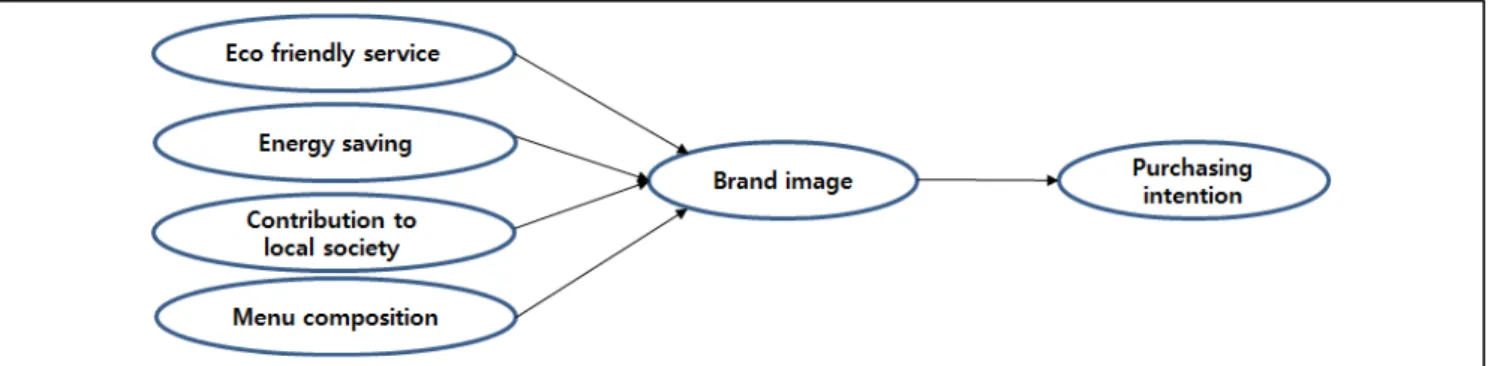
Fig. 1. Research model.
cribe it as being combined of product's features with the meaning of brand when it showed directly or indirectly out of the consumer's memory. Besides, it was described as the consumer's trust and emotion about specific company's brand, all thinking and imagination which were connected with brand in consumer's memory.
Brand image is composed of product's attributes of them- selves. Thus, because it contains the meaning of emotional reaction and psychological response which influences sales, it can show various aspects according to brand's features (Park et al., 2017). Namely, food service companies need to suggest efficient brand image for consumer's beneficial conclusion of buying and reputation of goods and service. They have to transfer reliable informations about brand image to consu- mers.
In the aspects of factors about brand image, Kotler (2015) suggested 3 factors of functional image, symbolic image and experiential image. Biel (1993) said another 3 factors of pro- duct image, company image and constant user image. In Korean researches, Yoon (2015) proposed some attributes consisted of food quality, food quantity nutrients and variety of menu. Kim and Lee (2017) described them as comfortable image, traditional image, highly qualitative image and clean image. Choi (2014) proposed 5 factors as reliability, consumer directivity, traditionality, future society directivity and creation about eco friendly information.
In this study, we suggest the purpose of this research to argue that the eco friendly management is antecedent to brand image. It was consulted by the document of the pre- vious study of Kotler (2015), Jeon (2017) and Yoon (2015). We shall propose the hypothesis that eco friendly management can influence consumer’s perception of brand image and purchasing intention. The research model on the bases of previous studies is showed in Fig. 1.
And the hypothesis is following about whether eco friendly management influences significantly brand image and pur- chasing intention or not.
Hypothesis 1 : Eco friendly management influences signifi- cantly brand image of food service corporation.
Hypothesis 2 : Brand image of food service corporation influences significantly consumer's purchasing intention.
3. METHODS
3.1. MeasurementA self-administered questionnaire was developed on the basis of a comprehensive review of eco friendly management and consumer's purchasing intention for this study. Eco friendly management's variables were referred to them of Park et al (2017), Lee (2003), Yoo and Nam (2012) and Rye and Suh (2015). It was composed of 4 factors. Namely, they were eco friendly service, energy saving, contribution to local society and the menu composition with 12 valuables. And these items were measured by strongly disagree (1 point), normally agree (4 point) and strongly agree (7 point).
Variables of brand image and purchasing intention referred to them of Julie and Eliza (1996), Ko et al. (2011) and Park et al. (2017). Brand image and purchasing intention were composed of each 4 variables. All variables of brand image and purchasing intention were measured by strongly disagree (1 point), normally agree (4 point) and strongly agree (7 point).
3.2. Sample and Data Collection
Subject of investigation was customers of franchise Korean restaurants (e.g., Nolbu, Bulgogi brothers and Wonhalmuni bossam corporation at two cities (e.g., Pusan, Seoul). They had 20 millions-Korean won over-sale per 1 month through be- forehand-questions and answers. Questionnaire were reformed through a preliminary examination after studying of previous researches. At first, eco friendly management was composed of 12 questions. Democratic variables put together 6 ques- tions (e.g., gender, job, scholarship, partner, number of mon- thly use and use expense per once of 1 person). Brand image and purchasing intention's variables were composed of each 4 questions. Surveys with written comments were encouraged during the completion of the questionnaire. They were collected immediately upon completion.
In this research, pilot test with 100 sheets was executed by customers on the spot at Korean restaurants (each 1 place in Pusan and Seoul) from June 1 to 30in 2016. After modifi- cation of this research, real question with 450 sheets was performed from December. 1 to 31in 2016. Efficient question- naires ~ 423sheets (withdrawal ratio ~ 94.0%) were adopted to analysis.
3.3. Data Analysis
SPSS 18.0 package program was adopted to analyze the data. In the analysis program, at first, we performed basic statistics analysis to find the general characteristics of custo- mers. Factor analysis was done to evaluate construction of validity and to identify reliability. At last, we performed multi regression analysis from eco friendly management to brand image and purchasing intention (H1, H2).
4. RESULTS
4.1. Descriptive Statistics of Sample
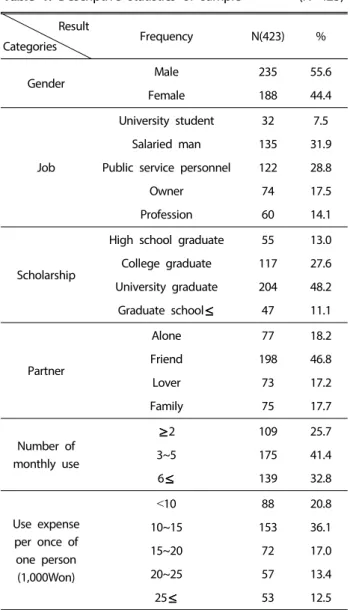
Descriptive statistics of purified sample was Table 1. At first, the number of man was 235 (55.6%), and woman was 188 (44.4%) by gender. The number of university student was 32 (7.5%), salaried man was 135 (31.9%), public service personnel was 122 (28.8%), owner was 74 (17.5%), and profession was 60 (14.1%) by job. Buy the way, highschool graduate was 55 (13.1%), college graduate was 117 (27.6%), university graduate was 204 (48.2%), and graduate school was 47 (11.1%). The number of alone was 77 (18.2%), friend was 198 (46.8%), lover was 73 (17.2%), and family was 75 (17.7%) by partner. The number of monthly use under 2 times was 109 (25.7%), the number from 3 to 5 times was 175 (41.4%), and the number over 6 times was 139 (32.8%). At last, use expense per once of one person under 10,000 Korean won was 88 (20.8%), the number from 10,000 to 15,000 won was 153 (36.1%), the number from 15,000 to 20,000 won was 72 (17.0%), the number was from 20,000 to 25,000 won was 57 (13.4%), and the number over 25,000 won was 53 (12.5%).
4.2. Factor Analysis about Eco-friendly Management, Brand Image and Purchasing Intention
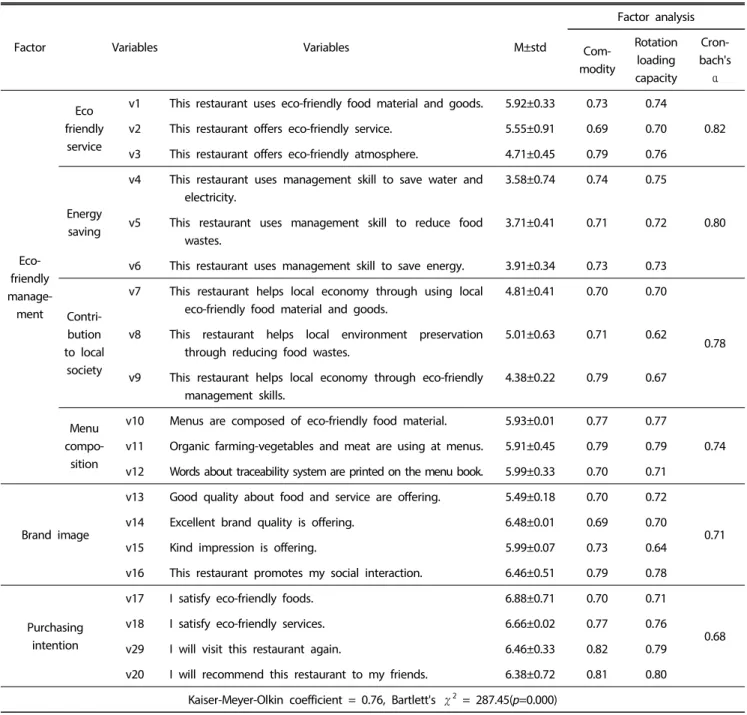
At the results of factor analysis about eco-friendly manage- ment, brand image and purchasing intention, the number of Kaiser-Meyer-Olkin (0.76) appeared to be suitable for factor
Table 1. Descriptive statistics of sample (N=423)
Result
Categories Frequency N(423) %
Gender Male
Female
235 188
55.6 44.4
Job
University student Salaried man Public service personnel
Owner Profession
32 135 122 74 60
7.5 31.9 28.8 17.5 14.1
Scholarship
High school graduate College graduate University graduate
Graduate school
55 117 204 47
13.0 27.6 48.2 11.1
Partner
Alone Friend Lover Family
77 198
73 75
18.2 46.8 17.2 17.7
Number of monthly use
2 3~5 6
109 175 139
25.7 41.4 32.8
Use expense per once of one person
(1,000Won)
<10 10~15 15~20 20~25
25
88 153
72 57 53
20.8 36.1 17.0 13.4 12.5
analysis. The number of Bartlett's χ2 was 287.45 (p=0.000).
It means that correlation of each factor's variables is signifi- cant statistically. The number of Cronbach's α appeared to be over 0.6. It means suitable reliability of divided factors.
4.3. The Influence of Eco-friendly Management on Brand Image
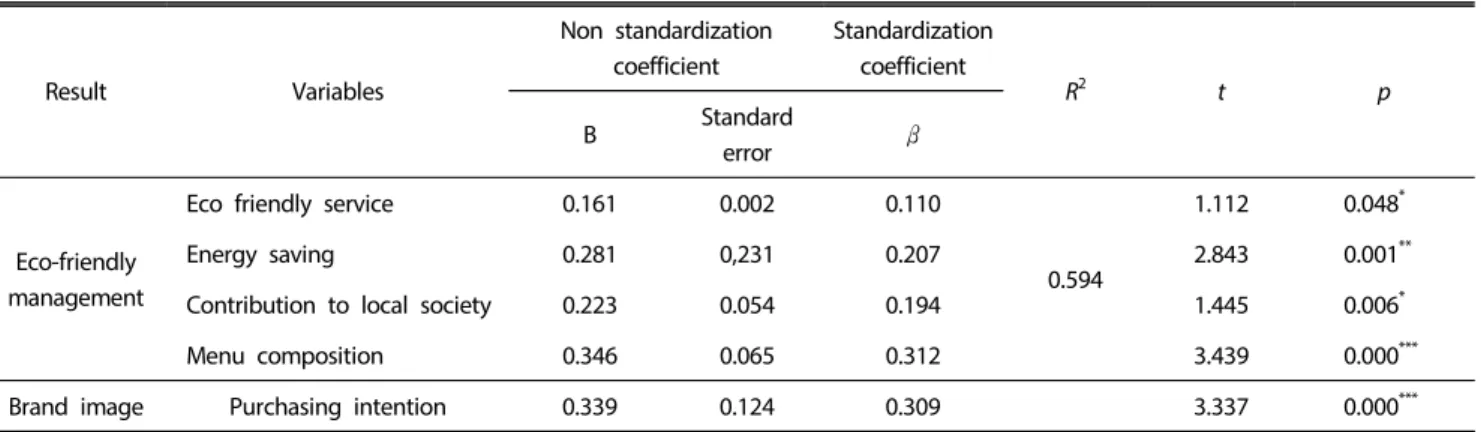
In order to research the eco-friendly management on brand image and purchasing intention, we performed the multi regression analysis. The results were as following (see Fig. 2 and Table 3).
At first, menu composition had the most positive (+) influence on brand image (β=0.312, t=3,439, p<0.001). This result was similar with the seafood preference study by Choi (2014). Choi informed the massage that consumers preferred
organic and natural seafood to cultivated ones. Jang (2010) indicated consumers considered food material like as environ- ment-friendly agricultural products, and they wanted to confirm food items' certificate mark of eco-friendly products.
Buy the way energy saving had positive (+) influence on brand image (β=0.207, t=2.843, p<0.005). According to this results, Yoo and Kim (2009) insisted the theory that consumer perceived the energy saving attributes (water, electricity and food wastes) at restaurants, and they considered the impor- tance about organic food items on choosing the menu.
Contribution to local society had positive (+) influence on brand image (β=0.194, t=1.445, p<0.05). Yoon (2015) said that customers considered about admiration, sense of identity, esteem, special concern and friendship on visiting at specific restaurant for social meeting. Because of social current about importance of energy saving and contribution to local society, customers will consider seriously them.
At last eco friendly service had positive (+) influence on brand image (β=0.110, t=1.112, p<0.05). According this results, Park et al. (2017) found the results of research that customers thought importantly providing of eco friendly ser- vice at restaurant. They added the theory that these eco- friendly factor could significantly influence customer's repur- chasing intention. Owing to this results about positive inf- luence of eco friendly service on brand image, we can per- ceive eco friendly service is the meaningful factor for the pur- pose of promoting the brand image.
4.4. The Influence of Brand Image on Purchasing Intention
Brand image had positive (+) influence on purchasing intention (β=0.309, t=3.337, p<0.001). Brand image can be said like as the term which is integrated impressions that customer's remembrance in their memory (Efthalia & Dimitris, 2005; Janssen & Hamm, 2012; Jeon, 2017). It includes me- morizations, behavior, feeling on of the specialty of real spe- cific brands. Brand image can be described of an aggregate with consumer's confidence to specific brand, and it can be the meaning to be perceived as specific goods. Brand image can influence consumer's repurchasing intention when it showed directly or indirectly out of the consumer's memory.
Besides, because it was expressed as the consumer's reliability and emotion about specific food service company's brand, maintaining and promoting of brand image is the critical strategies assets (Flanagin & Metzger, 2000; Manaktola &
Table 2. Factor analysis of eco-friendly management, brand image and purchasing intention
Factor Variables Variables M±std
Factor analysis
Com- modity
Rotation loading capacity
Cron- bach's α
Eco- friendly manage- ment
Eco friendly service
v1 v2 v3
This restaurant uses eco-friendly food material and goods.
This restaurant offers eco-friendly service.
This restaurant offers eco-friendly atmosphere.
5.92±0.33 5.55±0.91 4.71±0.45
0.73 0.69 0.79
0.74 0.70 0.76
0.82
Energy saving
v4
v5
v6
This restaurant uses management skill to save water and electricity.
This restaurant uses management skill to reduce food wastes.
This restaurant uses management skill to save energy.
3.58±0.74
3.71±0.41
3.91±0.34
0.74
0.71
0.73
0.75
0.72
0.73
0.80
Contri- bution to local
society v7
v8
v9
This restaurant helps local economy through using local eco-friendly food material and goods.
This restaurant helps local environment preservation through reducing food wastes.
This restaurant helps local economy through eco-friendly management skills.
4.81±0.41
5.01±0.63
4.38±0.22
0.70
0.71
0.79
0.70
0.62
0.67
0.78
Menu compo- sition
v10 v11 v12
Menus are composed of eco-friendly food material.
Organic farming-vegetables and meat are using at menus.
Words about traceability system are printed on the menu book.
5.93±0.01 5.91±0.45 5.99±0.33
0.77 0.79 0.70
0.77 0.79 0.71
0.74
Brand image
v13 v14 v15 v16
Good quality about food and service are offering.
Excellent brand quality is offering.
Kind impression is offering.
This restaurant promotes my social interaction.
5.49±0.18 6.48±0.01 5.99±0.07 6.46±0.51
0.70 0.69 0.73 0.79
0.72 0.70 0.64 0.78
0.71
Purchasing intention
v17 v18 v29 v20
I satisfy eco-friendly foods.
I satisfy eco-friendly services.
I will visit this restaurant again.
I will recommend this restaurant to my friends.
6.88±0.71 6.66±0.02 6.46±0.33 6.38±0.72
0.70 0.77 0.82 0.81
0.71 0.76 0.79 0.80
0.68
Kaiser-Meyer-Olkin coefficient = 0.76, Bartlett's χ2 = 287.45(p=0.000)
Fig. 2. Diagram of multi-regression analysis.
Table 3. Result of multi regression from eco friendly management to brand image and purchasing intention
Result Variables
Non standardization coefficient
Standardization coefficient
R2 t p
B Standard
error β
Eco-friendly management
Eco friendly service Energy saving
Contribution to local society Menu composition
0.161 0.281 0.223 0.346
0.002 0,231 0.054 0.065
0.110 0.207 0.194 0.312
0.594
1.112 2.843 1.445 3.439
0.048* 0.001**
0.006* 0.000***
Brand image Purchasing intention 0.339 0.124 0.309 3.337 0.000***
*p<0.05, **p<0.005, ***p<0.001
Jauhari, 2007; Rye & Suh, 2015).
5. DISCUSSION AND CONCLUSIONS
5.1. Discussion of Findings
This study conducted the questionnaire survey of custo- mers at franchise Korean restaurants in two cities (Busan and Seoul), South Korea. And this research furnished theoretical and practical contributions to the service marketing and strategy literature. The results of this research provided support of significant influence of eco-friendly managements on brand image and purchasing intention. The discussion of findings of this study was as follows.
At first, according to the result of descriptive statistics, the ratio of alone showed higher points (77, 18.2%) than family (75, 17.7%) and lover (73, 17.2%) by partner among custo- mers. Namely, we can consider activating differentiated and special Korean restaurant for one person household to enjoy the eco friendly foods by oneself.
In the second place, eco-friendly managements had signi- ficant influence on the brand image (see table 2 of 11 page).
Menu composition had the most positive (+) influence on brand image (p<0.001). This means that Korean restaurants of this study are performing efficiently the policy of confirming and informing customers of using eco-friendly food material.
Futhermore, we can watch the fact that consumers perceive the importance of natural and organic food's material, and they want safe and non-hazardous food items first of all at Korean restaurants. By the way, eco friendly service had the lowest positive (+) influence on brand image (p<0.05). In other words, food service companies need to provide efficient services.
In the third place, brand image had positive (+) influence on purchasing intention (p<0.001). As a result, for the purpose of gaining positive and proactive purchasing intention of customers, franchise Korean restaurant companies need to perform the eco friendly management efficiently.
5.2. Implications
The followings were practical application. This research confirmed a significant strong effect of all factors of eco- friendly managements on the brand image. Accordingly, we shall recommend the methods about practical applications for managers like as informing and explaining to customers about the certificate mark of eco-friendly food materials and food material traceability about grain, fruits, vegetables, kimchi, marine products and animal.
In the second place, on the considering energy saving, we could find customers perceived that restaurants were lack of energy saving (see table 2 of 11 page). Thus, we hope to propose the practical application methods about sensible acting water tab and lightning at restroom, and providing suitable quantity of food.
At last, considering of eco-friendly service, we can guess that restaurants were lack of performing and providing eco- friendly service and atmosphere. Therefore, we would like to recommend the management skill which is consisted of pro- viding harmless toy for children playroom, innocuous personal tissue, mineral water offering service, wooden furniture made of Japan cedar with remedial value, and tableware made of natural woods and woolen fabric.
5.3. Limitations and Future Research
The first limitation of this study was the differences of research's results due to the season. In this research pilot test was executed in June (summer), 2016 years. But real question was done in December (winter), 2016 years. Namely, some differences of research's results between June and December are expected (originated from kinds of main Korean foods, weather, outdoor’s temperature, customer’s favorite foods by season and etc). Therefore, it needs to research the compa- rative analysis of results among 4 seasons in the future research.
Because of limited area collecting questionnaire as two cities. It means that this research may not be evaluated as the study for whole South Korea. Therefore, this study hopes to perform at various cities and areas in the future research.
REFERENCES
Biel, A. L. (1993). Converting image into equity In: brand equity and advertising. Lawrence Erlbaum Association. Hillsdale NJ.
Choi, B. I. (2014). The study about seafood preference of uni- versity students in Gangwondo. Gwandong University.
Efthalia, D., & Dimitris, S. (2005). Consumer demand for infor- mative labeling of quality food and drink products: A european union case study. Journal Consumer Marketing, 22(2), 90-100.
Flanagin, A. J., & Metzger M. J. (2000). Perceptions of internet information credibility. Journalism & Mass Communication Quarterly, 77(3), 515-540.
Jang, Y. J. (2010). The study about influence of eco-friendly marketing of food service company on consumer's buying intention and wom. Kyungki unversity.
Janssen, M., & Hamm, U. (2012). Product labelling in the mar- ket for organic food: Consumer preferences and willing- ness-to-pay for different organic certification logos. Food Quality and Preference, 25(1), 9-22.
Jeon, Y. H. (2006). A study on how to promote food service businesses ingrowing wellbeing trend: Focus on case study. Journal of Management Society Korea, 2, 25-39.
Jeon, Y. M. (2017). A study on influence of family restaurant image on satisfaction, Culinary Science & Hospitality Research, 23(2), 74-85.
Julie, A. C., & Eliza, M. M. (1996). Using informational labeling to influence the market for quality in food products.
American Journal of Agricultural Economics, 78(5), 1248-
1253.
Keller, K. J. (1993), Conceptualizing & measuring and mana- ging customer based brand equity. Journal of Marketing, 23(3), 153-161.
Kim, J. S., & Lee, J. H. (2017). Structural influence and relationship between the environmentally-friendly atti- tude and purchase Intention based on the college stu- dents' values towards organic products. Culinary Science
& Hospitality Research, 23(2), 45-55.
Ko, J. Y., Um, M. R., & Lee, U. Y. (2011). The influence of well-being life-style on the perceived value, brand prefe- rence and buying intention about ece-friendly brand.
Tourism and Leisure Research, 23(6), 273-292.
Kotler, P. (2015). Principles of Marketing. Englewood Cliffs, NJ:
Prentice-Hall, Inc.
Lee, J. H. (2003). Customer's perceptions for the development of eco-friendly hotel marketing strategies. Korean Tourism Research, 27(1), 141-162.
Manaktola, K., & Jauhari, V. (2007). Exploring consumer attitude and behavior towards green practices in the lodging industry india. International Journal of Comtem- porary Hospitality Management, 19(5), 365-378.
Park, K. A,, Lee, J. D,, & Kim S. A. (2017). The impact of experience factors on brand attitude and revisit intention in rice cake specialty shop. Culinary Science & Hospitality Research, 23(2), 35-44.
Roitner, S. B,, Darnhofer, I., & Somsook, S. (2008). Consumer perceptions of organic foods in Bankok, Thailand. Food Policy, 33(2), 112-121.
Rye, E. S., & Suh, S. W. (2015). The effects of green practices, eco-friendly attitudes and perceived consumer effec- tiveness on purchase intention toward green restaurants.
International Journal of Tourism and Hospitality Research, 29(11), 87-100.
Shafie, F. A., & Rennie, D. (2012). Consumer perceptions towards organic food. Procedia-social and Behavioral Sciences, 49, 360-367.
Van, R. C. B. (2001). The added value of corporate logos - an empirical study. European Journal of Marketing, 35(3), 428-434.
Yoo, J. S., & Kim, J. M. (2009). The effect of theme restaurant image on the customer loyalty. The Journal of URASIA, 3(18), 133-147.
Yoo, W. Y., & Nam, K. Y. (2012). The study about relationship among eco-friendly management of restaurant, per-
ceived value, image and buying intention. The Journal of Hotel Management, 21(2), 113-130.
Yoon, T. H. (2015). Difference in additional marketing satis- faction by lifestyle of Korean restaurant customers - Focus on Foreign students at university in Gangwon province.
Journal of Korean Society of Food and Culture, 30(5), 587-595.
Zithaml, V., & Bitner, M. J. (2014). Services Marketing. New York:
Mcgram-Hill Book Company.
Received:
Revised:
Accepted:
06 March, 2017 16 March, 2017 26 May, 2017