Print ISSN: 2288-4637 / Online ISSN 2288-4645 doi:10.13106/jafeb.2020.vol7.no9.409
1
First Author and Corresponding Author. Faculty of Accounting and Auditing, Hanoi University of Insdustry, Vietnam [Postal Address:
No 298, Cau Dien Road, Bac Tu Liem District, Ha Noi City, 100000, Vietnam] Email: [email protected]
2
Faculty of Accounting and Auditing, Hanoi University of Insdustry, Vietnam. Email: [email protected]
3
Faculty of Accounting and Auditing, Hanoi University of Insdustry, Vietnam. Email: [email protected]
4
Faculty of Accounting and Auditing, Hanoi University of Insdustry, Vietnam. Email: [email protected]
5
Department of Financial and Accounting, Hanoi University of Insdustry, Vietnam. Email: [email protected]
© Copyright: The Author(s)
This is an Open Access article distributed under the terms of the Creative Commons Attribution
Non-Commercial License (https://creativecommons.org/licenses/by-nc/4.0/) which permits
unrestricted non-commercial use, distribution, and reproduction in any medium, provided the
original work is properly cited.
The Impact of Foreign Ownership and Management on Firm Performance in Vietnam
Thi Xuan Hong NGUYEN
1, Thu Huyen PHAM
2, Thi Nhung DAO
3, Thi Nga NGUYEN
4, Thi Kim Ngoc TRAN
5
Received: July 03, 2020 Revised: July 25, 2020 Accepted: August 10, 2020
Abstract
The human and capital resources from foreign investors are important sources of finance for developing countries. Foreign ownership can help the firm to raise funds for operations and the foreign management can help the firm expand the market and improve management.
However, does this really happen to Vietnamese firm? To find the answer to that question, this paper examines the impact of foreign ownership and management on the financial performance of listed firms on Vietnam’s stock market. The data collected include 427 listed firms in all fields over five years, from 2014 to 2018. The financial performance is measured by Tobin’s Q, ROA and ROE. The study carried out testing of each model by the least squares method of Pool OLS, assessing random effects (REM) and evaluating fixed effects (FEM).
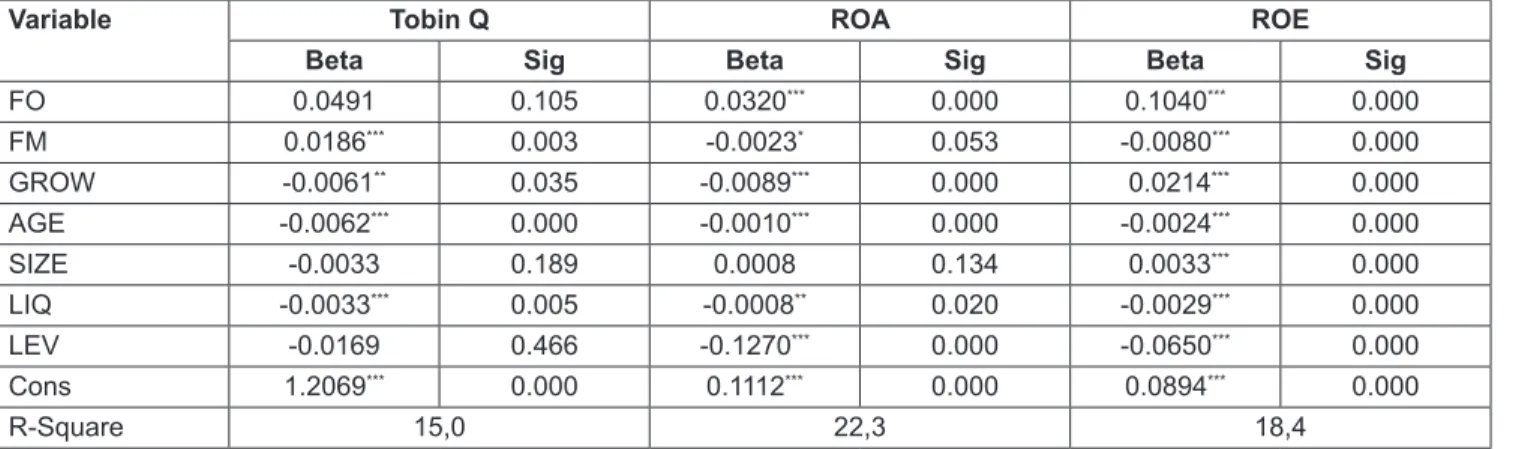
The most effective model is the FEM model. The results show that the foreign ownership ratio and the size of the firm have a positive impact on the financial performance. The foreign management, the age of the firms, the liquidity and financial leverage have a negative impact on the financial performance. Based on the research results, the study proposes some recommendations to improve the financial performance of listed firms in Vietnam.
Keywords: Foreign Ownership, Foreign Management, Financial Performance JEL Classification Code: G30, M40, M41
However, any country must answer the question of where resources for economic development investment lie and how to mobilize those resources. In the trend toward globalization, in order to survive and develop, each economy must bring into play internal resources in combination with external resources. It has been over 30 years of development since Vietnam carried out economic policies to attract and receive foreign investment capital. By now, the foreign- invested economic sector has been increasingly displaying its important role and significant contribution to the socio- economic development of the country. Especially, since the Law on Investment No. 67-2014-QH13 officially came into effect in 2015 and the relaxation of foreign ownership was carried out, stable foreign capital flows have been attracted into the Vietnamese stock market. The strong increase in the number of multinational investment flows has promoted economic development in general and the performance of enterprises in particular. In the coming period, Vietnam continues to affirm that the foreign-invested economic sector is an important component of the national economy.
This sector is encouraged for long-term development in
1. Introduction
Economic growth is an important goal of every country.
To achieve and maintain that goal, each country will have
policies and steps appropriate to their specific circumstances.