Print ISSN: 2288-4637 / Online ISSN 2288-4645 doi:10.13106/jafeb.2021.vol8.no11.0079
The Effect of Foreign Ownership and Product Market Competition on Firm Performance: Empirical Evidence from Vietnam*
Thach Xuan HA1, Thu Thi TRAN2
Received: July 15, 2021 Revised: September 28, 2021 Accepted: October 05, 2021
Abstract
In recent years, firm performance has been a topic that attracts many researchers. It is extremely important to identify the factors that change firm performance. In the current trend of competition and integration, foreign ownership, product market competition is found to reduce agency costs and impact firm performance. The purpose of this research is to investigate the relationship between foreign ownership, product market competition, and firm performance. Our research using a quantile regression model, through panel data of 290 companies listed on the Vietnam stock exchange (include Ho Chi Minh and Hanoi stock exchanges) from 2017 to 2019 that was collected by Thomson - Reuters DataStream has shown that foreign ownership and product market competition have a positive impact on Tobin’s Q but are not statistically significant with ROA. Critically, our quantile regression results suppose foreign ownership, product market competition have a significantly larger positive impact in high-performing firms relative to low-performing firms. The results help propose solutions to planners and managers to change foreign ownership and product market competition to increase business performance. Besides, through quantile regression analysis, managers need to pay attention to the impact on foreign ownership, product market competition; there will be a difference between high-performing firms relative to low-performing firms.
Keywords: Foreign Ownership, Product Market Competition, Financial Performance, Vietnamese Market JEL Classification Code: M41, C21, F65
rivalry affects company performance, based on the benefits of competition. Nickell (1996) researched in the UK to show that product market competition improves firm performance. Or the study of Sharma (2010) suggested that product market competition increases stock returns if the company has high product substitutability. On the other hand, a number of studies believe when competition is too high, businesses have to spend a lot of money to dominate the market, compete with prices, put pressure on corporate governance, thereby creating a negative impact on performance (Liu & Haman, 2018). It can be seen that the results of previous studies are not consistent, so further studies are needed to provide appropriate evidence in the practical context.
According to agency theory, the diversification of investment capital in the enterprise (especially the addition of foreign ownership) contributes to reducing conflicts between owners and managers, and the interests of foreign ownership are not only about governance, but also increases capital, technology, and expertise compared to domestic investment (Blomström & Sjoholm, 1999). Research results exploring this relationship have not been consistent, some views confirm that foreign ownership positively affects firm performance (Zraiq & Fadzil, 2018; Kao et al., 2019), while
*Acknowledgements:
This research is funded by the University of Economics Ho Chi Minh City, Vietnam.
1 First Author. Lecture, School of Accounting, University of Economics Ho Chi Minh City, Vietnam. Email: [email protected]
2Corresponding author. Ph.D. Student, School of Accounting, University of Economics Ho Chi Minh City, Vietnam. ORCID ID:
0000-0002-8377-2676. [Postal Address: 18/11 Nguyen Duy Trinh Street, Long Truong Ward, Thu Duc, Ho Chi Minh City, 880000, Vietnam] Email: [email protected]
© Copyright: The Author(s)
This is an Open Access article distributed under the terms of the Creative Commons Attribution Non-Commercial License (https://creativecommons.org/licenses/by-nc/4.0/) which permits unrestricted non-commercial use, distribution, and reproduction in any medium, provided the original work is properly cited.
1. Introduction
Nowadays, competition is an important part of the economy that puts direct pressure on businesses to reduce costs, improve quality, to increase profits (Baggs
& De Bettignies, 2007). Besides, competition puts strict requirements on managers who have to prove their capacity to ensure the interests of the company, so that the problem of the agency is also reduced/limited (Jensen & Meckling, 1976). Recent research has examined how product market
the study of Lensink et al. (2008) showed opposite results or found no relationship (Aitken & Harrison, 1999; Millet‐
Reyes & Zhao, 2010; Shan & McIver, 2011; Mihai, 2012).
This study combines two elements that affect firm performance: product market competitiveness and foreign ownership because we believe that under the pressure of competition and the movement of capital across nations, organizations who know how to grasp and adapt will have an advantage. At the same time, the research background was conducted in Vietnam, which is a developing economy with many advantages in attracting foreign investors, and a highly competitive market that is very suitable for conducting research. In particular, we use percentile regression to assess in more detail the impact of foreign ownership and product market competition on the performance levels of enterprises from high to low, thereby giving policy implications suitable to the reality of listed companies in Vietnam.
The structure of the research paper, in addition to the introduction, also includes the following sections:
section 2 presents a literature review and development hypotheses; section 3 is a methodology, section 4 focuses on analyzing results and discussing, and the last section gives conclusions.
2. Literature Review and Hypotheses 2.1. Agency Theory
Agency theory by Jensen and Meckling (1976) discussed the conflicting relationship between owners and managers.
Hassan et al. (2016) asserted that the conflict between owners and managers in the matter of representation is always present, so solutions to reduce agency problems are considered important for businesses. Jensen and Meckling (1976) argued that diversifying the ownership structure helps to reduce agency costs because of increasing scrutiny from owners, especially the involvement of foreign ownership.
Foreign ownership has the expertise, management level, and technologies, which improve production and corporate governance. Recent studies have confirmed this view such as Choi et al. (2007), Cho and Kim (2007), Kim (2007), and Black and Kim (2012), the authors argued that foreign ownership has a positive and significant impact on firm performance.
Some other studies have found that product market competition can help solve the problem of agency in the company (Jensen & Meckling, 1976). Besides, product market competition is a powerful mechanism to ensure that management does not waste the resources of the enterprise, reduce the manager’s slack, thereby contributing to improving business performance.
Thus, the combination of foreign investment factors and market competition with products together affect performance is supported by agency theory.
2.2. Foreign Ownership and Firm Performance Most recent studies have found a relationship between foreign ownership and firm performance in emerging economies, owing to the fact that foreign ownership increases product productivity (Aitken & Harrision, 1999), capital, technology, governance, and access to international markets (Caves, 1996). Kao et al. (2019) using a sample of Taiwanese listed firms from 1997 to 2015 and a two-stage least squares (2SLS) regression model, confirmed that foreign ownership has a positive influence on firm performance. However, Lensink et al. (2008) using stochastic frontier analysis for a sample of 2095 commercial banks in 105 countries for the years 1998–2003, found that foreign ownership negatively affects bank efficiency. Other research, such as MilletReyes and Zhao (2010) for France and Mihai and Mihai (2013) for Italy, have shown no link between foreign ownership and business performance. The conflict of results may arise from context, methodologies, statistical model, etc. (Adams et al., 2015).
Our study continues to test the above relationship but follows the approach of the quantile regression method. The proposed hypothesis is as follows:
H1: Foreign ownership is significantly and positively related to firm performance in high-performing firms than in low-performing firms.
2.3. Product Market Competition and Firm Performance
Market competition with products brings many advantages to enterprises such as good allocation efficiency, increasing pressure on product quality (Liu et al., 2018), or improving management from the point of agency theory.
However, studies on the relationship between product market competition and firm performance have not been consistent due to the different context and time horizons, omitted variables, etc. Hart (1983) asserted that product market competition reduces managerial slack by causing product or service selling prices to fall. Since managers have to improve firm performance to protect their economic interest, they are more likely to work hard to increase productivity, reduce cost and ultimately enhance firm performance. Similarly, Nickell (1996) used a fixed-effects model to analyze listed companies in the UK and suggested that the concentration of market competitors in the same product helps to increase product productivity. Additionally, Sharma (2010) collected data from listed companies in the US and showed that product market competition has a positive effect on stock returns. Next, Moradi et al. (2017) investigated the effect of product market competition and corporate governance on firm performance in the Tehran Stock Exchange market.
This study used one selected sample among the firms in
the capital market of Iran from 2004 to 2012. The results of this study indicated that there is a significant relationship between product market competition and management performance. The findings of this study also showed that product market competition is effective on the relationship between corporate governance and performance,
Some contradictory views are found in the study of Schmidt (1997) and Liu and Haman (2018) because they argued that product market competition puts pressure on managers, hence, managers find ways to increase business value, leading to high costs, thereby reducing profitability.
Due to the wide opening and deep integration into economic organizations such as the World Trade Organization (WTO), the Regional Comprehensive Economic Partnership (RCEP), and the Comprehensive and Progressive Agreement for Trans-Pacific Partnership (CPTPP), the pressure on market competition in Vietnam is extremely high (CPTPP).
We suggest the following research hypothesis:
H2: Product market competition is significantly and positively related to firm performance in high-performing firms than in low-performing firms.
3. Methodology
3.1. Percentage Regression Method
In recent studies on the relationship between foreign ownership/product market competition and firm performance, there are several commonly used methods:
multivariable regression method, OLS model, GLS model, 2SLS model. Quantile regression is used in our study which is a method to estimate conditional quantile functions (Koenker & Hallock, 2001; Koenker, 2007;). The advantage of the quantile regression method compared to the OLS estimator is it considers the whole fluctuation of dependent variables based on percentile change in the range (0, 1). In addition, according to Hao and Naiman (2007), conditions that apply for standard distribution and homogeneity of variances are not necessary for OLS. Conyon and He (2017) emphasized that quantile regression estimates are robust to the presence of outliers in a data set. However, the most important rationale for applying quantile regression is that a more complete picture of the relationship between a dependent and independent variable can be quantified (Conyon & He, 2017). In our research, quantile regression can be used to estimate firm performance from 5th to 75th percentile when is affected by foreign ownership and product market competition
Some fields apply this method to properly evaluate research issues. Specifically, labor experts study the benefits of learning and the difference in qualifications in wage regime distribution (Lemieux, 2006). Or in the field of health, health experts study women’s pregnancy
conditions based on income distribution (Budig & Hodges, 2010). Or in the field of corporate governance such as research such as Hallock et al. (2010), to check if CEO performance is strongly related to the high salary that the CEO receives from the business. The study of Li (2015) analyzed the difference in CEO salary of females versus males. Using the linear regression method Li (2015) found there was no difference. However, when applying the 95%
percentile regression method, the female CEO’s income is significantly lower than that of the male CEO. Conyon and He (2017) analyzed the impact of gender diversity on boards on corporate performance. Hence considering the above, we will apply to test the built hypothesis.
3.2. Sampling and Data Collection
To examine the relationship between foreign ownership, product market competition, and corporate performance, we used panel data from 2017 - 2019 with a sample size of 270 companies listed on Vietnam’s stock market through Thomson Reuter - DataStream Software.
Quantitative research methods are used in the study.
Specifically, for panel data, the commonly used regression model is OLS:
E(Yit/Xit) = yit = α + β OWNit + γ1HHIit + γ2AGEit + γ3 INDit + εit (1) Where:
yit: i’s firm performance in year t OWN: foreign ownership HHI: product market competition
AGE: the total number of years of i’s firm IND: Industry of i’s firm
Alternatively, a fixed-effects model (FEM) and a Random-effects model (REM) may be used. To choose the best model suitable for the research data, the author will use the Hausman test to verify. Also, the author will check for defects such as multicollinearity (VIF), heteroskedasticity (White test), and autocorrelation (Wooldridge test). The study uses generalized least squares (GLS) to overcome the aforementioned issues.
After selecting the regression estimation model to determine the relationship between the dependent variable and other variables, we use quantile regression model (Koenker & Hallock, 2001) to test the hypothesis as well as the research question:
Qτ (Yit/Xit) = ατ + βτ OWNit + γτ,1 HHIit + γτ, 2AGEit
+ γτ, 3 INDit + εit (2)
Qτ (Yit/Xit) is the τth quantile regression function.
Data will be estimated at the 5th percentile, 25th percentile,
50th percentile, and 75th percentile corresponding to Q(0.05), Q(0.25), Q(0.5), Q(0.75).
Variables are measured through Table 1.
4. Results and Discussion 4.1. Descriptive Statistics
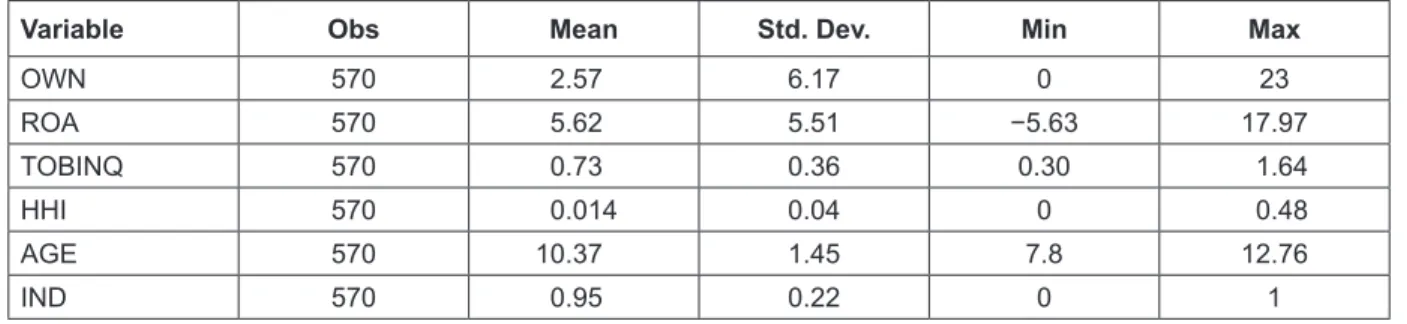
This paragraph presents descriptive statistics of the variables in the model in Table 2. The mean value of OWN
is 2.57 with the max value being 23%, ROA is 5.62, and Tobin’s Q is 0.73. The mean value of HHI is 0.01 ranging from 0 to 0.48. Besides, among the sample, we have an aged company that is about 12 years old with the median being 10 years. Our sampling frame encompasses several companies from different industries. However, we distinguish between financial and non-financial industries because they have different characteristics in terms of products, services, and so on. So, non-financial firms account for 95% of the total, whereas financial firms account for 5%.
Table 1: Summary of Measurement Variables
No Variables Operationalization Authors
Dependent Variables 1 Tobin’s Q (Tobin Q)
(Market-based performance) (Market equity + Book value of debt) / Total
assets Hassan et al. (2016),
Mardnly et al. (2018), Pillai and Malkawi (2018), Nguyen and Nguyen (2021), Qamruzzaman et al., (2021);
Almomani et al., (2021) ROA(Accounting-based
performance)
Net income/ Total assets
Independent Variables
2 Foreign Ownership (OWN) The percentage of shares owned by foreigners/
The total number of shares issued Zraiq and Fadzil (2018) Product Market Competion
(HHI) Herfindahl - Hirchman Index = HHIjt = i Sijt
Nj 2
1
is the market share of i firm in j industry during t year. The market share of every firm is calculated by dividing the firm’s net sale by the total net sale of an industry which is calculated for each industry separately every year
Januszewski et al. (2001), Jermias (2008), Chou et al.
(2011), Moradi et al. (2017), Yeh and Liao (2020)
Control Variables 3 The total number of years of i’s
firm (AGE) Ln(the current year – founding year + 1) Agarwal & Gort (2002) Dummy Variable
4 Industry (IND) 1: Non-Financial Company
0: Financial Company Marinova et al. (2016),
Buallay et al. (2017), Pillai and Malkawi (2018)
Table 2: Descriptive Statistics of Variables
Variable Obs Mean Std. Dev. Min Max
OWN 570 2.57 6.17 0 23
ROA 570 5.62 5.51 −5.63 17.97
TOBINQ 570 0.73 0.36 0.30 1.64
HHI 570 0.014 0.04 0 0.48
AGE 570 10.37 1.45 7.8 12.76
IND 570 0.95 0.22 0 1
4.2. Checking for Model
First, the VIF values of the variables in the model are all < 2, so there is no multicollinearity phenomenon (Hair et al., 2017). Next, we use White’s test to evaluate the phenomenon of variable variance, and with a p-value = 0.46 > 0.05, it indicates this phenomenon does not exist. Finally, the Wooldridge test evaluates the occurrence of autocorrelation with p-value = 0.003
< 0.05, when considering Tobin’s Q but not ROA (p-value = 0.19).
4.3. Regression Results
From the regression results between the variables through the OLS, FEM, and REM models, we use the Hausman test to select the FEM and REM models. The p-value results are 0.16 with Tobin’s Q and 0.15 with ROA > 0.05 so the REM model is considered suitable.
Because the autocorrelation phenomenon exists in the model, the GLS model is used to overcome it. After having GLS model results, we compare the results between OLS, REM, GLS models to choose the most
suitable model for the study and the results are shown in Table 3 below.
Table 3 presents the estimated value of the relationship between foreign ownership, product market competition, and firm performance. Columns 1, 2, 3 represent Tobin’s Q value, and columns 4, 5, 6 show the value of ROA. Columns 1 and 4 are estimated by the OLS model, columns 2 and 5 are estimated by the REM model, and columns 3 and 6 are estimated by the GLS model. We find that the OLS model for foreign ownership, product market competition has a strong and positive impact on Tobin’s Q but has no effect on ROA.
4.4. Percentile Regression Results
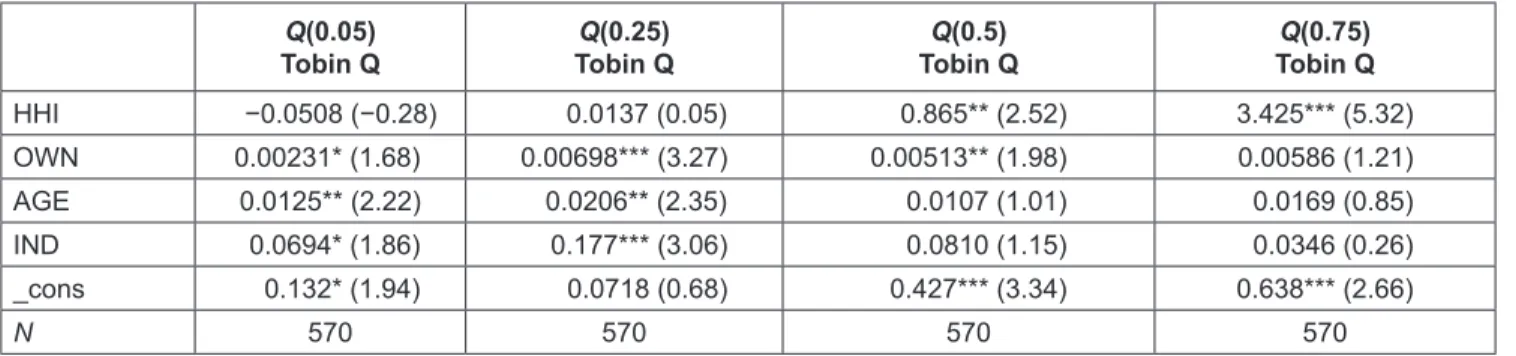
According to Conyon and He (2017), the OLS regression results give the average value in the relationship between the dependent variable and other variables, rather than taking into account each specific case with different influencing conditions. So we analyze the correlation between foreign investment capital, market competition for the same product, and Tobin’s Q at the 5%, 25%, 50%, and 75% percentiles, respectively Q(0.05), Q( 0.25), Q(0.5), Q(0.75). The details of the results are shown in Table 4.
Table 3: Relationship Between Performance and Variables
(1) (2) (3) (4) (5) (6)
Tobin’s Q
OLS Tobin’s Q
REM Tobin’s Q
GLS ROA
OLS ROA
REM ROA
GLS HHI 0.679** (2.04) 0.375 (1.95) 0.509 (1.42) 0.46 (0.09) 2.380 (0.31) −2.700 (−0.74) OWN 0.00493** (1.97) 0.00404** (2.20) 0.00302*** (3.06) 0.0426 (1.08) −0.0003 (−0.01) 0.0213 (1.54) AGE 0.0174* (1.70) 0.0231 (0.62) 0.000844 (0.21) −0.0240 (−0.15) −0.214 (−1.42) −0.25*** (−3.51) IND 0.161** (2.38) 0.153 (1.39) 0.154*** (3.85) 1.696 (1.59) 1.419 (0.89) 1.078** (1.96) _cons 0.374*** (3.02) 0.526*** (4.13) 0.504*** (8.76) 4.148** (2.14) 6.470*** (2.94) 6.680*** (7.14)
N 570 570 570 570 570 570
R-sq 0.029 0.029 0.029 0.005 0.005 0.005
Note: ***, ** and *Indicates significant at 1%, 5% and 10% level of significance based on t-statistics.
Table 4: Relationship Between Tobin’Q and Variables – Percentile Regression Method Q(0.05)
Tobin Q Q(0.25)
Tobin Q Q(0.5)
Tobin Q Q(0.75)
Tobin Q
HHI −0.0508 (−0.28) 0.0137 (0.05) 0.865** (2.52) 3.425*** (5.32)
OWN 0.00231* (1.68) 0.00698*** (3.27) 0.00513** (1.98) 0.00586 (1.21)
AGE 0.0125** (2.22) 0.0206** (2.35) 0.0107 (1.01) 0.0169 (0.85)
IND 0.0694* (1.86) 0.177*** (3.06) 0.0810 (1.15) 0.0346 (0.26)
_cons 0.132* (1.94) 0.0718 (0.68) 0.427*** (3.34) 0.638*** (2.66)
N 570 570 570 570
Note: ***, ** and *Indicates significant at 1%, 5% and 10% level of significance based on t-statistics.
The results of Table 4 show that hypotheses H1 and H2 are supported. The market competition variable with the same product has no regression correlation with Tobin’s Q at low percentiles Q(0.05) and Q(0.25) but it has a strong and positive influence when Tobin’s Q is at Q(0.5) and Q(0.75) percentiles. This result is consistent with previous research that ‘the higher the product market competition, the more pressure on managers to improve product quality and lower manufacturing costs to boost firm performance’ (Sharma, 2010; Moradi et al., 2017).
Meanwhile, the foreign ownership variable has a positive and significant effect on Tobin’s Q from the Q(0.05) to Q(0.5) percentiles, then there is no effect because when the market value of the enterprise is too high a threshold raises doubts among foreign ownership about the truth- fulness of financial data.
5. Conclusion
The purpose of this research is to investigate the relationship between foreign ownership, product market competition, and firm performance using the quantile regression method and data collected in the Vietnam stock market from 2017–2019. First, we show that foreign ownership and product market competition have a strong and positive impact on the results of enterprises’ market- based performance (Tobin’s Q) but no effect when measured by accounting-based performance (ROA). Second, we demonstrate the effect of foreign ownership and product market competition on market and accounting performance is heterogeneous across the performance distribution. In particular, the influence of foreign ownership and product market rivalry on corporate performance is more positive in high-performing firms than in low-performing enterprises.
When we use the quantile regression method, we get a new outcome when compared to previous studies.
We use agency theory to support the research and the results predict that that foreign ownership and product market competitiveness are major factors in changing business performance. Especially, low-performing firms are less likely to attract foreign ownership than high-performing firms because they prioritize profits then entering new markets, obtaining natural resources, acquiring advanced technology, and related brand equity. However, companies with very high performance, on the other hand, can reduce the percentage of foreign ownership, leading to skepticism about the accuracy of the company’s findings. When companies with high-performing employees have resources to invest in products, technology, and labor to compete with competitors, product market competition is considered an external corporate governance tool, as product market competition has a significant and positive impact on high- performing firms compared to low-performing firms.
Through the research, we propose some related policies as follows:
For a developing economy like Vietnam, attracting foreign ownership is very important, and creating a fair and objective competitive economic environment will be a lever to help improve business results. Legislators need to create a more appropriate legal and policy corridor.
Firm performance is different and changes over the years, so it is necessary to analyze the market value and book value of the enterprise to adjust the level of foreign ownership and product market competition, thereby finding more effective solutions.
The study is still limited in terms of sample size (190/744 listed companies in Vietnam) and data collection time. Because the relationship between foreign ownership, product market competition, and firm performance can be impacted by research context, if the data collected last up to the current year, it is possible to compare the impact of the COVID-19 epidemic to the current year.
References
Adams, R. B., de Haan, J., Terjesen, S., & van Ees, H. (2015). Board diversity: Moving the field forward. Corporate Governance:
An International Review, 23(2), 77–82. https://doi.org/10.1111/
corg.12106
Agarwal, R., & Gort, M. (2002). Firm and product life cycles and firm survival. American Economic Review, 92(2), 184–190.
https://doi.org/10.1257/000282802320189221
Aitken, B. J., & Harrison, A. E. (1999). Do domestic firms benefit from a direct foreign investment? Evidence from Venezuela.
American Economic Review, 89(3), 605–618. https://doi.
org/10.1257/aer.89.3.605
Almomani, T. M., Almomani, M. A., & Obeidat, M. I. (2021).
The Relationship between Working Capital Management and Financial Performance: Evidence from Jordan. The Journal of Asian Finance, Economics and Business, 8(6), 713–720.
https://doi.org/10.13106/jafeb.2021.vol8.no6.0713
Baggs, J., & De Bettignies, J. E. (2007). Product market competition and agency costs. The Journal of Industrial Economics, 55(2), 289–323. https://doi.org/10.1111/j.1467-6451.2007.00312.x Black, B., & Kim, W. (2012). The effect of board structure on
firm value: A multiple identification strategies approach using Korean data. Journal of Financial Economics, 104(1), 203–226. https://doi.org/10.1016/j.jfineco.2011.08.001 Blomström, M., & Sjöholm, F. (1999). Technology transfer and
spillovers: Does local participation with multinationals matter?.
European Economic Review, 43(4–6), 915–923. https://doi.
org/10.1016/S0014-2921(98)00104-4
Buallay, A., Hamdan, A., & Zureigat, Q. (2017). Corporate governance and firm performance: Evidence from Saudi Arabia.
Australasian Accounting, Business and Finance Journal, 11(1), 78–98. https://doi.org/10.14453/aabfj.v11i1.6
Budig, M. J., & Hodges, M. J. (2010). Differences in disadvantage:
Variation in the motherhood penalty across white women’s earnings distribution. American Sociological Review, 75(5), 705–728. https://doi.org/10.1177/0003122410381593
Caves, R. E. (1996). Multinational enterprise and economic analysis. Cambridge, UK: Cambridge University Press.
Cho, D. S., & Kim, J. (2007). Outside directors, ownership structure, and firm profitability in Korea. Corporate Governance: An International Review, 15(2), 239–250. https://doi.org/10.1111/
j.1467-8683.2007.00557.x
Choi, J. J., Park, S. W., & Yoo, S. S. (2007). The value of outside directors: Evidence from corporate governance reform in Korea. Journal of financial and Quantitative Analysis, 42(4), 941–962. https://doi.org/10.1017/S0022109000003458 Chou, J., Ng, L., Sibilkov, V., & Wang, Q. (2011). Product
market competition and corporate governance. Review of Development Finance, 1(2), 114–130. https://doi.org/10.1016/
j.rdf.2011.03.005
Conyon, M. J., & He, L. (2017). Firm performance and boardroom gender diversity: A quantile regression approach. Journal of Business Research, 79, 198–211. https://doi.org/10.1016/
j.jbusres.2017.02.006
Hair, J. F., Sarstedt, M., Ringle, C. M., & Gudergan, S. P., 2017.
Advanced issues in partial least squares structural equation modeling. Thousand Oaks, CA: Sage Publications.
Hallock, K. F., Madalozzo, R., & Reck, C. G. (2010). CEO pay‐
for‐performance heterogeneity using quantile regression.
Financial Review, 45(1), 1–19. https://doi.org/10.1111/j.1540- 6288.2009.00235.x
Hao, L., & Naiman, D. Q. (2007). Quantile regression. Thousand Oaks, CA: Sage Publications.
Hart, O. D., 1983. The market mechanism is an incentive scheme.
The Bell Journal of Economics, 14(2), 366–382. https://doi.
org/10.2307/3003639
Hassan, Y. M., Naser, K., & Hijazi, R. H., 2016. The influence of corporate governance on corporate performance: Evidence from Palestine. Afro-Asian Journal of Finance and Accounting, 6(3), 269–287. https://doi.org/10.1504/AAJFA.2016.079296 Januszewski, S. I., Köke, J., & Winter, J. K. (2002). Product market
competition, corporate governance and firm performance: An empirical analysis for Germany. Research in Economics, 56(3), 299–332. https://doi.org/10.1016/j.rdf.2011.03.005
Jensen, M. C., & Meckling, W. H. (1976). Theory of the firm:
Managerial behavior, agency costs, and ownership structure.
Journal of Financial Economics, 3(4), 305–360. https://doi.org/
10.1016/0304-405X(76)90026-X
Jermias, J. (2008). The relative influence of competitive intensity and business strategy on the relationship between financial leverage and performance. The British Accounting Review, 40, 71–86. https://doi.org/10.1016/j.bar.2007.11.001
Kao, M. F., Hodgkinson, L., & Jaafar, A. (2019). Ownership structure, board of directors and firm performance: Evidence
from Taiwan. Corporate Governance: The International Journal of Business in Society. https://doi.org/10.1108/CG-04- 2018-0144
Kim, Y. (2007). The proportion and social capital of outside directors and their impacts on firm value: Evidence from Korea. Corporate Governance: An International Review, 15(6), 1168–1176. https://doi.org/10.1111/j.1467-8683.2007.00638.x Koenker, R. (2007). Quantile regression. Montreal, Canada:
Econometric Society Monograph.
Koenker, R., & Hallock, K. F. (2001). Quantile regression. Journal of Economic Perspectives, 15(4), 143–156. https://doi.org/
10.1257/jep.15.4.143
Lemieux, T. (2006). Post-secondary education and increasing wage inequality. American Economic Review, 96(2), 195–199.
https://doi.org/10.1257/000282806777211667
Lensink, R., Meesters, A., & Naaborg, I. (2008). Bank efficiency and foreign ownership: Do good institutions matter? Journal of Banking & Finance, 32(5), 834–844. https://doi.org/10.1016/
j.jbankfin.2007.06.001
Li, M. (2015). Moving beyond the linear regression model: advantages of the quantile regression model. Journal of Management, 41(1), 71–98. http://doi.org/10.1177/0149206314551963 Liu, L., Qu, W., & Haman, J. (2018). Product market competition,
state-ownership, corporate governance, and firm performance.
Asian Review of Accounting. http://doi.org/10.1108/ARA-05- 2017-0080
Mardnly, Z., Mouselli, S., & Abdulraouf, R. (2018). Corporate governance and firm performance: An empirical evidence from Syria. International Journal of Islamic and Middle Eastern Finance and Management, 11(5), 107–119. https://doi.
org/10.1108/IMEFM-05-2017-0107
Marinova, J., Plantenga, J., & Remery, C. (2016). Gender diversity and firm performance: Evidence from Dutch and Danish boardrooms. The International Journal of Human Resource Management, 27(15), 1777–1790. https://doi.org/10.1080/095 85192.2015.1079229
Mihai, I. O. (2012). Foreign-owned companies and financial performance. a case study on companies listed on the Bucharest stock exchange. Annals of Dunarea de Jos University of Galati Fascicle I Economics and Applied Informatics, 1(1), 13–20.
http://www.ann.ugal.ro/eco/Doc2012.1/MihaiOana.pdf Mihai, I. O., & Mihai, C. (2013). The impact of foreign owner-
ship on the performance of Romanian-listed manufacturing companies. The International Journal of Management Science and Information Technology (IJMSIT), 10(12), 106–123. https://
www.econstor.eu/bitstream/10419/97848/1/786346973.pdf Millet‐Reyes, B., & Zhao, R. (2010). A comparison between
one‐tier and two‐tier board structures in France. Journal of International Financial Management & Accounting, 21(3), 279–310. https://doi.org/10.1111/j.1467-646X.2010.01042.x Moradi, M., Velashani, M. A. B., & Omidfar, M. (2017). Corporate
governance, product market competition and firm performance:
Evidence from Iran. Humanomics, 16, 53–87. https://doi.org/
10.1108/H-10-2016-0075
Nguyen, C., & Nguyen, L. (2021). The relationship between corporate social responsibility and financial performance:
Empirical evidence from Vietnam. The Journal of Asian Finance, Economics, and Business, 8(8), 75–83. https://doi.
org/10.13106/jafeb.2021.vol8.no8.0075
Nickell, S. J. (1996). Competition and corporate performance.
Journal of Political Economy, 104(4), 724–746. http://doi.
org/10.1086/262040
Pillai, R., & Al-Malkawi, H. A. N. (2018). On the relationship between corporate governance and firm performance:
Evidence from GCC countries. Research in International Business and Finance, 44, 394–410. https://doi.org/10.1016/
j.ribaf.2017.07.110
Qamruzzaman, M., Jahan, I., & Karim, S. (2021). The Impact of Voluntary Disclosure on Firm’s Value: Evidence from Manufacturing Firms in Bangladesh. The Journal of Asian Finance, Economics and Business, 8(6), 671–685. https://doi.
org/10.13106/jafeb.2021.vol8.no6.0671
Schmidt, K. M. (1997). Managerial incentives and product market competition. The Review of Economic Studies, 64(2), 191–213. https://doi.org/10.2307/2971709
Shan, Y. G., & McIver, R. P. (2011). Corporate governance mechanisms and financial performance in China: Panel data evidence on listed non-financial companies. Asia Pacific Business Review, 17(3), 301–324. https://doi.org/10.1080/13602380903522325
Sharma, V. (2010). Stock returns and product market competition:
Beyond industry concentration. Review of Quantitative Finance and Accounting, 37(3), 283–299. https://doi.org/10.1007/
s11156-010-0205-0
Yeh, Y. H., & Liao, C. C. (2020). The impact of product market competition and internal corporate governance on family succession. Pacific-Basin Finance Journal, 62, 101346. https://
doi.org/10.1016/j.pacfin.2020.101346
Zraiq, M. A. A., & Fadzil, F. H. B. (2018). The impact of ownership structure on firm performance: Evidence from Jordan. International Journal of Accounting, Finance and Risk Management, 3(1), 1–4. https://doi.org/10.11648/j.ijafrm.
20180301.1