OPEN ACCESS
Citation: Hong BD, Joo RN, Lee KS, Lee DS,
Rhie JH, Min SW, Song SG, Chung DY. 2016.
Fluoride in soil and plant. Korean Journal of Agricultural Science 43:522-536.
DOI: http://dx.doi.org/10.7744/kjoas.20160054
Editor: Kee Woong Park, Chungnam National
University, Korea
Received: October 12, 2016
Revised: December 6, 2016
Accepted: December 13, 2016
Copyright: ©2016 Korean Journal of
Agricultural Science.
This is an Open-Access article distributed under the
terms of the Creative Commons Attribution Non-
Commercial License which permits unrestricted non-
commercial use, distribution, and reproduction in
any medium, provided the original work is properly
cited.
REVIEW ARTICLE
Fluoride in soil and plant
Byeong-Deok Hong
3, Ri-Na Joo
1, Kyo-Suk Lee
1, Dong-Sung Lee
1, Ja-Hyun Rhie
1, Se-won Min
2, Seung-Geun Song
1, Doug-Young Chung
1*
1
Department of Bio-environmental Chemistry, Collage of Agriculture and Life Science, Chungnam National University, Deajeon 34134, Korea
2
Daejeon Doonsan Girl’s High School, Daejeon 35231, Korea
3
Technical Review & Quality Management Institute, Korea Rural Community, Daejeon 35229, Korea
Abstract
Fluorine is unique chemical element which occurs naturally, but is not an essential nutrient for plants. Fluoride toxicity can arise due to excessive fluoride intake from a variety of natural or manmade sources. Fluoride is phytotoxic to most plants. Plants which are sensitive for fluorine exposure even low concentrations of fluorine can cause leave damage and a decline in growth. All vegetation contains some fluoride absorbed from soil and water. The highest levels of F in field-grown vegetables are found up to 40 mg kg
-1 fresh weight although fluoride is relatively immobile and is not easily leached in soil because most of the fluoride was not readily soluble or exchangeable. Also, high concentrations of fluoride primarily associated with the soil colloid or clay fraction can increase fluoride levels in soil solution, increasing uptake via the plant root. In soils more than 90 percent of the natural fluoride ranging from 20 to 1,000 g g
-1 is insoluble, or tightly bound to soil particles. The excess accumulation of fluorides in vegetation leads to visible leaf injury, damage to fruits, changes in the yield. The amount of fluoride taken up by plants depending on the type of plant, the nature of the soil, and the amount and form of fluoride in the soil should be controlled. Conclusively, fluoride is possible and long-term pollution effects on plant growth through accumulation of the fluoride retained in the soil.
Keywords: fluoride, phytotoxicity, plant, soil
Introduction
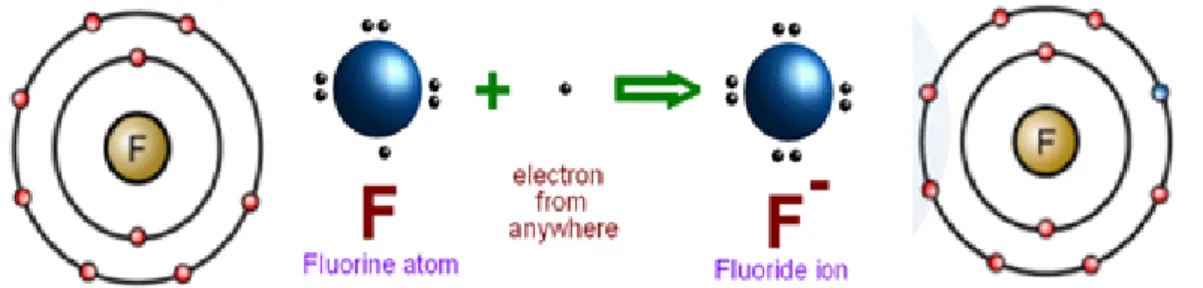
Fluorine, discovered as an element in other compounds in the early 1500s by the German physician Georgius Agricola, does not occur in the elemental state in nature because of its high reactivity and fluoride is the negative of element fluorine. Fluorine is the most reactive of all elements and no chemical substance is capable of freeing fluorine from any of its compounds. For this reason, fluorine does not occur free in nature and was extremely difficult for scientists to isolate.
Fluorine in the form of fluorides in a number of minerals, of which fluorspar, cryolite and
fluorapatite are the most common is the 13th most abundant element in the Earth's crust: 950 ppm
are contained in it. Annual world production of the mineral fluorite in around 4 million tons, and