. Introduction
Ⅰ
Heinberg, Thompon, and Stomer (1995) found
Corresponding author: Park Eunhee, Tel. +82-53-950-6220, Fax. +82-53-950-6219 E-mail: [email protected]
This research was presented at the 2013 Fall Conference of The Korean Society of Fashion Business.
media has made people feel much dissatisfied with their bodies by recognizing and internalizing
The Influence of Sociocultural Attitude toward Appearance and Narcissism on Body Stress
Park Eunhee⁺ ․ Lee Sangjoo Dept. of Fashion Design, Daegu University⁺
Dept. of Business Administration, Al Yamamah University, Kingdoms of Saudi Arabia
Abstract
The purpose of this study is to examine the influence of sociocultural attitudes toward appearance and narcissism on body stress. Questionnaires are being administered to 206 women in their 20's-50's living in Deagu and Kyunbook province. The Frequency, factor analysis, reliability analysis, correlation analysis, regression analysis, ANOVA, and Duncan-test are used for data analysis. Sociocultural attitudes toward appearance are categorized into media appearance internalization and social recognition of appearance.
Narcissism factors are found to be leadership/privilege, ostentation, and superiority. Body stress is categorized into 4 factors: weight stress, skin aging stress, body dissatisfaction, and hair stress. Sociocultural attitudes toward appearance was related to the sub-variables of narcissism, and body stress. Media appearance internalization is the sun-variable of sociocultural attitudes toward appearance and has significant effects on weight stress, skin aging stress, and body dissatisfaction sub-variables for body stress. Ostentation, and superiority being the sub-variables of narcissism, have significant effects on weight stress, skin aging stress, body dissatisfaction, and hair stress, the sub-variables for body stress.
Ages of women display distinctions between the sub-variables in sociocultural attitudes toward appearance such media appearance internalization, and in narcissism such leadership/privilege, ostentation, superiority, and body stress such weight stress, skin aging stress, body dissatisfaction, and hair stress. This result can be a necessary base line data for adult women’s appearance management by examining the influence of the attitude toward the appearance developed from the relationship with people around body stress.
Key words : body stress, narcissism, sociocultural attitude toward appearance
the extremely slim body image as a real image due to media in sociocultural attitude toward appearance.
This kind of body-dissatisfaction brings a side effect to both physical and psychological health and even causes a problem in life with decreased will to live. Like this women feel body stress due to the gap between real appearance and ideal appearance delivered through TV, internet, magazines and so on. Richins (1991) found that women are less satisfied with their body images when there's a remarkable dissonance between the body images on the media and their own body images. The sociocultural changes such as the influence of mass media and westernized values has brought a monotonous standard of beauty and this causes women who are under the ideal standard of beauty to get body-related stress with a negative image on their bodies.
Cha (2002) suggested a positive gumption and adaptation of the stress as a core factor for a human success and survival can minimize the negative results from stress. As positive stress can distribute to personal growth, the development and mental health, stress can be the essential factors for a person and an organization to succeed. This stress can also have a negative effect on psychological health such as depression or anxiety and on life adaptation like decreased self-confidence and demotivation (Moon, Chung, & Kim, 2012). A psychological stress leads to managing behavior to improve appearance for solving the stress related to body changes and aging. Kaiser (1995) suggested women show various appearance management behaviors such as weight control, makeup, plastic surgeries, skin care, clothes and so on and they are trying to minimize the gap between ideal and real body
image through these behaviors. The appearance is externally shown and plays an important role to evaluate people in interpersonal relationship.
As the beauty standards are determined by the influence of mass media and contemporary sociocultural changes, the sociocultural attitude toward appearance can have some body stress from personal environmental and psychological stimuli.
Lasch (1979) defined American society as a society of narcissism and this narcissistic style can be a dealing method for solving tension and anxiety in modern life. The narcissism can have a positive function if the dignity can be maintained by loving and cherishing the self, but if it overflows without a objective evaluation and results in self-ostentation or selfishness, it can become a problem to have a negative function (Suh & Yang, 2010). Suh and Yang (2010) found that people with high narcissism and low self-respect have high reaction level of psychological stress. Eunjeong Park and Chung (2010) found female university students have strong narcissistic characteristics to show themselves off and to get compliments and the desire for ostentation/compliments can be an important variable which can explain the appearance management behavior of those female university students having a big interest in the appearance. Therefore it is considered that the love for self developed from the desire to enhance the self-value has a significant relationship with body stress.
Prior researches dealt with sociocultural attitude toward appearance in appearance management behavior (Yunjung Hwang & Yoo, 2010; J. Jeon & Yoo, 2011), body complaints/dissatisfaction (Chung, 2011; Hong, 2006; Eunjeong Park & Chung, 2013), and narcissism and body stress were mainly dealt in
the field of sociology, psychology and neuropsychic area (Cha, 2002; Moon et al., 2012; Suh & Yang, 2010). The researches in clothing area have dealt with narcissism and shopping tendency (Yeonsoon Hwang, 2009), appearance management behavior (Yousung Kim
& Park, 2009; Eunjeong Park & Chung, 2010) while there are few studies on the relationship between sociocultural attitude toward appearance and narcissism and body stress.
Recently the terms 'a best face' or 'a best body' suggests to maintain slim body shape and youth putting importance on the beauty of women and in addition it includes an extended meaning of regular diet and exercise to maintain healthy body power. The social phenomena which emphasizes western-style face type and extremely slim body shape through the mass media has made women feel more gap between ideal body and real body and the bigger the gap the higher stress. This study tries to examine how the sociocultural attitude toward appearance influences body stress and how women with ability and attractiveness accept the stress by the changes of body condition.
Accordingly, This result can be a necessary base line data for adult women’s appearance management by examining the influence of the attitude toward the appearance developed from the relationship with people around on body stress.
. Background
Ⅱ
1. Sociocultural Attitude toward Appearance
Modern people put the standards for evaluating their body on the images from the mass media rather than on others around and
the psychologic tendency to prefer and copy those images, which made people try to change themselves by making up, managing body shape, managing skins to overcome the gap (Huh & Lee, 2011). Especially women are trying to maintain a beautiful and attractive body shape internalizing the standards for the ideal appearance through TV or magazines (Eunhee Park, 2012). Lim (2004) suggested the desire to be 'a best body' or 'a best face' can be the desire to copy the media image which includes the internalization of the media images. This study found 41% of male university students and 59% of female answered 'yes' to the question 'have you ever thought of having similarity to a specific part of an entertainer's body?'. And in a reaction of comparing their body shape with people on the TV or in magazines, about 36%
of male and 58% of female students agreed.
Eunhee Park and Ku (2012) found university students think it important to have a good appearance in the successful social life and showed to have a tendency of body shape internalization.
Jaesook Kim and Lee (2001) found juveniles who have more interests and attentions in TV programs and the appearance of entertainers negatively recognized their appearance and showed various diet behavior to reduce the weight. Hong (2006) the twenties showed highest score in media appearance internalization and appearance recognition followed by the thirties and forties. The forties as well as the twenties have a high level of dissatisfaction with their body despite of low BMI index and they were pressed by the sense of beauty enforced by the media appearance. Yunjung Hwang and Yoo (2010) found internalization in sociocultural attitude of appearance have a significant influence on the positive weight management
behavior. This can influence on the personal internalization while totally reflecting the self and the appearance seen by others as they think the body image will be more important personally and socially. Eunjeong Park and Chung (2013) found the more dissatisfaction with the face, the less frequency of weight management and clothes choice behavior. It is found that the sociocultural influence on the appearance and body dissatisfaction has a direct signigicant influence on appearance improvement behavior but not always with the body dissatisfaction as an intermediary, which can explain that women have an essential dissatisfaction with body.
Chung (2011) the higher level of internalization of the social value which put importance on the personal appearance and the standards of beauty tends to form the dissatisfaction with the observation of appearance and for the solution of this people show a variety of appearance management behaviors such as weight controlling by extreme diets or dietary supplement, purchase of beauty products, plastic surgeries and clothing which are far from body activities. The result that an objectified body sense had a significant relationship with social anxiety of body shape suggests the higher self-objectification of appearance, the higher dissatisfaction with the body.
Accordingly, women who internalize themselves through mass media can get stress from the body as they have dissatisfaction by the gap between ideal self and real self.
2. Narcissism
The narcissism is the love of self which comes from the desire to value up himself/herself (National Institute of the Korean Language, 2014) and is the self concept which
puts superiority on the self. Freud used this term in his book ‘On Narcissism' for psychoanalysis by conceptualizing the love of self (Kang & Lee, 2006) thereafter it has been researched by lots of scholars. Raskin and Hall (1979) regard the narcissism as a personality characteristic appeared in a daily life and developed NPI (Narcissistic Personality Inventory), the test for narcissistic characteristics and found narcissism to be a multi dimensional concept with the factor structure of NPI. The self-directed narcissism was found to coincide with privilege, self-fulfillment and superiority which are among the sub-factors of NPI and the main parts are assertiveness, preference of exercising the leadership, self-confidence, independence, desire for achievement, narcissistic self-expansion, and high aspiration level. These characteristics are called an adaptive and healthy side of the narcissism. On the other hand, the narcissism dependent on others tried to confirm the value of the self through others being nervous of how the self is evaluated by others rather than tries to find the self-value by oneself. The factor with these characteristics are exploitation and privileged sense which are non-adaptive and pathological side of narcissism (Yousung Kim & Park, 2009).
Kang and Lee (2006) found people who have high self-oriented narcissism watch themselves with positive viewpoints and are satisfied and they have chances to show self-confidence that things will get better with their efforts even though they're not doing well now, which can be inferred as adaptive and healthy side of narcissism. The factor of narcissism dependent on others showed significantly high scores in anxiety, general maladjustment, and hostility and resultly people who have narcissism dependent on others showed self-centered thinking and
emotions and these brings difficulties in adaption, which make them experience subjective uncomfortableness and anxiety. In this way, even with the desire to be appeared as an important person to others the real and stable self-value can be not that stable and vulnerable.
Yousung Kim and Park (2009) found a group of complex narcissism to have high scores in all parts such as basic makeup, functional makeup, skin makeup, eyelid makeup, eye makeup, and outline makeup, and this explains the importance of makeup is evaluated higher than others to express the appearance. This group also showed highest recognition of the importance of hair style with the highest scores in all parts of hair style as well as beauty behaviors with the highest scores in all factors and they are most active in expressing the self through beauty behaviors. The group of a shrink narcissism has lowest scores in all parts of beauty behaviors and this indicates this group is most passive to express and show the self. Eunjeong Park and Chung (2010) found female university students have a strong tendency to show off the self and to get compliments and this can be an important variable to explain the appearance management behavior of female university
students with the variable of
'ostentation/compliments' 3. Body Stress
Stress is defined as a result of the interaction between environmental stimuli factors and personal specific reaction and each personal reaction is shown through the control process of personal psychological process (Cha, 2002).
Physiological and medical viewpoint put an importance on human physical reaction toward stress while social and psychological sees the
unique psychological pattern of stress recognition and reaction to be important. The behavioral science approach regards how the stress influences the members to fit the organizational efficiency (M. Kim, Kim, & Lee, 1999). As the body shape is important to judge the appearance and deliver images, today lots of people wants to have their body shapes to be ideal with the importance of visual image embossed (Jeong & Chu, 2010). Recently the senses that to be slim would be the standard of beauty have been spread out and this made women have more negative recognition of the body image than men and made them perceive their body sizes to be bigger than the real ones (S. Lee & Lee, 2009) thus they get stress toward body as they have a negative image on their body. In other words, many women put importance more on the appearance than body functions as an ideal body image therefore, they feel lost and the sense of self-respect goes low when they can't reach the image they want, which brings serious stress (Jang & Song, 2004).
Yangjin Kim and Kahng (1992) found that stress can be reduced when the fear about social rejection is reduced and there's no need to have hiding behaviors which is considered to be out of social ideal standards because those who hate their own appearance show much stress from the life and self-contempt phenomenon but improved appearance can reduce or remove the reasons of stress. Y. Cho (2009) found out among female middle school students the appearance stress and female sense of identification had a negative influence but the stronger sense of male identification reduce the depression and increase the sense of self-respect. H. Jeon and Chung (2008) found the forties have more experience of stress related to the body shape than the fifties and
sixties, while the fifties experience more stress related to the face and hair style. J. Lee, Auh, Jung and Kim (2012)'s research suggested those who are satisfied with their appearance has low stress and there's an increased stress of obesity due to the dissatisfaction with their body shape with less satisfaction with their appearance while less stress of obesity.
. Methods
Ⅲ
1. Topics of Research
1. This study finds out the factors of sociocultural attitude toward appearance, narcissism and body stress.
2. There will be a relationship among sociocultural attitude toward appearance, narcissism and body stress.
3. The sociocultural attitude toward appearance and narcissism will influence on body stress.
4. There will be a difference in sociocultural attitude toward appearance, narcissism and body stress by the age group.
2. Data Collection and Analysis
A pilot test oriented to the university students living in Daegu, Kyoungbuk area was conducted during June, 2013 and a survey was developed on the basis of the result of pilot test. The main surveys was conducted from Jul. 10, 2013 to 19th, 2013, and the objects of the study are 230 adult female living in Daegu-Kyoungbuk area and total 206 answers were used for the analysis except for insincere answers. In research targets the twenties were 55 (26.7%), 30s were 73 (35.4%), 40s were 46 (22.3%), and
50s were 32 (15.5%).
The data analysis was conducted using SPSS PC+ 20.0 in various ways as frequency, factor analysis, credibility verification, regression, ANOVA, and Duncant test.
3. Measurement and Procedure
This study used surveys for gathering the needed data and the measurement for sociocultural attitude toward appearance, narcissism, and body stress was Likert scale (strongly disagree: 1 point, strongly agree: 5 points).
Sociocultural attitude toward appearance refers to perception and evaluation of ideal beauty delivered through mass media as what society wants by internalizing inside their own body.
Survey items were total 13 which were revised and complemented on the basis of. the previous researches (Heinberg et al., 1995;
Eunhee Park & Ku, 2012)
Narcissism means the heart that loves the self, which considers the self is a superior being and has a desire for showing off. Survey items were total 15 which were revised and complemented on the basis of. the previous researches (Kang & Lee, 2006; Eunjeong Park &
Chung, 2010).
Body stress refers to psychological tension, depression and uncomfortableness according to the changes in the body. Survey items were total 19 which were revised and complemented on the basis of. the previous researches (H.
Jeon & Chung, 2008).
. Results and Discussion
Ⅳ
1. The Factor Structure of Sociocultural Attitude toward Appearance, Narcissism
and Body Stress
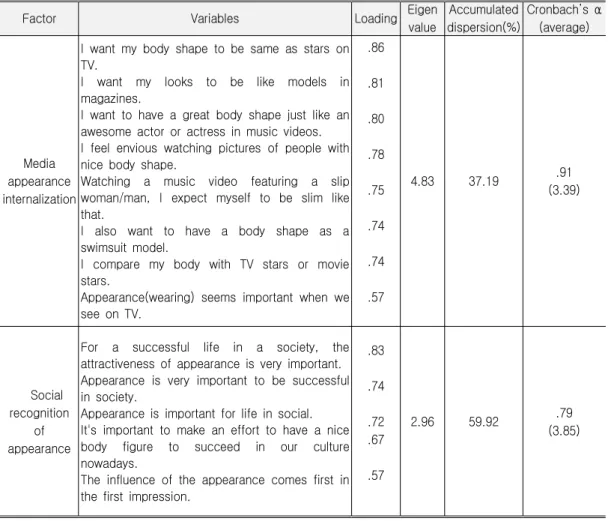
The result of principal component analysis and factor analysis with Varimax rotation to examine the sociocultural attitude toward appearance among adult female is shown in the Table 1.
The factor 1 is named 'media appearance internalization' with the fact that people want to have the same body shape as the entertainers on TV or magazines and they envy those who have a good body shape appeared in pictures.
Factor 2 is named as 'social recognition of
Table 1. Factor Analysis for Sociocultural Attitudes toward Appearance
Factor Variables Loading Eigen
value
Accumulated dispersion(%)
Cronbach’s α (average)
Media appearance internalization
I want my body shape to be same as stars on TV.
I want my looks to be like models in magazines.
I want to have a great body shape just like an awesome actor or actress in music videos.
I feel envious watching pictures of people with nice body shape.
Watching a music video featuring a slip woman/man, I expect myself to be slim like that.
I also want to have a body shape as a swimsuit model.
I compare my body with TV stars or movie stars.
Appearance(wearing) seems important when we see on TV.
.86
.81
.80
.78
.75
.74
.74
.57
4.83 37.19 .91
(3.39)
Social recognition
of appearance
For a successful life in a society, the attractiveness of appearance is very important.
Appearance is very important to be successful in society.
Appearance is important for life in social.
It's important to make an effort to have a nice body figure to succeed in our culture nowadays.
The influence of the appearance comes first in the first impression.
.83
.74
.72 .67
.57
2.96 59.92 .79
(3.85) appearance' with the fact that the attractiveness of appearance is important in successful social life. The credibility of two factors resulted in .91 for factor 1 and .79 for factor 2 in Cronbach's
with 59.92% of total explanation.
α
According to the average value, the appearance seemed to be important in social life, which supports the research findings of S.
Kim (2003) and Eunhee Park and Ku (2012) that women in twenties put higher importance on the physical appearance.
The result of factor analysis using Varimax
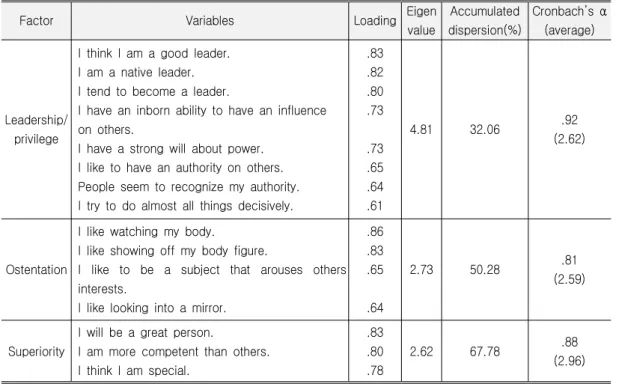
rotation and the principal component analysis to examine the narcissism is shown in the Table 2.
The factor 1 is about the fact 'I think I'm a good leader and a born-leader.' which is named as 'leadership/privilege'. The factor 2 is named as 'ostentation' which is about the fact 'I'd like to watch my body and to show off my body shape.' The factor 3 is named as 'superiority' with the fact 'I will be a great person and I am more competent than others'. The credibility for 3 factors showed in Cronbach’s α value for factor 1 was .92, factor 2 .81, and factor 3 .88 with 67.78% of explanation.
In the average scores, the leadership or ostentation of adult women showed low but the item of being more competent than others showed higher score than other sub-factors.
This result was different from the result of Eunjeong Park and Chung (2010)'s research which
Table 2. Factor Analysis for Narcissism
Factor Variables Loading Eigen
value
Accumulated dispersion(%)
Cronbach’s α (average)
Leadership/
privilege
I think I am a good leader.
I am a native leader.
I tend to become a leader.
I have an inborn ability to have an influence on others.
I have a strong will about power.
I like to have an authority on others.
People seem to recognize my authority.
I try to do almost all things decisively.
.83 .82 .80 .73
.73 .65 .64 .61
4.81 32.06 .92
(2.62)
Ostentation
I like watching my body.
I like showing off my body figure.
I like to be a subject that arouses others interests.
I like looking into a mirror.
.86 .83 .65
.64
2.73 50.28 .81
(2.59)
Superiority
I will be a great person.
I am more competent than others.
I think I am special.
.83 .80 .78
2.62 67.78 .88
(2.96) indicated female university students have strong narcissistic characteristics that they want to show off and to get compliments.
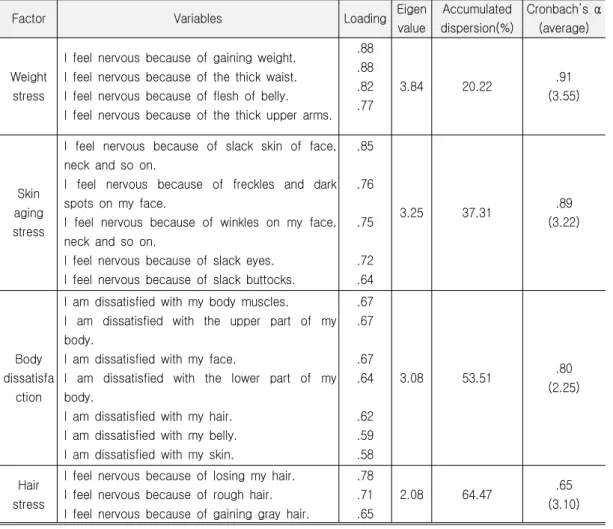
The result of factor analysis using Varimax rotation to examine the body stress among adult women is shown in the Table 3. The factor 1 is named as 'weight stress' as they are nervous about increasing weight and thicker waist. The factor 2 is named as 'skin aging stress' with the fact of being nervous about drooping skins in face or neck, and about age spots. The factor 3 is named as 'body dissatisfaction' with the fact of being satisfied with body muscle and the upper part of body. The factor 4 is about the fact of being nervous about rough hairs or hair loss, which is named as 'hair stress'. The result of credibility test for 4 factors showed in Cronbach’s α values with factor 1 was .91, factor 2 was .89, factor 3 was .80, and factor 4
Table 3. Factor Analysis for Body Stress
Factor Variables Loading Eigen
value
Accumulated dispersion(%)
Cronbach’s α (average)
Weight stress
I feel nervous because of gaining weight.
I feel nervous because of the thick waist.
I feel nervous because of flesh of belly.
I feel nervous because of the thick upper arms.
.88 .88 .82 .77
3.84 20.22 .91
(3.55)
Skin aging stress
I feel nervous because of slack skin of face, neck and so on.
I feel nervous because of freckles and dark spots on my face.
I feel nervous because of winkles on my face, neck and so on.
I feel nervous because of slack eyes.
I feel nervous because of slack buttocks.
.85
.76
.75
.72 .64
3.25 37.31 .89
(3.22)
Body dissatisfa
ction
I am dissatisfied with my body muscles.
I am dissatisfied with the upper part of my body.
I am dissatisfied with my face.
I am dissatisfied with the lower part of my body.
I am dissatisfied with my hair.
I am dissatisfied with my belly.
I am dissatisfied with my skin.
.67 .67
.67 .64
.62 .59 .58
3.08 53.51 .80
(2.25)
Hair stress
I feel nervous because of losing my hair.
I feel nervous because of rough hair.
I feel nervous because of gaining gray hair.
.78 .71 .65
2.08 64.47 .65
(3.10)
was .65 with 64.47% of explanation.
The average scores show adult women have a stress from gaining weight or having a thicker waist as the scores are high in weight stress while there was no high dissatisfaction with muscles, face, lower part of a body, and abdomen. This result is different from the research findings of H. Jeon and Chung (2008) which suggested middle-aged women (40-64) felt less stress related to the weight than to hair and weight. This difference can be explained by the ages.
2. The Interrelationship of Sociocultural Attitude toward Appearance, Narcissism, and Body Stress
The interrelationship of the sub-factors (media appearance internalization, social recognition of appearance) in sociocultural attitude toward appearance, the sub-factors (leadership/
privilege, ostentation, superiority) in narcissism, and the sub-factors (weight stress, skin aging stress, body dissatisfaction, hair stress) in body stress is shown in the Table 4.
The higher scores in media appearance internalization of sociocultural attitude toward appearance coincide with higher scores in leadership/privilege, ostentation and superiority of narcissism and with weight stress, skin aging stress, body dissatisfaction and hair stress of body stress. The correlations between the social recognition of appearance in sociocultural attitude toward appearance, ostentation in narcissism and stress turned out to be low, which shows that appearance is important in social life but has not that close to body-related stress.
Women who want to have the same body shape as those appeared on TV or music videos tried to be a better leader and thought themselves
Table 4. Correlation between Sociocultural Attitudes toward Appearance, Narcissism, and Body Stress Variables
Variables
Sociocultural attitudes toward
appearance Narcissism Body stress
Media appearance internalization
Social recognition of
appearance
Leaders hip/
privilege
Ostentat
ion Superiority Weight stress
Skin aging stress
Body dissatisf
action Hair stress Media
appearance internalization
1
Social recognition of
appearance
.506** 1
Leadership/
privilege .168** .086 1
Ostentation .358** .165* .518** 1
Superiority .138* .111 .650** .477** 1
Weight stress .388** .094 .071 .019 -.033 1
Skin aging
stress .271** .165* -.057 -.022 -.184** .462** 1
Body
Dissatisfaction .229** .156* -.293** -.229** -.330** .325** .476** 1 Hair stress .136 .150* -.077 -.142* -.238** .228** .489** .411** 1
*p .05,< **p .01<
to be superior to others. Women who want to look more like the models in magazines felt stressed from gaining weight or drooped skins and have dissatisfaction with their bodies. This refers to the fact that higher internalization leads higher weight stress, skin aging stress with higher narcissism. This supports the result of Lim (2004)'s research which suggested the university students who have a strong desire to be a 'best face' or 'best body shape' as they internalize the media images ideally to resemble.
3. The Influence of Sociocultural Attitude toward Appearance and Narcissism on Body Stress
In Table 5, the result of regression analysis to examine the influence of sociocultural attitude toward appearance and narcissism on body stress among adult female showed R2=.12, which explains 12% of the regression model. VIF (variable inflation factor) and tolerance have been examined to diagnose the multicollinearity among variables, which can be judged to have problem when VIF is over 10 or the tolerance is lower than 0.1. In this analysis the VIF values of all variables were below 10 and the tolerance were bigger than 0.1, which proves that there's no problem for the multicollinearity (Juyoun Kim, 2012). The media appearance internalization in the sociocultural attitude toward appearance and leadership/privilege and superiority in narcissism were found to have a significant influence on body stress. The higher media appearance internalization is and the higher leadership they have, the higher body stress shown. That is, women who have high internalization through mass media, who play the role of a leader and who lower themselves rather than show off seemed to feel less psychological depression or anxiety.
The regression analysis results to examine the influence of sociocultural attitude toward
Table 5. The Influence of Sociocultural Attitudes toward Appearance and Narcissism on Body Stress Dependent
variables
Independent
variables B S.E. β t VIF
Body stress
(constant) 2.64 .191 13.84***
Media appearance internalization Social recognition of appearance
Leadership/privilege Ostentation
Superiority
.14 -.02
.15 -.03 -.09
.04 .05 .05 .05 .04
.30 -.02
.26 -.06 -.20
3.62***
-.30 2.87**
-.74 -2.18*
1.51 1.35 1.92 1.60 1.83 R2=.12 F=5.33***
*p .05,< **p .01,< ***p .001<
appearance and narcissism of adult female on the sub-factors of body stress are shown in the Table 6. The media appearance internalization in sociocultural attitude toward appearance and the ostentation in narcissism showed a significant influence on weight stress with 18 % of explanation. Women who also want to be slim watching a slim woman on TV seemed to have stress from weight or abdomen flesh, and thickening arms. Women who have low intention of showing off the body shape are usually not confident with their body and this makes people being nervous about the waist size and abdomen flesh and have higher stress. In other words, women with higher internalization through the mass media seemed to have weight stress. This result is different from Yunjung Hwang and Yoo (2010)'s research result which indicated the internalization in sociocultural attitude toward appearance have a significant influence on the positive weight management behavior. On the other hand This result coincide with the result of S. Cho and Kim (1997)'s research which suggested women who have higher level of obesity judged by themselves had more stress and who have stronger belief of weight control had an increased stress.
The media appearance internalization in sociocultural attitude toward appearance and the superiority in narcissism proved to have a significant influence on skin aging stress with 11% of explanation. Women who envy the body shape of a nice entertainer seemed to have more stress from skin aging while those who have a belief in their abilities usually manage their skin thoroughly, which results in less stress from skin aging. Women who envy the appearance of great entertainers have lots of stress from skin aging. With 21% of explanation, media appearance internalization of sociocultural attitude toward appearance and ostentation and
Table 6. The Influence of Sociocultural Attitudes toward Appearance and Narcissism on Sub-factors of Body Stress
Dependent variables
Independent
variables β t F Adjusted
R2
Weight stress
Media appearance internalization Social recognition of appearance
Leadership/privilege Ostentation
Superiority
.51 -.14
.16 -.17 -.11
6.50***
-1.84 1.78 -2.11* -1.26
9.70*** .18
Skin aging stress
Media appearance internalization Social recognition of appearance
Leadership/privilege Ostentation
Superiority
.28 .07 .09 -.05 -.26
3.43**
.88 .98 -.64 -2.94**
6.05*** .11
Body dissatisfaction
Media appearance internalization Social recognition of appearance
Leadership/privilege Ostentation
Superiority
-.32 -.06 .11 .19 .22
4.13***
.86 -1.30 -2.42* -2.58*
11.92*** .21
Hair stress
Media appearance internalization Social recognition of appearance
Leadership/privilege Ostentation
Superiority
.14 .12 .17 -.16 -.31
1.77 1.59 1.82 -1.84 -3.42***
5.45*** .10
*p .05,< **p .01,< ***p .001<
superiority of narcissism have a significant influence on body stress. Women with low media appearance internalization and high ostentation had less complaints on body muscle, face, or skin. This results supports the results of Heinberg et al. (1995)'s study which found the social comparison of their own body with slim body shapes delivered through the mass media had a significant influence on the perception of body image and Eunjeong Park and Chung (2013)'s study which suggested the influence of mass media significantly influences on the dissatisfaction with body parts. The superiority of narcissism seemed to have a significant influence
on hair stress with 10% of explanation and women who considers themselves superior had less stress from hair.
On the other hand, there was no influence of social recognition in sociocultural attitude toward appearance and leadership/privilege and ostentation in narcissism on aging stress and hair stress. This is because people get stressed from the reaction by social comparison objects but not by what they prefer.
And there's no significant influence of appearance social recognition among the sub-factors of sociocultural attitude toward appearance on body stress. This can be comprehended as a reaction by the internalization of what they want rather than a reaction by recognition of social peripheral environment resulting from an interaction of environmental stimulation factors and personal specific reaction. media appearance internalization of sociocultural attitude toward appearance had a significant influence on weight stress, skin aging stress, body dissatisfaction of body stress, but not on hair stress. This means hair style seems to be decided by the hair styles created by hair designers not by the ideal hair style delivered through mass media as personal face image is different, which coincides the result of Eunjeong Park and Chung (2013).
4. The Difference in Sociocultural Attitude toward Appearance, Narcissism and Body Stress by the Age Groups
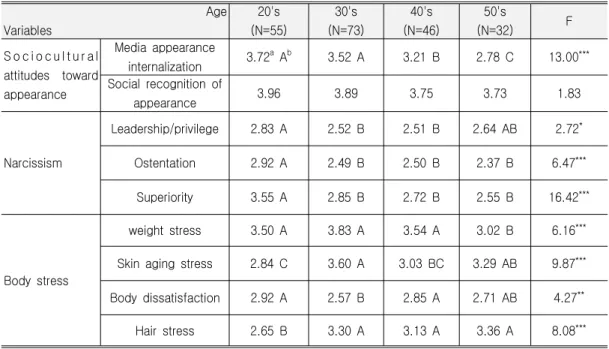
The result of variance analysis and Duncan-test to examine the difference among sociocultural attitude toward appearance, narcissism and body stress by the age groups is shown in the Table 7. There was a significant difference in media appearance internalization of
sociocultural attitude toward appearance between the group of the twenties and the 30s/40s, between 30s and 40s/50s, and between 40s and 50s. The groups of 20s and 30s want the body shape just as the models on TV or music videos more than those of 40s and 50s, and it's possible to recognize the group of 40s rather than 50s envy people with good bod shape. The score of media appearance internalization is highest in the group of 20s followed by 30s and 40s, which coincides with Hong (2006)'s research. There was a significant difference in leadership/privilege, ostentation and superiority of narcissism. The group of 20s think themselves to be better leaders than other groups and showed strong will of privilege. This shows the group of 20s love to show off their body shape more than other groups and they think themselves to be more competent. Women in the group of 50s and more had less stress from weight while women in their 20s to 40s get stress from the waist, abdomen, and arms getting thicker. This results support the result of H. Jeon and Chung (2008)'s research. The stress from skin aging is highest in the group of 30s, which means women in their 30s perceive their wrinkles or a drooped skin naturally so they get less stress than before. Women in their 40s are managing their skin as they accept some degree of drooped skin and women in their 50s feel more stress from more wrinkles in their neck and age spots on the skin as after 30s they lose more hair and the hair get crumpy and after 40s they got more gray hairs, women seem to have more interest in hair management. This result is different from the result of H. Jeon and Chung (2008)'s study which found the group of 50s experienced stress most related to face and hair.
Table 7. Sociocultural Attitudes toward Appearance, Narcissism and Body Stress according to Age Gender Age
Variables
20's (N=55)
30's (N=73)
40's (N=46)
50's
(N=32) F
S o c i o c u l t u r a l attitudes toward appearance
Media appearance
internalization 3.72aAb 3.52 A 3.21 B 2.78 C 13.00***
Social recognition of
appearance 3.96 3.89 3.75 3.73 1.83
Narcissism
Leadership/privilege 2.83 A 2.52 B 2.51 B 2.64 AB 2.72*
Ostentation 2.92 A 2.49 B 2.50 B 2.37 B 6.47***
Superiority 3.55 A 2.85 B 2.72 B 2.55 B 16.42***
Body stress
weight stress 3.50 A 3.83 A 3.54 A 3.02 B 6.16***
Skin aging stress 2.84 C 3.60 A 3.03 BC 3.29 AB 9.87***
Body dissatisfaction 2.92 A 2.57 B 2.85 A 2.71 AB 4.27**
Hair stress 2.65 B 3.30 A 3.13 A 3.36 A 8.08***
*p .05,< **p .01,< ***p .001 (a=factors score by the groups, b=literally indicated result of Duncan< test(A>B>C))
. Conclusion and Implications
Ⅴ
This study examined the influence of sociocultural attitude toward appearance and narcissism on body stress oriented to adult women in their 20s to 50s, and the results are as follows.
First, the sociocultural attitude has its components as media appearance internalization and social recognition of appearance and the narcissism has leadership/privilege, ostentation and superiority, while body stress has weight stress, body dissatisfaction and hair stress.
Second, the average shows that adult women think the appearance is important to succeed in a society and they tend to envy those who have good shape of body or they want to have that kind of body shape. These women have low
intention to show their prestige or to be a leader and they even have low intention in ostentation of body shape. They were not negative on their abilities and appeared to have a higher stress on the weight but lower stress on muscle, face and abdomen with the points under the median value.
Third, there was a significant relationship between the sub factors of sociocultural attitude toward appearance (media appearance internalization, social recognition of appearance) and those of body stress (weight stress, skin aging stress, body dissatisfaction, hair stress).
Women who are more influenced by mass media tended to show off their body shape and their ability with leadership falling into narcissism. In addition, they are not satisfied with upper part, abdomen, and lower part of their body and
appeared to have higher stress on weight, skin aging and hair. The correlations of skin-aging stress, body dissatisfaction, and hair stress turned out to be low, which shows that appearance is important in social life but has not that close to body-related stress.
Fourth, the result showed there is a significant influence of media appearance internalization in sociocultural attitude on ostentation in narcissism. These women had no self-confidence in their body shape, which brought high stress from their weight and as they grew older they are nervous having a thicker waist and abdomen. media appearance internalization of sociocultural attitude toward appearance and superiority of narcissism appeared to have a significant influence on skin aging stress. Women who think it's a kind of their ability to maintain younger skin had low stress on skin aging as they care about skin management. Women who think themselves to be more competent than others had lower stress as they find the problems before getting stress and manage their skin. media appearance internalization in sociocultural attitude toward appearance and ostentation and superiority in narcissism appeared to have a significant influence on body dissatisfaction while women who were confident in their body shape with competent abilities were satisfied with their face, skin and body parts. This shows an importance of internalization by the roles of mass media as the internalization with self-trust formed toward body and ability showed an intention of satisfaction with body parts. The superiority of narcissism proved to have a significant influence on hair stress. As different hair styles can display a complete image such as dignity, vividity, solemnness and so on, women who have high intention to show off are thoroughly
managing their hair styles, which results in low hair stress. Women felt high stress from body shape when they compare themselves with the ideal type delivered through the media. Women who tend much to express their body shape had a high stress from weight. Therefore it is needed to let women recognize the proper contents about changes of body shape and health through the mass media with the interest of adult women in their increasing weight and size of the waist as well as let them put into practice a healthy body management by each person's body shape. Women who think an attractive body shape to be an ideal one had more stress on their body while those who wanted to show off their body and felt more competent than others showed low stress.
From this result, we need to think an alternative strategy in advertisements to change the slim models into a various kind of models, which can suggest a new frame and recognition of women's body. Hair designers need to suggest a proper hair style according to a person's face shape and image as the hair style plays an important role in forming an image.
There was also a significant difference among sociocultural attitude toward appearance, narcissism and body stress by the age. Women in their thirties felt more psychological stress in skin aging than physical. This indicates they have more interest in skin than any other age groups and they need basic cosmetics proper for their ages. Dissatisfaction scores were high in muscle, face, upper and lower body, which can be considered as a change of body condition in the difference of the twenties and thirties. Like this most of modern women consider a slim body shape just like entertainers to be ideal even though they get older with changes in body. The interest in appearance