Kum river flows westward to the Yellow Sea.
River mouth dam was constructed to store fre- shwater resources in Kum river estuary in 1990 (KARIC, 1997a). There were a number of constr- uction of dams or lock gates in coastal areas of Korean peninsula. It was revealed to change the brackish ecosystem where the artificial blockade was constructed between seawater and freshwat- er, and even between seawater and seawater (cf.
Kim and Lee, 1994 for Inchon dock). With the co- nstruction of the dam, seawater input has been blockaded in the upstream of the dam in Kum ri- ver estuary. Then the upstream area has been changed to have the characteristics in freshwater ecosystem, gradually (cf. Yang et al., 2001 for Na- kdong river mouth dam). Shin and Cho (2000a, b) described the eutrophication in Kum river re- servoir and reported the bloom of Stephanodisc- us spp. in winter season and Microcystis spp. in
the summer. Then, the objective of the study is to clarify the impact of dam construction on the distribution of zooplankton and phytoplankton.
Three times of field observation were carried out at three selected stations in both upstream and downstream of the river-mouth dam in Kum river estuary during the study period (June -October 2000). Station 1 located at the front of newly constructing maritime village in the river mouth, station 2 just down the dam and station 3 just up the dam, respectively. Quantitative zoo- plankton samples were collected with Kitahara plankton net (mouth diameter: 25 cm, mesh aper- ture: 0.1 mm) and fixed with 4% neutralized formalin. Phytoplankton was collected with Van -Dorn water sampler both from surface (30 cm depth) and bottom waters, and fixed with lugol solution. Environmental factors, i.e., pH and water temperature (Hana HI 9023C), and DO
* Corresponding Author: Tel: 02) 2290-0951, Fax: 02) 2296-1741, E-mail: [email protected] Korean J. Limnol. 35 (2): 141~144 (2002)
─
─ 141 ──
Zooplankton and Phytoplankton Dynamics with the Construction of River Mouth Dam in Kum River Estuary, Korea
Kim, Saywa, Myung-
-Soo Han
1, Kwang--Il Yoo
1*, Kyung Lee
2and Young--Kil Choi
1 (Department of Life Science, Yongin University, 1Department of Life Science, Hanyang University,2Department of Biology, Catholic University)
The construction of river mouth dam has prevented seawater from backwarding to upstream in Kum river estuary since 1990. Field observations on environmental fac- tors, and zooplankton and phytoplankton dynamics have been carried out three times with two month interval in the summer and autumn in 2000 at three selected stations in Kum river estuary. Blockade of seawater flowing backward to upstream caused sharp contrast of zooplankton fauna and phytoplankton flora between up- stream and downstream of the river mouth dam. Freshwater cladocerans i.e., Bosmi- na longisrostris and Daphnia galeata dominated in the upstream, and marine cope- pods of Acartia omorii and Paracalanus crassirostris occurred abundantly in down- stream of the dam. Freshwater diatoms did not distributed in the downstream of the dam except Melosira varians, while marine diatom of Cylidrotheca closterium occur- red in benthic waters both in upstream and downstream of the dam. The construc- tion of the river mouth dam seems to play an ecological role to blockade the input of marine organism into the upstream in Kum river estuary.
Key words : River mouth dam, Kum river, zooplankton, phytoplankton, blockade
NOTE
(YSI 51B) were measured. Zooplankton samples were examined to species level under a dissec- ting microscope (Zeiss SV11) and compound mic- roscope (Zeiss Auxiolab), and phytoplankton, un- der compound microscope, respectively.
Water temperature fluctuated between 23.6~
25.5� C in June, 27.9~30.1� C in August and 22.1
~24.8� C in October, respectively (Table 1). Due to shallow water and high tidal movement, no distinct difference was observed between surface and bottom except in October at stn. 3 where the surface temperature was 2� C higher than bottom one. This result agrees well with that reported by Shin and Cho (2000b) where water tempera- ture arose to 30� C in the summer and around 20~25� C in June and October in 1998 and 1999 at just up the dam. pH varied around 7.5 except in October at stn. 1 where was higher than 9.3 both in surface and bottom. In August, stn. 3 showed more or less higher pH of 8.01. while pH in stn. 3 showed higher pH than 8 in August 1998 and less pH than 7.0 in August 1999 (Shin and Cho, 2000b). DO varied between 3.1 mg/l (in October at the bottom of stn. 2) and 9.6 mg/l (in August at the surface of stn. 3). Higher DO was measured at stn. 3 than those at stns. 1 and 2, and surface water showed higher D.O than those of bottom waters. Since Shin and Cho (2000b) measured DO only in the surface at stn. 3, they reported DO higher than 7 mg/l during their study period from January 1998 to September 1999. Low DO values observed by us suggested that bottom waters were not mixed well with surface ones in the study area due to the decre- ase of tidal mixing at there. Decomposition of sedimentary sewage seemed to demand oxygen consumption at the bottom, too (Kang and Song,
2000).
A total of 31 taxa of marine zooplankton and 18 taxa of freshwater zooplankton were distribu- ted during the present study. Among marine zoo- plankton, 12 species of copepod occurred and sh- owed the prosperity in species number, while 11 cladocerans distributed. Minimum abundance of 2,759 indiv./m
3was recorded at stn. 1 in August and the maximum was 190,433 indiv./m
3at stn.
3 in June (Fig. 1). Except the outstanding abun- dance due to the outburst of Noctiluca scintillans and Bosmina longirostris in June, zooplankton abundance never exceeded 20,000 individuals/m
3during the rest of the study period. Marine cope- pod of Acartia omorii and copepodites dominated at stns. 1 and 2, while freshwater clacoceran of Bosmina longirostris and freshwater copepod of Cyclops vicinus occurred abundantly at stn. 3.
142 Saywa Kim∙∙Myung--Soo Han∙∙Kwang--Il Yoo∙∙Kyung Lee∙∙Young--Kil Choi
Table 1. Seasonal variation in environmental factors (water temperature, pH and DO) in Kum River estuary during the period of study from June to October, 2000.
Month June August October
Station; Surface 1 2 3 1 2 3 1 2 3
Temperature (�C) 24.9 25.3 24.1 30.1 27.9 29.6 24.8 22.1 24.8
pH 7.51 7.65 7.27 7.47 7.01 8.01 9.32 7.71 7.55
DO (mg1-1) 8.2 8.5 9.0 4.2 8.9 9.6 6.1 6.5 9.5
Month June August October
Station; Bottom 1 2 3 1 2 3 1 2 3
Temperature (�C)) 25.5 25.5 23.6 29.9 28.4 28.1 24.2 23.8 23.6
pH 7.50 7.54 7.11 7.32 7.84 7.49 9.44 7.90 7.41
DO (mg1-1) 7.2 6.3 7.7 2.2 2.8 6.4 3.1 2.1 6.9
Fig. 1. Zooplankton abundance change at three stations in Kum river estuary from June to October, 2000.
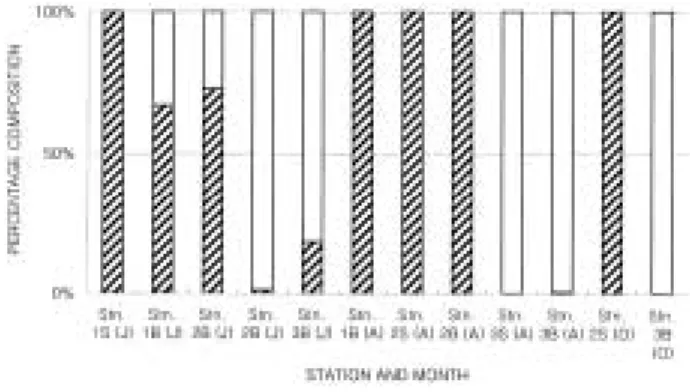
Marine zooplankton occurred at stn. 1 and a few number of freshwater cladocerans and copepods distributed at stn. 2 in August and October (Fig.
2).
Except the abundance of Noctiluca scintillans in October, more than 90% of zooplankton fauna consisted of freshwater zooplankton at stn. 3 (Fig. 3).
Phytoplankton standing crops were recorded to be maximum of 7,735,000 cells/l at the surface of stn. 3 in August and minimum of 3,398 cells/l at the bottom of stn. 1 in August, respectively. Skel- etonema costatum dominated at stns. 1 and 2, while Pediastrum duplex and Cryptomonas spp.
did at stn. 3 in June. Kim and Boo (1998) also re- ported the P. duplex in high frequency and stan- ding crops at the upstream of Kum river mouth
dam. Only marine diatoms occurred both in sur- face and bottom waters at stn. 1, whereas 30% of phytoplankton standing crops consisted of fresh- water ones in bottom waters at stn. 2 (Fig 4).
No such an occurrence of freshwater diatoms was observed at stations located down the dam in August and October. In October more than half of phytoplankton standing crops consisted of Melosira granulata and M. granulata var. angus- tissima at stn. 3.
In comparison with phytoplankton study in Nakdong river estuary (Lee et al., 1993, 1994, 1995; Seo and Chung, 1994), a few studies on ph- ytoplankton was carried out in Kum river (Shin and Cho, 2000b). Some reports on the phytoplan- kton dynamics in Kum river estuary (KARIC 1996, 1997b) dealt with the seasonal variation in phytoplankton standing crops, 2.98×10
6-2.37×
10
7cells/l at the upstream of the dam and 1.00×
10
6~1.10×10
7cells/l at the downstream in 1994
~1996. Our results on standing crops at stn. 3 was more or less similar to those reported by KARIC, however, even the maximum standing crops of 2.6×10
6cells/l was quite lower than those reported by KARIC at the downstream of the dam. This suggests that the primary produc- tion became to decrease with the construction of the dam at downstream waters of the dam, while upstream waters became to be eutrophicated (cf.
Shin and Cho, 2000a).
We suppose the biological productivity will dec- rease at the downstream of the dam in Kum riv- er estuary and eutrophication will be a serious problem in upstream waters.
Zooplankton and Phytoplankton Dynamics in Kum River Estuary 143
Fig. 2. Percentage composition of marine and freshwater zooplankton at three stations in Kum river estu- ary from June to October, 2000. Hached area: ma- rine species, open: freshwater species.
Fig. 3. Phytoplankton standing crops at three stations in Kum river estuary from June to October, 2000.
Hached column: June, open: August, solid: October.
Fig. 4. Percentage composition of marine and freshwater phytoplankton at three stations in Kum river es- tuary from June to October, 2000. Hached area:
marine species, open: freshwater species.
ACKNOWLEDGEMENT
The present study was supported by the Basic Science Research Institute Program, Ministry of Education (1998-015-D00231).
REFERENCES
Kang, Y.M. and H.G. Song. 2000. Effect of bottom sediment on oxygen demand of overlying water in onshore of lake Paldang. Korean J. Limnol. 33: 23 -30 (in Korean with English abstract).
KARIC (Korea agricultural and rural infrastructure corporation). 1996. Reports on the environmental impact assessment of rice paddy construction at Kum river I area. 31-33pp. (in Korean).
KARIC (Korea agricultural and rural infrastructure corporation). 1997a. Report on the maintenance of the river mouth dam in Kum river. 462pp. (in Ko- rean).
KARIC (Korea agricultural and rural infrastructure corporation). 1997b. Reports on theenvironmental impact assessment of rice paddy construction at Kum river I area. 93-94pp. (in Korean).
Kim, J.T. and S.M. Boo. Population dynamics of the cholorococcalean members (Chlorophyta) in Kum- gang river, Korea. Korean J. Limnol. 31: 219-224 (in Korean with English abstract).
Kim, S.W. and J.H. Lee. 1994. Seasonal distribution of zooplankton communities in Inchon dock, an
artificially closed marine embayment facing the Yellow Sea, western Korea. J. Korean Soc. Ocean- ogr. 29: 376-382.
Lee, J.A., A.R. Choi, and I.K. Chung. 1995. Phyto- plankton stoichiometry and nutrients status of the Sonakdong river. Korean J. Phycol. 10: 37-44.
Lee, J.A., K.J. Choi, O.S. Kwon, and I.K. Chung.
1993. A study on the environmental factors in Na- kdong estuarine ecosystem. Korean J. Phycol. 8:
29-36.
Lee, J.A., K.J. Choi, O.S. Kwon, I.K. Chung, and B.Y.
Moon. 1994. Primary production of phytoplankton in Nakdong estuarine ecosystem. Korean J. Lim- nol. 24: 69-78.
Seo, J.K. and I.K. Chung. 1994. The phytoplankton community structure in the Nakdong river mou- th. Korean J. Limnol. 27: 227-250.
Shin, J.K. and K.J. Cho. 2000a. Water quality assess- ment by algal growth potential (AGP) from mid- stream to downstream of the Kum river. Korean J. Limnol. 33: 244-250 (in Korean with English abstract).
Shin, J.K. and K.J. Cho. 2000b. Seasonal dynamics and pollution status of the water quality in the Kum river reservoir. Korean J. Limnol. 33: 251- 259 (in Korean with English abstract).
Yang, H.J., K.H. Kim, and J.D. Kum. 2001. The fish fauna and migration of the fish way of the Nak- dong river mouth dam. Korean J. Limnol. 34: 251 -258 (in Korean with English abstract).
(Received 14 Apr. 2002, Manuscript accepted 2 Jun. 2002) 144 Saywa Kim∙∙Myung--Soo Han∙∙Kwang--Il Yoo∙∙Kyung Lee∙∙Young--Kil Choi