http://dx.doi.org/10.11614/KSL.2013.46.3.367 ISSN: 2288-1115 (Print), 2288-1123 (Online)
─
─ 367 ──
꺽저기 Coreoperca kawamebari 와 꺽지 C. herzi 의 공서 하천인 보성강에서 환경 차이에 따른
두 종의 분포와 어류 군집 구조
김석현∙이상헌1∙이완옥2∙조강현*
(인하대학교 자연과학대학 생명과학과, 1서울대학교 환경대학원 환경계획학과,
2국립수산과학원 중앙내수면연구소)
Distribution of Coreoperca kawamebari and C. herzi and Fish Community Structure in Relation to Environmental Differences in Their Sympatric Area of the Boseong River, Korea.
Kim, Seog Hyun, Sang Hun Lee1, Wan-Ok Lee2and Kang-Hyun Cho* (Department of Biological Sciences, Inha University, Incheon 402-751; 1Department of Environmental Planning, Seoul National University, Seoul 151-742; 2Inland Fisheries Research Institute, NFRDI, Gapyeong 477-815, Korea)
The distribution of Coreoperca kawamebari was known to be restricted to the Tamjin River and several small streams flowing into the southern part of the West Sea, while C. herzi was widely distributed throughout South Korea except the areas inhabited by C. kawamebari: the two species were known to be allopatric. However, we found that both species were sympatric in the Boseong River, a tributary of the Seomjin River, and the Jiseok Stream, a tributary of the Yeongsan River. Local-scale distribu- tion of the two Coreoperca species, fish assemblages, and environmental variables were surveyed to investigate effects of environmental factors on fish community structures in the Boseong River. Rank abundance distribution of fish community at the study sites indicated that fish species diversity and distribution pattern of the two Coreoperca species were closely related to habitat diversity. The result of canon- ical correspondence analysis showed that C. kawamebari was distributed in pool areas while C. herzi was found in the areas with higher water velocity and boulder substrate. These results suggested that species diversity of fish community decreased and only one of the two Coreoperca species inhabited at the sites with less diverse habitat, but on the other hand, high habitat diversity increased species diversity and allowed the two species to coexist.
Key words : habitat, ordination, rank abundance distribution, species diversity, water velocity, substrate
* Corresponding author: Tel: +82-32-860-7698. Fax: +82-32-874-6737. E-mail: [email protected]
ⓒ The Korean Society of Limnology. All rights reserved.
This is an open-access article distributed under the terms of the Creative Commons Attribution Non-Commercial License (http://creativecommons.org/licenses/by-nc/3.0/), which permits unrestricted non-commercial use, distribution, and reproduction in any medium, provide the original work is properly cited.
서 론
하천에서 어류의 종조성과 수도는 지리적 위치, 진화 역사, 물리적 서식지, 수질 및 생물학적 상호관계 등에 영 향을 받는다(Poff et al., 1997; Taylor et al., 2006). 이중에 서 서식지 물리 환경 요인으로서 유속, 수심, 하상구조, 식 생 등이 중요하고(Gorman and Karr, 1978; Angermeier and Karr, 1983; Poff and Allan, 1995; Rowe et al., 2009), 수질로서 수온, 용존산소, 부유물질, 독성물질, 영양소, 오 염물질 등이 주요 물리화학적 요인이다(Lenat and Craw- ford, 1994; Meador and Goldstein, 2003). 이들 환경 요 인은 개별적 또는 복합적으로 어류의 서식지 선택과 군 집 구조에 영향을 미친다(Jackson et al., 2001; Taylor et al., 2006).
한편 생물의 서식지 선택에 있어서 중요한 개념인 생 태적 지위(niche)는 다차원 공간에서 다양한 무생물 환 경요인과 생물간의 상호작용에 의하여 결정된다(Hut- chinson, 1957; Jackson et al., 2001). 생태적 지위가 유사 한 종은 종간경쟁에 의하여 서식지를 완전히 달리하거나, 자원 또는 미소서식지(microhabitat)를 분리함으로써 동 일한 서식지에서 공존할 수 있다(Hardin, 1960; Nilsson, 1967; Ross, 1986). 이처럼 계통학적 또는 생태학적으로 유사한 종이 종간 상호작용에 의하여 서식지 이동(habi- tat shift)이 일어나고 서식지가 분리되어 공서(sympatry) 할 수 있다(Sone et al., 2001).
국외 하천에서 계통학적으로 유사한 어류 종을 대상으 로 공서 수역에서 자원 및 서식지 분리에 대한 연구가 연 어과 어류를 중심으로 활발히 진행되었는데, 연어과 어류 는 부분적으로 서식지 이용의 분화에 의하여 장기간 공 존이 촉진되었다(Hearn, 1987). 이밖에 다른 과에 속하 는 어류에 대한 연구에서는 미국 중동부에서Etheostoma 속의 여러 종이 이질적인 서식지 환경에서 경쟁에 의하 여 먹이활동에 대한 미소서식지를 분리하여 공존함을 확 인하였다(Greenberg 1988; Henry and Grossman, 2008;
Pratt and Lauer, 2013). 또한 캘리포니아 하천에서 둑중
개속 Cottus의 두 종이 유속과 수심에 따라서 서식지를
뚜렷하게 분리하였다(White and Harvey, 1999). 일본 Shikoku에서 공서하는 밀어속 Rhinogobius의 두 가지
유형(type)이 유속과 하상구조에 의하여 서식지를 분리하
였다(Sone et al., 2001). 우리나라에서는 유속에 의하여 참 갈겨니의 두 가지 유형이 서식지를 분리하였으며(Chae and Yoon, 2010), 수온에 의한 연준모치와 금강모치의 서 식지 분리가 보고되었다(Baek et al., 2002).
우리나라에 꺽지속Coreoperca어류는 꺽저기C. kawa- mebari와 꺽지C. herzi의 2종이 분포하고 있다(Chyung, 1977; Kim and Park, 2002; Kim et al., 2005). 꺽저기와 꺽지는 유전적으로 분화되어 있고(Okazaki and Jeon, 1996), 형태적으로 체고, 눈의 크기, 양안 간격과 측선비늘 수에서 차이를 보인다(Kim et al., 2005). 또한 두 종의 초 기 생활사와 산란 습성이 다른 것으로 알려져 있다(Park et al., 1997; Han et al., 1998; Han et al., 2000). 그러나 이들의 서식지 특성 등의 생태적 특징에 대한 연구는 많 지 않은데, 두 종은 모두 작은 물고기, 수서곤충 등을 먹 는 육식성 어류(Park et al., 1997; Kim and Park, 2002) 로서 유사한 생태적 지위를 가질 것으로 생각된다.
한편 꺽저기와 꺽지의 국내 분포지를 살펴보면, 꺽저기 는 탐진강, 낙동강, 거제도 등에 제한적으로 분포하는 반 면, 꺽지는 한국 고유종으로 전국의 여러 하천에 분포한 다고 보고되어 있었다(Kim and Park, 2002; Kim et al.,
2005). 그러나 최근까지 실제로 두 종이 동시에 서식하는
공서 수역이 발견되지 않았다(Jeon, 1986; Song and Lee, 1989; Jeon and Kim, 1996; Son and Song, 1998; Kim et al., 2001). 본 저자들이 꺽저기의 주요 서식지인 탐진강 과 인접 하천을 대상으로 꺽저기와 꺽지의 분포를 정밀 하게 조사한 결과 이들의 공서 수역을 발견할 수 있었다. 그러므로 본 연구에서는 새로 발견된 꺽저기와 꺽지의 공서 하천인 보성강 상류 수역에서 하천 환경 차이에 따 른 이들 두 종의 분포와 어류 군집 구조의 변화를 파악 하기 위하여, 두 종의 수도 비율이 다른 하천 구간을 선 정하여 어류의 종조성과 종별 개체수를 조사하고 어류 군집 구조에 영향을 미칠 것으로 예상되는 서식지 물리 환경과 수질 환경 요인을 측정하였다.
재료 및 방법
1. 조사지 선정
현장조사는 꺽저기와 꺽지의 공서 수역으로 밝혀진 전 라남도 보성군과 장흥군에 위치한 보성강 상류에서2011 년 9월 17~19일, 2012년 2월 17~19일, 4월 18~20일, 10월5~7일의 총4회 실시하였다. 이 하천에서 꺽저기와 꺽지의 상대적 수도가 상이한 5곳의 조사지를 선정하였 다. 각 조사지에서 수로를 따라서 100~150 m의 하천구 간에서 어류를 채집하고 환경을 조사하였다. 선정된5개 조사지의 행정구역, 위도 및 경도는 다음과 같다(Fig. 1).
St. 1: 전남 장흥군 장평면 기동리(34�47′40.9′′N, 126�
57′06.5′′E)
St. 2: 전남 장흥군 장평면 녹양리(34�47′33.6′′N, 127� 00′05.7′′E)
St. 3: 전남 보성군 노동면 옥마리(34�48′27.2′′N, 127� 01′33.5′′E)
St. 4: 전남 보성군 노동면 대련리(34�47′33.4′′N, 127� 03′02.0′′E)
St. 5: 전남 보성군 보성읍 용문리(34�47′20.9′′N, 127� 05′23.8′′E)
2. 현장 조사
선정된 조사지에서 어류를 정량 채집하기 위하여 1회 조사 시 투망(망목 7×7 mm)을 15회 투척하고 족대(망 목 4×4 mm)를 30분간 사용하여 채집하였다. 채집된 어 류는 현장에서 동정하고 계수한 후에 방류하였다. 어류의 동정은Kim and Park (2002)과 Kim et al. (2005)을 따랐 다.
어류를 채집한 조사지에서 하천 환경은 2012년 10월 5~7일에 조사하였다. 미국 환경청의 하천 표준 조사법 (Lazorchak et al., 1998; Barbour et al., 1999)을 참조하 여 총16개의 환경 요인을 측정하였다(Table 1). 각 조사 지에서 등간격으로 5곳에 횡단면을 설치하고 각 단면을 따라서2 m 간격으로 유속, 수심 및 하상구조를 측정하였
다. 유속은 유속계(Flowatch, JDC Electronic SA, 스위스) 를 사용하여 수심의60% 지점에서 측정하였다. 하상구조
는 Cummins (1962)의 방법을 참조하여 각 조사지에서
50×50 cm 방형구를 설치하고 방형구 내에서 가장 우세
한 하상 입자를 기록하였다. 각 단면의 평균 유속과 평균 수심을 다시 평균하여 조사지의 대표치로 산출하였다. 하 상구조의 조사지 대표치는 각 단면에서 하상입자의 상대 적 빈도를 구하고 이 빈도를 전체 조사지에서 평균하여 산출하였다. 조사지의 저수로 폭은 5개의 횡단면에서 측 정하여 평균하였다. 하천수의 이화학적 특성은 휴대용 수 질측정기(YSI 556 MPS, YSI Inc., 미국)를 사용하여 수 온, 용존산소, pH 및 전기전도도를 각 조사지의 가장 하 류에 위치한 횡단면의 중앙에서 측정하였다.
저수로의 식생 분포는 침수식물, 정수식물 및 목본식물 (overhanging tree)의3가지 식생형으로 구분하여 조사하 였다. 침수식물은 각 횡단면에서5개 지점을 동일 간격으 로 선정하여1×1 m 방형구를 설치하고 피도를 측정하였 다. 하안의 정수식물과 물 위로 드리운 목본식물은 각 횡 단면의 양안에서 상∙하류5 m의 구간을 관찰하여 각 식 생유형별로 피도를 측정하였다.
3. 자료 처리
각 조사지별 어류 군집 구조를 분석하기 위하여 종별 개 체수를 이용하여 Shannon-Weaver 다양도지수(Shannon and Weaver, 1949)를 산출하고, 순위 수도 분포(rank abundance distribution, RAD)를 분석하였다(Whittaker, 1965; Wilson, 1991). 순위 수도 분포는R 환경(ver. 2.14.0) (R Development Core Team, 2011)에서 Vegan package (Oksanen, 2011)의 ‘radfit’ 함수를 사용하여 분석하였다. 순위 수도 분포의 유형은 구간분할(broken stick) (Mac- Arthur, 1957), 선점(preemption) (Motomura, 1932), 대수 정규(lognormal) (Preston, 1948), Zipf (Zipf, 1949), Zipf- Mandelbrot (Mandelbrot, 1965)의5개 모델 중에서 Aka- ike 정보 기준(Akaike’s information criteria, AIC)이 가 장 작은 것을 최적 모델로 선정하였다. 또한 순위 수도 분포에서 곡선의 평균기울기(AS)는 다음 식을 이용하여 구하였다.
|log Sn-log S1| AS==mmmmmmmmmmmmmmm
n-1
여기에서n은 총출현종수, S1은 첫 번째 순위에 있는 종 의 개체수, Sn은 n번째 순위에 있는 종의 개체수이다.
꺽저기와 꺽지의 상대수도 및 어류 군집 구조의 특성 Fig. 1. Map showing the study area. The closed circles
indicate the study sites of Coreoperca kawamebari and C. herzi in the Boseong River, Korea.
KOREA
Boseong River Seomjin River
system
Juam Dam N
Boseonggang Dam St. 3
St. 2
St. 1 St. 4 St. 5
0 5 10 km
34�50′N
127�10′E
과 환경 요인 사이의 관계를 분석하기 위하여 다변량분 석인 정준대응분석(canonical correspondence analysis, CCA) (ter Braak, 1986; ter Braak and Verdonschot, 1995)을 실시하였다. 정준대응분석은 R 환경(ver. 2.14.0) (R Development Core Team, 2011)에서 Vegan package (Oksanen, 2011)를 사용하였다. 분석용 자료는 전체 조사 기간에서 채집된 어종별 총개체수를 log (S++1)로 전환하 여 사용하였으며, 한 조사지에서만 출현한 종은 분석에서 제외하였다. 서식지 환경 요인 자료로는 2012년 10월에 조사한 총 16개 항목을 사용하였다(Table 1), 조사지 환
경 요인과CCA축과의 상관관계를 분석하기 위하여 함수 Vegan package (Oksanen, 2011)의 함수 ‘envfit’를 사용 하여 상관계수와 유의수준을 산출하였다.
결 과
1. 서식지 환경
꺽저기와 꺽지의 공서 수역인 보성강의 조사지에서 하 천 환경 특성은Table 1과 같다. 5개 조사지에서 수온, 용 Table 1. Local-scale environmental variables at the study sites of Coreoperca kawamebari and C. herzi in the Boseong
River in October 2012 (mean±SD, range in parenthesis, n==5).
Environmental variable Abbreviation Study site*
St. 1 St. 2 St. 3 St. 4 St. 5
Water parameter
Water temperature (�C)** WT 19.5 19.2 19.3 19.2 20.5
Dissolved oxygen (mg L-1)** DO 8.3 8.9 8.2 8.9 8.6
pH** PH 7.2 7.5 7.4 7.7 7.6
Electrical conductivity (μS cm-1)** EC 71 72 71 71 72
Water velocity (m s-1) WV 0.01±0.02 0.31±0.34 0.35±0.30 0.71±0.32 0.23±0.04 (0~0.05) (0.04~0.74) (0.05~0.78) (0.43~1.25) (0.18~0.29) Stream morphology
Channel width (m) CW 19±7 29±8 46±21 32±4 48±29
(14~32) (20~38) (18~64) (26~38) (18~94)
Water depth (cm) WD 54±12 59±29 56±7 47±13 79±30
(45~79) (26~96) (51~66) (34~68) (45~126)
Substratum***
Mud (⁄0.1 mm) (%) MD 14±10 0 4±8 0 0
(0~25) (0~18)
Sand (0.1~2 mm) (%) SD 15±7 14±10 18±14 3±8 10±8
(6~22) (0~25) (0~32) (0~17) (0~17)
Gravel (2~16 mm) (%) GV 25±5 14±12 22±9 6±6 16±12
(22~33) (0~27) (11~31) (0~13) (0~30)
Pebble (16~64 mm) (%) PB 26±9 28±18 29±15 18±5 40±37
(13~33) (5~54) (11~50) (11~25) (2~100)
Cobble (64~256 mm) (%) CB 12±12 14±14 9±12 31±6 18±12
(0~25) (0~30) (0~25) (22~38) (0~28)
Boulder (¤256 mm) (%) BD 8±11 30±19 18±29 43±12 16±27
(0~22) (0~50) (0~67) (25~57) (0~62) In-stream cover by vegetation
Area covered by submerged SM 0 0 39±32 0 12±9
macrophytes (%) (0~82) (0~24)
Riverline covered by emergent EM 71±29 67±19 84±17 0 52±29
macrophytes (%) (25~100) (35~85) (65~100) (0~70)
Riverline covered by overhanging OT 14±18 19±14 13±14 0 0
tree canopy (%) (0~40) (10~45) (0~30)
*Relative abundances of C. kawamebari to C. herzi were 1 : 0 at St. 1, 0.8 : 0.2 at St. 2, 0.5 : 0.5 at St. 3, 0 : 1 at St. 4 and 0.2 : 0.8 at St. 5.
**Water chemical variables were measured once at the most downstream transect of each study site.
***Substratum classification by Cummins (1962).
존산소, pH 및 전기전도도는 유사하였다. 상류 수역인St.
1은 저수로 폭이 평균 19 m로 다른 조사지보다 좁았다. 이곳의 상류와 하류에 보가 위치하고 있어서 유속이 0.01 m s-1로서 정수 수역이 넓게 형성되어 있었다. 하상 은 주로 왕자갈(pebble)과 잔자갈(gravel)로 이루어져 있 었으나 식생이 밀집한 하안 쪽으로는 모래(sand)와 진흙
(mud)이 깔려 있었다. 이곳에서는 침수식물은 발달하지
않았으나 물가를 따라서 정수식물인 달뿌리풀과 줄이, 그
리고 목본식물인 버드나무류가 분포하고 있었다. 조사지 St. 2와 St. 3에서는 저수로 폭이 넓은 정수 수역과 저수 로 폭이 좁은 여울 구간이 연속적으로 반복되었다. 저수 로 폭과 여울 구간은 St. 3이 St. 2보다 넓었다. 하상구조 는 St. 2에서 호박돌(boulder)과 왕자갈이, St. 3에서는 왕자갈과 잔자갈이 우세하였다. 하안의 정수식물은 St. 2 와 St. 3에서 모두 발달하였으나, 검정말, 대가래, 민나자 스말의 침수식물은 St. 3에만 넓게 분포하였다. 조사지
Table 2. Individual number of fishes collected at the study sites in the Boseong River from September 2011 to October 2012.
Study site Relative
Species Abbreviation Total abundance
1 2 3 4 5 (%)
Coreoperca kawamebari Ck 58 14 43 4 119 5.93
Coreoperca herzi Ch 4 49 14 18 83 4.13
Zacco platypus Zp 140 144 87 20 151 542 26.99
Zacco koreanus Zk 66 143 53 16 278 13.84
Pungtungia herzi Ph 1 31 66 20 35 153 7.62
Acheilognathus koreensis Ak 22 60 11 53 146 7.27
Coreoleuciscus splendidus Cs 46 28 16 1 91 4.53
Microphysogobio yaluensis My 2 43 14 29 88 4.38
Rhodeus uyekii Ru 60 4 10 1 75 3.74
Zacco temminckii Zt 54 17 1 72 3.59
Sarcocheilichthys variegatus wakiyae Sv 1 40 4 4 49 2.44
Acheilognathus majusculus Am 7 19 15 41 2.04
Odontobutis interrupta Oi 13 2 11 1 5 32 1.59
Cobitis tetralineata Ct 7 6 9 7 29 1.44
Liobagrus mediadiposalis Lm 8 14 4 26 1.29
Acheilognathus lanceolatus Al 9 2 11 22 1.10
Squalidus gracilis majimae Sg 15 7 22 1.10
Hemibarbus longirostris Ho 1 5 15 21 1.05
Pseudobagrus koreanus Pk 16 1 2 19 0.95
Squalidus chankaensis tsuchigae Sc 3 7 7 17 0.85
Odontobutis platycephala Op 12 3 1 16 0.80
Rhinogobius brunneus Rb 6 3 6 15 0.75
Pseudogobio esocinus Pe 2 2 3 1 8 0.40
Sarcocheilichthys nigripinnis morii Sn 3 2 5 0.25
Hemibarbus labeo Ha 2 2 4 0.20
Carassius auratus Ca 1 2 3 0.15
Iksookimia longicorpa Ik 1 1 1 3 0.15
Rhodeus notatus 7 7 0.35
Rhodeus ocellatus 7 7 0.35
Lethenteron reissneri 4 4 0.20
Opsariichthys uncirostris amurensis 4 4 0.20
Misgurnus anguillicaudatus 2 2 0.10
Acanthorhodeus chankaensis 1 1 0.05
Acheilognathus rhombeus 1 1 0.05
Carassius cuvieri 1 1 0.05
Silurus asotus 1 1 0.05
Siniperca scherzeri 1 1 0.05
Total number of species 16 17 30 13 27 37
Total number of individuals 378 424 660 151 395 2,008
St. 4는 여울 구간이 발달하였고 저수로 폭이 32 m로서 인근 상하류보다 좁았고 유속이 0.71 m s-1로서 조사지 중에서 가장 빨랐다. 하상구조는 호박돌과 잔돌(cobble) 이 우세하여 전형적인 여울 구간의 특성을 가지고 있었 다. 조사지St. 4는 하천 공사로 인하여 환경이 매우 불안 정하였고 식생이 분포하지 않았다. 조사지 St. 5는 상류 에 보가 위치하고 있었으며, 보 직하류에는 정체 수역이 넓게 발달하였고 이곳 하류에는 폭이 좁은 여울 구간이 형성되어 있었다. 이곳에서 저수로 폭은 48 m, 수심은79 cm로서 조사지 중에서 가장 넓고 깊었다. 하상구조는 왕 자갈이 우세하였으며, 하안에는 정수식물 중에서 달뿌리 풀만 분포하였고 수중에는 침수식물인 대가래가 드물게 분포하고 있었다.
2. 군집 구조
1) 어류상 및 수도 분포
전체 조사지에서 채집된 어류는 총 9과 37종 2,008개 체이었다(Table 2). 피라미 Z. platypus가 상대수도(rela- tive abundance) 27%로서 우점종이었고, 참갈겨니가14%
로서 아우점종이었으며, 돌고기 Pungtungia herzi, 칼납 자루 Acheilognathus koreensis, 꺽저기, 쉬리Coreoleucis- cus splendidus, 돌마자 Microphysogobio yaluensis, 꺽지 의 순으로 상대수도가 높았다. 피라미는 모든 조사지에서 출현하였으며, 특히 조사지St. 1, St. 2 및 St. 5에서 우점 종이었다. 참갈겨니는St. 1을 제외한 모든 조사지에서 출 현하였으며, St. 3과 St. 4에서 우점종이었고, St. 2에서 아 우점종이었다. 상류 수역이지만 정수 구간이 넓은St. 1에 서는 피라미 외에 각시붕어 Rhodeus uyekii, 꺽저기, 갈겨 니 Z. temminckii가 우세하였다. St. 1을 제외한 나머지 조사지에서 돌고기와 칼납자루의 상대수도가 높았고 쉬 리는 St. 2와 St. 4에서, 돌마자는St. 2와 St. 5에서 상대 수도가 높았다(Table 2).
조사지별 꺽저기와 꺽지의 상대수도를 비교하면, 조사
지St. 1에서는 꺽저기만 출현하였고 조사지 중에서 이들
개체수가 가장 많았다(Fig. 2). St. 2에서는 꺽저기가78%, 꺽지가 22%로 꺽저기가 우세하였다. 조사지 St. 3에서는 두 종의 상대수도가 비슷하였고, 조사지 St. 4에서는 꺽지 만 출현하였으며 조사지 St. 5에서는 꺽저기 18%, 꺽지 82%로서 꺽지가 우세하였다.
2) 종 다양성
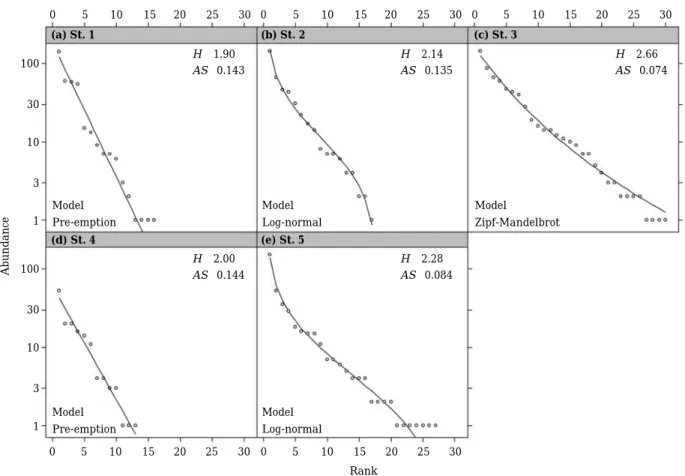
조사지별 순위 수도 분포, 다양도지수 및 순위 수도 분 포 곡선의 평균기울기는 Fig. 3에 나타내었다. 순위 수도 분포 곡선에 대한 모델의 적합성 판단을 위한 Akaike의
정보 기준 값은Table 3과 같다. 조사지St. 1 (Fig. 3a)과 St. 4 (Fig. 3d)는 선점 모델이 적합하였으며 다양도지수 는 각각 1.90과 2.00으로서 다른 조사지보다 낮았다. 조 사지 St. 2 (Fig. 3b)와 St. 5 (Fig. 3e)에서는 대수정규 모 델이 적합하였고, 다양도지수는 St. 2가 2.14, St. 5가 2.38로 St. 5가 다소 높았고, 곡선의 평균기울기는 St. 5 가 0.081로서 St. 2의 0.127보다 완만하였다. St. 3 (Fig.
3c)에서는 Zipf-Mandelbrot 모델이 적합하였으며 다양도 지수는2.66으로서 조사지 중에서 가장 높았다.
3) 군집 구조
어류 군집 구조와 환경 요인을 분석한 정준대응분석 (CCA) 결과에 의하면, 1축과 2축의 고유값(eigen value)은 각각 0.268 및 0.116이었으며, 두 축은 전체 변이의 80%
를 설명하였다(Fig. 4). 종의 배열을 살펴보면, 꺽저기(Ck) 는 각시붕어(Ru), 긴몰개Squalidus gracilis majimae (Sg), 참몰개 Squalidus chankaensis tsuchigae (Sc), 줄종개 Cobitis tetralineata (Ct), 얼록동사리 Odontobutis inter- rupta (Oi) 등과 가까이 분포하였다. 반면에 꺽지(Ch)는 칼납자루(Ak), 쉬리(Cs), 참중고기 Sarcocheilichtys vari- egatus wakiyae (Sv), 모래무지 Pseudogobio esocinus (Pe), 참갈겨니(Zk), 자가사리 Liobagrus mediadiposalis (Lm), 동사리O. platycephala (Op) 등과 가까이 위치하였다. 붕 어 Carassius auratus (Ca), 중고기 S. nigripinnis morii (Sn), 누치Hemibarbus labeo (Ha), 참마자H. longirostris (Ho)는 2축의 아래에 위치하여 꺽저기, 꺽지와 분리되어 분포하였다.
Fig. 2. Relative abundance of Coreoperca kawamebari and C. herzi at each study site in the Boseong River from September 2011 to October 2012.
Relative abundance(%)
100
80
60
40
20
0
C. kawamebari C. herzi
St. 1 St. 2 St. 3 St. 4 St. 5 Study site
정준대응분석의 두 축과 상관관계가 높은 환경 요인은 유속(WV) (r2==0.926, p==0.0421, 1000번 치환에 기초), 저 수로 폭(CW) (r2==0.968, p==0.040) 및 하상의 호박돌(BD) (r2==0.943, p==0.076)이었다(Table 4). 이 중에서 유속은1 축과 높은 상관관계를 보였고, 저수로 폭과 호박돌은 두 축 모두와 높은 상관관계를 나타내었다. 다른 환경 요인 은 두 축에 대하여 유의한 상관을 나타내지 않았으나, 유 속이 느린 곳에서는 하상이 잔자갈(GV), 진흙(MD) 및
모래(SD)가 우세하며 하안식생인 목본식물(OT)과 정수 식물(EM)이 분포하고 있었다. 하류의 특성을 가진 조사 지 St. 3과 St. 5에서는 침수식물(SM)이 분포하였고, 최 하류인St. 5에서는 수심(WD)이 깊고 수온(WT)이 높으 며 하상이 왕자갈(PB)로 이루어졌다.
정준대응분석의 결과에서 꺽저기와 꺽지의 배열과 환 경 요인의 관계를 살펴보면, 꺽저기는 유속이 느리며 하 상에 호박돌의 비율이 낮은 곳에서 서식하는 반면, 꺽지 Table 3. Akaike’s information criteria (AIC) values of ranked abundance distribution curves for each model. The lowest
AIC value of bold numeral indicates the best fitting model.
Model Study site
1 2 3 4 5
Broken stick 187.260 137.811 228.996 62.966 271.994
Preemption 90.181 95.045 142.862 58.816 175.824
Lognormal 100.242 81.725 149.143 58.818 108.297
Zipf 128.655 103.958 213.959 67.843 113.940
Zipf-Mandelbrot 91.242 88.260 138.264 62.511 113.691
Fig. 3. Rank abundance distribution of fishes collected at each study site in the Boseong River from September 2011 to October 2012 (H′, diversity index; AS, average slope). The horizontal axis indicates rank and the number of species, and the vertical axis indicates individual number of each ranked species by log-scale. The best fitted model was plotted into each study site.
0 5 10 15 20 25 30
0 5 10 15 20 25 30 0 5 10 15 20 25 30
Rank 100
30
10
3
1
H′==1.90 H′==2.14 H′==2.66
AS==0.143 AS==0.135 AS==0.074
H′==2.00 H′==2.28
AS==0.144 AS==0.084
Model Model Model
Pre-emption Log-normal Zipf-Mandelbrot
(a) St. 1 (b) St. 2 (c) St. 3
(d) St. 4 (e) St. 5
Model Model
Pre-emption Log-normal
Abundance 100
30
10
3
1
0 5 10 15 20 25 30 0 5 10 15 20 25 30
는 유속이 빠르고 하상에 호박돌이 많은 곳에 서식하는 것으로 나타났다(Fig. 4). 또한 꺽저기와 꺽지의 출현 비 율에 따라 조사지가 다르게 배열되었는데, 한 종만 출현 한 조사지인St. 1과St. 4는 1축을 중심으로 양 끝에 배 열된 반면, 두 종이 동시에 출현하였으나 한 종이 다른 종에 비해 우세하게 출현한 St. 2와 St. 5는 2축을 중심 으로 양 끝에 배열되었다. 두 종의 출현 비율이 비슷한 St. 3은 중앙에 배열되었다.
고 찰
우리나라에서 꺽저기의 분포지는 낙동강, 거제도 및 탐 진강과 그 주변 하천으로 알려져 있었으나(Jeon, 1986;
Jeon and Kim, 1996) 최근 그 분포지가 좁아지고 있다 (Fig. 5). 낙동강 수계에서는 꺽저기가 진주, 밀양, 고령, 경 산, 안동에 분포하는 것으로 보고되었으나(Mori, 1936,
1952), 1954년부터 최근까지 이곳에서 이 종의 분포를
확인하지 못하였다(Jeon, 1986; Kim et al., 2001). 그러므 로 꺽저기의 낙동강 분포에 대한 재검토가 필요하다고 생각된다. 한편 거제도에서는 산양천에서 1982년까지 출 현하였으나(Jeon, 1986; Son and Song, 1998), 최근에는
절멸한 것으로 추정하고 있다(NIBR, 2011). 섬진강에서 는Choi (1973)가 꺽저기가 분포하는 것으로 기록했으나, 그 후에는 서식이 확인되지 않고 있다(Jeon, 1986; Jeon and Kim, 1996). 반면에 1980년대 이후에 서해 남부로 흐르는 전남 해남의 소하천인 삼산천, 구산천, 옥천천에 서 꺽저기의 분포가 확인되었다(Song and Lee, 1989;
Jeon and Kim, 1996). 이상의 문헌조사 결과를 종합하면, 현재 꺽저기는 탐진강과 주변 하천으로 분포가 제한되어 있다.
분포지가 제한적인 꺽저기에 비하여 꺽지는 전국 대부 분의 하천에 분포하는 것으로 알려져 있다(Jeon, 1986;
Kim and Park, 2002) (Fig. 5). 동해로 흐르는 하천 중에 서 양양 남대천, 왕피천, 송천천에 꺽지가 분포하는 것으 로 알려져 있었는데(Jeon, 1986), 최근에는 고성 북천, 형 산강, 태화강 등에서도 이들의 서식이 확인되었다(Jang et al., 2001; Kim and An, 2010; Lee et al., 2010).
한편 꺽저기의 주분포지인 탐진강에서는 꺽지가 발견 되지 않고(Jeon, 1986), 꺽저기의 새로운 분포지로 알려 진 삼산천, 구산천, 옥천천에서도 꺽지의 서식은 확인되 지 않았다(Song and Lee, 1989; Jeon and Kim, 1996). 따 Fig. 4. Ordination biplot derived from the first two axes of canonical correspondence analysis (CCA) of the fish communities collected at the study sites in the Boseong River from September 2011 to October 2012. Eigen values of both axes are 0.268 and 0.116, explained 80.2% of total variation. The angles and lengths of the radiating arrows indicate the direc- tion and strength of relationships of environmen- tal variables with the ordination scores. Species abbreviations are provided in Table 2 and environ- mental variable abbreviations in Table 1.
Axis 2
1.5
1.0
0.5
0.0
-0.5 -1.0
-1.5
-2 -1 0 1
Axis 1 Table 4. The direction of biplot fitted environmental vec-
tors of canonical correspondence analysis (CCA) axes, coefficient of determination (r2) and signifi- cant levels (p) by permutation tests (refer to Table 1 for the abbreviation of variables).
Variables Vectors
r2 p
Axis 1 Axis 2
WT -0.174 -0.985 0.629 0.295
DO 0.391 0.920 0.759 0.309
PH 0.998 -0.067 0.513 0.427
EC 0.599 -0.801 0.025 0.904
WV 0.962 0.274 0.926* 0.042
CW 0.645 -0.765 0.968* 0.040
WD -0.057 -0.998 0.548 0.441
MD -0.996 0.093 0.721 0.159
SD -0.953 -0.303 0.169 0.805
GV -0.921 -0.388 0.631 0.367
PB -0.173 -0.985 0.683 0.299
CB 0.925 0.379 0.269 0.727
BD 0.799 0.601 0.943† 0.076
SM 0.454 -0.891 0.326 0.709
EM -0.943 -0.332 0.315 0.717
OT -0.549 0.836 0.462 0.461
†P⁄0.1, *P⁄0.05
라서 꺽저기와 꺽지의 공서 수역에 대하여 아직까지 보 고되지 않았다.
본 연구자들이2010년부터2012년까지 꺽저기가 분포 하는 것으로 알려진 전남 장흥군과 그 주변 하천을 조사 한 결과, 기존의 분포지로 알려진 탐진강, 삼산천, 현산천 을 포함하여 영산강의 지류인 지석천과 금천, 그리고 섬 진강의 지류인 보성강에서 꺽저기의 서식을 확인할 수 있었다. 특히 지금까지 영산강과 보성강에서 꺽저기 서식 에 대한 보고가 없었다(Jeon, 1986; Song and Lee, 1987;
Choi and Hwang, 1991; Kim et al., 1993; Seong et al., 1997; Choi and An, 2008). 한편 보성강과 지석천에서는 꺽지가 발견되어 이곳에서 최초로 꺽저기와 꺽지의 공서 수역을 발견하였다(Fig. 5). 이중 보성강에서는 넓은 수역 에서 두 종의 공서를 확인하였다. 이들 하천에서 꺽저기 가 서식하는 곳은 하천 상류로서 지리적으로 탐진강 상 류와 가까이 위치하고 있었다. 따라서 꺽저기가 새로 발 견된 하천에서 서식하는 것에 대하여 일차적인 분포인 지, 하천쟁탈에 의한 것인지, 인위적인 이입에 의한 것인 지에 대해 추후 탐문 조사와 유전자 분석 등의 정밀조사 가 필요할 것으로 판단된다.
순위 수도 분포 또는 순위 수도 곡선은 종 다양성의 두 구성요소인 종 풍부도와 종 균등도를 동시에 나타낼 수 있는 방법이다(Whittaker, 1965; Magurran, 2004). Wil- son (1991)은 순위 수도 분포에 구간분할, 선점, 대수정규, Zipf, Zipf-Mandelbrot 등의 다양한 모델을 적용시켜서 군 집 구조의 특성을 해석하였다. 조사지St. 2와St. 5는 대 수정규 모델이 적합하였는데(Fig. 3), 이 모델은 Preston
(1948)이 제안한 것으로서 종간 경쟁에서 특별히 우세하
거나 열세한 종이 많지 않고 자신의 기본 생태적 지위를 차지하는 종이 많다는 것을 의미한다(Wilson et al., 1996).
다만 분포 곡선의 평균기울기는St. 5가St. 2보다 완만하 고 다양도지수가St. 5에서 더 높았는데, 이는 St. 5가 St.
2보다 하류에 있고 하천 규모가 커서 보다 다양한 어류 가 분포하기 때문인 것으로 추정된다. 이 두 조사지의 종 다양도는St. 1과 St. 4보다 높았으나St. 3보다는 낮았는 데, 이는 두 조사지에서 정수 구간과 여울 구간이 모두 존재하지만, 이 두 환경 중에서 하나가 잘 발달하지 않았 기 때문이라고 생각된다. 조사지 St. 3에서 적합한 모델은 Zipf-Mandelbrot 모델로서 이곳의 서식환경이 가장 다양 하다는 것을 의미한다(Fig. 3). Zipf-Mandelbrot 모델은 일 반적으로 다양한 종이 서식할 기회가 많은 경우에 나타나 는 유형이다(Frontier, 1985). 결국 조사지St. 3에서는 다 양한 환경이 존재하여 다양한 종이 이곳에 서식하는 것으 로 추측할 수 있었다(Wilson, 1991). 선점 모델(Motomu-
ra, 1932)은 직선형 모델로서 단순한 환경 혹은 표본 크
기가 작을 때 나타나는 형태였다(Whittaker, 1965; Wil- son, 1991). 이 선점 모델은 조사지 St. 1과 St. 4에 적합 하였다(Fig. 3). 조사지St. 1에서는 정수 구간이, St. 4에서 는 여울 및 유수 구간이 하천의 대부분을 차지하여 환경 이 매우 단순하였고 종다양도지수 또한 가장 낮았다.
일반적으로 꺽저기는 중∙하류 하천에서 유속이 완만 하고 모래와 자갈이 깔려있으며 하안 식생이 발달한 환 경을 선호하고, 산란을 위한 부착기질로서 식물 줄기를 Fig. 5. Distribution of Coreoperca kawamebari and C. herzi
in South Korea. The solid line indicates distribution area of C. herzi (Jeon, 1986; Jang et al., 2001; Kim and Park, 2002; Kim and An, 2010; Lee et al., 2010).
The dotted line indicates distribution area of C.
kawamebari in the Nakdong River system and the Geoje Island but recently not found (Jeon, 1986;
Son and Song, 1998; NIBR, 2011). The dashed line indicates current distribution of C. kawamebari (Jeon, 1986; Song and Lee, 1989; Jeon and Kim, 1996). The closed circles indicate sympatric areas of both species newly found in the Jiseok Stream, a tributary of the Yeongsan River ①, and the Bo- seong River, a tributary of the Seomjin River ②.
KOREA
Nakdong River system
Geoje Isl.
128�E 37�N
0 50 100 km
이용하는 것으로 알려져 있다(Jeon, 1986; Han et al.,
2000). 반면에 꺽지는 중∙상류 하천에서 큰 돌이 깔려
있고 유속이 빠른 곳을 선호하고, 큰 돌 밑을 산란장소로 이용하는 것으로 알려져 있다(Jeon, 1986; Park et al., 1997; Han et al., 1998). 본 연구의 정준대응분석 결과에 의하면, 꺽저기는 유속이 느린 곳에 분포하는 반면, 꺽지 는 유속이 빠르고 하상구조가 호박돌로 구성된 곳에 분 포하여 기존의 연구 결과와 유사하였다(Fig. 4). 결국 꺽 저기와 꺽지는 유속과 하상구조에 의하여 서식지가 분리 되었는데, 하천 어류의 서식지 분리에서 이 두 환경 요인 의 중요성은 많은 연구에서 보고되고 있다(Ross, 1986).
예를 들면, 뉴질랜드 하천에서 공서하는 Galaxias속 두 종은 유속에 의하여 서식지가 분리되었고(Crow et al., 2010), 미국 인디애나 하천에 서식하는 Etheostoma속의 5종은 하상구조에 의하여 서식지를 달리하였다(Pratt and Lauer, 2013). 또한 일본 Shikoku에서 밀어속 Rhinogo- bius와 우리나라에서 참갈겨니의 두 가지 유형이 유속에 의하여 서식지를 분리하였다(Sone et al., 2001; Chae and Yoon, 2010). 한편 꺽저기의 서식환경은 식생 분포와 연 관성이 큰 것으로 알려져 있으나(Jeon, 1986; Han et al.,
2000), 본 연구에서 정준대응분석에서는 식생이 꺽저기
의 분포와 유의한 상관이 나타나지 않았다(Fig. 4). 그러 나 현장 관찰에 의하면, 꺽저기는 달뿌리풀 등의 수변식 물이 밀생하는 저수로변을 따라서 주로 분포하고 있었다. 본 연구에서 조사지가5곳에 불과하여 환경 요인과 꺽저 기와 꺽지의 분포 사이의 관계를 규명하는데 한계가 있 었고, 이를 보완하기 위하여 다양한 환경을 가진 다수의 조사지를 포함하는 추가적인 연구가 필요하다고 생각된 다.
하천생태계에서 서식지 다양성은 어류의 종다양성과 높은 연관성을 가지는데(Gorman and Karr, 1978; Taylor et al., 2006), 본 연구에서도 조사지의 환경에 따라 어류 군집 구조의 차이가 켰다(Fig. 4). 유속이 느린 곳에 꺽저 기와 함께 각시붕어, 긴몰개, 참몰개, 줄종개, 얼록동사리 등의 정수성 어류가 분포하는 반면, 유속이 빠르고 하상 이 호박돌로 구성된 곳에는 꺽지와 함께 쉬리, 참중고기, 모래무지, 참갈겨니, 자가사리, 동사리 등의 유수성 및 여 울성 어류가 분포하였다. 또한 5개 조사지에서 유속과 하 상구조의 서식지 환경이 다양하고 이질적으로 존재하는 곳에서 꺽저기와 꺽지가 공서하였고 어류 군집의 종다양 성이 높았다. 그러나 이들 서식지 환경이 단순하고 균일 하게 존재하는 조사지에서는 꺽저기와 꺽지가 이소(allo- patry)하였고 종다양성이 낮았다.
본 연구는 공서 하천에서 환경 차이에 따른 꺽저기와
꺽지의 분포와 어류 군집의 차이를 확인할 수 있었으며, 중요한 환경 요인으로 유속과 하상구조로 확인되었다. 반 면 두 종이 종간 상호작용에 의하여 서식지 분리 현상이 일어나는지에 대하여 체계적으로 판단할 수는 없었다. 따 라서 이들의 서식지 분리 현상을 상세히 밝히기 위하여 미소서식지의 차이와 식성 조사 등의 추가적인 연구가 필요할 것으로 생각된다.
적 요
꺽저기 Coreoperca kawamebari는 탐진강 및 인접 하 천에 제한적으로 분포하는 반면, 꺽지 C. herzi는 전국의 여러 하천에 분포한다. 두 종의 공서 수역에 대해서 지금 까지 보고되지 않았으나, 본 연구에서 섬진강의 지류인 보성강과 영산강의 지류인 지석천에서 두 종의 공서 수 역을 확인하였다. 꺽저기와 꺽지의 공서 수역 내에서 하 천 환경의 차이에 따른 두 종의 분포 양상과 어류 군집 의 특성을 확인하기 위하여 2011년 9월부터 2012년 10 월까지 보성강 상류 수역에서 환경 요인과 어류 군집을 조사하였다. 순위 수도 분포 분석에 의하면, 서식지 환경 이 다양할수록 꺽저기와 꺽지의 출현 비율이 비슷할 뿐 만 아니라 어류 군집의 종다양성이 높았다. 정준대응분석 결과에서 꺽저기는 정체 수역에 서식하는 반면, 꺽지는 하상이 호박돌으로 이루어지고 유속이 빠른 환경에 서식 하는 것으로 나타났다. 따라서 본 연구에서는 꺽저기와 꺽지의 서식지 환경이 상이하다는 것을 확인하였고, 하천 의 서식지 환경이 단순하면 꺽저기나 꺽지 중 한 종만 출현하고 어류 군집의 종 다양성이 감소하였으며 서식지 환경이 다양하면 이들 두 종이 공존할 수 있고 종 다양 성이 증가하는 것으로 파악되었다.
사 사
본 연구는 국토해양부 건설기술혁신사업의 연구비지원 (12기술혁신C02)에 의해 수행되었습니다.
인 용 문 헌
Angermeier, P.L. and J.R. Karr. 1983. Fish communities along environmental gradients in a system of tropical streams. Environmental Biology of Fishes 9(2): 117-135.
Baek, H.M., H.B. Song, H.S. Sim, Y.G. Kim and O.K. Kwon.
2002. Habitat segregation and prey selectivity on coha- bitation fishes, Phoxinus Phoxinus and Rhynchocypris kumgangensis. Korean Journal of Ichthyology 14(2): 121- 131. (in Korean)
Barbour, M.T., J. Gerritsen., B.D. Snyder and J.B. Stribling.
1999. Rapid Bioassessment Protocols for Use in Streams and Rivers: Periphyton, Benthic Macroinvertebrates and Fish, 2nd ed. EPA 841-B-99-002, Washington, D.C.
Chae, B.S. and H.N. Yoon. 2010. Habitat segregation bet- ween NE and NS type of Zacco koreanus (Cyprinidae).
Korean Journal of Ichthyology 22(1): 49-55. (in Korean) Choi, C.G. and Y.J. Hwang. 1991. On the fish communities
of the Posˇong River. Korean Journal of Limnological Society 24(3): 199-206. (in Korean)
Choi, J.W. and K.G. An. 2008. Characteristics of fish compo- sitions and longitudinal distribution in Yeongsan River watershed. Korean Journal of Limnological Society 41(3):
301-310. (in Korean)
Choi, K.C. 1973. On the geographical distribution of Fresh- water fishes south of DMZ in Korea. Korean Journal of Limnological Society 6(3): 29-36. (in Korean)
Chyung, M.K. 1977. The Fishes of Korea. Il-Ji Sa Publishing Company, Seoul. (in Korean)
Crow, S.K., G.P. Closs, J.M. Waters, D.J. Booker and G.P.
Wallis. 2010. Niche partitioning and the effect of inter- specific competition on microhabitat use by two sympa- tric galaxiid stream fishes. Freshwater Biology 55(5):
967-982.
Cummins, K.W. 1962. An evolution of some techniques for the collection and analysis of benthic samples with spe- cial emphasis on lotic waters. American Midland Natu- ralist 67(2): 477-504.
Frontier, S. 1985. Diversity and structure in aquatic ecosys- tems. Oceanography and Marine Biology: An Annual Review 23: 253-312.
Gorman, O.T. and J.R. Karr. 1978. Habitat structure and stream fish communities. Ecology 59(3): 507-515.
Greenberg, L.A. 1988. Interactive segregation between the stream fishes Etheostoma simoterum and E. rufilineat- um. Oikos 51(2): 193-202.
Han, K.H., J.T. Park, B.M. Kim, S.H. Oh, S.H. Lee and D.S.
Jin. 2000. Spawning behavior and early life history of Aucha perch, Coreoperca kawamebari from Korea.
Korean Journal of Ichthyology 12(2): 129-136. (in Korean) Han, K.H., J.T. Park, G.H. Jung, W.K. Lee, J.Y. Lee and I.C. Bang. 1998. Spawning behavior and early life his- tory of Korean Aucha perch, Coreoperca herzi Herzen- stein. Journal of Aquaculture 11(1): 49-58. (in Korean)
Hardin, G. 1960. The competitive exclusion principle. Sci- ence 131(3409): 1292-1297.
Hearn, W.E. 1987. Interspecific competition and habitat segregation among stream-dwelling trout and salmon:
A review. Fisheries 12(5): 24-31.
Henry, B.E. and G.D. Grossman. 2008. Microhabitat use by blackbanded (Percina nigrofasciata), turquoise (Etheo- stoma inscriptum), and tessellated (E. olmstedi) darters during drought in a Georgia piedmont stream. Environ- mental Biology of Fishes 83(2): 171-182.
Hutchinson, G.E. 1957. Concluding remarks. Cold Spring Harbor Symposia on Quantitative Biology 22: 415-427.
Jackson, D.A., P.R. Peres-Neto and J.D. Olden. 2001. What controls who is where in freshwater fish communities the roles of biotic, abiotic, and spatial factors. Canadian Journal of Fisheries and Aquatic Sciences 58(1): 157-170.
Jang, M.H., K.R. Choi and G.J. Joo. 2001. Fish community of headwater streams in Gaji Mountain, Ulsan. Korean Journal of Limnological Society 34(3): 239-250. (in Korean)
Jeon, S.R. 1986. Studies on the key and distribution of ser- ranid pheripheral fresh-water fishes from Korea. Bul- letin of Sangmyung Women’s University 18: 335-355. (in Korean)
Jeon, S.R. and Y.J. Kim. 1996. First record of the Coreoperca kawamebari (Pisces: Serranidae) from Samsan-river and Kusan-river. Korean Journal of Limnological Soci- ety 29(2): 97-101. (in Korean)
Kim, I.S. and J.Y. Park. 2002. Freshwater Fishes of Korea.
Kyo-Hak Publishing Co., Ltd., Seoul. (in Korean) Kim, I.S., Y. Choi and B.J. Kim. 2001. Percoidei Fishes of
Korea. Junghaengsa, Seoul. (in Korean)
Kim, I.S., Y. Choi, C.L. Lee, Y.J. Lee, B.J. Kim and J.H. Kim.
2005. Illustrated Book of Korean Fishes. Kyo-Hak Publ- ishing Co., Ltd., Seoul. (in Korean)
Kim, J.H., H.W. Cho, W.D. Han and W.O. Lee. 1993. The change of fish communities by the change of ecosystem in the Posong River. Korean Journal of Environmental Biology 11(2): 154-160. (in Korean)
Kim, Y.P. and K.G. An. 2010. Evaluations of ecological ha- bitat, chemical water quality, and fish multi-metric mo- del in Hyeongsan River watershed. Korean Journal of Limnological Society 43(2): 279-287. (in Korean) Lazorchak, J.M., D.J. Klemm and D.V. Peck. 1998. Environ-
mental Monitoring and Assessment Program - surface Waters: Field Operations and Methods for Measuring the Ecological Condition of Wadeable Streams. EPA 620- R-94-004, Washington, D.C.
Lee, W.O., M.H. Ko, J.M. Bak, D.H. Kim, H.J. Jeon and K.H.
Kim. 2010. Characteristics of fish fauna and community structure in Buk Stream of Goseong, Korea. Korean Journal of Ichthyology 22(4): 238-248. (in Korean) Lenat, D.R. and J.K. Crawford. 1994. Effects of land use on
water quality and aquatic biota of three North Carolina Piedmont streams. Hydrobiologia 294(3): 185-199.
MacArthur, R.H. 1957. On the relative abundance of bird species. Proceedings of the National Academy of Sciences of the United States of America 43(3): 293-295.
Magurran, A.E. 2004. Measuring Biological Diversity.
Blackwell Science Ltd., Oxford.
Mandelbrot, B. 1965. Information theory and psycholingui- stics, pp. 350-368. In: Scientific Psychology: Principles and Applications (Wolman, B.A. and E.N. Nagel, eds.).
Basic Books, New York.
Meador, M.R. and R.M. Goldstein. 2003. Assessing water quality at large geographic scales: relations among land use, water physicochemistry, riparian condition, and fish community structure. Environmental Management 31(4): 504-517.
Mori, T. 1936. Studies on the geographical distribution of freshwater fishes in Chosen. Bulletin of the Biogeogra- phical Society of Japan 6(7): 35-61. (in Japanese) Mori, T. 1952. Check List of the Fishes of Korea. Hyogo
University of Agriculture, Sasayama.
Motomura, I. 1932. A statistical treatment of association.
Japanese Journal of Zoology 44: 379-383. (in Japanese) NIBR. 2011. Red Data Book of Endangered Fishes in Korea.
National Institute of Biological Resources, Incheon. (in Korean)
Nilsson, N.A. 1967. Interactive segregation between fish species, pp. 295-313. In: The Biological Basis of Fresh- water Fish Production (Gerking, S.D. ed.). Blackwell Scientific Publication, Oxford.
Okazaki, T. and S.R. Jeon. 1996. Genetic differentiation of the genus Coreoperca (Pisces: Serranidae) from Korea.
Korean Journal of Limnological Society 29(4): 387-391.
(in Korean)
Oksanen, J. 2011. Multivariate Analysis of Ecological Com- munities in R: Vegan Tutorial. http://cc.oulu.fi/~jarioksa/.
Park, J.T., K.H. Han, I.C. Bang and G.H. Chung. 1997. Life history of the Korean perch, Coreoperca herzi. Bulletin of the Marine Sciences Institute, Yosu National Fisheries University 6: 49-57. (in Korean)
Poff, N.L. and J.D. Allan. 1995. Functional organization of stream fish assemblages in relation to hydrological vari- ability. Ecology 76(2): 606-627.
Poff, N.L., J.D. Allan, M.B. Bain, J.R. Karr, K.L. Prestega- ard, B.D. Richter, R.E. Sparks and J.C. Stromberg. 1997.
The natural flow regime. BioScience 47(11): 769-784.
Pratt, A.E. and T.E. Lauer. 2013. Habitat use and separa- tion among congeneric darter species. Transactions of the American Fisheries Society 142(2): 568-577.
Preston, F.W. 1948. The commonness, and rarity, of species.
Ecology 29(3): 254-283.
R Development Core Team. 2011. R: A Language and Envi- ronment for Statistical Computing. R Foundation for Statistical Computing. Available: www.R-project.org.
Ross, S.T. 1986. Resource partitioning in fish assemblages:
a review of field studies. Copeia 1986(2): 352-388.
Rowe, D.C., C.L. Pierce and T.F. Wilton. 2009. Fish assem- blage relationships with physical habitat in wadeable Iowa streams. North American Journal of Fisheries Management 29(5): 1314-1332.
Seong, C.N., K.S. Baik, J.H. Choi, H.W. Cho and J.H. Kim.
1997. Water quality and fish community in streamlets of Juam Reservoir. Korean Journal of Limnological Society 30(2): 107-118. (in Korean)
Shannon, C.E. and W. Weaver. 1949. The Mathematical Theory of Communication. University of Illinois Press, Urbana.
Son, Y.M. and H.B. Song. 1998. Freshwater fish fauna and distribution in Kojedo, Korea. Korean Journal of Ichth- yology 10(1): 87-97. (in Korean)
Sone, S., M. Inoue and Y. Yanagisawa. 2001. Habitat use and diet of two stream gobies of the genus Rhinogobius in south western Shikoku, Japan. Ecological Research 16: 205-219.
Song, T.K. and W.O. Lee. 1987. Freshwater fish fauna in the upper and middle streams of Yongsan River in Korea.
Bulletin of Institute of Littoral Biota 4(1): 81-90. (in Korean)
Song, T.K. and W.O. Lee. 1989. The fish fauna of several streams in Haenam-gun, Ch ˇollanam-do. Bulletin of In- stitute of Littoral Biota 6(1): 111-119. (in Korean) Taylor, C.M., T.L. Holder, R.A. Fiorillo, L.R. Williams, R.B.
Thomas and M.L., Jr. Warren. 2006. Distribution, abun- dance, and diversity of stream fishes under variable en- vironmental condition. Canadian Journal of Fisheries and Aquatic Sciences 63(1): 43-54.
ter Braak, C.J.F. 1986. Canonical correspondence analysis:
a new eigen vector technique for multivariate direct gra- dient analysis. Ecology 67(5): 1167-1179.
ter Braak, C.J.F. and P.F.M. Verdonschot. 1995. Canonical correspondence analysis and related multivariate meth- ods in aquatic ecology. Aquatic Sciences 57(3): 255-287.
White, J.L. and B.C. Harvey. 1999. Habitat separation of prickly sculpin, Cottus asper, and coastrange sculpin,
Cottus aleuticus, in the Mainstem Smith River, North- western California. Copeia 1999(2): 371-375.
Whittaker, R.H. 1965. Dominance and diversity in land plant communities: Numerical relations of species ex- press the importance of competition in community func- tion and evolution. Science 147(3655): 250-260.
Wilson, J.B. 1991. Methods for fitting dominance/diversity curves. Journal of Vegetation Science 2(1): 35-46.
Wilson, J.B., T.C.E. Wells, I.C. Trueman, G. Jones, M.D.
Atkinson, M.J. Crawley, M.E. Dodd and J. Silvertown.
1996. Are there assembly rules for plant species abun- dance? An investigation in relation to soil resources and successional trends. Journal of Ecology 84(4): 527-538.
Zipf, G.K. 1949. Human Behaviour and the Principle of Least Effort. Addison-Wesley Publishing Co., Cambridge, MA.
(Manuscript received 2 May 2013, Revised 19 June 2013
Revision accepted 22 July 2013)