- 470 - 서 론
1)
근래 식생활의 수준향상과 다양화로 인하여 소비자들의 식품에 대한 건강지향적인 욕구가 커지면서 만성독성, 돌 연변이 유발성, 발암성 등의 안전성 문제가 제기되고 있는 합성보존료의 사용을 제한하려는 추세에 있다. 따라서 가 공식품의 저장성 향상 및 저온식품의 안전성 확보라는 측면 으로 볼 때 천연보존료의 개발과 이용은 필연적이라 할 수 있다. 국내외에서 천연항균제제 및 식품보존제의 개발 을 위하여 생약재 및 식용식물 추출물 등 각종 천연물로부 터 항균활성물질의 탐색과 활성본체의 규명에 관한 연구가
†Corresponding author. E-mail:[email protected], Phone:82-53-950-5778, Fax:82-53-950-6772
활발하게 이루어지고 있으며 실제로 지금까지 보고된 각종 천연항균물질은 식물추출물(1-3), 한약재(4,5), 특정단백질 또는 효소류(6), 유기산류(7-9), 지방산류(10), 향신료(마늘, 갓)로부터 추출한 성분(11) 등이 있다. 이들 대부분은 phenol성 화합물, quinone류, terpene류 및 휘발성 향기성분 등의 이차 대사산물이거나 유도체들로 알려져 있으며(12), 특히 훈취가 매우 강한 산성액인 목초액은 그 자체가 미생 물의 성장을 억제하는 기능이 있는 것으로 알려져 있다.
목초액은 주로 참나무류(Quercus sp.), 소나무(Pinus densiflora) 등의 천연목재를 400∼700℃로 가열하여 탄화 시키는 과정에서 발생되는 연기와 수증기를 포집, 냉각, 응축, 추출 정제시킨 담갈색의 액상 천연물질로서 잡초방 제, 토양살균, 종자소독 및 발아촉진, 작물의 병해충방지,
목초액의 항균활성과 페놀화합물의 함량
김종수․박승우1․함유식2․정수근2․이상한․정신교†
경북대학교 식품공학과, 1경상북도 보건환경연구원, 2울산광역시 보건환경연구원
Antimicrobial Activities and Phenolic Compounds of Pyroligneous Liquor
Jong-Soo Kim, Seung-Woo Park1, You-Shik Ham2, Soo-Kun Jung2, Sang-Han Lee and Shin-Kyo Chung†
Department of Food Science & Technology, Kyungpook National University, Daegu 702-701, Korea
1
Gyeongsangbuk-Do Institute of Health and Environment, Daegu 702-702, Korea
2
Ulsan Institute of Health and Environment, Ulsan 680-042, Korea
Abstract
Antimicrobial activities of pyroligneous liquor were investigated by determining Minimal Inhibitory Concentration (MIC). The solvent extracts of pyroligneous liquor, which were extracted by using solvents with different polarities such as hexane, ethylacetate, or butanol. The activities were examined by disc diffusion method using MIC against 7 food poisoning microbe type strains. Antimicrobial activities were shown in hexane, ethylacetate, butanol, and aqueous fractions of pyroligneous liquor. Among the four fractions, ethylacetate fraction showed the highest inhibitory effect on the microorganism such as Shigella sonnei, and Yersinia enterocolitica at the concentration of 2.0 mg/disc.
The purified P-1 and P-2 fractions isolated by silica gel column chromatography from ethylacetate fraction of pyroligneous liquor had the highest antimicrobial activity. The total phenolic compounds content in ethylacetate, hexane, butanol, and aqueous fraction was 488.3 mg/g, 403.8 mg/g, 83.6mg/g, and 74.5 mg/g, respectively. Taken together, these results suggest that the ethyl acetate fraction could be suitable for the development of isolation and identification of antimicrobial compound from pyroligneous liquor, resulting from the above antimicrobial activity.
Key words:pyroligneous liquor, antimicrobial activity, phenolic compound
식물생장 촉진, 낙과방지, 등 여러 가지 효능이 있음이 밝혀 지고 있으며(13,14), 최근에는 간기능 회복효과, 항당뇨 효 과, 알코올 해독효과, 내분비 호르몬 조절작용, 아토피성 피부염의 치료효과, 온열작용, 위암과 대장암에 대한 증식 억제효과 및 면역조절효과가 있다는 병례 보고(15-19)로부 터 이들 물질이 우수한 약리 및 임상효능이 있는 것으로 알려져 있다.
목초액의 항균작용에 관한 연구에서 서 등(20)이 식중독균 인 E. coli, E. coli O157, Vibrio parahaemolyticus, Salmonella typhimurium, Streptococcus mutans, Pseudomonas aeruginosa 균에 대해서 항균효과를 가진다고 보고하였으며, 류(21)는 0.5% 이상의 목초액 농도에서 겹둥근무늬병균(Alternaria solani), 잿빛곰팡이병균(Botrytis cinerea), 잎곰팡이병균 (Cladosporium fulvum), 오이잎곰팡이병균(C. cucumerrium) 에 대하여 항진균효과가 있었다고 보고하였고, 5% 농도에 서는 균사가 전혀 생장하지 않는 것으로 보고하는 등 곰팡 이 및 병충해 방제의 효과가 있는 것으로 나타났다. 또한 목초액에서 분리된 catechol 유도체 화합물(catechol, 3- methylcatechol, 4-methylcatechol)들은 제초활성이 있어 유 기농업자들을 중심으로 잡초방제에도 이용하고 있는 등 (22), 인체에 유해한 합성농약을 대체할 수 있는 물질로 이용되기도 한다.
이와 같이 다방면으로 이용되며 많은 효능이 있는 것으 로 알려진 목초액을 식품가공에 적용할 수 있는 방안을 찾고자 함이 본 연구의 최종 목표이며, 우선 목초액이 식중 독균에 어떤 영향을 미치는지를 조사하고 total phenol 함량 에 대하여 분석하였다.
재료 및 방법
재료 및 시약
본 실험에 사용한 시료는 경상북도 포항시 기계면에 소 재하는 거여목초산업(주)의 기계식 전용 탄화로에서 제조 된 참나무목초액을 분양 받아 여과지(Toyo No. 5B)로 여과 시킨 것을 공시재료로 사용하였다. 실험에 사용한 시약들 은 모두 특급 이상을 사용하였으며, 대부분 Sigma사, Aldrich사, Merck사의 제품을 구입하여 사용하였다.
목초액의 조제 및 용매분획
목초액 1L을 취하여 진공농축기(R-205, Buchi Co., Switzerland)로 감압 농축하여 추출물 68.5 g을 얻어 조추출 물로 하였다. 따로 목초액 1 L에 3배량의 hexane을 가하여 분액여두에서 수 회 반복 추출한 후 hexane층을 진공농축기 로 감압 농축하여 hexane 분획물 1.2 g을 얻고, 이어 동일한 방법으로 ethyl acetate, butanol 등 용매의 극성도를 높여가 며 순차적으로 계통 분획하여 ethyl acetate 분획물 32.4 g,
butanol 분획물 13.0 g, 물 분획물 1.7 g을 얻어 항균성 시험 의 시료로 사용하였다.
Silica gel column chromatography에 의한 항균
물질의 분획화
목초액의 ethyl acetate 분획 35.3 g을 silica gel column chromatography(7×110 cm)에 충진하고 (EtOAC : Hexane)- MeOH 용매계로 methanol 농도를 순차적으로 증가시키는 step-wise elution법으로 정제하여 Table 1과 같이 6개의 획 분을 얻었다.
Table 1. Fractions obtained from pyroligneous liquor by silica gel chromatography
Fraction No. Elution solvent
(EtOAC : Hexane)-MeOH Yield(g)
P-1 10 : 0 9 : 1 1.1
P-2 9 : 1 8 : 2 4.0
P-3 8 : 2 7 : 3 8.9
P-4 7 : 3 5 : 5 7.1
P-5 5 : 5 3 : 7 3.7
P-6 3 : 7 0 : 10 2.9
항균성 시험
항균성 시험에는 식중독 원인균을 사용하였으며 그람 음성균으로 Salmonella enteritidis ATCC 13076, Esche- richia coli O157 ATCC 43895, Shigella sonnei ATCC 9290, Yersinia enterocolitica ATCC 27729을, 그람양성균으로 Staphylococcus aureus ATCC 13565, Bacillus cereus ATCC 14579, Listeria monocytogenes ATCC 19115를 공시균주로 사용하였다. 모든 균주는 계대배양하여 충분히 활성화 시 킨 후 실험에 사용하였고 배지는 Mueller-Hinton broth와 Mueller-Hinton agar(Difco Co., Detroit, MI)를 사용하였다.
목초액의 추출물 및 용매 분획물의 항균성 시험은 paper disc를 이용한 disc diffusion법(23)으로 시험하였다. 즉, agar plate에 미리 배양한 균액을 멸균 면봉으로 도말하고 paper disc(φ 8 mm)에 각 추출물을 DMSO(dimethylsulfoxide)에 농도별로 용해하여 30 μL씩 흡수시켜 plate 표면에 얹고 30 또는 35℃에서 24∼48시간 동안 배양한 다음 paper disc 주위의 생육저지환의 직경(mm)로 항균력을 비교하였다.
대조군으로 DMSO를 병행 실험하였다.
항균성이 우수하게 나타난 hexane 분획물과 ethyl acetate 분획물의 최소저해농도(minimum inhibitory concentration, MIC)의 측정은 96 well microplate를 이용한 broth dilution method(24)로 시험하였다. 배지와 시료를 microplate의 well에 넣고 two-fold serial dilution 방법으로 계단 희석한 후 미리 배양한 균액을 가하여 30℃ 또는 35℃에서 24∼48시간 동안 배양한 다음 균 증식유무로 최소저해농도를 측정하였다.
페놀성 화합물의 함량 측정
목초액 조추출물과 각 용매 분획물의 총페놀성 화합물의 함량은 Folins-Denis법(25)을 일부 변경하여 측정하였다. 즉, 목초액을 2 ppm으로 희석시킨 다음 0.2 mL을 시험관에 취하 고 증류수로 2 mL로 만든 후 여기에 0.2 mL Folin-Ciocalteau phenol reagent를 첨가하여 잘 혼합하고 실온에서 3분간 방 치하였다. 이 후 Na2CO3 포화용액 1 mL를 가하여 혼합하고 실온에서 1시간 정치한 후 spectrophotometer (Varian cary 300, Australia)를 이용하여 725 nm에서 흡광도를 측정하였 고 tannic acid(Sigma, St. Louis, MO)를 이용하여 작성한 검량선으로부터 총 페놀화합물의 함량을 구하였다.
결과 및 고찰
목초액 추물물의 수율
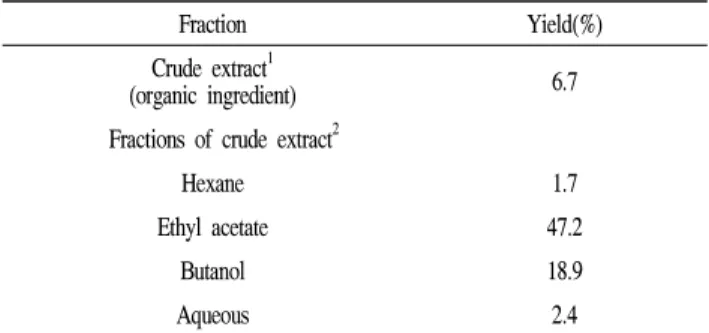
목초액 1 L을 용매의 극성에 따라 hexane, ethyl acetate, butanol, 물 등 순차적으로 얻은 각각의 용매 분획물의 수율 은 Table 2와 같다. 목초액을 농축하여 물을 제거한 조추출 물은 전체 무게의 6.7%였고, 조추출물에 대한 각 순차 분획 물의 수율은 ethyl acetate 분획물이 47.2%로 가장 높았고, butanol 분획물 18.9%, 물 분획물 2.4%, hexane 분획물이 1.7%의 수율을 보임으로서 대부분의 목초액 분획물은 중간 극성쪽의 용매분획에서 얻을 수 있음을 알 수 있었다.
Table 2. Yield of each fractions extracted from pyroligneous liquor
Fraction Yield(%)
Crude extract1
(organic ingredient) 6.7
Fractions of crude extract2
Hexane 1.7
Ethyl acetate 47.2
Butanol 18.9
Aqueous 2.4
1g/100g pyroligneous liquor.
2% of crude extract.
조추출물의 항균성
목초액을 농축하여 얻은 조추출물을 paper disc법에 따라 7종의 식중독균에 대하여 항균성 시험을 한 결과는 Table 3과 같다. 균종별로 살펴보면 그람음성균인 Shigella sonnei 와 Yersinia enterocolitica는 2.0 mg/disc의 농도에서 각각 16 mm, 18 mm의 clear zone을 형성하여 다른 미생물에 비하여 상대적으로 높은 항균활성을 나타내었으며, Esche- richia coli O157에 대해서는 12 mm의 clear zone을 형성하 여 상대적으로 낮은 항균성을 보였다. 한편 그람양성균에서 는 Listeria monocytogenes가 20 mm, Staphylococcus aureus가
17 mm, Bacillus cereus 15 mm의 clear zone을 형성하여 그람 음성균에 비해 대체적으로 항균력이 높게 나타났다.
서 등(20)은 일부 식품부패균 및 식중독균을 대상으로 참나 무 목초액을 10∼50 μL 첨가시 항균활성을 조사한 결과 모든 균종에서 농도 의존적으로 항균활성이 나타났다고 하였고, 균종별로는 Escherichia coli, Streptococcus mutans, Salmonella typhimurium, Vibrio parahaemolyticus에 대해서 는 clear zone이 10.0∼15.0mm, 8.5∼14.2mm, 10∼14.8mm, 10∼18mm정도의 높은 항균력을 나타내었다고 하였다. 그 밖에 Pseudomonas aeruginosa 및 Escherichia coli O157균의 경우 clear zone이 8.0∼13.1 mm, 8.5∼13 mm 정도의 항균력 이 있다고 보고한 것과 마찬가지로 본 연구 결과에서도 목초액은 식중독균에 대해서 높은 항균성을 가지고 있는 것으로 나타났다.
Table 3. Antimicrobial activity of the crude extract from pyroligneous liquor
Strain
Clear zone (mm) 0.5 mg/disc 1.0 mg/disc 2.0
mg/disc Gram(-)
Salmonella enteritidis ATCC 13076 12 14 15
Escherichia coli O157 ATCC 43895 10 12 12
Shigella sonnei ATCC 9290 13 14 16
Yersinia enterocolitica ATCC 27729 14 15 18
Gram(+)
Staphylococuus aureus ATCC 13565 13 15 17
Bacillus cereus ATCC 14579 13 14 15
Listeria monocytogenes ATCC 19115 15 17 20
용매분획별 항균성
목초액 조추출물을 용매의 극성을 높여가며 순차용매 분획한 분획물의 식중독균에 대한 항균성을 측정한 결과는 Table 4와 같다. 용매 분획별 항균성 시험에서는 농도가 높아질수록 농도 의존적으로 항균성이 증가하였으며, hexane 분획과 ethyl acetate 분획은 0.5 mg/disc의 농도에서 도 실험 균주 7종 모두에 대하여 항균성을 나타내어 항균성 이 우수한 것으로 나타났다. 특히 ethyl acetate 분획은 2.0 mg /disc 농도에서 Listeria monocytogenes, Yersinia enterocolitica, Shigella sonnei, Staphylococcus aureus에 대해서 각각 24, 23, 22, 20 mm의 clear zone을 형성하여 매우 강한 항균력을 보였으며, Salmonella enteritidis, Bacillus cereus, Escherichia coli O157 균에 대해서는 18, 18, 13 mm의 clear zone을 형성하는 등 조사 대상 모든 균주에 높은 항균효과를 나타 내었다. 물 분획과 butanol 분획은 2.0 mg/disc의 농도에서는 모든 균주에 항균성을 나타내었으나 0.5 mg/disc의 농도에 서는 항균성을 나타내지 않거나 약한 항균성을 나타내었
다. 이 결과로 보아 목초액의 항균활성 물질은 중간극성이 거나 비극성에 가까운 성질을 갖는 물질일 것으로 추정되며 여러 분획에서 항균성을 나타내는 것으로 보아 항균성 물질 은 다양한 성분들이 혼합되어 나타나는 것으로 판단된다.
Fig. 1은 그람 음성균인 Yersinia enterocolitica와 그람양 성균인 Bacillus cereus에 대한 항균력을 측정한 결과를 사진 으로 나타낸 것으로 다른 분획 보다 ethyl acetate 분획과 hexane 분획의 생육저지환이 크게 나타난 것을 보여준다.
Table 4. Antimicrobial activity of various solvent fractions from pyroligneous liquor Solvent
fraction Conc.
(mg/disc)
Clear zone (mm)
S. enteritidis E. coli O157 S. sonnei Y. enterocolitica S. aureus B. cereus L. monocytogenes Hexane
0.5 12 12 13 14 15 14 16
1.0 15 14 15 18 16 16 18
2.0 17 15 18 21 19 19 20
Ethyl acetate
0.5 12 10 14 15 15 13 18
1.0 16 12 16 18 17 16 22
2.0 18 13 22 23 20 18 24
Butanol
0.5 10 9 9 ± ± ± ±
1.0 11 11 9 9 ± 10 10
2.0 13 12 10 9 9 11 13
Water
0.5 ± - 11 10 ± ± 10
1.0 12 10 12 11 9 10 12
2.0 15 12 14 13 11 12 13
Disc diameter : 8 mm, ± :≤8.5 mm, - : none.
(A) (B)
Fig 1. Inhibitory effects against Bacillus cereus (A) and Yersinia entercolitica (B). 1, control (DMSO); 2, crude extract; 3, hexane fraction; 4, EtOAc fraction; 5, BuOH fraction; 6, water fraction.
Hexane과 ethyl acetate 분획의 최소저해농도
항균성이 우수하게 나타난 목초액의 ethyl acetate 분획과 hexane 분획의 식중독균에 대한 최소저해농도를 측정한 결과 Table 5와 같다.
Hexane 분획은 1,000 μg/mL의 농도에서 Salmonella enteritidis와 Escherichia coli O157의 생육을 억제시켰고, 500 μg/mL 농도에서 Shigella sonnei, Yersinia entercolitica, Staphylococcus aureus, Bacillus cereus를, 125 μg/mL의 농도 에서 Listeria monocytogenes의 생육을 억제하였다. 에칠아 세테이트 분획은 1,000 μg/mL의 농도에서 Salmonella
Enteritidis와 Escherichia coli O157를, 500 μg/mL 농도에서 Shigella sonnei와 Bacillus cereus를, 250 μg/mL의 농도에서 Yersinia entercolitica, Staphylococcus aureus를, 125 μg/mL 의 농도에서 Listeria monocytogenes의 생육을 억제하였다.
분획별로는 ethyl acetate 분획이 hexane 분획에 비해 다소 높 은 항균성을 나타내었고, 균종별로는 Listeria monocytogenes.
Yersinia enterocolitica, Staphylococcus aureus에 대하여 항 균성이 높게 나타났다.
Table 5. Minimal inhibitory concentration of hexane and ethyl acetate solvent fractions from pyroligneous liquor
Strain MIC(μg/mL)
Hexane fr. EtOAc fr.
Gram(-)
Salmonella enteritidis ATCC 13076 Escherichia coli O157 ATCC 43895
Shigella sonnei ATCC 9290 Yersinia enterocolitica ATCC 27729
Gram(+)
Staphylococuus aureus ATCC 13565 Bacillus cereus ATCC 14579 Listeria monocytogenes ATCC 19115
1,000 1,000 500500
500 500125
1,000 1,000 500250
250 500125
*MIC : minimal inhibitory concentration.
Silica gel column chromatography 정제에 의한 항균성 분획 확인
항균성이 우수하게 나타난 목초액 ethyl acetate 분획을 용매의 극성을 높이면서 silica gel column chromatography 하여 얻은 각 분획에 대하여 항균성 시험을 한 결과는 Table 6과 같다. 시료의 농도를 1.0 mg/disc가 되도록 paper disc에 첨가한 후 7종의 공시균주를 대상으로 항균력을 확인한 결과, 분획 P-1, P-2, P-3, P-4는 모든 균주에 대하여 항균성
Table 6. Antimicrobial activity of each fraction by silica gel column chromatography from ethyl acetate fraction of pyroligneous liquor Fraction No. S. enteritidis E. coli O157 S. sonnei Y. enterocolitica S. aureus B. cereus L. monocytogens
P-1 11 11 12 12 20 14 32
P-2 10 10 10 11 17 13 27
P-3 10 10 10 10 16 12 25
P-4 9 9 9 10 16 12 25
P-5 -1) - - 9 14 10 20
P-6 - - - - - - -
-1): not inhibited.
을 나타내었다. 특히 P-1은 11∼32 mm, P-2는 10∼27 mm의 clear zone을 형성하여 항균성이 매우 우수하게 나타났다.
균종별로는 Listeria monocytogenes의 경우 모든 분획에서 항균력을 나타내었으며 P-1이 32 mm, P-2과 27 mm의 clear zone을 형성하여 매우 강한 항균력을 보였고, 나머지 분획 에서도 15∼25 mm를 형성하여 다른 균주들에 비해 항균활 성이 뛰어남을 볼 수 있었다. 그리고 P-1과 P-2은 Staphylococcus aureus에 대하여 20 mm, 17 mm의 clear zone을 나타내어 강한 항균력을 보였고, Bacillus cereus에 대하여서는 14 mm, 13 mm의 clear zone을 보여 다른 분획들보다는 우수한 항균성을 나타내었다. 한편 그람음성균인 Salmonella enteritidis, Escherichia coli O157, Shigella sonnei, Yersinia enterocolitica에 대해서는 P-6 분획은 항균성을 나타내지 않았고 다른 분획들도 9∼12 mm의 clear zone을 형성하는 등 큰 차이가 없는 것으로 나타나서 그람음성균에는 항균성 이 저하하는 것을 알 수 있었다. 향후 항균성이 높게 나타난 P-1과 P-2에서 항균성 물질을 분리하여 구조를 밝히는 연구 가 필요할 것으로 생각된다.
총 페놀성 화합물의 함량
페놀성 물질은 식물계에 널리 분포되어 있는 2차 대사산 물의 하나로 다양한 구조와 분자량을 가지며 phenolic hydroxy기를 가지고 있다. 식품의 품질변화와 생체노화의 근원이 되는 산화반응은 이들 물질과 반응시 산화반응이 지연되어서 항산화 및 항균성을 가지게 된다. 따라서 천연 에 존재하는 생리활성물질의 대부분이 페놀성 물질들로 최근에는 이에 대한 연구가 활발히 수행되고 있다.
목초액 및 각 용매 분획의 총페놀성 화합물의 함량을 Folin-Denis법으로 측정한 결과는 Table 7과 같다. 총 페놀 성 화합물의 함량은 목초액 농축물이 227.5 mg/g이었으며, 용매 분획별로는 에틸아세테이트 분획과 헥산 분획이 488.3 mg/g와 403.8 mg/g 으로 높게 나타났으며 부탄올 및 수용성 분획은 각각 83.6 mg/g와 74.5 mg/g으로 나타났 다. Clark 등(26)이 식물체에 함유된 페놀성 물질이 항균활 성을 나타낸다고 보고한 것과 관련지어 볼 때 본 연구에서 도 항균활성이 높게 나타난 에틸아세테이트 분획과 헥산
Table 7. Total phenols concentration of extracts from pyroligneous liquor by Folin Denis method
Fraction Concentration(mg/g)
Crude extract 227.5
Hexane 403.8
Ethylacetate 488.3
Butanol 83.6
Aqueous 74.5
분획에 페놀성 물질을 상대적으로 높게 함유하고 있어 목초 액의 항균성은 페놀성 물질에 기인된 것으로 생각된다.
요 약
목초액의 천연보존료로서의 이용성을 검토하기 위하여 기계식 전용탄화로에서 제조된 목초액을 대상으로 항균활 성과 총페놀성 화합물의 함량을 측정하였다.
목초액을 농축하여 얻은 조추출물과 극성에 따라 분획한 용매분획물의 항균성을 측정한 결과 식중독균인 Salmonella enteritidis, Escherichia coli O157, Shigella sonnei, Yersinia enterocolitica, Staphylococcus aureus, Bacillus cereus, Listeria monocytogenes에 대하여 항균성을 나타내었다. 특 히 hexane 분획과 ethyl acetate 분획이 다른 분획보다 항균 성이 강하게 나타났으며, 균종별로는 Staphylococcus aureus, Listeria monocytogenes 등 그람 양성균이 그람 음성균에 비하여 항균활성이 높게 나타났다. 최소생육저해농도는 Listeria monocytogenes에 대해서는 두 분획 모두 125 μg/mL 의 농도에서 생육을 억제하여 가장 높은 항균성을 보였고, Yersinia enterocolitica와 Staphylococcus aureus에 대하여 ethyl acetate 분획은 250 μg/mL hexane 분획은 500 μg/mL의 농도에서 생육을 억제하였고 대부분의 다른 균에서도 hexane 분획과 ethyl acetate 분획은 500 μg/mL∼1,000 μ g/mL 농도에서 생육을 억제하였다. 목초액의 ethyl acetate 분획을 silica gel column chromatography로 정제한 후 항균
성을 시험한 결과 P-1과 P-2 fraction에서 강한 항균성 물질 이 존재함을 확인하였다. 목초액의 조추출물과 용매분획물 의 총페놀화합물의 함량을 측정한 결과 ethyl acetate 분획과 hexane 분획이 각각 488.3 mg/g와 403.8 mg/g으로 다른 분획 에 비해 페놀성 물질의 함량이 높게 나타나 목초액의 항균 성 물질은 페놀성 물질일 것으로 판단되었다.
감사의 글
본 연구는 바이오그린21사업의 지원(20050901-034-034- 001-02-00)에 의하여 이루어졌습니다.
참고문헌
1. Vargas, I., Sanz, I., Moya, P. and Prima-Yufera, E. (1999) Antimicrobial and antioxidant compounds in the nonvolatile fraction of expressed orange essence oil. J.
Food Prot., 62, 929-932
2. Himejima, M. and Kubo, I. (1991) Antimicrobial agents from the cashew Anacardium occidentate(Anacarrdiaceae) nut shell oil. J. Agric. Food Chem., 39, 418-421 3. Lee. H.S. and Ahn, Y.J. (1998) Growth-inhibition effects
of Cinnamomum cassia bark-derived materials on human intestinal bacteria. J. Kor. Agric Chem. Soc., 46, 8-19 4. Lee, B.W. and Shin, D.H. (1991) Screening of natural antimicrobial plant extract on food spoilage microo- rganisms. Kor. J. Food Sci. Technol., 23(2), 200-204 5. Park, U.Y., Chang, D.S. and Cho, H.R. (1992) Screening
of antimicrobial activity for medicinal herb extracts. J.
Korean Soc. Food Nutr., 21(1), 91-96
6. Smith, J.L. and Marmer, B.S. (1991) Growth temperature and action of lysozyme on Listeria monocytogenes. J.
Food Sci., 56, 1101-1103
7. Dickson, J.S. (1992) Acetic acid action on beef tissue surfaces contaminated with Salmonella typhimurium.
J. Food Sci., 57, 297-301
8. 渡邊昭宣 (1993) 米飯の腐敗および食中毒防止對策として の有機酸の效果. New Food Industry, 35(1), 65-78 9. Delaquis, P.J., Sholberg, P.L. and Stanich, K. (1999)
Disinfection of mung bean seed with gaseous acetic acid.
J. Food Prot., 62, 953-957
10 Wang, L.L. and Johnson, E.A. (1992) Inhibition of Listeria monocytogenes fatty acids and monoglycerides. Appl.
Environ. Microbiol., 58(2), 624-629
11. Smith-Palmer, A., Stewart, J. and Fype, L. (1998) Anti-
microbial properties of plant essential oils and essences against five important food-borne pathogens. Lett. Appl.
Microbial, 26, 118-122
12. Oh, D.H., Ham, S.S., Park, B.K., Ahn, C. and Yu, J.Y.
(1998) Antimicrobial of natural medicinal herbs on the food microorganism. Kor. J. Food Sci. Technol., 30, 957-963
13. 전순자, 이계화, 설계신 (1998) 식물병충해 방제 및 사과 배 신선도 유지에 목초액의 이용. Res. Natural Resour., 1, 91-97
14. 김영철, 이종원 (1993) 저농약 고품질 생산에 기여하는 목초액. 한국시설원예연구회 6(1), 105-119
15. 永田耕一 (1984) 肝實質性黃疸における天然樹液の臨床的 檢討. 基礎と臨床, 17(11), 1-19
16. 川上純, 福島義信, 石橋撤夫 (1978) 特殊木醋液によう治療 成績. 島根縣守, 醫學會發表要旨, 1-15
17. 田村豊行 (1976) 藥物の解毒作用に關する硏究. 基礎と臨 床, 9(13), 1-21
18. Ikegami, F., Sekine, T. and Fujii, Y. (1998) Anti- dermaptophyte activity of phenolic compound imokusaku- eki. J. Pharmaceut. Soc. Japan, 118(1), 257-266 19. 大槻 彰 (1997) 木炭, 木草液 健康法, 日本經濟通信社, 1997 20. 서권일, 하기정, 배영일, 장진규, 심기환 (2000) 참나무
목초액의 항균효과. Kor. J. Postharvest Sci. Technol., 7(3), 337-341
21. 유승헌 (1998) 유기농업에서 무공해 생물자원을 이용한 병충해 종합방제 기술개발-키토산, 식초, 목초액의 토 마토 잎곰팡이병, 겹둥근무늬병, 오이흰가루병 억제효 과와 토마토 뿌리혹선충 억제효과. 한국식물병리학회 지, 14(3), 134-139
22. Kim, J.S., Kim, J.C., Choi, J.S., Kim, T.J., Kim, S.M.
and Cho, K.Y. (2001) Isolation and identification fo herbicidal substance from wood vinergars. Kor. J. Weed Sci., 21(4), 357-364
23. Bauer, C., Kirby, W.M., Scheris, J.C. and Turck, M.
(1966) Antibiotic susceptibility testing by a standardized single disc method. Am. J. Clin. Patho., 45, 493-499 24. Kim, H.O., Park, S.W. and Park, H.D. (2004) Inactivation of Escherichia coli O157:H7 by cinnamic aldehyde purified from Cinnamomum cassia shoot. Food Microbiol., 21, 105-110
25. A.O.A.C. Official Methods of Analysis, 13th ed., Asso- ciation of Official Analytical Chemists, Washington. DC, USA (1980)
26. Clark, A.M., EI-Feraly, F.S. and Li, W.S., (1981) Anti- microbial activity of phenolic constituent of Mangolina grandiflora L. J. Pharm. Sci., 70, 951-952
(접수 2005년 7월 20일, 채택 2005년 9월 30일)