Original Article: Food Science/Microbiology
Combined Treatment of Fumaric Acid with Mild Heat to Inactivate Microorganisms on Fresh Spinach during Storage
Hyeon-Jeong Son · Ji-Hoon Kang · Deog-Hwan Oh · Sea Cheol Min · Kyung Bin Song*
Fumaric acid 와 mild heat의 병합 처리에 따른 시금치의 저장 중 미생물 제어 효과
손현정 · 강지훈 · 오덕환 · 민세철 · 송경빈*
Received: 9 December 2015 / Accepted: 4 January 2016 / Published Online: 31 March 2016
© The Korean Society for Applied Biological Chemistry 2016
Abstract The objective of this study was to examine the combined effect of fumaric acid with mild heat on the inactivation of microorganisms on spinach. Spinach leaves were inoculated with Escherichia coli O157:H7 and Listeria monocytogenes.
Based on the results of single treatment of fumaric acid (0.1, 0.3, and 0.5%) or mild heat (40, 50, and 60
oC) regarding the inactivation of the inoculated bacteria, the optimal condition for the combined treatment was suggested to be 0.5% fumaric acid and mild heat treatment at 50
oC for 5 min. The combined treatment of fumaric acid with mild heat caused 2.53 and 2.62 log reductions of the populations of L. monocytogenes and E. coli O157:H7, respectively. In addition, during storage of fresh spinach at 4
oC for 12 d, the combined treatment reduced initially the populations of total aerobic bacteria by 2.77 log CFU/g
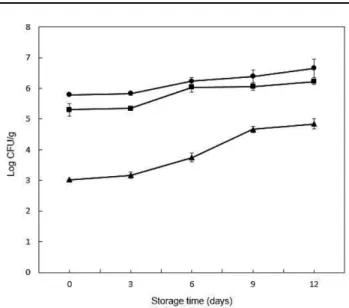
compared with the control. In particular, after 12 d of storage, the population of total aerobic bacteria for the combined treatment sample was 4.84 log CFU/g, whereas the control sample had 6.66 log CFU/g. Color and vitamin C content of spinach samples were not altered significantly by the combined treatment during storage.
These results indicate that the combined treatment of fumaric acid with mild heat is an effective method to control microorganisms on spinach during storage.
Keywords combined treatment · fumaric acid · mild heat · pathogenic bacteria · spinach
서 론
최근 소비자들의 건강에 대한 관심이 높아짐에 따라 신선편이 채소에 대한 수요가 증가하고 있다(Perni 등, 2008). 그 중에서 도 시금치(Spinacia oleracea L.)는 높은 영양적 가치를 가져 널 리 소비되는 채소 중 하나로, 유기산 및 비타민 C가 많이 함유 되어 있고, 또한 칼슘, 마그네슘, 엽산 등 다양한 영양소를 함 유하고 있다(Hong과 Ahn, 2005; Koh 등, 2012). 시금치는 주 로 나물로 섭취하지만, 최근에는 녹즙 등 익히지 않은 상태로 섭취하는 소비도 증가하고 있다. 신선 과채류가 별도의 가공 및 조리를 거치지 않을 경우, 미생물 오염에 노출되고 실제로 몇 몇 신선편이 과채류로 인한 감염이 발생되었다고 보고되었다 (Miller 등, 2013; Taylor 등, 2013). 시금치의 경우, 2006년 미 국에서 Escherichia coli O157:H7의 outbreak로 205명이 감염 되어 4명이 사망하였고, 2012년에도 33명이 E. coli O157:H7에 감염되었다고 보고된 바 있다(CDC, 2006; 2012). 따라서 시금 H.-J. Son · J.-H. Kang · K. B. Song
Department of Food Science and Technology, Chungnam National University, Daejeon 34134, Republic of Korea
D.-H. Oh
Department of Food Science and Biotechnology, Kangwon National University, Chuncheon, Gangwon 24341, Republic of Korea
S. C. Min
Department of Food Science and Technology, Seoul Women’s University, Seoul 01797, Republic of Korea
*Corresponding author (K. B. Song: [email protected])
This is an Open Access article distributed under the terms of the Creative Commons Attribution Non-Commercial License (http://creativecommons.
org/licenses/by-nc/3.0/) which permits unrestricted non-commercial use, distribution, and reproduction in any medium, provided the original work is properly cited.
치의 소비 전 미생물학적 안전성 확보를 위한 전 처리 과정이 필요하다고 판단된다.
신선편이 과채류의 미생물학적 안전성 확보를 위해서 방사선 조사(Nthenge 등, 2007), 유기산(Akbas와 Olmez, 2007), 오존 (Garcia 등, 2003), 염소(Beuchat 등, 2004), 전기분해수 (Guentzel 등, 2008) 등 다양한 비가열 처리 방법이 사용된다.
화학적 처리 방법인 유기산의 경우, 오래 전부터 식품 첨가제 또는 식품 보존제로 식품의 부패 방지 및 저장기간 증대를 위 해 사용되어 왔다. 유기산은 식품의 pH를 낮추고 undissociated form으로 미생물의 생육을 억제한다. 즉, 유기산의 undissociated form이 쉽게 미생물 세포막을 통과하여 세포의 cytoplasm을 산 성화시킴으로써 미생물이 억제되는 기작이다(Ricke, 2003; Akbas 와 Olmez, 2007). 유기산 중 fumaric acid는 강한 살균력을 지 니는데, 딸기, 브로콜리 싹, 사과주 등에서 그 효과가 보고되었 다(Comes와 Beelman, 2002; Kim 등, 2009; Kim 등, 2010).
미생물 저감화를 위한 물리적인 방법으로 mild heat 처리가 다양하게 시도되고 있는데, 메론, 연근, baby spinach 등에서 미 생물 억제효과가 보고되었다(Lamikanra와 Watson, 2007; Huang 과 Chen, 2011; Park 등, 2013). 그리고 mild heat는 신선편이 과채류의 갈변 관련 효소인 polyphenol oxidase, peroxidase 등 을 불활성화 시켜 갈변을 억제시킨다(Lamikanra와 Watson, 2007). 이러한 mild heat는 다양한 세척제와 병합처리 시 세척 제의 미생물 억제 효과를 증대시켜 준다. Delaquis 등(2002)은 E. coli O157:H7으로 접종한 iceberg lettuce에 염소수를 47oC, 3분 처리 했을 때 대조구에 비해 2 log CFU/g 이상 감균 되었 으며, Lin 등(2002)은 E. coli O157:H7과 Salmonella enteritidis 를 접종한 상추에 과산화수소를 50oC에서 처리 시 약 4 log CFU/g의 감균 효과를 보였다고 발표한 바 있다.
따라서 본 연구에서는 시금치의 저장성 증대를 위해 화학적 처리인 유기산과 물리적 처리 방법인 mild heat에 의한 단일처 리 및 병합처리에 따른 미생물 제어 효과 및 시금치의 저장 중 품질변화에 미치는 효과를 조사하여 그 결과를 보고하는 바이다.
재료 및 방법
실험 재료. 본 실험에서 사용된 시금치(Spinacia oleracea L.)는 전라북도 장수군 농가에서 수확한 것으로, 수확 후 선별한 후 24시간 이내에 실험에 사용하였다.
병원성 미생물 배양 및 접종. Escherichia coli O157:H7 (ATCC 43889, NCTC 12079)와 Listeria monocytogenes (ATCC 19111, KCTC 13064)는 각각 25 mL의 tryptic soy broth (Difco Laboratories, Detroit, MI, USA)와 brain heart infusion (Difco Laboratories)에 접종하여 37에서 24시간 동안 배양한 후 3,000×g에서 15분간 원심분리 하였다. 원심분리 후 0.1% 멸균 펩톤수로 cell pellet을 2회 세척한 후 0.1% 멸균 펩톤수로 현 탁하였고, 각 균을 cocktail한 후 최종농도가 약 105−106 CFU/
mL가 되도록 희석하여 사용하였다. 시료 표면에 존재하는 부착 미생물을 제거하기 위해 ultraviolet 조사로 시료 앞, 뒷면을 각 각 15분씩 처리한 후, E. coli O157:H7과 L. monocytogenes 용액 1 mL을 시금치 10 g의 표면에 접종하여 clean bench 내 에서 20분간 건조하였다.
Fumaric acid와 mild heat 처리. 시금치는 tap water나 fumaric acid 용액에 1:50 (w/v)의 비율로 5분간 침지한 후,
laminar-flow biosafety hood에서 30분간 air-dried 상태로 표면 에 남아있는 수분을 건조시켰다. Fumaric acid 용액의 경우 0.1, 0.3, 0.5%의 농도에 따른 미생물 수 감균 효과를 비교하여 최 적농도를 선정하였다. 대조구로는 세척하지 않은 시금치를 사용 하였다. Fumaric acid 용액의 사용 농도 범위는 기존 연구 결 과(Kim 등, 2009)를 참고하여 설정하였다. Mild heat 방법은 tap water를 온도별(40, 50, 60), 시간별(1, 3, 5 분)로 조건을 설정하여 1:50 (w/v)의 비율로 세척처리 하였다.
병합처리. 병합처리는 단일처리를 통해 최적 조건으로 선정된 0.5% fumaric acid 용액과 각 온도에 따라 1:50 (w/v)의 비율 로 5분간 침지한 후, laminar-flow biosafety hood에서 30분간 air-dried 상태로 표면에 남아있는 수분을 건조시켰다.
저장 및 포장조건. 대조구와 단순 물 세척, 최적 조건으로 선정 된 병합 세척 처리 시료는 low density polyethylene bag (25×30 cm, 60µm thickness, 4,100 mL O2/m2·24 h·atm at 24oC) 에 포장한 후 4oC cold chamber에서 12일 동안 저장하며 미생 물 수 및 품질변화를 측정하였다
미생물 수 측정. 시금치 시료 10 g과 멸균 펩톤수 90 mL을 멸 균 bag에 넣고 3분 동안 stomacher를 이용하여 균질화 하였다.
균질화 된 시료를 멸균 펩톤수로 10배 연속 희석한 후 각 배 지에 분주하였고, 총 호기성 균은 plate count agar (Difco Laboratories), E. coli O157:H7은 sorbitol MacConkey (Difco Laboratories), L. monocytogenes는 Oxford medium base (Difco Laboratories)를 사용하였다. 37oC에서 48시간 배양한 후 형성된 colony를 계수하여 g당 colony forming unit (CFU)로 나타내었다.
색도 측정. 시금치의 색도는 색차계(CR-400 Minolta Chroma Meter, Konica Minolta Sensing Inc., Tokyo, Japan)를 사용하 여 측정하였는데, 사용된 표준 백판의 L, a, b 값은 각각 L=97.36, a=−0.07, b=2.03이었다.
비타민 C 함량 측정. 시금치의 비타민 C 함량 분석은 HPLC (Waters, Milford, MA, USA)를 이용하여 측정하였다. 시료는 mixer를 이용하여 마쇄한 후 동결건조하여 준비하였다. 동결건 조한 시료 2 g에 10% 메타인산용액 2 mL을 가하여 10분간 현 탁시킨 후, 다시 5% 메타인산 용액 25 mL을 넣어 30분간 균 질화 하였다. 균질화된 시료를 1,590×g에서 15분간 원심분리를 하여 상등액 만을 취하고, 상등액 1 mL에 5% 메타인산 용액 3 mL을 가하여 희석시킨 후 0.2 µm polyvinylidiene fluoride filter로 여과한 뒤 10 µL씩 주입하여 분석하였다. 사용된 칼럼 은 Kinetex 5 µ EVO C18 100A (250×4.6 mm, Phenomenex Inc., Torrance, CA, USA)였다. 이동상은 0.05 M KH2PO4/ acetonitrile (60:40, v:v)을 1 mL/min으로 흘려주었으며 UV detector를 사용하여 254 nm에서 검출하였다. 표준물질로 ascorbic acid를 사용해 비타민 C 함량을 산출하여 mg ascorbic acid equivalent/100 g으로 표시하였다.
통계분석. 실험결과의 통계 분석은 SAS (Statistical Analysis System program version 9.4, SAS Institute Inc, Cary, NC, USA) 프로그램을 이용하였으며, 유의수준 p <0.05에서 Duncan’s multiple range test 방법을 사용하였다. 실험 결과는 최소 3회 이상 반복실험 하여 평균 ± 표준편차로 나타내었다.
결과 및 고찰
Fumaric acid 단일처리에 따른 미생물 제어 효과. 시금치에
fumaric acid 단일처리를 한 후 접종된 L. monocytogenes, E.
coli O157:H7의 미생물 제어 효과를 측정하였다(Table 1). 시금 치의 초기 L. monocytogenes, E. coli O157:H7의 수는 각각 6.11, 5.97 log CFU/g이었다. 0.5% fumaric acid 처리 후 4.19, 3.89 log CFU/g으로 1.92, 2.08 log CFU/g의 감소효과 를 보였고, 0.1과 0.3% fuamric acid와는 유의적인 차이를 보여 가장 높은 감소효과를 나타냈다. 이러한 결과는 초기 L.
monocytogenes, E. coli O157:H7의 미생물 수가 7.39, 6.14 log CFU/g인 브로콜리 싹에 0.5% fumaric acid를 단일 처리 시, 2.29, 2.26 log CFU/g이 감소하였다는 연구결과와 유사하였 다(Kim 등, 2009).
Mild heat 단일처리에 따른 미생물 제어 효과. Mild heat 단일 처리 경우, 온도별(40, 50, 60oC), 시간별(1, 3, 5분) 처리를 통 해 각 온도에 따른 최적처리 시간을 선정하였다(Table 2). 대조 구의 초기 L. monocytogenes, E. coli O157:H7의 수는 각각 5.92, 6.03 log CFU/g이었는데, 단순 물 세척의 경우 5.64, 5.69 log CFU/g로 단순 물 세척만으로는 미생물 수 감소가 어 렵다는 것을 알 수 있었다. 40oC 처리구의 경우, 1분 처리 시 L. monocytogenes, E. coli O157:H7의 수가 5.47, 5.30 log CFU/g으로 단순 물 세척 처리구와 유사한 수준의 감소를 보인 반면에, 5분 처리 시에는 대조구에 비해 0.85, 0.96 log CFU/g 의 감소효과로 1분 또는 3분에 비해 높은 감소를 보였다. 50과 60oC 처리구 역시 5분 처리 시 가장 높은 감소를 보였다. 특히, 50oC, 5분 처리의 경우 총 L. monocytogenes, E. coli O157:H7 수가 대조구에 비해 각각 1.54, 1.74 log CFU/g의 감소를 나타 내었고, 60oC, 5분 처리의 경우에도 50oC와 유사한 수준의 감 소효과를 보였다. 이러한 결과는 E. coli O157:H7을 접종한 baby spinach를 40oC (5분), 50oC (2분)의 증류수로 처리하였을 때 대조구에 비해 각각 1.1, 1.6 log CFU/g의 감소하였다는 연
구결과와 유사하였다(Huang과 Chen, 2011). 또한 Koseki 등 (2004)의 연구에 따르면, E. coli O157:H7과 Salmonella를 접종 한 상추를 증류수에 50oC에서 5분간 세척처리를 하였을 때 대 조구에 비해 E. coli O157:H7의 경우 2.73 log CFU/g, Salmonella 의 경우 2.81 log CFU/g의 감소수준을 보였다. 이러한 결과들 은 상온(20oC)에서의 세척보다 mild heat된 50oC에서의 세척이 미생물 수 감소에 있어서 더 효과적임을 알 수 있었다.
Fumaric acid와 mild heat 병합처리에 따른 미생물 제어 효과.
단일 처리를 통해 선정된 fumaric acid 최적 농도와 최적 mild heat 처리와의 병합처리를 통해 미생물 제어 효과를 확인하였다 (Table 3). 단일 처리 결과를 통해 fumaric acid의 최적 농도는 0.5%로 선정하였으며, 각 온도에 따른 최적 시간은 모두 5분으 로 선정하였다. 0.5% fumaric acid와 각 온도에 따른 mild heat 처리를 하였을 경우 40oC 처리에 비해 50oC 처리에서 더 높은 효과를 나타내었으며, 50oC과 60oC 간에는 큰 차이를 보 이지 않았다. 0.5% fumaric acid와 50oC에서의 병합처리 경우, L. monocytogenes, E. coli O157:H7의 수가 대조구에 비해 각 각 2.53, 2.62 log CFU/g의 감소 효과를 나타내었고, 0.5%
fumaric acid 단일처리에 비해선 각각 1.03, 0.94 log CFU/g의 감소를 나타내었다. 이러한 연구결과는 Rahman 등(2010)의 양 배추에 1% citric acid와 50oC 처리 시, L. monocytogenes, E.
coli O157:H7 의 수가 대조구에 비해 각각 2.83, 2.85 log CFU/g이 감소했다는 보고와, Huang과 Chen(2011)의 baby spinach에 1%의 lactic acid, citric acid, malic acid 등을 50oC Table 1 Change in the populations of L. monocytogenes and E. coli
O157:H7 inoculated on spinach by fumaric acid treatment (log CFU/g) Treatment L. monocytogenes E. coli O157:H7
Control 6.11±0.12A 5.97±0.16A
Water 5.69±0.16B 5.39±0.10B
Fumaric acid 0.1% 4.89±0.06C 4.88±0.06C
0.3% 4.61±0.09D 4.42±0.18D
0.5% 4.19±0.15E 3.89±0.22E
1)Any means in the same column (A-E) followed by different letters are significantly (p <0.05) different.
Table 2 Change in the populations of L. monocytogenes and E. coli O157:H7 inoculated on spinach by mild heat treatment (log CFU/g)
Treatment L. monocytogenes E. coli O157:H7
Control 5.92±0.16A 6.03±0.07A
Water 5.64±0.11B 5.69±0.15B
Mild heat 40oC, 1 min 5.47±0.08B 5.38±0.08C
3 min 5.50±0.17B 5.24±0.20CD
5 min 5.07±0.18C 5.07±0.21DE
Mild heat 50oC, 1 min 4.98±0.14C 4.96±0.07E
3 min 4.74±0.14D 4.71±0.09F
5 min 4.38±0.10EF 4.29±0.25G
Mild heat 60oC, 1 min 4.60±0.16DE 4.68±0.17F
3 min 4.22±0.27FG 4.63±0.08F
5 min 4.10±0.14G 4.22±0.06G
1)Any means in the same column (A-G) followed by different letters are significantly (p <0.05) different.
Table 3 Change in the populations of L. monocytogenes and E. coli O157:H7 inoculated on spinach by combined treatment (log CFU/g)
Treatment L. monocytogenes E. coli O157:H7
Control 5.80±0.05A 5.98±0.08A
Water 5.34±0.10B 5.44±0.16B
Fumaric acid 0.5% 4.30±0.21D 4.28±0.18D
Mild heat (40oC, 5 min) 4.81±0.17C 5.04±0.13C
Mild heat (50oC, 5 min) 4.28±0.15D 4.27±0.20D
Mild heat (60oC, 5 min) E4.15±0.12DE 4.16±0.16D
Fumaric acid 0.5%+Mild heat (40oC, 5 min) 4.01±0.07E 4.11±0.31D
Fumaric acid 0.5%+Mild heat (50oC, 5 min) 3.27±0.19F E3.34±0.09FE
Fumaric acid 0.5%+Mild heat (60oC, 5 min) 3.23±0.27F 3.26±0.10E
1)Any means in the same column (A-F) followed by different letters are significantly (p <0.05) different.
에서 처리 시 미생물 수가 2 log CFU/g 이상 감소하였다는 연 구결과와 유사하였다.
저장 중 미생물 수 변화. 수확 후 신선한 시금치 시료를 본 연 구에서 선정된 최적의 병합처리 조건인 0.5% fumaric acid와 mild heat (50oC, 5분) 처리한 후 4±1oC에서 12일간 저장하면 서 미생물 수 변화를 측정하였다(Fig. 1). 저장 초기 대조구의 총 호기성 균 수가 5.78 log CFU/g이고 단순 물 세척은 5.30 log CFU/g 인 반면에. 병합처리의 경우 3.02 log CFU/g으로 2.76 log CFU/g의 감소를 나타내었으며, 저장기간 동안 대조구
와 모든 처리구에서 미생물 수가 증가하는 결과를 보였다. Kim 등(2010)에 따르면 0.5% fumaric acid를 딸기에 처리하여 저장 했을 때, 저장 초기 대조구에 비해 1.41 log CFU/g의 감소를 보였고, Klaiber 등(2005)의 당근에 50oC mild heat를 처리하여 저장했을 때, 저장 초기 총 호기성 균이 대조구에 비해 1.7 log CFU/g이 감소하였다. 따라서 이러한 연구결과들을 통해서, 본 연구에서의 fumaric acid와 mild heat병합처리가 synergy effect 를 나타내어 더 큰 감균 효과를 나타냄을 알 수 있었다. 특히, 저장 12일차에는 병합처리구가 4.84 log CFU/g으로 대조구와 비교하여 1.82 log CFU/g의 감균 효과를 보여 저장 중에도 미 생물 감소 효과가 지속되었다. 이는 Wei 등(2005)의 iceberg lettuce에 citric acid를 50oC로 처리한 후 4oC에서 7일 저장 시, 저장 초기 총 호기성 균이 대조구에 비해 2.30 log CFU/g의 감소를 보였고 저장 7일 후에는 2.9 log CFU/g으로 감균 효과 를 지속하였다는 연구와 유사하였다. 이러한 결과들은 화학적 세척제와 mild heat와의 병합처리가 세척제의 단일처리보다 미 생물 감소에 효과적임을 시사하며, mild heat가 세척제의 미생 물 저감효과를 상승시켜 준다는 것을 알 수 있다. 따라서 fumaric acid와 mild heat의 병합처리는 시금치를 비롯한 신선 편이 과채류의 저장 중 미생물 제어에 있어서 효과적인 방법이 라고 판단된다.
색도 변화. 식품의 저장 중 품질 지표 중 하나인 색도와 관련 해서, 시금치의 저장 중 Hunter L, a, b값을 나타내었는데, 12 일간의 저장 중 처리구 간의 유의적인 차이는 보이지 않았다 (Table 4). Park과 Kang(2015)은 시금치에 10 ppmv 이산화염 소 가스와 80 ppm peracetic acid를 처리하여 7일간 저장했을 때, 대조구와 비교하여 유의적인 차이가 없었다고 보고한 바 있 다. Siddiq 등(2013) 또한 양파를 50, 60, 70oC에서 1분간 처 리한 후 4oC에서 21일간 저장했을 때, 60, 70oC의 경우 저장기 Fig. 1 Change in the populations of total aerobic bacteria of spinach
during storage at 4oC. ●: Control, ■: water, ▲: combined treatment
Table 4 Change in Hunter color values of spinach during storage at 4oC Color
parameter Treatment1) Storage time (days)
0 3 6 9 12
L
Control 031.61±0.89Aa2) 31.65±0.72Aa 31.51±0.72Aa 31.54±0.93Aa 31.65±0.92Aa
Water 31.64±0.91Aa 31.57±0.95Aa 31.56±0.65Aa 31.62±0.90Aa 31.62±1.01Aa
Combined treatment 31.57±0.76Aa 31.60±0.75Aa 31.54±0.67Aa 31.47±0.87Aa 31.58±0.86Aa
a
Control -9.21±0.54Aa -9.23±0.57Aa -9.28±0.31Aa -9.31±0.26Aa -9.45±0.16Aa
Water -9.34±0.50Aa -9.25±0.61Aa -9.28±0.47Aa -9.34±0.22Aa -9.36±0.49Aa
Combined treatment -9.26±0.55Aa -9.25±0.27Aa -9.26±0.24Aa -9.31±0.21Aa -9.39±0.21Aa
b
Control 13.24±0.46Aa 13.25±0.55Aa 13.24±0.56Aa 13.24±0.62Aa 13.10±0.03Aa
Water 13.25±0.44Aa 13.25±0.57Aa 13.25±0.50Aa 13.24±0.40Aa 13.23±0.41Aa
Combined treatment 13.24±0.41Aa 13.26±0.58Aa 13.26±0.52Aa 13.29±0.32Aa 13.32±0.39Aa
1)Control; no treatment, Combined treatment; 0.5% fumaric acid + mild heat (50oC).
2)Any means in the same column (A) or row (a) followed by different letters are significantly (p <0.05) different.
Table 5 Change in vitamin C content of spinach during storage at 4oC (mg/100 g)
Treatment1) Storage time (days)
0 3 6 9 12
Control 055.51±0.05Aa2) 55.50±0.37Aa 55.56±0.48Aa 055.02±0.19Aab 54.90±0.23Ab
water 55.49±0.45Aa 55.48±0.51Aa 55.45±0.16Aa 54.99±0.26Aa 54.92±0.14Aa
Combined treatment 55.21±0.70Aa 55.48±0.48Aa 55.78±0.64Aa 55.03±0.19Aa 54.97±0.24Aa
1)Control; no treatment, Combined treatment; 0.5% fumaric acid + mild heat (50oC).
2)Any means in the same row (a-b) followed by different letters are significantly (p <0.05) different.
간에 따라 L값이 감소한 반면 50oC 처리의 경우 저장기간 중 L값의 변화가 없었다는 결과는 본 연구결과와 유사하였다. 따 라서 본 연구에서 사용된 fumaric acid와 50oC에서의 mild heat 병합처리는 시금치의 색도에 영향을 미치지 않는다고 판단 되고, 본 연구에서는 수행되지 않았지만 물성 등에도 큰 영향 을 끼치지는 않는다고 생각된다.
비타민 C 함량 측정. 저장 중 시금치의 비타민 C 함량을 Table 5에 나타내었다. 저장 초기 대조구의 비타민 C 함량은 55.51 mg/100g에서 12일 후 54.90 mg/100 g이었으며, 병합처리의 경 우 저장 초기 55.21 mg/100 g에서 54.97 mg/100 g로 처리구 간 의 유의적인 차이를 보이지 않았다. Choi 등(2007)에 따르면, 본 연구결과와는 달리 34일 저장 시 비타민C 함량이 감소하였 는데, 시금치 저장 시 비타민 C 함량의 손실율이 저장온도에 따라 달랐다고 하면서, 비타민 C 산화효소가 저온에서 보다 고 온에서 높은 활성을 지니기 때문이라고 보고하였다. 따라서 시 금치에서의 비타민 C 함량은 품종, 수확시기, 초기 비타민C함 량의 차이, 저장온도에 따라 다른데, 본 연구에서 사용된 시금 치의 경우, fumaric acid와 mild heat의 병합처리가 비타민 C 함량에 있어서 큰 영향을 끼치지 않았다. 따라서 이러한 연구 결과는 fumaric acid와 mild heat의 병합처리가 시금치의 색도, 영양성분, 물성 등 품질에 영향을 끼치지 않으면서도 저장 중 미생물학적 안전성 유지에 효과적인 처리라는 것을 시사한다.
초 록
시금치에 fumaric acid와 mild heat의 병합처리를 통해 병원성 미생물 제어효과를 규명하고자 시금치에 E. coli O157:H7, L.
monocytogenes 를 접종한 후 각 단일처리 후 미생물 수 변화를 측정하였다. Fumaric acid (0.1, 0.3, 0.5%)와 mild heat (40, 50, 60oC)의 각 단일처리 실험 결과를 토대로, 병합처리를 위한 fumaric acid의 최적농도는 0.5%, mild heat 처리조건으로 50oC 에서 5 min으로 선정하였고, 병합처리 시 L. monocytogenes, E.
coli O157:H7의 수는 대조구에 비해 각각 2.53, 2.62 log CFU/g 감소하였다. 그리고 신선한 시금치에 병합처리 후 4oC 에서 12일간 저장하면서 미생물 수 감소 및 품질 변화를 조사 하였다. 시금치의 초기 미생물 수에 있어서 대조구와 비교하여, 병합 처리구에서 총 호기성 균을 2.77 log CFU/g 감소시켰다.
특히, 저장 12일 후 병합 처리구의 총 호기성 균 수는 4.84 log CFU/g으로 대조구와 비교하여 1.82 log CFU/g의 감균 효 과를 가졌다. 또한 시금치의 저장 중 Hunter 색도 값 및 비타 민 C 함량에 있어서 처리구 간의 유의적인 차이를 보이지 않 았다. 따라서 본 연구 결과, fumaric acid와 mild heat의 병합처 리가 시금치의 미생물학적 안전성 유지에 효과적인 처리라고 판 단된다.
Keywords 병원성 미생물 · 병합처리 · 시금치 · 열 처리 · 푸마 르산
Acknowledgment This research was supported by the High Value-Added Food Technology Development Program (314059), Ministry of Agriculture, Food and Rural Affairs a grant from the Korea Institute of Planning and Evaluation for Technology in Food (IPET) (Project No. 314059-3), Republic of Korea.
References
Akbas MY and Olmez H (2007) Inactivation of Escherichia coli O157:H7 and Listeria monocytogenes on iceberg lettuce by dip wash treatments with organic acids. Lett Appl Microbiol 44, 619–24.
Beuchat LR, Adler BB, and Lang MM (2004) Efficacy of chlorine and peroxyacetic acid sanitizer in killing Listeria monocytogenes on iceberg and romaine lettuce using simulated commercial processing conditions. J Food Prot 67, 1238–42.
CDC (2006) Ongoing multistate outbreak of Escherichia coli serotype O157:H7 infections associated with consumption of fresh spinach.
MMWR Dispatch 55, 1–2.
CDC (2012) Multistate outbreak of Shiga toxin-producing Escherichia coli O157:H7 infections linked to organic spinach and spring mix blend.
(http://www.cdc.gov/ecoli/2012/O157H7-11-12).
Choi DJ, Lee SH, Yoon JT, Sim YG, Oh SG, and Jun HJ (2007) Effect of polypropylene film package and storage temperature on the shelf-life extension of spinach (Spinacia oleracea L.). J Bio-Env Con 16, 247–51 Comes JE and Beelman RB (2002) Addition of fumaric acid and sodium
benzoate as an alternative method to achieve a 5-log reduction of Escherichia coli O157:H7 populations in apple cider. J Food Prot 65, 476–83.
Delaquis P, Stewart S, Cazaux S, and Toivonen P (2002) Survival and growth of Listeria monocytogenes and Escherichia coli O157:H7 in ready-to-eat iceberg lettuce washed in warm chlorinated water. J Food Prot 65, 459–
64.
Garcia A, Mount JR, and Davidson PM (2003) Ozone and chlorine treatment of minimally processed lettuce. J Food Sci 68, 2747–51.
Guentzel JL, Liang Lam K, Callan MA, Emmons SA, and Dunham VL (2008) Reduction of bacteria on spinach, lettuce, and surfaces in food service areas using neutral electrolyzed oxidizing water. Food Microbiol 25, 36–41.
Hong JJ and Ahn TH (2005) Changes in phytochemical compounds and hazardous factors of spinach by blanching methods. Korean J Food Sci Technol 37, 268–73.
Huang Y and Chen H (2011) Effect of organic acids, hydrogen peroxide and mild heat on inactivation of Escherichia coli O157:H7 on baby spinach.
Food Control 22, 178–83.
Kim JY, Kim HJ, Lim GO, Jang SA, and Song KB (2010) Effect of combined treatment of ultraviolet-C with aqueous chlorine dioxide or fumaric acid on the postharvest quality of strawberry fruit. J Korean Soc Food Sci Nutr 39, 138–45.
Kim YJ, Kim MH, and Song KB (2009) Efficacy of aqueous chlorine dioxide and fumaric acid for inactivating pre-existing microorganisms and Escherichia coli O157:H7, Salmonella typhimurium, and Listeria monocytogenes on broccoli sprouts. Food Control 20, 1002–5.
Klaiber RG, Baur S, Wolf G, Hammes WP, and Carle R (2005) Quality of minimally processed carrots as affected by warm water washing and chlorination. Innovative Food Sci Emerging Technol 6, 351–62.
Koh E, Charoenprasert S, and Mitchell AE (2012) Effect of organic and conventional cropping systems on ascorbic acid, vitamin C, flavonoids, nitrate, and oxalate in 27 varieties of spinach (Spinacia oleracea L.). J Agric Food Chem 60, 3144–50.
Koseki S, Yoshida K, Kamitani Y, Isobe S, and Itoh K (2004) Effect of mild heat pre-treatment with alkaline electrolyzed water on the efficacy of acidic electrolyzed water against Escherichia coli O157:H7 and Salmonella on lettuce. Food Microbiol 21, 559–66.
Lamikanra O and Watson MA (2007) Mild heat and calcium treatment effects on fresh-cut cantaloupe melon during storage. Food Chem 102, 1383–8.
Lin CM, Moon SS, Doyle MP, and McWatters KH (2002) Inactivation of Escherichia coli O157:H7, Salmonella enterica serotype Enteritidis, and Listeria monocytogenes on lettuce by hydrogen peroxide and lactic acid and by hydrogen peroxide with mild heat. J Food Prot 65, 1215–20.
Miller BD, Rigdon CE, Robinson TJ, Hedberg C, and Smith KE (2013) Use of global trade item numbers in the investigation of a Salmonella Newport outbreak associated with blueberries in Minnesota, 2010. J
Food Prot 76, 762–9.
Nthenge AK, Weese JS, Carter M, Wei CI, and Huang TS (2007) Efficacy of gamma radiation and aqueous chlorine on Escherichia coli O157:H7 in hydroponically grown lettuce plants. J Food Prot 70, 748–52.
Park JH, Hong SI, Jeong MC, and Kim DM (2013) Effect of mild heat and organic acid treatments on the quality of fresh-cut lotus roots. Korean J Food Preserv 20, 23–9.
Park SH and Kang DH (2015) Combination treatment of chlorine dioxide gas and aerosolized sanitizer for inactivating foodborne pathogens on spinach leaves and tomatoes. Int J Food Microbiol 207, 103–8.
Perni S, Shama G, and Kong MG (2008) Cold atmospheric plasma disinfection of cut fruit surfaces contaminated with migrating microorganisms. J Food Protect 71, 1619–25.
Rahman SME, Jin YG, and Oh DH (2010) Combined effects of alkaline
electrolyzed water and citric acid with mild heat to control microorganisms on cabbage. J Food Sci 75, 111–5.
Ricke SC (2003) Perspectives on the use of organic acids and short chain fatty acids as antimicrobials. Poult Sci 82, 632–9.
Siddiq M, Roidoung, S, Sogi DS, and Dolan KD (2013) Total phenolics, antioxidant properties and quality of fresh-cut onions (Allium cepa L.) treated with mild-heat. Food Chem 136, 803–6.
Taylor EV, Nguyen TA, Machesky KD, Koch E, Sotir MJ, Bohm SR et al.
(2013) Multistate outbreak of Escherichia coli O145 infections associated with romaine lettuce consumption, 2010. J Food Prot 76, 939–44
Wei H, Brandt MJ, Wolf G, and Hammes WP (2005) Optimization of acidified warm water treatment to improve the microbiological status and sensory quality of iceberg lettuce. Eur Food Res Technol 220, 168–75.