Kor. J. Mater. Res.
Vol. 23, No. 7 (2013)
353
Microstructure and Biocompatibility of Ti-Nb-Si-HA Composites Fabricated by Rapid Sintering Using HEMM Powders
Kee-Do Woo*
,**
†, Sang-Hyuk Kim**, Dong-Soo Kang** and Dong-Gun Kim**
*Division of Advanced Materials Engineering, Research Center of Advanced Materials Development(RCAMD), Chonbuk National University, Chonbuk 561-756, Korea
**Chonbuk National University, Chonbuk 561-756, Korea
(Received May 10, 2013 : Received in revised form June 21, 2013 : Accepted June 27, 2013)
Abstract
To improve coating ability and the life of the coating, Ti based composite materials with hydroxyapatite(HA) should be developed. The raw materials of Ti-26wt%, Nb-1wt%, and Si with 10wt% HA were mixed for 24 h by a mixing machine and milled for 1 h to 6 h by planetary mechanical ball milling. Ti-26%Nb-1%Si-(10%HA) composites, composed of nontoxic elements, were fabricated successfully by spark plasma sintering(SPS) at 1000oC under 70 MPa. The relative density of the sintered Ti-Nb-Si-HA composites using the 24 h mixed powder, and the 6 h milled powder, was 91 % and 97 %, respectively.The effects of HA contents and milling time on microstructure and mechanical properties were investigated by SEM and hardness tester, respectively. The Vickers hardness of the composites increased with increasing milling time and higher HA content. The Young’s modulus of the sintered Ti-26%Nb-1%Si-10%HA composite using the 6 h-milled powder was 55.6 GPa, as obtained by compression test. Corrosion resistance of the Ti-26wt%Nb-1wt%Si composite was increased by milling and by the addition of 10wt%HA. Wear resistance was improved with increasing milling time. Biocompatibility of the Ti-Nb-Si alloys was improved by the addition of HA.
Key words
biomaterial, hydroxyapatite, power metallurgy, SPS, sintering, HEMM.1. Introduction
Ti and its alloys are commonly being used in biome- dical applications due to their low density, high specific strength, excellent corrosion resistance and biocompati- bility.
1-2)However, the elastic modules of titanium(Ti) and its alloys are higher than those of human bones. Further- more, coating material of HA used to be peeled off with affecting badly to biocompatibility of commercial Ti-6Al- 4V ELI alloy. In order to overcome these problems, new Ti based alloys with non-cytotoxic elements such as Nb, Zr, Ta, Sn, Mo, and Si have been developed
3-4)and new materials included HA in Ti based alloy are also needed.
Recently β-Ti alloys, such as Ti-Nb and Ti-Ta based alloys, have been studied to achieve lower elastic modules and higher compression strengths than those of commercial Ti-6Al-4V ELI alloy. And Ti-26Nb-1Si alloy has lower elastic modules than some Ti-6Al-4V alloy. Therefore, Ti-26Nb-1Si alloy was used in this study.
5-9)Hydroxyapatite(HA) is the main substance in human bones. It has many advantages for biomaterial such as excellent biocompatibility and good combination ability with human bones. For this reason, HA is widely used to produce porous ceramics and to modify the surface of titanium implant alloy by coating.
10-11)However, the study about Ti alloys containing bioceramics such as HA was not clarified until now, because it is hard to fabricate with ingot casting due to density of Ti and HA. In this study, Ti-26%Nb-1%Si-(10%HA) composites were fabri- cated by spark plasma sintering(SPS) using various milled powders for improving mechanical pro-perties, coating ability and biocompatibility.
2. Experimental
The raw materials of Ti(Se-Jong Materials LtD; 150 µm), Nb(Alfa Aesar; 180 µm), Si(Samchun Pure Chemical Co.LTD: 150 µm) and HA(Fluidinova Co. LTD; 10 µm)
†Corresponding author
E-Mail : [email protected] (K. -D. Woo, Chonbok Nat'l Univ.)
©Materials Research Society of Korea, All rights reserved.
This is an Open-Access article distributed under the terms of the Creative Commons Attribution Non-Commercial License (http://creative- commons.org/licenses/by-nc/3.0) which permits unrestricted non-commercial use, distribution, and reproduction in any medium, provided the original work is properly cited.
powders were mixed and milled by a mixing machine (24 h) and a planetary high energy ball milling machine (1 h, 4 h and 6 h), respectively. The powders were mixed for 24 h using a low energy mixing in a plastic jar with a ball to powder ratio of 7:1. In the other experiment, powders were placed with steel balls in a sealed cylin- drical stainless steel vial under argon atmosphere and then high energy mechanical milled for 1 h, 4 h and 6 h using high energy mechanical milling equipment with a ball to powder ratio of 30:1. The compositions of samples used in this study are shown in Table 1. The sintering was conducted by SPS equipment using four major stages of the SPS process.
12-15)The chamber was evacuated down to 10
−3torr and an uniaxial pressure of 70 MPa was applied. The mixed and milled powders were sintered at 1000
oC and cooled in air. Temperature was measured using a pyrometer focused on the surface of the graphite die. The phase of Ti-26%Nb-1%Si-(10%HA) composites and powders have been investigated using X-ray diffrac- tion(XRD) Cu-K α radiation in the range of 20-80
o. The shape of Ti-26%Nb-1%Si-10%HA powders and morph- ologies were observed by a scanning electron microscope (JMS-6400: SEM). The relative density of Ti-Nb-Si-HA composites was calculated by Archimedes’ method. The hardness was measured using Vickers hardness machine (Load: 500 gf).
composites was obtained by measure of the sample weight before and after conducting.
Potentiodynamic polarization test was performed for the comparison of corrosion resistance between the sin- tered Ti-Nb-Si composites, Ti-Nb-Si-HA composites and commercial Ti-6Al-4V ELI alloy using a Potentiostat / Galvanostat(263A, EG&G PAR, USA) polarization tester.
The electrolyte was composed of NaCl(8.00 g/L), NaHCO
3(0.353 g/L), CaCl
2(0.278 g/L), NaHPO
4·12H
2O(0.322 g/L), MgCl
2·6H
2O(0.203 g/L), MgSO
4·7H
2O(0.123 g/L) and KCl (0.358 g/L). Potential range was from −1.0 to 1.5 V and carried out at a scan rate of 5 mV/sec.
The biocompatibility of the Ti-26%Nb-1%Si-(10%HA) composites was conducted using cell cultivation experi- mental.
12-14)The sintered composites were placed in a 24- well plate and 5 × 10
4cells were attached on the sintered composites under a 5 % CO
2atmosphere and held in an incubator for 3days.
The sintered Ti-26%Nb-1%Si-(10%HA) composites were held in 100 µl of MTT(Tetrazolium-based colorimetric) solution for 4 hours to distinguish between the cultivated cells. The surviving cells were counted by ELISA(Enzume- Linked Immuno Sorbent Assay) leader.
3. Results and Discussion
Fig. 1 shows SEM images of the mixed and milled Ti- 26%Nb-1%Si-10%HA powders. As shown in Fig. 1, the average particle size of the powders decreased with in-
Type2 26 1 10 Bal.
Fig. 1. SEM images of the Ti-26%Nb-1%Si-10%HA powders ; 24 h mixed, (b) 1 h milled, (c) 4 h milled and (d) 6 h milled.
creasing milling time. The shape of the powder particles also changed from needle and plate-like shape to spherical shape.
The particles of Ti-26%Nb-1%Si-10%HA were agglo- merated by cold welding and followed by broken of steel balls during high energy mechanical milling(HEMM). This phenomenon such as agglomerating and smashing con- tinuously appeared. The size of the 6h-milled powders was below 50 nm calculated from the full-width at half maximum(FWHM) using the equation of the Surya- narayana and Norton.
16)B
r(B
crystalline+ B
strain)cos θ = Kλ/L + ηsinθ (1)
where B
ris the FWHM of the diffraction peak after in- strument correction, B
crystallineand B
strainare the FWHM caused by the small grain size and internal stress, re- spectively. And k is a constant(with a value of 0.9), λ is the wavelength of the X-ray radiation, L and η are the grain size and internal strain and θ is the Bragg angle, respectively. The parameters B and B
rfollow Cauchy’s form with the relationship: B = B
r+ B
s, where B and B
sare FWHM of the broadened Bragg peaks and the standard sample’s Bragg peaks, respectively.
Fig. 2 shows transmission electron microscope(TEM) images of the 6h-milled powder. HA particles(white in dark field image : DFI) were embedded into Ti based alloy
Fig. 3. SEM images of the sintered Ti-26%Nb-1%Si-10%HA composites ; 24 h mixed, (b) 1 h milled, (c) 4 h milled and (d) 6 h milled.Fig. 2. TEM images of the Ti-26%Nb-1%Si-10%HA milled powder for 6 h. (a) BFI (b) DFI and (c) SADP.
Fig. 3 shows the surface of the sintered Ti-26%Nb- 1%Si-10%HA composites using SPS at 1000
oC for 7min under the pressure of 70MPa. Applied temperature and uniaxial pressure led the powders to a densification and shrinkage. As shown in Fig. 3, ratio of pore in sintered composites decreased with increasing milling time, and morphology of phase at 6 h milling was more homo- geneous than 24 h mixing because fine powders affected densification and sintering ability.
As a results of EDS analysis, two phases of Ti rich (marked by 1) and Nb rich(marked by 2) phases were presented in Fig. 3(d), respectively. However, because Ca and P elements were very small and few, the elementals were not detected in EDS even though Ca and P is main elements of HA.
Fig. 4 shows the relative density and the hardness values of the sintered Ti-Nb-Si and Ti-Nb-Si-HA composites using each powder. The relative density of the sintered Ti-Nb-Si-HA composites using 24 h mixed powder and 6 h milled powder was 91 %, 97 % respectively. With increase milling time, the relative density was increased.
But the relative density of the Ti-Nb-Si alloy was de- creased by the addition of HA because increase of residual pores with addition of HA due to dehydroxylation reaction during sintering.
17)The hardness of the sintered composites using 6 h milled powder was higher than that of com- posites using 24 h mixed powder. Some papers have been reported that the hardness of the sintered composite by milled powder depended on the milling time, because grain size of the sintered composite decreased with in- creasing milling time. And the reason for hardness dif- ference between the Ti-Nb-Si-HA composite and Ti-Nb-Si composite might be depended on the effect of HA which is a bio-ceramic having good hardness.
By Zhang’s result of compression test using Ti-5Mo- 30HA composite, Young’s modulus of this sintered Ti-5Mo-
30HA composite was 37-55GPa.
18)Therefore our sintered composite might be showed lower Young’s modulus than commercial Ti-6Al-4V ELI.
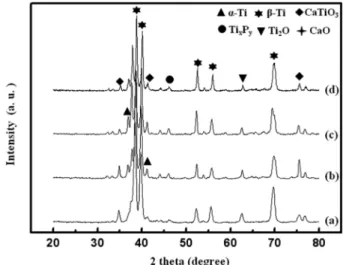
Fig. 5 shows the XRD result of the sintered Ti-26%Nb- 1%Si-10%HA composites fabricated by SPS at 1000
oC for 7min under the pressure of 70MPa using each milled powder. The XRD patterns show that α-Ti phase still remained in all sintered specimens, even though the peak of α-Ti phase is very weak. The peak of β-Ti phase is strongly detected with increasing milling time. This is because α-Ti powder with a stabilize element of Nb and Si became nanosize grain by high energy milling. Diffu- sion rate of Ti during sintering was increased by de- creasing grain size. Therefore phase transformation from α to β phase can be accelerated. By Abdel-A Omran et al, phase transformation from α-Ti to β-Ti phase was obtained by 12h-milling with high energy ball milling.
19)Main phase of the sintered Ti-26%Nb-1%Si-10%HA com- posites is β phase. This is because Nb in Ti alloy promotes phase transformation of α-Ti phase to β phase. The β phase was known to decrease Young’s modulus of Ti
Fig. 4. Relative density and hardness of sintered composites.
Fig. 5. XRD patterns of the Ti-26%Nb-1%Si-10%HA compo- sites ; 24 h mixed, (b) 1 h milled, (c) 4 h milled and (d) 6 h milled.
based alloy. By Hon et al., elastic modulus decreased with increase of Nb content in Ti-Nb alloy.
20)Hon’s equation of E of Ti-Nb alloys is as follows;
E(GPa) = 119.5 − 1.75(5Nb) (2)
Using equation (1), the elastic modulus of the Ti-26%
Nb-1%Si alloy was about 70-80GPa. Young’s modulus obtained by compression test of the sintered Ti-26%Nb- 1%Si-10%HA composite using 6 h milled powder was 55.6GPa.
The XRD pattern showed chemical reaction during the sintering and revealed new phases, Ti
2O, CaO, CaTiO
3, and Ti
xP
y. Therefore, sintering reaction could be expressed by the following equation (2):
Ti + Ca
10(PO
4)
6(OH)
2→ Ti
2O + CaO + CaTiO
3+ Ti
xP
y(3) C.Q. Ning reported that CaTiO
3, CaO, Ti, Ca
4P
2O
9and some Ti
xP
ywere appeared in the Ti-50vol%HAp com- posites after sintering at 1000 or 1100
oC for 30 min under a pressure of 20MPa.
21)Also, he argued that formed TiO
2and CaO can induce the nucleation of apatite on the com- posite surface. It is important because formed bonelike apatite can lead to a chemical bone bonding between bio- composite and natural bone. These phases indicate that HA would react with Ti during sintering process. And this reaction has been found in many Ti-HA bio-composites.
The grain size of the sintered Ti-26%Nb-1%Si-10%HA composite using 6h-milled powders was below 200 nm calculated from the full-width at half maximum(FWHM) using the equation of the Suryanarayana and Norton.
16)This ultra fine grain(UFG) can be obtained by rapid sintering of SPS. But grain size in SEM micrographs in Fig. 3(d) was shown micron size. This is because agglo- merate particles in Fig. 1(d) became micron size grains after sintering. In one big grain, a lot of ultrafine grains co-existed.
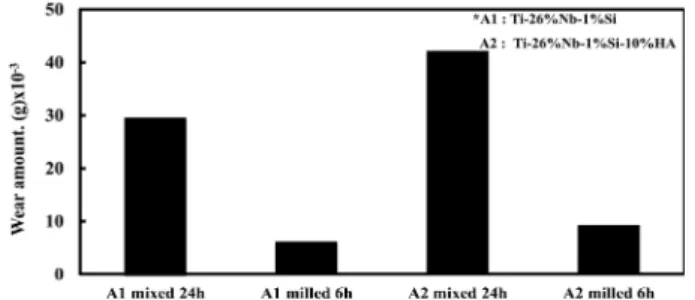
22)The wear mounts of each composite are shown in Fig.
6. As shown in Fig. 6, the higher wear amount was ob- served in Ti-26%Nb-1%Si-10%HA composite using 24 h
mixed powders due to the difference in surface mor- phology and lower density. By addition of HA in Ti- 26%Nb-1%Si alloy, hardness increased. But wear amount of 26%Nb-1%Si-10%HA composite decreased due to lower density than that of Ti-26%Nb-1%Si alloy.
23)The corrosion property of the sintered composite could be analyzed by using the polarization curves. The results of the Tafel extrapolation of the polarization curves are presented in Table 2 and Table 3. High corrosion current density indicates more rapid corrosion rate of the samples.
From the Table 2, Ti-26wt%Nb-1wt%Si-10wt%HA com- posite fabricated by using 6 h milled powders has the lowest value of current density(I
corr). And the value of current density was decreased by using 6h-milled powder and by addition of HA content instead of by using 24 h mixed powder. Therefore, Ti-26%Nb-1%Si-10%HA com- posite fabricated by using 6 h milled powder has good corrosion resistance. The difference in corrosion tendency between each composite is attributed to the difference in the chemical composition of the sample surface affecting the surface sensitivities such as corrosion and high tem- perature oxidation rate.
Fig. 7 shows the results of absorbance cell cultivation of the sintered composites using mixed and milled powders.
And the value of Ti-6Al-4V ELI alloys is obtained from our previous study.
13)The surviving cells were counted by ELISA(Enzume-Linked Immuno Sorbent Assay) leader.
As shown in Fig. 7, each composite in biocompatibility
Fig. 6. The wear amounts of each composite.Table 2. The result of potentiodynamic polarization test of the Ti- 26%Nb-1%Si-10%HA composites; (a) 24 h mixed, (b) 1 h milled, (c) 4 h milled and (d) 6 h milled.
Samples (a) (b) (c) (d) Ti-6Al-4V10)
Icorr(µA) 15 12.9 12.6 8.2 17.0
Table 3. The result of potentiodynamic polarization test of the Ti- 26%Nb-1%Si alloy; (a) 24 h mixed, (b) 6 h milled, Ti-26%Nb-1%Si- 10%HA composite; (c) 24 h-mixed and (d) 6 h milled.
Samples (a) (b) (c) (d) Ti-6Al-4V
Icorr(µA) 32 28.9 12.6 8.2 17.0
Fig. 7. The results of cell cultivation of sintered composites and Ti- 6%Al-4%V.20)
milled specimens decreased OD(optical density), this is due to inclusion of iron by HEMM.
4. Conclusions
This study was conducted to observe mechanical and corrosion property, wear resistance and biocompatibility of the Ti-Nb-Si-HA composites fabricated by SPS using mixed (24 h) and milled powders (1 h, 4 h, 6 h). The re- sults were summarized as follows.
1) HA added Ti-26%Nb-1%Si-10%HA composites can be fabricated successfully by SPS using nanosized milled powder. Microstructure of the sintered Ti-Nb-Si-HA composites became finer with increasing milling time.
2) New phases such as β-Ti phase, Ti
2O, CaO, CaTiO
3, and Ti
xP
ywere formed during sintering. β-Ti phase is useful phase to decrease elastic modulus. Ti
2O and CaO are useful phases to increase a chemical bone bonding between bio-composite and natural bone.
3) Vickers hardness was increased with increase milling time. And also hardness of composites was increased by the addition of HA. Wear resistance was improved with increasing milling time, but decreased a little by addition of HA due to lower density than without HA.
4) Ti-26wt%Nb-1wt%Si-10wt%HA composite using 6 h milled powder has the lowest value of current density (I
corr). And corrosion resistance of the Ti-26wt%Nb- 1wt%Si composite was increased by introduced milling and by the addition of 10wt%HA.
5) Biocompatibility of the Ti-26%Nb-1%Si composite improved by the addition of 10wt%HA.
References
1. M. Long and H. J. Rack, Biomater., 19, 1621 (1998).
2. H. S. Kim, W. Y. Kim and S.H. Lim, Scripta Mater., 54, 887 (2006).
3. E. Takahashi, T. Sakurai, S. Watanabe, N. Masahashi, and S. Hanada, Mater. Trans. 43, 2978 (2002).
4. L. M. Elias, S. G. Schneider, S. Schneider, H. M. Silva
6. S. Ishiyama. S. Hanada and O. Izumi, ISIJ Inter., 31, 807 (1991).
7. P. Laheurte, A. Eberhardt and M. J. Philippe, Mater. Sci.
Eng., A396, 223 (2005).
8. S. Nag, R. Banerjee and H. L. Fraser, Acta Biomater., 3, 369 (2007).
9. Y. L. Hao, S. J. Li, S.Y. Sun, R. Yang, Mater. Sci. Eng., A441, 112 (2006).
10. R. Gadow, A. Killinger, N. Stiegler, Surf. Coat. Technol., 205, 1157 (2010)
11. C. Renghini, E. Girardin, A. S. Fomine, A. Manescu, A.
Sabbioni, S. M. Barinov, V. S. Komlev, G. Albertini, F.
Fiori, Mater. Sci. Eng., B152, 86 (2008).
12. Kee-Do Woo, Xiaopeng Wang, Duck-Soo Kang, Sang- Hyuk Kim, Jeong-Nam Woo, Sang-Hoon Park and Zhiguang Liu, J.Kor. Powd. Metall.Inst., 17, 443 (2010).
13. W. D. Woo, H. B. Lee, I. Y. Kim, I. J. Shon, and D. L.
Zhang, Met. Mater. Int., 14, 327 (2008).
14. Sang-Hoon Park, Kee-Do Woo, Ji-Young Kim and Sang- Mi Kim, Kor, J.Met. Mater., 50, 469 (2012).
15. Kee Do Woo, Sang Mi Kim, Dong Gun Kim, Dae Young Kim and Dong Soo Kang, Kor.J.Mater. Res., 23(2), 135 (2013).
16. C. Suryanarayana, M. Grant Norton, X-ray Diffraction : A Practical Approach, Plenum Press, New York, p. 207-213 (1988).
17. E. Champion, Acta Biomaterialia, 9(4), 5855 (2013).
18. Y. M. Zhang, Mast Thesis, Harbin Institute of Technology in China, (2007).
19. Abdel-Nasser Omran, Kee-Do Woo and Hyun-Bom Lee, Metall. Mater. Trans., 43A(12), 3865 (2012).
20. Y. H. Hon, E. Y. Wu and Y. N. Pan, Proceeding of the 9th Aasian Foundary Congress, Hanoi, Vietnam, 2005, p.
129-141.
21. C. Q. Ning, Y. Zhou, Biomater.. 23, 2911 (2002).
22. K. D. Woo, D. S. Kang, M. S. Moon, S. H. Kim, S. H.
Park and I. J. Shon, Mater. Tech., 27(1), 39 (2012).
23. Sang Hoon Park, Kee Do Woo, Sang Hyuk Kim, Seung Min Lee, Ji Young Kim, Hye Rim Ko and Sang Mi Kim, Kor. J. Mater. Res., 21(7), 384 (2011).