225
✽ Corresponding author: [email protected]
해수순치에 따른 무지개송어
( Oncorhynchus mykiss )
의 프로락틴 및 성장호르몬 유전자의 발현 변화신지혜1・이철호2・조미희1・홍관의2・김동수3,4・손영창1,4✽
1강릉원주대학교 해양분자생명공학과, 2수산자원사업단 양양연어사업소,
3부경대학교 해양바이오신소재학과, 4부경대학교 해양수산형질전환생물연구소
Changes in Prolactin and Growth Hormone Gene Expression of Rainbow Trout Oncorhynchus mykiss Adapted to Seawater
Jihye Shin1, Cheul Ho Lee2, Mihee Jo1, Kwan Eui Hong2, Dong Soo Kim3,4 and Young Chang Sohn1,4*
1Department of Marine Molecular Biotechnology, Gangneung-Wonju National University, Gangneung 210-702, Korea
2Yangyang Salmon Station, Korea Fisheries Resources Agency, Yang-yang, Gangwon 215-821, Korea
3Department of Marine Bio-Materials and Aquaculture, Pukyung National University, Busan 608-737, Korea
4Center for Risk Assessment of Marine Living Modified Organisms, Pukyung National University, Busan 608-737, Korea
Prolactin (PRL) plays an important role in freshwater (FW) osmoregulation by preventing the loss of ions and the uptake of water in fish. Growth hormone (GH) promotes acclimation to seawater (SW) in several teleosts. We acclimated rainbow trout Oncorhynchus mykiss weighting 68.2± 16.6, 138.3± 24, and 287.5±42.1 g in separate experiments to SW under slow-acclimation (SSW) or acute-acclimation (ASW) conditions, and then examined the PRL and GH mRNA levels using the real-time quantitative polymerase chain reaction.
The PRL mRNA levels in all three experimental groups decreased significantly with both the SSW and ASW treatments, as compared to a control group kept in FW for 30 days. The GH mRNA levels increased with ASW in the largest fish, whereas the levels in the other groups did not change significantly. The mortality rate of the largest fish was lower than for the other groups, whereas the growth rate among the three experimental groups did not differ significantly. The growth rate of the ASW group was highest for the smallest fish. These results suggest that SW acclimation is associated with the gene expression levels of PRL and GH in relatively large rainbow trout. In addition, the fish mortality and growth rate on FW-SW transfer seem to be related to body weight, and the SW acclimation method may be applied to the hatcheries industry.
Key words: Rainbow trout, Prolactin, Growth hormone, Seawater acclimation, Real-time PCR
서 론
경골어류인 무지개송어 (Oncorhynchus mykiss)는 우리나라 의 내수면 양식어 중 냉수성어류의 대표적 어종으로서 양식이 도입된 1965년부터 년간 약 4,000톤 내외로 생산되는 산업으 로 정착되었다. 현재, 시대의 변화에 따른 소비성향이 바뀌면 서 기존의 횟감 위주에서 가공품에 의한 소비로 전환되는 추세에 있다 (Baik et al., 2007). 이에 따라 무지개송어는 대형 어 (2 kg 이상)로의 사육이 대두되고 있으나, 육상양어장에 대한 제한된 환경여건으로 인해 대형어 생산이 어려워지면서 해면에서의 사육으로 확대할 필요성이 요구되어지고 있다.
최근, 우리나라에서는 무지개송어의 해면사육을 통한 대형어 생산을 시도하고 있으나, 염분변화에 의한 어류의 생리학적
이온과 수분 불균형, 성장지연 및 폐사가 초래됨으로서 높은 생산성을 유지하지는 못하고 있는 실정이다 (Tsuzuki et al., 2001; Partridge and Jenkins, 2002).
어류는 환경수의 염분변화에 적응하기 위하여 항상성 (homeostasis) 유지를 위한 삼투압 조절 (osmoregulation)기구 를 가지고 있으며 (Morgan and Iwama, 1991; Jarvis and Ballantyne, 2003), 경골어류의 삼투압 조절은 주로 아가미, 소화관 및 신장에서 이뤄진다 (Maina 1990). 삼투압 조절에 관여하는 대표적인 호르몬은 뇌하수체에서 분비되는 프로락 틴 (prolactin, PRL)과 성장호르몬 (growth hormone, GH)으로 서 두 호르몬은 서로 유사한 펩타이드의 이황화결합 구조를 포함하고 있다 (Kawauchi and Sower, 2006). 경골어류의 PRL 은 환경수의 담수조건에서, GH는 해수조건에서 높게 발현되 어 이질적인 발현패턴으로 삼투조절에 관여한다. 두 호르몬은
유사한 펩타이드 구조를 근거로 공통의 선조 유전자로부터 분화되었지만 (Kawauchi and Sower, 2006), 기능적인 측면에 서는 독자적인 진화의 과정을 거쳐 왔다고 추정되고 있다 (Madsen and Bern, 1992; Manzon, 2002). 도미 (Sparus auratus), 감성돔 (Acanthopagrus schlegeli)과 같은 광염성 경골어류의 뇌하수체 PRL mRNA는 담수 환경조건에서 높게 발현되어지 며, GH mRNA는 이와 대조적으로 낮은 발현 양상을 나타낸다 (Laiz-Carrion et al., 2009; Tomy et al., 2009). 해수로부터 담수 로 순치 할 경우, 틸라피아 (Oreochromis mossambicus)의 혈장 내 PRL 농도는 높아지고, 삼투압은 저하되며, 역으로 담수에 서 해수로 순치 시, 혈장 내 GH와 삼투압은 높아진다고 보고된 바 있다 (Seale et al., 2002). In vitro 실험에서도 저삼투압 배지에서 배양된 뇌하수체 세포에서 증가된 PRL의 분비와 고삼투압 배지 조건에서 GH의 분비가 증가되는 경향이 radioimmunoassay (RIA) 방법으로 증명되었다 (Seale et al., 2002). GH 뿐만 아니라 그것의 조절인자인 인슐린양성장인자 (insulin-like growth factor 1, IGF-1) 또한 광염성 어류 틸라피아 (O. mossambicus) (Fruchtman et al., 2000)와 송사리 (Fundulus heteroclitus) (Mancera and McCormick, 1998) 그리고 무지개송 어 (McCormick et al., 1991)의 해수 적응을 조절하는데 관여한 다는 보고가 있다.
본 연구의 목적은 무지개송어의 점진적 혹은 급진적 해수 순치에 따른 생존율의 비교와 삼투압 조절 호르몬 PRL과 GH mRNA 발현 변화를 분자 수준에서 밝히고자 하였으며, GH 유전자 발현 변화와 개체의 성장에 따른 연관성을 조사하였 다. 또한, 무지개송어의 염분변화에 따른 항상성 유지에 필요 한 생리적 조절기구를 이해하고, 향후 산업현장에서 필요한 해수사육에 관한 기초자료로 활용될 것으로 사료된다.
재료 및 방법 실험어와 실험조건
실험에 사용된 무지개송어는 선명수산 (강원도, 정선)에서 제공 받았으며, 실험은 국립수산과학원 냉수성어류연구센터 (강원도, 양양)에서 실시하였다. 해수순치사육이 적용되기에 적합한 무지개송어를 선택하기 위하여, 각각 1차 실험군 (평균 전장 18.1 ±1.7 cm, 평균체중 68.2 ±16.6 g, n=282, 부화후 약 5개월), 2차 실험군 (평균전장 22.3 ± 1.5 cm, 평균체중 138.3±
24 g, n=207, 부화후 약 7개월), 3차 실험군 (평균전장 26.9±1.3 cm, 평균체중 287.5± 42.1 g, n=102, 부화후 약 9개월)으로 나 누어 진행하였다. 실험 전 1-2일 동안 제공된 실험어를 담수에 서 안정화 시킨 후 해수순치를 시작하였다. 어류는 냉각기가 부착된 3개의 사각형수조 (140×80×60 cm)에서 자연일장 및 15℃ 내외로 유지된 수온으로 사육하였으며, 3-5회/일로 동일 한 양의 사료를 공급하였다. 각 실험은 담수 (FW, freshwater), 점진적 해수순치 (SSW, slow-acclimation in seawater), 그리고 급진적 해수순치 (ASW, acute-acclimation in seawater) 그룹으 로 나누어 진행하였다. SSW는 5일 동안 점진적 (20% → 40%
→ 60% → 80% → 100%)으로 해수를 첨가하였으며, ASW는 2일 동안 급진적 (50% → 100%)으로 해수를 첨가하였다. FW
는 대조군으로서 SSW와 동일한 양의 담수를 5일 동안 첨가하 였다.
시료 채취
해수순치 7일과 30일 후, 각 그룹의 무지개송어를 0.1%
2-phenoloxyethanol로 마취시켜 전장과 체중을 측정하였다.
참수하여 채취한 뇌하수체는 즉시 액체질소에 급속 동결하였 으며, total RNA를 추출하기 전까지 -80℃에서 보관하였다 (n=6-8). 뇌하수체 total RNA(각 0.5μg)는 RNeasy Mini Kit (QIAGEN, Valencia, CA, USA)로 추출하였으며, cDNA는 QuantiTect Reverse Transcription Kit (QIAGEN)로 합성하였다.
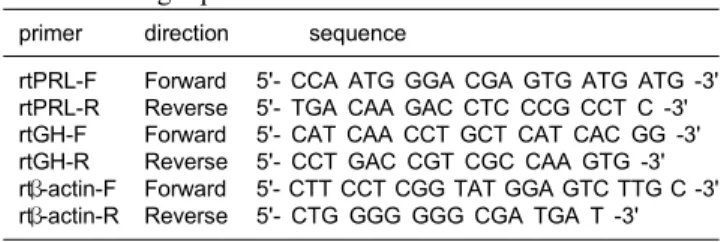
Real-time Polymerase Chain Reaction (real-time PCR) 해수순치에 따른 PRL과 GH 유전자 발현 분석은 Real-time PCR 방법으로 조사하였다. 사용된 oligo primers는 GenBank에 등록된 염기서열을 바탕으로 Primer Express v3.0 software (Applied Biosystems, Boston, MA, USA)를 이용하여 제작하였 다 (Table 1). 뇌하수체 cDNA (0.5μg)를 주형으로 oligo primers (10μM) 2x SYBR primix Ex-Taq, 50x ROX Referance Dye II, oligo primer (10μM)와 함께 총량 20μL로 real-time PCR (Applied Biosystems 7500)을 수행하였다. PCR 조건은 50℃에 서 2분, 95℃에서 10분 반응 후, two-step PCR 방법으로 95℃에 서 15초, 60℃에서 1분으로 총 40 cycles을 수행하였다.
Table 1. Oligo primers used in the Real-Time PCR
primer direction sequence rtPRL-F
rtPRL-R rtGH-F rtGH-R rtβ-actin-F rtβ-actin-R
Forward Reverse Forward Reverse Forward Reverse
5'- CCA ATG GGA CGA GTG ATG ATG -3' 5'- TGA CAA GAC CTC CCG CCT C -3' 5'- CAT CAA CCT GCT CAT CAC GG -3' 5'- CCT GAC CGT CGC CAA GTG -3' 5'- CTT CCT CGG TAT GGA GTC TTG C -3' 5'- CTG GGG GGG CGA TGA T -3'
통계처리
각각의 실험결과로부터 얻어진 자료 값 사이의 유의성 검정 은 SPSS 통계 패키지 (V.17)를 이용하여 분산분석 후, Neuman-Keuls test와 t-test, χ2 test로 분석하였다 ( P <0.05).
결 과 폐사율
실험기간동안 실험어의 폐사율은 실험어의 무게와 해수순 치의 방법에 따라 차이를 보였다. 1차, 2차 실험군에서 FW (대조군; 0-5.8%)와 비교하여 SSW (20.2-39.7%)와 ASW (47.1-58.5%)은 높은 폐사율을 보였다. 특히, 급진적 해수순치 를 시도한 ASW그룹의 폐사율이 상대적으로 높았다 (P<0.05, χ2 test). 한편, 3차 실험군의 SSW그룹 (11.8%) 및 ASW그룹 (17.6%)의 폐사율은 1차, 2차 실험군과 비교하여 감소된 경향 을 보였다 (P<0.05, χ2 test) (Table 2).
뇌하수체 PRL mRNA 발현 변화
1차 실험군에서 30일 동안 지속된 담수사육의 결과, 뇌하수
Table 2. The mortalities of three experimental groups during 30 days (%)
FW SSW ASW p
1st experiment 2nd experiment 3rd experiment p
0 5.8
0 0.023*
20.2 39.7 11.8 0.003*
58.5 47.1 17.6
<0.001*
<0.001*
<0.001*
0.045*
Note. FW, control group in freshwater; SSW, slow- acclimation in seawater; ASW, acute-acclimation in seawater ( P <0.05). *, χ2 test.
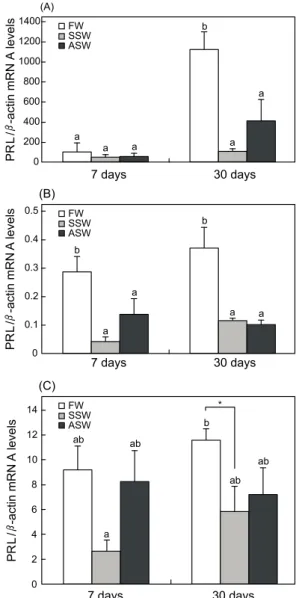
체 PRL mRNA의 발현이 높은 수준으로 증가되는 경향을 보 였으며, 이와 대조적으로 SSW, ASW 처리는 상대적으로 낮은 발현 수준을 보였으며, 해수순치 7일 후와 30일 후 간의 유의 적인 차이를 나타내지 않았다 (P<0.05) (Fig. 1A). 2차 실험군 의 경우, 해수순치 7일 후 SSW, ASW 그룹의 PRL mRNA 발현 수준은 FW 그룹과 비교하여 유의적으로 낮은 발현 수준 을 보였으며, 이와 같은 경향은 해수순치 30일 까지 지속되었 다 (P<0.05) (Fig. 1B). 3차 실험군의 경우 각 그룹간의 PRL mRNA 발현은 유의적인 차이가 관찰되지 않았으나, 해수순치 7일 및 30일 째 SSW 처리된 어체의 PRL 발현은 대조군에 비해 유의적으로 낮은 수준을 나타내었다 (P<0.05, t-test) (Fig. 1C).
뇌하수체 GH mRNA 발현 변화
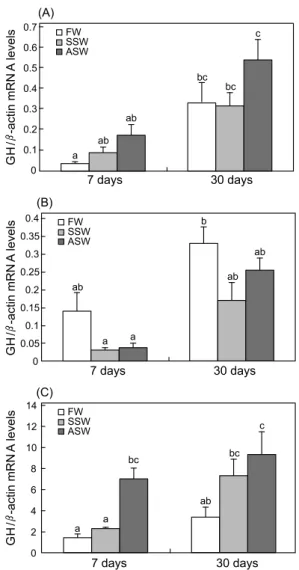
1차 실험군에서 해수순치 7일 후 ASW 처리군의 GH mRNA 발현이 증가하였으나 (P<0.05), 30일 후 해수순치에 의한 유 의적인 발현 차이는 관찰되지 않았다 (Fig. 2A). 2차 실험군은 FW, SSW, ASW 그룹 사이에 GH mRNA의 유의적인 차이는 관찰되지 않았다 (Fig. 2B). 한편, 3차 실험군의 경우, 해수순치 7일 및 30일 째의 ASW에서 GH mRNA의 발현이 유의적으로 증가하는 경향을 보였다 (P<0.05) (Fig. 2C).
성장율
해수순치 7일 후 FW, SSW, ASW 그룹의 실험어 평균체중 과 비교하여 해수순치 30일 후의 평균체중변화를 조사하였다.
1차 실험군의 ASW 그룹은 해수순치 30일 째 약 2.5배 증가된 성장률을 보였으며, 이는 FW 그룹 (약 1.5배) 와 비교하여 유의적으로 증가된 성장률을 나타내었다 (P<0.05) (Fig. 3A).
2차 및 3차 실험군의 경우, 해수순치로 인하여 성장이 증가하 는 경향을 보였으나, FW와 비교하여 SSW, ASW 처리 그룹 사이에 유의적인 차이는 관찰되지 않았다 (Fig. 3B, 3C).
고 찰
송어류의 체내 염분농도는 해수의 약 1/3 미만으로 유지되 는데, 이는 담수에서는 아가미나 체표를 통해 유입된 환경수 를 신장에서 뇨로 배설시키고, 해수에서는 체내에 과잉 축적 된 염분을 아가미의 염류세포를 통하여 체외로 방출시킴으로 서 체내 항상성이 유지될 수 있기 때문이다. 이와 같은 생리적 인 조절이 가능한 무지개송어는 연어․송어류의 급증하는 수요
Fig. 1. Expression levels of prolactin (PRL) mRNA in the pituitary of rainbow trout that were exposed to SSW and ASW at 7 or 30 days after transfer. The relative PRL mRNA levels were nomalized by β-actin values. Data were represented by the mean± S.E.M of six independent samples ( P< 0.05). *, t-test; (A) 1st experiment; (B) 2nd experiment;
(C) 3rd experiment.
량을 충족시키기 위한 적절한 방법으로 제시되는 해수사육이 가능한 어종이다 (Chen and Lin, 1994). 무지개송어의 해수사 육에 대한 연구가 일부 실행되고 있으나, 사육어의 폐사문제 로 인하여 실용화되지 못하는 상황에 당면하고 있다. 이러한 문제는 어류의 염분내성과 밀접한 관련이 있으며, 특히 연어 과 어류는 어체의 크기가 큰 개체일수록 염분내성이 높은 것으로 알려져 있다 (Parry, 1958; Houston, 1961; Heifetz et al., 1989; Dempson, 1993). 본 연구에서도 개체무게별 (1차, 2차, 3차 실험군)로 해수순치에 따른 무지개송어의 폐사율을 조사한 결과, 해수순치 시 전반적으로 어체중이 낮은 어류가 높은 폐사율을 나타내었으며, 특히 급진적 해수순치에 따른
Fig. 2. Expression levels of growth hormone (GH) mRNA in the pituitary of rainbow trout that were exposed to SSW and ASW at 7 or 30 days after transfer. The relative GH mRNA levels were nomalized by β-actin values. Data were represented by the mean ± S.E.M of six independent samples ( P <0.05). (A) 1st experiment; (B) 2nd experiment; (C) 3rd experiment.
폐사율이 현저히 높은 것을 확인할 수 있었다 (Table 2). 이는 해수사육에 대한 염분내성이 어체의 중량과 밀접한 상관관계 를 가지며, 더불어 점진적인 염분변화의 환경조건이 어류 폐 사율의 감소에 효과가 있음을 확인할 수 있었다. 하지만 모든 어종의 크기 및 무게가 염분내성과 절대적인 연관성을 갖는 것은 아니다. 홍연어 (O. nerka)의 염분내성은 어체의 크기에 의한 영향이 없는 것으로 보고된 바 있다 (Kaeriyama et al., 1987). 또한, 무지개송어 치어의 염분내성은 성장 외에도 집단 간의 유전적 요인이 관여하고, 이에 따른 염분내성이 강한 우량형질의 확보 가능성을 제안한 바 있다 (Choe and Yeo, 2002).
어류는 환경수의 염분변화에 적응하기 위하여 체내 항상성 유지 측면에서 삼투압 조절기구 (아가미, 장 및 신장) (Jarvis
Fig. 3. Rates of increased body weight of rainbow trout that were exposed to SSW or ASW during 30 days after transfer.
Data were represented by the mean ± S.E.M. of six independent samples ( P< 0.05). (A) 1st experiment; (B) 2nd experiment; (C) 3rd experiment.
and Ballantyne, 2003; Morgan and Iwama, 1991; Maina, 1990;
Shin and Sohn, 2008)를 가지고 있으며, 이는 삼투압 조절 호르 몬인 PRL과 GH의 작용에 의해 이루어진다고 알려져 있다.
경골어류의 PRL은 뇌하수체로부터 생산․분비되며, 낮은 삼투 압 환경에 적응 시 분비가 촉진된다. 광염성 어류 틸라피아 (O. mossambicus)는 아미노기의 아미노산 수가 다른 두 가지의 PRL (PRL177과 PRL188)을 생산하며, 담수순치에 의한 혈중 및 뇌하수체 내 두 PRL의 발현은 유사한 패턴으로 증가한다 (Yamaguchi et al., 1988). 상대적으로 낮은 광염성을 지닌 틸라 피아 (O. niloticus)의 두 PRL은 발현수준의 차이는 있으나, 공통적으로 담수순치에 의해 높은 발현패턴을 나타내며, 특히 PRL177의 발현이 현저하게 증가하는 경향을 나타낸다 (Ayson et al., 1993). 이와 반대로 고염분의 환경수 사육에 따른 틸라피아의 혈장 PRL 농도는 감소된다는 보고가 있다 (Auperin et al., 1994). PRL은 어류의 담수적응에 관여하는
중요한 삼투조절 호르몬으로 작용하지만 모든 어종이 그러한 것은 아니다. 회유성 어류 뱀장어 (Anguilla japonica), 연어과 어류 산천어 (O. masou)와 담수어 붕어 (Carassius auratus)의 PRL 발현은 다른 경향을 보인다. 뱀장어, 산천어의 뇌하수체 내 PRL mRNA 발현은 해수순치에 의해 감소되는 패턴을 보이 나, 붕어의 그것은 50% 염도의 기수조건에서 유의적인 차이를 나타내지 않으며 해수사육을 유도할 경우, 전 개체가 모두 폐사한다는 보고가 있다 (Park et al., 2008). 본 연구에서는 무지개송어를 통하여 해수순치에 의한 담수적응호르몬 PRL 발현이 유의적으로 변화되는 것을 관찰하였다. 삼투조절을 위한 PRL 발현은 개체의 중량의 차이 그리고 해수순치 방법에 따라 상이한 발현 경향을 나타냈다. 상대적으로 높은 어체중 의 실험군 (2차, 3차 실험군)에서 PRL은 담수적응에 따라 신속 한 유전자 발현 증가 반응을 보였으나, 낮은 어체중의 실험군 (1차 실험군)은 담수사육 30일 후에 비로소 증가된 PRL의 발현을 나타내었다. 또한 급진적 해수순치에 따른 PRL의 발현 은 고체중의 개체군 (3차 실험군)에서 담수에 비해 유의적인 발현 차이를 나타내지 않았다 (Fig. 1). 이러한 세 실험군 간의 PRL 발현 차이는 개체의 중량에 따른 삼투조절의 차이라 사료 된다. 실제로 150 g 전후의 연어과 어류는 은화 (smoltification) 가 진행됨으로서 환경수의 염분에 대한 높은 감수성이 보이 며, 어류의 중량 및 연령에 따라 삼투조절반응은 변화 될 수 있다 (Boeuf, 1993).
경골어류의 GH는 어류의 삼투조절과 더불어 성장, 대사, 생식 그리고 발생 등의 다양한 생리작용에 관여한다 (Bern and Madsen, 1992; Donaldson et al., 1979; McLean and Donaldson, 1993; Shepherd et al., 1997). GH의 조절인자인 IGF-I 또한 어류의 해수 적응을 돕는 작용을 하며 이는 무지개 송어 (McCormick et al., 1991)와 틸라피아 (O. mossambicus) (Fruchtman et al., 2000) 그리고 바다송사리 (F. heteroclitus) (Mancera and McCormick, 1998)에서 보고된 바 있다. 광염성 틸라피아 중에서 상대적으로 낮은 광염성을 지닌 어종 (O.
niloticus)의 경우 고염도의 환경수에 대한 GH의 삼투압 조절 영향이 나타나지 않고, 높은 광염성을 지닌 틸라피아 (O.
mossambicus)는 뇌하수체 내 GH의 수준과 세포활성이 현저 히 높아지게 되는데, 이를 근거로 Auperin et al. (1995)은 GH의 해수적응 효과는 광염성을 지닌 어류에서 제한적으로 나타난 다고 제안하였다. 본 연구에서는 상대적으로 고체중의 3차 실험군에서 해수순치로 인한 뇌하수체 GH mRNA 발현이 증 가되는 경향을 확인하였다. 특히 급진적으로 해수에 적응시 킨 그룹은 담수 대조군과 비교하여 유의적으로 증가된 GH mRNA 발현 패턴이 관찰되었다. 한편, 1차 및 2차 실험군은 해수순치에 의한 GH mRNA의 발현 변화에 유의적인 차이를 보이지 않았다 (Fig. 2). 그러므로 어종과 개체의 중량에 따라 해수 적응에 대한 GH의 분비 반응은 다른 경향을 보이는 것으로 사료된다. 광염성 해산어인 도미 (S. auratus)와 넙치 (Paralichthys olivaceus)의 경우 해수순치에 대한 GH 발현 패 턴이 이질적인 경향을 보이기도 한다. 도미는 해수 (38 ppt)에 서 PRL mRNA의 발현이 감소하고, GH mRNA의 발현은 증가
하는 패턴을 보인다 (Laiz-Carrion et al., 2009). 하지만 넙치의 경우, 해수에 대한 PRL는 낮은 수준으로 발현되어지나 GH의 발현 변화는 유의적인 차이를 보이지 않으므로서 종에 따라 GH의 삼투조절반응에 대한 차이가 있다고 할 수 있다 (Cho et al., 2006). 본 연구에서 전반적으로 급진적 해수순치로 인한 GH mRNA의 발현이 증가하는 경향을 나타내는데, 이는 체내 항상성 유지를 위한 삼투조절반응이기도 하지만, 높은 환경 수의 염분에 대한 스트레스와도 상관관계가 있을 수 있다.
높은 GH의 발현은 환경변화 유래의 스트레스로 인한 에너지 대사와 간접적으로 연관성이 있다 (Pickering et al., 1991;
Wendelaar Bonga, 1997). 또한, 은화과정에 따른 세 실험군 간의 삼투반응에 대한 감수성의 차이와도 관계될 수 있다.
특히 연어는 은화과정 중 코르티졸과 GH의 분비가 급격히 증가하며, 이는 아가미 염류세포의 수와 활성을 증대시켜 체 내 흡수된 과잉의 염분을 능동적으로 배출시키는 효과를 나 타낸다 (Bjornsson et al., 2010). 이러한 삼투반응에 따른 GH의 감수성은 상대적으로 고체중의 무지개송어에서 민감하게 나 타난다고 사료된다.
현재까지 다양한 어종의 해면사육이 시도된 바 있다. 담수 어 잉어 (C. carpio), 초어 (Ctenopharyngodon idella), 러시아 철갑상어 (Acipenser gueldenstaedtii)를 기수 (2 ppt)에서 사육 할 시, 개체의 섭이율과 성장률이 현저히 증가되는 경향을 보였으며 (Konstantinow and Martynova, 1993), 광염성 차노스 (Chanos chanos)의 경우에도 고염분 (55 ppt)에서 사육하면 성장률이 급격히 증가하는 경향을 나타낸다는 보고가 있다 (Swanson, 1998). 한편, 본 연구에서는 1차 실험군에서 해수순 치에 의해 무지개송어의 성장이 증가되는 것을 확인할 수 있었지만, 상대적으로 고체중의 2차, 3차 실험군 성장률은 유의적인 차이가 없었다. (Fig. 3A). 따라서, 고염분 또는 GH의 발현이 어류의 성장률을 증가시키는데 전적으로 관여되지는 않는다고 사료된다. 광염성 숭어 (Mugil cephalus) (1.3 g 혹은 20 g 개체)의 경우, 기수사육 (25% SW)을 유도할 시 담수 혹은 해수에 비해 빠른 성장을 보였으며 (Chang and Hur, 1999), 감성돔 (A. schlegeli)은 해수 혹은 담수조건에서 모두 성장이 유의적으로 증가한다는 보고가 있다 (Min et al., 2005).
또한, 틸라피아 (O. niloticus)의 해수사육을 통하여 환경수의 염분이 높아질수록 개체의 산소소비가 급증하고, 이는 삼투조 절에 필요한 에너지 생성에 산소가 다량 사용되기 때문으로 알려져 있다 (Farmer and Beamish, 1969). 따라서, 해수사육으 로 인한 세 실험군 간의 성장률의 차이는 개체 중량에 따른 삼투조절과 에너지 대사간의 차이점에 유래할 것으로 추정되 지만, 추가적인 연구가 필요할 것으로 사료된다.
이상의 결과를 정리하면 본 연구는 무지개송어의 해수순치 시, 뇌하수체 내 PRL은 감소하고 GH은 증가하는 경향을 확인 하였으며, 두 호르몬의 이질적인 발현 패턴이 무지개송어의 해수적응을 위한 효과적인 삼투조절에 기여된다는 것을 시사 하고 있다. PRL은 모든 그룹에서 해수에 대한 낮은 발현 패턴 을 보이나, GH는 상대적으로 높은 중량의 개체에서 해수에 의해 유의적으로 높게 발현되는 것을 확인하였다. 하지만 이
러한 삼투조절호르몬의 발현 양상이 실험어의 최종 성장률과 는 밀접한 연관성을 나타내지 않았으나, 개체 중량이 높을수 록 혹은 점진적으로 해수를 첨가하여 순치 시킬수록 폐사율이 감소되는 효과를 얻었다. 이러한 연구 결과는 무지개송어의 해면 사육 시 요구되는 개체의 선택과 순치 조건을 결정하는 데 중요한 연구 자료가 될 것이며, 향후 산업화에 적용할 수 있고 생산성 향상에 기여될 것이라 사료된다.
사 사
본 연구는 국토해양부의 재원으로 한국해양과학기술진흥 원의 지원을 받아 수행된 해양환경기술개발사업 (20088033-1) 과 국립수산과학원 내수면양식기술개발사업 (RP-2010-AQ- 070)의 지원에 의하여 수행되었으며, 실험어 관리에 도움을 준 냉수성어류연구센터 김경식님에게 사의를 표합니다.
참고문헌
Auperin B, Rentier-Delrue F, Martial JA and Prunet P.
1994. Evidence that two tilapia (Oreochromis niloticus) prolactins have different osmoregulatory functions during adaptation to a hyperosmotic environment. J Mol Endocrinol 12, 13-24.
Auperin B, Leguen I, Rentier-Delrue F, Smal J and Prunet P. 1995. Absence of a tiGH effect on adaptability to brackish water in tilapia (Oreochromis niloticus).
Gen Comp Endocrinol 97, 145-159.
Ayson FG, Kaneko T, Tagawa M, Hasegawa S, Grau EG, Nishioka RS, David SK, Bern HA and Hirano T. 1993. Effects of acclimation to hypertonic environment on plasma and pituitary levels of two prolactins and growth hormone in two species of tilapia, Oreochromis mossambicus and Oreochromis niloticus. Gen Comp Endocrinol 89, 138-148.
Baik KK, Choi YH, Lee JC, Park IS, Kim YK, Kim DY, Lee CS. 2007. Studies on seed production of rainbow trout, Oncorhynchus mykiss-hatching rate and early stage performance of USA strain rainbow trout, Oncorhynchus mykiss. J Aquaculture 20, 85-89.
Bern HA and Madsen SS. 1992. A selective survey of the endocrine systerm of the rainbow trout (Oncorhynchus mykiss) with emphasis on the hormonal regulation of ion balance. Aquaculture 100, 237-262.
Bjornsson BT, Stefansson SO and McCormick SD. 2010.
Environmental endocrinology of salmon smoltifica- tion. Gen Comp Endocrinol in press.
Boeuf G, Marc AM, Le Bail PY, Prunet P and Smal J.
1994. Stimulation of parr-smolt transformation by hormonal treatment in Atlantic salmon (Salmo salar
L.). Aquaculture 121, 195-208.
Chang YJ, Lee YC and Lee BK. 1996. Comparison of growth and survival rates of juvenile grey mullets (Mugil cephalus) in different salinities. J Aquaculture 9, 311-320.
Chen JC, Lin JL. 1994. Osmolality and chloride concentration in the hemolymph of subadult Penaeus chinensis subjected to different salinity levels.
Aquaculture 125, 167-174.
Cho YM, Shin J and Sohn YC. 2006. Gene expression levels of growth hormone, prolactin and their receptors of olive flounder Paralichthys olivaceus by salinity changes. J Kor Fish Soc 39, 326-332.
Choe MK and Yeo IK. 2002. Studies on the salinity tolerance of juvenile rainbow trout, Oncorhynchus mykiss. Korean J Ichthyol 14, 205-211.
Dempson JB. 1993. Salinity tolerance of freshwater acclimated, small-sized arctic charr, Salvelinus alpinus from northern labrador. J Fish Biol 43, 451-462.
Donaldson EM, Fagerlund UHM, Higgs DA and McBride JR. 1979. Hormonal enhancement of growth in fish.
In: Hoar, W.S., Randall, D.J., Brett, J.R. (Eds.), Fish Physiology: Bioenergetics and Growth, vol. 8.
Academic Press, New York, U.S.A., 456-597.
Farmer GJ and Beamish FWH. 1969. Oxygen consumption of Tilapia nilotica in relation to swimming speed and salinity. J Fish Res Bd Canada 26, 2807-2821.
Fruchtman S, Jackson L and Borski R. 2000. Insulin-like growth factor I disparately regulates prolactin and growth hormone synthesis and secretion: studies using the teleost pituitary model. Endocrinology 141, 2886-2894.
Heifetz J, Johnson SW, Koski KV and Murphy ML. 1989.
Migration timing, size, and salinity tolerance of sea-type sockeye salmon (Oncorhynchus nerka) in an Alaska estuary. Can J Fish Aqua Sci 46, 633-637.
Houston AH. 1961. Influence of size upon the adaptation of steelhead trout (Salmo gairdneri) and chum salmon (Oncorhynchus keta) to sea water. J Fish Res Board Can 18, 401-415.
Jarvis PL and Ballantyne JS. 2003. Metabolic responses to salinity acclimation in juvenile shortnose sturgeon Acipenser brevirostrum. Aquaculture 219, 891-909.
Kaeriyama M, Shimizu I and Kakizaki H. 1987. Seasonal changes in seawater adaptation of sockeye salmon reared in the freshwater. Sci Rep Hokkaido Salm Hatch 41, 129-135.
Kawauchi H and Sower SA. 2006. The dawn and evolution
of hormones in the adenohypophysis. Gen Comp Endocrinol 148, 3-14.
Laiz-Carrion R, Fuentes J, Redruello B, Guzman JM, Martin del Rio MP, Power D and Mancera JM. 2009.
Expression of pituitary prolactin, growth hormone and somatolactin is modified in response to different stressors (salinity, crowding and food-deprivation) in gilthead sea bream Sparus auratus. Gen Comp Endocrinol 162, 293-300.
Madsen SS and Bern HA. 1992. Antagonism of prolactin and growth hormone: impact on seawater adaptation in two salmonids, Salmo trutta and Oncorhynchus mykiss Zool Sci 9, 775-784.
Maina JN. 1990. A study of the morphology of the gills of an extreme alkalinity and hyperosmotic adapted teleost Oreochromis alcalicus grahami (Boulenger) with particular emphasis on the ultrastructure of the chloride cells and their modifications with water dilution. A SEM and TEM study. Anat Embryol 181, 83-98.
Mancera JM and McCormick SD. 1998. Evidence for growth hormone/insulin-like growth factor I axis regulation of seawater acclimation in the euryhaline teleost Fundulus heteroclitus. Gen Comp Endocrinol 111, 103-112.
Manzon LA. 2002. The role of prolactin in fish osmoregulation: a review. Gen Comp Endocrinol 125, 291-310.
McCormick SD, Sakamoto T, Hasegawa S and Hirano T. 1991. Osmoregulatory actions of insulin-like growth factor-I in rainbow trout (Oncorhynchus mykiss). J Endocrinol 130, 87-92.
McLean E and Donaldson EM. 1993. The role of growth hormone in the growth of poikilotherms. In: The Endocrinology of Growth, Development, and Metabolism in Vertebrates. Schreibman MP, Scanes CG and Pang PKT, eds. Academic Press, New York, U.S.A., 43-71.
Min BH, Choi CY and Chang YJ. 2005. Comparison of physiological conditions on black porgy, Acantho- pagrus schlegeli acclimated and reared in freshwater and seawater. J Aquaculture 18, 37-44.
Morgan JD and Iwama GK. 1991. Effects of salinity on growth, metabolism, and ion regulation in juvenile rainbow trout and steelhead trout (Oncorhynchus mykiss) and fall chinook salmon (Oncorhynchus tshawytscha). Can J Fish Aquat Sci 48, 2083- 2094.
Park WD, Lee CH, Kim DJ and Sohn YC. 2008. Changes in prolactin and growth hormone gene expression in
three freshwater teleosts with rapid changes in salinity.
J Kor Fish Soc 41, 1-6.
Parry G. 1958. Size and osmoregulation in fishes. Nature 181, 1218-1219.
Partridge GJ and Jenkins GJ. 2002. The effect of salinity on growth and survival of juvenile black bream (Acanthopagrus butcheri). Aquaculture 210, 219-230.
Pickering AD, Pottinger TG, Sumpter JP, Carragher JF and Le Bail PY. 1991. Effect of acute and chronic stress on the levels of circulating growth hormone in the rainbow trout, Oncorhynchus mykiss. Gen Comp Endocrinol 83, 86-93.
Seale AP, Riley LG, Leedom TA, Kajimura S, Dores RM, Hirano T and Gordon Grau E. 2002. Effects of environmental osmolality on release of prolactin, growth hormone and ACTH from the tilapia pituitary.
Gen Comp Endocrinol 128, 91-101.
Shepherd BS, Ron B, Burch A, Sparks R, Richman NHI, Shimoda SK, Stetson MH, Lim C and Grau EG. 1997.
Effects of salinity, dietary level of protein and 17 alpha-methyltestosterone on growth hormone (GH) and prolactin (tPRL177 and tPRL188) levels in the tilapia, Oreochromis mossambicus. Fish Physiol Biochem 17, 279-288.
Shin J and Sohn YC. 2008. Molecular cloning of stanniocalcin 1 and its extracorpuscular regulation by salinity and Ca2+ in the Japanese flounder. Zoolog Sci 25, 728-738.
Tomy S, Chang YM, Chen YH, Cao JC, Wang TP and Chang CF. 2009. Salinity effects on the expression of osmoregulatory genes in the euryhaline black porgy Acanthopagrus schlegeli. Gen Comp Endocrinol 161, 123-132.
Tsuzuki MY, Ogawa K, Strussmann CA, Maita M and Takashima F. 2001. Physiological responses during stress and subsequent recovery at different salinities in adult pejerrey Odontesthes bonariensis. Aqua- culture 200, 349-362.
Wendelaar Bonga SE. 1997. The stress response in fish.
Physiol Rev 77, 591-625.
Yamaguchi K, Specker JL, King DS, Yokoo Y, Nishioka RS, Hirano T and Bern HA. 1988. Complete amino acid sequences of a pair of fish (tilapia) prolactins, tPRL177 and tPRL188. J Biol Chem 263, 9113-9121.
2010년 11월 23일 접수 2011년 4월 26일 수정 2011년 6월 10일 수리