Kor J Fish Aquat Sci 42(6), 721-724 한수지, 42(6), 721-724, 2009
<단보>
721 Corresponding author: [email protected]✽
CLA
와 멍게 껍질 추출물 급이에 따른 무지개송어 색소조성강석중・최병대1✽
경상대학교 해양생명과학과, 1해양식품공학과/해양산업연구소
Composition in Carotenoids of Rainbow Trout Fed with CLA and Ascidian Tunic Extracts
Seok-Joong Kang and Byeong-Dae Choi
1✽Dept. of Life Science and
1Dept. of Seafood Science and Technology/Institute of Marine Industry, Gyeongsang National University, Tongyeong 650-160, Korea
Astaxanthin is a valuable pigment source for many aquacultured species, including salmonoids, shrimp, sea bream, and ornamental species. Conjugated linoleic acid (CLA) and ascidian tunic extracts were mixed with the basal diet of rainbow trout to investigate their pigmentation effects. Synthetic Carophyll Pink and natural carotenoids that came from the tunic extracts were incorporated into muscle and skin tissues.
The main carotenoids found in muscle after 8 weeks were canthaxanthin in CP12 (13.4%), and CP52 (17.2%), and astaxanthin in CP12 (58.5%), and CP52 (59.2%) in the Carophyll Pink group, while those in skin were canthaxanthin in CP14 (34.5%), and CP54 (29.2%), and astaxanthin in CP14 (32.0%), and CP54 (36.5%) in the ascidian tunic extract group. The total carotenoid content in skin (53.0-69.3 mg/kg) was greater than that in muscle (9.5-13.8 mg/kg).
Key words: Rainbow trout, Astaxanthin, Canthaxanthin, Muscle color, Skin color
서 론
카로테노이드는 다양한 화학적 구조와 기능성을 가지고 있고, 동ㆍ식물세포 뿐만 아니라 미생물에도 존재하는 등으로 자연계에 널리 분포되어 있으며, 현재 분리, 동정된 종류만도 700여종에 달하는 중요한 천연색소 중의 하나이다. 양식 연어 나 무지개송어의 사료에 카로테노이드 색소의 공급이 원활하 지 못하면 육색을 발현하지 못하여 상품의 가치를 저하시키는 원인이 됨으로 인하여 자연히 소비자의 요구에 맞는 천연색소 의 탐색은 양식산업에서 매우 중요하다 (Harmon, 2006). 사람 이 균형 있는 건강상태를 유지하려면 유리 라디칼의 생성을 억제하고 항산화성분이 많은 식품을 섭취하여야 한다. 특히 스트레스를 유발하는 행동은 활성산소 및 산화질소의 생성을 증가시켜 생체균형을 기울게 한다. Astaxanthin은 일중항산소 의 포촉 효과, 유리 라디칼의 생성 억제효과, 과산화물질의 연쇄반응을 억제하는 물질로 알려져 있어, 연어 및 무지개송 어를 섭취하는 경우 이를 방어하는 효과를 얻을 수 있어 좋은 식품급원이 될 수 있다 (Jorgensen and Skibsted, 1993; Miki, 1991).
무지개송어와 같은 지방의 함량이 높은 어종은 오메가-3 지방산의 좋은 공급원이 되며, 영양학적인 측면에서도 오메가-3 지방산의 중요성에 대하여 잘 알려져 있다 (Shekelle and Stamler, 1993). 오메가-3 지방산을 많이 섭취하면 심장혈관질 환과 알츠하이머와 같은 신경변성질환의 예방에 효과적이라
는 연구결과도 보고되어 있다 (Shahidi and Miraliakkbari, 2004). 그러나 이들 고도불포화지방산의 함량이 높은 재료는 산화 발생이 용이하여 식품으로 활용하는 경우 보관 및 처리 에 주의를 기울여야한다 (Baron et al., 2009).
전 세계적으로 비만 인구가 급증하고 있고, 건강식품에 대 한 소비자들의 관심이 높아지면서 수산식품은 웰빙 식품으로 서의 가치가 매우 높다 (Sloan, 2006). 비만을 질병으로 규정한 후 각국에서는 이를 예방하기 위하여 많은 노력을 기울이고 있으며, 이를 예방하기 위한 새로운 식품성분에 대한 연구가 활발히 진행되고 있다. CLA의 다양한 기능성 중 체지방감소 기능을 이용한 제품이 개발되어 1998년 이후 전 세계에서 80여 가지의 제품이 출시되었다. 우리나라에서도 CLA가 체지 방감소에 도움을 준다는 연구결과를 바탕으로 2006년 식품의 약품안전청으로부터 건강기능식품 개별인정형 원료로 허가 되어 2008년 약 500억 원 판매가 이루어지기도 하였다 (NutraDex, 2009).
Guo et al. (2008)은 무지개송어에 CLA와 카로테노이드 색 소를 동시에 공급하였을 때 어류의 성장과 CLA의 축적량에 대하여 연구한 결과 1.0%의 첨가량에서는 어류체중의 감소 없이 정상적인 성장이 이루어진다고 하였다. 또한 판매용으로 양식한 무지개송어 사료에 CLA를 1% 첨가하였을 때 12주 뒤 2.1%의 CLA가 축적되었다고 하였다 (Valente et al., 2007).
따라서 본 연구에서는 멍게 껍질 카로테이드 추출물과 CLA를 동시에 급이하였을 때 무지개송어 육색발현에 어떠한 영향을 미치는지에 대하여 살펴보고자 하였다.
722 강석중・최병대 112
재료 및 방법
재료
무지개송어는 2007년 3월에 충북 영동군 소재 송천 양어장 으로부터 구입하여 시판사료로 2주간 예비 사육한 평균체중 약 200±10 g의 것을 사용하였다. 사료 제조에 사용한 CLA는 (주) HK 바이오텍 (Jinju, Korea)에서, 백색어분은 천제일사 료 (Daejeon, Korea)에서, 어유는 코리아상사 (Busan, Korea)에 서 어류용 피드오일을 구입하여 사용하였다. 색소추출물은 우렁쉥이 껍질로부터 Choi et al. (1994)의 방법을 활용하여 추출하였고, Carophyll pink (10%)는 수입시판용 (Vixxol Co., Anyang, Korea)을 구입하였다.
사육실험
사육실험은 경상대학교 해양생명과학과 어류양식 실험실 에서 8주간 각 실험구 마다 20마리씩 수용하여 duplicate로 행하였으며, 사육장치는 유수식을 겸한 순환여과식 사육장치 로서 계속적인 보충수의 첨가에 의하여 어류의 배설물이 즉시 사육조 밖으로 유출될 수 있도록 하였다. 사육조는 1톤의 둥근 fiber glass를 사용하였고, 이 때 주수량은 60 L/min였으며, 용존산소량은 7 ppm 전후였고, 전 사육기간을 통하여 수온은 18.6~21.4℃ (평균 20.0℃)였다. 급이는 체중의 3%에 해당하는 양을 하루 2회, 주 6일 급이하였다.
사료제조
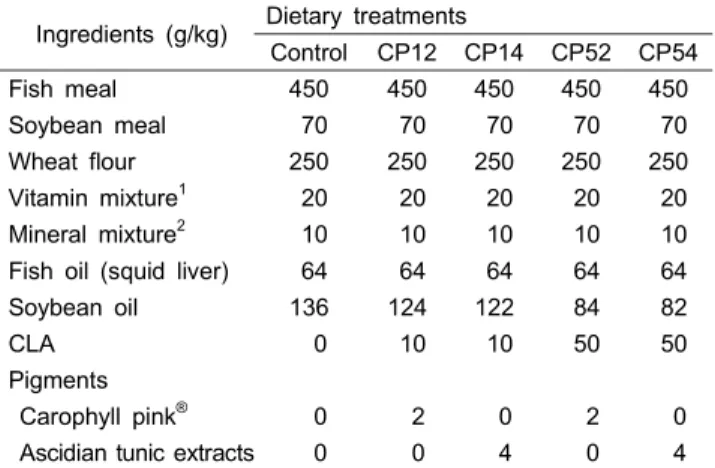
사료조성은 Table 1에 나타낸 바와 같이 어분, 대두박, 비타 민 및 미네랄 등을 혼합하여 제조하였다. 제조한 실험사료는 Table 1. Ingredients of the experimental diets
Ingredients (g/kg) Dietary treatments
Control CP12 CP14 CP52 CP54
Fish meal 450 450 450 450 450
Soybean meal 70 70 70 70 70
Wheat flour 250 250 250 250 250
Vitamin mixture1 20 20 20 20 20
Mineral mixture2 10 10 10 10 10
Fish oil (squid liver) 64 64 64 64 64
Soybean oil 136 124 122 84 82
CLA 0 10 10 50 50
Pigments
Carophyll pink® 0 2 0 2 0 Ascidian tunic extracts 0 0 4 0 4
1Vitamin mixture (mg/ kg diet or IU): thiamin, 50 mg;
riboflavin, 60 mg; calcium pantothenate, 200 mg; biotin 1 mg; folic acid 20 mg; pyridoxine, 40 mg; cyanocobalamin, 0.05 mg; niacin, 250 mg; ascorbic acid, 1000 mg; inositol, 400 mg; retinyl acetate, 8000 IU; DL-cholecalciferol, 2400 IU; DL-alpha tocopherol acetate 300 IU; sodium menadione bisulphate, 5 mg.
2Mineral mixture (mg/kg): calcium carbonate, 850 mg;
magnessium oxide, 750 mg; copper sulphate, 25 mg;
manganese sulphate, 100 mg; ferric citrate, 150 mg; zinc sulphate, 120 mg.
소량 단위로 비닐 포장한 다음 질소 충진하여 -20℃의 냉동고 (GC-124AGF, LG Electronics, Seoul, Korea)에 보관하면서 실 험에 사용하였다.
총 카로테노이드의 추출 및 정량
사육된 무지개송어는 육 및 껍질로 분리한 다음 껍질은 바로 acetone에 침지하였고, 육은 acetone 일정량을 가하여 Ultra-Turrax (IKA T25, GMBH Co., Staufen, Germany)로 잘 마쇄하여 실온 암소에 하룻밤 방치한 다음 색소 성분을 추출, 여과하였다. 이 조작을 3회 반복하여 시료로부터 색소를 충분 히 용출시켰다. 여과된 acetone 추출물을 회전진공증발 농축 기로 40℃ 이하에서 농축하여 100 mL로 정용하였다. 총 카로 테노이드 함량은 acetone을 용매로 가시부 흡광도 460 nm에서 McBeth (1972)의 방법에 따라 UV-spectrophotometer (Shimadzu UV-1700, Shimadzu Co., Tokyo, Japan)로 측정하고 흡광계수는 E1%1cm=1,900으로 계산하였다.
카로테노이드의 분석 및 동정
육 및 표피 중의 카로테노이드는 Sumichiral OA-2000 (4.0
× 250 mm) 칼럼이 장착된 HPLC (LC-10AT, Shimadzu Co.
Ltd., Tokyo, Japan)로 분석하였고, 이 때 흡광도는 SPD-10A (Shimadzu Co. Ltd., Tokyo, Japan)를 이용하여 460 nm에서 측정하였다. 용매는 hexane:dichloromethane:ethanol (50:20:
0.5, v/v/v)을 사용하여 1.0 mL/min씩 용출시키면서 분석하였 다. 각 peak의 동정은 흡수극대치, HPLC retention time, 표품과 의 co-TLC, co-HPLC 등을 비교하여 동정하였다 (Jeong et al., 2000).
통계처리
결과의 통계처리는 One-way ANOVA test를 실시하여 분산 분석한 후 Turkey의 정직유의차검정을 JMP 통계프로그램 (SAS Institute Inc., Cary, NC, USA)으로 최소 유의차 검정 (P<0.05)을 실시하였다.
Table 2. Proximate compositions of experimental diets Dietary treatments
Control CP12 CP14 CP52 CP54
Moisture 6.9±0.5a 7.5±0.8a 7.6±0.7a 7.5±0.6a 7.6±0.9a Crude protein 50.6±2.0a 51.0±2.4a 50.7±1.3a 50.3±1.9a 51.5±1.2a Crude lipid 20.4±1.5a 20.5±1.2a 20.6±0.4a 20.5±1.1a 19.3±0.4a Ash 9.5±0.1a 9.6±0.1a 9.7±0.1a 9.5±0.2a 9.6±0.2a The values are mean±S.D. (n=3). Different superscript letters within rows represent significant differences between treatments (P<0.05).
결과 및 고찰
사료의 일반성분 함량
실험사료가 단백질이 52%, 지질이 20%, CLA가 1~5%, 카로 테노이드 색소가 0.2~0.4%되도록 각 첨가물의 조성을 조정하 여 제조한 다섯 개의 실험구 (Control, CP12, CP14, CP52 및
127 CLA와 멍게 껍질 추출물 급이에 따른 무지개송어 색소조성 723
CP54)의 일반성분 함량은 Table 2와 같다. 사료의 일반성분 함량은 수분의 경우 대조구가 6.93%, 카로테노이드 첨가구가 7.50~7.63%로 비슷하였고, 단백질의 경우 사료의 종류에 관계 없이 51% 전후였으며, 지질의 경우도 첨가량과 유사한 범위에 있었다. 회분의 경우 사료의 종류에 관계없이 9% 전후로 각 실험구별 유의차(P<0.05)가 인정되지 않았다.
카로테노이드 조성
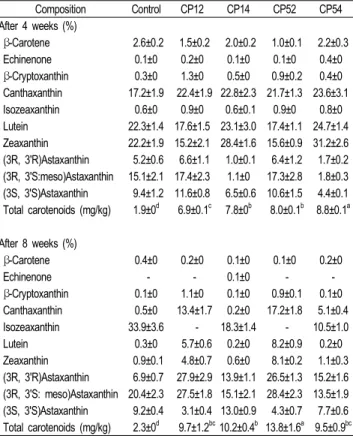
실험 시작 4주 및 8주 후 무지개송어 육에 함유된 카로테노 이드의 함량과 조성을 분석하여 Table 3, 4에 각각 나타내었다.
예비 사육한 무지개송어의 카로테노이드 함량은 육에서 0.5 mg/kg, 표피에서 4.9 mg/kg으로 표피가 육에 비하여 훨씬 높았 다 (자료는 나타내지 않았음). 4주간 색소가 포함되지 않은 사료를 섭취한 무지개 송어 (Control)의 카로테노이드 조성은 표피의 경우 대부분이 β-carotene (55.8%)으로 이루어져 근육 (Control)에 비하여 단순하였으나, 근육의 경우 canthaxanthin (17.2%), lutein (22.3%) 및 zeaxanthin (22.2%)으로 다양하게 구성되어 있었다. 멍게 껍질 추출물이 첨가된 실험구의 4주 후 근육 중 카로테노이드의 조성은 canthaxanthin의 경우 22.8% (CP14), 23.6% (CP54)로 증가하였으나, astaxanthin의
Table 3. Amount and percentage compositions of carotenoid in the muscle of rainbow trout after feeding diet for 4 and 8 weeks
Composition Control CP12 CP14 CP52 CP54
After 4 weeks (%)
β-Carotene 2.6±0.2 1.5±0.2 2.0±0.2 1.0±0.1 2.2±0.3
Echinenone 0.1±0 0.2±0 0.1±0 0.1±0 0.4±0
β-Cryptoxanthin 0.3±0 1.3±0 0.5±0 0.9±0.2 0.4±0 Canthaxanthin 17.2±1.9 22.4±1.9 22.8±2.3 21.7±1.3 23.6±3.1
Isozeaxanthin 0.6±0 0.9±0 0.6±0.1 0.9±0 0.8±0
Lutein 22.3±1.4 17.6±1.5 23.1±3.0 17.4±1.1 24.7±1.4 Zeaxanthin 22.2±1.9 15.2±2.1 28.4±1.6 15.6±0.9 31.2±2.6 (3R, 3'R)Astaxanthin 5.2±0.6 6.6±1.1 1.0±0.1 6.4±1.2 1.7±0.2 (3R, 3'S:meso)Astaxanthin 15.1±2.1 17.4±2.3 1.1±0 17.3±2.8 1.8±0.3 (3S, 3'S)Astaxanthin 9.4±1.2 11.6±0.8 6.5±0.6 10.6±1.5 4.4±0.1 Total carotenoids (mg/kg) 1.9±0d 6.9±0.1c 7.8±0b 8.0±0.1b 8.8±0.1a
After 8 weeks (%)
β-Carotene 0.4±0 0.2±0 0.1±0 0.1±0 0.2±0
Echinenone - - 0.1±0 - -
β-Cryptoxanthin 0.1±0 1.1±0 0.1±0 0.9±0.1 0.1±0 Canthaxanthin 0.5±0 13.4±1.7 0.2±0 17.2±1.8 5.1±0.4 Isozeaxanthin 33.9±3.6 - 18.3±1.4 - 10.5±1.0
Lutein 0.3±0 5.7±0.6 0.2±0 8.2±0.9 0.2±0
Zeaxanthin 0.9±0.1 4.8±0.7 0.6±0 8.1±0.2 1.1±0.3 (3R, 3'R)Astaxanthin 6.9±0.7 27.9±2.9 13.9±1.1 26.5±1.3 15.2±1.6 (3R, 3'S: meso)Astaxanthin 20.4±2.3 27.5±1.8 15.1±2.1 28.4±2.3 13.5±1.9 (3S, 3'S)Astaxanthin 9.2±0.4 3.1±0.4 13.0±0.9 4.3±0.7 7.7±0.6 Total carotenoids (mg/kg) 2.3±0d 9.7±1.2bc10.2±0.4b 13.8±1.6a 9.5±0.9bc The values are mean±S.D. (n=3). -: trace. Different superscript letters within rows represent significant differences between treatments (P<0.05). Sample codes (Control, CP12, CP14, CP52 and CP54) are shown in Table 1.
Table 4. Amount and percentage compositions of carotenoid in the skin of rainbow trout after feeding diet for 4 and 8 weeks
Composition Control CP12 CP14 CP52 CP54
After 4 weeks (%)
β-Carotene 55.8±3.5 76.1±3.0 51.7±4.0 65.9±3.8 62.6±1.4 Echinenone 2.7±0.7 3.8±0.8 2.3±0.1 4.5±0.7 4.3±2.2 Canthanxanthin 5.3±0.8 8.3±0.9 10.3±2.7 7.8±0.8 8.1±1.6
Lutein - - - - -
Zeaxanthin - - - - -
Total carotenoids (mg/kg) 13.2±2.3d 55.3±2.3a 40.3±1.6bc 53.7±2.1a 43.1±3.0b
After 8 weeks (%)
β-Carotene 7.8±0.7 17.6±1.2 24.5±2.4 19.6±1.6 28.4±3.6
Echinenone 0.9±0 1.1±0 2.5±0.4 2.4±0 3.3±0.2
α-Cryptoxanthin - - 0.5±0 - 0.3±0
Canthaxanthin 25.3±3.1 11.0±2.4 34.5±0.2 15.7±0.7 29.2±1.1
Lutein - 3.1±0.8 0.8±0 2.3±0.2 0.4±0
Zeaxanthin - 30.4±3.3 0.5±0 35.7±2.6 0.6±0
Salmoxanthin - 2.6±0.3 - 3.1±0.3 -
(3R, 3'R)Astaxanthin 7.6±0.3 5.8±0.4 9.6±1.4 5.5±1.0 9.7±0.9 (3R, 3'S:meso)Astaxanthin 21.0±1.8 10.6±1.0 10.8±0.8 7.1±0.5 14.3±2.7 (3S, 3'S)Astaxanthin 15.9±2.6 8.6±0.5 11.6±1.7 4.7±0.1 12.5±0.7 Total carotenoids (mg/kg) 14.0±2.2e 63.7±4.2ab 53.0±4.4cd 69.3±3.6a 58.7±3.6c
The values are mean±S.D. (n=3). -: trace. Different superscript letters within rows represent significant differences between treatments (P<0.05). Sample codes (Control, CP12, CP14, CP52 and CP54) are shown in Table 1.
경우 15.1% (CP14), 7.9% (CP54)로 오히려 감소하였으며, 특 히 Carophyll pink 첨가구의 astaxanthin의 경우 35.6% (CP12), 34.3% (CP52)로 월등히 높게 나타났다. 그러나 표피 중 β -carotene 조성은 더욱 증가하여 51.7~76.1%에 이르렀으며, 총 카로테노이드 함량은 급격히 증가하여 40.3~55.3 mg/kg에 이르렀다. CLA가 첨가된 실험구의 경우 근육에서는 축적량에 영향을 받지 않았지만, 표피에서는 CLA 첨가량이 높은 실험 구일수록 축적량은 감소하여 40.3~43.1 mg/kg으로 53.7~55.3 mg/kg 보다 낮은 값을 보였다. Choubert et al., (2009)은 무지개 송어에 Astaxanthin 0 (1.6 mg/kg), Astaxanthin 100 (104 mg/kg) 및 Astaxanthin 200 (197 mg/kg) 등 세 개의 실험구를 설정하고, 종일 급이한 구, 오전과 오후로 나누어서 급이하는 등 급이방 법을 달리하여 6주간 사육한 결과 astaxanthin을 오전, 오후로 나누어 급이한 경우나 종일 급이한 경우 카로테노이드 색소의 축적에 영향을 미치지 않으며, 공급하는 절대량에 비례하는 것으로 나타난다고 하였다.
실험 8주 후 근육 중 주 성분은 사료의 종류에 관계없이 canthaxanthin과 astaxanthin이었고, 이들의 조성은 Carophyll pink 첨가구가 각각 13.4% (CP12), 17.2% (CP52) 및 58.5%
(CP12), 59.2% (CP52)로, 멍게 껍질 추출물 첨가구의 각각
724 강석중・최병대 112
0.2% (CP14), 5.1% (CP54) 및 42.0% (CP14), 36.4% (CP54)에 비하여 낮은 함량을 나타내었다. 그러나 총 카로테노이드 함 량은 두 시료구가 각각 9.7~13.8 mg/kg 및 9.5~10.2 mg/kg으로 큰 차이를 보이지 않았다. 표피 중 주성분은 Carophyll pink 첨가구의 경우 zeaxanthin이 30.4% (CP12) 및 35.7% (CP52), astaxanthin이 17.3% (CP52) 및 25.0% (CP12)이었으나, 멍게 껍질 추출물 첨가구의 경우 canthaxanthin이 34.5% (CP14) 및 29.2% (CP54), astaxanthin이 32.0% (CP14) 및 36.5% (CP54)로 다른 성상을 나타내었다. 그리고 총 카로테노이드 함량은 표 피에서 월등히 높아 Carophyll pink 첨가구가 63.7~69.3 mg/kg, 멍게 껍질 추출물 첨가구가 53.0~58.7 mg/kg으로 육에 비하여 5~6배 높은 축적율을 나타내었다. Davies et al. (1999)에 의하 면 Carophyll pink와 천연색소인 Haematococcus를 50 ppm 농 도로 16주간 급이 하였을 때 일일성장율은 약간 낮았지만, 사료효율은 높았으며 (FCR 0.97), 색상 카드에 의한 스테이크 육의 색상은 훨씬 밝고 자연스러워 소비자의 선호도가 높았다 고 하였다. 멍게 껍질 추출물도 CLA와 함께 급이 하였을 때 합성색소와 같은 효과를 나타내는 것으로 나타나 어류 체색 개선제로 활용 가능한 것으로 여겨진다.
참고문헌
Baron CP, Hyldig G and Jacobsen C. 2009. Does feed composition affect oxidation of rainbow trout (Oncorhynchus mykiss) during frozen storage. J Agric Food Chem 57, 4185-4194.
Choi BD, Kang SJ, Choi YJ, Youm MG and Lee KH.
1994. Utilization of ascidian (Halocynthia roretzi) tunic 5. Feeding effect of ascidian tunic extracts on liver lipid of rainbowtrout, Oncorhynchus mykiss.
J Korean Fish Soc 27, 445-453.
Choubert G, Cravedi JP and Laurentie M. 2009. Effect of alternate distribution of astaxanthin on rainbow trout (Oncorhynchus mykiss) muscle pigmentation.
Aquaculture 286, 100-104.
Davies S, Serwata R and Lagocki S. 1999. Evaluation of Haematococcus pluvialis as a pigment source for salmonids. MS Thesis, University of Plymouth, Plymouth, United Kingdom.
Guo R, Jeong UC, Kang SJ, Choi YJ and Choi BD.
2008. Effect of dietary conjugated linoleic acid on growth, lipid class, and fatty acid composition in rainbow trout (Oncorhynchus mykiss). Fish Aquatic Sci 11, 125-132.
Harmon V. 2006. Astaxanthin from Haematococcus pluvialis microalgae. Inter Aquafeed 9, 20-28.
Jeong YG, Choi BD, Kang SJ, Kim CW, Kim HY and Jeong MJ. 2000. Effect of pigmentation on rainbow trout fed carotenoid diets from halophilic bacteria (Haloarcular sp. EH-1). Korean J Biotechnol Bioeng 6, 658-663.
JorgensenK and Skibsted L. 1993. Carotenoid scavenging radicals. Effect of carotenoid structure and oxygen partial pressure on antioxidative activity. Z Lebensm Unters Forsch 196, 423-429.
MecBeth TW. 1972. Carotenoids from nudibranches.
Comp Biochem Physiol 41B, 55-68.
Miki W. 1991. Biological functions and activities of animal carotenoids. Pure Applied Chem 63, 141- 146.
NutraDex. 2009. Cover story NutraDex. NutraDex report.
182, 26-27.
Shahidi F and Miraliakkbari H. 2004. Omega-3 fatty acids in health and disease: part 1- cardiovascular disease and cancer. J Med Food 7, 387-401.
Shekelle RB and Stamler J. 1993. Fish and coronary heart disease: the epidemiologic evidence. Nutr Metab Cardiovasc Dis 3, 46-51.
SloanAE. 2006. The top 10 functional foods. J Food Technology 60, 22-40.
Valente LMP, Bandarra NM, Figueiredo-Silva AC, Rema P, Vaz-Pires P, Martins S, Prates JAM and Nunes ML. 2007. Conjugated linoleic acid in diets for large-size rainbow trout (Oncorhynchus mykiss):
effects on growth, chemical composition and sensory attributes. Brit J Nutri 97, 289-297.
2009년 11월 9일 접수 2009년 11월 23일 수정 2009년 12월 12일 수리