*트리부반대학교 지리학과 부교수(Associate Professor, Central Department of Geography, Tribhuvan University, Kathmandu, kanhaiya, [email protected])
이주노동자의 송금이 네팔에 남겨진 가족에게 미치는 영향:
Tanahun지구 Vyas지역을 사례로
Kanhaiya Sapkota* *
Impact of Remittances on the Left Behind Families in Nepal:
A Case of Vyas Municipality, Tanahun District
Kanhaiya Sapkota*
요약 : 이 논문은 네팔의 Tanahun지구 Vyas지역에서의 노동이주가 왜 나타났고 어떻게 남겨진 가족들과 커뮤니티에 변화를 이끌어 냈는지 조사하였다. 본 논문에 필요한 정보를 취득하기 위하여 눈덩이 표집 방법을 이용하여 샘플링된 175개의 이주가정들을 대상으로 인터뷰를 시행했다. 송금에 관한 심층적 정보와 송금과 남겨진 구성원들의 사회적 변화 관계를 알아보기 위하여 관심 집단 토론과 주요 인터뷰를 시행했다. 송금의 영향력을 알아보기 위하여 기술 통계와 추론 통계를 시행하였다. 본 논문은 송금이 개인이주자들과 뒤쳐진 가계의 사회·경제적 조건에 긍정적인 영향을 미친다는 사실을 발견하였다. 이주 가정의 경제적 지위향상, 가계들의 커뮤니티 발전 활동 참여, 그리고 가계의 사회조직 참여는 이주 가정의 사회·경제적 지위에 일반적으로 긍정적인 변화를 이끌었다. 커뮤니티 단위에서의 삶의 조건, 사회변화 그리고 발전의 다른 부분에 영향을 미치는 이주 잠재력은 기존의 권력구조에 의해 만들어지고 제한된다. 송금이 표본의 사회·경제적 조건에 미치는 영향력은 상당한 것으로 나타났다. 가계의 지위는 이주 후가 이주 전보다 나은 것으로 인식되었다. 최종적으로 가계설문조사를 위해 이주 가족 구성원이 있는 175가구를 선정하였다.
주요어 : 노동이주, 사회변화, 남겨진 가족, 송금, 사회·경제적 영향력, 가계지위
Abstract : This paper examines why and how labor migration from Vyas Municipality, Tanahun, Nepal has mastered changes for the left-behind as well as in their community. The information was collected via interview by using a semi-structured interview with 175 migrant households through snowball sampling method. Focus group discussion and key informant interview also conducted for the in-depth information about remittance and its relation with the social changes of left-behind family members. Descriptive as well as inferential statistics were carried out to analyze the impact of remittance. The research finds that the remittance impacts positively on the social and economic conditions of individual migrants as well as their left-behind families. Improvement in the economic status of migrant households, the involvement of the household in community development activities, and participation of the household in social organizations have brought a positive change in the overall socio-economic status of the migrant households. The potential of migration to impact on other aspects of living conditions, social change and development at community levels are shaped and often limited by existing structures of power. The impact of remittances on economic and the social status of the sampled households is remarkable.
The perceived status of the household in the post-migration period is better than that in the pre-migration period.
For this purpose, one hundred and seventy-five households having migrant family member were selected for the household survey.
Key Words : Labor migration, Social change, Left-behind families, Remittance, Socio-economic impact, Household
status.
I. Background
International labor migration has an integral part of broader social transformations for developing countries (ILO, 2016). It has its own internal dynamics that help to shape the social transformations of the community (Van Hear, 2010). Therefore, an increasing number of people worldwide are migrating to improve or secure their livelihoods which is often the result of a combination of push factors (e.g. conflict, economy, social status, poverty, disaster, etc.) and pull factors (e.g. job opportunities) (Stark and Bloom, 1985; Massey et al., 1993).
Nature and the prospects of the economic development of Nepal have been repeatedly drawn attention into the social and cultural hindrance to the evolution of globalization and open market economy (ILO, 2016).
Regarding the economic development of the country, labor migration has become an intrinsic part of the lives of the people. The latest census indicates that one in every four households in Nepal has at least one member absent – living out of the country (ILO, 2016). Out of every two (56%), households have a grace of receiving remittance (CBS, 2011b). Lack of employment opportunities fueled the out-migration trend in Nepal. It forces to open international labor migration which is one of the potential drivers to open up the Nepalese societies to explore the economic opportunities in the world. Therefore, inter- national labor migration has increased dramatically in recent years, which is predicted to gain strength (Subedi, 1991; 1997). About 62% of Nepal’s population constitutes the labor force age between 15-64 years. Due to the decline in employment opportunities in the country, there is an increasing trend towards the migration of Nepalese workers abroad (World Bank, 2016). Privatization of state-owned industries, as well as the collapse of industrial enterprises, have been pushing the citizens to abroad to acquire foreign currency (Dahal, 2004).
In the traditional societies of the hill and the mountain in Nepal, remittances are an important source of income and it has to change or impact on the social structure of the community (Subedi, 2006). They change household con-
sumption patterns and create “remittance landscapes.”
Because of the inflow of remittances in the household level, rural people shifted their occupations, for example, paddy fields have been replaced by other cash crops, such as beans.
Thus, the trend of international labor migration in Nepal has been on the increase in recent years, with the majority of flows consisting of low-skilled migrants to Malaysia or Gulf Cooperation Council (GCC) countries for temporary work contracts as construction and domestic workers.
Among several impacts of the migration, one of the positive consequences is the level of workers’ income remitted to the home. Nepal is heavily dependent on this remittance inflow, with money sent home representing almost a third of the gross domestic product (World Bank, 2016). Therefore, to look at migration and social change within the traditional Nepalese community of Vyas muni- cipality context, this study investigates the complexities of remittances and its impact on remittance-receiving households.
1. History of labor migration
Social researchers have examined labor migration from
rural areas for a long time. Amid the most recent couple of
years, there has been a critical increment in rural out-
migration to urban areas and to different nations (IFAD,
2006). However, there is increasing evidence that
remittances from abroad are crucial to the survival of
communities in many developing countries (Quartey and
Blankson, 2004). However, it remains controversial
whether remittances have an overall positive or negative
impact on a receiving country’s economy (Page and Plaza,
2005). Sharma (2006) found that the income of migrants
from foreign employment has not only increased their
income but also their social prestige. On the other hand,
the downside of remittance is that the shortage of labor
due to emigration has not only compelled to keep barren
land in rural areas but has also hampered agricultural
productivity, ultimately forcing the nation to import a
large quantity of food grains.
The choice to move includes ‘push and pull’ factors.
Push factors that force migrants out of rural areas while
‘pull factors’ which attracts migrants to urban areas (Parkins, 2010). The prior model of rural out-migration clarified this as a reaction to the expected rather than current income differential between the rural and the destination areas (Connell et al., 1976). A few investigations show that monetary push factors are most significant (Bhandari, 2004; Deshingkar, 2010) while others propose that financial force factors are predominant (IFAD, 2011).
Johnson (1948) perceived rural out-migration as a reason for surplus work and low income in agriculture. Dete- rioration of the agricultural sector recognized among numerous components driving the migratory flows of agricultural labor from rural areas (IOM, 2009). Similarly, Todaro (1969) proposed rural out-migration model in which every potential rural to urban migrant decides whether or not to move to the city dependent on an expected-income amplification objective.
Labor migration from Nepal to Malaysia and the Gulf countries, as well as other parts of the world, was spurred on by the oil boom in the early 1970s. International labor migration, mostly to the Gulf States, Malaysia and other East Asian countries is a new phenomenon of migration in the Nepali context with about 30 years’ history (Kunwar, 2015). However, the history of migration is very long
(Sijapati and Limbu, 2012). They pointed out that the population mobility since 500 BC that is the beginning of Trans-Himalayan trade between India, Nepal, Tibet and China. But, the formally institutionalized the migration after the treaty between Nepal and India British India in 1815. Since then the British Indian encouraged Nepali people to migrate in India. But, formally British Indian recruited Nepali people as Indian army after 1886. Since then, Nepali youth started to join either in Indian army or in the other sectors as labor. More recently, however, the GCC has attracted foreign labor from all over the world.
Though extraordinarily diverse, expatriate workers share one common goal: to send as much money home as possible (Naufal and Termos, 2010).
There are various definitions of a migrant worker and remittances. For the purpose of this study, a “migrant” is defined as “a person who is engaged or has been engaged in a remunerated activity in a state of which he or she is not a national”. Remittances are defined as “monies earned or acquired by non-nationals that are transferred back to their country of origin” (IOM, 2004:54). However, this narrow definition limits remittances to monetary transfers and excludes “social remittances”. Levitt and Nyberg- Sorensen (2004:8) define social remittances as “ideas, behaviors, identities and social capital that migrants export to their home countries”. For the purpose of this
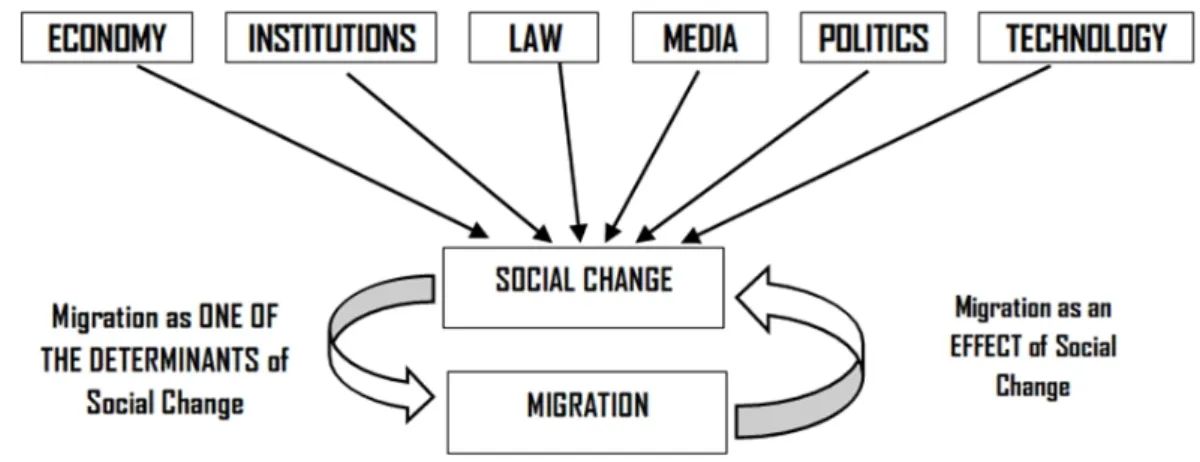
Fig. 1. Migration as the effect and one of the determinants of social change Source : Dzięglewski (2016).
study, the research analyzes the current mechanism and structure of labor migration, remittance income and use, and how it is influencing the economy of the stay-behind family members in the study area.
According to the World Bank report (2011) that nearly half of all households in Nepal have at least one member abroad or a returnee and the number of labor migrants is increasing every year and so is the scale of remittances they send back. At present, the top destinations to which Nepalese migrate for work include Malaysia, the Gulf countries and followed by South Korea. However, the lack of proper data recording system of Nepalese migrating to India for employment which is believed to be very large in number. There are, however, some studies that provide information on the number and characteristics of Nepali migrant workers in India but these have been conducted at a small scale and focus on a particular region only (Bhattrai, 2007; Sharma and Thapa, 2013).
2. Remittance and social change
International labor migration as an integral part of the wider change or one of the dynamics of social change in Nepal. Thus, it should not be isolated components of social change in the context of traditional Nepalese societies. It has been impeded by wider social change and is the consequence of endogenous determinants, but it plays a significant role in the dynamics and direction of the change (Dzięglewski, 2016). This means that migration is an effect of social change in the form of accession, but owing to migrants’ non-economic transfers it also has an impact on the dynamics and direction of social change.
Along these lines the connection between social change and relocation is proportional, it might be said movement is both the effect and one of the determinants of social change (Figure 1).
The procedure of social change is multifaceted and can’t be actuated by an individual alone or by a gathering of people. Be that as it may, the spot of the individual entertainer in the process might be unfathomably significant, quickening or obstructing the entire procedure. An
interesting example of the role of individuals as actors of social change comes from a study of the return migration of Kathmandu born young adults from the different parts of the world (Sapkota, 2018). These respondents were without a doubt effectively associated with Kathmandu’s issues and willing to partake in their economic as well as social change (Sapkota, 2018). Their interesting abilities as far as language aptitudes and learning of social examples made them ideal possibility to set up new opportunities.
For most return migrants, being compelling entertainers of progress was a demonstration of enthusiasm yet additionally spoke to a lifelong change.
II. Materials and Methods
Vyas municipality of Tanahun District in the western mid-hills of Nepal was purposefully selected for the study.
Tanahun District is in the fourth rank among the hilly
districts of Nepal and the first in Gandaki Province, in
terms of the issue for international labor migration
permission ILO, 2016). Within the district, Vyas muni-
cipality is the oldest municipality and have a very high rate
of international migration. This municipality was chosen
to represent the largest flow of migrant workers, based on
the government data on labor permits issued. Vyas,
popularly known as Damauli (a name of district head-
quarters), is a municipality and the district headquarter of
Tanahun District in Gandaki Province of Nepal. The
municipality was established by merging the former
village development committee Damauli with several of
its neighbors, the most recent merger being the one with
Pokhari Bhanjyang in 2014. It lies on the bank of Madi and
Seti River. At the time of the 2011 Nepal census, it had a
population of 70,335 people living in 18,339 individual
households and the area of the municipality is 248 km
2(CBS, 2011a). Vyas municipality is about 150 km west of
Kathmandu and 50 km east of Pokhara along the Prithvi
Highway. In this municipality, there 14 wards altogether,
out of which 3 wards in the urban area, 3 wards in semi-
urban area and rest of wards area of rural characteristics.
The Vyas municipality represents people in both traditional agricultural occupation and those migrating for various reasons. While agriculture remains the primary occupation for a majority of the people of semi-urban and rural settings of the municipality, migration has also become a prominent factor in the municipality.
The households who have member migrating as international labor migrant and remaining at least six months outside (international) their home were considered the migrating households. The sampling frame consisted of 175 migrating households represented all 14 wards of the municipality. The identification of remittance-receiving households was then done using snowball sampling to generate a listing of households receiving remittances from family member working abroad. The sampling pro- cedure was purposive because of the unavailability of the list of remittance-receiving households in the study area.
Semi-structured questionnaires for migrating household
were used to collect information about the household as well as the perception related to the migration and remittances.
In addition to the semi-structured questionnaire,
checklists were used to collect information through focus
group discussions (FGD) with the migrant families. Two
groups were selected for FGD, and the composition of the
groups was inclusive. I preferred two different locations
for two separate FGD, because of the composition of the
households. The participants for FGD were parents left
behind, local school teachers who provide outsider
perspectives into the situations and problems encoun-
tered by the children. In addition to that, key informants
interview (KII) also conducted with five local people who
have knowledge about the issue of international labor
migration, social structure and the local settings. Secondary
data were also collected from both published and unpub-
lished sources. The fieldwork was conducted between
Fig. 2. Map of the study areaMay-June 2018. The primary tool of data collection was a direct interview with migrant people’s household using questionnaire schedule. In this study, descriptive (i.e.
tables and charts) and inferential statistics (T-test) were run for presenting and analyzing for significant difference between average expenditure in different headings before and after migration household expenditure and remittances.
Likewise, the opinion regarding the priority sector for remittance expenditure was identified on the basis of their priority to make expenses on different requirements through their perceptions. Ethical consideration is one of the important components in research that involves human subjects as participants which I fully aware of it and adopt no harm to any human subjects in my study area.
For the education-related analysis, only 127 families have been selected because they are sending their children to elementary school. Regarding the analysis of the information about school attendance and time distance, only 127 households were considered. For this purpose, four categories of children were surveyed for comparison, i.e. that only father migrated, the only mother migrated, both parents migrated and neither parent migrated. Likewise, in the context of remittance and the household economy, mainly focused on three dimensions, such as; households’ amenities before and after migrant household uses; food sufficiency and use of new technology; and expenditure in households.
In addition, for the working definition, remittances are a transfer of money from the migrant workers to their families in their home country. In general, remittance refers to the portion of migrants earning sent from the destination country to home. Although they can also be sent in other sorts, the term “remittance” is normally limited to denote monetary and other cash transfers from migrant worker to their home country. However, in this paper, the monetary part is only considered as a remittance.
Several methodological constraints may limit the extent of the conclusions that can be drawn from this study. First, the issue of sampling. The sample for this study was small and issues of universal applicability arise. The question of the true randomness of the sampling process can also be
raised. These factors constraints statistical analysis and the researchers’ ability to test the research assumptions and their ability to arrive at more conclusive statements.
Therefore, further research needs to be done to follow up and verify these findings. Likewise, the issue relates to the use of FGD to supplement the survey data. This is a frequently used research strategy to gain a better perspective on the problem of interest. The mainly qualitative data could be collected through FGD and caution must be exercised in the conclusions.
III. FINDINGS OF THE STUDY 1. Annual remittance received
The income earned by migrant worker varies according to the nature of the host country, nature of job and efficiency of the workforce. For developing countries, remittance inflow has a significant effect on its economy (World Bank, 2016). However, the size of the remittance inflows differs from country to country. Although some of the migrant workers sent a large amount of remittance back home, the average range they sent in Nepal is more or less similar.
Among remittance received households, about 30% of households used to receive more than 2 lakh rupees annually as remittance from a foreign country. But the majority of the households (70%) received less than 2 lakh rupees annually as remittance Table 1.
Table 1. Annual remittance received Amount in NPR Number of households Percentage
Less than 1 Lakh1 46 30.7
1 Lakh to 2 Lakh 59 39.3
2 Lakh to 4 Lakh 43 28.7
More than 4 Lakh 2 1.3
Total 150 100.0
Source : Field Survey.
11 Lakh = NPR. 100,000 and 1 US$ = NPR. 113.03 (exchange rate of 9th August 2019)
2. Channel of migration and remittance
Employment agencies are important in labor migration sector in Nepal. They are acting as the conduits and arranging jobs for migrants and processing their paper works with some charges. For 63% of the migrants from Vyas, they preferred to contact the local agency for international labor migration. But, only 11% went through the government channel. The difference is that persons seeking foreign jobs approach an employment agency (mostly in the Kathmandu Valley) and provide the necessary documents, while agents of employment agencies or agents with varying degrees of association with such an agency recruit potential migrant in different parts of the country.
Regarding the channel of remittance, most migrants used a money transfer agency (79%) as their channel for remitting money to their home because they are quick, reliable and efficient(Figure 3). A bank was the second choice, at 10%; these households chose the bank because they had a savings account in that facility. Although the sample size is small, this has possible implications for the ways in which remittances may be sent to Nepal; if more of the population had access to banks.
While hundi, an informal way of transferring money was popular among migrants in the past due to better exchange rates and the speed of transfer, but only 9% of the households used it. Because hundi works on trust with no proof of payment and lack of legal recourse, it can be risky. Thus, Hundi is remittance transfer channel which is illegal in Nepal. In some cases, migrants send money with
their friends who visit their home for vacation. This type of remittance channel was not incorporated in this study, because of the lack of information.
3. Utilization of remittance
Most of the research shows that there is a positive impact of inward remittance in the developing world in areas, for example, increase in the standard of living, people being able to fulfil their basic needs. Researchers support the idea that remittance helps to the overall growth of the economy and social transformation by increasing economic security (Connell and Conway, 2000;
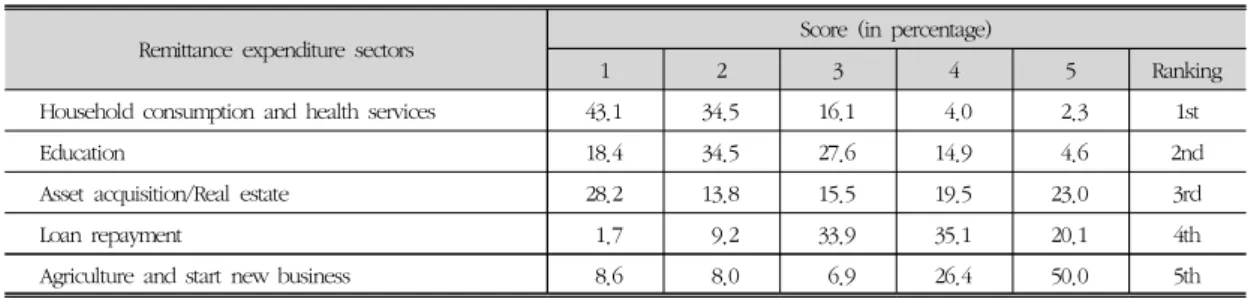
Cooray 2012; Walmsley et al., 2017). Based on the respondents’ perceptions, the priority sectors for remittance utilization is shown in Table 2. The study revealed that remittances were mostly used for household-related
Fig. 3. Remittance sending channels to home
Table 2. Priority wise remittance expenditure sector
Remittance expenditure sectors Score (in percentage)
1 2 3 4 5 Ranking
Household consumption and health services 43.1 34.5 16.1 4.0 2.3 1st
Education 18.4 34.5 27.6 14.9 4.6 2nd
Asset acquisition/Real estate 28.2 13.8 15.5 19.5 23.0 3rd
Loan repayment 1.7 9.2 33.9 35.1 20.1 4th
Agriculture and start new business 8.6 8.0 6.9 26.4 50.0 5th
Source : Field survey.
activities including health services but not for the livelihood. The education sector comes second most prioritized sector where remittances were used. Similarly, remittance incomes were being used for asset acquisition as a third important sector followed by loan payment and investment in agriculture and new business.
Generally, remittance increases the income of house- holds. The low level of income could not reach the basic basket of goods but if the income level increases, the ability to purchase luxury goods also increases. So, remittance increases the expenditure behavior of the people.
It seems that the significant difference between ex- penditure on different variables (household consumption, health service, education, real estate, loan repayment and agriculture). Expenditure on these sectors is significant at 1% level of significance by t-test (p-value <0.01). Similarly, living arrangement expenditure is significant at 5% level of significance (p-value <0.05). These trends show that remittance increases the expenditure of households on consumption.
4. Social impact of remittances
With a big rise in the number of Nepali migrants seeking jobs abroad, there has been a steep increase in remittance income overall flowing into the country. The impact of remittance is a crucial issue which has not been properly micro-level studied in the traditional Nepali community.
Several dimensions of the international labor migration and its impact on social change are closely observed and examined during the field study. Thus, the impact of
remittance through international labor migration on the labor-sending households of the study area is the most important dynamics of social change. In this regards, the study mainly focused on the participation of the left behind family members in community activities, children’s education, and use of health services, which are going to be discussed in the following sections:
1) Community participation
Community participation is one of the social capitals for a person to know the society. Community engagement of the left-behind family members of the migrants has been identified as an important element in developing both individual well-being and social transformation. In this study, the members of migrants’ household participated in mothers’ group, school management committee members, community forest management committee members, youth club members and cooperatives members among others. These are the community-level organizations where local people contribute voluntarily. For example, the most visible impact of mass male migration on local forestry institutions as well as school management committee is the increasing presence of women or left behind other family members in the general assembly meeting and other activities.
Involvement or participation in the variety of com- munity-based program is one of the most important indicators of the social change of international labor migration. Left behind family members are interested to participate in such activities.
Here, I compared between four types of households:
nuclear (with at most a married couple and their unmarried
Table 3. Participation in the community level meeting by a household representative and migration status of the household (n = 175)
Type of household Primary participant (% of the household)
Man Woman A woman goes when man migrate
Nuclear migrant 27.6 53.8 18.6
Extended migrant 31.4 54.5 14.1
Nuclear non-migrant 65.5 31.5 3.5
Extended non-migrant 43.4 36.9 19.7
Source : Field survey.
children) and extended (larger) households, with and without at least one migrant family member. Of these, women’s participation in the community level activities was highest among nuclear migrant households. In the study area, 53.8% of nuclear migrant households, but only 31.5% of nuclear non-migrant households, were represented by women in those community-level activities.
2) Educational attainment
Generally, the structure of the schooling system in Nepal, it is not much different than the neighboring countries. Primary education in Nepal called Basic Education consists of grades one through eight. Secondary levels are grades nine and ten, and Higher Secondary Levels cover grades eleven and twelve. Pre-primary education is available in some areas, and students usually begin grade one at age six. A district-level examination Basic Level Examination (BLE) is given on grade eight while a national Secondary Education Exam (SEE) examination is conducted at the end of grade 10 while completing the Grade 12 examination leads to the School Leaver’s Certificate. The National Examinations Board (NEB) supervises all BLE, SEE and 12th-grade exams. In addition to that, Nepal has two primary types of schools: community and private.
Community (public) schools receive government grants, and private (institutional) schools are self-funded. In- stitutional schools are non-profit trusts or companies.
During this research, children education was examined in diverse ways; for example, age of schooling, distance and the proportion of children time to reach their school.
In this study, I considered the impact of remittances on the issue of the children school before and after migration. It is clearly evident that the impact of remittance is significantly influenced by schooling issues. For example,
before migration, 59.84% of the children studied in private school and 40.16% at public or community school. These trends were drastically changed after receiving remittance where 63.78%% of the households sent their children to private school and 36.22% of the family preferred public school for their children. Therefore, after receiving the remittance in the Philippines the perception of the family has the choice of better school if they are financially well-off (Battistella and Conaco, 1998). Similar findings I can draw from my study where parents’ preferred to send their children to the better schooling system when they receive financial support (Table 4).
Similarly, remittance received in a year and children schooling in the households also related to the schooling status. For the analysis, I have categorized the schooling system as a government school, public-private partnership and private school. Majority 80 (53.14%) of the children were studying in private school, which is followed by the government and other 45 (30.29%) schooling. Minimum percentage of the households’ children were studying public-private partnership school 25 (16.57%).
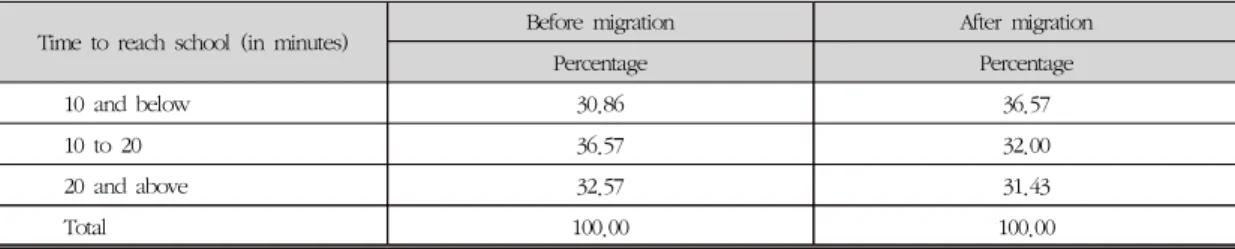
Similarly, travelling to go to school also determined by economic status. When people received remittance, most of them preferred to shift to those place where they can have better facilities. The time spent to reach school for those children who were from migrant households has also changed before and after the migration (Table 5).
More than one third (36.57%) of the children used to travel their school between 10 to 20 minutes and 30.86%
of children reach their school within 10 minutes before migration.36.57% children reached their school within 10 minutes which is followed by 32% of the children reached their educational institution between 10 to 20-minute time after migration. This trend shows that migration increases
Table 4. Type of school attendance (n = 127)
Type of school Before migration After receiving remittance
Private school 59.84 63.78
Public school 40.16 36.22
Total 100 100
Source : Field survey.
the access to an educational institution near at home.
A schooling system is one of the most important necessities for society. If households are economically well, they can have offered better schooling than others.
So, the income of households is one of the factors affecting the development of society. Those students who spent 10 to 20 minutes to reach their school/college are from medium to a higher range of remittance-receiving households (more than 2 lakhs receivers). This trend shows that the majority of the migrant households are either shifted or transferred their children to the nearest educational institution. Therefore, if members of house- holds have migrated then other family members also migrate toward better-facilitated areas in this type of traditional societies in Nepal.
3) Remittance and the quality of life Remittance is a considerable source to influence the national economy. As the growing volume of remittance earning has a positive impact on income, growth and poverty reduction, the potential contribution for improving the quality of life of the domestic people (Pradhan and Khan, 2015). Remittance can prompt the improvement in wellbeing status in mainly two different ways; first they can be utilized to improve the nutritional status of the populace, especially youngsters, through the arrangement of good quality nourishment; second, this cash can be utilized to get to better health services on account of sickness.
In the study area, various types of health and sanitation- related services and facilities were observed from the
selected migrant households for the comparison of pre and post-migration situation. More than one-third of the household members reported that they gave birth to their children with the help of community health worker at home. But, the number of households who reported giving birth to their children in health facilities post- migration increased to 33.71% from the baseline of 22.32% prior to migration. In addition, increased health awareness and access to health facilities lead to improved quality of life. Households who received antenatal care from health facilities were also significantly increased from 46.43% before migration to 82.29% post-migration.
Similarly, a nearly equal proportion of the household members had had knowledge about reproductive health.
According to 40.57% of respondents, they were drinking filtered water after receiving remittance, whereas it was only 24.57% before migration. All these reflect the improvement of the quality of health as well as the awareness on the health services because the financial well-off of the migrant family.
4) Remittance and economy
Households with their family members working abroad were to improved their monetary status and economic wellbeing through the progression of remittances.
Notwithstanding the investigation on speculations gave in the past area, this improvement can be analyzed in a few different ways. This segment centres around three dimensions: households’ amenities before and after migrant household uses; food sufficiency and use of new technology; and expenditure in households.
Table 5. Time to reach school before and after the migration (n = 127)
Time to reach school (in minutes) Before migration After migration
Percentage Percentage
10 and below 30.86 36.57
10 to 20 36.57 32.00
20 and above 32.57 31.43
Total 100.00 100.00
Source : Field survey.
5) Changes in household amenities It is because of the regular source of income; migrant’s household economic status is very sound in the study area. It has clearly been observed through the improve- ment of their household level amenities. Thus, economic status should be measured as household amenities they use in their household. Therefore, I considered twelve different types of household amenities to be recorded before migration and after migration households they use.
One-third of the households did use as a household amenity followed by the television (14.42%) before migration, but no one reported of owing four-wheelers as their amenity before migration. The ownership of household amenities has been significantly changed among four households who were able to add four- wheelers as an amenity after migration. Similarly, 16.68%
of households used a mobile phone after migration, which was only about 14% before they migrate. Household amenities clearly indicate the changes in the living standard of those who left behind by the migrants. Thus, it is the demonstration effect for non-migrants in the same community and they also intend to migrate for a few years and accumulate the capital for the household (Table 6). As
a result, the number of migration and the remittance amount has increased every year.
6) Changes in food sufficiency
Foreign employment is one of the major livelihood strategies and the high class feudal owns the majority of the land but grassroots civil are deprived of owning land for sufficient food production. Hence, migrant households have less land occupancy than other non-migrant household does. In that case, costs of migration have been paid by selling their property (Dhungana and Pandit, 2014). Because of the lack of proper employment opportunity in the destination countries, the migrant households are not economically well even after migration. Because of the lack of manpower in the society, the issue of land abandonment has been critically observed in the study area. After migration, only 14% of households increased their land occupancy, whereas more than 20% lost their occupancy. But, later they were investing remittances to buy new land in the well- facilitated areas as well as within their own homeland.
Food security is another component which has a direct impact on the traditional migrant households in Nepal.
Table 6. Household amenities before and after migrant household’s uses (n = 175) Household Amenities
Responses (multiple response possible)
Before migration After migration
Number Percentage Number Percentage
Radio 134 31.68 118 12.78
Television 61 14.42 143 15.49
Mobile phone 59 13.95 154 16.68
Bio-gas/ L.P. gas 56 13.24 156 16.90
Cycle 16 3.78 18 1.95
Cable television 24 5.67 99 10.73
Refrigerator 31 7.33 59 6.39
Telephone 26 6.15 48 5.20
Motorcycle 7 1.65 24 2.60
Computer 6 1.42 49 5.31
Internet 3 0.71 51 5.53
Four-wheeler 0 0.00 4 0.43
Source : Field Survey.