The Korean Journal of Mycology 한국균학회지
© The Korean Society of Mycology Kor. J. Mycol. 39(3) : 213-216 (2011)
DOI:10.4489/KJM.2010.39.3.213
213
Botrytis cinerea에 의한 블루베리 잿빛곰팡이병의 한국 내 발생
홍성기1·최효원1·이영기1·이상엽2·김완규2*
1국립농업과학원 작물보호과, 2국립농업과학원 농업미생물팀
Occurrence of Gray Mold on Blueberry Trees Caused by Botrytis cinerea in Korea
Sung Kee Hong1, Hyo Won Choi1, Young Kee Lee1, Sang Yeob Lee2 and Wan Gyu Kim2*
1Crop Protection Division, National Academy of Agricultural Science (NAAS), Rural Development Administration (RDA), Suwon 441- 707, Korea
2Agricultural Microbiology Team, NAAS, RDA, Suwon 441-707, Korea
(Received 14, November 2011., 1st Revised 17, November 2011., Accepted 21, November 2011)
ABSTRACT : Gray mold symptoms were frequently observed on green twigs, blossoms, leaves, and fruits of blueberry trees grown in greenhouses in Cheongyang, Dangjin, Daejeon, and Jeju during disease survey in eight locations of Korea from 2007 to 2010. The disease symptoms were not observed in the fields of the other locations investigated.
The disease incidence ranged 1~30% in the greenhouses investigated. A total of 27 single spore isolates of Botrytis species were obtained from the gray mold symptoms, and all the isolates were identified as Botrytis cinerea based on their morphological and cultural characteristics. Four isolates of the fungus were tested for pathogenicity to leaves of four varieties of blueberry trees by artificial inoculation with conidial suspensions. All the tested isolates caused gray mold symptoms on the leaves, which were similar to those observed in the greenhouses. This is the first report that B. cinerea causes gray mold of blueberry trees grown in greenhouses in Korea.
KEYWORDS : Blueberry, Botrytis cinerea, Gray mold, Identification, Pathogenicity
서 론
블루베리(Vaccinium spp.)는 진달래과의 산앵두나무속 목본식물로서 원산지는 북아메리카이며, 국내에 도입되어 과 수로서 일반 농가에서 재배가 시작된 것은 2000년대 이후인 것으로 알려져 있다. 블루베리의 열매에는 안토시아닌이 많이 함유되어 있어 건강식품의 활용 소재로서 세계적으로 널리 인식되고, 최근 국내에서도 시장에서의 수요가 크게 늘어나면 서 블루베리의 재배면적이 급격이 증가하는 추세에 있다.
블루베리는 온대지역에서 많이 재배되고, 국내에서는 노 지와 온실에서 모두 재배되고 있는데, 재배 중에 발생하는 병은 세계적으로 수십 종류가 보고되어 있으나(Farr and Rossman, 2010), 국내에서는 탄저병(김 등, 2009; Kim et al., 2009) 이외에는 병 발생이 거의 보고되어 있지 않다. 최근 주요 블루베리 재배지역의 병 발생 실태를 조사하였던 바, 온실재배 블루베리에서 잿빛곰팡이병 증상이 심하게 발생 하고 있는 것으로 나타났다. 따라서 본 연구에서는 이 병의 전반적인 병 발생 실태를 조사하고, 병원균을 분리하여 동정하였으며, 병원균의 주요 블루베리 재배 품종에 대한 병원성 검정 결과를 보고한다.
재료 및 방법
병 발생 조사 및 병원균 분리
2007년부터 2010년까지 국내 8개 지역의 블루베리 재배 과수원을 대상으로 병 발생을 조사하고, 병원균 분리를 위하 여 병반을 채집하였다. 채집한 시료는 습실 처리된 플라스틱 상자(30 × 24 × 6 cm) 내에 두고, 25oC의 항온기에 배양하 면서 병반상에 형성된 자실체를 조사하였다. 자실체에 형성된 분생포자는 살균수에 현탁하여 물한천배지(water agar : WA) 에서 발아시킨 다음, 단포자분리 하였다. 순수분리된 진균은 감자설탕배지(potato dextrose agar : PDA)가 들어 있는 시험 관에 이식하여 배양한 다음, 10oC의 저온고에 보존하면서 동정 및 병원성 검정을 위한 실험에 사용하였다.
분리균주의 배양 및 동정
분리하여 선발한 진균의 균주는 PDA에 배양하여 형태적 및 배양적 특성을 조사하고, 각 균주별 특성을 정리하여 전연구자들이 기술한 분류키에 따라(Ellis, 1971; Ellis and Waller, 1974) 검색을 실시하여 동정하였다.
병원성 검정
분리된 균주 중에서 각기 다른 시료에서 분리한 4균주를
*Corresponding author <E-mail : [email protected]>
214 홍성기 등 선발하여 4품종의 건전한 블루베리 잎에 인공접종을 실시 하였다. 공시균주를 PDA에서 배양하여 분생포자를 형성시킨 다음, 형성된 분생포자를 감자설탕액(PD broth, Difco)에 희석하여 분생포자현탁액(농도 : 1~2 × 10⁶/ml)을 만들었다.
분리균주의 병원성검정을 위하여 온실에서 재배한 4품종 (Conelly, Coville, Darrow, Duke)의 블루베리나무(Vaccinium corymbosum L.)의 잎을 채취하여 습실처리된 플라스틱 상자 (30 × 24 × 6 cm)에 넣고, 각 공시균주의 분생포자현탁액 10µl를 잎의 뒷면에 점적접종 하였으며, 대조구는 점적접 종과 같은 방법으로 감자설탕액을 처리하였다. 접종 처리된 플라스틱 상자는 25oC의 항온기에 4일간 배양 후, 병반의 형성 유무를 조사하고, 병반의 크기를 측정하였다.
결과 및 고찰
병 발생 및 병징
2007년부터 2010년에 걸쳐 국내 8지역에서 블루베리의 병을 조사한 결과, 청양, 당진, 대전, 제주 지역의 온실에서 재배중인 블루베리의 신초, 잎, 꽃, 열매에서 잿빛곰팡이병 증상이 빈번하게 관찰되었으며, 조사된 다른 지역의 포장에서 는 잿빛곰팡이병 증상이 관찰되지 않았다(Table 1). 조사된 온실 내 이 병의 발생율은 1~30%였으며, 당진과 제주 지역의 재배온실에서는 이 병의 발생율이 10~30%로서 매우 심 하게 발생하였다.
이 병에 감염된 신초에는 초기에 감염부위가 갈색 내지 암갈색으로 변하고(Fig. 1A), 진전되면 병반이 크게 확대 되면서 신초 전체가 말라죽고, 병반상에는 많은 잿빛의 곰팡 이가 발생하였다(Fig. 1B). 잎에서의 감염은 주로 잎의 가 장자리로부터 시작되며, 잎의 감염부위는 초기에 갈색으로 마르고, 진전되면 병반이 안쪽으로 크게 확대되었다(Fig. 1C).
병든 잎은 후에 전체적으로 말라죽고, 병반상에는 많은 잿 빛의 곰팡이가 발생하였다. 열매에서의 감염은 주로 꽃이
달렸던 부위에서 비롯되거나 꼭지부위에서 발생하였다. 감염 된 열매는 자주색으로 변하여 말라죽고, 감염된 열매와 꽃에는 많은 잿빛의 곰팡이가 발생하였다(Fig. 1D).
병원균 분리 및 동정
채집한 잿빛곰팡이병 증상의 병반에서 27개 균주의 Botrytis 속 균을 단포자분리 하였으며, 단포자분리된 27개 균주의 형태적 및 배양적 특성을 조사한 결과, 모두 Botrytis cinerea Pers.로 동정되었다(Table 2, Fig. 2). 동정된 B. cinerea 균주들은 PDA 배양기에서 회색 내지 회갈색 균총을 형성 하였으며(Fig. 2A), 후에 부정형의 검은 균핵을 형성하였다.
이 균은 분생자경 위에 많은 분생포자를 형성하였으며 (Fig. 2B), 분생포자는 단세포로서 타원형 내지 도란형이고, 무색 내지 담갈색을 띠었다(Fig. 2C).
병원성
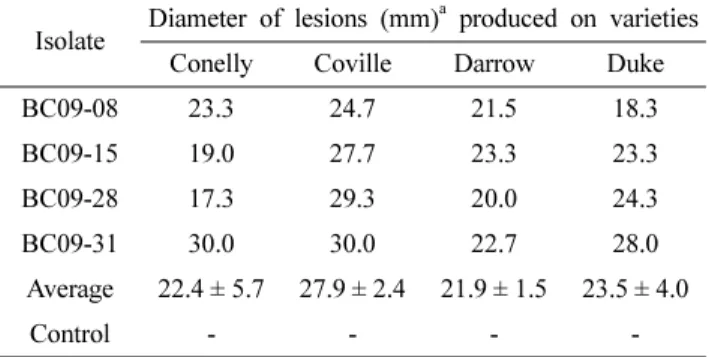
병원성 검정을 위하여 선발한 4균주를 4품종의 블루베리 잎에 분생포자현탁액으로 인공접종한 결과, 4균주 모두 접종 한 블루베리 잎에 자연병반과 유사한 병반을 형성하였으며, 대조구에서는 병반이 형성되지 않았다(Fig. 2D). 병반이 형 성된 잎에서 병원균을 다시 분리한 결과, B. cinerea가 분리 되었다. 접종한 모든 균주는 모든 공시품종의 잎에 병반을 잘 형성하였으며, 형성된 병반의 크기는 품종간에 큰 차이가 없었다. 따라서 공시한 4품종은 B. cinerea에 모두 감수성 Table 1. Incidence of gray mold on buleberry trees grown in
several locations in Korea from 2007 to 2010
Location Cultivation pattern
No. of fields or greenhouses infected/surveyed
% infected treesa
Cheongyang Greenhouse 2/2 3-10
Daejeon Greenhouse 1/1 1-5
Dangjin Greenhouse 1/1 10-30
Geumsan Field 1/1 0
Gochang Field 0/12 0
Haenam Field 0/2 0
Jeju Greenhouse 2/2 10-30
Jeongseon Field 0/2 0
aTen buleberry trees in each field were investigated with three rep- licates.
Fig. 1. Gray mold symptoms on blueberry trees observed in the greenhouse. A, a dark brown spot on a green twig with an infected leaf; B, a severely infected green twig and leaves with conidial masses; C, an infected leaf with conidial masses; D, infected fruits and a blossom with conidial masses.
Botrytis cinerea에 의한 블루베리 잿빛곰팡이병의 한국 내 발생 215
인 것으로 나타났다.
일반적으로 B. cinerea에 의한 작물의 잿빛곰팡이병은 서 늘하고 습도가 높은 조건에서 많이 발생하는 것으로 알려져 있으며(Ellis and Waller, 1974), 블루베리 잿빛곰팡이병 또한 15~20oC의 서늘한 온도와 상대습도 95% 이상의 조건에서 발 생이 잘 되는 것으로 보고되어 있다(Bristow and Milholland, 1995). 한편 국내의 블루베리 잿빛곰팡이병 발생 조사 결과를
보면, 조사된 노지포장에서는 이 병의 발생이 전혀 관찰되지 않았으나, 온실재배 조건에서는 이 병이 모두 발생한 것으로 보아 온실 내의 기후 조건이 이 병의 발생에 큰 영향을 미치 는 것으로 여겨진다. 따라서 블루베리를 온실 내에서 재배할 경우에는 이 병의 방제를 위하여 온실내의 온도와 습도를 잘 조절하는 것이 매우 중요하다고 생각된다.
블루베리의 잿빛곰팡이병은 목질화된 줄기 이외에 주로 신초, 잎, 꽃, 열매에서 발생하는데, 특히 열매 끝에 꽃이 붙어 있을 경우에는 열매에 대한 병원균의 감염이 매우 잘 이루 어지는 것으로 관찰되어 Kim과 Cho(1996)가 보고한 고추의 잿빛곰팡이병 발생 경향과 매우 유사한 것으로 나타났다.
최근 Kwon 등(2011)은 국내 경남농업기술원의 저장고 내 에 저장중인 블루베리의 열매에 B. cinerea가 감염되어 잿 빛곰팡이병이 발생하였음을 보고하였으나, 국내에서 재배중 인 블루베리의 잿빛곰팡이병 발생에 대한 보고는 전혀 없다.
따라서 국내의 온실재배 블루베리에 발생하는 B. cinerea에 의한 잿빛곰팡이병은 본 연구에 의해 처음으로 보고된다.
적요
2007년부터 2010년에 걸쳐 국내 8지역에서 블루베리의 병을 조사한 결과, 청양, 당진, 대전, 제주 지역의 온실에서 재배중인 블루베리의 신초, 잎, 꽃, 열매에서 잿빛곰팡이병 증상이 빈번하게 관찰되었으며, 조사된 다른 지역의 포장 에서는 잿빛곰팡이병 증상이 관찰되지 않았다. 조사된 온실 내 이 병의 발생율은 1~30%였다. 병반에서는 Botrytis속 균이 분리되었으며, 단포자 분리된 27개 균주의 형태적 및 배양적 특성을 조사한 결과, 모두 Botrytis cinerea로 동정되었다.
병원성 검정을 위하여 선발한 4균주를 4품종의 블루베리 잎에 분생포자현탁액으로 인공접종한 결과, 4균주 모두 접종 한 블루베리 잎에 자연병반과 유사한 병반을 형성하였다.
국내의 온실재배 블루베리에 발생하는 B. cinerea에 의한 잿빛곰팡이병은 본 연구에 의해 처음으로 보고된다.
감사의 글
본 연구는 농촌진흥청 국립농업과학원 농업과학기술 연 구 개발사업(과제번호: PJ0069422009)의 지원에 의해 이 루어진 것이며, 이에 감사드립니다.
Table 2. Morphological characteristics of Botrytis cinerea isolates from buleberry trees
Structure Characteristics
Present isolates Ellis (1971)
Conidiophore Shape Branched and terminated in a rounded apical cell Branched and terminated in a rounded apical cell Size More than 2 mm long, 16-30 µm thick 2 mm or more long, 16-30 µm thick Conidium Shape One-celled, ellipsoidal or obovoid One-celled, ellipsoidal or obovoid
Size 7.0-17.5 × 5.0-12.0µm (mostly 9.0-14.5 × 7.0-10.0 µm) 6.0-18.0 × 4.0-11.0 µm (mostly 8.0-14.0 × 6.0-9.0 µm)
Fig. 2. Cultural and morphological features of Botrytis cinerea isolated from blueberry trees and lesions produced on leaves of blueberry trees by artificial inoculation. A, a 7- day-old colony grown on PDA at 25oC; B, a conidiophore and conidia produced in PDA culutre (scale bar = 20µm);
C, conidia (scale bar = 10µm); D, lesions produced on leaves of blueberry trees at four days after inoculation with conidial suspensions (ct = control).
Table 3. Pathogenicity of Botrytis cinerea isolates to leaves of blueberry trees by artificial inoculation
Isolate Diameter of lesions (mm)a produced on varieties Conelly Coville Darrow Duke
BC09-08 23.3 24.7 21.5 18.3
BC09-15 19.0 27.7 23.3 23.3
BC09-28 17.3 29.3 20.0 24.3
BC09-31 30.0 30.0 22.7 28.0
Average 22.4 ± 5.7 27.9 ± 2.4 21.9 ± 1.5 23.5 ± 4.0
Control - - - -
aDiameter of lesions was measured four days after artificial inocula- tion. Average from three replicates. - = no symptom.
216 홍성기 등
참고문헌
김완규, 구한모, 김경희, 현익화, 홍성기, 차재순, 이영기, 김국형, 최홍수, 김동근, 박병용. 2009. 한국식물병명목록. 한국식물병 리학회. 수원, 한국.
Bristow, P. R. and Milholland, R. D. 1995. Botrytis blight. In:
Compendium of Blueberry and Cranberry Diseases, pp. 8-9.
Eds. F. L. Caruso and D. C. Ramsdell. APS Press, The American Phytopathological Society, St. Paul, MN, USA.
Ellis, M. B. 1971. Dematiaceous Hyphomycetes. Commonwealth Mycological Institute, Kew, Surrey, England.
Ellis, M. B. and Waller, J. M. 1974. Sclerotinia Fuckeliana (conidial state : Botrytis cinerea). CMI Descriptions of Pathogenic Fungi
and Bacteria. No. 431. Commonwealth Mycological Institute.
Ferry Lane, Kew, Surrey, England.
Farr, D. F. and Rossman, A. Y. 2010. Fungal databases, systematic mycology and microbiology laboratory, ARS, USDA. Available from: http://nt.ars-grin. gov/fungaldatabases.
Kim, W. G. and Cho, W. D. 1996. Developmental characteristics of gray mold in pepper. RDA. J. Agri. Sci. 38:466-472.
Kim, W. G., Hong, S. K., Choi, H. W. and Lee, Y. K. 2009.
Occurrence of anthracnose on highbush blueberry caused by Colletotrichum species in Korea. Mycobiology 37:310-312.
Kwon, J. H., Cheon, M. G., Choi, O. and Kim, J. 2011. First report of Botrytis cinerea as a postharvest pathogen of blueberry in Korea. Mycobiology 39:52-53.