
청정환경기술
Enthalpy Changes of Adsorption of Tetrafluorocarbon (CF 4 ) and Hexafluoroethane (C 2 F 6 ) on Activated Carbon
Jiyoung Shin, Sung-Sup Suh, and Moon Kyu Choi*
Department of Chemical Engineering, Hongik University 72-1 Sangsu-dong, Mapo-gu, Seoul, 121-791, Korea
(Received for review August 6, 2013; Revision received December 9, 2013; Accepted December 11, 2013)
요 약
CF
4와 C
2F
6의 압력이 20.7 kPa 이하일 경우, 활성탄에의 평형흡착량을 여러 온도(293.15-333.15 K)에서 실험적으로 조사하 였다. 실험데이터가 가장 잘 맞을 수 있도록 1차층 흡착으로 Langmuir모델을 쓰고 그 다음 단계에는 Freundlich 물리흡착을 이용하는 이단계모델을 제안한다. 1단계에 대한 흡착엔탈피를 구하기 위해 실험데이터의 최초기울기를 이용하였고, Clausius-Clapeyron식을 사용함으로써 2단계에 대한 흡착엔탈피를 구하였다. CF
4의 경우 1, 2단계의 흡착엔탈피는 각각 25.9와 11.8 kJ/mol이고, C
2F
6의 경우는 38.7과 38.2 kJ/mol이다.
주제어 : 흡착엔탈피변화, 사불화탄소, 육불화에탄, PFC
Abstract : Under low pressures of CF
4and C
2F
6up to 20.7 kPa, the equilibrium adsorbed quantity on activated carbon was experimentally examined using the volumetric method at various temperatures between 293.15 K and 333.15 K. To give the best fit to the experimental data curve, the two step model (i.e., Langmuir model for the first layer adsorption and then Freundlich physisorption) is suggested. The method of initial slope yielded the enthalpy of adsorption for the first step while we could apply the Clausius-Clapeyron equation to find the heat of adsorption of the second step. They are 25.9 kJ/mol and 11.8 kJ/mol, respectively, with CF
4, and 38.7 and 38.2 kJ/mol with C
2F
6.
Keywords : Enthalpy change of adsorption, Tetrafluorocarbon, Hexafluorocarbonethane, PFC
* To whom correspondence should be addressed.
E-mail: [email protected] doi: 10.7464/ksct.2014.20.1.022 pISSN 1598-9721 eISSN 2288-0690 http://cleantech.or.kr/ct/
1. Introduction
Nowadays one of the popular research topics in the world is modeling the global warming process[1,2] and reducing green house gases which cause the ozone layer depletion and the global warming. These harmful phenomena come from more absorp- tion of infrared light due to the green house gases such as car- bon dioxide, methane, nitrous oxide, chlorofluorocarbons (CFCs), hydrochlorofluorocarbons (HCFCs), hydrochlorofluoro- carbons (HFCs), perfluorocarbons (PFCs), etc[3-5]. Among these chemicals, CFCs that had a lot of uses with refrigerators and air conditioners, have been already replaced by HFCs. PFCs are used as CFC substitutes for cleaning or printing electronic circuit boards, hybrid ICs, etc. However, PFCs which are more stable than CFCs, are not decomposed until they soar up above the stratosphere and thus are considered significant global warming compounds. Thus one needs to be concerned with the emission and life of PFCs in the atmosphere.
Among the PFCs, the light PFCs (i.e., CF
4and C
2F
6) are the most potentially damaging due to their long atmospheric lifetime.
The atmospheric lifetimes of CF
4and C
2F
6are estimated to be 50,000 years and 10,000 years, respectively[6]. The main usage of PFCs is the CVD chamber cleaning, dry etching, heat transfer medium and coolant in the semiconductor processing. The total amount of PFC emission is small compared to CO
2, but PFCs contribute to the global warming as much as 6,500 to 9,200 times the same amount of CO
2. Considering the long-lived con- tribution of PFCs to the global warming, their emissions should be treated somehow to reduce their entry into the atmosphere in the semiconductor industry[7-9].
There are many approaches to reduce and eliminate PFCs emissions from industrial processes. Potential methods are as follows: recovery/recycle of PFCs[10]; conversion of PFCs to non-PFCs[11,12]; process optimization using reconfiguration and endpoint detection[13]; replacement of PFCs with non- PFCs[14]. Among these control technologies, recovery/recycle methods are currently the most available and cost-efficient ways for treating PFCs gases from emissions of industrial processes.
In general, the potential technologies are condensation, absorp- tion, adsorption, and membrane separation[15-19].
22
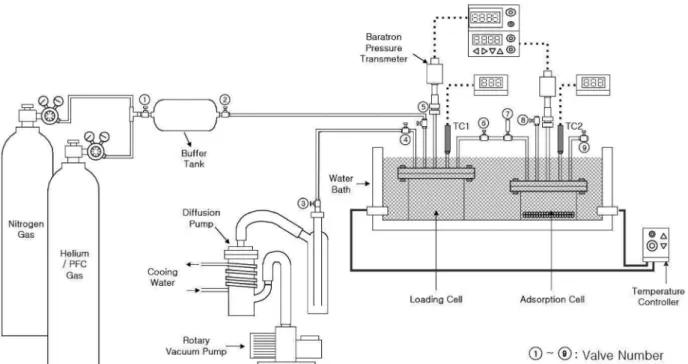
Figure 1. Volumetric apparatus used for adsorption data measurement.
For recovery of volatile organic gases, adsorption is a useful method because it offers some recognized advantages. These include the possibility of recovery of raw materials for recycling and a high removal efficiency at a low concentration of adsor- bates. Furthermore, this technology often demands low energy costs. It is also important to select the proper adsorbent for the development of an efficient adsorption process. Single-walled carbon nanotubes (SWNTs) can serve as good nanoscale vessels for encapsulation of tetrafluoromethane at 300 K and operating external pressure of 1 bar[20]. However, from an economic point of view, activated carbon is suitable adsorbent for commer- cial processes such as pressure swing adsorption[21,22].
In this work, the adsorption quantity of CF
4and C
2F
6on acti- vated carbon (20 to 40 mesh) were experimentally measured at various temperatures under low pressures of CF
4and C
2F
6up to 20.7 kPa by the constant volume method. The objective of this study is to find the heats of adsorption from the two step model which consists of Langmuir model for the first layer ad- sorption and then Freundlich physisorption.
2. Experimental 2.1. Materials
The adsorbents used in the experiments were activated carbon (20 to 40 mesh) supplied by Darco Co. Their physical properties were measured using an automatic volumetric sorption analyzer (ASAP2010, Micromeritics Instrument Co.) and pycnometer (Accupyc2375, Micromeritics Instrument Co.). These physical
Table 1. Physical properties of the adsorbents Adsorbents
BET surface area
m
2/g
Total pore volume
cm
3/g
Mean pore size
Å
Solid density
a)g/cm
3Activated C
20 to 40 mesh 633.1 0.231 5.9 1.993
Activated C
12 to 20 mesh 549.1 0.200 5.9 2.114
a)
Solid density: the density crushed and compressed solid containing no pores
properties are given in Table 1. We used 20 to 40 mesh activated carbon only because smaller particles (or larger mesh) takes less time to reach equilibrium due to faster diffusion into pores. The physical data for another size range (10 to 20 mesh) are, although its activated carbon was not used for this study, presented in Table 1 for comparison. The adsorbents (CF
4and C
2F
6) were provided by Dae-Han gas Co. and Daikin industry Co. The phy- sical properties of their products are good enough to be used in real processes and the prices are also economical. Their pu- rity was 99.99% and 99.999%, respectively.
2.2. Method
A volumetric type apparatus was used to determine the equi-
librium isotherms for the single component systems[8,9]. A
schematic diagram of the apparatus is shown in Figure 1. It was
composed of an adsorption cell, a loading cell, a vacuum pump,
gas cylinders, water bath with temperature controller, pressure
Figure 2. Flow diagram of experiment procedure.
transducer (PT), thermocouple (TC), and displays. Figure 2 dis- plays a flow diagram of the experiment procedure.
The internal volume of the various parts of the system was accurately measured by expanding helium gas. Before each ex- periment, the adsorbent was outgassed overnight in a vacuum at a pressure lower than 10
-4kPa at 423 K. Adsorption isotherms of pure components on various adsorbents were measured at temperatures; 303 K, 323 K, 343 K and pressures up to 20.7 kPa. A static equilibrium technique was used for the measure- ment of the pure gas adsorption isotherms. The sample gas was introduced into the adsorption cell containing the weighed adsor- bent sample. The amount of gas adsorbed was hence determined by performing a material balance on the number of moles pre- sent in the gas and the adsorbed phase before and after the ad- dition of a new dose of gas to the adsorption cell using the ideal gas P-V-T relationships.
Adsorbed phase moles are
n
ads= (n
L1- n
L2) - (n
A2- n
A2) (1) where n
Land n
Aare moles of gas in the loading cell and the
adsorption cell, respectively. Subscripts 1 and 2 are the before and after supply of PFC gas to the adsorption cell, respectively.
The moles of gas (n
A2) was measured at adsorption equilibrium.
The adsorbed amount q is
q = n
ads/ w (2)
where w is mass of adsorbent.
3. Results and Discussion
We employ the two step model of adsorption for data analy- sis of the present adsorption experiments. This model applies Langmuir isotherm model until the first layer of adsorbate is covered. Thus this first step is a sort of chemical reaction between the gas phase adsorbent and the solid phase adsorbate. After all the possible spots of adsorbate are covered, the gas phase adsor- bent may deposit right on the already-adsorbed spots. This second step may be taken as Freundlich physisorption. Another way of interpretation of the second step is the phase change to a con- densed phase. Although most isotherms (for instance, Langmuir, Sips, and Toth isotherms) would fit the experimental data for CF
4and C
2F
6in the experimental pressure range (under 20.7 kPa), the two step model is theoretically more reasonable and good enough to predict the adsorbed amounts.
For the second step of physisorption or condensation, the en- thalpy change of adsorption (-ΔH
2) can be calculated by the Clausis-Clapeyron equation
22
ln
RT H T
P
q
− Δ
⎟ =
⎠
⎜ ⎞
⎝
⎛
∂
∂ (3)
where P is the pressure, T is the temperature, and R is the gas constant.
If the difference in the heat capacity of the adsorbate in ad- sorbed and vapor phases can be neglected,
- Δ H
2is independent of temperature and Eq. (3) may be inte- grated directly to yield.
RT t H cons
P
2ln = + Δ (4)
Assuming that the above approximation concerning the heat capacity is valid, a plot of ln P versus 1/T should yield a linear plot with slope (ΔH
2)/R. This provides a simple and useful me- thod for the determination of the heat of adsorption for CF
4and C
2F
6.
As for the first step of the two step model, one can derive
the Langmuir isotherm by considering the reaction between em-
pty active surface spots and the gas phase molecules. Langmuir
isotherm is derived as
KP P q Kq
= + 1
max
(5)
where K is the equilibrium constant for the reaction of the second step and q
maxis the maximum amount of the first layer adsorption.
One cannot determine from the experimental adsorption iso- therms when the first step is finished and when the adsorption process evolutes to the second step because this change of ad- sorption mechanism is not clearly being made. While the first step is still going on, the second step may move in. Rather than using the general form of Langmuir isotherm, Eq. (5), one can calculate the asymptotic slope of the adsorption isotherm curve at zero pressure and obtain the heat of adsorption from the sim- plified form of Eq. (5) at zero pressure. At zero pressure the adsorbed amount (q) is proportional to the pressure. These ini- tial slopes are listed in Table 2 for the present investigation.
Adsorption experiments of CF
4and C
2F
6were performed on activated carbon in the pressure lower than 21 kPa, maintaining the temperature at 293.15 K, 303.15 K, 313.15 K, 323.15 K, and 333.15 K. The adsorption amounts of CF
4and C
2F
6in- creased with increasing pressure and decreased with increasing temperature. These experiments are a typical gas solid reaction and thus samples of solid should be variant from each other when they are newly prepared, which causes experimental data very difficult to reproduce. We should admit that data spread is inevitable in the present research and that every data point should be taken as entailing an error. Figure 3 is a typical data set of experiments with error bars. The solid line going through the data points were carefully drawn. Other isotherm figures that will appear later are results similarly obtained and should be understood to have error bars with them, which were left out for clarity of lines and points. Figures 4 and 5 are displays of the equilibrium amounts adsorbed with respect to the pressure at the above-mentioned temperatures. One can see that adsorp- tion is more favorable with lower temperature and higher pressure, which is a typical adsorption characteristic. Figures 4 and 5 allow us to determine the equilibrium pressure at any selected adsorbed quantity. In the present investigation four values (0.05, 0.10, 0.15, 0.20 mol/kg) of adsorbed quantity (q) were picked out and then the corresponding pressures were read from Figures
Table 2. Initial slopes of adsorption isotherms for CF
4and C
2F
6at various temperatures
Temperature (K) 293.15 303.15 313.15 323.15 333.15 K [mol/kg/kPa] ×
10
2for CF
42.82 1.92 1.35 1.05 0.781 K [mol/kg/kPa] ×
10
2for C
2F
616.1 11.2 6.31 4.34 2.39
Figure 3. A typical data set of adsorbed amounts with respect to pressure. The error bars are used to imply that the data are scattered and that data reproduction is very hard to ac- complish with a new setup of adsorbates.
Figure 4. Adsorption isotherms of CF
4on activated carbon at va- rious temperatures with respect to pressure.
Figure 5. Adsorption isotherms of C
2F
6on activated carbon at
various temperatures with respect to pressure.
Figure 6. Logarithm of pressure (kPa) versus 1/T (K) for CF
4. The heat of adsorption can be calculated from the slope.
Figure 7. Logarithm of pressure (kPa) versus 1/T (K) for C
2F
6. The heat of adsorption can be calculated from the slope.
Table 3. Heats of adsorption [kJ/mol] derived with the two step mo- del for CF
4and C
2F
6The 1
ststep The 2
ndstep Heat of adsorption [kJ/mol] for CF
425.9 11.8 Heat of adsorption [kJ/mol] for C
2F
638.7 38.2
4 and 5. Those results of (P, T) in Figure 4 for CF
4are dis- played in Figure 6. The straight line fitting the data points in Figure 6 gave us the slope to find the heat of adsorption (- Δ H
2) for CF
4.
Similarly we could choose three different values (0.2, 0.4, 0.6 mol/kg) of adsorbed quantity and produce Figure 7 using the results of (P, T) in Figure 5 for C
2F
6, In the same way as with CF
4the slope was measured and we could find the heat of ad- sorption (-ΔH
2) for C
2F
6. These enthalpy changes for the second
Figure 8. Logarithm of the initial slope (k) versus 1/T (K).
step of the two step model are listed in Table 3.
We could measure the initial slope of each curve in Figures 4 and 5 and have them listed in Table 2. The equilibrium con- stant, K, in Eq. (5) is the ratio of adsorption coefficient to desor- ption coefficient, and has the relationship with temperature as
)
exp(
10

![Table 2. Initial slopes of adsorption isotherms for CF 4 and C 2 F 6 at various temperatures Temperature (K) 293.15 303.15 313.15 323.15 333.15 K [mol/kg/kPa] × 10 2 for CF 4 2.82 1.92 1.35 1.05 0.781 K [mol/kg/kPa] × 10 2 for C 2 F 6 16.1 11.2 6.31 4](https://thumb-ap.123doks.com/thumbv2/123dokinfo/4956904.299648/4.892.465.822.107.364/table-initial-slopes-adsorption-isotherms-various-temperatures-temperature.webp)

