• 검색 결과가 없습니다.

Stabilization of serum alkaline phosphatase in hemodialysis patients by implementation of local chronic kidney disease-mineral bone disorder management strategy: A quality improvement study

N/A
N/A
Protected

Academic year: 2021

Share "Stabilization of serum alkaline phosphatase in hemodialysis patients by implementation of local chronic kidney disease-mineral bone disorder management strategy: A quality improvement study"

Copied!
10
0
0

로드 중.... (전체 텍스트 보기)

전체 글

(1)

Stabilization of serum alkaline phosphatase in hemodialysis patients by implementation of local chronic kidney disease-mineral bone disorder

management strategy: A quality improvement study

Kyubok Jin 1, *, Tae Hyun Ban 2, *, Ji Yong Jung 3 , Ae Jin Kim 3 , Yaerim Kim 1 , So-Young Lee 4 , Dong Ho Yang 4 , Bum Soon Choi 2 , Kook-Hwan Oh 5 , Jieun Kim 6 , Young Joo Kwon 6 , Jong Wook Choi 7 , Gheun-Ho Kim 7

1

Department of Internal Medicine, Keimyung University School of Medicine, Daegu, Korea

2

Department of Internal Medicine, College of Medicine, The Catholic University of Korea, Seoul, Korea

3

Department of Internal Medicine, Gachon University School of Medicine, Incheon, Korea

4

Department of Internal Medicine, CHA University School of Medicine, Seongnam, Korea

5

Department of Internal Medicine, Seoul National University College of Medicine, Seoul, Korea

6

Department of Internal Medicine, Korea University Guro Hospital, Korea University College of Medicine, Seoul, Korea

7

Department of Internal Medicine, Hanyang University College of Medicine, Seoul, Korea

Background: The aim of this study is to narrow the gap between global guidelines and local practices, we recently established domestic recommendations by adapting the international guidelines for management of chronic kidney disease-mineral bone disorder (CKD-MBD) in patients on maintenance hemodialysis (MHD). This study was undertaken to determine whether application of this guideline adaptation was associated with improved serum mineral profiles in patients with CKD-MBD.

Methods: A total of 355 patients on MHD were enrolled from seven dialysis units. After adhering to our strategy for one year, serum phosphorus, calcium, intact parathyroid hormone (iPTH), and alkaline phosphatase (AP) levels were compared with the baseline. The endpoint was improvement in the proportion of patients with serum mineral levels at target recommendations.

Results: The median serum phosphorus level and proportion of patients with serum phosphorus within the target range were not changed. Although the median serum calcium level was significantly increased, the proportion of patients with serum calcium within the target range was not significantly affected. The proportion of patients with serum iPTH at the target level was not altered, although the median serum iPTH was significantly decreased. However, both median serum AP and the proportion of patients with serum AP at the target level (70.4% vs. 89.6%, P < 0.001) were improved.

Conclusion: In our patients with MHD, serum mineral profiles were altered and the serum AP level stabilized after implementing our recommendations. Long-term follow-up evaluations are necessary to determine whether uremic bone disease and cardiovascular calcifications are affected by these recommendations.

Keywords: Alkaline phosphatase, Hemodialysis, Local adaptation, Parathyroid hormone, Secondary hyperparathyroidism

Kidney Res Clin Pract 37:157-166, 2018(2) pISSN: 2211-9132 • eISSN: 2211-9140 https://doi.org/10.23876/j.krcp.2018.37.2.157

KIDNEY RESEARCH

AND CLINICAL PRACTICE

Received February 2, 2018; Revised April 17, 2018; Accepted April 18, 2018 Correspondence: Gheun-Ho Kim

Department of Internal Medicine, Hanyang University College of Medicine, 222-1 Wangsimni-ro, Seongdong-gu, Seoul 04763, Korea. E-mail:

[email protected]

ORCID: http://orcid.org/0000-0002-8445-9892

*Kyubok Jin and Tae Hyun Ban contributed equally to this work as co-first authors.

Copyright © 2018 by The Korean Society of Nephrology

CC

This is an open-access article distributed under the terms of the Creative Commons Attribution Non-Commercial License (http://creativecommons.org/licenses/by-nc-nd/4.0/),

which permits unrestricted non-commercial use, distribution, and reproduction in any medium, provided the original work is properly cited.

(2)

Introduction

Dysregulation of mineral and bone metabolism is com- mon in patients on maintenance hemodialysis (MHD) and is typically characterized by abnormal serum calci- um, phosphorus, parathyroid hormone (PTH), and alka- line phosphatase (AP) levels. International clinical prac- tice guidelines, including the Kidney Disease: Improving Global Outcomes (KDIGO) and Kidney Disease Out- comes Quality Initiative (KDOQI), have suggested target ranges of serum minerals to prevent and/or ameliorate uremic bone disease and vascular calcification [1-3].

How ever, only about half of patients on MHD in different coun tries were reported to be within the guideline range for serum phosphorus and calcium [4].

In contrast, regional guidelines from Japan (Japanese Society for Dialysis Therapy, JSDT) [5], Australia (Caring for Australians with Renal Impairment, CARI) [6], United Kingdom (United Kingdom Renal Association, UKRA) [7], and Europe (European Renal Best Practice, ERBP) [8]

presented variable target levels of serum phosphorus, calcium, and PTH for management of chronic kidney disease-mineral bone disorder (CKD-MBD). Further- more, each country has its own reimbursement system that affects daily practices. This led us to prepare our own regional recommendations for CKD-MBD management

in patients on MHD [9].

This study was undertaken to test whether our adapted domestic recommendations are feasible and valid in the management of our patients on MHD. The short-term ef- fects on serum mineral levels were determined after ap- plying a 1 year quality improvement (QI) strategy.

Methods Patients

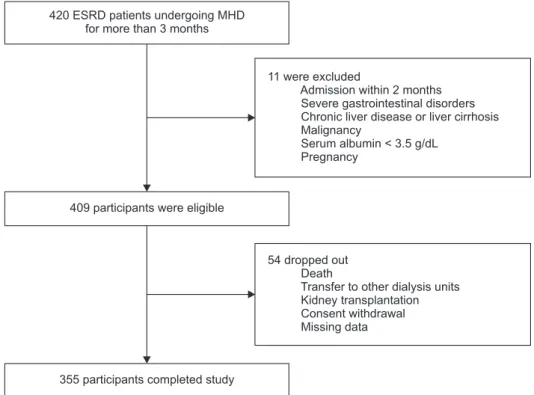
This study was conducted in seven medical centers in South Korea from March 2016 to February 2017. Adult (age ≥ 19 years) patients with end-stage renal disease (ESRD) who had been receiving MHD therapy for more than 3 months were screened between December 2015 and February 2016, and a total of 420 patients were iden- tified. Eleven patients were excluded because of intercur- rent illness requiring hospitalization during the prior 2 months, severe gastrointestinal disorders, chronic liver disease or liver cirrhosis, malignancy, serum albumin

< 3.5 g/dL, and pregnancy. The remaining 409 patients were eligible, but 54 dropped out of this study due to death, transfer to other dialysis units, kidney transplanta- tion, consent withdrawal, or no follow-up data. There- fore, 355 patients were included in the final analysis (Fig.

420 ESRD patients undergoing MHD for more than 3 months

11 were excluded

Admission within 2 months Severe gastrointestinal disorders Chronic liver disease or liver cirrhosis Malignancy

Serum albumin < 3.5 g/dL Pregnancy

409 participants were eligible

54 dropped out Death

Transfer to other dialysis units Kidney transplantation Consent withdrawal Missing data

355 participants completed study

Figure 1. Flow chart of patient enrol- ment.

ESRD, end-stage renal disease; MHD,

main tenance hemodialysis.

(3)

Phosphorus (mg/dL) Dietary restriction 4.5

Ca + Calcitriol Ca Carbonate (between meal)

Ca + Calcitriol Ca Carbonate

Ca Carbonate Ca + Calcitriol

5.0

2.4

8.4 9.0 9.6 10.2

Nutrition assessment

Calcium (mg/dL)

Ca Acetate NCBP (or Ca Acetate)*

Paricalcitol

Cinacalcet

Ca Acetate

Paricalcitol

NCBP (or Ca Acetate)*

Cinacalcet Calcitriol

Paricalcitol

Calcitriol

#1. Serum P mg/dL

#2. Serum PTH

#3. Serum Ca

Diet P control consider P binder

Serum Ca Serum Ca

Calcitriol Calcitriol

Calcitriol or Paricalcitol

Paricalcitol or Cinacalcet

Cinacalcet Ca-based P binder

NCPB

P > 5.5 mg/dL Ca x P > 55

F/U Serum

PTH

F/U Serum P

Efforts to avoid ABD

Reduce or Stop

Increase or Combination

Consider parathyroidectomy

#1 #2

Re-evaluate nutritional

status

Stop P binder NCPB

Stop vitamin D analogues Decrease dialysate Ca.

If needed Consider low turn-over

disease NCPB Reduce vitamin D

analogues Continue current tx.

Ca-based P binder Ca carbonate (between meal)

< 8.4 mg/dL

8.4 9.6 mg/dL

mg/dL

> 10.2 mg/dL

100 200 pg/mL

200 300 pg/mL

> 4.5 mg/dL

> 300 pg/mL

< 8.4 mg/dL 8.4 9.0 mg/dL mg/dL > 10.2 mg/dL < 9.6 mg/dL > 9.6 mg/dL

Continue

> 2.4 mg/dL < 2.4 mg/dL

< 10 pg/mL 0 < 15 pg/mL 0 > 300 pg/mL

> 500 pg/mL

Parathyroid USG > 500 mm Intractable hyper Ca, P, calcification

3
A

B

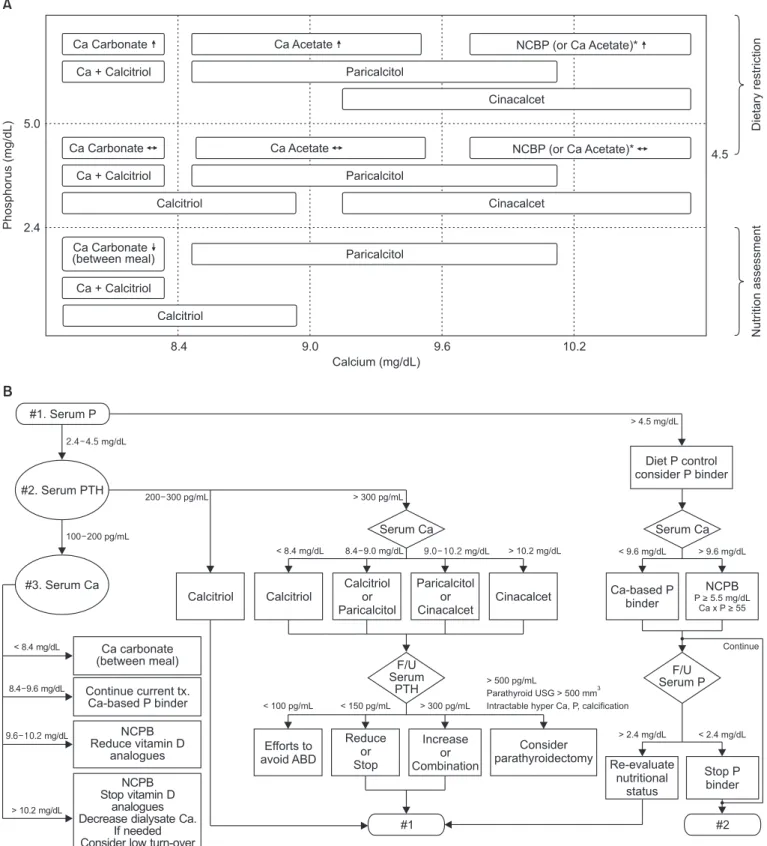
Figure 2. Quality improvement strategy for chronic kidney disease-mineral bone disorder (CKD-MBD) management based on Korean Recommendations. (A) Medication categories are shown according to levels of serum calcium and phosphorus. Adapted from the article of Hwang et al (Kidney Res Clin Pract 34:4-12, 2015) [9]. (B) Sequential approaches are presented for selection and adjustment of medications.

ABD, adynamic bone disease; Ca, calcium; F/U, follow-up; NCPB, non-calcium-based phosphate binder; P, phosphorus; PTH, parathyroid hor- mone; tx., treatment; USG, ultrasonography.

*Non–calcium-based phosphate binder (NCPB) is reimbursed for P ≥ 5.5 mg/dL and Ca-P ≥ 55 mg 2 /dL 2 according to the current Korean Na-

(4)

1). This study was approved by the review board of Han- yang University Hospital (IRB File No. 2015-10-045-004).

Informed consent was obtained from each patient in ac- cordance with the Helsinki Declaration.

Intervention and endpoints

During the study period, our previous recommenda- tions for management of CKD-MBD were followed [9].

Fig. 2 summarizes our strategy to control hyperphospha- temia and secondary hyperparathyroidism. The choice of phosphate binders and PTH-lowering agents was de- termined based on serum calcium levels (Fig. 2A). Serum phosphorus, calcium, and AP were measured at least once per month, and the intact PTH level was measured once every 3 months. Our target ranges were as follows:

serum phosphorus, 2.4 to 5.0 mg/dL; calcium, 8.4 to 9.6 mg/dL; and intact PTH, 100 to 300 pg/mL [10]. Prescrip- tions were altered monthly according to the flow chart shown in Fig. 2B.

After adhering to this strategy for 1 year, serum phos- phorus, calcium, AP, and intact PTH levels were com- pared with the baseline. The primary endpoints of this study were improvement in the proportion of patients with serum mineral levels within the target range of our recommendations. The target level of serum AP was de- fined as ≤ 120 U/L in this study. Secondary endpoints were changes in serum mineral levels after introduction of our recommendations. Serum concentrations of phos- phorus, calcium, and AP were determined by automated and standardized methods, and the intact PTH concen- tration was measured by second-generation PTH assays at each center. In addition to demographic features, data for use of calcium-based or calcium-free phosphate binders, vitamin D analogues, and cinacalcet were collected.

Statistics

Continuous data are presented as means ± standard deviation, and categorical variables are expressed as frequency counts and percentages. A McNemar test was used to assess the difference between the proportion of patients with serum mineral levels at the target of our recommendations before and after implementation of the QI strategy. A Wilcoxon signed-rank test was used to test the difference between basal and follow-up levels of

serum minerals. Other categorical variables were also compared using the McNemar test. Statistical signifi- cance was defined as P < 0.05. All statistical analyses were performed using R programming language ver. 3.4.0 (R Foundation for Statistical Computing, Vienna, Austria).

Results

Demographic features of patients

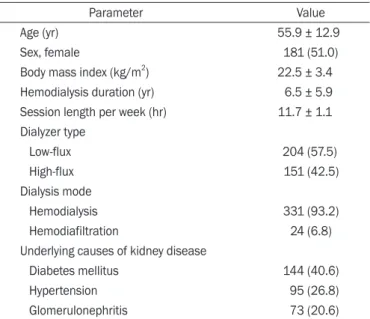
Table 1 shows demographic features of the patient pop- ulation in our study, which consisted of 174 men (49.0%) and 181 women (51.0%) with a mean age of 55.9 ± 12.9 years. The duration of hemodialysis was 6.5 ± 5.9 years.

Data regarding session length, dialyzer type, and dialysis mode were also collected. Although session length and dialysis did not change throughout the study period, the prevalence of high-flux dialyzer use increased from 42.5%

to 50.7% over the study period (P < 0.05). Diabetes mel- litus (n = 144, 40.6%), hypertension (n = 95, 26.8%), and glomerulonephritis (n = 73, 20.6%) were the major causes of ESRD.

Changes in serum concentrations of phosphorus, calcium, AP, and intact PTH

After applying our recommendations for 1 year, the final

Table 1. Demographic features of patients (n = 355)

Parameter Value

Age (yr) 55.9 ± 12.9

Sex, female 181 (51.0)

Body mass index (kg/m

2

) 22.5 ± 3.4 Hemodialysis duration (yr) 6.5 ± 5.9 Session length per week (hr) 11.7 ± 1.1 Dialyzer type

Low-flux 204 (57.5)

High-flux 151 (42.5)

Dialysis mode

Hemodialysis 331 (93.2)

Hemodiafiltration 24 (6.8)

Underlying causes of kidney disease

Diabetes mellitus 144 (40.6)

Hypertension 95 (26.8)

Glomerulonephritis 73 (20.6)

Data are presented as mean ± standard deviation or number (%).

(5)

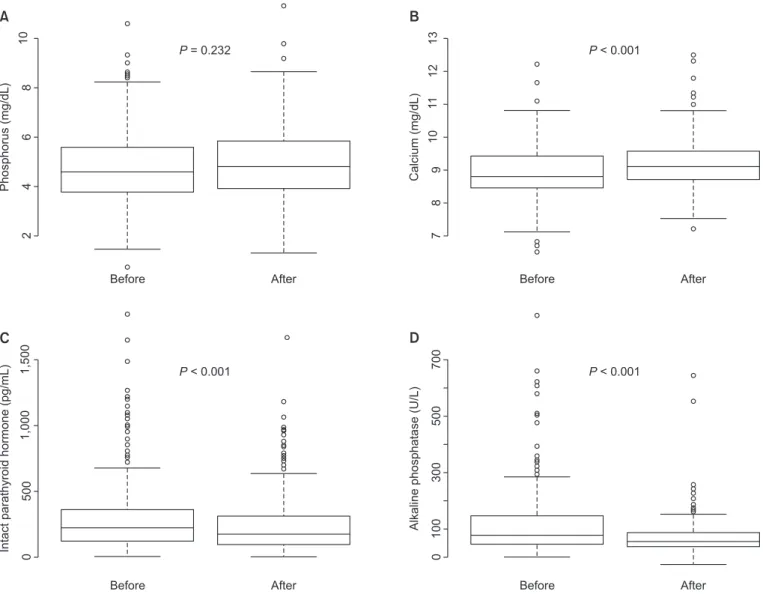
serum phosphorus concentration (4.9 ± 1.5 mg/dL) was not different from baseline (4.8 ± 1.5 mg/dL, P = 0.232).

However, serum calcium concentration significantly increased from 8.9 ± 0.8 mg/dL to 9.2 ± 0.8 mg/dL (P <

0.001). The intact PTH level significantly decreased from 223 ± 235 pg/mL to 176 ± 218 pg/mL (P < 0.001). Consis- tent with this, serum AP decreased from 115 ± 88 U/L to 78 ± 45 U/L (P < 0.001) after the QI activities (Fig. 3).

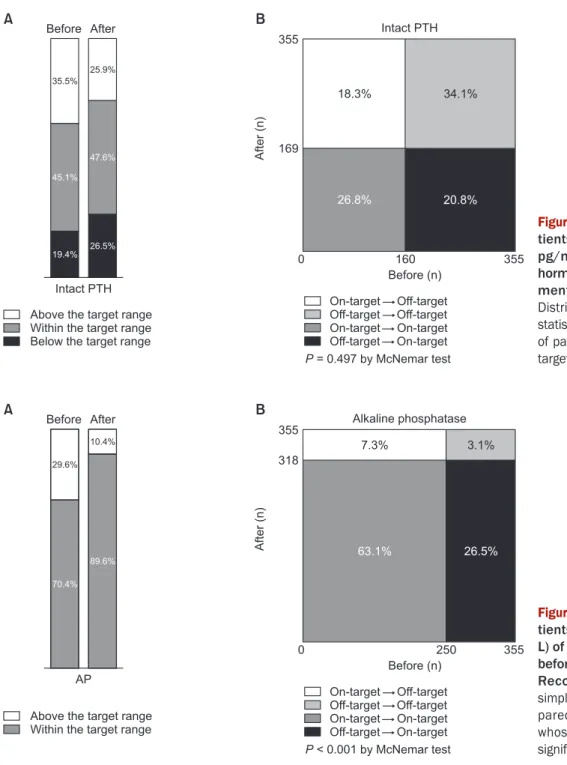
Changes in proportion of patients meeting the target Next, we evaluated whether the proportion of patients meeting the target recommendations was improved by our strategy. Fig. 4 to 7 illustrate changes in the distribu-

tion of patients according to target ranges of serum phos- phorus, calcium, intact PTH, and AP both before and after implementing this strategy.

The target for serum phosphorus was 2.4 to 5.0 mg/dL [10]. Initially, 186 patients (52.4%) were within the target range of serum phosphorus (Fig. 4A). Similarly, 180 pa- tients (50.7%) had the target level of serum phosphorus at the end of the study. Among 169 patients who were out of the target range at baseline, 69 patients (40.8%) were in the target range at the end of the study. However, 75 (40.3%) of 186 patients who were within the target range at baseline had moved out of the target range at the study end. As a result, the proportion of patients with serum phosphorus within the target range was not significantly

Phosphorus (mg/dL) 10 8 6 4 2

Before After

P = 0.232

Calcium (mg/dL) 12 1 1 10 9 8 7 13

Before After

P < 0.001

Intact parathyroid hormone (pg/mL) 1,500 1,000 500 0

Before After

P < 0.001

Alkaline phosphatase (U/L) 700 500 300 100 0

Before After

P < 0.001

A B

C D

Figure 3. Comparisons of serum phosphorus (A), calcium (B), intact parathyroid hormone (C), and alkaline phosphatase (D) levels

before and after implementing Korean Recommendations. Serum calcium concentration was significantly increased, and levels of se-

rum intact parathyroid hormone and alkaline phosphatase were significantly decreased.

(6)

changed (P = 0.677, Fig. 4B).

Our target for serum calcium was 8.4 to 9.6 mg/dL [10].

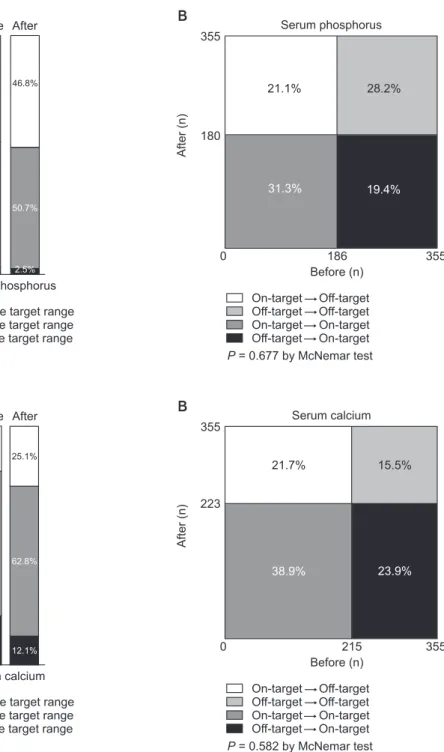
Initially, 215 patients (60.6%) were within the target range of serum calcium (Fig. 5A). Among these, only 138 pa- tients (64.2%) had the target level of serum calcium at the end of the study. In addition, 85 patients (60.7%) entered the target range among 140 patients who were out of the target range at baseline. Finally, 223 patients (62.8%) had serum calcium within the target range when the study

finished. Thus, the proportion of patients with serum calcium within the target range was not significantly af- fected (P = 0.582, Fig. 5B).

A total of 160 (45.1%) and 169 patients (47.6%) were within the target range of intact PTH (100-300 pg/mL) at baseline and at the end of the study, respectively (Fig.

6A). Only 95 patients (59.4%) remained within the tar- get range of serum intact PTH among those who were initially at the target, whereas 74 (37.9%) of 195 patients

Above the target range Within the target range Below the target range

Serum phosphorus Before After

44.5% 46.8%

52.4%

50.7%

3.1% 2.5%

A

On-target Off-target Off-target Off-target On-target On-target Off-target On-target 355

After (n)

180

0

Serum phosphorus

186 355

21.1% 28.2%

19.4%

31.3%

Before (n)

P = 0.677 by McNemar test

B

Figure 4. Changes in the proportion of patients within the target range (2.4- 5.0 mg/dL) of serum phosphorus be- fore and after implementing Korean Recommendations. Distributions are simply shown in A and statistically com- pared in B. The proportion of patients whose serum phosphorus was at the tar- get was not significantly altered.

Above the target range Within the target range Below the target range

Serum calcium Before After

A

On-target Off-target Off-target Off-target On-target On-target Off-target On-target 355

After (n) 223

0

Serum calcium

215 355

21.7% 15.5%

23.9%

38.9%

Before (n)

P = 0.582 by McNemar test

B

18.9%

25.1%

60.6%

62.8%

20.6%

12.1%

Figure 5. Changes in proportion of pa- tients within target range (8.4-9.6 mg/

dL) of serum calcium before and after

implementing Korean Recommen-

da tions. Distributions are simply shown

in A and statistically compared in B. The

proportion of patients whose serum cal-

cium was at the target was not significantly

altered.

(7)

who were out of the target at baseline entered the target range by the study end. Thus, the proportion of patients with intact PTH level within the target range was not sig- nificantly altered (P = 0.497, Fig. 6B). Conversely, the pro- portion of patients with serum intact PTH > 500 pg/mL significantly decreased from 51 (14.4%) to 34 (9.6%) after 1 year (P = 0.022).

Serum AP results are the most notable. Initially, 250 patients (70.4%) were within the target range of serum AP

(Fig. 7A). Most of these (237 patients) maintained their target level of serum AP at the end of the study. Among 105 patients who were out of the target at baseline, 81 patients entered the target range. Finally, 318 patients (89.6%) achieved the target level of serum AP at the study end. Thus, the proportion of patients with serum AP within the target range was significantly increased (P <

0.001, Fig. 7B).

Above the target range Within the target range Below the target range

Intact PTH Before After

A

On-target Off-target Off-target Off-target On-target On-target Off-target On-target 355

After (n)

169

0

Intact PTH

160 355

18.3% 34.1%

20.8%

26.8%

Before (n)

P = 0.497 by McNemar test

B

35.5%

25.9%

45.1%

47.6%

19.4%

26.5%

Figure 6. Changes in proportion of pa- tients within target range (100—300 pg/mL) of serum intact parathyroid hormone (PTH) before and after imple- menting Korean Recommendations.

Distributions are simply shown in A and statistically compared in B. The proportion of patients whose serum PTH was at the target was not significantly altered.

Above the target range Within the target range

AP Before After

A

On-target Off-target Off-target Off-target On-target On-target Off-target On-target 355

After (n)

318

0

Alkaline phosphatase

250 355

7.3% 3.1%

26.5%

63.1%

Before (n)

P < 0.001 by McNemar test

B

29.6%

10.4%

70.4%

89.6%

Figure 7. Changes in proportion of pa- tients by the target range (< 120 U/

L) of serum alkaline phosphatase (AP)

before and after implementing Korean

Recommendations. Distributions are

simply shown in A, and statistically com-

pared in B. The proportion of patients

whose serum AP was at the target was

signi ficantly increased.

(8)

Use of phosphate binders, vitamin D analogues, and cinacalcet

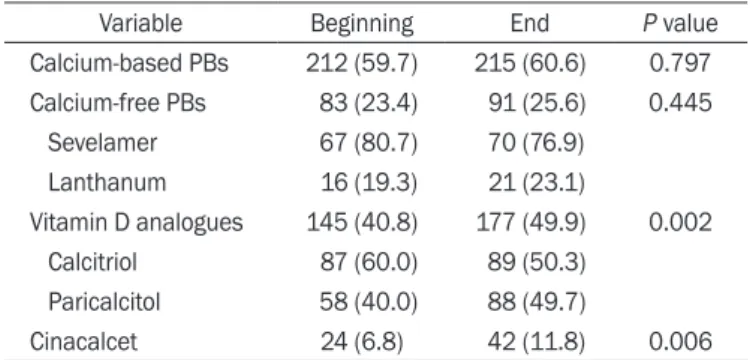
Table 2 shows the difference in medications between the beginning and end of implementing our domestic recom- mendations. Throughout the study period, more than half of the patients took calcium-based phosphate binders.

The number of patients who used either calcium-based or calcium-free phosphate binders was not significantly changed. However, use of PTH-lowering agents, including vitamin D analogues (e.g., paricalcitol), and cinacalcet significantly increased during the study (P < 0.05).

Discussion

Management of CKD-MBD in patients on MHD is chal- lenging because steady control of the parameters is dif- ficult to achieve. Similar to a previous report from several years ago [10], only about half of our patients on MHD were within the target ranges of serum phosphorus, cal- cium, and intact PTH. However, some serum mineral parameters of CKD-MBD were affected by implementa- tion of our local practice recommendations for patients on MHD. In particular, the serum AP level stabilized after adopting our strategy for 1 year to achieve target ranges for serum phosphorus, calcium, and intact PTH.

Treatment of hyperphosphatemia was the pivot of our recommendations for management of CKD-MBD. In ad- dition to phosphate binders, dietary phosphorus restric- tion and adequate dialysis were implemented. However,

the final serum phosphorus level was not different from the baseline in patients in this study. Interestingly, al- most the same number of patients moved into and out of the target range of serum phosphorus during the study period. Thus, our efforts to improve control of hyper- phosphatemia were not successful over a short period of time. Consistent with this, the prevalence of phosphate binders did not significantly change over the study period even though the use of calcium-based versus calcium- free phosphate binders was differentiated.

Albumin-corrected calcium concentrations were not obtained in this study because patients with malnutrition or intercurrent acute illness were excluded. Although the median value of serum calcium was increased by our strategy, the proportion of patients with serum cal- cium levels within the target range was not significantly altered. According to the reimbursement policy of our National Health Insurance program, calcium-based phosphate binders had to be initially prescribed. The in- creased prescription of both vitamin D receptor agonists and cinacalcet may explain the counterbalance in serum calcium by the end of our study. Data on vascular calcifi- cation were not included in this study.

The third mineral parameter in our recommendations is PTH. Our target for intact PTH is somewhat low com- pared with the KDIGO guidelines [1], but similar to the KDOQI and Japanese guidelines [3,5]. Consistent with the change in serum calcium, the median value of serum intact PTH was decreased in this study. Suppression of PTH and AP was associated with the use of both vitamin D analogues and cinacalcet. However, our attempt to im- prove control of secondary hyperparathyroidism was not successful because the proportion of patients with serum intact PTH levels within the target range did not signifi- cantly increase.

In contrast, the changes in serum AP were remarkable.

Our strategy to manage patients with CKD-MBD was as- sociated with a decrease in the median value of serum AP after a short period of time. Furthermore, the number of patients with serum AP levels within the target range was significantly increased by implementation of our domes- tic practice recommendations. We believe that use of vi- tamin D receptor agonists and cinacalcet was successful in modifying high turnover bone disease. Among routine clinical and biochemical markers, serum AP is a sensitive marker of bone mineral density in patients on MHD [11].

Table 2. Comparison of use of PBs, vitamin D analogues, and cinacalcet between the beginning and end of implementing our domestic recommendations

Variable Beginning End P value

Calcium-based PBs 212 (59.7) 215 (60.6) 0.797 Calcium-free PBs 83 (23.4) 91 (25.6) 0.445 Sevelamer 67 (80.7) 70 (76.9)

Lanthanum 16 (19.3) 21 (23.1)

Vitamin D analogues 145 (40.8) 177 (49.9) 0.002 Calcitriol 87 (60.0) 89 (50.3)

Paricalcitol 58 (40.0) 88 (49.7)

Cinacalcet 24 (6.8) 42 (11.8) 0.006

Data are presented as number (%).

PB, phosphate binder; Vitamin D analogues include oral or intravenous calcitriol, 1-a hydroxycholecalciferol, and paricalcitol.

P values were calculated by McNemar test.

(9)

We did not previously include any suggestions on the target level of serum AP in patients on MHD because se- rum total AP may be seen as an adjunct to PTH measure- ment with no clearly defined management targets [12].

However, the recently revised 2017 KDIGO CKD-MBD guidelines recommend monitoring total or bone-specific serum AP activity in patients with advanced CKD [2].

Although bone formation rate was better correlated with plasma bone-specific AP levels than with either plasma total AP or intact PTH concentrations [13,14], serum total AP was used because of its feasibility for routine monitor- ing in patients on MHD. A large cohort study showed that increased serum total AP > 120 U/L was associated with mortality among patients on MHD [15]. Unlike the U- or J-shaped association of serum phosphorus or PTH with mortality in patients on chronic dialysis, serum total AP level had a more linear association with mortality. Other studies also showed that only higher serum AP concen- trations were associated with increased mortality [16,17].

Thus, we defined our target for serum AP as ≤ 120 U/L.

There are several limitations to this study. There were a small number of patients, the follow-up period was short, and parameters related to hard outcomes were not obtained. Among the 7 dialysis units that participated in this study, only a few centers previously had their own CKD-MBD treatment protocols. Most centers complied with the national health insurance guidelines and adopt- ed international guidelines such as KDOQI and KDIGO.

Because the general principles in treating CKD-MBD in patients on MHD were not substantially changed by our new strategy, strict adherence to a certain recommenda- tion or overcoming the physician’s inertia is very impor- tant to achieve quality care. Within a certain guideline, individualized approaches would enhance achievement as well. Nonetheless, we showed that our local adapta- tion for managing CKD-MBD in patients on MHD was feasible and can be applied as a QI strategy. To the best of our knowledge, few previous studies have reported adap- tation of global clinical practice guidelines for QI of local practices.

In conclusion, we carried out a simplified medication adjustment over 1 year to achieve certain targets of se- rum phosphorus, calcium, and intact PTH in patients on MHD. Although serum phosphorus, calcium, and PTH levels were not effectively controlled over a short period of time, serum AP level improved in our patients. This

stabilization of serum AP activity in patients with CKD- MBD will ameliorate high turnover bone disease and possibly improve mortality. Long-term follow-up evalu- ations are necessary to determine whether our modifi- cations affect uremic bone disease and cardiovascular calcifications.

Conflicts of interest

All authors have no conflicts of interest to declare.

Acknowledgments

This study was funded by AbbVie Korea.

References

[1] Kidney Disease: Improving Global Outcomes (KDIGO) CKD-MBD Work Group. KDIGO clinical practice guideline for the diagnosis, evaluation, prevention, and treatment of Chronic Kidney Disease-Mineral and Bone Disorder (CKD- MBD). Kidney Int Suppl (113):S1-S130, 2009

[2] Ketteler M, Block GA, Evenepoel P, et al. Executive sum- mary of the 2017 KDIGO Chronic Kidney Disease-Mineral and Bone Disorder (CKD-MBD) Guideline Update: what’s changed and why it matters. Kidney Int 92:26-36, 2017 [3] National Kidney Foundation. K/DOQI clinical practice

guidelines for bone metabolism and disease in chronic kid- ney disease. Am J Kidney Dis 42(4 Suppl 3):S1-S201, 2003 [4] Kim GH. Gaps between global guidelines and local prac-

tices in CKD-MBD. Electrolyte Blood Press 12:35-40, 2014 [5] Fukagawa M, Yokoyama K, Koiwa F, et al. Clinical practice

guideline for the management of chronic kidney disease- mineral and bone disorder. Ther Apher Dial 17:247-288, 2013

[6] Elder G, Faull R, Branley P, Hawley C; Caring for Austral- asians with Renal Impairment (CARI). The CARI guide- lines. Management of bone disease, calcium, phosphate and parathyroid hormone. Nephrology (Carlton) 11 Suppl 1:S230-S261, 2006

[7] Steddon S, Sharples E. Renal Association Clinical Practice Guideline in mineral and bone disorders in CKD. Nephron Clin Pract 118 Suppl 1:c145-c152, 2011

[8] Goldsmith DJ, Covic A, Fouque D, et al. Endorsement of

the Kidney Disease Improving Global Outcomes (KDIGO)

Chronic Kidney Disease-Mineral and Bone Disorder (CKD-

(10)

MBD) Guidelines: a European Renal Best Practice (ERBP) commentary statement. Nephrol Dial Transplant 25:3823- 3831, 2010

[9] Hwang E, Choi BS, Oh KH, Kwon YJ, Kim GH. Management of chronic kidney disease-mineral and bone disorder: Ko- rean working group recommendations. Kidney Res Clin Pract 34:4-12, 2015

[10] Kim GH, Choi BS, Cha DR, et al. Serum calcium and phos- phorus levels in patients undergoing maintenance hemodi- alysis: A multicentre study in Korea. Kidney Res Clin Pract 33:52-57, 2014

[11] Park JC, Kovesdy CP, Duong U, et al. Association of serum alkaline phosphatase and bone mineral density in main- tenance hemodialysis patients. Hemodial Int 14:182-192, 2010

[12] Lamb EJ, Delaney MP. Does PTH offer additive value to ALP measurement in assessing CKD-MBD? Perit Dial Int 34:

687-691, 2014

[13] Ureña P, Hruby M, Ferreira A, Ang KS, de Vernejoul MC.

Plasma total versus bone alkaline phosphatase as mark- ers of bone turnover in hemodialysis patients. J Am Soc Nephrol 7:506-512, 1996

[14] Chiang C. The use of bone turnover markers in chronic kidney disease-mineral and bone disorders. Nephrology (Carlton) 22 Suppl 2:11-13, 2017

[15] Regidor DL, Kovesdy CP, Mehrotra R, et al. Serum alkaline phosphatase predicts mortality among maintenance he- modialysis patients. J Am Soc Nephrol 19:2193-2203, 2008 [16] Abramowitz M, Muntner P, Coco M, et al. Serum alkaline

phosphatase and phosphate and risk of mortality and hos- pitalization. Clin J Am Soc Nephrol 5:1064-1071, 2010 [17] Rhee CM, Molnar MZ, Lau WL, et al. Comparative mortal-

ity-predictability using alkaline phosphatase and parathy-

roid hormone in patients on peritoneal dialysis and hemo-

dialysis. Perit Dial Int 34:732-748, 2014

수치

Figure 1. Flow chart of patient enrol- enrol-ment.
Figure 2. Quality improvement strategy for chronic kidney disease-mineral bone disorder (CKD-MBD) management based on  Korean Recommendations
Fig. 2 summarizes our strategy to control hyperphospha- hyperphospha-temia and secondary hyperparathyroidism
Figure 3. Comparisons of serum phosphorus (A), calcium (B), intact parathyroid hormone (C), and alkaline phosphatase (D) levels  before and after implementing Korean Recommendations
+4

참조

관련 문서