뇌졸중 환자군의 Warfarin Nomogra m 설정을 위한 실제 처방전 평가
장주영
*
·고경미*
·윤지연*
·한옥연*
·임성실**
,#*가톨릭대학교 강남성모병원 약제팀, **충북대학교 약학대학
(Received February 12, 2009; Revised February 28, 2009; Accepted March 4, 2009)
Evaluation of Prescription Data for Development of Warfarin Nomogram in Korean Patients with Cerebral Infarction
Ju Young Jang*, Kyung Mi Ko*, Ji Yeon Yoon*, Ok Yeon Han* and Sung Cil Lim**
,#*Department of Pharmacy, Kangnam ST, Mary’s Hospital, The Catholic University of Korea
**College of Pharmacy, CBITRC, Chungbuk National University, 410 Sungbong-ro, Heungduk-gu, Cheongju, Chungbuk 361-763, Korea
Abstract
— Warfarin is the most widely used oral anticoagulant in the world but maintenance of proper therapeutic range and prevention of adverse drug events always need to be careful. Especially, in Korea, warfarin dosing for patients with cere- bral infarction is currently based on the nomogram which is done by foreign clinical trials not for the Korean. Therefore we evaluate warfarin dose of patients in the neurology and eventually get the base data of warfarin nomogram for Korean with stroke. We performed this study retrospectively on reviewing the medical charts to evaluate the prescribed loading dose (LD) and maintenance dose (MD) of warfarin and each responding International Normalized Ratio (INR) with any bleeding adverse drug reaction including of patient's characteristics for total 75 patients with stroke in the department of neurology of Kangnam ST. Mary’s Hospital from January 2005 to June 2008. All evaluated patients should not be treated with warfarin in the past at all and should be initiated warfarin therapy first.ly at this time. All evaluated patients were divided as two classes by wafarin LD which is; 1) HDG - a high loading dosing group prescribed over 5mg, and 2) LDG - a low loading dosing group prescribed 5mg or below. As a result, average LD was 9.34±0.22 mg (p=0.000) in HDG and 4.25±0.39 mg (p=0.000) in LDG. Average baseline INR was 0.91±0.05 (p=0.161) in HDG and 1.26±0.14 (p=0.002) in LDG. On the first and second week, daily MD was 4.21±0.14 mg (p=0.000) and 2.96±0.19 mg (p=0.696) in HDG and also in LDG, 2.95±0.29 mg (p=0.000) and 3.14±0.36 mg (p=0.696). Also average reacting daily INR was respectively 2.53±0.12 (p=0.141) and 2.51±0.16 (p=0.678) in HDG, and in LDG, 2.11±0.17 (p=0.141) and 2.42±0.14 (p=0.678). After the second week, INR was not measured in regularly. Also most of underlying diseases were hypertension (n=38), diabetes mellitus (n=14), dys- lipidemia (n=8) in order. Four ADRs with simple hemorrhage were occurred and those were due to drug interaction by co- medication. In the conclusion, proper starting LD for Korean with stroke is 10 mg if baseline INR is around 1.0 or 5 mg if over 1.3. Proper MD need to be more evaluated in the future for setting up warfarin nomogram to make prospective study.
Keywords □
warfarin, INR, nomogram, dosing
Warfarin
은coumarin
유도체로서실제임상에서혈전이과도 하게많이생기는질환(
심부정맥혈전,
폐색전,
심장판막질환,
심장판막치환술환자
,
심방세동,
급성심근경색등)
에서혈전및색전증의치료와예방을위해사용되는항응고제이다
.
1-5)이 약물은치료학적범위가좁아적정용량보다적게복용할경우 혈전생성의위험이있으며,
과량복용시출혈등과같은위험한 부작용이발생될 수 있으므로증상과 함께 반드시
INR
(International Normalized Ratio) monitoring
을해야 한다.
2-5)또한해당질환과환자의상태에따라반응이다르기때문에반 드시투약시
INR monitoring
결과에따른개별화된용량설정이필요하다
.
6,7)지금까지이전의국내연구를살펴보면warfarin
의용량설정에대한평가는주로순환기내과에서의심장및판 막질환환자
,
외래환자를대상으로한연구가대부분이었다.
8-11)이에반해현재우리나라사망원인
2
위를차지하고있는뇌졸중환자의
warfarin
치료에있어서는순환기환자못지않게많이사용하고있음에도불구하고연구가매우부족한실정이다
.
즉한국인뇌졸중환자의치료시
warfarin
용량설정및적용은현재외국의경우를적용하여사용하므로적절한치료효과에도달
#본논문에관한문의는저자에게로
(
전화) 043-261-3590 (
팩스) 043-268-2732
(E-mail) [email protected]
하지못하거나출혈등과같은위험한부작용을초래할수있다
.
12)이에본원뇌졸중환자에게처방된
warfarin Loading Dose(LD)
및
Maintenance Dose(MD)
를검토하고실제반응INR
과부작 용 발생 및 약물 상호 작용 기전에 대한 조사를 실시하여, warfarin nomogram
작성을위한기초자료로삼아뇌졸중환자 의치료의질을높이고자하였다.
실험 방법
연구대상환자및자료수집방법
2005
년1
월~2008
년6
월까지뇌졸중으로본원신경과에입원 한환자중에서처음으로warfarin
복용을시작한환자163
명을 선정하고그들의의무기록지를후향적으로검토하여평가하였다.
단
,
대상환자들중2005
년이전부터warfarin
복용경력이있는 환자,
타임상과에서warfarin
을복용하다가뇌졸중으로입원한 환자(warfarin
복용으로인한INR
변화의영향을배제하기위함),
외래에서
warfarin
복용을이미시작했던환자(
초기15
일동안의daily INR
측정값이없음),
퇴원후외래진료기록이없는환자(
투여12
주까지의warfarin
투여용량과반응INR
값을알수없음),
외국인환자
(
한국인의warfarin
용량에따른반응INR
값을보기 위함),
사망한환자는괄호안에나열한이유로인해연구대상에서제외하였다
.
자료수집내용
수집내용은크게환자의특성들
, Loading dose(LD),
투여12
주까지의
Maintenance dose(MD),
각용량에따른반응INR
및 출혈증상과같은부작용발생,
부작용발생시병용한약물의종류와
warfarin
의antidote
인비타민K
투여여부이다.
조사된환자의특성들에는나이
,
성별,
체중,
기저질환,
흡연유무,
음주 유무,
최근2
개월이내수술경력등이있다. LD
는첫날복용한용량으로
5 mg
초과하여 복용한 경우를High Dose Group (HDG)
으로분류하고5 mg
이하의용량으로복용한경우는Low
Dose Group(LDG)
으로분류하여평가하였고MD
는복용이틀째부터의용량으로
daily dose
와weekly dose
로나누어조사하 였다.
특히MD
는warfarin
복용둘째날부터복용15
일째까지 만조사하였고복용15
일째가되기전에퇴원한경우는퇴원시까지만
MD
를조사하였다. Weekly dose
는LD
를제외하고둘째 날부터복용한용량을기준으로7
일간격으로정하였으며투여1
주부터투여12
주까지조사하였다.
평가한반응INR
은복용전초기
INR(baseline INR),
첫번째복용12
시간후INR,
첫번째 복용36
시간이후INR,
퇴원시까지매일아침측정한INR,
퇴원이후투여
12
주까지외래방문시마다측정한INR
로나누어조사하였다
.
조사된부작용의발생과양상은약물의투여시작일부터투여
12
주째까지에서혈전생성과출혈증상들이다.
즉, warfarin
저용량투여에기인한혈전생성으로발생되는다리통증또는빈 맥이며또한
warfarin
과용량투여에기인된멍,
잇몸출혈,
혈뇨,
잠혈
,
코피,
안구또는점막출혈등을살펴보았다.
추가로warfarin
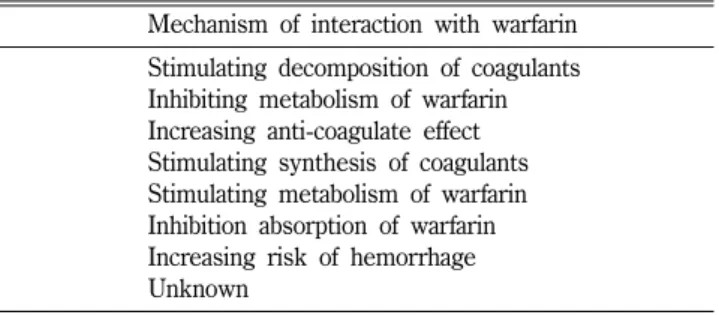
과상호작용이있는병용약물들을조사하되상호작용기전에 따라분류조사하였다
.
즉,
응고인자의분해를촉진하는경우, warfarin
의대사를저해하는경우,
항응고효과를상승시키는경우
,
응고인자의합성을촉진하는경우, warfarin
대사를촉진하 는경우, warfarin
의흡수를저해하는경우,
출혈위험을증가시키는경우와그기전이밝혀지지않은경우의
8
가지로나누어분류하였다
.
12-14)이때위험성출혈부작용이발생시처치법인비타민
K
투여의여부도조사하여반영하였다(Table I).
통계
자료분석은
SPSS Ver.12(for windows)
이용하여통계처리하였고데이터분석을위해사용한통계분석방법은빈도분석및교 차분석및
Student t-test
를이용하였고유의수준p
값이p<0.05
인경우에유의한것으로통계처리하였다
. 연구 결과 및 고찰
연구대상환자들의특성
연구대상으로선정된환자들은총
75
명이었으며총75
명중 남성이45
명,
여성이30
명이었다.
HDG
의수는61
명, LDG
는14
명이었다.
성별,
연령,
체중,
기 저질환등의특성을살펴보면,
연령의분포는HDG
의경우에는 평균69.10±1.51
세, LDG
의경우에는평균62.29±4.61
세로고령화연령이많았다
.
그룹별평균체중은64.06±1.51 kg(HDG)
와58.23±2.482 kg(LDG)
로,
특별히warfarin
투여시체중을고려해 야할만큼의과체중자나저체중자는없었다.
또한warfarin
투여시반드시
monitoring
을해야하는기저질환인,
출혈의위험 을높일수있는고혈압,
혈전생성의위험이높은당뇨,
지질이상증을앓고있는환자들을조사하였는데고혈압을가진대상자 가
38
명,
당뇨를가진사람이14
명이었고8
명은지질이상증을 가지고있었다(Table II).
Table I −
Mechanism of drug interaction by warfarin
Mechanism of interaction with warfarin
Stimulating decomposition of coagulants
Inhibiting metabolism of warfarin
Increasing anti-coagulate effect
Stimulating synthesis of coagulants
Stimulating metabolism of warfarin
Inhibition absorption of warfarin
Increasing risk of hemorrhage
Unknown
Group별warfarin용량및INR
Loading Dose(LD)와 baseline INR − 연구결과
HDG
와LDG
의그룹간의baseline INR
의차이가있었다. Baseline INR
은
HDG
에서0.91±0.05(p=0.161)
이고LDG
에서는1.26±0.14 (p=0.002)
로평균적으로LDG
가높은baseline INR
을보였다.
두그룹간평균
LD
를살펴보면HDG
의LD
는평균9.34±0.22 mg
이고LDG
의경우에는4.25±0.39 mg
였다(Table III).
Weekly MD와반응INR
복용첫주의
Group
별평균weekly dose
는HDG
와LDG
가각각
29.49±0.96 mg, 20.68±2.00 mg
이었고이것을하루용량 으로 환산한MD
는HDG
의 경우4.21±0.14 mg
이고LDG
는2.95±0.29 mg
이었다(P=0.00).
복용둘째주의경우에는HDG
의평균
weekly dose
는20.75±1.35 mg, daily dose 2.96±0.19 mg
이었고LDG
의평균weekly dose
는21.96±2.55 mg, daily
dose
는3.13±0.36 mg
이었다(p=0.696).
즉, HDG
의경우첫주 약4 mg,
둘째주3 mg
의MD
를투여하고있었고LDG
경우첫주와둘째주모두약
3 mg
의MD
를투여하고있었다.
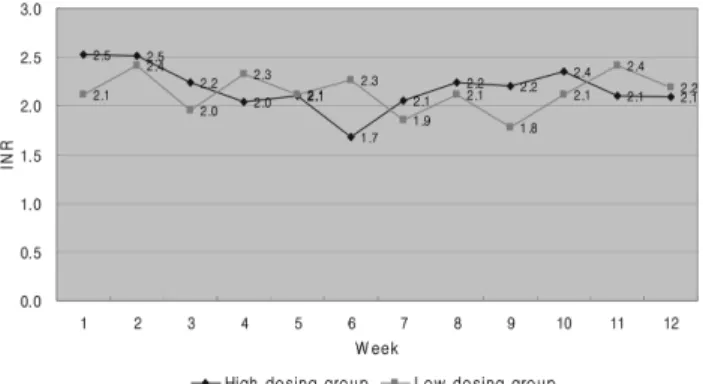
또한이 에따른반응INR
을HDG
의경우첫주2.52±0.12 mg, LDG
의 경우에는2.10±0.17 mg
이었다(p=0.141).
둘째 주는HDG
와LDG
가각각2.50±0.16 mg, 2.41±0.14 mg
이었다(p=0.678).
둘째주이후부터
12
주까지의값들은INR
결측값이많아투여용량과그에따른반응
INR
값을정확히나타낼수없었으나첫주와둘째주의값들과함께
Table IV
에정리하였다.
또한Weekly INR
을나타내었다(Table IV)(Fig. 1).
부작용과약물상호작용
대상환자들중
warfarin
저용량투여에기인된혈전생성으로다리통증이나빈맥을호소한환자는없었으며
,
과용량투여로인한멍
,
잇몸출혈,
혈뇨,
잠혈,
코피,
안구또는점막출혈등 만총4
명의환자들에서발생하였다.
세부적으로살펴보면멍이든환자가
1
명,
혈뇨가있었던환자가2
명,
가래에피가섞여나온환자가
1
명이었으며또한이때이들부작용발생환자들의병용약물을조사한결과
Warfarin
과상호작용의기전은다음과같다
.
멍이있었던환자의경우에서는warfarin
흡수를저해하는약물
(1
종류)
과출혈위험을증가시키는약의병용(1
종류),
혈뇨가 있었던2
명의환자들에서는warfarin
대사를저해하는약의병Table II −
Demographic characteristics of patients
Variable HDG (n
‡=61) LDG (n
‡=14)
The number of patient
(n‡) Male 39 Male 6
Female 22 Female 8
Age (years) 69.10±1.51 62.29±4.61
Average weight (kg) 64.06±1.518 58.23±2.482
Underlying Disease*
(n‡)
Stroke (4) Hypertension (34) Hyperlipidemia (7) Diabetes (12) Hyperthyroidism (1) Cardiomegaly(1) Myocardial (1) Parkinson disease (1) Lung cancer (1)
Coronary Arterial Disease (1) Congestive Heart Failure (1) Heart failure (1)
Valve disease (1)
Myocardiac Infarction(+)=1 Percutaneous Transluminal Coronary Angioplasty (1) Tuberculosis (1) Varix (1) A-fib(1)
Intra-Cerebral Hemorrhage (1) Acute Myocardial Infarction (1) Mitral obstruction(1)
Hypertension (4)
Pulmonary hypertension (1) Hyperlipidemia (1)
Diabetes (2) Myocardial (1) Gastric cancer (1) Valve disease (1) Febrile seizure(1)
* Duplication count
‡ n=number
Table III −
LD and Baseline INR** per each dosing group Loading dose Baseline INR
p
HDG (n=61) 9.34±0.22 0.91±0.05 0.161
LDG (n=14) 4.25±0.39 1.26±0.14 0.002
**INR=International Normalized Ratio
용
(1
종류), warfarin
의항응고효과를상승시키는약의병용(2
종 류), warfarin
흡수를저해하는약의병용(1
종류)
등이있었으며,
가래에피가나왔던한명의환자의경우는
warfarin
대사를저해하는약물의병용
(3
종류), warfarin
의항응고효과를상승시키 는약의병용(2
종류), warfarin
의흡수를저해하는약의병용(1
종류
)
이있는것으로조사되었다.
비타민K
의투여가필요한위험 한출혈의경우는없었던것으로조사되었다(Table V).
결 론
본연구결과에서도현재본원에서뇌졸중환자에게
LD
로처방되고있는
10 mg
이적절한용량으로평가되었다.
지난연구의결과는신경과뇌졸중환자의경우흉부외과환자의평균
LD
인
4 mg
에비해고용량인10 mg
을사용하고있으며목표INR
2~3
에도달하는시간이흉부외과환자의경우평균6
일이걸리는데반해신경과뇌졸중환자의경우에는
3~4
일만에도달함을보여주었다
.
또한재원일수도흉부외과보다신경과환자들이짧아서
10 mg
사용이적절하다는결론을내렸었다.
이번연구에서도
HDG
의평균반응INR
이일주일안에목표치에도달하여그Table IV −
Weekly dose and each responding INR
MD*** responding INR
dosing group High Low
dosing group P
dosing group High Low
dosing group P
n Weekly
dose Daily
dose n Weekly
dose Daily
dose n Weekly
INR n Weekly
INR W1 n=61,
non=0 29.49±
0.955 4.21±
0.14 n=14,
non=0 20.68±
2.00 2.95±
0.29 0.000 n=60,
non=1 2.53±
0.12 n=13,
non=1 2.11±
0.17 0.141
W2 n=61,
non=0 20.75±
1.35 2.96±
0.19 n=14,
non=0 21.96±
2.55 3.14±
0.36 0.696 n=46,
non=15 2.51±
0.16 n=13,
non=1 2.42±
0.14 0.678
W3 n=61,
non=0 20.49±
1.33 2.93±
0.19 n=14,
non=0 21.46±
2.53 3.07±
0.36 0.749 n=34,
non=27 2.24±
0.14 n=13,
non=1 1.95±
0.35 0.503
W4 n=61,
non=0 21.45±
1.36 3.06±
0.19 n=14,
non=0 22.29±
2.22 3.18±
0.32 0.785 n=35,
non=26 2.04±
0.11 n=7,
non=7 2.33±
0.38 0.320
W5 n=60,
non=1 22.07±
1.43 3.15±
0.20 n=14,
non=0 22.46±
2.08 3.21±
0.30 0.902 n=24,
non=37 2.10±
0.20 n=6,
non=8 2.12±
0.46 0.961
W6 n=60,
non=1 22.39±
1.43 3.20±
0.20 n=14,
non=0 23.21±
2.31 3.32±
0.33 0.796 n=21,
non=40 1.68±
0.24 n=5,
non=9 2.26±
0.36 0.181
W7 n=60,
non=1 23.19±
1.41 3.31±
0.20 n=14,
non=0 23.14±
2.23 3.31±
0.32 0.988 n=29,
non=32 2.05±
0.12 n=5,
non=9 1.85±
0.26 0.515
W8 n=60,
non=1 23.9±
1.43 3.41±
0.20 n=14,
non=0 24.00±
2.17 3.43±
0.31 0.977 n=19,
non=42 2.24±
0.32 n=7,
non=7 2.11±
0.22 0.691
W9 n=60,
non=1 23.87±
1.45 3.41±
0.21 n=14,
non=0 24.07±
2.25 3.44±
0.32 0.949 n=10,
non=51 2.20±
0.26 n=4,
non=10 1.78±
0.36 0.391 W10 n=60, non=1 24.25±
1.49 3.46±
0.21 n=14,
non=0 24.66±
2.30 3.52±
0.33 0.901 n=16,
non=45 2.35±
0.17 n=4,
non=10 2.12±
0.23 0.543
W11 n=59
non=2 24.25±
1.53 3.46±
0.22 n=14,
non=0 24.44±
2.30 3.49±
0.33 0.954 n=17,
non=44 2.10±
0.20 n=4,
non=10 2.42±
0.59 0.53 W12 n=57, non=4 23.95±
1.51 3.42±
0.22 n=14,
non=0 24.96±
2.29 3.56±
0.33 0.764 n=17,
non=44 2.09±
0.21 n=4,
non=10 2.19±
0.07 0.827
***MD=Maintenance dose non; no measuring laboratory result Wn; each week number from the dosing
Fig. 1 −
Weekly international normalized ratio (1
st~12
thweek)
between HDG and LDG groups. HDG: High loading dose
group; LDG: Low loading dose group.
적절성을보여주었다
.
8-12)MD
는HDG
의경우첫주4 mg/
일,
둘째주
3 mg/
일, LDG
의경우둘째주까지3 mg/
일로유지하여복용했을때그반응
INR
이목표INR 2~3
에모두도달하였으므로적절하게사용되고있는것으로보인다
.
13-16)또한그룹별평균연령과
LD
의관계를보면HDG
의평균나이
69.10±1.51
세, LDG
의평균62.29±4.61
세로두그룹모두 고령화연령층이었으며이것은뇌졸중발생평균연령에일치하 는결과였다.
특이한사항으로는연령이좀더낮은그룹에서LD
가오히려더적은것으로보여져이전의연구들의결과와는다
른결과를보였다
.
15-19)이결과는LDG
의n
수가적은것때문으로추가적인연구가필요할것으로사료된다
.
용량설정에있어서특별히체중을조절해야할정도로과체중이나저체중이심 할경우
warfarin
용량에따른반응INR
에영향을미칠수있기때문에대상환자의체중을모두살펴보았지만모두실제체중
(actual body weight)
이 이상체중(ideal body weight)
의±20%
범위안에들어
,
이번연구에서체중에의한영향은없었다.
부작용평가에있어서는이전결과에서
Vit. K
투여환자의명수로부작용발현을조사했던것과는달리더구체적으로혈뇨
,
멍,
피섞인가래등생명을위협하는수준의부작용이아닌경미한 부작용이발현하였다는것과부작용발현환자들이
warfarin
과 상호작용이있는약물들을병용하고있었다는것이밝혀짐으로부작용발현이고용량복용으로인한것으로보기어려워
10mg
의적절성이더욱명확히확인되었다
.
12-15)특히이번연구를통해
baseline INR
이환자의LD
를결정하 는기준이될수있는의미있는수치를얻어내었는데,
한국인뇌졸중환자에서초기용량투여시
baseline INR 1.0
전후일 때10 mg, baseline INR 1.3
이상이면5 mg
로투여하는것이 적절하다는결과는이전연구에서는없었던것으로서한국인뇌 졸중환자의용량설정시매우유용하게활용될수있을것으로기대된다
.
11,16)그러나본연구수행시대상환자의n
수가적고
,
후향적연구의특성상조사자료의INR
결측값이많아자료를분석하는데한계가있었으므로앞으로더넓은범위의전향 적연구가필요할것으로사료되며또한
,
반응INR
은특정유전자들에의해개인마다다르게나타나므로간혹개인간의이상반
응성을설명할수있는
pharmacogenomics
의측면도고려해야할것으로사료된다
.
14,15,17-22)본연구의결과가한국인뇌졸중환자의
warfarin
용량설정에도움이되기를기원한다.
감사의 말씀
"
이논문또는저서는2008
년교육과학기술부로부터지원받아수행된연구임
"(
지역거점연구단육성사업/
국문사업단명).
"This work was supported by the grant of the Korean Ministry of Education, Science and Technology"(The Regional Core Research Program/Chungbuk BIT Research- Oriented University Consortium).
참고문헌
1) American Society of Health-system. AHFS Drug Information, Iron Preparations.
1458(2008).
2) David, A. Garcia MD, Elaine M. Hylek MD, MPH. : Antithrombotic therapy in atrial fibrillation. Clin. Geriar. Med.
22
, 155 (2006).
3) Furie, K. L., Rosenberg, R., Thompson, J. L., Bauer, K., Mohr, J. P., Rosner, B., Sciacca, R., Barzegar, S., Thornell, B., Costigan, T. and Kistler, J. P. : Thrombin generation in non- cardioembolic stroke subtypes: the hemostatic system activation study. Neurology
63, 768 (2004).
4) Garcia, D. A. and Hylek, E. : Reducing the risk for stroke in patients who have atrial fibrillation. Cardiol. Clin.
26, 267 (2008).
5) Goldstein, J. N., Thomas, S. H., Frontiero, V., Joseph, A., Engel, C., Snider, R., Smith, E. E., Greenberg, S. M. and Rosand, J. : Timing of fresh frozen plasma administration and rapid correction of coagulopathy in warfarin-related intracerebral hemorrhage. Stroke. Jan.
37, 151 (2006).
6) Hankey, G. J. and Warlow, C. P. : Treatment and secondary
Table V −
Mechanism of drug interaction and type of adverse drug reaction per each patient with adverse effect Total numbers of patients
with ADR**** Type of ADR
(n=numbers of patient) Mecahnism of drug interaction each patient with ADR (n=numbers of co-medication)
Numbers of patient
=4
Bruise (n=1) Decrease absorption of warfarin (n=1)
Drugs that increase risk of bleeding (n=1) Hematuria (n=2) Inhibition warfarin metabolism (n=1)
Additive anticoagulant effect (n=3) Decreased absorption of warfarin (n=1) Blood tingled sputum (n=1) Inhibition warfarin metabolism (n=3)
Additive anticoagulant effect (n=2) Decreased absorption of warfarin (n=1)
****ADR: Adverse drug reaction
prevention of stroke: evidence, costs, and effects on individuals and populations. Lancet
354, 1457 (1999).
7) Ng, P. W. : The stroke epidemic. Hong Kong Med. J.
13, 92 (2007).
8) Anderson David R, Wilson S. Jo-Anne, Blundell Jennifer, Petrie David, Leighton Ross, Stanish William, Allexander David, Robinson K. Sue, Burton Erica, Gross Michael. : Comparsion of a nomogramand physician-adjusted dosage of warfarin for prophylaxis against deep-vein thrombosis after Arthroplaty. J.
Bone Joint Surg Am.
84, 1992 (2002).
9) Kovacs, M. J., Rodger, M., Anderson, D. R., Morrow, B., Kells, G., Kovacs, J., Boyle, E. and Wells, P. S. : Comparison of 10-mg and 5-mg warfarin initiation nomograms together with low- molecular-weight heparin for outpatient treatment of acute venous thromboembolism. A randomized, double-blind, controlled trial. Ann.
138, 714 (2003).
10) Wada, Y., Mizushige, K., Ohmori, K., Iwado, Y., Kohno, M. and Matsuo, H. : Prevention of cerebral thromboembolism by low- dose anticoagulant therapy in atrial fibrillation with mitral regurgitation. J. Cardiovasc. Pharmacol.
37, 422 (2001).
11) Lee, B. K. : Analysis of factors affecting nontherapeutic INRs and determination of practical dosing of warfarin in Korean outpatients with mechanical heart valves. Dept. of Pharmacy graduate school, Chungbuk National University Cheong ju, Korea (2002).
12) Yamaguchi, T. : Optimal intensity of warfarin therapy for secondary prevention of stroke in patients with nonvalvular atrial fibrillation : a multicenter, prospective, randomized trial.
Japanese nonvalvular atrial fibrillation-embolism secondary prevention cooperative study group. Stroke
817(2000).
13) Zhou, J.-M., Liu, S.-W., Lin, J.-X., Nie, Z.-N., Wu, H.-Y., Zhou, J., Hao, Y., Cai, N.-S. and Ge, J.-B.. : Thromboembolic event rate in patients with persistent or paroxysmal atrial fibrillation post circumferential pulmonary vein isolation: a single center
experience in China. China Med. J.
120, 956 (2007).
14) Banet, G. A., Waterman, A. D., Milligan, P. E., Gatchel, S. K.
and Gage, B. F. : Warfarin dose reduction vs watchful waiting for mild elevations in the international normalized ratio. Chest.
123