†Corresponding author: Young-Sim Choi, Dept. of Food & Culinary Arts, Suwon Women’s University, 1098, Juseok-ro, Bongdam-eup, Hwasung-
si, Gyeonggi-do, 18333, Korea, Tel. +82-31-290-8966, Fax. +82-31-290-8924, E-mail. [email protected]
The Quality Characteristics of Macaroon added with Helianthus tuberosus L. Powder
Young-Sim Choi
†Dept. of Food & Culinary Arts, Suwon Women’s University
ABSTRACT
This study made macaroon with the addition of Helianthus tuberosus L. powder so as to increase the application of Helianthus tuberosus L. powder (HTP) to food products and look into the quality characteristics depending on an addition ratio. Helianthus tuberosus L. powder 0%, 0.5%, 1.0%, 1.5%, and 2.0% were added, respectively, to make macaroon. As Helianthus tuberosus L. powder was added more, the moisture content tended to decrease more significantly (p<0.001). As Helianthus tuberosus L.
powder was added more, lightness and yellowness tended to reduce more significantly (p<0.001). As Helianthus tuberosus L.
powder was added more, the content of total phenol compounds and DPPH radical scavenging activity were significantly increased (p<0.001). In terms of texture analysis, hardness, gumminess, cohesiveness and chewiness were significantly increased, as the Helianthus tuberosus L. powder was increased (p<0.05). In terms of sensory test, regarding taste, 0.5% HTP group had the highest points. And as color, flavor, and texture were improved, 1.5% HTP showed the most desirable result in terms of overall acceptability. Results, if Helianthus tuberosus L. powder is added for cooking macaroon, it seems to increase anti-oxidation function and develop functional macaroon with excellent sensory factors.
Keywords: Helianthus tuberosus L., macaroon, quality characteristics, texture, sensory, overall acceptability
INTRODUCTION
With the economic growth and the change in the pattern of dietary life, adult disease has emerged as a social issue.
In the circumstances, the demands for the food products with health functionality are on the rise, and relevant research is conducted in diversified ways (Choi, & Lee, 2009; Kim, Oh, Kim, & Kim, 1996; Park, 2010). In addition, the development of a new product with functional ingredients in line with the taste of today's people has become a critical factor of purchase (Kim, & Jeong, 2006; Park, An, & Ryu, 2013).
Helianthus tuberosus L. is a perennial plant belonging to the same Asteraceae family, growing in the world. It is possible to cultivate a large volume of the plant in a barren land at a low price, so that the plant is known to contribute to a high income (Jung, 2015). A tuber of Helianthus tuberosus L. has been used to control blood sugar and treat rheumar- thritis and osteoporosis (Hwang, Lee, Jang, & Kim, 2015).
The main substance inulin is helpful in reducing neutral lip,
controlling blood cholesterol, improving constipation, enhancing blood sugar, and improving enteropathy and obesity, and recently is reported to help to prevent cancer (Jung, 2015;
Kim, Yu, Yoon, Jang, Jang, & Lee, 2014: Kim, Lee, & Kim, 2014; Park, 2014; Park et al., 2013). In addition, the plant help to increase fiber intake and improve health so that it is helpful to develop a well-being food product (Kim et al., 2013). However, because it lacks gluten, it is necessary to improve a product in flour process (Kim, 2015; Kim et al., 2013; Shin, Byun, Noh, Choi, 1991).
Recently, research on Helianthus tuberosus L. was conducted
by antioxidant (Kim, Lee, Hwang, Kim, Park, & Jeon, 2011)
and by Skin-Whitening Efficacy (Hwang et al., 2015). Mook
(Kim, 2015), rice dumpling shell (Jung, 2015), noodle (Shin
et al., 1991), rice sponge cakes (Kim et al., 2014), sulgidduk
(Park, 2010), cookies (Park & Ryu, 2013), buchimgaru (Kim
et al., 2013), sponge cakes (Suh & Kim, 2014), muffin (Park,
2014), and jochung (Lee, 2015) have researched the food
products relating to the plant. But, research on macaroon of
the plant has yet to be conducted.
Helianthus tuberosus L. was produced in a way that the egg white, sugar and nut are mixed and squeezed out by the petit four sec before baked. It is the round cookie with 3 inch tall and 2 inch in diameter. The information on Helianthus tuberosus L. was informed to France by a chef who was brought to France when Princess Catrin of Medici Family married Henry the Second of France. Afterwards, it was spread over each corner of France. In 17th century, the name of macaroon used in the monastery located in Nancy, Lorraine was spread over the France. Since late 18th century, macaroon has been produced in the same shape as today (Peam, 2013).
With the recent change of advanced and diversified con- sumption pattern, more interest has been in western dessert.
As a result, macaroon made of almond powder has rapidly been consumed (Choi, Lim, Jung, Yoo, & Hawng, 2015; Park et al., 2013; Yoo, 2015).
The research on macaroon simply focused on the addition of gaba rice powder and xylose (Choi et al., 2015), Eclipta alba (Kim, 2015), black ginseng powder (Peam, 2013), and Korean red peppers and gaba rice (Yoo, 2015). More studies are needed.
Therefore, this study made macaroon with the addition of Helianthus tuberosus L. powder so as to increase the applica- tion of Helianthus tuberosus L. powder to food products and look into the quality characteristics depending on an addition ratio.
MATERIAL AND METHODS
Materials
In the study, Helianthus tuberosus L. powder (Agapefood Co., GyeongSan, Korea) was purchased in Feb. 2016 and sieved (100 mesh). Eggs (Pulmuone, Co., Seoul, Korea), sugar (Samyang, Co., Incheon, Korea) and Almond powder (One- food, Kimpo, Korea) were used. The approximate composition of Helianthus tuberosus L. powder is shown in Table 1.
Material Mixing Ratio of Macaroon
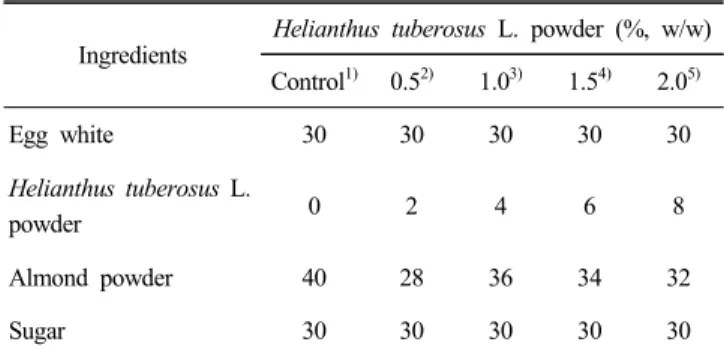
This study first conducted a preliminary experiment based on the advanced research of macaroon cookie (Peam, 2013), and then made change and supplementation. After that, as shown
Table 1. Approximate composition of Helianthus tuberosus
L. powder (g)
Helianthus tuberosus L. powder
Carbohydrate Moisture Crude protein Crude lipid Crude ash 70.13±0.52
1)3.73±0.09 9.72±0.78 0.55±0.01 5.57±0.42
1)
Mean±S.D.
in Table 2, Helianthus tuberosus L. powder 0%, 0.5%, 1.0%, 1.5%, and 2.0% were added, respectively, to make macaroon.
Preparation of Macaroon added with Helianthus tuberosus L. Powder
A kneader (KM-800, Kenwood, England) was used to make foam with 30g of egg white. And then, the ground fined sugar (30 g) was put in the egg white foam, and was mixed together 3 seconds. In the state, 40g of almond powder and each ratio of Helianthus tuberosus L. powder were put and mixed to- gether 10 seconds. The mixed dough was put in a pan by 10 mL, and was baked in a preheated oven (HB-428GB, Samsung, Korea) at 160 ℃ for 15 minutes. After that, the dough was cooled 4 hours before being used for experiment.
Moisture
The moisture content was repeatedly measured by a moi- sture analyzer (MS-70, A&D Cp., Tokyo, Japan), and the mean was calculated.
Table 2. Formulas for the macaroon cookies added with Helianthus tuberosus L. powder (g)
Ingredients
Helianthus tuberosus L. powder (%, w/w)
Control
1)0.5
2)1.0
3)1.5
4)2.0
5)Egg white 30 30 30 30 30
Helianthus tuberosus L.
powder 0 2 4 6 8
Almond powder 40 28 36 34 32
Sugar 30 30 30 30 30
1)
Control : Almond powder 100%
2)
Almond powder 99.5%, Helianthus tuberosus L. powder 0.5%
3)
Almond powder 99.0%, Helianthus tuberosus L. powder 1.0%
4)
Almond powder 98.5%, Helianthus tuberosus L. powder 1.5%
5)
Almond powder 98.0%, Helianthus tuberosus L. powder 2.0%
Color Evaluation
Chromaticity was repeatedly measured by a color meter (JX777, Minolta, Japan), and the mean was presented with Hunter’s L value, a value, and b value. At this time the cali- bration value of standard plate was L=98.46, a= —0.23, b=
+1.02, respectively.
Spread Factor
For spread factor, the diameter and height of macaroon were measured, and the spread was repeatedly measured by the modified AACC (10-50D) (AACC, 2000) method. After that, the mean was measured.
Spread factor =
Average width of 6 cookies (mm) Average thickness of 6 cookies (mm)
Content of Total Phenol Compounds
The content of total phenol compounds was measured in compliance with Folin-Denis’s phenol method. In the sample 0.2 mL, 2N Folin-Ciocalteau reagent 0.2 mL was added, and then the sample was left alone 3 minutes. After that, 10% so- dium carbonate (Na
2CO
3) 3 mL was added for reaction 1 hour in a dark place. At 765 nm, absorbance was measured. As standard material, gallic acid was used to draw calibration curve, which was presented with mg Gallic acid of cookie 10g. Three experiments were performed repeatedly, and the mean and standard deviation were calculated.
DPPH (1,1-diphenyl-2-picrylhydrazyl) Radical Scavenging Activity
DPPH radical scavenging activity was presented by the relative comparison between control group and Helianthus tu- berosus L. addition group. In advanced research of macaroon cookie (Lee, Hwang, Liang, & Mau, 2007) method, DPPH radical scavenging activity was measured for comparative analysis. In other words, DPPH solution (1.5 × 10
—4) 1 mL was added in the sample liquid 4 mL, and was stirred toge- ther. The mixed one was left alone 30 minutes in a dark place.
The absorbance was measured at 517 nm. After DPPH solution was added in ethanol, the absorbance of control group was measured. DPPH radical scavenging activity was presented
with percentage. After three repeated experiments, the mean and standard deviation were calculated.
Texture Analysis
Texture of the macaroon to which Helianthus tuberosus L.
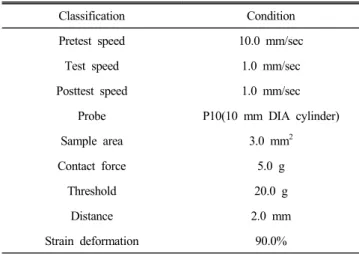
powder was added was repeatedly measured three times by a texture analyzer (TAXT Express v 2.1, London, England) in the conditions of Table 3. And the mean was calculated.
At this time, the measured items were hardness, cohesiveness, gumminess, springiness and chewiness.
Sensory Analysis
A assessors of 30 were recruited university students in the major of culinary (Seoul, Korea) from July 11, 2016 to July 16, 2016. For sensory test, 15 men and women in their 20s to 30s who previously had education and recognized the pur- pose of this study and evaluation method were selected. All samples were put on the white dish and provided to the panelists. They was recommended to rinse their mouth after each evaluation of sample. The evaluated items were color, flavor, taste, texture, overall acceptability and seven point scale was applied. The better an item was evaluated, the closer the points were to 7; the worse evaluated, the closer to 1. Each panelist conducted three trials in a row for evaluation.
Statistical Analysis
SPSS (Statistical Package for Social Sciences, ver. 14.0, SPSS Inc., IL, USA) program was used to calculate mean± standard and conduct ANOVA test. As post-hoc test, Duncan’s mul-
Table 3. Operating condition for texture profile analysis
Classification Condition
Pretest speed 10.0 mm/sec
Test speed 1.0 mm/sec
Posttest speed 1.0 mm/sec
Probe P10(10 mm DIA cylinder)
Sample area 3.0 mm
2Contact force 5.0 g
Threshold 20.0 g
Distance 2.0 mm
Strain deformation 90.0%
tiple range test was carried out at a significance level of 5%.
RESULTS AND DISCUSSION
Moisture of Macaroon Cookie
The moisture content of the macaroon with the addition of Helianthus tuberosus L. powder is presented in Table 4. As Helianthus tuberosus L. powder was added more, the moisture content tended to decrease more significantly (19.00±0.02 ∼ 17.61±0.22) (p<0.05). The result is similar to that of Sulgidduk research (Park, 2010).
Color Evaluation
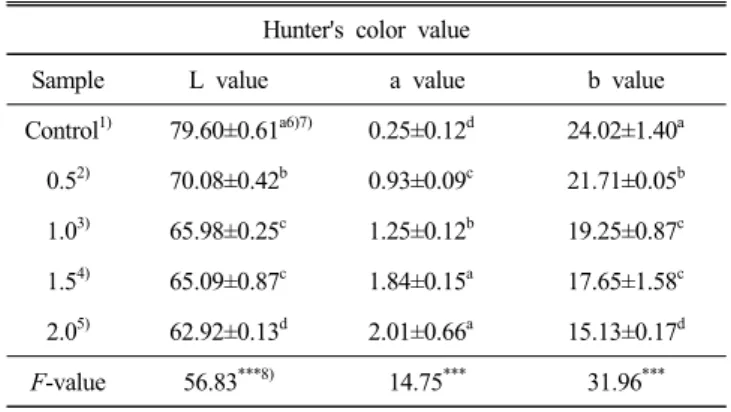
Chromaticity of the macaroon with the addition of Heli- anthus tuberosus L. powder is shown in Table 5. Regarding lightness, the control group had 79.60±0.61, or the highest. As Helianthus tuberosus L. powder was added more, lightness tended to reduce more significantly (p<0.001). According to Sulgidduk research (Park, 2010), Buchimgaru research (Kim et al., 2014), cookie research (Park et al., 2013), rice sponge cakes research (Kim et al., 2014), sponge cakes research (Suh
& Kim, 2014), and Mook research (Kim, 2015), the more Helianthus tuberosus L. powder was added, the more lightness tended to decrease significantly. Therefore, it was similar to
Table 4. Chemical composition of macaroon added with Helianthus tuberosus L. powder
Sample Moisture (%)
Control
1)19.00±0.02
a6)7)0.5
2)18.53±0.25
b1.0
3)18.66±0.11
b1.5
4)18.38±0.15
b2.0
5)17.61±0.22
cF-value
7.81
***8)1)
Control : Almond powder 100%
2)
Almond powder 99.5%, Helianthus tuberosus L. powder 0.5%
3)
Almond powder 99.0%, Helianthus tuberosus L. powder 1.0%
4)
Almond powder 98.5%, Helianthus tuberosus L. powder 1.5%
5)
Almond powder 98.0%, Helianthus tuberosus L. powder 2.0%
6)
Means in the column with different superscripts are significantly different at p<0.05 as by Duncan's multiple range test.
7)
Mean±S.D.
8)*
p<0.05,
**p<0.01,
***p<0.001,
**p<.01,
***p<.001.
Table 5. Hunter’s color values of macaroon added with Helianthus tuberosus L. powder
Hunter's color value
Sample L value a value b value
Control
1)79.60±0.61
a6)7)0.25±0.12
d24.02±1.40
a0.5
2)70.08±0.42
b0.93±0.09
c21.71±0.05
b1.0
3)65.98±0.25
c1.25±0.12
b19.25±0.87
c1.5
4)65.09±0.87
c1.84±0.15
a17.65±1.58
c2.0
5)62.92±0.13
d2.01±0.66
a15.13±0.17
dF-value
56.83
***8)14.75
***31.96
***1)
Control: Almond powder 100%
2)
Almond powder 99.5%, Helianthus tuberosus L. powder 0.5%
3)
Almond powder 99.0%, Helianthus tuberosus L. powder 1.0%
4)
Almond powder 98.5%, Helianthus tuberosus L. powder 1.5%
5)
Almond powder 98.0%, Helianthus tuberosus L. powder 2.0%
6)
Means in the column with different superscripts are significantly different at p<0.05 as by Duncan's multiple range test.
7)
Mean±S.D.
8) *
p<0.05,
**p<0.01,
***p<0.001.
the result of this study.
With regard to redness, 2.0% HTP group had 2.01±0.66, or the highest. The more added, the more redness was increased significantly (p<0.001). According to Sulgidduk research (Park, 2010), Buchimgaru research (Kim et al., 2013), cookie research (Park et al., 2013), rice sponge cakes research (Kim et al., 2014), and Mook research (Kim, 2015), with an increase in Helianthus tuberosu L. powder addition, redness tended to increase significantly. Therefore, it was similar to the result of this study. However, sponge cakes research (Suh & Kim, 2014) reported that redness tended to reduce as the power was added more.
Regarding yellowness, the control group had 24.02±1.40, or the highest. As Helianthus tuberosus L. powder was added more, yellowness tended to reduce significantly (p<0.001).
According to sponge cakes research (Suh & Kim, 2014) and Mook research (Kim, 2015), the more Helianthus tuberosus L. powder was added, the more yellowness tended to increase significantly. Therefore, it was different from the result of this study.
Spread Factor
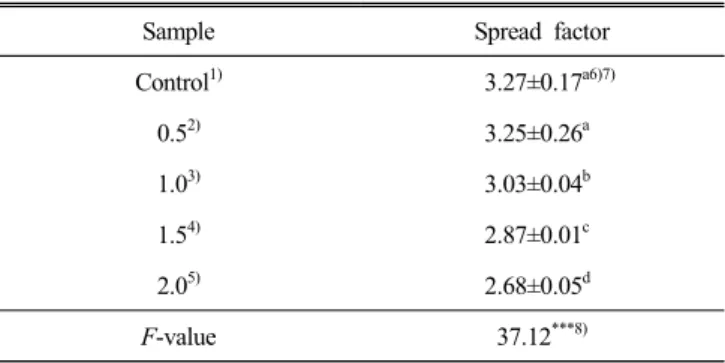
The spread factor the macaroon with the addition of He-
lianthus tuberosus L. powder is presented in Table 6. The control group had 3.27±0.17 (the highest) and 2.0% MTP group had 2.68±0.05 (the lowest). The control began to be significantly different from 1.0% MTP group (p<0.001). The spread ration tended to reduce as Helianthus tuberosus L.
powder was added more.
Content of Total Phenol Compounds
The content of total phenol compounds of the macaroon to which Helianthus tuberosus L. powder was added is presented in Table 7. As Helianthus tuberosus L. powder was added more, the content of total phenol compounds significantly increased to 2.73±0.42 ∼15.88±0.42 (mg/10g) (p<0.0001).
Rice sponge cakes research (Kim et al., 2014) also revealed that the more Helianthus tuberosus L. powder was added, the more the content of total phenol compounds significantly in- creased (p<0.05). Therefore, it was similar to the result of this study. Buchimgaru research (Kim et al., 2013) reported that because of a significant increase in total polyphenol contents, anti-oxidation function was excellent.
DPPH Radical Scavenging Activity
DPPH radical scavenging activity of the macaroon with the addition of Helianthus tuberosus L. powder is presented in
Table 6. Spread factors of polyphenol of macaroon added with Helianthus tuberosus L. powder
Sample Spread factor
Control
1)3.27±0.17
a6)7)0.5
2)3.25±0.26
a1.0
3)3.03±0.04
b1.5
4)2.87±0.01
c2.0
5)2.68±0.05
dF-value
37.12
***8)1)
Control: Almond powder 100%
2)
Almond powder 99.5%, Helianthus tuberosus L. powder 0.5%
3)
Almond powder 99.0%, Helianthus tuberosus L. powder 1.0%
4)
Almond powder 98.5%, Helianthus tuberosus L. powder 1.5%
5)
Almond powder 98.0%, Helianthus tuberosus L. powder 2.0%
6)
Means in the column with different superscripts are significantly different at p<0.05 as by Duncan's multiple range test.
7)
Mean±S.D.
8)*
p<0.05,
**p<0.01,
***p<0.001
Table 7. Content of total phenol compounds of macaroon added with Helianthus tuberosus L. powder
Sample Content of total phenol compounds (mg/10g)
Control
1)0.88±0.58
a6)7)0.5
2)2.73±0.42
b1.0
3)7.45±1.31
c1.5
4)13.38±1.63
d2.0
5)15.88±0.42
eF-value
102.17
***8)1)
Control: Almond powder 100%
2)
Almond powder 99.5%, Helianthus tuberosus L. powder 0.5%
3)
Almond powder 99.0%, Helianthus tuberosus L. powder 1.0%
4)
Almond powder 98.5%, Helianthus tuberosus L. powder 1.5%
5)
Almond powder 98.0%, Helianthus tuberosus L. powder 2.0%
6)
Means in the column with different superscripts are significantly different at p<0.05 as by Duncan's multiple range test.
7)
Mean±S.D.
8) *
p<0.05,
**p<0.01,
***p<0.001.
Table 8. Regarding DPPH radical scavenging activity, the control group had 33.59±0.64, and 2.0% HTP group 81.43±
0.37. Therefore, as Helianthus tuberosus L. powder was added more, DPPH radical scavenging activity significantly increa- sed (p<0.001). According to rice sponge cakes research (Kim et al., 2014), Buchimgaru research (Kim et al., 2013), and Mook research (Kim, 2015), the more the powder was added, the more DPPH radical scavenging activity was increased. It was similar to the result of this study. Therefore, it is consi- dered that phenol of Helianthus tuberosus L. powder led to an improvement in DPPH radical scavenging activity.
Texture Analysis
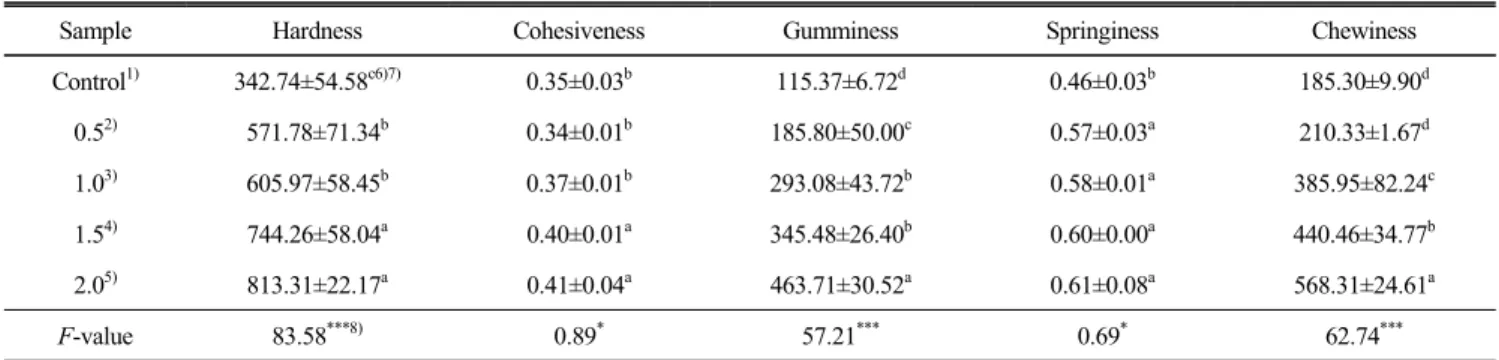
Texture of the macaroon with the addition of Helianthus tuberosus L. powder is shown in Table 9. Regarding hardness, the control group had 342.74±54.58 (the lowest) and 2.0%
HTP group 813.31±22.17 (the highest). Therefore, there was
significant difference between the two groups (p<0.001). It is
considered that as the spread ratio of the macaroon with the
addition of Helianthus tuberosus L. powder reduced, hardness
got stronger. According to rice sponge cakes research (Kim
et al., 2014), gaba rice powder and xylose research (Choi et
al., 2015), and sponge cakes research (Suh & Kim, 2014), the
more Helianthus tuberosus L. powder was added, the stronger
Table 9. Texture values of macaroon added with Helianthus tuberosus L. powder
Sample Hardness Cohesiveness Gumminess Springiness Chewiness
Control
1)342.74±54.58
c6)7)0.35±0.03
b115.37±6.72
d0.46±0.03
b185.30±9.90
d0.5
2)571.78±71.34
b0.34±0.01
b185.80±50.00
c0.57±0.03
a210.33±1.67
d1.0
3)605.97±58.45
b0.37±0.01
b293.08±43.72
b0.58±0.01
a385.95±82.24
c1.5
4)744.26±58.04
a0.40±0.01
a345.48±26.40
b0.60±0.00
a440.46±34.77
b2.0
5)813.31±22.17
a0.41±0.04
a463.71±30.52
a0.61±0.08
a568.31±24.61
aF-value
83.58
***8)0.89
*57.21
***0.69
*62.74
***1)
Control: Almond powder 100%
2)
Almond powder 99.5%, Helianthus tuberosus L. powder 0.5%
3)
Almond powder 99.0%, Helianthus tuberosus L. powder 1.0%
4)
Almond powder 98.5%, Helianthus tuberosus L. powder 1.5%
5)
Almond powder 98.0%, Helianthus tuberosus L. powder 2.0%
6)
Means in the column with different superscripts are significantly different at p<0.05 as by Duncan's multiple range test.
7)
Mean±S.D.
8)*
p<0.05,
**p<0.01,
***p<0.001
Table 8. DPPH radical scavenging activity of macaroon added with Helianthus tuberosus L. powder
Sample DPPH (%)
Control
1)33.59±0.64
a6)7)0.5
2)42.41±0.63
b1.0
3)52.53±0.70
c1.5
4)73.08±0.81
d2.0
5)81.43±0.37
eF-value
69.35
***8)1)
Control: Almond powder 100%
2)
Almond powder 99.5%, Helianthus tuberosus L. powder 0.5%
3)
Almond powder 99.0%, Helianthus tuberosus L. powder 1.0%
4)
Almond powder 98.5%, Helianthus tuberosus L. powder 1.5%
5)
Almond powder 98.0%, Helianthus tuberosus L. powder 2.0%
6)
Means in the column with different superscripts are significantly different at p<0.05 as by Duncan's multiple range test.
7)
Mean±S.D.
8)*
p<0.05,
**p<0.01,
***p<0.001
hardness was. It was similar to the result of this study. How- ever, Mook research (Kim, 2015) revealed that the more the power was added, the more hardness was decreased. It was different from the result of this study.
With regard to cohesiveness, 2.0% HTP group had 0.41±
0.04 or the highest. The control group began to be significantly different from Helianthus tuberosus L. powder 1.5% HTP group (p<0.05). However, according to rice sponge cakes re-
search (Kim et al., 2014), sponge cakes research (Suh & Kim, 2014), and Mook research (Kim, 2015), as Helianthus tuberosus L. power was added more, cohesiveness tended to decrease.
It was different from the result of this study.
Regarding gumminess, the control group was significantly different from the groups with the addition of Helianthus tu- berosus L. powder (p<0.001). The more the powder was added, the more gumminess tended to increase. However, Mook research (Kim, 2015) reported that gumminess tended to de- crease with a rise in power addition.
With regard to springiness, the control group was signifi- cantly different from the groups with the addition of Helianthus tuberosus L. powder (p<0.05). However, there was no signi- ficant difference between the groups with the addition of Helianthus tuberosus L. powder (p<0.05). Mook research (Kim, 2015) also revealed the similar result.
With regard to chewiness, the control group had 185.30±
9.90, and 2.0% HTP group 568.31±24.61. Therefore, as Heli- anthus tuberosus L. powder was added more, chewiness was significantly increased (p<0.001). Therefore, it was similar to the result of rice sponge cakes research (Kim et al., 2014).
However, Mook research (Kim, 2015) reported that chewiness tended to decrease with an increase in power addition.
Sensory Analysis
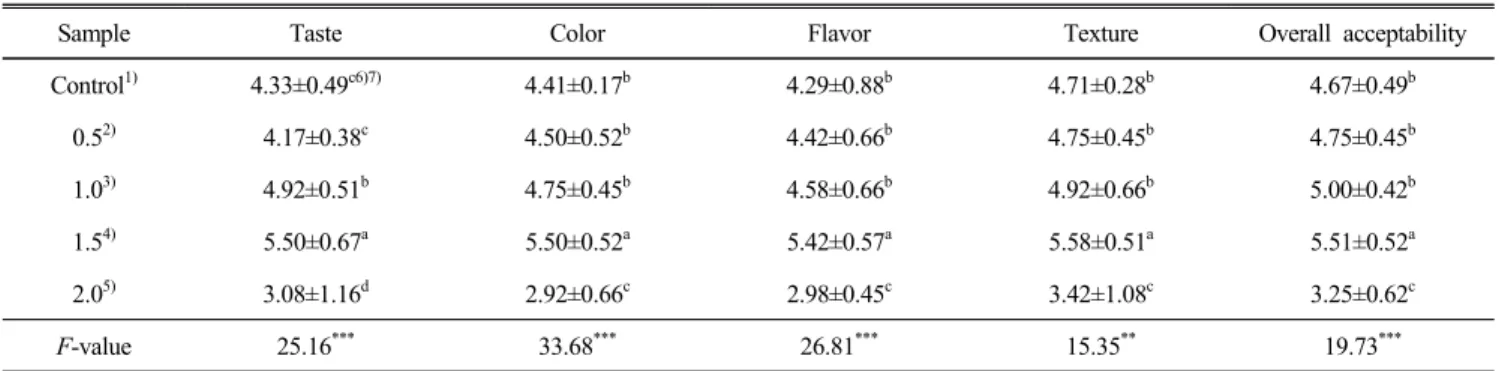
Sensory test on the macaroon with the addition of Heli-
Table 10. Sensory evaluation of macaroon added with Helianthus tuberosus L. powder
Sample Taste Color Flavor Texture Overall acceptability
Control
1)4.33±0.49
c6)7)4.41±0.17
b4.29±0.88
b4.71±0.28
b4.67±0.49
b0.5
2)4.17±0.38
c4.50±0.52
b4.42±0.66
b4.75±0.45
b4.75±0.45
b1.0
3)4.92±0.51
b4.75±0.45
b4.58±0.66
b4.92±0.66
b5.00±0.42
b1.5
4)5.50±0.67
a5.50±0.52
a5.42±0.57
a5.58±0.51
a5.51±0.52
a2.0
5)3.08±1.16
d2.92±0.66
c2.98±0.45
c3.42±1.08
c3.25±0.62
cF-value
25.16
***33.68
***26.81
***15.35
**19.73
***1)
Control: Almond powder 100%
2)
Almond powder 99.5%, Helianthus tuberosus L. powder 0.5%
3)
Almond powder 99.0%, Helianthus tuberosus L. powder 1.0%
4)
Almond powder 98.5%, Helianthus tuberosus L. powder 1.5%
5)
Almond powder 98.0%, Helianthus tuberosus L. powder 2.0%
6)
Means in the column with different superscripts are significantly different at p<0.05 as by Duncan's multiple range test.
7)
Mean±S.D.
8)*