ISSN 1225-1534 (Print) http://dx.doi.org/10.5303/PKAS.2012.27.4.293 Publications of the Korean Astronomical Society
27: 293 ∼ 294, 2012 September
° 2012. The Korean Astronomical Society. All Rights Reserved. c
CLASSIFICATION SCHEMES AND PROPERTIES OF INFRARED GALAXIES
P. Rybka 1 , A. Pollo 2,3 , and T. T. Takeuchi 1
1 Department of Particle and Astrophysical Science, Nagoya University, Japan
2 The Astronomical Observatory of the Jagiellonian University, Krak´ow, Poland
3 National Centre for Nuclear Research, Warsaw, Poland E-mail: [email protected]
(Received June 30, 2012; Accepted August 09, 2012)
ABSTRACT
We established a separation scheme to distinguish galaxies from stars with the aid of AKARI/FIS color-color (CC) diagrams. In all the combinations of CC diagrams we can distinguish two separate clouds. It was shown that in all cases one of them contains more than 95% of galaxies and the other one, in most cases, consists in more than 80% of stars (Pollo et al., 2010). Currently we are looking into more detailed classifications. We are especially interested in separating different morphological types of galaxies, mainly within spiral galaxies. Moreover, we study the properties of infrared galaxies.
Key words: infrared: galaxies, stars; telescope; conferences: proceedings
1. OUR SAMPLE
It is crucial for all-sky surveys, detecting tremendous amount of sources, to find a way to distinguish between different kinds of objects based on minimal amount of additional information. The best option would be to use only data which is brought by the survey itself.
The AKARI/FIS catalogue contains more than 400,000 sources. For the reason mentioned above, we are looking for various classification schemes be- tween different types of objects within the catalogue, using photometric information only. For our pur- pose, we selected sources in regions of low Galactic emission at 100 µm (I 100 < 10 MJy sr −1 ) in order to increase the probability of finding a counterpart.
This condition is met by 39968 sources within which 5,176 sources have complete photometric information.
This sample of sources was identified in the NED and SIMBAD databases, resulting in the following identifi- cation: 68.8% of sources is extragalactic, about 6.6% is Galactic, 4% have been observed in infrared and 2.7%
in radio wavelengths, and finally 16.4% of sources were unidentified.
Table 1.
Morphological Types of 9217 FIS Galaxies Type of galaxies Number Percentage in IR in IR in opt.
Spiral 7877 85% 61%
Lenticular 911 10% 22%
Irregular 161 2% 4%
Elliptical 268 3% 13%
Pollo et al. (2010) have shown, for AKARI/FIS Bright Source Catalogue Version β-1, that in all the combinations of far-infrared (FIR) color-color (CC) di- agrams we can distinguish two separate clouds. Based on these scatter plots, the division line between stars and galaxies was decided. Two examples of the dia- grams, for the sources with the best quality FIS fluxes, are shown in Fig. 1.
There are 27,384 galaxies in the cross-identified sam- ple of FIS sources. Nearly 68% of these galaxies have their redshift measured and 95% of them are located at very low redshifts below 0.1. Morphology was obtained for just over one third (34%) of the galaxies. Summary of morphological counts is presented in Table 1.
http://pkas.kas.org 293
294 RYBKA ET AL.
-1 -0.5 0 0.5 1
-0.4 -0.2 0 0.2 0.4
log(S65/S140)log(S
65/S
90)
-1 -0.5 0 0.5 1
-0.4 -0.2 0 0.2 0.4
log(S90/S140)log(S
65/S
90)
Fig. 1. The S
65/S
90–S
65/S
140, S
65/S
90–S
90/S
140CC di- agrams for the sources with flux quality indicators equal to 3. Symbols represent the sources as follows: red squares - galaxies; blue triangles - Galactic stars. The solid line is a division line between the two classes of objects. The dotted lines represent the uncertainty ranges in the color determination.
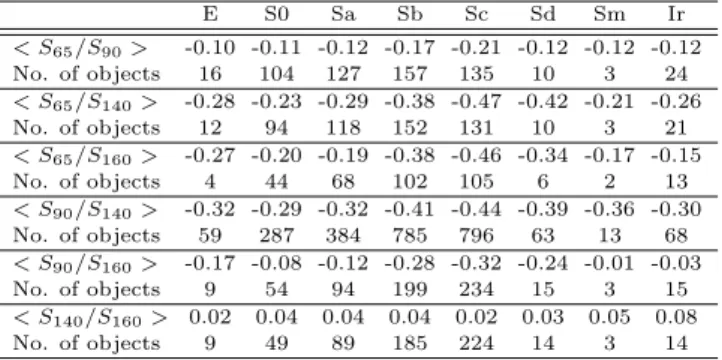
-0.2 -0.1 0
El S0 Sa Sb Sc Sd Sm Ir log(S65/S90)
Morphology
-0.6 -0.5 -0.4 -0.3 -0.2
El S0 Sa Sb Sc Sd Sm Ir log(S90/S140)
Morphology