Received: 27 October, 2015 Revised: 12 January, 2016 Accepted: 24 January, 2016
†
Corresponding Author: Hee Hwa Kim Tel: +82-51-510-2832 E-mail: [email protected]
This is an Open-Access article distributed under the terms of the Creative Commons Attribution Non-Commercial License (http://creativecommons.org/licenses/by-nc/3.0) which permits unrestricted non-commercial use, distribution, and reproduction in any medium, provided the original work is properly cited.
Korean J Community Living Sci 27(1) : 5~17, 2016 http://dx.doi.org/10.7856/kjcls.2016.27.1.5
교사와 유아 간의 관계와 유아의 사회적 능력간의 관계에서 유아 수줍음의 매개효과
노 진 희ㆍ김 희 화
†부산대학교 아동가족학과
The Mediating Effects of Young Children’s Shyness on the Relationship between Teacher-Children Relationship
and Young Children’s Social Competence
Jin-Hee NoㆍHee-Hwa Kim
†Dept. of Child and Family, Pusan National University, Pusan, Korea 1)
ABSTRACT
The purpose of this study was to examine the mediating effects of young children's shyness on the relationship between teacher-children relationship and young children’s social competence.
The subjects of the study were 270 children from three years to five years old and their teachers in Busan. Frequency, t-test, Cronbach α, Pearson’s correlation coefficients, and hierarchial regression were used for data analysis. The results were as follows: first, teacher-children intimacy showed positive correlation with the young children’s social competence.
Teacher-children conflict showed negative correlation with the young children’s social competence. Second, teacher-children intimacy showed negative correlation with the young children’s shyness. Teacher-children conflict showed positive correlation with the young children’s shyness. Third, young children’s shyness showed negative correlation with the young children’s social competence. Fourth, young children’s shyness had partial mediating effects on the relationship between teacher-children intimacy and young children’s sociability. Young children’s shyness had partial mediating effects on the relationship between teacher-children intimacy and young children’s popularity and leadership. Young children’s shyness had partial mediating effects on the relationship between teacher- children conflict and young children’s sociability. Young children’s shyness had partial mediating effects on the relationship between teacher-children conflict and young children’s popularity and leadership.
Key words: teacher-child relationship, shyness, social competence
I. 서론
또래와 원만한 관계를 형성하고 유지하기 위해 필 요한 사회적 능력은 유아기 발달에 중요하다. 사회적 능력이란 사회적으로 적절하고 효과적인 방법을 통 해 환경과 상호작용함으로써 자신의 목적을 효과적 으로 획득하는 능력을 의미한다(Doh 1994). 유아의 사회적 능력은 보육기관의 적응 및 또래관계를 예측 하고(Water & Sroufe 1981; Katz & McCellan 1997a;
Hay et al. 2004; Jeong & Park 2010), 이후 학령기 학업성취(O'Mally 1977), 내재화 및 외현화 행동문제 (Bornstein et al. 2010; Zhang & Sun 2011;
Korhonen et al. 2014)와도 관련이 있다. 또한 사회 적 능력을 발달시키지 못할 경우 발달적 부적응을 나 타낼 가능성이 높은 것으로 밝혀지고 있음을 감안해 보면(Katz & McCellan 1997b), 유아의 사회적 능력 을 촉진시킬 수 있는 요인들에 대한 연구가 필요함을 알 수 있다.
사회적 능력에 영향을 미치는 요소는 성별, 연령, 출생순위, 정서조절(Eisenberg & Fabes 1992; An &
Kim 2008; Woo 2013)과 같은 개인변인과 부모의 양 육태도(Kim et al. 2008; Lee et al. 2014; Lee & Jang 2015), 교사와 유아 간의 관계와 같은 환경변인으로 구분된다. 사회변화에 따른 핵가족화, 형제수의 감소 로 인해 유아가 타인과 상호작용 할 기회가 적어지면 서 유아의 사회성 발달을 위해 유아를 보육기관에 보 내는 부모들이 증가하고 있다. 따라서 유아가 과거보 다 일찍 보육기관을 경험하고 유아보육기관에서 보 내는 시간 또한 늘어나게 됨에 따라 유아의 발달에 미치는 교사의 역할이 중요하게 되었다. 교사는 유아 교육현장에서 부모 역할을 대신하는 성인이므로 부 모와 자녀 간의 관계 못지않게 교사와 유아 간의 관 계가 유아의 사회적 능력 발달에 미치는 영향이 크므 로 이에 대한 연구가 중요하게 다루어져야 할 것이다.
교사와 유아 간의 관계는 교사와 유아 간의 친밀 감과 교사와 유아 간의 갈등으로 구분되어 연구되고 있다. 교사와 유아 간의 친밀감 및 갈등과 유아의 사 회적 능력 하위요인 간의 관계에 대한 선행연구를 살 펴보면 일관된 결과가 보고되고 있다. 사회적 능력의
하위 요인으로는 대인적응성, 사회적 참여, 인기도 및 지도력이 있다. 교사와 유아 간의 친밀감이 높아 질수록, 갈등이 적어질수록 유아의 사회적 능력 하위 요인 중 대인적응성이 높아지고(Howes et al. 1994;
Jo 2007; Yu & Kwon 2009a; Lee & Hyun 2010a;
Kim 2011; Oh 2012a; Shim & Moon 2014a; Song 2014), 사회적 참여가 높았으며(Shim & Moon 2014b), 인기도 및 지도력이 높은 것으로 밝혀지고 있다(Yu
& Kwon 2009b; Kim 2011; Oh 2012b; Song 2014a).
한편, 사회적 능력에 관련되는 유아의 심리적 특 성으로 유아의 수줍음을 고려해 볼 수 있다. 수줍음 은 사회적 상황에서 느끼는 불안과 긴장, 과도한 자 기의식 및 자기몰두로 인한 염려 및 위축되고 억제되 는 행동들(Lee 2008)로서, 연구자들은 수줍음과 사회 적 능력 간의 관계에 많은 관심을 두고 있다. 수줍음 이 사회적 능력을 저해한다는 연구가 국외에서 일찍 부터 보고되었고(Jones et al. 1986a; Asendorpf 1990a;
Pilkonis 1997a), 국내에서는 최근 수줍음에 대한 학 자들의 관심이 증가하는 추세이다(Jeon 2010; Park 2012a; Yang 2012). 유아의 수줍음과 사회적 능력 간의 관계에서는 수줍음이 높아질수록 조화로운 또 래관계를 나타내는 대인적응성이 낮아지기 쉽다 (Doh 1995). 수줍음이 높아질수록 놀이에 참여하기 보다는 활동에 참여하는 다른 유아를 쳐다보거나, 주 변에 서성이는 행동, 다른 유아가 접근해 오면 부끄 러워 뒤로 빼는 행동, 친구들과 함께 있는 것을 좋아 하는 행동과 같은 사회적 참여가 낮아졌다(Yun &
Park 2003; Seo et al. 2007a; Coplan et al. 2008;
Jeon 2010; Park 2012b). 수줍음이 높아질수록 또래 로부터 거부되거나 무시되는 경향이 높으며(Asendorpf 1990b; Doh 1996; Perren & Alsaker 2006), 친구수 가 적고 사회적 관계망이 좁은 것을 나타내는(Jones et al. 1986b; Seo et al. 2007b) 인기도 및 지도력이 낮았다. 이처럼 수줍음이 높은 유아는 사회적 능력이 낮은 것으로 밝혀지고 있다.
뿐만 아니라 교사와 유아 간의 친밀감 및 갈등 정 도에 따라 수줍음은 다르게 나타난다. 교사와 유아 간의 친밀감이 높아질수록 수줍음은 낮아지는 것으 로 나타나고(Rudasill & Rimm-Kaufman 2009a; Kwon
2014a), 교사와 유아 간의 갈등이 높아질수록 수줍음 이 높아지는 것으로 나타났다(Kwon 2014b). 또한 교사와 유아 간의 친밀감 및 갈등이 유아의 걱정과 불안에 직접적인 영향을 미친다는 연구결과(Moon &
Lee 2012a; Moon & Hong 2013a)에 근거해 교사와 유아 간의 친밀감 및 갈등은 유아의 수줍음에 관련될 수 있을 것으로 여겨진다.
이처럼 교사와 유아 간의 친밀감 및 갈등과 유아 의 사회적 능력 두 변인 간의 관계는 일관되게 밝혀 지고 있고, 교사와 유아 간의 친밀감 및 갈등이 유아 의 걱정과 불안에 영향을 미치며, 유아의 수줍음은 사회적 능력에 영향을 미친다는 결과에 근거하면 교 사와 유아 간의 친밀감 및 갈등과 사회적 능력 관계 에서 수줍음의 매개 가능성을 추정해 볼 수 있다. 어 머니의 정서적 가용성이 유아의 사회적 능력에 직접 적인 영향을 미치기도 하지만, 유아의 기질적 특성인 의도적 통제에 영향을 미쳐 사회적 능력의 변화를 초 래하는 것을 감안해보면(Moon 2010a), 교사와 유아 간의 친밀감과 갈등이 유아의 사회적 능력에 직접적 인 영향을 미치기도 하지만, 유아의 수줍음의 변화를 초래하여 사회적 능력에 영향을 미칠 수 있을 것으로 본다. 아버지의 온정적 양육행동과 어머니의 격려와 지지가 유아의 수줍음 감소를 초래한다는 연구결과 (Doh & Jung 1997; Grady et al. 2012)가 있듯이 유 아교육현장에서 교사는 유아의 발달에 영향을 미치 는 중요한 성인이고 유아들에게 정서적 안정감을 제 공하기 때문에(Thijs & Koomen 2008a) 환경적인 개 입인 교사와 유아 간의 친밀감 및 갈등 역시 부모의 양육행동처럼 유아의 수줍음의 변화에 직접적인 영 향을 발휘할 수 있을 것이다.
따라서 본 연구에서는 교사와 유아 간의 관계인
친밀감, 갈등, 수줍음 및 유아의 사회적 능력 간의 관 계를 살펴보고, 교사와 유아 간의 친밀감 및 갈등과 유아의 사회적 능력 간의 관계가 수줍음에 의해 매개 되는지 살펴보고자 한다. 이처럼 유아의 사회적 능력 에 대한 교사와 유아 간의 관계 및 유아의 수줍음의 영향을 살펴봄으로써 사회적 능력 향상을 도모할 수 있는 교사역할의 중요성을 밝히고 교사 교육을 위한 기초자료를 제공하고자 한다.
본 연구의 목적에 따른 연구문제는 다음과 같다.
1. 교사와 유아 간의 관계 및 수줍음과 유아의 사 회적 능력 간의 관계는 어떠한가?
2. 교사와 유아 간의 관계가 유아의 사회적 능력에 미치는 영향은 수줍음에 의해 매개되는가?
2-1. 교사와 유아 간의 친밀감이 유아의 사회 적 능력에 미치는 영향은 수줍음에 의해 매개 되는가?
2-2. 교사와 유아 간의 갈등이 유아의 사회적 능력에 미치는 영향은 수줍음에 의해 매 개 되는가?
II. 연구방법
1. 연구대상
본 연구의 대상은 보육시설에 재원중인 만 3, 4, 5 세 남녀 유아 270명과 담임교사 28명이다. 선정이유 는 취학 전 시기부터 또래 상호작용이 증가하여 또래 관계의 중요성이 커지고, 이 시기에 사회적 능력을 발달시키지 못할 경우 발달적 부적응을 나타낼 가능 성이 높기 때문이다(Katz & McCellan 1997c).
연구 대상 표집을 위해 부산광역시에 소재하는 보 육시설 중 10개를 임의 선정하여 보육시설의 보육교
Variable Section N(%)
Child’s gender Male 132(48.9)
Female 138(51.5)
Child’s age
3 years 122(45.2)
4 years 85(31.5)
5 years 63(23.3)
Table 1. General characteristics of children (N=270)
사에게 배포였다. 배부된 설문지는 360부였으나 회 수된 설문지는 총 295부였고, 응답이 누락되거나 불 성실한 질문지 25부를 제외하고 총 270부만이 최종 분석 자료로 사용하였다.
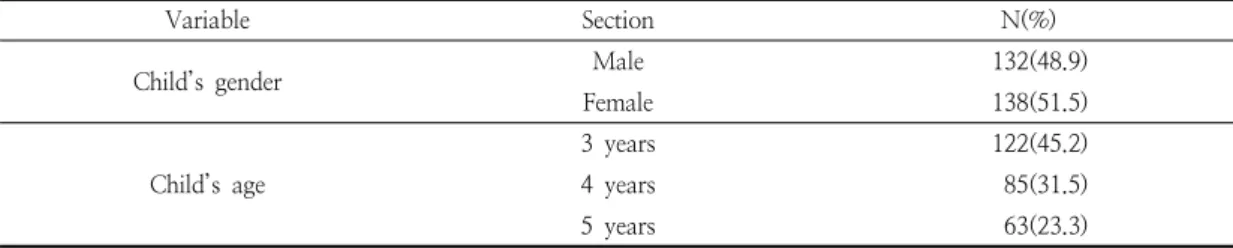
본 연구대상자의 일반적 특성을 살펴보면 Table 1 과 다음과 같다. 먼저, 성별 빈도는 남아 132명 (48.9%), 여아 138명(51.5%)이었고, 연령별 빈도는 만3세 122명(45.2%), 만4세 85명(31.5%), 만5세가 63명(23.3%)이었다.
2. 측정도구
1) 교사와 유아 간의 관계
교사와 유아 간의 관계를 측정하기 위하여 Lee (2001)가 사용한 척도를 사용하였다. Lee(2001)는 Pianta(2001)가 개발한 교사와 유아 간의 관계 척도 (Student-Teacher Relationship Scale : STRS)를 번안 하고 수정․보완하였다. 교사와 유아 간의 관계는 친 밀감, 갈등으로 구성되어 있고, 친밀감 12문항, 갈등 12문항으로 총 24문항이다. 각 문항은 ‘거의 그렇지 않다(1점)’에서 ‘매우 그렇다(5점)’까지 5점 Likert식 척도로 구성되어 있다. 점수 범위는 친밀감, 갈등 각 각 12-60점이고, 점수가 높을수록 친밀감, 갈등관계 가 높음을 의미한다. 척도의 신뢰도는 계수 Cronbach’s α값은 교사 유아 간 친밀감은 0.87, 교사 유아 간 갈 등은 0.94로 나타났다.
2) 유아의 수줍음
유아의 수줍음을 측정하기 위해서 Lee(2008)가 사 용한 척도를 사용하였다. Lee는 Cheek(1983)의 Revised Shyness Scale, Rothbart et al.(2001)의 Children’s Behavior Questionnaire, Crozier(1995)의 Children’s Shyness Questionnaire 기존의 척도를 토대로 수줍 음 척도를 제작하였다. 이 척도는 보육기관에서 접할 수 있는 다양한 사회적 상황에서 나타나는 수줍음 정 도를 알아보는 교사평정용 질문지로 총 16문항이다.
각 문항별로 유아가 보인 행동을 근거로 ‘거의 그렇 지 않다(1점)’에서 ‘매우 그렇다(5점)’의 5점 Likert식 척도로 구성되어 있다. 점수 범위는 16-80점이며, 점
수가 높을수록 수줍음이 높음을 의미한다(2, 4, 11, 13, 15번 문항의 경우 역으로 채점). 척도의 내적 합 치도 계수 Cronbach’s α값은 0.92로 나타났다.
3) 유아의 사회적 능력
유아의 사회적 능력을 측정하기 위하여 Seo(2005) 의 연구에서 사용된 척도를 사용하였다. Seo(2005)가 사용한 척도는 Doh & Falbo(1999)가 개발한 유아용 사회적 능력 척도(Competence Questionnaire for Kindergarteners)를 번안한 것이다. 본 척도는 전체 24문항으로 대인 적응성(11문항), 사회적 참여(5문 항), 인기도 및 지도력(8문항) 3가지 하위요인으로 구 성되어 있다. 각 문항별로 교사가 유아의 행동을 ‘거 의 그렇지 않다(1점)’에서 ‘매우 그렇다(5점)’까지 5점 Likert식 척도로 구성되어 있다. 점수 범위는 대인적 응성 11점-55점, 사회적 참여 8점-40점, 인기도 및 지 도력 5점-25점이고, 전체 사회적 능력 24점-120점이 다. 점수가 높을수록 사회적 능력이 높음을 의미한다 (1, 5, 10, 14, 19, 21, 24번 문항의 경우 역으로 채 점). 척도의 내적 합치도 계수 Cronbach’s α값은 사 회적 능력 전체 0.92이고 하위 요인별로는 대인적응 성 0.92, 사회적 참여 0.87, 인기도 및 지도력 0.88로 나타났다.
3. 자료분석
본 연구의 자료들은 PASW Statistics 18 프로그램 을 사용하여 분석되었다. 먼저 연구대상자들의 일반 적 특성인 유아 성별과 연령을 알아보기 위하여 빈도 분석을 실시하였고, 척도의 신뢰도 검증을 위하여 내 적 일치도 계수 Cronbach’s α 계수를 산출 하였다.
교사와 유아 간의 관계 및 수줍음과 유아의 사회적 능력 간의 관계를 분석하기 위해 Pearson의 적률상 관관계 분석을 실시하였다. 교사와 유아 간의관계와 유아의 사회적 능력 간의 관계에서 수줍음의 매개효 과를 분석하기 위해 Baron & Kenny(1986)의 3단계 접근모델에 근거한 회귀분석을 실시하였다.
III. 결과 및 고찰
1. 교사와 유아 간의 관계, 유아의 수줍음, 유아 의 사회적 능력의 기술 통계치
Table 2에서 각 변인들의 기술 통계치를 살펴보 면, 교사와 유아 간의 친밀감은 41.94점, 교사와 유아 간의 갈등은 21.90점, 유아의 수줍음의 평균은 41.02 점, 유아의 사회적 능력인 대인적응성은 39.80점, 사 회적 참여는 18.60점, 인기도 및 지도력은 25.06점으 로 나타났다. 각 변인들의 왜도와 첨도는 모두 -1에 서 1사이에 있어 다변량 정규분포 가정을 충족하는 것으로 확인되었다(Curran et al. 1996).
2. 교사와 유아 간의 관계 및 유아의 수줍음과 유아의 사회적 능력 간의 관계
교사와 유아 간의 관계, 유아의 수줍음 및 유아의 사회적 능력 간의 관련성을 파악하기 위하여 변인들 간의 Pearson의 적률 상관계수를 산출하였고, 결과는
Table 3과 같다.
Table 3에서 나타난 바와 같이, 교사와 유아 간의 친밀감은 수줍음(r =-0.46,p<0.01)과 유의한 부적상 관이 있었고, 사회적 능력의 하위영역인 대인적응성 (r =0.30,p<0.01), 사회적 참여(r =0.46,p<0.01), 인 기도 및 지도력(r =0.54,p<0.01)과는 유의한 정적상 관이 있는 것으로 나타났다.
교사와 유아 간의 갈등은 수줍음(r =0.25, p<0.01) 과는 유의한 정적상관이 있었고, 사회적 능력의 하위 영역인 대인적응성(r =-0.70,p<0.01), 사회적 참여(r
=-0.50,p<0.01), 인기도 및 지도력(r =-0.27,p<0.01) 과는 유의한 부적상관이 있는 것으로 나타났다. 수줍 음은 대인적응성(r =-0.13, p<0.05), 사회적 참여(r
=-0.60,p<0.01), 인기도 및 지도력(r =-0.67,p<0.01) 과 유의한 부적 상관이 있는 것으로 나타났다. 이를 통해 교사와 유아 간의 친밀감이 높아질수록, 갈등이 낮아질수록 유아의 수줍음 정도가 감소하는 것을 알 수 있다. 또한 유아의 수줍음이 낮아질수록 유아의
N Min Max M SD skewness kurtosis
Teacher-Children intimacy 270 27 60 41.94 6.31 .06 -.30
Teacher-Children conflict 270 12 52 21.90 9.41 .77 -.40
Shyness 270 16 76 41.02 10.59 .20 .25
Social competence
Interpersonal adjustment 270 15 55 39.80 8.24 -.34 -.54
Sociability 270 10 25 18.60 3.37 -.08 -.60
Popularity & Leadership 270 9 40 25.06 4.89 -.09 .51
Table 2. Descriptive statistics (N=270)
Teacher- Children intimacy
Teacher- Children conflict
Shyness
Social Competence Interpersonal
Adjustment Sociability Popularity
& Leadership
Teacher-Children intimacy 1
Teacher-Children conflict -.33** 1
Shyness -.46** .25** 1
Social competence
Interpersonal adjustment .30** -.70** -.13* 1
Sociability .46** -.50** -.60** -.45** 1
Popularity & Leadership .54** -.27** -.67** .32** .66** 1
*p<.05, **p<.01
Table 3. Correlations between Teacher-Children Relationship, shyness, and social competence
(N=270)
대인적응성, 사회적 참여, 인기도 및 지도력과 같은 사회적 능력이 높아짐을 알 수 있다. 본 자료의 회귀 분석을 실시하기 위하여 종속변수의 자기상관과 독 립변수간의 다중공선성을 검토하였다. 검토한 결과 Durbin-Watson 지수가 1.98로 나타나 자기상관이 없이 독립적인 것으로 판단되었다. 독립변수 간 분산 팽창계수(Variance Inflation Factor: VIF) 값을 산출 한 결과 1.14-1.36의 범위로 10미만이므로 다중공선 성이 없는 것으로 나타났다. 따라서 본 자료는 회귀 분석을 실시하기에 적합하였다.
3. 교사와 유아 간의 관계와 유아의 사회적 능력 간의 관계에 대한 수줍음의 매개효과
교사와 유아 간의 관계와 유아의 사회적 능력 간 의 관계를 수줍음이 매개적 역할을 하는지 살펴보기 위해 Baron & Kenny(1986)가 제안한 절차에 따라 중다 회귀분석을 실시하였다. Baron & Kenny(1986) 가 제안한 분석모델은 독립변인과 종속변인 간의 관 계에 대한 매개변인의 효과를 검증하기 위해서 첫 번 째 회귀방정식에서 독립변인의 매개변인에 대한 영 향력의 유의성을 검증하고, 두 번째 회귀방정식에서 독립변인의 종속변인에 대한 영향력의 유의성을 검
증하고, 세 번째 회귀방정식에서 종속변인에 대한 독 립변인과 매개변인의 영향력의 유의성을 검증한다.
이때, 매개변인의 통제 후 종속변인에 대한 독립변인 의 영향력이 유의하게 나타났으나 영향력이 감소하 면 부분매개모형, 종속변인에 대한 독립변인의 영향 력이 완전히 사라진다면 완전매개모형이 된다.
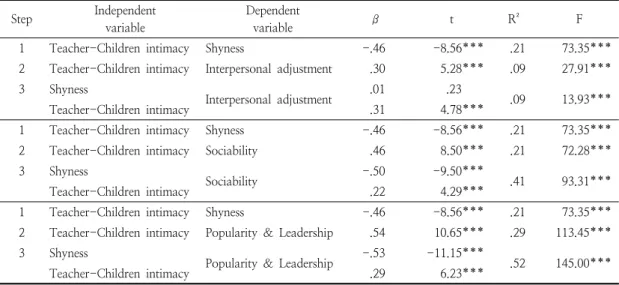
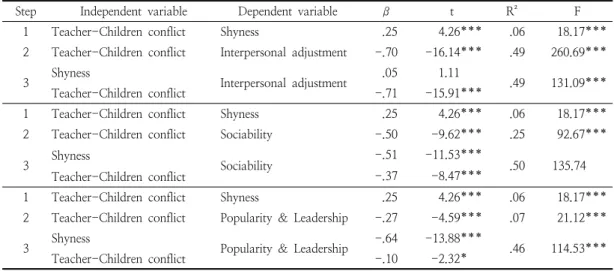
Baron & Kenny(1986)의 절차에 따라, 교사와 유 아 간의 관계와 유아의 사회적 능력 간에 유아의 수 줍음이 매개적 역할을 살펴본 결과는 Table 4, Table 5와 같다.
3-1. 교사와 유아 간의 친밀감과 유아의 사회적 능력 간의 관계에 대한 수줍음의 매개효과
유아의 사회적 능력의 하위 영역별로 살펴보면 먼 저, 교사와 유아 간의 친밀감과 유아의 대인적응성 간의 관계에서 유아의 수줍음의 매개효과는 유의하 지 않게 나타났다.다음으로 사회적 참여에 대한 1단계의 회귀모형에 서 교사와 유아 간의 친밀감은 유아의 수줍음을 유의 미하고 예측하고(β= -0.46, p<0.001), 2단계에서는 교 사와 유아 간의 친밀감이 유아의 사회적 참여를 유의미하 게 예측하고 있음을 알 수 있다(β= 0.46, p<0.001). 마
Step Independent
variable
Dependent
variable β t R² F
1 Teacher-Children intimacy Shyness -.46 -8.56*** .21 73.35***
2 Teacher-Children intimacy Interpersonal adjustment .30 5.28*** .09 27.91***
3 Shyness
Interpersonal adjustment .01 .23
.09 13.93***
Teacher-Children intimacy .31 4.78***
1 Teacher-Children intimacy Shyness -.46 -8.56*** .21 73.35***
2 Teacher-Children intimacy Sociability .46 8.50*** .21 72.28***
3 Shyness
Sociability -.50 -9.50***
.41 93.31***
Teacher-Children intimacy .22 4.29***
1 Teacher-Children intimacy Shyness -.46 -8.56*** .21 73.35***
2 Teacher-Children intimacy Popularity & Leadership .54 10.65*** .29 113.45***
3 Shyness
Popularity & Leadership -.53 -11.15***
.52 145.00***
Teacher-Children intimacy .29 6.23***
***p<.001
Table 4. Mediating effects of shyness on the relationship between teacher-child intimacy and social
competence (N=270)
지막으로 3단계에서 유아의 수줍음이 유아의 사회적 참여를 유의미하게 예측하였고(β= -0.50, p<0.001), 유아의 수줍음을 통제한 후 교사와 유아 간의 친밀감 이 유아의 사회적 참여에 미치는 유의미한 영향력이 감소하였다(β= 0.22, p<0.001). 그러므로 유아의 수 줍음은 교사와 유아 간의 친밀감과 유아의 사회적 참 여 간의 관계에 대해 부분 매개효과를 갖는다고 할 수 있다.
마지막으로 유아의 인기도 및 지도력에 대한 1단 계의 회귀모형에서 교사와 유아 간의 친밀감은 유아의 수줍음을 유의미하게 예측하고(β= -0.46, p<0.001), 그리고 2단계에서는 교사와 유아 간의 친밀감이 유 아의 인기도 및 지도력을 유의미하게 예측하고 있음 을 알 수 있다(β= 0.54, p<0.001). 마지막으로 3단계 에서 유아의 수줍음이 유아의 인기도 및 지도력을 유 의미하게 예측하였고(β= -0.53, p<0.001), 유아의 수 줍음을 통제한 후 교사와 유아 간의 친밀감이 유아의 인기도 및 지도력에 미치는 유의미한 영향력이 감소 하였다(β= 0.29, p<0.001). 그러므로 유아의 수줍음
은 교사와 유아 간의 친밀감과 유아의 인기도 및 지 도력 간의 관계에 대해 부분 매개효과를 갖는다고 할 수 있다. 이상의 매개효과 분석 결과를 토대로 부분 매개모형을 제시하면 Fig.1, Fig.2와 같다.
3-2. 교사와 유아 간의 갈등과 사회적 능력 간의 관계에 대한 수줍음의 매개효과
하위 영역별로 살펴보면 먼저, 교사와 유아 간의 갈등과 유아의 대인적응성 간의 관계에서 유아의 수 줍음의 매개효과는 유의하지 않게 나타났다.
다음으로 사회적 참여에 대한 1단계의 회귀모형에 서 교사와 유아 간의 갈등은 유아의 수줍음을 유의미 하고 예측하고(β= 0.25, p<0.001), 2단계에서는 교사 와 유아 간의 갈등이 유아의 사회적 참여를 유의미하 게 예측하고 있음을 알 수 있다(β= -0.50, p<0.001).
마지막으로 3단계에서는 유아의 수줍음이 유아의 사회 적 참여를 유의하게 예측하였고(β= -0.51, p<0.001), 유아의 수줍음을 통제한 후 교사와 유아 간의 갈등이 유아의 사회적 참여에 미치는 유의한 영향력이 감소
Note) ( ) is standardized coefficients before including the mediating variable
Fig. 1. The partial mediation model of shyness on the relationship between teacher-children intimacy and sociability
Note) ( ) is standardized coefficients before including the mediating variable
Fig. 2. The partial mediation model of shyness on the relationship between teacher-children
intimacy and popularity and leadership
하였다(β= -0.37, p<0.001). 그러므로 유아의 수줍음 은 교사와 유아 간의 갈등과 유아의 사회적 참여 간 의 관계에 대해 부분 매개효과를 갖는다고 할 수 있 다.
마지막으로 인기도 및 지도력에 대한 1단계의 회 귀모형에서 교사와 유아 간의 갈등은 유아의 수줍음 을 유의하고 예측하고(β= 0.25, p<0.001), 2단계에서 는 교사와 유아 간의 갈등이 유아의 인기도 및 지도 력을 유의하게 예측하고 있음을 알 수 있다(β= -0.27, p<0.001). 마지막으로 3단계에서는 유아의 수줍음이 유아의 인기도 및 지도력을 유의하게 예측하였고(β=
-0.64, p<0.001), 유아의 수줍음을 통제한 후 교사와 유아 간의 갈등이 유아의 인기도 및 지도력에 미치는 유의미한 영향력이 감소하였다(β= -0.10, p<0.05).
그러므로 유아의 수줍음은 교사와 유아 간의 갈등과 유아의 인기도 및 지도력 간의 관계에 대해 부분 매 개효과를 갖는다고 할 수 있다. 이상의 매개효과 분 석 결과를 토대로 부분매개모형을 제시하면 Fig. 3, Fig. 4와 같다.
IV. 요약 및 결론
본 연구의 목적은 유아를 대상으로 교사와 유아
간의 관계와 유아의 사회적 능력 간의 매개변인으로 유아의 심리적 특성인 수줍음을 선정하여 이들 변인 과의 관계를 살펴보고, 유아의 사회적 능력에 대한 교사와 유아 간의 관계의 영향에서 수줍음의 매개효 과를 살펴봄으로써 유아의 사회적 능력 향상을 도모 할 수 있는 교사역할의 중요성을 밝히고 교사교육을 위한 기초자료를 제공하는 것이다.
본 연구에서의 목적에 따른 연구결과를 요약하면 다음과 같다.
첫째, 교사와 유아 간의 친밀감 및 갈등과 유아의 사회적 능력 하위 영역간의 관계는 다음과 같이 나타 났다. 교사와 유아 간의 친밀감이 높을수록 대인적응 성, 사회적 참여, 인기도 및 지도력이 높은 것으로 나 타났다. 교사와 유아 간의 갈등이 낮아질수록 대인적 응성, 사회적 참여, 인기도 및 지도력이 높아지는 것 으로 나타났다. 둘째, 교사와 유아 간의 친밀감이 높 을수록 수줍음이 낮아지고, 교사와 유아 간의 갈등이 적어질수록 수줍음이 낮아지는 것으로 나타났다. 셋 째, 수줍음이 낮아질수록 대인적응성, 사회적 참여, 인기도 및 지도력이 높아지는 것으로 나타났다. 넷 째, 교사와 유아 간의 친밀감 및 갈등이 유아의 사회 적 능력의 하위영역에 미치는 영향에서 수줍음의 매 개효과를 분석한 결과를 종합해 보면, 사회적 참여,
Step Independent variable Dependent variable β t R² F
1 Teacher-Children conflict Shyness .25 4.26*** .06 18.17***
2 Teacher-Children conflict Interpersonal adjustment -.70 -16.14*** .49 260.69***
3 Shyness
Interpersonal adjustment .05 1.11
.49 131.09***
Teacher-Children conflict -.71 -15.91***
1 Teacher-Children conflict Shyness .25 4.26*** .06 18.17***
2 Teacher-Children conflict Sociability -.50 -9.62*** .25 92.67***
3 Shyness
Sociability -.51 -11.53***
.50 135.74 -.37 -8.47***
Teacher-Children conflict
1 Teacher-Children conflict Shyness .25 4.26*** .06 18.17***
2 Teacher-Children conflict Popularity & Leadership -.27 -4.59*** .07 21.12***
3 Shyness
Popularity & Leadership -.64 -13.88***
.46 114.53***
Teacher-Children conflict -.10 -2.32*
*p<.05, ***p<.001
Table 5. Mediating effects of shyness on the relationship between teacher-child conflict and social
competence (N=270)
인기도 및 지도력의 경우에만 부분매개 효과를 나타 내고, 대인적응성의 경우에는 유의한 매개효과가 나 타나지 않았다.
이상의 결과에 대해 몇 가지 논의를 하면 다음과 같다.
첫째, 교사와 유아 간의 친밀감이 높아질수록, 갈 등이 적어질수록 대인적응성, 사회적 참여, 인기도 및 지도력이 높아지는 것으로 나타났다. 이는 교사와 유아 간의 친밀감과 사회적 능력 하위요인인 대인적 응성, 사회적 참여, 인기도 및 지도력과 정적 상관이 있다는 것을 밝힌 결과와 일치한다(Lee & Hyun 2010b; Shim & Moon 2014c; Song 2014b). 이는 교 사와 유아 간의 갈등이 대인적응성, 사회적 참여, 인 기도 및 지도력과 부적상관으로 나타난 연구결과와 일치한다(Shim & Moon 2014d; Song 2014c). 따라 서 유아의 사회적 능력 증진을 위하여 긍정적인 교사 와 유아 간의 관계형성에 도움을 주는 프로그램과 교 사와 유아간의 갈등 해결에 도움을 주는 다양한 교사 교육 프로그램 개발 및 실시가 필요할 것으로 보인다.
둘째, 교사와 유아 간의 친밀감이 높아질수록 수 줍음이 낮아지는 것으로 나타났다. 이는 교사와의 관 계가 친밀할수록 수줍음이 낮아진다는 연구결과와 일치하고(Rudasill & Rimm-Kaufman 2009b; Kwon 2014a), 친밀한 교사와 유아 간의 관계가 유아의 걱 정과 불안에 직접적인 영향을 미친다는 연구결과와 도 맥을 같이한다(Moon & Lee 2012b). 교사와 유아 간의 갈등이 적어질수록 수줍음이 낮아지는 것으로 나타났다. 이는 교사와 유아 간의 갈등이 적을수록 수줍음 정도가 낮아진 연구결과와 일치하고(Kwon 2014b), 유아의 걱정과 불안에 직접적인 영향을 미친 다는 연구결과와도 맥을 같이한다(Moon & Lee 2012c;
Moon & Hong 2013b). 따라서 또래관계 속에서 어 려움을 경험하는 수줍은 유아에게 교사가 안정적인 지지기반(Thijs & Koomen, 2008b)을 제공해줌으로 써 사회적 상황에서 느끼는 불안과 긴장, 위축되고 억제되는 수줍음이 감소될 수 있음을 시사해준다.
셋째, 유아가 수줍음을 적게 느낄수록 사회적 능 력이 높아지는 것으로 나타났다. 이는 수줍음은 사회
Note) ( ) is standardized coefficients before including the mediating variable
Fig. 3. The partial mediation model of shyness on the relationship between teacher-children conflict and sociability
Note) ( ) is standardized coefficients before including the mediating variable
Fig. 4. The partial mediation model of shyness on the relationship between teacher-children
conflict and popularity and leadership
적 능력과 관련이 있는 연구결과와(Pilkonis 1997b;
Perren & Alsaker 2006a; Jo 2013a) 일치하는 것으로 유아가 수줍음을 적게 느낄수록 유아들은 부정적인 정서 및 행동을 보이지 않고 친구들과 함께 노는 것 을 좋아하며 친구들을 잘 이끌어 나갈 수 있음을 시 사해준다.
넷째, 교사와 유아 간의 친밀감 및 갈등이 유아의 사회적 능력인 사회적 참여, 인기도 및 지도력에 미 치는 영향은 수줍음에 의해 부분매개 되는 것으로 확 인되었다. 즉, 교사와 유아 간의 친밀감이 높아질수 록, 갈등이 낮아질수록 유아의 사회적 참여, 인기도 및 지도력이 높아지기도 하지만, 교사와 유아 간의 친밀감이 높아질수록, 갈등이 낮아질수록 수줍음의 감소와 같은 심리적 변화가 일어남으로써 사회적 참 여, 인기도 및 지도력이 증가됨을 본 연구는 밝혀주 었다. 이는 어머니의 정서적 가용성이 유아의 사회적 능력에 직접적인 영향을 미치기도 하지만, 유아의 기 질적 특성인 의도적 통제에 영향을 미쳐 사회적 능력 의 변화를 초래하는(Moon 2010b) 연구결과와 유사 한 맥락으로 본 연구는 유아교육 현장에서 교사 역시 수줍은 유아가 느낄 수 있는 감정에 공감하고 유아도 자신의 감정이나 경험을 교사와 나누는 친밀감을 많 이 보일수록 수줍은 유아들이 보육기관에서 안정감 을 갖게 되어 친구들과 함께 하는 것을 좋아하고 친 구들과의 관계에서 주도적이고 인기 또한 얻을 수 있 음을 알 수 있었다. 하지만 교사가 수줍은 유아를 다 루는 것이 힘들고, 유아 역시 교사를 벌주거나 비난 하는 사람으로 인식하게 되면 보육기관 내에서 유아 의 수줍음이 증가되어 또래들과 함께 어울리는 것이 어렵고 소극적인 태도를 보이게 됨을 알 수 있었다.
본 연구에서 지지된 수줍음의 매개효과는 유아가 또 래관계를 형성하고 유지함에 있어 필요한 사회적 능 력의 향상은 수줍음의 감소가 중요한 심리적 변인임 을 밝혀주어, 유아의 수줍음을 감소시킬 수 있는 교 사와 유아 간의 관계 및 교사역할이 중요한 요소임을 밝혔다.
한편, 교사와 유아 간의 친밀감 및 갈등이 유아의 대인적응성에 미치는 영향은 수줍음에 의해 유의한 매개효과가 나타나지 않았다. 이는 수줍음과 대인적
응성 간의 관계가 높지 않아서(Cassidy & Asher 1992; Jo 2013b), 수줍음과 교사와 유아 간의 관계의 영향을 동시에 살펴볼 경우, 수줍음의 영향이 유의미 하지 않게 나타난 결과를 의미하는 것으로 사회적 능 력 중 대인적응성의 변화에는 수줍음의 변화보다는 교사와 유아 간의 친밀감 및 갈등의 변화가 더 효율 적일 수 있음을 시사해준다. 즉, 상대적으로 공격적 이지 않으면서 부정적인 정서 및 행동을 보이지 않는 대인적응성의 변화를 위해서는 유아의 수줍음을 감 소시키는 것 보다 교사가 유아에게 친밀감을 느끼고 갈등을 적게 느끼는 것이 더 중요함을 시사해 준다.
본 연구의 의의는 다음과 같다. 첫째, 교사와 유아 간의 관계와 사회적 능력 간의 관계를 살펴본 연구는 다수 있으나 본 연구에서는 이러한 관계뿐만 아니라 유아의 심리적 특성인 수줍음에 관심을 가지고, 수줍 음으로 나타나는 사회적 능력의 저하는 교사와의 관 계를 통해 감소 될 수 있음을 밝힘으로써, 교사와 유 아 간의 관계가 수줍음을 감소시켜 사회적 능력을 증 진할 수 있음을 밝힌 점이다. 둘째, 기존의 선행연구 에서는 유아의 수줍음으로 비롯되는 적응의 어려움 에 부모나 교사의 중재적 역할에 대해 연구했다면, 본 연구에서는 교사와 유아 간의 관계가 유아의 수줍 음의 변화에 직접적인 영향을 줄 수 있다는 것을 밝 힌 점이다.
본 연구의 제한점 및 추후 연구를 위한 제언은 첫 째, 유아의 수줍음을 측정하는데 있어 교사가 지각하 는 보고 외에 부모가 지각하는 수줍음, 보육시설 내 에서의 행동관찰을 하면 유아의 상황에 따른 수줍음 정도를 다차원적으로 파악할 수 있을 것이다. 둘째, 유아의 심리적 요인 중 수줍음의 매개효과를 밝혔지 만, 자아존중감, 자기조절, 자아탄력성 등을 추가로 연구하여 유아의 심리적 영향은 교사와 유아 간의 관 계에서 어떤 영향을 받아 유아의 사회적 능력에 영향 을 미치는지 파악할 필요가 있다. 셋째, 본 연구는 부 산광역시에 소재한 보육시설을 통해 270명의 유아와 교사를 통해 이루어 진 것으로 그 결과를 일반화시키 기에는 한계가 있다. 따라서 연구 대상이 가지고 있 는 지역적 특성과 표본의 수가 적은 것을 고려해야 한다.