− 689 − http://dx.doi.org/10.5720/kjcn.2012.17.6.689
초등학교 고학년용 영양교육 소책자 개발 및 효과 분석 - 하루 필요 식품군 단위수 교육을 중심으로 -
임은수·조영숙1)·김세나1)·김숙배2)†
전북대학교 교육대학원,
1)농촌진흥청 국립농업과학원 농식품자원부,
2)전북대학교 식품영양학과·인간생활과학연구소
Development and Effects' Analysis of Nutrition Education Pamphlet for the Higherr Grades Elementary Students
-Focused on Individual Daily Needed Food Exchange Units-
Eun-Su Lim, Young-Sook Cho
1), Se-Na Kim
1), Sook-Bae Kim
2)†Graduate School of Education, Chonbuk National University, Jeonju, Korea
1)
Department of Agrofood Resources, NAAS, RDA, Suwon, Korea
2)
Department of Food Science & Human Nutrition, Research Institute of Human Ecology, Chonbuk National University, Jeonju, Korea
Abstract
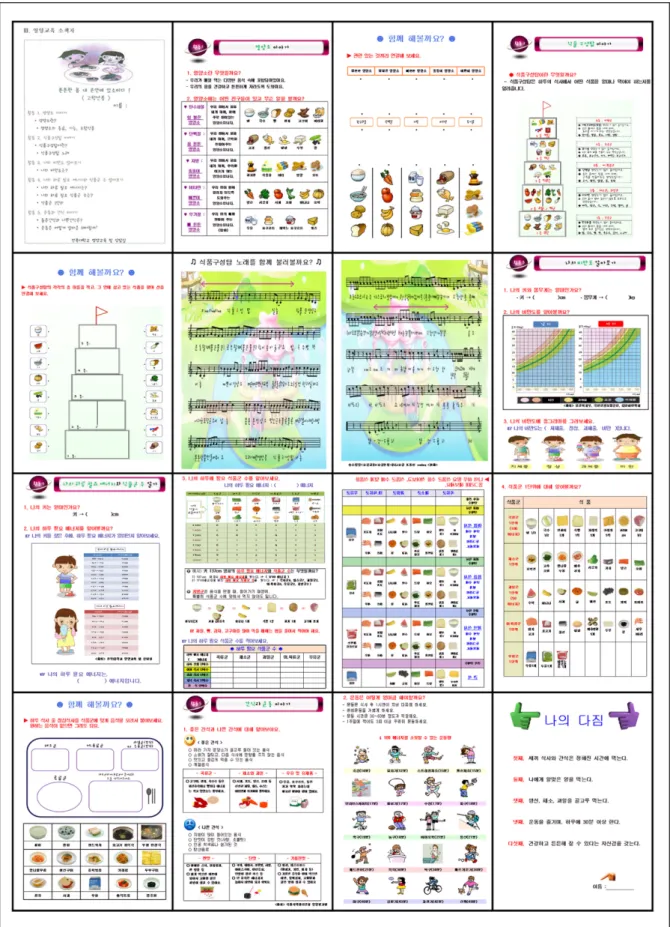
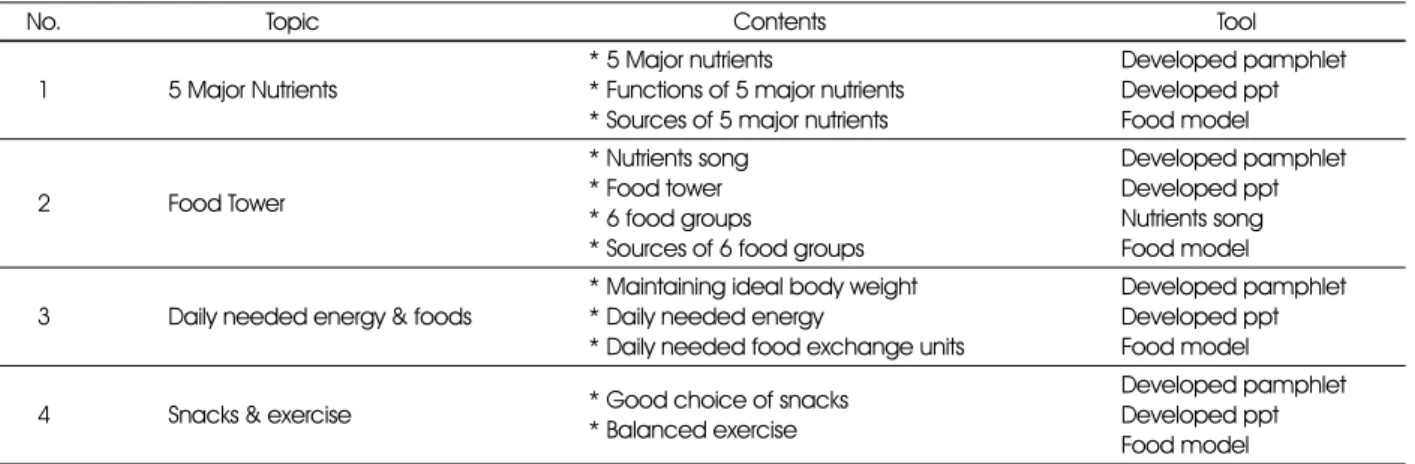
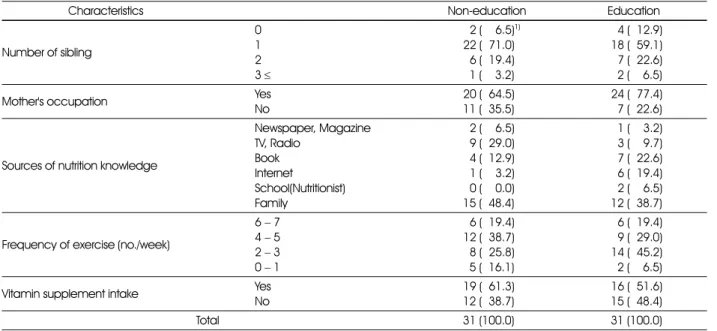
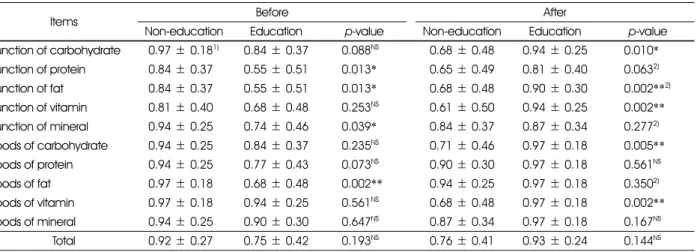
The purpose of this study was to evaluate effects of a nutrition education focused on Food Exchange System for the higher grades elementary children. Nutrition education lessons (40 min/lesson, 4 times), ‘5 major nutrients and functions’, ‘6 food groups’, ‘daily needed energy and food exchange units’, ‘good choice of snacks and balanced exercise’ were provided to elementary students (5th grade students). This research was based on the data from two groups of elementary school children in the ‘education’ group (n = 31) and ‘non-education’ group (n = 31). We assessed the changes in dietary attitude, food habit and nutrition knowledge using questionnaire and nutrient intake using 24hr recall method by nutrition education using the developed pamphlet. After education, there was a significant difference in the dietary attitude score only in attitude of ‘balanced meal’ (p < 0.001) in the education group compared to the non-education group. In food habit, there were significant positive changes in the type of breakfast and in the priority of choosing snack in the educated group. In nutrition knowledge, there were significant increases in scores of ‘function of carbohydrate’ (p < 0.05), ‘function of fat’
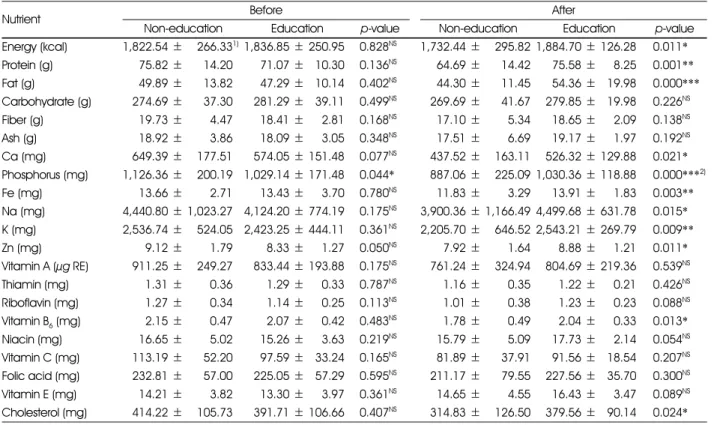
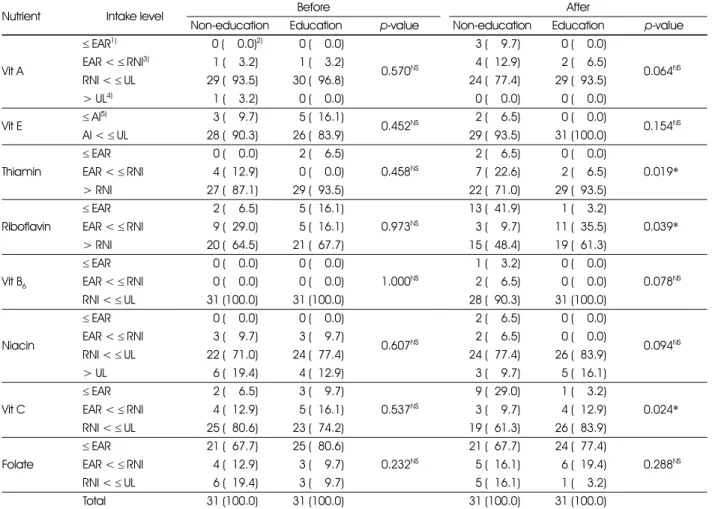
(p < 0.01), ‘function of vitamin’ (p < 0.01), ‘foods of carbohydrate’ (p < 0.01), and ‘foods of vitamin’ (p < 0.01) in the educated group. After education,carbohydrate: protein: fat (CPF) ratio was significantly different between the two groups (education group, 59 : 16 : 26 vs. non-education group, 63 : 15 : 23). In evaluation of nutrient intake by Dietary Reference Intakes for Koreans (KDRIs), there were significant positive effects in energy (p < 0.05), thiamin (p < 0.05), riboflavin (p < 0.05), vitamin C (p < 0.05), phosphorus (p < 0.01), Fe (p < 0.01) and zinc (p < 0.01) in the education group compared to the non-education group. In conclusion, the developed 4 times’ nutritional education pamphlet focused on individual daily energy requirements and food exchange units using food exchange system for higher grades’ elementary student may positively change nutrition knowledge and dietary intakes. (Korean J Community Nutr 17(6) : 689~706, 2012)
KEY WORDS : Food Exchange System·nutrition education·higher grades elementary school students·pamphlet
—————————————————————————
서 론
—————————————————————————
학령기는 비교적 성장이 완만하게 지속되면서 제 2의 급 속한 성장을 준비하는 시기이다(Koo 등 2006). 학령기 후 기에 해당하는 고학년 아동은 신체적 성장과 함께 자아개념 의 발달, 사물을 판단·종합하는 인지능력이 이루어져, 평생 의 건강에 기초가 되는 자발적인 식습관을 형성하는 시기이 다(Cole 등 2006).
최근 우리나라는 급속한 경제 성장과 사회 변화로 소득수 준과 생활수준이 향상되어 식생활이 크게 변화되었다. 편의
접수일: 2012년 11월 20일 접수수정일: 2012년 12월 14일 수정 채택일: 2012년 12월 14일 채택
*This study was carried out with the support of "Cooperative Research Program for Agricultural Science & Technology Development (PJ006488)", Rural Development Administration, Republic of Korea.
†Corresponding author: Sook-Bae Kim, Chonbuk National University, 664-14, Duk-Jin Dong 1-Ga, Duk-Jin Gu, Jeonju 561-756, Korea Tel: (063) 270-3823, Fax: (063) 270-3854
E-mail: [email protected]
This is an Open-Access article distributed under the terms of the Creative Commons Attribution Non-Commercial License(http://
creativecommons.org/licenses/by-nc/3.0) which permits unrestricted non-commercial use, distribution, and reproduction in any medium, provided the original work is properly cited.