• 검색 결과가 없습니다.

Association between Diabetes and Chewing Problems and Periodontal Disease in Korean Adults

N/A
N/A
Protected

Academic year: 2021

Share "Association between Diabetes and Chewing Problems and Periodontal Disease in Korean Adults"

Copied!
9
0
0

로드 중.... (전체 텍스트 보기)

전체 글

(1)

http://doi.org/10.14347/kadt.2019.41.4.327

한국 성인의 당뇨병 및 씹기 문제와 치주질환의 관련성

황홍구, 이종화*

경운대학교 의료서비스 경영학과, 수성대학교 치기공과*

Association between Diabetes and Chewing Problems and Periodontal Disease in Korean Adults

Hong-Gu Hwang, Jong-Hwa Lee*

Department of Medical Service Management, Kyungwoon University Department of Dental Laboratory Technology, Suseong University*

[Abstract]

Purpose: The purpose of this study was to investigate the relationship between periodontal disease, diabetes and chewing problems in Korean adults over the age of 19 using the 6th National Health Nutrition Survey.

Methods: Data from the 6th National Health and Nutrition Survey (Ministry of Health & Welfare, 2013; 2014; 2015) were used. In this study, 17,101 adults aged 19 and older were included in the study to determine the relationship between diabetes and chewing problems in Korean adults.

Results: Diabetes and chewing problems have been associated with periodontal disease. Diabetes was 0.719 times lower(p<0.001) in periodontal disease than in the case of diabetes. Chewing problem was 1.360 times(p<0.001) periodontal disease prevalence compared to ‘not at all uncomfortable’. It was found that the prevalence of periodontal disease was 2.139 times(p<0.001) compared to ‘not at all uncomfortable’. It was found that the prevalence of periodontal disease was 2.296 times higher(p<0.001) compared to ‘not at all uncomfortable’. It was found that the prevalence of periodontal disease was 2.119 times higher(p<0.001) compared to ‘not at all uncomfortable’.

Conclusion: Diabetes and chewing problems were found to be related to periodontal disease, and as reported in previous studies, diabetes and chewing problems related to oral disease need to be prevented and treated with regular checkups.

In addition, based on the research results, it can be used as basic data for the health business plan that can maintain and manage health.

Key words: Chewing Problems, Diabetes, Korean Adults, Ministry of Health and Welfare, Periodontal Disease,

Corresponding author

Name

이 종 화

Tel.

053-749-7253

E-mail

[email protected]

Address

대구광역시 수성구 달구벌대로 528길 15

(2)

I. 서 론

당뇨병은 대사 장애로 인슐린 분비와 작용의 결함 을 특징으로 하는 다발성 병인의 대사 장애로(WHO, 2019a). 치료하지 않으면 신경과 혈관을 비롯한 장기 손상 등의 합병증을 유발할 수 있다(WHO, 2019b). 국 내 당뇨병 환자는 2011년 12.4%, 2012년 11.8%였다 가 2013년 14.5%로 높아졌고, 2014년 13.0%, 2015년 11.4%로 내림세를 보이다가 2016년 14.4%로 증가하였 으며, 인구 변화를 감안하면 전반적으로 당뇨병 유병률 은 증가하는 추세이다(Park, 2018).

치주질환은 전 세계적으로 유병률이 높은 만성 염증 성 질환으로(Mumghamba et al, 1995; Nazir, 2017), 치주 조직의 파괴와 결합 연조직 및 치조골의 상실로 결 국 치아 손실을 초래한다(Okada & Murakami, 1998;

Bascones-Martinez et al, 2011).

이러한 치주질환으로 요양기관을 방문한 진료 인원 은 2012년 707만 명에서 2016년에는 1천 107만 명으로 56.6% 증가하였으며, 50대 24.2%, 40대 19.7% 순으로 40대와 50대가 43.9%로 가장 높았다(National Health Insurance Service, 2018). 미국 성인의 경우 47.2%가 치주질환 유병을 보고하였으며(Ruiz, 2019), 독일은 35 세 이상 성인에서 치주낭의 깊이가 3mm 이상 임상적 부착 치은 손실이 95.0%로 보고하였다(Holtfreter et al, 2010).

치주질환의 유병률은 연령이 증가할수록 높아지며 (Petersen & Ogawa, 2005), 45세에서 64세의 연령 그 룹에서 가장 높은 비율의 당뇨병과 밀접한 관련이 있다 (Casagrande & Cowie, 2017). 특히 당뇨병은 치주질 환이 있는 환자에서 더 심각하게 나타나며(Llambes et al, 2015), 당뇨병과 치주질환은 전신건강과 관련이 있 다고 하였다(Lambeth et al, 2015; Teles et al, 2013).

구강의 씹는 기능은 소화 과정의 첫 단계로써 큰 음 식 입자를 연하에 부드럽도록 작은 입자로 분해하고, 타 액과 음식 자체에서 방출된 액체와 혼합하여(Peyron et al, 2004), 음식을 삼킬 준비를 하는데, 이는 필요한 씹기의 횟수로 결정된다(Chauncey et al, 1984). 이러 한 씹기 기능은 치아의 수와 최대 무는 힘(bite force)

Braley, 1950)에 따라 악화하며, 씹는 것은 치주막에 서 수용체를 활성화하며(Anderson & Hector, 1987;

Hector & Linden, 1987), 치아를 압축하여 치주막 수 용체를 활성화한 다음, 삼차 신경을 통해 타액선으로 전 달한다(Pedersen et al, 2002). 이들 수용체의 활성화 는 타액 흐름과 양의 상관관계가 있으며, 타액 분비는 씹는 대상의 경도와 크기 및 저작 근육에 의한 씹는 힘 (Anderson & Hector, 1987; Rosenhek et al, 1993)에 따라 증가한다.

따라서 치주질환과 치아의 손실 등은 중추신경계 에 전달되는 구강 감각을 감소시키고, 씹기 기능의 감 소 등을 초래하며, 건강한 삶의 질에 부정적 영향을 미 친다(Kim, 2018). 또한, 당뇨병과 치주질환 사이의 생 물학적 연관성으로 당뇨병은 고혈당증을 지속시켜 치 주 병원성 박테리아에 대한 염증 반응을 일으키며 (Southerland et al, 2006; Nishimura et al, 2007).

치주질환의 주요 위험 인자로 확인되었다(Kader et al, 2006; Ch ávarry et al, 2009),

이러한 선행연구들은 주로 치주질환과 당뇨병 합병증 의 위험 사이의 관련성에 대한 관찰연구(Thorstensson et al, 1996), 당뇨병 및 그 합병증과 치주질환의 종 단 연구(Saremi et al, 2005), 성별, 연령, 당뇨병 지 속 시간, 체질량 지수 및 흡연 등에 따른 치주염의 영향 (Shultis et al, 2007), 성별에 따른 만성질환과 구강 건 강행태가 치주질환에 미치는 위험도(Hong, 2018) 등 치주질환과 혈당 조절 불량 및 당뇨병 환자의 당뇨병 합 병증 위험에 기여한다는 치주질환과의 관련성에 관한 연구들이 대부분이며, 우리나라 성인의 치주질환에 대 한 객관적인 씹기 문제 요인을 고려한 연구는 부족한 실 정이다.

따라서 본 연구는 우리나라의 건강 및 구강 관련 대표

통계자료(Choi et al, 2010; Jung & Oh, 2011; Woo et

al, 2013)를 통해 한국 성인의 치주질환과 관련된 당뇨

병 및 씹기 문제 변수가 치주질환에 미치는 관련성을 알

아보고자 하였으며, 성인들의 구강 보건 향상을 위한 기

초자료를 제공하고자 하였다.

(3)

Ⅱ. 연구 방법 1. 연구 대상

본 연구는 국민건강영양조사 제6기(Ministry of Health & Welfare, 2013; 2014; 2015) 자료를 이용하 였다. 자료에서 한국 성인의 당뇨병 및 씹기 문제와 치 주질환의 관련성을 알아보기 위해 만19세 이상 성인 17,101명을 연구에 포함하여 분석하였다.

2. 조사 도구와 내용

1) 통제변수

본 연구에 사용된 통제변수는 일반적 특성과 구강 보 건행태를 사용하였다. 일반적 특성의 통제변수는 성별, 연령, 지역, 교육수준, 기초생활수급 여부, 흡연, 음주 등을 사용하였다. 성별은 ‘남자’와 ‘여자’로 분류하였고, 연령은 ‘19-39세’, ‘40-64세’, ‘65세 이상’으로 분류하 였다. 지역은 ‘도시’와 ‘농촌’으로 분류하였으며, 교육 수준은 ‘초졸 이하’, ‘중졸’, ‘고졸’, ‘대졸 이상’으로 분류 하였고, 기초생활수급 여부는 ‘예’, ‘아니오’로 분류하였 다. 흡연과 음주는 ‘예’, ‘아니오’로 분류하였으며, 구강 보건행태 통제변수는 어제 하루 칫솔질 여부와 최근 1 년간 구강검진 여부 등을 사용하여 ‘아니오’, ‘예’로 분 류하였다.

2) 독립변수

본 연구에 사용된 독립변수는 당뇨병과 씹기 문제를 사용하였다. 당뇨병은 ‘있음’, ‘없음’으로 분류하였고, 씹 기 문제는 ‘전혀 불편하지 않음’, ‘불편하지 않음’, ‘그저 그러함’, ‘불편함’, ‘매우 불편함’으로 분류하였다.

3) 종속변수

본 연구에 사용된 종속변수는 치주질환 유병여부를 사 용하였다. 치주질환 유병여부는 ‘있음’, ‘없음’으로 구분 하였다.

3. 자료처리 및 분석 방법

본 연구는 국민건강영양조사 제6기 자료를 통합하여, 분석계획 파일을 생성하였고, 생성된 분석 자료의 결측 값 처리는 결측 자료도 모두 적용하였다. 일반적 특성과 구강 보건행태, 씹기 문제에 따른 치주질환 유무는 복합 표본 t-검정, 교차분석을 하였고, 일반적 특성과 구강 보건행태를 통제한 후, 당뇨병 및 씹기 문제와 치주질환 유병여부의 관련성은 복합표본 로지스틱 회귀분석을 하 였다. 통계적 분석은 SPSS(SPSS 21.0 for Windows, SPSS Inc, USA)를 사용하여 유의수준(significance level)은 0.05로 설정하였다.

Ⅲ. 결 과

1. 연구대상자의 일반적 특성과 구강 건강행태

연구대상자의 일반적 특성과 구강 건강행태를 살펴 보면(Table 1), 성별은 ‘여자’ 50.5%, ‘남자’ 49.5%이었 고, 연령에서는 ‘40-64세’가 46.7%, ‘19-39세’ 37.6%,

‘65세 이상’은 15.7% 순으로 나타났다. 지역은 ‘도시’

82.2%, ‘농촌’ 17.8%이었으며, 교육수준에서는 ‘고졸’

38.1%, ‘대졸 이상’ 35.9%, ‘초졸 이하’ 16.9%, ‘중졸’

9.1% 순으로 나타났다. 기초생활수급 여부는 ‘아니오’

92.3%, ‘예’ 7.7%이었고, 흡연은 ‘비흡연’ 77.3%, ‘흡연’

가 22.7%의 분포를 보였으며, 음주는 ‘음주’ 89.8%, ‘비 음주’ 10.2%로 나타났다. 어제 하루 칫솔질 여부는 ‘예’

98.5%, ‘아니요’ 1.5%이었으며, 최근 1년간 구강검진 여

부에서는 ‘아니오’가 70.1%, ‘예’가 29.9%이었다.

(4)

2. 연구대상자의 당뇨병 및 씹기 문제와 치주질환 유병여부

연구대상자의 당뇨병 및 씹기 문제와 치주질환 유병 여부를 살펴보면(Table 2) 당뇨병 유병 여부는 ‘없음’

93.4%, ‘있음’ 6.6%이었고, 씹기 문제는 ‘전혀 불편하 지 않음’ 39.0%, ‘불편하지 않음’ 23.6%, ‘그저 그러함’

16.4%, ‘불편함’ 15.8%, ‘매우 불편함’ 5.1%이었다. 치주 질환 유병 여부는 ‘아니오’ 71.1%, ‘예’ 28.9%이었다.

3. 치주질환 유병여부의 관련성 비교

1) 연구대상자의 일반적 특성 및 구강 건강행태와 치주 질환 유병여부의 관련성 비교

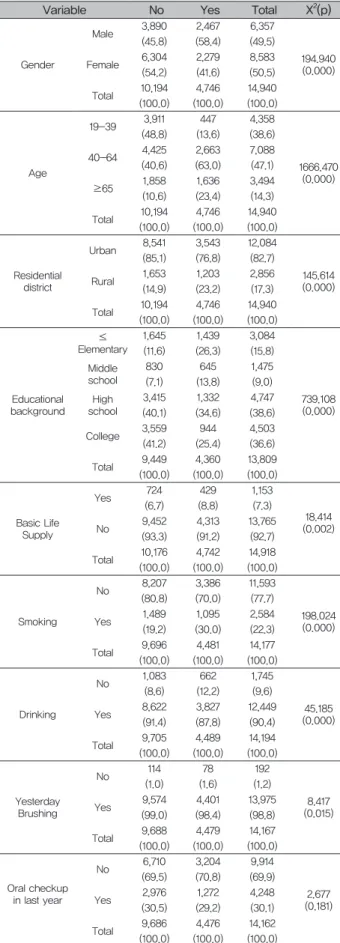
연구대상자의 일반적 특성 및 구강 건강행태와 치주 질환 유병여부의 관련성 비교는 Table 3과 같다. 치 주질환 유병여부의 치주질환 있음에서 성별은 ‘남자’

58.4%, ‘여자’ 41.6%로 ‘남자’가 치주질환 유병이 높았 으며(p<0.001), 연령에서는 ‘40-64세’가 63.0%, ‘65 세 이상’은 23.4%, ‘19-39세’ 13.6% 순으로 나타났 고 통계적으로 유의하였다(p<0.001). 지역은 ‘도시’

76.8%, ‘농촌’ 23.2%, 나타났고(p<0.001), 교육수준 에서는 ‘고졸’ 34.6%, ‘초졸 이하’ 26.3%, ‘대졸 이상’

25.4%‘중졸’ 13.8% 순으로 나타나 통계적으로 유의 하였다(p<0.001). 기초생활수급 여부 ‘아니오’ 91.2%,

‘예’ 8.8%로 나타났고(p<0.01), 흡연상태는 ‘비흡연’은 70.0%, ‘흡연’가 30.0%의 분포를 보였으며(p<0.001), 음주는 ‘음주’ 87.8%, ‘비음주’ 12.2%로 통계적으로 유의하였다(p<0.001). 어제 하루 칫솔질 여부는 ‘예’

98.4%, ‘아니오’ 1.6%로 나타났고(p<0.01), 최근 1년간 구강검진 여부는 통계적으로 유의하지 않았다(p>0.05).

Disease in Subjects

Variable  N %

Diabetes

No 12736 93.4

Yes 1210 6.6

Total 13946 100

Chewing

Very uncomfortable 1017 5.1 Uncomfortable 2907 15.8

Just so 2684 16.4

Not inconvenient 3661 23.6 Not at all uncomfortable 5652 39

Total 15921 100

Periodontal disease

No 10194 71.1

Yes 4746 28.9

Total 14940 100

of Subjects

Variable  N %

Gender

Male 7327 49.5

Female 9774 50.5

Total 17101 100

Age

19-39 4817 37.6

40-64 7944 46.7

≥65 4340 15.7

Total 17101 100

Residential district

Urban 13719 82.2

Rural 3382 17.8

Total 17101 100

Educational background

≤Elementary 3683 16.9

Middle school 1640 9.1

High school 5225 38.1

College 4876 35.9

Total 15424 100

Basic Life Supply

Yes 1396 7.7

No 15676 92.3

Total 17072 100

Smoking

No 12970 77.3

Yes 2965 22.7

Total 15935 100

Drinking

No 2075 10.2

Yes 13884 89.8

Total 15959 100

Yesterday Brushing

No 285 1.5

Yes 15639 98.5

Total 15924 100

Oral checkup in last year

No 11245 70.1

Yes 4674 29.9

Total 15919 100

(5)

2) 연구대상자의 씹기 문제와 치주질환 유병여부의 관련성 비교

치주질환 유병여부의 ‘치주질환 있음’에서 당뇨병 유 병은 ‘없음’ 88.3%, ‘있음’ 11.7%로 나타났다(p<0.001).

씹기 문제는 ‘전혀 불편하지 않음’ 24.8%, ‘불편함’

24.6%, ‘불편하지 않음’ 21.3%, ‘그저 그러함’ 21.3%,

‘매우 불편함’ 8.1%로 나타났다(p<0.001)(Table 4).

3) 당뇨병 및 씹기 문제와 치주질환 유병여부의 복합표 본 로지스틱 회귀분석

일반적 특성과 구강 보건행태를 통제한 후, 당뇨병 및 씹기 문제와 치주질환 유병여부의 관련성을 알아보기 위한 복합표본 로지스틱 회귀분석 결과는 Table 5와 같 다. 분석결과, 당뇨병과 씹기 문제는 치주질환 유병과 관련성이 있는 것으로 나타났다. 당뇨병은 ‘있음’에 비해

‘없음’이 0.719배(p<0.001) 치주질환 유병이 낮았으며, 씹기 문제는 ‘전혀 불편하지 않음’에 비해 ‘불편하지 않 음’이 1.360배(p<0.001) 치주질환 유병이 높았고, ‘그저 그러함’ 2.139배(p<0.001), ‘불편함’ 2.296배(p<0.001),

‘매우 불편함’ 2.119배(p<0.001) 치주질환 유병이 높은 것으로 나타났다. Nagelkerke R

2

적합도 검정 결과, 유 의확률이 0.248로 나타나 모형은 적합하였다.

Table 3. Comparison of General Characteristics, Oral Health Behavior, and Periodontal Disease Prevalence among Subjects

Variable  No Yes Total X2(p)

Gender

Male 3,890 2,467 6,357

194.940 (0.000) (45.8) (58.4) (49.5)

Female 6,304 2,279 8,583

(54.2) (41.6) (50.5)

Total 10,194 4,746 14,940

(100.0) (100.0) (100.0)

Age

19-39 3,911 447 4,358

1666.470 (0.000) (48.8) (13.6) (38.6)

40-64 4,425 2,663 7,088

(40.6) (63.0) (47.1)

≥65 1,858 1,636 3,494

(10.6) (23.4) (14.3)

Total 10,194 4,746 14,940

(100.0) (100.0) (100.0)

Residential district

Urban 8,541 3,543 12,084

145.614 (0.000) (85.1) (76.8) (82.7)

Rural 1,653 1,203 2,856

(14.9) (23.2) (17.3)

Total 10,194 4,746 14,940

(100.0) (100.0) (100.0)

Educational background

≤ Elementary

1,645 1,439 3,084

739.108 (0.000) (11.6) (26.3) (15.8)

Middle school

830 645 1,475

(7.1) (13.8) (9.0) High

school

3,415 1,332 4,747

(40.1) (34.6) (38.6)

College 3,559 944 4,503

(41.2) (25.4) (36.6)

Total 9,449 4,360 13,809

(100.0) (100.0) (100.0)

Basic Life Supply

Yes 724 429 1,153

18.414 (0.002)

(6.7) (8.8) (7.3)

No 9,452 4,313 13,765

(93.3) (91.2) (92.7)

Total 10,176 4,742 14,918

(100.0) (100.0) (100.0)

Smoking

No 8,207 3,386 11,593

198.024 (0.000) (80.8) (70.0) (77.7)

Yes 1,489 1,095 2,584

(19.2) (30.0) (22.3)

Total 9,696 4,481 14,177

(100.0) (100.0) (100.0)

Drinking

No 1,083 662 1,745

45.185 (0.000) (8.6) (12.2) (9.6)

Yes 8,622 3,827 12,449

(91.4) (87.8) (90.4)

Total 9,705 4,489 14,194

(100.0) (100.0) (100.0)

Yesterday Brushing

No 114 78 192

8.417 (0.015)

(1.0) (1.6) (1.2)

Yes 9,574 4,401 13,975

(99.0) (98.4) (98.8)

Total 9,688 4,479 14,167

(100.0) (100.0) (100.0)

Oral checkup in last year

No 6,710 3,204 9,914

2.677 (0.181) (69.5) (70.8) (69.9)

Yes 2,976 1,272 4,248

(30.5) (29.2) (30.1)

Total 9,686 4,476 14,162

(100.0) (100.0) (100.0)

Table 4. Comparison of Chewing Problems and Prevalence of Periodontal Disease in Subjects

Variable  No Yes Total X2(p)
Diabetes

No 8,929 3,807 12,736

230.173 (0.000) (95.4) (88.3) (93.4)

Yes 603 607 1,210

(4.6) (11.7) (6.6)

Total 9,532 4,414 13,946

(100.0) (100.0) (100.0)

Chewing

Very uncomfortable

409 400 809

887.178 (0.000)

(3.1) (8.1) (4.5)

Uncomfortable 1,334 1,176 2,510 (11.5) (24.6) (15.3)

Just so 1,498 911 2,409

(14.9) (21.3) (16.7) Not

inconvenient

2,386 918 3,304

(24.9) (21.3) (23.8) Not at all

uncomfortable

4,060 1,072 5,132

(45.6) (24.8) (39.6)

Total 9,687 4,477 14,164

(100.0) (100.0) (100.0)

(6)

Ⅳ. 고 찰

치주질환은 수 세기 동안 인간을 괴롭힌 가장 흔 한 만성 장애 중 하나이며, 치주낭, 치조골 손실 및 치 아 손실을 나타내는 용어인 pyorrhea(치조 농루)로 널 리 알려지게 되었다(Williams, 1990). 이러한 치주질 환은 당뇨 합병증의 위험 증가와 관련이 있으며, 구강 건강을 유지하는 데 있어 중요한 요소이다(Taylor &

Borgnakke, 2008). 특히, 불완전하게 조절된 당뇨병 은 치주 질환을 포함한 구강 감염에 대한 감수성이 증가 하는 것과 관련이 있으며(Lim et al, 2007; Campus et al, 2005; Tsai et al, 2002; Lalla & Lamster, 2012).

치주질환은 결합 조직의 손실로 치아 상실로 이어져 씹 는 기능에 문제를 초래한다(Lalla & Lamster, 2012;

Taylor, 2001).

따라서 본 연구는 국민건강영양조사 제6기 원시 자료 를 이용하였으며, 우리나라의 만19세 이상 성인에서 당 뇨병과 씹기 문제와 치주질환의 관련성을 살펴보았다.

복합표본 로지스틱 회귀분석 결과, 일반적 특성과 구 강 보건행태를 통제한 후, 당뇨병과 씹기 문제는 치주질 환과 관련성이 있었다. 이러한 결과는 당뇨병 환자의 경 우 정상군에 비해 치주 조직 소실이 유의하게 증가하였 고, 치주질환이 증가하였다고 보고한 연구(Khader et al, 2006; Lalla & Lamster, 2012; Taylor, 2001)와 일치하였으며, 치주질환이 있는 경우 공복혈당이 높았

2006; Kim et al, 2014; Kown et al, 2011; Taylor, 2001)와 일치하였다. 따라서 당뇨병 환자의 경우 적절 한 치주질환의 치료를 병행하여야 할 것으로 생각된다.

결과적으로 당뇨병과 씹기 문제 등이 치주질환 유병 과 관련성이 있었으며, 선행연구에서의 결과와 같이 구 강질환과 관련이 높은 당뇨병, 씹기 문제 등은 정기적인 검진으로 예방과 치료를 함께 할 필요성이 있다고 생각 된다. 또한, 연구결과를 바탕으로 건강을 유지·관리할 수 있는 보건사업계획에 기초자료로 활용할 수 있을 것 으로 생각된다.

본 연구의 제한점으로는 국민건강영양조사 6기 원시 자료를 사용한 단면조사로 인하여 치주질환과 당뇨병, 씹기 문제와의 전·후 인과관계를 설명하기 어려운 문 제가 있으며, 추후 연구에서는 지속적인 조사를 통한 전 향성 추적조사인 코호트 연구의 필요성이 있다.

그러나 우리나라 국민 건강정보에 대표성이 있는 국 민건강영양조사의 자료를 이용하여 분석하였다는 것에 의의를 둘 수 있다. 또한, 건강검진과 설문 조사를 통해 이루어진 당뇨병, 씹기 문제 등 관련 변수들이 통계 분 석에 사용하여 향후 구강 건강 관련 관련성을 밝히기 위 한 다양한 연구의 기초자료로 활용될 수 있을 것이라 생 각한다.

Ⅴ. 결 론

본 연구는 한국 성인의 당뇨병과 씹기 문제가 치주질 환 유병과 어떠한 관련성은 있는지 알아보고자 복합표 본분석을 하여 다음과 같은 결과를 얻었다.

연구대상자의 일반적 특성과 구강 보건행태를 통제한 후, 당뇨병 및 씹기 문제와 치주질환의 관련성을 알아본 결과, 치주질환과의 관련성이 있는 것으로 나타났다. 당 뇨병은 ‘있음’에 비해 ‘없음’이 0.719배 치주질환 유병이 낮았다. 씹기 문제는 ‘전혀 불편하지 않음’에 비해 ‘불편 하지 않음’이 1.360배 치주질환 유병이 높았고, ‘전혀 불 편하지 않음’에 비해 ‘그저 그러함’이 2.139배 치주질환 유병이 높았고, ‘전혀 불편하지 않음’에 비해 ‘불편함’이 Prevalence of Diabetes and Chewing Problems

and Periodontal Disease

Variable B SE t p OR 95% CI

하한 상한

Diabet- es 

No -.330 .079 -4.169 .000 .719 .615 .840

Yes Reference

Chew- ing

Very

uncomfortable .751 .107 6.993 .000 2.119 1.716 2.617 Uncomfortable .831 .068 12.165 .000 2.296 2.008 2.626

Just so .760 .069 11.086 .000 2.139 1.869 2.448

Not inconvenient .308 .066 4.640 .000 1.360 1.194 1.549 Not at all

uncomfortable Reference

(7)

2.296배 치주질환 유병이 높았으며, ‘전혀 불편하지 않 음’에 비해 ‘매우 불편함’이 2.119배 치주질환 유병이 높 은 것으로 나타났다.

REFERENCES

A n d e r s o n D J , H e c t o r M P . P e r i d o n t a l mechanoreceptors and parotid secretion in animals and man. J Dent Res 66, 518–523, 1987.

Bascones-Martinez A, Matesanz-Perez P, Escribano-Bermejo M, Gonz ález-Moles M Á, Bascones-Ilundain J, Meurman JH.

Periodontal disease and diabetes-Review of the literature. Med Oral Patol Oral Cir Bucal, 16(6), e722–729, 2011.

Campus G, Salem A, Uzzau S, Baldoni E, Tonolo G. Diabetes and periodontal disease: a case- control study. J Periodontol, 76, 418–425, 2005.

Casagrande SS, Cowie CC. Trends in dietary intake among adults with type 2 diabetes:

NHANES 1988–2012. J Hum Nutr Diet, 30, 479–489, 2017.

Chauncey HH, Muench ME, Kapur KK et al.

The effect of the loss of teeth on diet and nutrition. Int Dent J, 34, 98–104, 1984.

Ch ávarry NGM, Vettore MV, Sansone C, Sheiham A. The relationship between diabetes mellitus and destructive periodontal disease:

a meta-analysis. Oral Health Prev Dent, 7(2), 107–127, 2009.

Choi JS, Lee YJ, Jeon SB, Kim HM, Jeong EH, Jo EJ. The association between self-reported oral health problems and oral health related quality of life. J Korean Acad Oral Health, 34, 411-421, 2010.

Hector MP, Linden RWA. The possible role of periodontal mechanoreceptors in the control of parotid secretion in man. Q J Exp Physiol, 72, 285–301, 1987.

Hong MH. TRelationship between Oral Health Behavior, Chronic Disease and Periodontal Disease in Middle and Older Adults According to Gender. J Korea Academia- Industrial cooperation Society, 19(11), 403- 410, 2018.

Holtfreter B, Kocher T, Desvarieux M, Micheelis W. Prevalence of periodontal disease and treatment demands based on a German dental survey(DMS Ⅳ). J Clin Periodontol, 37, 211-219, 2010.

Jung JO, Oh GJ. A study of the relationship between socioeconomic status, oral health behaviors and periodontitis in the elderly Korean population. J Korean Acad Oral Health, 35, 57-66, 2011.

Julien K, Buschang P, Throckmorton G et al.

Normal masticatory performance in young adults and children. Arch Oral Biol, 41, 69–

75, 1996.

Khader YS, Dauod AS, El-Qaderi SS, Alkafajei A, Batayha W Q. Periodontal status of diabetics compared with nondiabetics: a meta- analysis. J. Diabetes Complications, 20(1), 59–68, 2006.

Kim SH. Effects of Nutrient Intake on Oral Health and Chewing Difficulty by Age Group. J Korea Academia-Industrial cooperation Society, 19(2), 202-209, 2018.

Kim YS, Jeon JH, Min HH. The association

between diabetes mellitus and community

periodontal index: The 5th Korean National

Health and Nutrition examination survey. J

Dent Hyg Sci, 14, 1805-1812, 2014.

(8)

relationship between periodontitis and metabolic syndrome among a Korean nationally representive sample of adults. J Clin Periodontol, 38, 781-786, 2011.

Lalla E, Lamster IB. Assessment and management of patients with diabetes mellitus in the dental office. Dent Clin North Am, 56, 819–

829, 2012.

Lambeth SM, Carson T, Lowe J et al. Composition, diversity and abundance of gut microbiome in prediabetes and type 2 diabetes. J Diabetes Obes, 2, 1–7, 2015.

Lee JT, An epidemiological study of relationship between periodontal disease and systemic health status of the elderly in Dong- gu, Gwangju. Master’s thesis of Gwangju Unversity, 2012.

Lee SM, Kim KY, Kim J. Analysis of the Relationship Between Systemic Health Status and Periodontal Disease in Korean Adults - Survey study of the Fifth Korea National Health and Nutrition Examination.

J Korean Assoc Oral Maxillofac, 39(2), 447- 455, 2015.

Lim LP, Tay FB, Sum CF, Thai AC. Relationship between markers of metabolic control and inflammation on severity of periodontal disease in patients with diabetes mellitus. J Clin Periodontol, 34(2), 118–123, 2007.

Llambes F, Arias Herrera S, Caffesse R.

Relationship between diabetes and periodontal infection. World J Diabetes, 6, 927–935, 2015.

Manly RS, Braley JC. Masticatory performance and efficiency. J Dent Res, 29, 448–462, 1950.

Ministry of Health & Welfare 2012 Korean National

Ministry of Health & Welfare, 2012.

Ministry of Health & Welfare Korea Health Statistics 2013. The sixth Korea National H e a l t h & N u t r i t i o n E x a m n i n a t i o n Survey(KNHANES-1). Seoul, Ministry of Health and Welfare, 2014.

Ministry of Health & Welfare Korea Health Statistics 2014. The sixth Korea National H e a l t h & N u t r i t i o n E x a m n i n a t i o n Survey(KNHANES-2). Seoul, Ministry of Health and Welfare, 2015.

Mumghamba EGS, Markkanen HA, Honkala E.

Risk factors for periodontal diseases in Ilala, Tanzania. J Clin Periodontol, 22(5), 347–

354, 1995.

National Health Insurance Service. Archived from the original on 26 April 2018. Retrieved 23 September 2019.

Nazir MA. Prevalence of periodontal disease, its association with systemic diseases and prevention. Int J Health Sci, 11, 72–80, 2017.

Nishimura F, Iwamoto Y, Soga Y. The periodontal host response with diabetes. Periodontol 2000, 43, 245–253, 2007.

Okada H, Murakami S. Cytokine expression in periodontal health and disease. Crit Rev Oral Biol Med, 9(3), 248–266, 1998.

Pedersen AM, Bardow A, Beier Jensen S, Nauntofte B. Saliva and gastrointestinal functions of taste, mastication, swallowing and digestion. oral diseases, 8(3), 117-129, 2002.

Park SJ. Archived from the original on 03 May 2018. Retrieved 23 September 2019.

Petersen PE, Ogawa H. Strengthening the

prevention of periodontal disease: the WHO

(9)

approach. J Periodontol, 76, 2187-2193, 2005.

Peyron MA, Mishellany A, Woda A. Particle size distribution in the food bolus after mastication of six natural foods. J Dent Res, 18(5), 803-812, 2004.

Rosenhek M, MacPherson LMD, Dawes C. The effects of chewing gum stick size and duration of chewing on salivary flow rate and sucrose and bicarbonate concentrations.

Arch Oral Biol, 38, 885–891, 1993.

Ruiz B. The Association Between Periodontal Disease and Metabolic Syndrome Among Unites States Adults, Analysis Of NHANES 2013-2014, 2019.

Southerland JH, Taylor GW, Moss K, Beck JD, Offenbacher S. Commonality in chronic inflammatory diseases: periodontitis, diabetes, and coronary artery disease.

Periodontol 2000, 40, 130–143, 2006.

Taylor GW. Bidirectional interrelationships between diabetes and periodontal diseases: an epidemiologic perspective. Ann Periodontol, 6, 99–112, 2001.

Taylor GW, Borgnakke WS. Periodontal disease:

associations with diabetes, glycemic control and complications. Oral Diseases, 14(3), 191-203, 2008.

Teles R, Teles F, Frias Lopez J, Paster B, Haffajee A. Lessons learned and unlearned in periodontal microbiology. Periodontol 2000, 62, 95–162, 2013.

Tsai C, Hayes C, Taylor GW. Glycemic control of type 2 diabetes and severe periodontal disease in the US adult population.

Community Dent Oral Epidemiol, 30, 182–

192, 2002.

Williams RC. Periodontal Disease. New England J

medicine, 322, 373-382, 1990.

Woo DH, You HY, Kim MJ, Kim HN, Kim JB, Jeong SH. Risk indicators of periodontal disease in Korean adults. J Korean Acad Oral Health, 37(2), 95-102, 2013.

World Health Organization(a). Archived from the original on 31 March 2014. Retrieved 23 September 2019.

World Health Organization(b). Archived from the

original on 31 March 2014. Retrieved 23

September 2019.

수치

Table 3. Comparison of General Characteristics, Oral Health  Behavior,  and  Periodontal  Disease  Prevalence  among Subjects

참조

관련 문서

Purpose: This study aims to investigate oral health behaviors and the characteristics of diabetes management according to the duration of diabetes and examine

The purpose of this study was to investigate associations between combinations of body mass index (BMI) cate- gories plus non-alcoholic fatty liver disease (NAFLD) and diabetes

In this study with Korean adults, we demonstrated that serum cystatin C levels were sig- nificantly increased in subjects with diabetic conditions (pre- diabetes plus

Triglyceride to high density lipoprotein cholesterol ratio and its association with periodontal disease in Korean adults: findings based on the 2012-2014 Korean national

Objectives: The purpose of the study is to investigate the relationship between body mass index(BMI) and periodontal disease in Korean adult from the data of the fifth

대사성질환에 따른 치주질환 위험비(odds ratio) 대사성질환에 따른 치주질환 위험비(기준으로 odds ratio)를 산출한 결과는 &lt;Table 7&gt;과 같다.. Odds

Methods: Among the 18,034 adults who participated in the 6th Korean National Health and Nutrition Examination Survey, 3,020 adults with missing values were excluded, and 15,014

SUBJECTS/METHODS: Clinical indices and nutrient intakes in Korean diabetic adults aged 19-64 years were examined according to the awareness of diabetes, using 2012 and 2013