Effect of Dietary Herb Mix on the Physicochemical Quality of Cooked Chicken Egg during Refrigerated Storage
X. D. Liu
1, A. Jang
2, M. H. Shin
1, B. D. Lee
1, S. K. Lee
1, E. M. Kim
3and C. Jo
1,†1
Department of Animal Science and Biotechnology, Chungnam National University, Daejeon 305-764, Republic of Korea
2
Department of Animal Products and Processing, National Institute of Animal Science, Suwon 441-706, Republic of Korea
3
Department of Food Science and Technology, Chungnam National University, Daejeon 305-764, Republic of Korea
복합 한약재 급여가 냉장 저장 중 삶은 계란의 물리화학적 품질에 미치는 영향
류현덕
1․장애라
2․신명호
1․이봉덕
1․이수기
1․김은미
3․조철훈
1,†1충남대학교 동물자원생명과학과, 2축산과학원 축산물이용과, 3충남대학교 식품공학과
ABSTRACT Three dietary herbs, Coptis japonica Makino (48.5%), Lonicera japonica Thunb (48.5%), and Morus alba L. (3%) were mixed and used as additives in hen’s feed. One hundred-eight, 28-wk-old Lohmann Brown hens were assigned randomly with three diet treatments (0, 0.3, and 1% of herb mix). Hens were fed for 6 wks to investigate the effect of herb mix on the physicochemical quality of eggs during storage at 4 ℃ for 0, 3, 7, and 14 days. Proximate composition including the content of water, protein, fat, and ash had no difference among 3 diet treatments. Objective color of cooked whole egg from hens fed herb mix did not show any effect compared with control except for the color a
*- and b
*-values at day 3. However, color a
*- and b
*-values increased during storage regardless of treatment. From the texture analysis, eggs from hens fed with the herb mix were not different compared with control remove for springness at day 14. However, it was observed that springness and gumminess were decreased as storage period increased. Therefore, a dietary supplementation of herb mix to hen may not affect on proximate composition, color and texture of eggs.
(Key words : dietary herb mix, egg, proximate composition, color, texture)
†
To whom correspondence should be addressed : [email protected] Introduction
Antibiotics have been supplemented to animal to improve growth performance and protect animals from adverse effects of pathogenic and non-pathogenic enteric microorganisms (Vichi et al., 2001). But approvals for the inclusion of non-therapeutic antibiotics in animal feed are disappearing due to fear of deve- lopment of antibiotic resistant microbes. Herbs have been found to enhance antimicrobial, antiviral, and antioxidative activities, and to simulate the endocrine and immune system (Dahiya et.
al., 2006). In food industry, herb and their extracts with antioxi- dant capacity are used to improve food quality and shelf-life of meat products (Vichi et al., 2001).
Lonicera japonica Thunb has a wide spectrum of biological
and pharmacological activities such as antibacterial, antiviral
(Houghton et al., 1993), antioxidant (Kim et al., 1994), and inhi-
bition of the platelet activating factor (Cheng et al., 1944). Lo-
nicera japonica Thunb contains anticomplementary polysaccha-
rides and polyphenolic compounds which inhibit the platelet
aggregation, thromboxane biosynthesis, and hydrogen peroxide-
induced endothelial injury (Chang and Hsu, 1992). Like a num-
ber of polyanionic compounds including dextran sulfate, poly-
anionic polysaccharide, polyhydroxy carboxylates derived from
phenolic compounds and flavanoids, tannins selectively inhibit
human immunodeficiency virus (HIV) (Chang et al., 1995). Lea-
ves, barks and branches of mulberry (Morus alba L.) have long
been used in Chinese medicine to treat fever, protect the liver,
improve eyesight, strengthen joints, facilitate discharge of urine
and lower blood pressure (Zhishen et al., 1999). Leaves of mul- berry species are consumed in Korea and Japan as anti-hyper- glycemic nutracetical for patients with diabetes mellitus because the leaves contain 1-deoxynojirimycin, known to be one of the most potent α-glycosidase inhibitors (Kim et al., 2003). The me- thanol extract of Coptis japonica Makino showed the very strong antioxidative activity in both methylene blue-sensitized and chlorophyll-sensitized photooxidations of linoleic acid (Jung et al. 1999).
These 3 medicinal herbs were mixed to develop the natural alternatives of antibiotics however, the quality of eggs were questioned. Therefore, the aim of this work was to determine the physicochemical quality of chicken egg from hens fed with herb mix containing Coptis japonica Makino, Lonicera japonica Thunb, and Morus alba L. including proximate composition, color, and texture characteristics.
Meterials and Methods
1. Animal, Diets, and Experimental Design
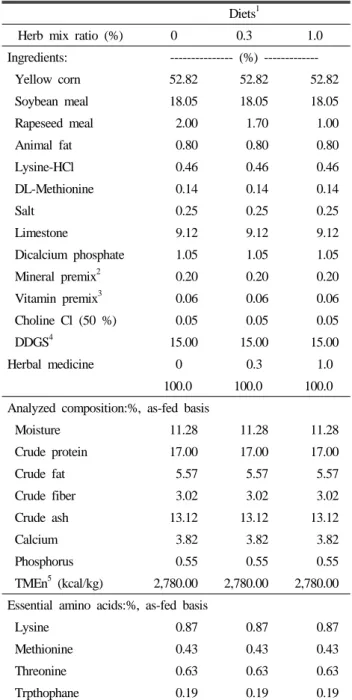
Coptis japonica Makino, Lonicera japonica Thunb, and Morus alba L. were obtained from Kyung Dong market for oriental medicine (Seoul, Korea) and the mix ratio of herbs were 48.5 : 48.5 : 3, respectively. This ratio was directed by an oriental physician and its antimicrobial effect was proved (Data not shown). One hundred eight, 28-wk-old Lohman Brown hens were used in this study. The birds were randomly allotted into 3 dietary treatments based on added herb mix (0. 0.3 and 1%) with 6 replications in each treatment and 6 hens per replicate.
The diets were formulated (Table 1) to contain herb mix. The lighting regimen was 17 hr of light per day and the birds re- ceived feed and water freely during the feeding period for 6 wks. Egg sample collection commenced at 6 wk and 5 eggs per each treatment and replication were collected with total 90 eggs.
The collected eggs were stored at 4 ℃ for 14 days and physico- chemical analysis was performed.
2. Proximate Analysis
The proximate composition of eggs was determined in tripli- cate according to the Association of Official Analytical Chemists (AOAC, 1995). The homogenized whole egg in conical tube (50 mL) were cooked with boiling water for 10 min and used
Table 1. Experimental formula for layers Diets
1Herb mix ratio (%) 0 0.3 1.0
Ingredients: --- (%) ---
Yellow corn 52.82 52.82 52.82
Soybean meal 18.05 18.05 18.05
Rapeseed meal 2.00 1.70 1.00
Animal fat 0.80 0.80 0.80
Lysine-HCl 0.46 0.46 0.46
DL-Methionine 0.14 0.14 0.14
Salt 0.25 0.25 0.25
Limestone 9.12 9.12 9.12
Dicalcium phosphate 1.05 1.05 1.05
Mineral premix
20.20 0.20 0.20
Vitamin premix
30.06 0.06 0.06
Choline Cl (50 %) 0.05 0.05 0.05
DDGS
415.00 15.00 15.00
Herbal medicine 0 0.3 1.0
100.0 100.0 100.0
Analyzed composition:%, as-fed basis
Moisture 11.28 11.28 11.28
Crude protein 17.00 17.00 17.00
Crude fat 5.57 5.57 5.57
Crude fiber 3.02 3.02 3.02
Crude ash 13.12 13.12 13.12
Calcium 3.82 3.82 3.82
Phosphorus 0.55 0.55 0.55
TMEn
5(kcal/kg) 2,780.00 2,780.00 2,780.00 Essential amino acids:%, as-fed basis
Lysine 0.87 0.87 0.87
Methionine 0.43 0.43 0.43
Threonine 0.63 0.63 0.63
Trpthophane 0.19 0.19 0.19
1
Three herbs, Coptis japonica Makino (48.5%), Lonicera japo- nica Thunb (48.5%), and Morus alba L. (3%) were mixed and added with designated ratio to hen's diet.
2
Provided followings per kg of diet : Cu, 10 mg; Fe, 80 mg; Mn, 80 mg; Zn, 80 mg; I, 0.9 mg; Se, 0.2 mg; Co, 0.5 mg.
3
Provided followings per kg of diet : Vit. A, 12,000 IU; Vit. D
3, 3,000 IU; tocopherol 15 mg; Vit. K
3, 2 mg; thiamin, 2.0 mg;
riboflavin, 6.0 mg; pyridoxin, 2.0 mg; vit. B
12, 0.03 mg; folic acid, 1.0 mg; biotin, 0.15 mg; niacin, 45 mg; D-Ca pantothe- nate, 15 mg; antioxidant, 0.5 mg.
4
Corn distillers dried grains with solubles from the US.
5
Calculated values.
for analysis. To analysis of protein content Kjeldahl apparatus (Vapo Dest 45, Gerhardt Laboratory System, Konigswinter, Ger- many) was used. For calculation of the % protein in a sample, the % N was multiplied by a conversion factor of 5.8. The fat content of cooked egg was determined using Soxtec 2055 Avanti instrument (Ildong Science, Seoul, Korea). For ash content, the cooked egg (1 g) was dried to a constant mass and ashed in a furnace at 600 ℃ for 6 hr. The ash content was calculated by the difference initial and final mass of the sample.
3. Color
The cooked egg by same method above was cut by a knife to have 3 cm thickness × 3 cm diameter at each storage day (0, 3, 7, and 14 days). Hunter color L
*-, a
*-, and b
*-value of homogenized whole egg were measured using Chroma Meter (CR-300, Minolta, Osaka, Japan). The instrument was standar- dized with a white and black ceramic plate before measurement.
The Hunter L
*-, a
*-, and b
*-values correspond to lightness (L
*), redness (a
*) and yellowness (b
*), respectively.
4. Texture Profile Analysis
Hardness, springness, gumminess, chewiness, and resilience were determined using Texture Analyzer (TA-XT Ⅱ, Stable Microsystem Ltd., Surrey, UK). The homogenized whole eggs, which was mixed form of egg white and yolk, were transferred into a plastic test tube (50 mL), cooked with boiling water for 10 min, and then placed in tap water for 10 min at each storage day (0, 3, 7, and 14 days). The cooked eggs were cut by a knife with 3 cm thickness × 3 cm diameter and used for texture ana- lysis. Test conditions were follows; aluminum rectangular probe (P/5), test speed with 1 mm/s; pre-test speed with 2 mm/s, post-test speed with 1 mm/s, compression (strain) of 75%; and a 30 kg load cell.
5. Statistical Analysis
Significance among treatments was analyzed by GLM pro- cedure (SPSS, 2004) and Turkey's multiple range tests was used to differentiate among mean values at p < 0.05 level.
Results and Discussion
For many years, herbs and spices and their essential oils have
been used as pharmaceuticals in alternative medicine and as a natural therapy. Herbs have been found to enhance antimicro- bial activity, have antiviral and antioxidative properties and are said to stimulate the endocrine and immune system. They pro- mote a higher metabolic and immune status within the animal, as well as enhancing welfare. Various botanical ingredients have been shown to facilitate beneficial effects on gut environment and microflora (Besra et al., 2002; Rao and Nigam, 1970). Essen- tial components are known to stimulate digestive enzymes and to have an in vitro antimicrobial activity against many bacteria.
There are various reports regarding the antibacterial effects of Origanum vulgare, Piper nigrum, Syzygium aromaticum and Thymus vulgaris, and the essential oil components thymol, car- bacrol, curcumin, piperim and engenol against various strains of Clostridia including Clostridium perfringens and other bacteria such as Escherichia coli, Salmonella aureus, Salmonella typhi- murium, Listeria monocytogenes and Yersinia enterocolotica (Fa- bio et al., 2003; Cosentino et al., 1999). To be effective on a practical scale, it is likely that these compounds will need to be provided in more concentrated form than they are found in their natural source.
The herb mix used for this study contained 3 herbs and the ratio of herbs was directed by an oriental physician. Proximate composition of cooked eggs from hens fed different ratio of herb mix is shown in Table 2. It was observed an increasing trend of ash and higher ash content was observed in the treatment group with 1% herb dietary mix but there was no difference among the treatment and control groups statistically (p > 0.05).
Color is one of the most important quality attributes of meat or meat products, since it directly influences consumer accepta- bility. The Hunter color L
*-, a
*-, and b
*-values of cooked whole egg are shown in Tables 3~5. As similar to data for proximate composition, there was no difference among treatment was ob- served. However, during storage at 4 ℃, color L
*-value increased at day 3 and 7 and decreased at day 14 regardless of treatments.
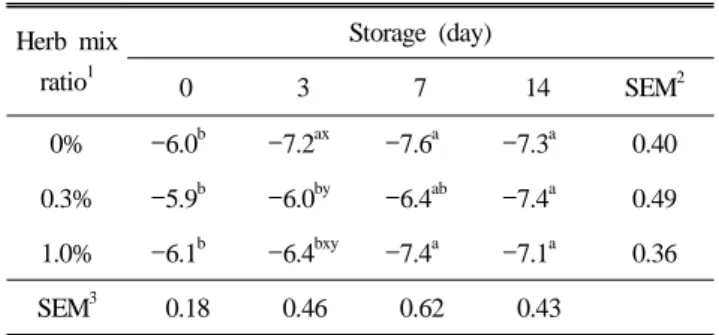
The Hunter color a
*-value decreased during storage until 14 days but difference among treatments was only shown at day 3 with higher a
*-value in egg from hens fed 0.3% herb mix in their diet than control. The Hunter color b
*-value showed the highest at day 7 regardless of treatments and also difference was found at day 3.
Since texture is a multi-parameter attribute and the classifi-
Table 2. Proximate composition of cooked whole egg from hens fed dietary herb mix
Herb mix ratio
1Water Fat Protein Ash
0% 74.0 8.7 14.3 1.1
0.3% 74.6 8.5 14.4 1.2
1.0% 73.1 10.4 14.0 1.5
SEM
20.26 0.25 0.05 0.28
1
Three herbs, Coptis japonica Makino (48.5%), Lonicera japonica Thunb (48.5%), and Morus alba L. (3%) were mixed and added with designated ratio to hen's diet.
2
Standard errors of the mean (n = 9).
Table 3. Hunter color L
*-value of cooked egg from hens fed dietary herb mix during storage at 4 ℃ for 14 days.
Herb mix ratio
1Storage (day)
0 3 7 14 SEM
20% 84.2
b90.7
a89.9
a85.8
b0.80
0.3% 83.8
c90.6
a89.7
a86.9
b0.91 1.0% 84.2
c90.4
a90.4
a86.6
b0.76
SEM
30.62 0.73 0.74 1.00
a~c
Means with different superscripts within the same row are sig- nificantly different at p < 0.05.
1
Three herbs, Coptis japonica Makino (48.5%), Lonicera japonica Thunb (48.5%), and Morus alba L. (3%) were mixed and added with designated ratio to hen's diet.
2
Standard errors of the mean (n = 12) and
3(n = 9).
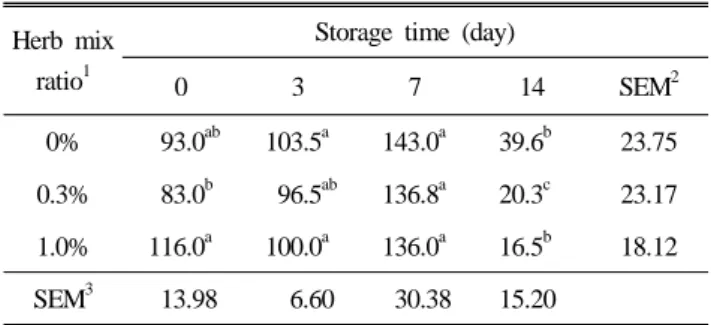
cation of textural terms for solids and semi-solids gave rise to a profiling method of texture description (TPA) applicable to both sensory and instrumental analysis (Szczesniak, 2002). With the instrumental method, texture profiling involves compressing the test substances at least twice and quantifying the mechanical parameters from the recorded force-deformation curves. Using texture profile analysis, which showed excellence correlation with sensory analysis (Szczesniak, 2002), the hardness, spring- ness, gumminess, and chewiness of cooked whole egg was inves- tigated (Tables 6~9). Results showed that there was no diffe- rence found among treatments in terms of overall texture, except for springness at day 14, which showing a decrease in eggs from hens fed herb mix. The storage effect on texture of cooked
Table 4. Hunter color a
*-value of cooked egg from hens fed die- tary herb mix during storage at 4 ℃ for 14 days Herb mix
ratio
1Storage (day)
0 3 7 14 SEM
20% -6.0
b-7.2
ax-7.6
a-7.3
a0.40 0.3% -5.9
b-6.0
by-6.4
ab-7.4
a0.49 1.0% -6.1
b-6.4
bxy-7.4
a-7.1
a0.36
SEM
30.18 0.46 0.62 0.43
a,b
Means with different superscripts within a row are significantly different at p ≤ 0.05.
x,y
Means with different superscripts within a column are signi- ficantly different at p ≤ 0.05.
1
Three herbs, Coptis japonica Makino (48.5%), Lonicera japonica Thunb (48.5%), and Morus alba L. (3%) were mixed and added with designated ratio to hen's diet.
2
Standard errors of the mean (n = 12) and
3(n =9).
Table 5. Hunter color b*-value of cooked egg from hens fed die- tary herb mix during storage at 4 ℃ for 14 days Herb mix
ratio
1Storage (day)
0 3 7 14 SEM
20% 18.0
c29.1
bx34.1
a26.5
b2.50 0.3% 17.6
c22.5
by27.7
a27.4
a2.28 1.0% 18.6
c25.8
bxy32.8
a25.5
b1.95
SEM
30.88 2.04 3.06 2.99
a~c
Means with different superscripts within a row are significantly different at p ≤ 0.05.
x,y
Means with different superscripts within a column are signifi- cantly different at p ≤ 0.05.
1
Three herbs, Coptis japonica Makino (48.5%), Lonicera japonica Thunb (48.5%), and Morus alba L. (3%) were mixed and added with designated ratio to hen's diet.
2
Standard errors of the mean (n = 12) and
3(n = 9).
whole egg was observed. Eggs from hens fed 0.3% herb mix showed higher hardness at day 14 (Table 6). In contrast, spring- ness and chewiness were decreased significantly as storage period extended, regardless of dietary herb mix treatment. Other texture profiles were not consistent and fluctuated.
There was limited information available investigating the
Table 6. Hardness of cooked egg from hens fed dietary herb mix during storage at 4 ℃ for 14 days
Herb mix ratio
1Storage (day)
0 3 7 14 SEM
20% 205.2 236.1 303.4 276.7 45.14
0.3% 297.8 209.7 315.3 410.1 99.37
1.0% 252.9
ab199.6
b287.6
ab360.9
a65.40 SEM
387.67 25.39 64.85 76.38
a,b
Means with different superscripts within a row are significantly different at p ≤ 0.05.
1
Three herbs, Coptis japonica Makino (48.5%), Lonicera japo- nica Thunb (48.5%), and Morus alba L. (3%) were mixed and added with designated ratio to hen's diet.
2
Standard errors of the mean (n = 12) and
3(n = 9).
Table 7. Springness of cooked egg from hens fed dietary herb mix during storage at 4 ℃ for 14 days
Herb mix ratio
1Storage time (day)
0 3 7 14 SEM
20% 0.9
a0.9
a0.8
a0.5
bx0.09
0.3% 0.9
a0.9
a0.9
a0.2
by0.04
1.0% 0.9
a0.8
ab0.8
b0.2
cy0.06
SEM
30.00 0.07 0.07 0.09
a~c
Means with different superscripts within a row are significantly different at p ≤ 0.05.
x,y
Means with different superscripts within a column are signifi- cantly different at p ≤ 0.05.
1
Three herbs, Coptis japonica Makino (48.5%), Lonicera japo- nica Thunb (48.5%), and Morus alba L. (3%) were mixed and added with designated ratio to hen's diet.
2
Standard errors of the mean (n = 12) and
3(n = 9).
effect of herb mix on color and texture of chicken egg during storage because many studies have observed only general egg qualities such as Haugh unit, egg shell thickness and hardness of egg shell, yolk color, and egg weight (Hwangbo et al., 2005;
Na et al., 2005, Shon et al., 2004; Hong et al., 2001). Shon et al. (2004) reported that the supplementation of 0.2% Animunin Powder
Ⓡin the diet of hens resulted into higher egg yolk color unit. They also found an improved egg production but no di-
Table 8. Gumminess of cooked egg from hens fed dietary herb mix during storage at 4 ℃ for 14 days
Herb mix ratio
1Storage time (day)
0 3 7 14 SEM
20% 95.4 108.3 148.6 95.5 27.17
0.3% 84.8
b98.7
ab159.9
a79.8
b35.46 1.0% 119.2
ab101.9
ab144.0
a72.7
c23.60 SEM
314.37 6.64 33.94 24.11
a~c
Means with different superscripts within a row are significantly different at p ≤ 0.05.
1
Three herbs, Coptis japonica Makino (48.5%), Lonicera japoni- ca Thunb (48.5%), and Morus alba L. (3%) were mixed and added with designated ratio to hen's diet.
2
Standard errors of the mean (n = 12) and
3(n = 9).
Table 9. Chewiness of cooked egg from hens fed dietary herb mix during storage at 4 ℃ for 14 days
Herb mix ratio
1Storage time (day)
0 3 7 14 SEM
20% 93.0
ab103.5
a143.0
a39.6
b23.75 0.3% 83.0
b96.5
ab136.8
a20.3
c23.17 1.0% 116.0
a100.0
a136.0
a16.5
b18.12 SEM
313.98 6.60 30.38 15.20
a~c
Means with different superscripts within a row are significantly different at p ≤ 0.05
1
Three herbs, Coptis japonica Makino (48.5%), Lonicera japoni- ca Thunb (48.5%), and Morus alba L. (3%) were mixed and added with designated ratio to hen's diet.
2