168
Korean J. Pl. Taxon.
43(3): 168-170 (2013)
http://dx.doi.org/10.11110/kjpt.2013.43.3.168
ISSN 1225-8318 Korean Journal of Plant Taxonomy
New species of Euonymus (Celastraceae): E. baekdusanensis M. Kim Yong Hwang, Soonku So and Muyeol Kim*
1
Department of Biological Sciences, Chonbuk National University, Jeonju 561-756, Korea (Received 29 July 2013; Accepted 10 September 2013)
화살나무속(노박덩굴과)의 신종: 백두산회나무 (Euonymus baekdusanensis M. Kim)
황 용·소순구·김무열*
전북대학교 자연과학대학 생명과학과
ABSTRACT:
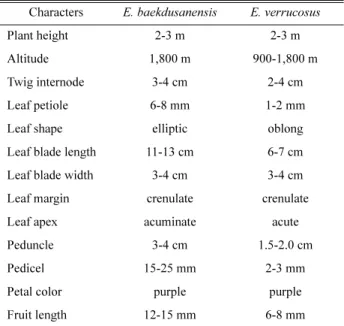
A new species, Euonymus baekdusanensis M. Kim (Celastraceae), has been named and described from Mt. Baekdu of the Korean peninsula. Euonymus baekdusanensis shares several characteristics (4-merous flowers, 4-angled capsule, warted branches and twigs, etc.) with its related species E. verrucosus Scopoli. It is, however, distinct from E. verrucosus which have small oblong leaves (6-7 cm), short petioles (1-2 mm), and small capsules (6-8 mm) by having large elliptical leaves (11-13 cm), long petioles (6-8 mm), and large cap- sules (12-15 mm).
Keywords:
Euonymus baekdusanensis, Celastraceae, Mt. Baekdu
적 요:
백두산에서 화살나무속의 신종인 백두산회나무(Euonymus baekdusanensis M. Kim)를 새로이 발견하 여 기재하였다. 백두산회나무는 4수성 꽃구조를 가지고 4개로 각이 진 삭과를 가지며 사마귀 같은 혹이 가지 와 소지에 있어 회목나무(E. verrucosus Scopoli)와 유사하다. 그러나 백두산회나무는 커다란 장타원형의 잎 (11-13 cm) 을 가지고 엽병이 뚜렷하며(6-8 mm) 과실이 대형(12-15 mm)인 반면에, 회목나무는 작은 도란형의 잎(6-7 cm)을 가지고 엽병이 거의 없으며(1-2 mm) 과실이 소형(6-8 mm)인 점에서 두 종이 뚜렷하게 차이가 난다.
주요어:
백두산회나무, 노박덩굴과, 백두산
The genus Euonymus L. (Celastraceae) consists of approximately 130 species and is distributed from Asia through Europe to North America (Ma and Funston, 2008).
The genus Euonymus is characterized by shrubs, opposite leaves, cyme inflorescence, 4- or 5-merous flowers, and dehiscent capsules (Kim, 2007). Ten taxa of Euonymus are reported from Korea (Lee, 1980; Kim, 2007). Almost all taxa have a popular occurrence in Korea.
Baekdusan (Mt. Baekdu) is an active volcanic and highest
mountain (2,744 m) on the Korean peninsula and in Manchuria (Lee, 1991; Lee et al., 2013). Mt. Baekdu contains about 1,500 species of vascular plants, of which 11 angiosperms are endemic (Kim, 2004).
In 2011, the authors first discovered Euonymus baekdusanensis M. Kim on Mt. Baekdu. It forms a small population of twenty individuals at 1,800 m altitude in the Geumgang Grand Canyon area of Mt. Baekdu. The species shares several characteristics with its related taxa E. verrucosus Scopoli, but it can be distinguished based on large elliptical leaves, long petioles, large capsules, etc.
Euonymus baekdusanensis M. Kim sp. nov. (Figs. 1-3)
*Author for correspondence: [email protected] http://www.pltaxa.or.kr
Copyright © 2013 the Korean Society of Plant Taxonomists
Korean Journal of Plant Taxonomy Vol. 43 No. 3 (2013) New species of Euonymus (Celastraceae): E. baekdusanensis M. Kim 169
Korean name: Baek-du-san-hoe-na-mu 백두산회나무
Deciduous shrubs, 2-3 m tall; branches and twig warts.
Petiole 6-8 mm long, pubescent; leaf blade elliptic, 11-13 × 3-
4 cm, pubescent on veins of abaxial surface, base cuneate, margin crenulate, apex acuminate; lateral veins 7-8 pairs.
Inflorescence cyme; peduncle 3-4 cm, glabrous; pedicel 15-15 mm, glabrous. Flowers 4-merous. Sepals 4, semi-rounded, green, 1 × 1 mm. Petals 4, rounded, purple, 2 × 2 mm. Stamens 4, anther 2-celled. Pistil 1, ovary tetragonal, style absent, stigma globose. Capsule 4-angled. Seeds ovoid, covered by orange aril. Flowering June.
Holotype: Mt. Baekdu. August 12, 2011. M. Kim 110060.
Herbarium of Chonbuk National University (JNU).
Isotype: Mt. Baekdu. August 12, 2011. M. Kim 110060 (3 sheets, JNU).
Paratype: Mt. Baekdu. June 12, 2012. M. Kim 120305 (5 sheets, JNU).
Distribution: Mt. Baekdu
Etymology: The specific epithet is derived from Mt. Baekdu where this new species is located.
Habitats: The natural habitat of Euonymus baekdusanensis M. Kim was found in the woodlands of the Keumgang Grand Canyon area on Mt. Baekdu. This species occurs under trees in forests dominated by Larix olgensis, Picea jezoensis, Acer ukurunduense and Sorbus pohuashanensi. The species also occurs with principal shrub and herbaceous species dominated by Euonymus verrucosus, Lonicera caerulea, Rosa davurica, and Maianthemum bifolium.
Fig. 1. Euonymus baekdusanensis M. Kim. A. Branches with leaves and fruits; B. Flower; C. Stamen; D. Pistil; E. Fruit. Scale bars 1 cm in A ans E; 2 mm in B and D; 0.2 mm in C.
Fig. 2. Photographs of Euonymus baekdusanensis M. Kim at the natural habitat in Mt. Baekdu. A. Branches with leaves and fruits;
B. Twig; C. Flower; D. Habitat.
Fig. 3. Holotype of Euonymus baekdusanensis M. Kim.
Korean Journal of Plant Taxonomy Vol. 43 No. 3 (2013)
170 Yong Hwang, Soonku So and Muyeol Kim
Key to Euonymus baekdusanensis and its related taxa.
1. Winter bud large; stamens sessile, anther 1-celled; capsule winged
2. Flowers 4-merous ···E. macropterus 나래회나무 2. Flowers 5-merous
3. Capsule nearly without wing···E. oxyphyllus 참회나무 3. Capsule with long wings ··· E. sachalinensis 회나무 1. Winter bud small; stamens filamentous, anther 2-celled;
capsule without wings
4. Capsule 4-lobed ··· E. alatus 화살나무 4. Capsule unlobed
5. Capsule smooth and rounded ··· E. japonicus 사철나무 5. Capsule rugose and angled
6. Branches and twigs warts
7. Petiole 1-2 mm, blade 6-7 cm and oblong; fruit 6- 8 mm ··· E. verrucosus 회목나무
7. Petiole 6-8 mm, blade 11-13 cm and elliptic; fruit 12-15 mm ··· E. baekdusanensis 백두산회나무 6. Branches and twigs smooth
···E. hamiltonianus 참빗살나무
By applying the IUCN Red List criteria (IUCN, 2011), Euonymus baekdusanensis M. Kim will be evaluated as the category of Endangered (EN) species, because of its small population of twenty individuals found in Mt. Baekdu.
Acknowledgement
We are deeply indebted to Dr. Jungsim Lee and Hyun-Sook Choi for their kindly help.
Literature Cited
IUCN. 2011. Guidelines for Using the IUCN Red List Categories and Criteria. Version 9.0. Retrieved Aug. 5, 2013. from http://
www.iucnredlist.org.
Kim, J. H. 2007. Euonymus L. In The Genera of Vascular Plants of Korea. Park, C.-W. (ed.), Academy Publishing Co., Seoul. Pp.
658-661.
Kim, M. 2004. Korean Endemic Plants. Solkwahak, Seoul. Pp. 122- 123. (in Korean)
Lee, J., S.-N. Kim and M. Kim. 2013. First record of Androcorys pusillus (Orchidaceae) from Mt. Baekdu. Korean Journal of Plant Taxonomy 43(1): 27-29.
Lee, T. B. 1980. Illustrated Flora of Korea. Hyangmunsa, Seoul.
(in Korean)
Lee, Y. N. 1991. Flowering Plants on Baekdu Mountain. Hang- ilsa, Seoul. Pp. 1-39.
Ma, J. and A. M. Funston. 2008. Euonymus L. In Flora of China.
Vol. 11. Wu, Z.-Y. and P. H. Raven (eds.), Science Press, Beijing and Missouri Botanical Garden Press, St. Louis, USA.
Pp. 440-463.
Table 1. Comparison of morphological characters between Euonymus baekdusanensis M. Kim and E. verrucosus Scopoli.
Characters E. baekdusanensis E. verrucosus
Plant height 2-3 m 2-3 m
Altitude 1,800 m 900-1,800 m
Twig internode 3-4 cm 2-4 cm
Leaf petiole 6-8 mm 1-2 mm
Leaf shape elliptic oblong
Leaf blade length 11-13 cm 6-7 cm
Leaf blade width 3-4 cm 3-4 cm
Leaf margin crenulate crenulate
Leaf apex acuminate acute
Peduncle 3-4 cm 1.5-2.0 cm
Pedicel 15-25 mm 2-3 mm
Petal color purple purple
Fruit length 12-15 mm 6-8 mm