*
준회원, 울산대학교 전기전자컴퓨터공학과
**
정회원, 울산대학교 전기전자컴퓨터공학과 (교신저자) 접수일자 2013년 11월 24일, 수정완료 2013년 12월 13일 게재확정일자 2013년 12월 13일
Received: 24 November, 2013 / Revised: 13 December, 2013 Accepted: 13 December, 2013
**
Corresponding Author: [email protected] Dept. of Electrical and Computer Engineering, Korea http://dx.doi.org/10.7236/JIIBC.2013.13.6.203
JIIBC 2013-6-26
무선 애드혹 네트워크에서 경로 품질 및 잔여 대역폭 예측에 기반한 고속 멀티미디어 데이터 전송의 라우팅
프로토콜
An Ad-hoc Routing Protocol for High-speed Multimedia Traffic Based on Path Quality and Bandwidth Estimation in Wireless Ad
Hoc Networks
아흐메드 엠디소헬
*, 윤석훈
**Ahmed Md Shohel, Seokhoon Yoon
요 약
무선 애드혹 네트워크에서는 제한된 대역폭 , 간섭 , 높은 패킷 에러율로 인하여 영상과 같은 고속 데이터 전
송 시 높은 전송 품질을 제공하기 어렵다 . 본 논문에서는 이러한 제약을 극복하고 고품질의 고속 멀티미디어 데이터
전송을 제공하기 위하여 패킷전송성공률 기반의 종단간 경로 품질과 각 중계노드에서의 잔여 대역폭 예측을 이용하 는 PBBR (Path-Quality and Bandwidth-Estimation Based Routing) 프로토콜을 제안한다 . 제안된 프로토콜의 성능을 검
증하기 위하여 NS2 를 이용한 시뮬레이션이 수행되었으며 , 시뮬레이션 결과는 제안되는 프로토콜이 기존의 라우팅 프
로토콜에 비해 높은 Throughput 을 획득할 수 있음을 보인다 .
Abstract Majority of the wireless ad hoc routing protocols are proposed to find feasible routes without considering the network load, end-to-end link quality and bandwidth requirements of the application. Therefore, protocol may not provide sufficient quality of service (QoS) to a high speed traffic such as multimedia. In this paper, we propose a path-quality and bandwidth-estimation based routing protocol (PBBR) for the high quality multimedia stream that can meet the application's bandwidth requirements and find the best reliable route. The novelty of this protocol is to select a reliable path to respond the application's requirements based on available bandwidth at each intermediate node and end-to-end path loss ratio. Obtained results from the simulation demonstrates that our protocol can achieve sufficient performance in terms of throughput and end-to-end delay.
Key Words : Ad hoc network, Bandwidth, MANET, QoS, Video Stream.
Ⅰ. Introduction
The rapid advancement of wireless technology has gained much attention to the research community for
high quality multimedia applications such as video
telephony, video games, voice over IP, and emergency
rescue systems
[1]. Performance of some real world
test-bed have persuaded the researcher to investigate
the possibility of mobile ad hoc network (MANETs)
[2]. Delivering these services over mobile ad hoc network (MANET) brings a lot of challenges
[3][4]. Major challenges of MANETs are dynamic topology management, reliable route selection, supporting quality of service (QoS) and bandwidth constraints. In this paper, we investigate the QoS for high quality multimedia traffic in MANETs based on available bandwidth estimation at each intermediate node and end-to-end path loss ratio. Multimedia transmission in MANET has two major requirements. One is bandwidth and another is reliable route. Packets of multimedia streams are usually large in size and the transmission rate is higher than best effort traffic.
Thus multimedia transmission needs minimum bandwidth requirements to ensure the quality of service. In wireless ad hoc network, many wireless links have intermediate loss ratio due to the poor link quality
[5]. A link that can not deliver packet sufficiently is not useful for multimedia data, even though the link might deliver enough routing update or routing query packets. Therefore, reliable route is indispensable to provide adequate service.
Most ad hoc routing protocols use hop count as a path metrics. However, minimum hop-count metrics does not meet the application requirements all the time.
Moreover, in a dense network, there may be many minimum hop-count routes possible with varying link quality. The arbitrary choice of minimum hop-count route may not be the best one. Thus our aim here is to develop a routing protocol that can find best possible route and provides better services than best-effort traffic.
There are few routing protocols in the literature that considered available bandwidth estimation to provide
QoS
[6][7]. However, they did not consider the
end-to-end path quality such as end-to-end path loss ratio which is essential to provide sufficient QoS. This motivates us to design the path-quality and bandwidth-estimation based routing protocol (PBBR).
In our protocol, total consumed bandwidth is estimated
at each node and disseminates the information to the neighbors through periodic "Hello" message. Each host estimates the available bandwidth using the neighbor's overall consumed bandwidth information and updates periodically.
End-to-End path quality is measured based on the packet delivery ratio of each link of the path. In our protocol, when an intermediate node meets the bandwidth requirements, it relays the link quality information otherwise the routing probe packet is discarded. Destination node selects the best possible route based on the path loss ratio among all the paths.
Our protocol (PBBR) is evaluated and compared with other best-effort routing protocol. Obtained average result reveals that, PBBR outperforms the best-effort protocol in terms of throughput and delay.
The rest of the paper is organized as follows, section II describes the path-quality and bandwidth-estimation based routing protocol (PBBR) implementation.
Simulation results and discussions are presented in section III. Finally, Section IV draws the concluding remarks.
II. Path-quality and Bandwidth- estimation Routing Protocol
Quality of service (QoS) is a overall performance of a network such as required bandwidth, packet delivery ratio and delay constraints to the applications. We consider the required bandwidth constraints and end-to-end path loss ratio for supporting the QoS of real time multimedia transmission.
We propose PBBR protocol that satisfy the required bandwidth and best available route termed as 'reliable route' in the network. We focus on estimating the available bandwidth at each node, integrating PBBR scheme into the route discovery process.
1. Available Bandwidth Estimation
Available bandwidth estimation is a challenging task
due to the wireless characteristics such as fading of channel, re-transmission and error from physical obstacles
[8]. Wireless channel is shared access medium and available bandwidth varies with the number of host contending for the channel
[9]. Therefore, individual node is not aware about the neighboring nodes traffic status. In our protocol, we consider the AODV "Hello"
messages to propagate currently consumed bandwidth.
Every host's bandwidth usage is piggybacked onto the "Hello" messages and neighboring host estimates its available bandwidth based on the information. This approach does not need extra control message.
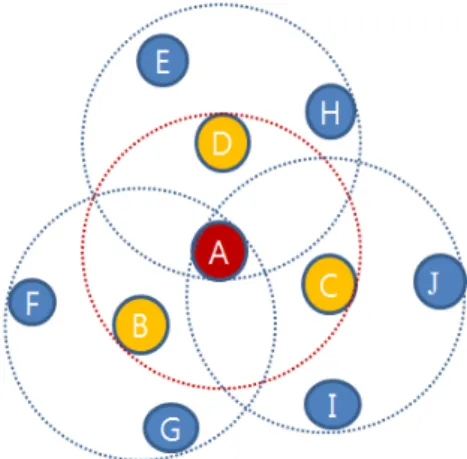
그림 1. 이웃노드의 채널 사용 정보를 이용한 가용 채널용량 추정
Fig. 1. Available bandwidth estimation with neighbor's currently used bandwidth information.
We modify the AODV "Hello" message to include consumed bandwidth information. Each node estimates the total amount of data it feed into the network within a time window (In our case five seconds). Let S denotes the average packet size during time interval t, then the consumed bandwidth ( ) is computed as,
(1)
The consumed bandwidth is kept in the bandwidth-consumption register and updated periodically. For example, as shown in Fig.1. node A
has three neighbors (B, C, D) which are within interference range of node A. Node A knows the consumed bandwidth of node B, C and D through
"Hello" message and estimates the overall consumed bandwidth at host A.
The actual bandwidth usage depends on the network topology and traffic status. The raw channel bandwidth is the soft upper bound of total bandwidth. we consider the soft upper bound to estimate the approximate bandwidth usage. once the host knows the consumed bandwidth of its neighbors, the available bandwidth is calculated as, the overall consumed bandwidth is subtracted from raw channel bandwidth then divided by weight factor.
We divide the available bandwidth with weight factor because of the characteristics of IEEE 802.11 MAC. Weight factor is calculated without considering physical layer preamble, backoff time and UDP header in
[6]. Their estimation of available bandwidth can be extended to reflect actual operations of IEEE 802.11 MAC. In order to estimate the available bandwidth more accurately, we consider physical layer preamble, backoff time and UDP header in our implementation.
Weight factor =
(2)
The overhead time taken by MAC operation for a successful packet transmission is:
(3) where is the physical layer preamble,
is the backoff time used by each station and is the acknowledgement of the received packet. is a function of collision probability and thus number of contending node. is approximated as
[10].
2. End-to-End path loss ratio
In this paper, the path loss ratio is estimated as,
end-to-end packet delivery ratio of a routing path is
subtracted from one. In our protocol, we consider path
loss ratio as metrics to select the most reliable path available in the network. Delivery ratio of a link is measured as, each node sends a series of broadcast packets during a fixed time window and counted the number of packets sent. Every other node records the number of packets received. In our implementation, we consider only the forward delivery ratio ( ). For example, node A broadcasts probe packets and node B receives probe packets. Node B knows the number of probe packets received within last T seconds. This allows B to calculate the forward delivery ratio (A->B).
Every node broadcasts probe packets of fixed size at every seconds. Each node records the number of probe packets received during last T seconds. So forward delivery ratio at any receiving node at time t is :
(t) =
(4)
where is the number of probe packets received last T seconds and T/ is the number of probe packet that should have received. In our case, we use AODV's default "Hello" message as probe packet and time window T (In our case 10 seconds). As Hello message is sent every 1 second, so
is 1. Each host computes the forward delivery ratio with all of its neighbors and updated periodically.
3. Route Selection
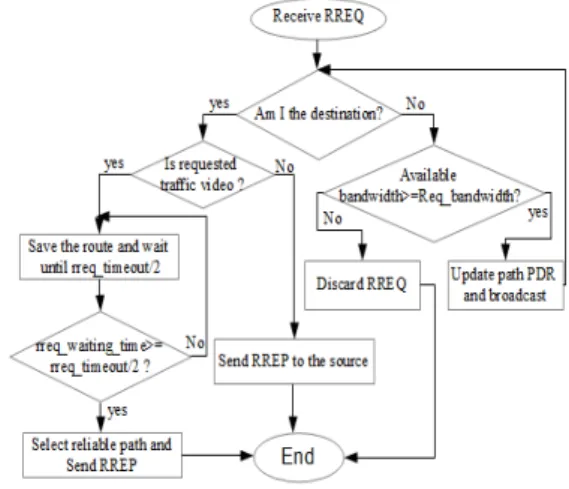
To determine the most reliable route, host node initiates the route discovery. We add three new fields in the AODV RREQ header such as, required bandwidth, end-to-end packet delivery ratio (PDR) and traffic type. When an intermediate node receives RREQ, it first compares the available bandwidth with the required bandwidth attached in the RREQ header. If the available bandwidth is greater than or equal to the required bandwidth then, RREQ is broadcasted otherwise discarded. This approach ensures the required bandwidth to the applications. When an intermediate node broadcasts the RREQ, it updates the
path PDR by multiplying the PDR of the link from which RREQ comes. Fig.2. shows the detail route selection procedure.
그림 2. 중간노드와 목적지 노드에서의 경로 선택 과정 Fig. 2. Route selection procedure in intermediate
and destination node.
When the destination node receives the RREQ, it first checks the requested traffic type. If the traffic is video, it stores the route into a temporary data structure and wait until the half of the route request time out period. During this waiting time, destination node records all the RREQ received and corresponding route. After the waiting time, destination node compares the path PDR of all routes and computes the path loss ratio. If n is the number of hops in a path and m is the total number of possible path at a destination node then,
= (5)
=min{ } | =(1- ) (6) where is the packet delivery ratio of link on the path. The lowest path loss means highest path PDR. Equation (5) determines the end-to-end path PDR(
). Destination node selects the most reliable path ( ) according to the equation (6).
Finally, destination node, sends the RREP towards the
source which is termed as "the most reliable path" in
the network. For other type of traffic, destination node
sends RREP immediately after the first RREQ received.
(a) (b)
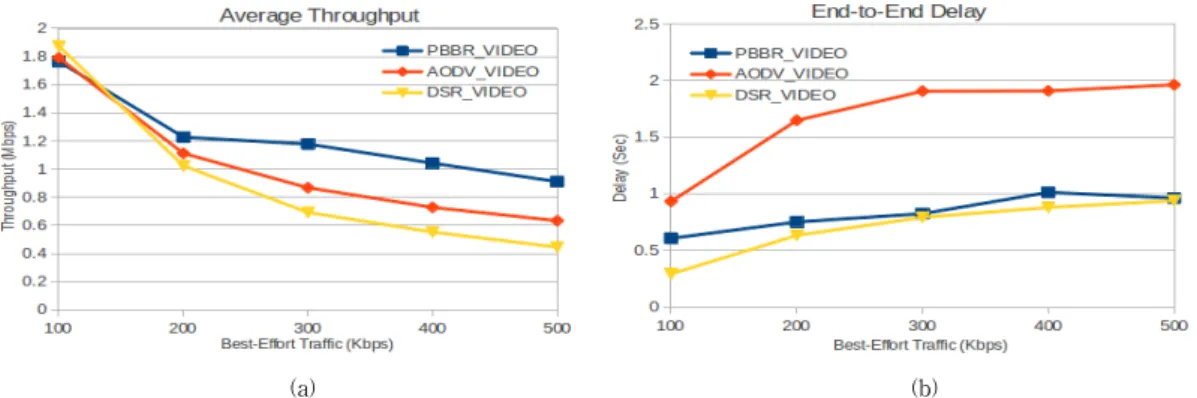
그림 3. (a) Throughput에 대한 Best-effort 트래픽의 영향 (b) 종단간 지연에 대한 Best-effort 트래픽의 영향 Fig. 3. (a) Throughput with variable best-effort traffic (b) End-to-End delay with variable best-effort
traffic.
III. Simulation Results and Discussions
The effectiveness of the proposed Path-quality and Bandwidth-estimation Based Routing (PBBR) protocol is evaluated through simulation using NS2
[11]. We evaluate the performance of video traffic with the presence of best-effort traffic. We assume a multi-hop wireless network of 50 nodes distributed in 1000x1000
area. We use IEEE 802.11 MAC protocol with RTS/CTS disabled. RTS/CTS is recommended in IEEE 802.11 standard to avoid hidden terminal problem.
However, for multimedia transmission, it is recommended to disable RTS/CTS
[12].
IEEE 802.11 MAC is not well designed for supporting quality of service for high speed multimedia traffic. However, IEEE 802.11 standard is widely adopted in wireless network ecosystem. Many wireless devices are commercialized world wide with IEEE 802.11. Therefore, we consider IEEE 802.11 standard with underlying MAC for our protocol design. The maximum channel data rate is 54Mb/s. The packet size of the video traffic in simulation is 1500 bytes.
To ensure the high quality video transmission we consider the H.264/MPEG-4 encoding technique
[13]. This video coding technique offers low bit rates with high video quality as well as high compression ratio. In our case, we consider the frame size 480x360, where frame per second 25 with average background motion.
According to H.264/MPEG-4 approach, we get bandwidth requirement for the video transmission is 0.6048 Mbps. Table 1. summarizes the simulation setup.
Physical Layer IEEE802.11g Network layer PBBR, AODV, DSR
Transport layer UDP
Application layer CBR
Area Size 1000x1000
Simulation time 500 sec
No. of Node 50
Video Packet size 1500 byte Traffic Best-effort, Video
표 1. 주요 시뮬레이션 설정 값Table 1. Simulation Setup
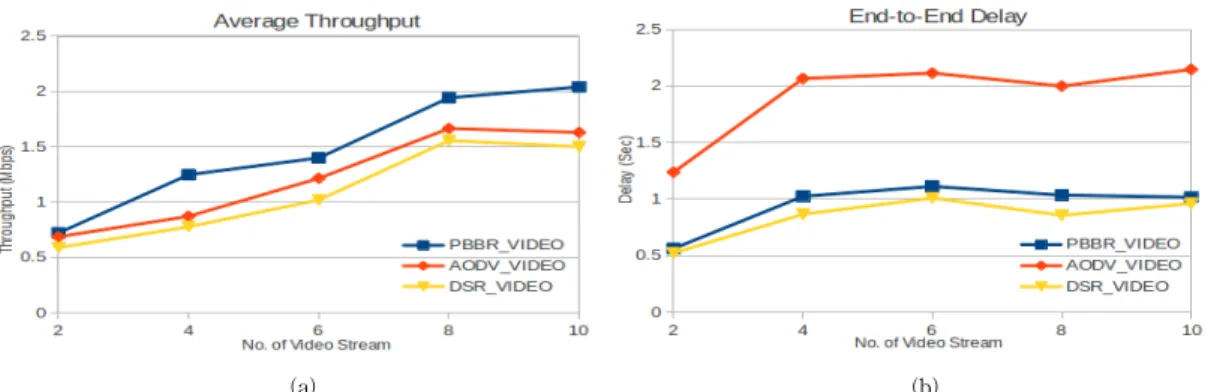
We randomly choose four sets of source and destination. The performance of the protocol is measured and compared using two different types of traffic patterns, 1. Varying the best-effort traffic, 2.
Varying the number of video connection. The average simulation results are shown in Fig.3. and Fig.4.
1. Variable Best-Effort Traffic
Our protocol is designed to provide guaranteed
bandwidth at each routing node. Therefore, it can
provide quality of service in terms of bandwidth when
the network is congested. Thus in the first simulation
scenario, we fix four video connection each of load
0.6048 Mbps and vary the best effort traffic. In our
(a) (b)
그림 4. (a) Throughput에 대한 비디오스트림 플로우 수의 영향 (b) 종단간 지연에 대한 비디오스트림 플로우 수의 영향 Fig. 4. (a) Throughput with variable video stream (b) End-to-End delay with variable video stream.