제10권, 제3호 (2011년 6월) pp.101~109
무선 멀티미디어 센서 네트워크에서
다중 경로와 다중 우선순위 기반의 라우팅 알고리즘
Multipath and Multipriority based Routing Protocol for Wireless Multimedia Sensor Networks
이 동 훈* 나빈 가우탐** 변 재 영***
(Dong-Hoon Lee) (Navin Gautam) (Jae-Young Pyun)
요 약
본 논문에서 소개하는 새로운 라우팅 프로토콜은 무선 멀티미디어 센서 네트워크에서 다중경로와 다중 우선순위 기 반의 라우팅 프로토콜 (MMRP)이다. 제안된 MMRP는 소스부터 싱크까지 다중 라우팅 경로를 선택하고, 선택된 라우팅 경로 내의 잔여 에너지와 전송지연에 따라서 우선순위 레벨이 할당된다. 즉, MPEG 비디오의 경우 높은 우선순위를 갖는 I 프레임은 높은 우선순위의 라우팅 경로를 통해 전송이 되며, P와 B 프레임의 경우 낮은 우선순위를 갖는 라우팅 경로 를 통해 전송되도록 한다. 제안된 MMRP 프로토콜은 무선 멀티미디어 센서 네트워크에서 낮은 전력소모 특성을 만족하 면서 작은 전송 지연을 고려하는 시간 민감 응용 분야에 적용이 가능하다. MMRP 프로토콜에 대한 시뮬레이션 결과는 다중경로 라우팅을 지원하거나 지원하지 않는 프로토콜과 비교 시, 에너지 절약적인 부분에서는 23.48%에서 23.11% 그 리고 지연 부분에서는 81.6%에서 32.01%로 향상을 보였다.
Abstract
In this paper, we present a new routing protocol, multipath and multi-priority based routing protocol, (MMRP) for wireless multimedia sensor networks. The proposed MMRP chooses the multiple routing paths from source to the sink, then the selected paths are assigned with different priority levels depending upon the residual energy and transmission delay in the routing paths.
That is, the highly prioritized I frames of the MPEG video are transmitted over the high priority routing paths, and other P and B frames are transmitted over the lower priority routing paths. The proposed MMRP protocol can be applied to time critical applications which require both lower latency and low power consumption over wireless multimedia sensor network. Simulations results of MMRP protocol show respectively an improvement of 23.48% and 23.11% in energy conservation and 81.6% and 32.01% improvement in latency as compared to protocols without and with multipath routing.
Key Words : Wireless sensor network, multimedia, MPEG, multipath routing, latency
†This work was supported by National Research Foundation of Korea Grant funded by the Korean Government(KRF-2008-331-D00344) * 주저자 : 조선대학교 정보통신공학과 석사과정
** 공저자 : 조선대학교 정보통신공학과 석사과정
*** 공저자 및 교신저자 : 조선대학교 정보통신공학과 부교수
†논문접수일 : 2010년 10월 11일
†논문심사일 : 2011년 4월 20일
†게재확정일 : 2011년 4월 21일
Ⅰ. Introduction
Wireless sensor network (WSN) has wide range of applications such as environment monitoring, health care, battle field surveillance, habitat monitoring, and etc. The sensor nodes are constrained with resources such as battery power, memory, bandwidth, and computational capabilities. Energy conservation is one of the most discussed issues in WSN application and protocol developments [1]. When it comes to multimedia sensor networks, applications also require data with low delay and higher QoS.
The integration of low-power wireless networking technologies with inexpensive hardware such as complementary metal–oxide semiconductor (CMOS) cameras and microphones is now enabling the development of distributed multimedia network systems that we refer as wireless multimedia sensor networks (WMSNs). That is, WMSN interconnected with smart devices enables to retrieve video, audio streams, still images, and scalar sensor data [2].
The characteristics of WMSNs are different from the traditional network paradigms such as Internet or even from the WSN. The most common and potential application of WMSN is to deliver the multimedia content from the environment with the predetermined QoS and delay. But the energy minimization is not the only concern in WMSN as opposed to the WSN applications [2]. Because of the natures of resource constraint and deployment of the wireless sensor nodes, various issues and challenges exist in WMSN protocols and application design. They are related to issues of variable channel capacity, power consumption, coverage, flexible architecture, and integration with other wireless technologies [3-7].
Recent research interests in WMSN include timely and efficiently delivering the multimedia contents over WMSNs. Many multimedia routing protocols
have been proposed in order to meet these requirements. Protocols such as a two phase geographical greedy forwarding (TPGF) and energy efficient image transmission in sensor networks achieve these goals to some extent. However, both of these protocols have limited scope [8, 9]. The former focuses just on creating the node disjoint multiple routing paths and hole node avoidance, whereas the latter focuses just on energy efficiency and proposes no mechanisms to lower the delay for real time transmission service. Also, in [10]
multi-priority multi-path selection (MPMPS) protocol is shown to transfer image and audio over WMSN.
But, it is also constrained with the fact that MPMPS was developed for the transmission of still images and audios over WMSN.
In order to address the delay tolerance as well as energy efficiency needs for the video transmission in WMSNs, we propose a new routing protocol, multi-path and multi-priority based routing protocol (MMRP). The major contribution of our work is to deliver the video contents with lower delay and energy consumption as compared to the traditional routing protocols. We use multiple paths with priorities set on each of the paths for the delivery of video over the network.
The rest of the paper is organized as follows:
sections II presents related works and motivation.
Similarly, sections III and IV show the proposed protocol design and performance evaluation. Finally, we conclude this paper in section V.
Ⅱ. Related works & research motivation
In this section, we discuss routing protocols developed for mobile ad-hoc network (MANET) and WSN. Since these two wireless networks have
Route Discovery: RREQ Source
Sink
Route Discovery: RREP Source
Sink
<그림 1> AODV 와 AOMDV 에서 사용된 경로 발견 방법.
<Fig. 1> Route discovery method used in AODV and AOMDV.
similar characteristics such as no administrative node, dynamic network topology, and node with finite power, we need to review their routing protocols together.
One issue affecting the performance of WSN routing is the distribution of energy load in the network. In order to achieve fair distribution of energy load in the network, popular routing protocols such as low energy adaptive clustering hierarchy (LEACH) and LEACH-C divide the network into a number of clusters and randomly selected cluster head (CH) node collects data in each transmission round and transfers them to sink node [11, 12].
However, the CH node in these representative WSN protocols aggregate the data delivered from nodes belonging to the current cluster which is not suitable for the video transmission. The video frame size on WMSN is too big to aggregate and already compressed once at the camera sensor node.
Now, we need to see typical routing protocols over MANET and previous routing protocols proposed for WMSN. In the case of ad hoc on-demand distance vector (AODV), main routing path is determined according to hopcounts between nodes, and then a connection between source and sink nodes is established [13]. This connection can be broken as the signal strength becomes weak. As the link failures happen more frequently, the more control messages such as RRER, RREQ and RREP are required. In ad hoc on-demand multi-path distance vector (AOMDV), the same failure situation can happen except that the failed path is alternated with one of multiple redundant paths, whereas AODV starts a new route recovery as shown in Fig. 1 [14].
These typical MANET routing protocols don't support multi-path simultaneously and priority based path selection strategy for the video transmission requiring higher QoS level.
Also the other previous routing protocols, i.e.,
TPGF, MPMPS, and energy efficient image transmission in sensor networks, proposed for multimedia transmission are described [8-10]. TPGF focuses on exploring the maximum number of approximately optimal node-disjoint routing paths in the network layer in order to minimize the path lengths and the end-to-end transmission delay while taking the energy limitations of WSNs into consideration [8].
TPGF protocol is assuming that the locations of sensor nodes and the base station are fixed and can be obtained by using GPS. It implies that all nodes should have GPS module implanted which is not useful in the indoor video transmission applications. Also it does not use unequal error protection (UEP) QoS strategy like priority based path selection for real-time application such as video transmission. Therefore, both real time and non-real time data are transmitted under the same channel conditions such as transmission delay or energy consumption. Therefore, it fails to address the low latency requirement of time critical applications. In [9], two methods for energy efficient image transmission over WSNs are presented: open-loop and closed-loop image transmission schemes. In both of these schemes, the image is split into multiple packets and priorities are assigned to each of the packets. In the open-loop based scheme, when a packet arrives at the node, the priority level of the packet is checked. According to the priorities of the arriving packets and energy of the node receiving the packet, the decision of accepting or discarding the packet is made. In the second scheme, i.e., closed-loop based scheme, the decision performed
by an intermediate node is based upon the knowledge of the available energy at the nodes which are located further on the network path. On the basis of this anticipation, the node drops or transmits the packet with low priority, even if it has higher energy to transmit all the packets to the next nodes. This method in sensor networks achieves energy conservation goals, but the time criticality is not considered. Also, packet dropping on the intermediate node requires packet classification except for packet forwarding. In [10], MPMPS controls to send image and audio streams on the different paths by allocating higher priority to the more important stream, and showing how much they get data received at the sink node. Thus, it's not suitable for video transmission over WMSN.
The existing multimedia routing protocols such as TPGF and energy efficient image transmission in sensor networks present ways to find the multiple routing paths in the network, prioritize the data packets, and transmit the prioritized data. These protocols use the same transmission route for any class of data: time critical data and periodic non-time critical data. Therefore, they fail to address the low latency requirement of time critical applications. We derived our motivation from the fact that by using multiple routing paths with prioritized paths for prioritized data, the latency for the transmission can be improved. The main motivation behind our MMRP protocol is that a considerable amount of energy can be saved, if we can choose the suitable routing path according to the video frame priority, transmission delay on paths, and residual energies on nodes. Also, the proposed MMRP won't use GPS for the indoor video transmission application and data packet classification is not on the intermediate nodes, but on the source node. We exploit the data format of MPEG video and then set up the frames to differentiated paths according to their frame dependency and importance.
Ⅲ. Proposed MMRP Design and Operation
In near-future network, WMSN is getting required to support both static and mobile sensor nodes. In this work, we focus on mobile video sensor node which is different from the typical WSN applications using static sensor nodes. For example, a building security scenario in Fig. 2 shows that a slowly walking guard equipped with mobile sensor node is patrolling around the building and sending captured videos to the sink node. In this scenario, AODV, AOMDV, and variants can be useful to support the mobility requirement. Also, this situation needs the sensor nodes consuming less energies. Thus, we need to develop a routing protocol satisfied with mobility, efficient multimedia delivery, and low energy consumption.
In this paper, we consider compressed video (i.e., MPEG4, H.263, and H.264) transmission over WMSN in our proposed MMRP scheme. In the proposed MMRP, we identify multiple routing paths before video transmission. We then prioritize the paths on the basis of delay and available energy in the nodes. Then, we transmit the I, P, and B video frames along these paths. At this transmission time, I frames get the highest priority path because they are used reference frames in encoding and decoding, and P frames get the lower priority paths as compared to I frames, then B frames get the rest of them. Thus, we can derive at least I frames satisfied with the timing condition required at the sink node.
The proposed MMRP can be divided into three phases: routing path identification and prioritization, routing path maintenance, and data transmission.
Sink sensor node Video sensor node
Video sensor node
Camera module Camera module
Intermediate sensor node
<그림 2> WMSN 에서 비디오 전송 예제.
<Fig. 2> Example of video transmission over WMSN.
Start
Identify frame types before the transmission at source node
(I, P, B)
Select the routing paths and transmit I , P, and B frames on
the available paths
Received ACK_lost ? No
Yes
Retransmit lost I frames through highest priority path if
can be tranferred before the decoding time Measure number of hops and
estimate transmission time ( ) at all end-to-end paths
Establish multiple paths
Yes Start
Establish multiple paths for video delivery over WMSN
Receive frames and identify frame types
I frame lost ?
Mark the number of lost frame and to ACK_lost packet
Send ACK_lost to Source node Measure frame transmission time over all routing paths and update the average value ( )Tfrm
Tfrm Update average frame
transmission time ( )Tfrm
No Tfrm
Measure number of hops and estimate transmission time ( ) at all end-to-end routing
paths Tfrm
(a) (b)
<그림 3> 흐름도 : MMRP 데이터 전송, (a) 소스 노드, (b) 싱크 노드
<Fig. 3> Flowchart:Data transmission in MMRP, (a) source node, (b) sink node.
1. Routing path identification and prioritization In this phase, multiple routing paths from the source to the sink or base station (BS) are identified. On the basis of available energy in the nodes and the end-to-end delay, the paths are assigned with priorities.
In the beginning, the MMRP invokes the route discovery process by generating the RREQ as in
AOMDV protocol. Also, in the RREQ, the node energy levels and time of RREQ generation is piggybacked. Then the RREQ is transmitted to the one hop neighbors. These RREQs are evaluated to find all the alternate reverse paths. When an intermediate node obtains a reverse path via a RREQ, it checks whether there are one or more valid forward paths to the destination. If so, the node generates a RREP and sends it back to the source along the reverse path. In the mean time it updates its routing table for the available multiple forward paths towards the sink and backward paths towards the source.
When RREQs are received at the sink or the BS, then it evaluates the RREQs and finds the reverse multipaths to the sources. Also, the sink node calculates the time taken for the RREQ to reach from the source to the BS, number of hops between the source and sink for each of the routing paths, and the energy available in each of the routing paths. On the basis of available energy, delay, and number of hop counts, the sink assigns priorities to each of the routing paths. The path with the least delay is assigned the highest priority. In the case of ties, the path with more residual energy and least number of hops from the source is selected as higher priority path.
Then after, the sink creates RREPs containing routing path priorities and sends to the nodes in the reverse path. During this process, the sink as well as all the nodes in the reverse path update their routing table with the path priorities.
2. Routing path maintenance
In this phase path maintenance is done in the case of routing path failures. For this maintenance, the node uses RERR packets and time out mechanism, i.e., it waits for RREP or acknowledgement for a
# of path Path selection and type of frames 2 Higher priority path : I
lower priority path : P and B
greater than 2
Higher priority path : I medium priority path : P and B lowest priority path : B
<표 1> 비디오 프레임의 타입에 따른 경로 선택
<Table 1> Path selection according to the type of video frame
predetermined period of time, and if it can not receive acknowledgement or RREP after the predetermined period of time, it generates RERR packets as in AODV. The RRER packet generated is forwarded along the reverse path to the preceding nodes. The preceding node then invokes the route discovery processes to avoid the dead nodes and construct a new routing path.
3. Data transmission
In this phase, the data transmission occurs from the source to the sink. Once the source senses the video frame, it identifies the type of video data frame. If the application is reactive and time critical, then it transmits the I frames over the highest priority routing paths and the other P and B frames over the remaining available paths. The detail explanation for the path selection is shown in Table 1.
All of transmission decisions are made in the source node since all of established path information including the residual energies among the intermediate nodes and transmission delay time are delivered into the source node in the form of RREP.
After the video frame transmission, the receiver calculates the percentage of frames received successfully and attach the number of lost frame within a new control message (ACK_lost) designed to acknowledge the loss of I frame, if I frame is lost over the unreliable wireless channels. The sender
will have to transmit the lost frame over the highest priority path if it is anticipated to be arrived before the decoding time. This arrival time estimation can be done by using the observed transmission time () delivered from sink node. The flowchart for the data transmission is shown in Fig. 3.
Ⅳ. Performance Evaluation
1. Simulation environment
We used NS-2.34 for the performance evaluation of the proposed MMRP protocol [15, 16]. For our simulation, WMSN building security scenario shown in Fig. 1 is considered, thus we used a network of 10 intermediate sensor nodes, a video camera sensor node, and a sink node deployed in an area of 100m
× 100m with BS at the position (250, 250). We set the initial energy of each sensor node to 200 J. The channel bandwidth was set to 1 Mbps and the rate was set to 512 kbps, and two different routing paths are found at the path discovery time of the routing protocols. One path is for I frame, the other is established for P and B frames as described in Table 1. The maximum retransmission limit is set to 1 in this simulation experiment. We assumed that no energy is consumed when the node stays idle or goes to sleep and the energy is spent only during data transmission and reception. We started video application in the beginning and then measured the performance at an interval of 20 seconds for 300 seconds. Since the nodes drained away their energy at 200 seconds for other protocols, we take result up to 200 seconds only, although the simulation time was set to 300 seconds.
2. Simulation results
We used three performance metrics for the
0 20 40 60 80 100 120 140 160 180 200 220 0
500 1000 1500 2000
Total energy consumed[J]
Time[s]
AODV AOMDV MMRP
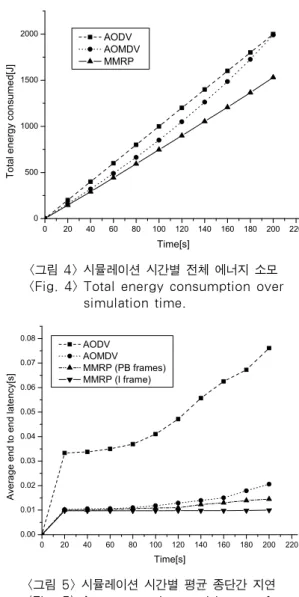
<그림 4> 시뮬레이션 시간별 전체 에너지 소모 <Fig. 4> Total energy consumption over
simulation time.
0 20 40 60 80 100 120 140 160 180 200 220
0.00 0.01 0.02 0.03 0.04 0.05 0.06 0.07 0.08
Average end to end latency[s]
Time[s]
AODV AOMDV MMRP (PB frames) MMRP (I frame)
<그림 5> 시뮬레이션 시간별 평균 종단간 지연 <Fig. 5> Average end to end latency for
different simulation times.
performance evaluation of the proposed MMRP protocol: energy consumption over simulation time, average end to end latency, and packet delivery ratio.
The first performance metrics, energy consumption over simulation time gives an idea of consumption rate of energy in the network. The second performance metrics, end to end latency gives the time taken by the data for transmission from the source to the sink. This end to end latency metrics can be used to find out whether the protocols can be used for time critical applications or not. Finally, the third performance metrics, packet delivery ratio can be used for determining whether the protocol guarantees QoS or not.
We modified the existing AODV protocol for video transmission as in [7], and then compared our MMRP protocol against modified routing protocol without multipath support and with multipath support.
Fig. 4 shows the simulation result for total energy consumption in the network at different times. In the case of single path used, it takes time to reestablish the path and consumes more energies since there is no candidate paths when the current path is released owing to the unreliable path feature or packet congestion. When the multiple paths are randomly chosen without consideration of path delay time and energies left on the node, it also consumes the energies than proposed one. Our simulation results showed an average improvement of 23.48% and 23.11% over AODV (without multipath support) and revised AOMDV for multipath support, respectively.
Similarly, Fig. 5 shows the simulation result for average end to end latency at different times. We summed up latencies for all the transmissions between the interval of 20 seconds and calculated the average latency for a period of 20 seconds. Our simulation results showed that the proposed MMRP protocol improved the latency by 81.6% and 32.01%
as compared to the routing protocols without
multipath and with multipath support. Also, the latency of I frame was lower as compared to the latency of the P and B frames, since I frames were transferred over the high priority path which has a low latency feature. Even though the retransmitted frames are getting increased as in this simulation, latency of I frames is maintaining low as compared to others. Similarly, our calculations from the simulation result showed a packet delivery ratio of 0.88201 and 0.9351 for the AODV and revised
AOMDV with multipath support respectively.
Similarly, for the proposed MMRP protocol, the packet delivery ratio was 0.9621.
Ⅴ. Conclusion
In this paper, we proposed a new routing protocol MMRP for the video transmission over WMSN with the satisfaction of energy efficiency as well as low latency time criticality requirement. The proposed MMRP protocol conserves energy by around 23%
and improves latency by around 81.6% at maximum, as compared to other non multipath protocols. Our path selection and priority method can be combined with other type of typical WSN and MANET. Also, this proposed multimedia transmission strategy over WMSN can be applied to transmission between vehicles which requires high mobility support and stable data transmission. As a future work, we will work on test-bed implementation for the proposed MMRP over WMSN which is consisting of a streaming server, intermediate nodes supporting MMRP, and a sink node reordering, decoding, and buffering video frames.
References
[1] J. N. Al-Karaki and A. E. Kamal, “Routing techniques in wireless sensor networks: a survey,”
IEEE Wireless Communications, vol. 11, pp.6-28, Dec. 2004.
[2] I. F. Akyildiz, T. Melodia and K. R. Chowdury,
“Wireless multimedia sensor networks: a survey,”
IEEE Wireless Communications, vol. 14, pp.32-39, Dec. 2007.
[3] I. F. Akyildiz, T. Melodia and K. R. Chowdury,
“A survey on wireless multimedia sensor networks,”
Computer Networks, vol. 51, pp.921-960, Mar.
2007.
[4] H. Oztarak, A. Yazici, D. Aksoy and R. George,
“Multimedia processing in wireless sensor networks,” in Proc. Innovations in Information Technology, pp.78-82, Nov. 2007.
[5] 8B. Karp and H. T. Kung, “GPSR: greedy perimeter stateless routing for wireless networks,”
in Proc. International Conference on Mobile Computing and Networking, pp.243-254, Aug.
2000.
[6] 9I. Akyildiz, W. Su, Y. Sankarasubramaniam and E. Cayirci, “Wireless sensor networks: A survey,”
Computer Networks, pp.393-422, Dec. 2001.
[7] 10J. Ibriq and I. Mahgoub, “Cluster-based routing in wireless sensor networks: Issues and challenges,” in proc. Performance Evaluation of Computer Telecommunication Systems, pp.759-766, Mar. 2004.
[8] 6L. Shu, Y. Zhang, L. T. Yang, Y. Wang, M.
hauswirtha and N. Xiong, “TPGF: geographic routing in wireless multimedia sensor networks,”
Telecommunication Systems, vol. 44, no. 1-2, pp.79-95, Dec. 2009.
[9] 7V. Lecuire, C. D. Faundz and N. Krommenacker,
“Energy-Efficient image transmission in sensor networks,” International Journal of Sensor Networks, vol. 4, pp.37-47, Jul. 2008.
[10] 13L. Zhang, M. Hauswirth, L. Shu1, Z. Zhou1, V. Reynolds and G. Han, “Multi-priority multi-path selection for video streaming in wireless multimedia sensor networks,” Lecture Notes in Computer Science, vol. 5061 pp.439-452, Jun.
2008.
[11] 14W. Heinzelman, A. Chandrakasan and H.
Balakrishnan, “Energy-Efficient communication protocol for wireless microsensor networks,” in Proc. of the Hawaii International Conference on System Sciences, vol. 2, pp.10, Jan. 2000.
[12] 15W. Heinzelman, A. Chandrakasan and H.
Balakrishnan, “An application-specific protocol
저자소개 이동훈 (Yi, Dong-Hoon)
2010년 3월 ~ 현 재 : 조선대학교 석사과정(정보통신공학전공) 2010년 2월 : 조선대학교 학사과정졸업(정보통신공학전공)
나빈 가우탐 (Navin Gautam)
2010년 : 조선대학교 석사과정 졸업(정보통신공학전공) 2007년 : 네팔, 카스만두대학 학사과정 졸업(컴퓨터공학전공)
변 재 영 (Pyun, Jae-Young)
2010년 ~ 현 재 : 조선대학교 정보통신공학과 부교수 2006년 ~ 2010년 : 조선대학교 정보통신공학과 조교수 2004년 ~ 2005년 : 조선대학교 정보통신공학과 전임강사 2003년 ~ 2004년 : (주)삼성전자 TN총괄 무선사업부 선임연구원 2003년 : 고려대학교 박사과정 졸업(전자공학전공)
1999년 : 전남대학교 석사과정 졸업(전자공학전공) 1997년 : 조선대학교 학사과정 졸업(전자공학전공) architecture for wireless microsensor networks,”
IEEE Transactions on Wireless Communications, vol. 1, pp.660-670, Oct. 2002.
[13] 16C. Perkins, E. R and S. Das, “Ad hoc On-Demand Distance Vector (AODV) routing,”
Internet Draft, Jul. 2003.
[14] 5M. K. Marina and S. R. Das, “Ad hoc on-demand multipath distance vector routing,”
Wireless Communications and Mobile Computing, vol. 6, pp.969-988, Nov. 2006.
[15] 11NS-2 simulator,
http://wwwmash.cs.berkeley.edu/ns/.
[16] 12MPEG transmission in NS-2, http://hpds.ee.ncku.edu.tw/~smallko/ns2/
Evalvid_in_N-S2.htm