• 검색 결과가 없습니다.

Particle filter-assisted ad hoc routing in a multi-hop wireless ad hoc network for multi-robots

N/A
N/A
Protected

Academic year: 2021

Share "Particle filter-assisted ad hoc routing in a multi-hop wireless ad hoc network for multi-robots"

Copied!
5
0
0

로드 중.... (전체 텍스트 보기)

전체 글

(1)

Particle filter-assisted ad hoc routing in a multi-hop wireless ad hoc network for multi-robots

Nakju Lett Doh * , Changjoo Nam * , Suk Kyu Lee * , Hwangnam Kim *

Abstract

We describe in this paper how to facilitate ad hoc routing with a particle filter in a hostile radio environment for multi-hop wireless ad hoc networks that connect multi-robots. The proposed scheme increases a connection's throughput by exploiting alternative links without going through the procedure of route discovery when link failure happens among multi-robots' networking. The scheme is implemented by using a particle filter to find strongly connected nodes. The filter estimates the probability distribution function in a sample-based manner with N particles. The particles are associated with a weight which represents the probability of the corresponding node to be the node with the best link. At every step of the estimation, the weights of particles are calculated and particles are resampled based on the weights. Since a node with the strongest link status possesses the largest number of particles, we take this node to forward the packets.

Key words: Particle filter, multi-robots, ad hoc network, wireless network, multi-hop.

* School of Electrical Engineering, Korea University

★ Corresponding author

Manuscript received Dec. 2, 2010 ; revised Dec. 29, 2010

I. Introduction

For the wireless networking of multi-robots, we traditionally use routing techniques in multi-hop wireless ad hoc networks similar to those in wired networks [1,2]. The routing protocols choose the best path between a source and a destination robot, and forward each packet through this pathmult the case of link failures, the source robot should recover the path by conop wing a route discovery again as soon as it knows about the failure. This procedure not only wastes network bandwidth but also incurs a service discontinuity to the connection during the recovery period.

In this paper, we propose a particle filter based scheme of assisting the ad hoc routing protocol, where each node is allowed to use multiple links for establishing a routing path for a pair of source robot and destination robot, to utilize a particle filter [3,5] to choose a link with highest reliability, and to forward packets to the chosen link.

II. Problem formulation

As well-perceived, wireless links are exposed to hostile radio environments. Thus, many wireless links cannot permanently stay at the state of reliability, 1.0, called the ON state, or at the opposite state of reliability, 0.0, called the OFF state. In other words, each wireless link status can have any value of reliability in between 0.0 and 1.0, from time to time, which means that the links do not always successfully transmit data nor drop data in a given interval.

On top of this unstable wireless link, an ad hoc routing protocol should choose the best path between a pair of source and destination points.

However, any unstable link over the path cannot guarantee that the best path is continuously best in the whole session of data transmissions. Usually if some node on the path discovers a failure in the course of forwarding packets, it reports the failure to the source node and asks the node to again conduct route discovery, or this node attempts to make a detour in order to avoid the point of failure.

This procedure of recovery wastes the network

bandwidth and causes a service discontinuity for the

connection.

(2)

In this letter, we propose to use multiple paths for a single pair of source and destination by allowing each intermediate node to use multiple link information, and then to exploit a particle fillter to choose the best link according to the link status at the instant of forwarding packets. Consequently, the routing path can be more robust to link failures and also the overall network can avoid temporal partitioning.

III. Algorithm description

The particle filter is a recursive filter that estimates the probability distribution function in a sample-based manner. This filter is used for non-linear system such as,

x



 

x

  

v

  

, (1) z



 

x



n

, (2)

where x



and z



are a node to forward the packet and the measurement of link status for i-th particle at time step k. Here, v

  

and n

are system and measurement noises at time step k.

Initially, the particle filter generates N particles x



  ⋯   associated with a weight w



 which represents the probability of the corresponding node x



 to be the node with the best link status. Then, the filter conducts the following three steps, repeatedly. First, the filter predicts the node at the next time step by x



 

x

  

v

  

 . Second, the filter updates each particle's weight w



 based on the new measurement of link status z



 as in (4) under an assumption that the measurement noise n

is in the Gaussian form with a covariance of R.

w



    R



 × (3)

exp 

 z



 

x





R

 

z



 

x





.

Third, the filter regenerates particles x

 

by deleting particles with small weights and interchanging them with particles with higher weights. By these procedures, the number of particles with higher weights increases. Thus, a

node with the strongest link status possesses the largest number of particles, and we take this node to forward the packets. The main advantage of the usage of the particle filter is that the choice of a node with the best link status is performed at a higher speed. This feature is enabled by the fact that the particle filter uses a limited number of particles. If some nodes are more strongly connected than others, the number of particles for these nodes increases. For other nodes which are weakly connected, the number of particles for those nodes significantly decreases not only by the weak connection but also by migrations of particles to the strongly connected nodes.

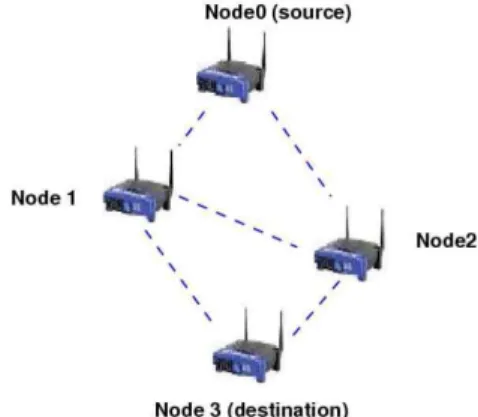
Fig. 1. A network topology used for the simulation.

V. Simulation results

As already described, the proposed particle filter

based scheme assists the routing software by

maintaining multiple link information made possible

by retaining old path information, rather than

discarding it when new path information is

available, and choosing the best link according to

the current link status. For the simulation study, we

have the network topology in Fig. 1, where node 0

can directly communicate with nodes 1 and 2; node

1 can communicate with nodes 0, 2, and 3; node 2

can communicate with nodes 0, 1, and 3; and node

3 can communicate with nodes 1 and 2. With this

topology, we conducted a simulation study with a

ns-2 network simulator and the following simulation

scenarios:

(3)

1. The total simulation time is 80s;

2. Node 0 transmits FTP traffic to node 3 via node 1 or node 2;

3. All of the nodes employ Ad Hoc On-Demand Distance Vector(AODV) routing as a wireless ad hoc routing protocol;

4. In the periods of [10s, 20s], [30s, 40s], and [50s, 60s], all wireless links around node 1 come to experience a 0.85 Packet Error Rate(PER) (which means that node 1 receives and transmits only 15% of the traffic) and those of node 2 come to have 0.15 PER (which means that node 2 successfully receives and sends 85% of the traffic).

(a)

(b)

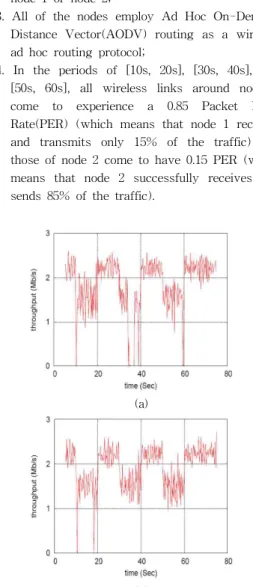
Fig. 2. TCP throughput when a) AODV routing and b) particle filter-assisted AODV routing is used.

Fig. 2(a) shows the time-varying fluctuation of TCP throughput when we do not use the proposed scheme. Initially, AODV uses node 1 to reach node 3, where the routing path is node 0, node 1, and node 3. When the routing starts to encounter wireless errors at the time instant of 10s, 30s, and 50s, the routing suddenly loses the connection to node 1 (due to many frame errors at wireless links

around node 1). Thus the protocol needs to carry out an additional route discovery in order to recover the path, which sometimes blocks FTP traffic as shown at the instant of 30 seconds.

In contrast to the above, we have different results as shown in Fig. 2(b) when we enable the proposed scheme in the same configuration. Initially, node 0 uses the path of node 0, node 1, and node 3 to reach node 3 as observed in the previous case.

When all of the wireless links around node 1 come to have the state of reliability of 0.15 at the time instant of 10s, 30s and 50s, the proposed scheme provides alternative link information (connecting to node 2) to AODV. Thus, AODV can easily change its routing path from node 0, node 1, and node 3 to node 0, node 2, and node 3 without involving an expensive route discovery procedure.

Table 1. TCP throughput for AODV.

Average PER AODV

Wireless links around

node 1

Wireless links around

node 2 Average rate (Mb/s)

0.4 0.6 0.8860

0.5 0.5 0.8761

0.6 0.4 1.0757

0.7 0.3 1.1967

0.8 0.2 1.6886

0.9 0.1 2.0256

1.0 0.0 2.2098

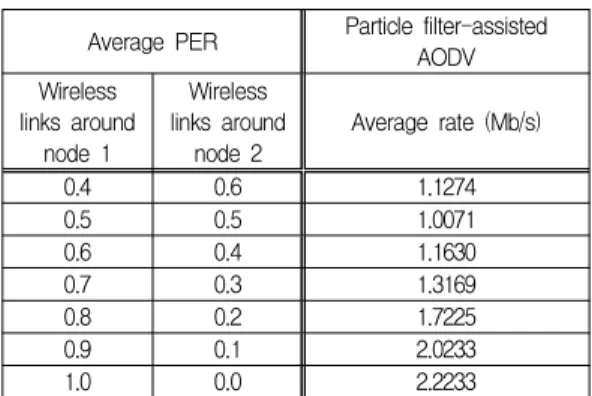
Additionally, Tables 1 and 2 present the average throughput when we set the reliability of the wireless links around nodes 1 and 2 to different values in the previous configuration. The table depicts that AODV and particle filter-assisted AODV show similar performance when wireless links are sharply stated as being in the ON or OFF state, but the particle filter-assisted AODV performs better than AODV in the other cases by using alternative links. Note that the values in the table are obtained by taking the average over 10 simulation runs.

VI. Conclusion

In this letter, we proposed to use multiple links for

(4)

a routing path between pairs of source and destination robots, and to employ a particle filter to choose the best link according to the current link

Table 2. TCP throughput for the particle filter-assisted AODV.

Average PER Particle filter-assisted AODV Wireless

links around node 1

Wireless links around

node 2 Average rate (Mb/s)

0.4 0.6 1.1274

0.5 0.5 1.0071

0.6 0.4 1.1630

0.7 0.3 1.3169

0.8 0.2 1.7225

0.9 0.1 2.0233

1.0 0.0 2.2233

status at the time instant of forwarding each packet. The estimation is conducted as following steps. At the initial step, the filter initializes N particles represented by weights. The filter repeats next three steps until the final step. First, the filter predicts the node at the next time step. Second, the filter calculates each particle's weight. Third, the filter resamples particles by deleting particles with small weights and replicates particles which have higher weights. By using the particle filter, the choice of a node with the best link status is performed at a higher speed. Simulation results clearly indicate that the proposed scheme makes the routing path robust to link failure.

Acknowledgment

본 연구는 지식경제부 및 한국산업기술평가관리원의 산업원천기술개발사업(정보통신)[KI001822, 서비스 가 용성을 위한 이동성 관리 기술 연구]과 2010년도 정부 (교육과학기술부)의 재원으로 한국연구재단 사업(No.

2010-0014060), 지식경제부/한국산업기술진흥원 융복합 형로봇전문인력양성사업의 지원으로 수행되었음

References

[1] C. E. Perkins and E. M. Royer, "Ad hoc on-demand distance vector routing," Proc. IEEE Workshop on Mobile Computing Systems and

Applications, LA, USA, pp. 99-100, Feb., 1999.

[2] S. Biswas and R. Morris, "ExOR: opportunistic multi-hop routing for wireless networks," Proc. ACM SIGCOMM, Pennsylvania, USA, pp. 133-144, Aug., 2005.

[3] S. Arulampalam, S. Maskell, N. Gordon, and T.

Clapp, "A tutorial on particle filters for on-line non-linear / non-Gaussian Bayesian tracking," IEEE Trans. on Signal Processing, vol. 50, issue 2, pp.

174-188, 2002.

[4] L. Mihaylova, D. Angelova, S. Honary, D. R. Bull, C. N. Canagarajah, and B. Ristic, "Mobility tracking in cellular networks using particle filtering," IEEE Trans. on Wireless Communications, vol. 6, issue 10, pp. 589-3599, 2007.

[5] C. Fernández-Prades, P. Closas, and J. A.

Fernández- Rubio, "Rao-blackwellized variable rate particle filtering for handset tracking in communication and sensor networks," European Signal Processing Conference, Poznań, Poland, Sep., 2007.

BIOGRAPHY Nakju Lett Doh (Nonmember)

1998 : BS degree in Mechanical Engineering, POSTECH.

2000 : MS degree in Mechanical Engineering, POSTECH.

2005: PhD degree in Mechanical Engineering, POSTECH.

2006 ~ present : Assistant Professor, School of Electrical Engineering, Korea University.

Changjoo Nam (Nonmember)

2009 : BS degree in Electrical Engineering, Korea University.

2009 ~ present : Master's course in Electrical

Engineering, Korea University.

(5)

Suk Kyu Lee (Nonmember)

2009: BS degree in Computer Science, University of Illinois at Urbana Champaign

2009 ~ present: MS/Ph.D course in Electrical

Engineering, Korea University

Hwangnam Kim (Nonmember)

1992 : BS degree in Computer Science, Pusan National University.

1994 : MS degree in Computer Engineering in Seoul National University.

2004 : PhD degree in University of Illinois at Urbana-Champaign.

1994~1999 : Research Engineer, LG Electronics.

2004~2005 : University of Illinois at Urbana- Champaign, Post-Doctorate Fellow.

2005 : Senior Research Engineer, Samsung Electronics.

2005 ~ present : Associate Professor, School of

Electrical Engineering, Korea University

수치

Fig. 1. A network topology used for the simulation.
Fig. 2. TCP throughput when a) AODV routing and b) particle filter-assisted AODV routing is used.
Table 2. TCP throughput for the particle filter-assisted AODV.

참조

관련 문서

In this paper, we propose an DSR(Dynamic Source Routing) protocol to support QoS for reliable data transmission in the mobile ad-hoc network.. The proposed

These simulation results reveal that the average path length and the number of trans- missions are very important metrics for a multi- cast routing tree in

To solve this problem, we propose a load balancing protocol called Dynamic Congestion Aware Routing Protocol (DCAR) which monitors the remaining buffer length of all nodes in

The proposed routing protocol is based on the source routing and chooses a path that maximize the path lifetime, by considering both transmit/receive

In this paper, we propose a new energy-efficient routing algorithm for sensor networks that selects a least energy consuming path among the paths formed by

The performance evaluation of the proposed routing protocol using OPNET shows that the routing method considering both route availability and route stability

In this paper, we propose a Cooperative Routing Protocol, called CooRP, to support packet delivery ratio efficiently with advanced SNR, increased operational lifetime of routes as

In case of multipath routing, several protocols using multiple paths between source and destination to provide secure data transmission in wireless ad