• 검색 결과가 없습니다.

Relevant Analysis on User Choice Tendency of Intelligent Tourism Platform under the Background of Text mining

N/A
N/A
Protected

Academic year: 2021

Share "Relevant Analysis on User Choice Tendency of Intelligent Tourism Platform under the Background of Text mining"

Copied!
7
0
0

로드 중.... (전체 텍스트 보기)

전체 글

(1)

Relevant Analysis on User Choice Tendency of Intelligent Tourism Platform under the Background of Text mining

1)

Zi-Yang Liu*, Kai Liao*, Zi-Han Guo*

Abstract

The purpose of this study is to find out the relevant factors of the choice tendency of tourism users to Intelligent Tourism platform through big data analysis, which will help enterprises to make accurate positioning and improvement according to user information feedback in the tourism market in the future, so as to gain the favor of users' choice and achieve long-term market competitiveness.

This study takes the Intelligent Tourism platform as the independent variable and the user choice tendency as the dependent variable, and explores the related factors between the Intelligent Tourism platform and the user choice tendency. This study make use of text mining and R language text analysis, and uses SPSS and AMOS statistical analysis tools to carry out empirical analysis. According to the analysis results, the conclusions are as follows: service quality has a significant positive correlation with user choice tendency; service quality has a significant positive correlation with tourism trust; Tourism Trust has a significant positive correlation with user choice tendency; service quality has a significant positive correlation with user experience; user experience has a significant positive correlation with user choice tendency Positive correlation effect.

▸Keyword: Big data, Text mining, R language, Intelligent tourism, platform, User Choice Tendency

I. Introduction

With the advent of Internet Industry 4.0 era, big data analysis has become a high-tech product that traditional enterprises must possess when they change their careers.

Predicting users behavior will increasingly be based on data and analysis rather than traditional experience and intuition. On March 1, 2018, China Tourism Research Institute and Ctrip Tourist Group released the "Big Data Report on China's Outbound Tourism 2017", which showed that Chinese citizens spent 115.29 billion US dollars on outbound tourism in 2017, an increase of 5%

over 2016, and China maintained the status of the world's largest outbound tourist source country.

As early as December 1, 2009, guided by the spirit of

"Opinions on Accelerating the Development of Tourism Industry" of the State Council of China, tourism began to seek a tourism industry system with information technology as a link, and on January 10, 2015, the China Tourism Administration issued "Guidance Opinions on Promoting the Development of Intelligent Tourism", which mentioned the construction of a national public service network and platform for Intelligent Tourism - "Intelligent Tourism" Platform came into being.

Intelligent tourism platform uses new technologies such as cloud computing, Internet of things, big data and so on,

∙First Author: Zi-Yang Liu, Corresponding Author: Kai Liao

*Zi-Yang Liu ([email protected]), Department of Global Business Graduate School, Kyonggi University, Korea

*Kai Liao ([email protected]), Department of Global Business Graduate School, Kyonggi University, Korea

*Zi-Han Guo ([email protected]), Department of Global Business Graduate School, Kyonggi University, Korea

∙Received: 2019. 06. 17, Revised: 2019. 07. 08, Accepted: 2019. 07. 08.

(2)

through the Internet or mobile Internet, with the help of portable terminal networking equipment, to provide users with various tourism resources data and information accurately, as well as to meet users'needs by using various new media and carriers, such as the laying of WIFI in scenic spots and the sharing of scenery with APP Yijian. Points, scenic spots, platform providing VR map of scenic spots and intelligent route optimization, the platform established fundamentally breaks the barrier of traditional tourism information resources, and establishes a new type of tourism mode, so that people can enjoy convenience better when they go out to travel. Quick and efficient service.

Intelligent tourism platform stands at the enterprise's point of view: it urges relevant tourism enterprises to rebuild the service platform of tourism information resources, provide more personalized services for different groups of tourism users by using big data technology, actively discover people's needs and help tourism users make decisions by pushing service, and help tourism users to accurately locate by mining tourism user data information. Self-consumption behavior. From the user's point of view: how to choose different intelligent tourism platforms for users with travel ideas is more in line with their own tourism decision-making, more convenient for self-personalized arrangement, and more in line with their own consumption level.

II. Theoretical Background

2.1 Intelligent tourism platform

Intelligent tourism originates from "Intelligent Earth".

As early as 2005, a ski resort in the United States introduced the feedback system of passenger positioning device into the wireless radio frequency wristband system. In 2010, Zhejiang City, Jiangsu Province, first put forward the concept of "intelligent tourism" in China. By consulting the domestic and foreign research on Intelligent Tourism platform, there is little research, no unified and standard definition, and lack of theoretical support.

Emmelhainz (1999):Suggested that e-commerce is defined as the realization of logistics and business exchange activities on the basis of the network through electronic means, while coordinating the corresponding

transactions of human and financial resources using advanced Internet technology to support a business acquisition.

Ye Tiewei (2015):Mentioned that by using new technologies such as cloud computing and Internet of Things, through the Internet or mobile Internet, and with the help of portable terminal Internet devices, we can mainly perceive and release information on tourism resources, activities and tourists, so that people can timely understand these information, timely arrange and adjust tourism plans, and provide more convenient and high-quality services for tourists.

Ulrike Gretzel (2015):Suggested that intelligent tourism is defined as intelligent destination, intelligent business ecosystem and intelligent experience as three basic components of data creation, processing and exchange layer support. In the process of doing so, it establishes intelligent tourism, which is different from general e-tourism, not only in its core technology, but also in the way of creating enhanced destination experience.

Gioconda Mele (2018):Suggested that Through multi-case study, it is found that the derivation of big data analysis in the process of value creation of intelligent tourism destination will be an important factor for the realization of value creation model in the future development of Intelligent Tourism industry.

In summary, this research defines Intelligent Tourism platform as: Intelligent tourism platform integrates tourism resources by using big data, Internet of Things, cloud computing, mobile communication and artificial intelligence technology, and provides users with personalized experience services or products and create tourism projects through big data analysis. The establishment of maximum value makes it easy for users to perceive and use all kinds of tourism information conveniently.

2.2 User choice tendency

Customer behavioral orientation is a statement that connects consumers themselves and future behavior.

Warshaw and Davis (1985) concluded that behavioral orientation is defined as a degree of consciousness that is formed to carry out or not carry out certain future behavior.

A large number of studies have proved that if measured

correctly, the corresponding behavioral tendency can

predict most of the social behavior very accurately. The

mechanism of the effect of online shopping experience of

(3)

He Aizhong and Gong Wanshen (2010) on customer choice tendency is that the formation of positive attitude and choice tendency of users is due to well-designed and abundant customer experience. Yan, Y., Huang, C., Wang, Q., Hu, B.

(2018) With the support of data mining technology in network intelligence, user experience can be enhanced, and the confusion of user selection behavior mechanism can be eliminated. That is, user-centered selection mechanism and service can be established to make the best choice for users, and supported by big data analysis and relationship fusion technology.

In summary, this study defines user choice preference as: under the analysis of Internet big data technology, user choice preference is how to make the choice of a product or brand after comparing the competing products or brands of the same type. The behavioral process of consumption decision-making.

III. Research Methods and Model

This study will use the combination of large data and empirical analysis methods to achieve innovation in research methods. Through large data collection of customer reviews hotspots, the variable dimension of this study is selected, and the research model is constructed.

Finally, the data samples are collected and analyzed through the form of questionnaires. The survey was conducted from May 20, 2019 to June 2, 2019. Firstly, 100 questionnaires were sent out in the pre-survey stage, and the problems in the questionnaires were found through the feedback of 100 customers, so as to further improve the content of the questionnaires; secondly, formal questionnaires were issued. A total of 424 questionnaires were sent out. After the questionnaires were recovered, the data were checked with Excel. A total of 23 questionnaires were found to be invalid.

Finally, 401 valid questionnaires were actually recovered, with an actual recovery rate of 95%. According to the results of valid questionnaires, the reliability, factor, correlation and constructive equation model were analyzed with SPSS 23.0.

3.1 Research hypothesis

Firstly, this research uses big data text mining as sampling method in Google Play Travel Application Store.

By collecting 5950 customer reviews from apps under the major Intelligent Tourism platforms, we analyze the word frequency of the collected data and delete invalid reviews, such as messy, good, contacts,

Fig. 1. Data acquisition process

etc. The results shown in the following table are obtained:

Fig. 2. Hot frequency vocabulary

Fig. 3. Hot Word Frequency Diagram

Through the analysis of hot word clouds, it is concluded that "intelligent, flash back, convenient and other functional words" are attributed to the quality of service. Delone (2004) added the quality of service as the main factor affecting tourists adoption of information system in the updated successful model of information system. In this theory, the quality of service is also considered to be a shadow. Respond to the satisfaction of user choice. Service quality refers to users' perception of their operators' services when they travel on Intelligent Tourism platforms. Service quality is the first variable in this study.

H1: Quality of Service has a positive correlation with user choice preference

The vocabulary of travel, such as train ticket, push,

hotel, air ticket and safety, is attributed to the tourism

trust of the Intelligent Tourism platform. Moorman (1993)

(4)

introduced the willingness to rely on, believing that trust refers to the confidence and a degree of dependence on the trading object, and believing that trust includes beliefs and behavioral tendencies. Because users inevitably need to provide personal privacy information (name, bank card, etc.) in choosing intelligent travel platform, tourism trust is the second variable in this study.

H2: Service quality has a positive correlation with Tourism Trust

H3: Tourism trust has a positive correlation with user preference

The perceptual vocabulary of scenic spots, customer service, design and artifacts is attributed to the user experience of Intelligent Tourism platform. Daniel (2003) defines user experience as the user's behavior, thoughts and feelings in the process of using products or services, including rational value and perceptual experience.

Because users in the stage of choosing and booking travel itineraries, because of the virtual and actual information asymmetry, if the services provided by the Intelligent Tourism platform can improve the user experience, Increased willingness to enhance users' choice of the platform. User experience is the third variable of this study.

H4: Service quality has a positive correlation with user experience

H5: User experience has a positive correlation with user choice tendency

3.2 Research method

In summary of the above research hypothesis, the research model of this study is proposed, as shown in the following figure.

Fig. 4. Research model

3.3 Definition of variable operability

Questionnaire Selection of Service Quality: Operability Reference Zhou (2013) Service Quality is the main factor affecting trust, while System Quality is the main factor affecting user satisfaction; Travel Reliability Questionnaire Selection: Operability Reference Turban and Lee (2001) Obtain the trust and foundation of online business through empirical research Facilities (security, third-party CER) and third-party platform as shopping media trust are the main positive factors affecting the trust of business integrity to users; User Experience Questionnaire Selection: Operational Reference

Kujala (2011) User Experience Design aims to improve customer satisfaction and loyalty by providing practicability, ease of use and fun through interaction with products; User Selection Tendency Questionnaire, operability reference to Dong Dahai and Jin Yufang (2003) customer line selection tendencies can be divided into four categories: word of mouth, recommendation and premium purchase.

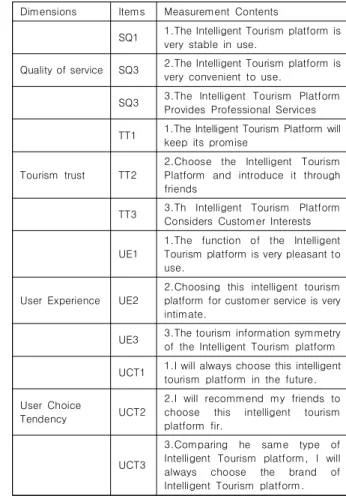
Dimensions Items Measurement Contents

  SQ1 1.The Intelligent Tourism platform is very stable in use.

Quality of service SQ3 2.The Intelligent Tourism platform is very convenient to use.

  SQ3 3.The Intelligent Tourism Platform Provides Professional Services

  TT1 1.The Intelligent Tourism Platform will keep its promise

Tourism trust TT2

2.Choose the Intelligent Tourism Platform and introduce it through friends

  TT3 3.Th Intelligent Tourism Platform Considers Customer Interests

  UE1

1.The function of the Intelligent Tourism platform is very pleasant to use.

User Experience UE2

2.Choosing this intelligent tourism platform for customer service is very intimate.

  UE3 3.The tourism information symmetry of the Intelligent Tourism platform

  UCT1 1.I will always choose this intelligent tourism platform in the future.

User Choice

Tendency UCT2

2.I will recommend my friends to choose this intelligent tourism platform fir.

  UCT3

3.Comparing he same type of Intelligent Tourism platform, I will always choose the brand of Intelligent Tourism platform.

Table 1. Measurement Scale

(5)

IV. Data Analysis

4.1 Reliability analysis

Through SPSS 23.0 analysis, we can conclude that the Cronbach's alpha coefficient values in the above tables are all above 0.6, which can judge that the internal consistency of each item exists and has good stability, which fully conforms to the scope of the reliability measurement in this study.

Cronbach’ α Number of Items

SQ 0.911 3

TT 0.917 3

UE 0.939 3

UCT 0.901 3

Table 2. Reliability analysis results

4.2 Validity test

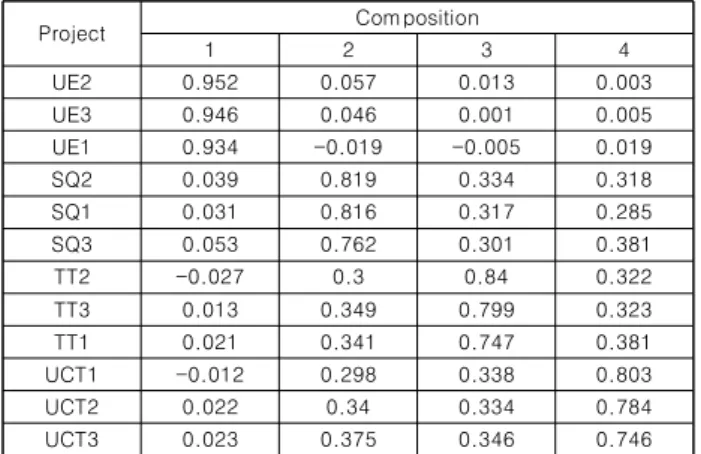
The validity model results of the above table were obtained by SPSS23.0 statistical analysis. Using factor analysis, we can see that the weighted values of each variable are more than 0.7, which shows that the scale has good constructive validity.

Project Composition

1 2 3 4

UE2 0.952 0.057 0.013 0.003

UE3 0.946 0.046 0.001 0.005

UE1 0.934 -0.019 -0.005 0.019

SQ2 0.039 0.819 0.334 0.318

SQ1 0.031 0.816 0.317 0.285

SQ3 0.053 0.762 0.301 0.381

TT2 -0.027 0.3 0.84 0.322

TT3 0.013 0.349 0.799 0.323

TT1 0.021 0.341 0.747 0.381

UCT1 -0.012 0.298 0.338 0.803

UCT2 0.022 0.34 0.334 0.784

UCT3 0.023 0.375 0.346 0.746

Table 3. Validity Analysis results

4.3 Correlation analysis

Through the correlation analysis of the four variables in this study by SPSS23.0, the results obtained in Table 5 above prove that SQ, TT, UE and UCT have a good linear positive correlation.

  SQ TT UE UCT

SQ 1      

TT 0.74 1    

UE 0.63 0.61 1  

UCT 0.75 0.76 0.65 1

Table 4. Relevant analysis results

4.4 Research results

Fig. 4. Structural Equation Model Analysis

      S ta nda rdi zed

Estimate Estimate AVE

SQ1 <--- SQ 0.86 0.319

0.73

SQ2 <--- SQ 0.91 0.222

SQ3 <--- SQ 0.86 0.326

TT1 <--- TT 0.86 0.387

0.72

TT2 <--- TT 0.91 0.249

TT3 <--- TT 0.9 0.282

UCT3 <--- UCT 0.88 0.284

0.68

UCT2 <--- UCT 0.88 0.291

UCT1 <--- UCT 0.83 0.456

UE3 <--- UE 0.85 0.623

UE2 <--- UE 0.91 0.26 0.62

UE1 <--- UE 0.78 0.375

Table 5. AVE analysis

In the validation of the basic adaptation index of the model, according to Bogozzi (1988) and other scholars' test methods, as shown in Figure 4. We can get Chi-square=145.283,GFI=0.947,RMSEA=0.68,AGFI= 0.916 and so on. According to the criterion of index judgment, we can definitely determine that this result can be judged by the criterion of model fitness. By calculating the average extracted variance of each potential variable (AVE) > 0.5, as shown in Table 5. It shows that the four potential variables in this study have good convergence validity.

Hypothesis Estimate S.E. C.R. P Conclusion

H1 (SQ→TT) 0.871 0.051 17.248 *** Supported

H2 (SQ→UE) 0.731 0.054 13.575 *** Supported

H3 (TT→UCT) 0.39 0.058 6.718 *** Supported

H4 (UE→UCT) 0.256 0.05 5.169 *** Supported

H5 (SQ→UCT) 0.343 0.075 4.568 *** Supported Table 6. Hypothesis test

(6)

The indicators for evaluating the results of hypothesis tests are sorted out, as shown in Table 6. According to the hypothesis test results of the construction equation, we can get the following results:

H1: Service quality has a significant positive correlation with user choice tendency

H2: Service quality has a significant positive correlation with tourism trust.

H3: Tourism trust has a significant positive correlation with user preference.

H4: Service quality has a significant positive correlation with user experience

H5: User experience has a significant positive correlation with user choice tendency

V. Research Conclusion

Firstly, this study obtains the choice of variable dimension through large data analysis, and constructs a theoretical research model, using structural equation model (SEM) for empirical analysis. The specific conclusions are as follows:

1,service quality, Tourism Trust and user experience all have significant positive effects on user choice tendency. By comparing the standard regression coefficient in SEM, the influence is tourism trust, service quality and user experience in turn. It shows that the Intelligent Tourism platform based on the Internet as a bridge wants to enhance the stability and long-term user preference viscosity. Firstly, we can personalize the design style of the web-site of the Intelligent Tourism platform; the background information of the web-site of the platform, the introduction of the real information of the company or organization affiliated to the platform, and provide detailed contact information so that users can easily contact; we can make good use of the information such as user comments of the web-site of the tourism platform, so that the original users can influence the new.

Users; A well-positioned tourism brand platform is always the key to win users' choice.these four aspects to enable users to have a sense of trust and dependence, and then affect the user choice psychology. Secondly, the improvement of service quality and user experience can be achieved through information services (travel due to weather and other reasons to change the original itinerary

and booking ticket travel days reminder), strict supervision of online businesses by the platform, to avoid the situation of asymmetric information between online and offline, and to promote the home page of excellent businesses. Establish a good platform reputation, and then affect the user choice tendency.

2, service quality has a significant positive impact on Tourism Trust and user experience, which shows that improving the service quality of Intelligent Tourism platform can effectively enhance the trust level and good user experience of the tourism platform, because in the Internet era, the confidentiality, security of users' privacy information and the authenticity of the content of commodity reviews are true. Information symmetry has always been a concern of users, so high-quality service quality will enhance the user's sense of security and pleasure, and make users more active in the choice of tourism platform. Limited to the ability of this study, there are some limitations. Data collected only on the platform of Google web-site, and the demographic characteristics of samples are not analyzed, such as gender, age, occupation and so on.

Finally. It is hoped that this study will help the future intelligent tourism platform to establish a better brand awareness, improve the choosing tendency stickiness of tourism users, cultivate loyal city users and achieve long-term competitive advantage in the tourism market in terms of improving service quality, enhancing tourism trust and increasing user experience.

REFERENCES

[1] GiocondaMele;ValentinaNdou;GiustinaSecundo.,(2018), Creating value from Social Big Data: Implications for Smart Tourism Destinations, Information Processing&Manage ment, volume54,page847-860

[2] Ulrike Gretzel;Marianna Sigala;Zheng Xiang;Chulmo Koo.,(2015).Smart tourism: foundations and developme nts, Electronic Markets ,volume25, pp179-188 [3] Yan, Y. , Huang, C. , Wang, Q. , & Hu, B.,(2018). Data

mining of customer choice behavior in internet of things within relationship network. International Journal of Information Management.

[4] Delone W H, Mclean E R.,(2004).Measuring e- commerce

success:Applying the De Lone & Mc Lean information

systems success model. International Journal of

(7)

Electronic Commerce,9(1): 31-47.

[5] Moorman C, Zaltman G, Despande R.,(1993). Factors affecting trust in market research relationships. Journal of marketing,57(01):81-101.

[6] Zhou T.,(2013).An empirical examination of continuance intention of mobile payment services.Decision Support Systems, 54(2): 1085-1091.

[7] Lee M K O, Turban E.,(2001).A trust model for consumer internet shopping. International Journal of Electronic Commerce,6(1): 75-91.

[8] Kujala, S. , Roto, V. , V??N?Nen-Vainio-Mattila, K. , Karapanos, E. , & Sinnel,A.,(2011). Ux curve: a method for evaluating long-term user experience. Interacting with Computers, 23(5), 473-483.

[9] Dahai,D & Yufang,J.,(2003). Research on the antecedents of consumer behavioral preferences. Nankai Management Review, 6 (6), 46-51.

[10] Warshaw, P. R., & Davis, F. D.,(1985). Disentangling behavioral intention and behavioral expectation. Journal of Experimental Social Psychology, 21(3), 213-228.

[11] Aizhong, H&Wanchen,G.,(2010).A Preliminary Study on the Mechanism and Models of the Effect of Online Shopping Experience on Customer Behavior Tendency.

East China Economic Management (3), 112-116.

[12] Bagozzi, R.P. ,& Yi,Y.,(1988). On the evaluation of structural equation model. Journal of Academy of Marketing Science, 16 (1), 74-94.

[13] Hull, R., Kumar, B., Daniel Lieuwen, Peter F.

PatelSchneider, Sahuguet, A., & Varadarajan, S., et al. ,(2003). “everything personal, not just business:”

improving user experience through rule-based service customization. Lecture Notes in Computer Science, 29-10, page. 149-164.

[14] Mariani, M., Baggio, R., Fuchs, M., & Wolfram Höepken.

(2018). Business intelligence and big data in hospitality and tourism: a systematic literature review. International Journal of Contemporary Hospitality Management, 30(12), 3514-3554.

[15] Kim, K. , Park, O. J. , Yun, S. , & Yun, H. . (2017).

What makes tourists feel negatively about tourism destinations? application of hybrid text mining methodology to smart destination management.

Technological Forecasting and Social Change, S0040162517300112.

[16] Zhu, W. (2017). Design and Implementation of Intelligent Tourism Platform for Mobile Terminal. International Conference on Smart Grid & Electrical Automation.

[17] Shen, S., & Wang, Q. (2018). Innovation Strategy of Traditional Village Tourism Development in Liaoning

Province under the Background of Smart Village Construction. International Conference on Intelligent Transportation.

[18] Pejsachowicz, L., & Toussaert, S. (2017). Choice deferral, indecisiveness and preference for flexibility

☆. Journal of Economic Theory, 170, 417-425.

Authors

Ziyang Liu. Received the B.A. degree in Management from Army superintend institute of shijiazhuang China PLA ,China, in 2006, M.A. degree and Ph.D. degree in Management from Kyonggi University, Korea, in 2010 and 2013, reapectively.

Dr. Liu joined the faculty of the Global Business Kyongggi University, Korea in 2015. He is currently an Assistant Professor in the Global Business Kgonggi University. He is intrested in Quality Management. Management Information Systems, International economics, E-business etc.

Kai Liao Graduated from Dhurakij Pundit University. Now studying for a doctor degree at Kyonggi University. During the school period, the main research interest is Global Business.

Zi-Han Guo. Graduated from Southwest

Petroleum University. Now studying for a

doctor degree at Kyonggi University. During

the school period, the main research

interest is Global Business.

수치

Fig.  1.  Data  acquisition  process
Fig.  4.  Research  model
Fig.  4.  Structural  Equation  Model  Analysis

참조

관련 문서

It considers the energy use of the different components that are involved in the distribution and viewing of video content: data centres and content delivery networks

1 John Owen, Justification by Faith Alone, in The Works of John Owen, ed. John Bolt, trans. Scott Clark, &#34;Do This and Live: Christ's Active Obedience as the

Second, for the relationship between hospital capability and service orientation, the hospital capability had the positive significant impact on the service orientation in the

In terms of the relationship between personal service contact and passengers' emotions, this study classified service contact quality factors into four groups based on

The purpose of this study is to examine the service quality of a tennis court which is one of public sport facilities and analyze a difference in

Interest in sustainability and improving the quality of living has brought changes in the measurement and judgement for the quality of living.

In conclusion, this study examines the impact of the security quality level of Busan port on port service quality, customer satisfaction, and customer loyalty, and

model for the connection among service orientation, organizational commitment and trust, group efficacy, service quality and customer satisfaction was