Regular Article
J F E S
Journal of Forest and Environmental Science
pISSN: 2288-9744, eISSN: 2288-9752
Journal of Forest and Environmental Science Vol. 34, No. 2, pp. 162-164, April, 2018 https://doi.org/10.7747/JFES.2018.34.2.162
162 Journal of Forest and Environmental Science http://jofs.or.kr
Carbon Storage and Uptake by Street Trees in Seoul
Hyun-Kil Jo1, Jin-Young Kim2,* and Hye-Mi Park2
1Department of Ecological Landscape Architecture Design, Kangwon National University, Chuncheon 24341, Republic of Korea
2Department of Landscape Architecture, Graduate School, Kangwon National University, Chuncheon 24341, Republic of Korea
Abstract
This study quantified the carbon storage and uptake by street trees in Seoul and explored suitable planting and management strategies. A systematic sampling model was used to select 50 plots to survey the structures of street trees. The average density and cover of street trees were approximately 5.8 trees/100 m2 and 12.1%, respectively. Trees with a dbh of less than 30 cm accounted for about 66.3% of the total number of trees surveyed. The total carbon storage and uptake by the street trees were approximately 103,641 t and 10,992 t/yr, respectively. The total carbon uptake equaled the amount of annual carbon emissions from driving of about 11,000 cars. Street tree planting and management strategies were proposed to enhance carbon uptake. They included multi-layered and multi-aged planting, securing ground and space for plant growth, and avoiding excessive tree pruning.
Key Words: species, tree density, tree size, planting, management
Received: January 13, 2018. Revised: March 5, 2018. Accepted: March 8, 2018.
Corresponding author: Jin-Young Kim
Department of Landscape Architecture, Graduate School, Kangwon National University, Chuncheon 24341, Republic of Korea Tel: 82-33-250-8345, Fax: 82-33-259-5618, E-mail: [email protected]
Introduction
The growing awareness about the need for carbon reduc- tion has evoked interest in the effect of planting trees on the urban environment. Planting and management of street trees are becoming increasingly important due to their car- bon absorption ability and various other benefits. Studies on carbon reduction by trees in the urban environment have been carried out globally (Jo 1999; Nowak and Crane 2002; Nowak et al. 2013; Russo et al. 2015; Gratani et al.
2016; McGovern and Pasher 2016).
However, information is limited on carbon reduction ef- fects of street trees. The purpose of this study was to quanti- fy the carbon storage and uptake by street trees in Seoul, Korea and to suggest suitable planting and management strategies. In this study, carbon storage refers to the total
amount of carbon accumulated by the trees over growth years, while carbon uptake refers to the amount of carbon sequestered by the trees in one year.
Materials and Methods
Sampling and field survey
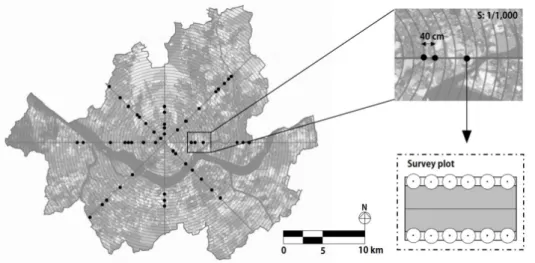
To survey the structures of street trees, a systematic sam- pling method was used to extract 50 plots from aerial photo- graphs with a scale 1:1,000 (Fig. 1). Eight straight lines ra- diating from the center of the study city were drawn in eight different directions. Subsequently, circles were drawn 40 cm apart. The points at which the circles and lines coincided were subject to sample extraction. One-lane roads or streets with no sidewalks were excluded from this study. The num- ber of samples was determined based on whether the sam-
Jo et al.
J For Environ Sci 34(2), 162-164 163
Fig. 1. Depiction of the systematic sampling method used in this study.
ples contained majority of the street tree species in the study city, the cost and time required for field survey, and the stat- istical reliability of the research data.
The sample points were visited, and a survey plot for each point was established up to 40 m for each side in length from the point (total: 80 m) and up to architectural bounda- ries of both sidewalks in width. Field survey data included species, stem diameter, height, crown width, and density of street trees. Stem diameter was measured at a breast height of 1.2 m (dbh) for trees and at 15 cm above ground for shrubs (2 cm or less in dbh). These data were used to esti- mate the carbon storage and uptake per unit area.
Estimation of carbon storage and uptake
The carbon storage and uptake by each tree species were estimated using quantitative models for carbon storage and uptake per tree. The quantitative models, which apply the stem diameter as an independent variable, were derived from the annual measurement of CO2 exchange rates or a direct harvest method (Jo and Cho 1998; Jo 1999; Jo and Ahn 2001; Jo and Ahn 2012; Jo et al. 2013; Jo et al. 2014).
The tree density was applied to determine the carbon stor- age and uptake per unit area. Subsequently, total carbon storage and uptake by street trees were computed using total street area in the study city.
Results and Discussion
Distribution of street trees
The average density and cover of street trees and shrubs were approximately 5.8 trees/100 m2 and 12.1%, respectively.
Trees with dbh of less than 30 cm accounted for approx- imately 66.3% of the total number of trees surveyed (15.8%
for less than 10 cm, 14.9% for 10-20 cm, and 35.6% for 20-30 cm). The total number of species was 34, which sug- gests significant species diversity. The dominant tree and shrub species (based on importance values) planted as street trees were Ginkgo biloba (25.0%), Platanus occidentalis (17.8%), Buxus microphylla var. koreana (7.8%), Pinus densi- flora (6.4%), Zelkova serrata (5.8%), and Chionanthus retusa (4.9%). Street tree cover and density in the study city were 1.4-2.8 times higher than those in Chuncheon (Jo et al.
2017).
Carbon storage and uptake
Carbon storage and uptake per unit area by street trees were approximately 13.2 t/ha and 1.4 t/ha/yr, respectively (Table 1). Total carbon storage and uptake of the entire street area were about 103,641 t and 10,992 t/yr, respect- ively. The carbon storage per unit area in the study city was 52% of that (25.1 t/ha) by urban trees in the United States (Nowak and Crane 2002). This difference appears to be due to lower planting density, smaller tree sizes, and poorer growth conditions in the study city. Carbon uptake per street tree averaged approximately 16 kg/yr (mean dbh: 26 cm).
Carbon Storage and Uptake by Street Trees in Seoul
164 Journal of Forest and Environmental Science http://jofs.or.kr Table 1. Carbon storage and uptake by street trees in Seoul
Carbon Per unit area (ha) Total area
Storage (t) 13.19±1.66 103,641
Uptake (t/yr) 1.36±0.36 10,992
Annual carbon emissions from gasoline consumption per car were about 1 t/yr in Korea (KEA 2017). The total car- bon uptake by street trees in the study city equaled the amount of carbon annually emitted by driving of approx- imately 11,000 cars. Thus, street trees played a significant role in reducing atmospheric carbon levels in urban envi- ronments with limited greenspace.
Planting and management
The structures of street trees in the study city were char- acterized by single-layered and single-aged planting.
Single-layered planting accounted for about 73% of all the survey plots. Majority of the trees were in the young and growing stages. These structures should be replaced by multi-layered and multi-aged planting to improve carbon storage and uptake per unit area. Available growing spaces were limited due to aboveground utility lines, street furni- ture, and impervious pavement. It is essential to maintain productive growth of the trees to enhance performance of carbon reduction. A desirable space for normal crown and root growth must be supplied through relocation of the util- ity lines and reduction of unnecessary pavement. Severe tree pruning to protect the utility lines was found at approx- imately 58% of all the survey plots. This excessive pruning should be avoided not to hinder normal tree growth. This study is expected to contribute to globally sharing the role and importance of urban street trees in reducing atmos- pheric carbon levels.
Acknowledgements
This study was carried out with the support of the ‘R&D
Program for Forest Science Technology (Project No.
2017043B10-1819-BB01)’ provided by the Korea Forest Service (Korea Forestry Promotion Institute).
References
Gratani L, Varone L, Bonito A. 2016. Carbon sequestration of four urban park in Rome. Urban For Urban Green 19: 184-193.
Jo HK. 1999. Carbon uptake and emissions in urban landscape, and the role of urban greenspace for several cities in Kangwon province. J Korean Inst Landsc Archit 27: 39-53.
Jo HK. 2002. Impacts of urban greenspace on offsetting carbon emissions for middle Korea. J Environ Manag 34: 115-126.
Jo HK, Ahn TW. 2001. Annual CO2 uptake and atmospheric puri- fication by urban coniferous trees - for Pinus densiflora and Pinus koraiensi -. Korean J Environ Ecol 15: 118-124.
Jo HK, Ahn TW. 2012. Carbon storage and uptake by deciduous tree species for urban Landscape. J Korean Inst Landsc Archit 40: 160-168.
Jo HK, Cho DH. 1998. Annual CO2 uptake by urban popular landscape tree species. J Korean Inst Landsc Archit 26: 38-53.
Jo HK, Kim JY, Park HM. 2013. Carbon storage and uptake by evergreen trees for urban landscape - for Pinus densiflora and Pinus koraiensis. Korean J Environ Ecol 27: 571-578.
Jo HK, Kim JY, Park HM. 2014. Carbon reduction effects of ur- ban landscape trees and development of quantitative models - for five native species. J Korean Inst Landsc Archit 42: 13-21.
Jo HK, Kim JY, Park HM. 2017. Carbon uptake by urban forests and planning strategies in Chuncheon. Proc Korea Environ Sci Conf 26: 181.
KEA (Korea Energy Agency). 2017. Car CO2 Emissions Database.
http://bpms.kemco.or.kr/transport_2012. Accessed 12 Jan 2017.
McGovern M, Pasher J. 2016. Canadian urban tree canopy cover and carbon sequestration status and change 1990-2012. Urban For Urban Green 20: 227-232.
Nowak DJ, Crane DE. 2002. Carbon storage and sequestration by urban trees in the USA. Environ Pollut 116: 381-389.
Nowak DJ, Greenfield EJ, Hoehn RE, Lapoint E. 2013. Carbon storage and sequestration by trees in urban and community areas of the United States. Environ Pollut 178: 229-236.
Russo A, Escobedo FJ, Timilsina N, Zerbe S. 2015. Transportation carbon dioxide emission offsets by public urban tree: a case study in Bolzano, Italy. Urban For Urban Green 14: 398-403.