
http://dx.doi.org/10.7839/ksfc.2020.17.4.125
Analysis of the Axle Load of a Rice Transplanter According to Gear Selection
Md Abu Ayub Siddique1, Wan Soo Kim1, Seung Yun Baek2, Yong Joo Kim1,2*, Seong Un Park3, Chang Hyun Choi4, and Young Soo Choi5
Received: 02 Nov. 2020, Revised: 18 Nov. 2020, Accepted: 24 Nov. 2020 Key Words:Transplanter, Load Analysis, Gear Stage, Planting Depth
Abstract: The objective of this study was to analyze the axle load of a rice transplanter when planting rice seedlings at different working load conditions to select a suitable gear stage and a constant planting depth for rice seedlings. In this study, there are four levels of planting distances (26, 35, 43, and 80 cm) and three planting depths (low, medium, and high) with two gear stages (1.3 and 1.7 m/s). Axle loads and required planting pressures were analyzed statistically. It was observed that axle torques were increased with increasing planting depths for both gear stages, meaning that axle torques were directly proportional to planting depths for both gear stages. It was also observed that required planting pressures had a significant difference between planting distances. Planting pressures also showed significant difference according to gear stage and planting depth. These results indicate that planting pressures were directly proportional to both gear stage and planting depth. Results revealed that the automatic depth control system of a rice transplanter could not guarantee a constant planting depth as supplied pressures were variable. This indicates that a control algorithm is needed to ensure a constant planting depth. In the future, a control algorithm will be developed for an automatic depth control system of a rice transplanter to improve its comprehensive performance and efficiency.
* Corresponding author: [email protected]
1 Department of Biosystems Machinery Engineering, Chungnam National University, Daejeon 34134, Korea
2 Department of Smart Agriculture Systems, Chungnam National University, Daejeon 34134, Korea
3 Reliability Test Team, TYM ICT Co. Ltd., Gongju 32530, Korea
4 Department of Bio-Mechatronics Engineering, Sungkyunkwan University, Suwon 16419, Korea
5 Department of Rural and Biosystems Engineering, Chonnam National University, Gwangju 61186, Korea
Copyright Ⓒ 2020, KSFC
This is an Open-Access article distributed under the terms of the Creative Commons Attribution Non-Commercial License(http://
creativecommons.org/licenses/by-nc/3.0) which permits unrestricted non-commercial use, distribution, and reproduction in any medium, provided the original work is properly cited.
Nomenclature
and : torque of the front and rear axle, Nm
, , and : weight of the total, front, and rear axle, N
and : weight distribution of the front and rear axle (%)
: the traction coefficient
and : rolling radius of front and rear tire, m
: average
: standard deviation
: maximum
: minimum
1. Introduction
Rice transplanter is a machine that is used to plant the grown seedlings on a seedbed uniformly with exact planting space and planting depth. Goldstein Research1) reported that the demand for rice transplanter is estimated to reach USD 13.06 billion in 2024 than that of USD 8.07 billion in 2016 because of the labor
shortage, the aging of the farmers, and higher food production for the increasing world population2). Therefore, several researchers and manufacturer companies are applying advanced technology to rice transplanter to improve its comprehensive performance.
Transplanter has several working conditions such as planting depth, planting distance3), gear selections4), and field conditions depending on crop type5). In this study, planting depth is considered to analyze the axle loads.
According to Sanusan6), the planting depth of the seedlings has significant effects on the rice yield.
Bozorgi7) reported that the optimum spacing of the seedlings also increases rice production. Therefore, planting depth is an important factor of a rice transplanter, which is highly related to the performance and efficiency of the transplanter. There are several studies to analyze working loads for vegetable transplanter but there is no research on load analysis of rice transplanter. That is why the automatic planting depth control system was developed using the proportional valve to plant the seedling at a constant planting depth. The developed planting depth system is performed by the supplied pressure of the proportional valve. According to Siddique8), the proportional valve is frequently used in the automation industries to control precisely. As it is controlled by the pressure of the proportional valve, the analysis of the required pressure to plant the rice seedlings is essential9) because the hydraulic proportional valve has nonlinear characteristics that declaim the stability and accuracy of the hydraulic system10-11). The main reason is the hydraulic system is highly responsive to the temperature and viscosity of the hydraulic oils because the temperature of the hydraulic oil is closely related to change the oil viscosity and the leakage, which highly affects the damping ratio of the proportional valve and makes the system unstable12-13). Park14) mentioned the response of the hydraulic system was delayed at initial operation because being of higher viscosity at lower temperatures.
Therefore, the objective of this study is the analysis of the axle load of a rice transplanter for selecting suitable gear stages under working load conditions. The specific objectives are as follows: (i) to analyze the axle load of the rice transplanter to plant the rice seedlings at
different planting depth for different gear selections, and (ii) to analyze the required pressures to plant the rice seedlings based on working loads.
2. Materials and Methods
2.1 Rice transplanter
The six-row rice transplanter (ERP60DS) is manufactured commercially by Daedong Industrial Company, Korea. The main components of the rice transplanter’s hydraulic system are the hydraulic pump, proportional valve, and hydraulic actuator. The hydraulic pump generates hydraulic pressure by operating the engine and supplies to the proportional valve. The proportional valve controls the pressure according to the command of the float sensor. The hydraulic actuator adjusts the movement based on the control pressure of the proportional valve. The actuator movement is the planting depth and the proportional valve helps to control the uniform planting depth of a rice transplanter.
2.2 Simulation model
The simulation model of the rice transplanter is developed and simulated by LMS AMESim (version 16, SIEMENS Company, Germany), which is shown in Fig.
1. The simulation model of rice transplanter consists of a mechanical, hydraulic, and control unit. The simulation model of the planting depth control system of the rice transplanter was composed of a 4.5 cc/rev and a 2650 rpm rated rotational speed hydraulic pump for generating the flow and supplying it to the proportional valve. The proportional valve, which had a 20 MPa operating pressure was used to regulate the hydraulic actuator movement. The piston and rod diameters of the hydraulic actuator were 55 and 15 mm. The planting depth of the rice seedling directly depended on the actuator movement that was controlled by the proportional valve. Also, the hydraulic actuator was used for balancing the load of the proportional valve. The control unit is performed to control the supplied pressure of the proportional valve. In the case of the mechanical unit, there are two clutches (front and rear) for forward and reverse movement of the transplanter using various gear ratios. According to the
Fig. 1 The simulation model of a rice transplanter power transmission
manufacturer, the planting depth range is 1.5 to 4.4 cm in Korea.
2.3 Calculation of axle load
The front and rear axle torques of the transplanter were calculated based on the total weight of the transplanter, weight distribution, traction coefficient, and wheel radius15).
f f
f W r
T
(1)r r
r W r
T
(2)f
f W
W
(3)r
r W
W
(4)where and are the torques of the front and rear axles (Nm), respectively. , , and are the weights of the total, front and rear axles (N), which are 7355, 4746, and 2610 N, respectively. is the traction coefficient (0.8). and are the weight distributions of the front and rear axles, which are 64.52 and 35.48%, respectively. and are the wheel radius of the front and rear tires, which are 0.65 and 0.95 m, respectively.
The equations (1)~(4) are used to calculate the axle torque of the rice transplanter that is used as an input parameter.
2.4 Simulation methods
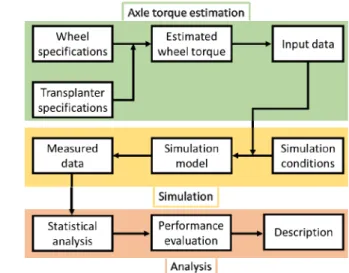
In this study, the axle torque was calculated based on wheel and transplanter specifications. The calculated torques were applied to the simulation model to conduct the simulation. The simulation was performed on the basis of two gear selections (1.3 m/s and 1.7 m/s) and analyzed the axle torque considering the different planting depths (high: 4.4 cm, medium: 2.4 cm, and low: 1.5 cm). Each planting depth has 4 repeated measurements for different planting distances. The planting distances were selected from the user’s survey in Korea, which were 26, 35, 43, and 80 cm. The pressures of the proportional valve to plant rice seedlings were also analyzed for different planting distances at low, medium, and high depth. The overall procedure of the simulation was shown in Fig. 2.
Fig. 2 The entire procedure of this study
2.5 Statistical analysis
The statistical analysis was conducted by the IBM SPSS Statistics (SPSS Inc., Chicago, IL, USA). to determine whether the gear stages, planting depth, and planting distances affect the axle torques of the rice transplanter. Duncan Multiple Range Test was also conducted to identify the significant difference between the required planting pressures at 5%.
3. Results and Discussion
3.1 Axle load of rice transplanter
The axle torques of the transplanter were conducted
Table 1 The axle load at different planting distances for low planting depth
Planting distance [cm]
Axle torque [Nm] at 1.7 [m/s]
Max. Min. Avg. ± Std. Dev.
26 594.94 546.75 580.98 a ±10.85 35 594.97 546.78 580.92 a ±10.87 43 594.91 546.80 580.88 a ±10.83 80 594.93 546.73 580.95 a ±10.85
Axle torque [Nm] at 1.3 [m/s]
26 777.95 715.07 759.70 b ±14.18 35 778.00 714.98 759.67 b ±14.18 43 777.97 715.03 759.65 b ±14.18 80 777.99 715.01 759.67 b ±14.18
a, b Means within each gear stage with the same combination of letters are not significantly different at p<0.05 according to Duncan’s multiple range tests.
for three different planting depths at 26, 35, 43, and 80 cm planting distances. It was observed that the axle torques were constant for different planting distances at low planting depth. The t-test results also showed that there was no significant difference among the axle torques calculated at different planting distances for low planting depth. The t-results of the axle loads are listed in Table 1.
Fig. 3 The axle load at different planting depths:
(a) 1.7 m/s and (b) 1.3 m/s
Therefore, the representative average axle torques at each planting depth are shown in Fig. 3. It was noticed that the axle torques were comparatively higher at higher planting depth. It indicates that the axle torques are directly proportional to the planting depth. It was also observed that the gear stages also have great affects on the axle torque of the transplanter. It means the axle torques are inversely proportional to the gear stages of a transplanter.
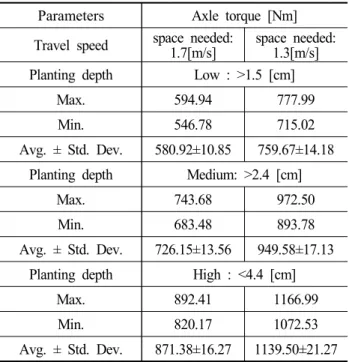
The maximum torques for low speed (1.3 m/s) were found 594.94, 743.68, and 892.41 Nm at low, medium, and high planting depth, respectively. However, the maximum torques for high speed (1.7 m/s) were 777.99, 972.50, and 1166.99 Nm at low, medium, and high planting depth, respectively. Therefore, it is clearly stated that the axle torques were directly proportional to the planting depth for both gear stages of the rice transplanter.
The t-test was conducted for the representative axle torques at different planting depth for both gear stages (1.7 and 1.3 m/s), which were listed in Table 2.
As the axle torques were constant at different planting distances, the driving powers were also constant. Therefore, the driving powers were calculated for different planting depths. The calculated driving powers were shown in Fig 4. It was observed that the required driving powers were increased with the i
Table 2 The axle load of the rice transplanter for different planting depths
Parameters Axle torque [Nm]
Travel speed space needed:
1.7[m/s] space needed:
1.3[m/s]
Planting depth Low : >1.5 [cm]
Max. 594.94 777.99
Min. 546.78 715.02
Avg. ± Std. Dev. 580.92±10.85 759.67±14.18 Planting depth Medium: >2.4 [cm]
Max. 743.68 972.50
Min. 683.48 893.78
Avg. ± Std. Dev. 726.15±13.56 949.58±17.13 Planting depth High : <4.4 [cm]
Max. 892.41 1166.99
Min. 820.17 1072.53
Avg. ± Std. Dev. 871.38±16.27 1139.50±21.27
ncreasing rate of planting depths, and decreased with increasing rate of gear stages. It means the required driving powers are directly proportional to the planting depths because the axle torques are also proportional to the planting depth, and inversely proportional to the gear stages because the axle torques are higher at low gear stages.
Fig. 4 The driving power of rice transplanter: (a) 1.7 m/s and (b) 1.3 m/s
Table 3 The driving power of the rice transplanter for different planting depths
Parameters Driving power [kW]
Travel speed 1.7 [m/s] 1.3 [m/s]
Planting depth Low
Maximum 1.31 1.72
Minimum 1.21 1.58
Avg. ± Std. Dev. 1.28±0.02 1.68±0.03
Planting depth Medium
Max. 1.64 2.15
Min. 1.51 1.97
Avg. ± Std. Dev. 1.60±0.03 2.10±0.04
Planting depth High
Max. 1.97 2.58
Min. 1.81 2.37
Avg. ± Std. Dev. 1.93±0.04 2.52±0.05
The t-test results of driving powers were listed in Table 3. The results revealed that the driving power has a highly significant difference with the planting depth of rice seedlings and gear stages of the rice transplanter.
As a constant axle torques at different planting distances for the same planting depth and gear stage, it is important to analyze the planting pressures to insure a constant planting depth because the constant supply pressures at different planting distances are needed to maintain a constant planting depth.
3.2 Analysis of the planting pressures
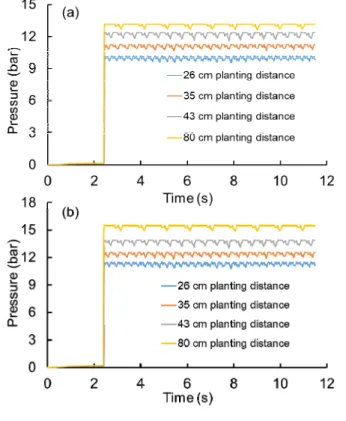
In this study, the proportional valve supply pressures were measured for different planting distances of the rice seedlings. The required planting pressures for low planting depth were shown in Fig. 5. It was observed that the trend of the pressures for both gear stages was similar.
The results of the t-test show that there is a highly significant difference between the planting pressure supplied from the proportional valve at different planting distances. The t-test results are listed in Table 4.
Fig. 5 The planting pressure of transplanter: (a) 1.7 m/s and (b) 1.3 m/s
Table 4 The planting pressures at different planting distances for low planting depth Planting distance [cm] Pressures [bar] at 1.7 [m/s]
Max. Avg. ± Std. Dev.
26 10.20 7.89a ± 4.05
35 11.31 8.79b ± 4.50
43 12.43 8.79c ± 4.50
80 13.23 10.39d ± 5.30
Pressures [bar] at 1.3 [m/s]
26 11.50 7.89a ± 4.05
35 12.60 8.89b ± 4.56
43 13.91 9.79c ± 5.01
80 15.50 10.84d ± 5.54
It means that the planting pressures of the rice transplanter were variable at different planting distances for each gear stage and each planting depth.
The range of the required maximum pressures at 1.7 m/s gear stage was 10.20 to 13.23 bar for low planting depth. In the case of 1.3 m/s, the range of the required maximum pressures were calculated almost 11.50 to 15.50 bar for low planting depth. It indicates that the gear stages have a highly significant difference between the different planting depths. The required planting pressures were also analyzed for various planting depths at 26 cm planting distance. The results were listed in Table 5.
Table 5 The proportional valve pressures to plant the seedlings
Parameters Planting pressure [bar]
Travel speed 1.7 [m/s] 1.3 [m/s]
Planting depth Low
Max. 10.20 11.50
Avg. ± Std. Dev. 7.89±4.05 7.89±4.05
Planting depth Medium
Max. 11.38 11.95
Avg. ± Std. Dev. 8.79±4.50 9.23±4.72
Planting depth High
Max. 13.08 12.96
Avg. ± Std. Dev. 10.24±5.24 9.96±5.10
Table 6 The relationship between axle torque and planting pressure for both gear satges Planting depth Gear stage at 1.7 [m/s]
Axle torque [Nm] Pressure [bar]
Low 580.92±10.85 7.89±4.05
Medium 726.15±13.56 8.79±4.50 High 871.38±16.27 10.24±5.24
Gear stage at 1.3 [m/s]
Low 759.67±14.18 7.89±4.05
Medium 949.58±17.13 9.23±4.72 High 1139.50±21.27 9.96±5.10
It was observed that the planting pressures were increased when the planting depths were increased. It means the required planting pressures were directly proportional to the planting depth. It was also observed that the required pressures to plant seedlings were at least 10% higher at 1.7 m/s gear stage than that of 1.3 m/s gear stage.
The overall relationship among axle torque, planting pressure, planting depth and gear stages for one planting distance are listed in Table 6. Because the axle torques were no significant defference among the planting distances (Table 1). However, the planting distance have significant affect on the planting pressures (Table 4).
The results stated that the automatic depth control system of a rice transplanter is unable to ensure a constant planting depth as the supplied pressure of the proportional valve is variable. Therefore, a pressure control algorithm is needed to maintain a constant planting depth for rice seedlings.
4. Conclusion
The goal of this study is to analyze the axle load for planting rice seedlings at different planting distances and at different planting depths for selecting suitable gear stages. There are four levels of planting distances (26, 35, 43, and 80 cm) and three planting depths (low, medium, and high) for 1.3 and 1.7 m/s gear stages. The axle load and required planting pressures were analyzed statistically. The results are shown as the following:
It was found that the axle torques of a rice
transplanter for different planting distances at the same planting depth were constant. However, the axle torques were increasing with increasing planting depths for both gear stages. It means the axle torques were directly proportional to planting depths for both gear stages.
It was also found that the required planting pressures have a significant difference between planting distances.
Also, there has a highly significant difference in gear stages and planting depth.
In conclusion, the automatic depth control system of rice transplanter is required a pressure control algorithm to ensure a constant planting depth for various working conditions. The drawback of this study is the simulation performance was conducted only. It is required to verify the simulation result by field operation. In the future, a control algorithm will be developed to enhance the comprehensive performance of the automatic depth control system of a rice transplanter.
Acknowledgement
This work was supported by the Korea Institute of Planning and Evaluation for Technology in Food, Agriculture, Forestry (IPET) through Agriculture, Food and Rural Affairs Research Center Support Program, funded by Ministry of Agriculture, Food and Rural Affairs (MAFRA) (714002-07). It was also supported by the Korea Institute of Planning and Evaluation for Technology in Food, Agriculture, Forestry (IPET) through Advanced Production Technology Development Program, funded by Ministry of Agriculture, Food and Rural Affairs (MAFRA) (316019-03).
Conflicts of Interest
The authors declare that there is no conflict of interest.
References
1) Goldstein Research. Available online:
https://www.goldsteinresearch.com/report/rice-transpla nter-market-outlook-2024-global-opportunity-and-dem and-analysis-market-forecast-2016-2024 (accessed on
20 October 2020).
2) M. A. A. Siddique, W. S. Kim, Y. S. Kim, T. J.
Kim, C. H. Choi, H. J. Lee, S. O. Chung, Y. J.
Kim, “Effects of Temperatures and Viscosity of the Hydraulic Oils on the Proportional Valve for a Rice Transplanter Based on PID Control Algorithm,” Agriculture, Vol.10, No.3, 73, 2020.
doi.org/10.3390/agriculture10030073
3) W. S. Kim, Y. S. Kim, Y. J. Kim, C. H. Choi, E.
Inoue, T. Okayasu, “Analysis of the load of a transplanter PTO shaft based on the planting distance,” J. Fac. Agric. Kyushu Univ., Vol.63, pp.97–102, 2018.
4) Y. S. Kim, P. U. Lee, W. S. Kim, O. W. Kwon, C. W. Kim, K. H. Lee, Y. J. Kim, “Strength analysis of a PTO (Power Take-Off) gear-Train of a multi-Purpose cultivator during a rotary ditching operation,” Energies, Vol.12, No.6, 1100, 2019.
doi:10.3390/en12061100.
5) W. S. Kim, Y. S. Kim, T. J. Kim, K. C. Nam, T.
B. Kim, T. H. Han, R. G. Im, Y. H. Kim, Y. J.
Kim, “Effects of planting distance and depth on PTO load spectrum of a small riding-type transplanter,” Int. J. of Agri. and Biol. Eng., Vol.13, No.2, pp.57-63, 2020.
6) S. Sanusan, A. Polthanee, A. Audebert, S.
Seripong, J. C. Mouret, “Growth and Yield of Rice (Oryza sativa L.) as affected by Cultivars, Seeding Depth and Water Defwordicits at Vegetative Stage,”
Asian J. Plant Sci. Vol.9, pp.36–43, 2010.
doi:10.3923/ajps.2010.36.43
7) H. R. Bozorgi, A. Faraji, R. K. Danesh, “Effect of plant density on yield and yield components of rice,” World Appl. Sci. J. Vol.12, pp.2053–2057, 2011.
8) M. A. A. Siddique, W. S. Kim, S. Y. Beak, Y. J.
Kim, C. H. Choi, “Simulation of hydraulic system of the rice transplanter with AMESim software,” In Proceedings of 2018 ASABE Annual International Meeting, Detroit, Michigan, USA, July 29–August 1, 2018; ASABE: St. Joseph, MI, USA, Paper No.
201800981.
9) M. A. A. Siddique, W. S. Kim, S. Y. Baek, Y. S.
Kim, C. H. Choi, Y. J. Kim, J. K. Park,
“Determination of PID coefficients for the
ascending and descending system using proportional valve of a rice transplanter,” J. of Biosystems Engineering, Vol.43, No.4, pp.331–341, 2018.
https://doi.org/10.5307/JBE.2018.43.4.331
10) W. R. Anderson, Controlling Electrohydraulic Systems, 1st ed.; Marcel dekker: New York, NY, USA, 1988.
11) Q. Zhang, “Hydraulic linear actuator velocity control using a feedforward-plus-PID control,” Int. J.
Flex. Autom. Integr. Manuf., Vol.7, pp.277–292, 1999.
12) B. Feng, G. Gong, H. Yang, “Self-Tuning parameter fuzzy PID temperature control in a large hydraulic system,” In Proceedings of the 2009 IEEE/ASME International Conference on Advanced Intelligent Mechatronics, Singapore, Singapore, 14–
17 July 2009.
13) Z. Lui, X. Hu, X. Li, “Study on fuel oil temperature PID control system and simulation,” In Proceedings of the 2012 2nd International Conference on Consumer Electronics, Communications and Networks (CECNet), Yichang, China, 21-23 April 2012.
14) Y. N. Park, D. C. Kim, S. J. Park, “Delayed operation characteristics of power shuttle according to hydraulic oil temperature in the hydraulic circuit of agricultural tractor,” J. of Biosystems Engineering, Vol.40, No.2, pp.95–101, 2015.
15) W. S. Kim, Y. S. Kim, Y. J. Kim, "Development of prediction model for axle torque of agricultural tractors," Transactions of the ASABE, Vol.63, No.6, pp.1773–1786, 2020. doi: 10.13031/trans.14012
![Table 4 The planting pressures at different planting distances for low planting depth Planting distance [cm] Pressures [bar] at 1.7 [m/s]](https://thumb-ap.123doks.com/thumbv2/123dokinfo/5529795.462594/6.892.456.809.152.365/planting-pressures-different-planting-distances-planting-planting-pressures.webp)
