Received: 2011.10.15. Revised: 2012.1.28. Accepted: 2012.2.6.
Corresponding author: Sang Wook Bai, MD, PhD
Department of Obstetrics and Gynecology, Institute of Women’s Life Medical Science, Yonsei University College of Medicine, C.P.O. Box 8044, Seoul 120-752, Korea
Tel: +82-2-2228-2230 Fax: +82-2-313-8537 E-mail: [email protected]
Th is is an Open Access article distributed under the terms of the Creative Commons Attribution Non-Commercial License (http://creativecommons.org/licenses/
by-nc/3.0/) which permits unrestricted non-commercial use, distribution, and reproduction in any medium, provided the original work is properly cited.
Copyright © 2012. Korean Society of Obstetrics and Gynecology http://dx.doi.org/10.5468/KJOG.2012.55.4.237
pISSN 2233-5188 · eISSN 2233-5196
Worldwide, over 200 million people are living with urinary inconti- nence (UI). Estimated 19% of women under the age of 45 experi- ence UI and 29% of women over the age of 80 also experience this condition. Stress urinary incontinence (SUI) is commonly found in healthy adult women‐approximately 30% of the women under 30 years old and 14% to 41% of the women between the ages of 30 to 60. The prevalence of daily UI increases with age, ranging from 12.2% in all women from 60 to 64 years of age to 20.9% in those 85 years of age and over [1].
Pelvic organ prolapse (POP) has been estimated that over the next
EFFECTIVE PARAMETERS OF URODYNAMIC STUDY BEFORE PELVIC ORGAN PROLAPSE SURGERY AND VALIDATION
OF CONCOMITANT SURGERY ON URINARY OUTCOMES:
RETROSPECTIVE COHORT STUDY
Ju Hyun Cho, MD 1 , Soo Rim Kim, MD 1 , Yeo Jung Moon, MD 2 , Sei Kwang Kim, MD 1 , Sang Wook Bai, MD 1
1
Department of Obstetrics and Gynecology, Institute of Women’s Life Medical Science, Yonsei University College of Medicine;
2Department of Pharmacology, Yonsei University College of Medicine, Seoul, Korea
Objective
To evaluate effective parameters of preoperative urodynamic study (UDS) before performing surgery for pelvic organ prolapse (POP) and to validate effectiveness of concomitant surgery on urinary outcomes.
Methods
This was a retrospective cohort study of 308 patients who had UDS before POP surgery from January 2006 through December 2010 at Yonsei University Severance Hospital, Seoul, Korea. The patients who were diagnosed with stress urinary incontinence (SUI) by positive result of UDS (group 1) had a concomitant sling operation with POP surgery. And the patients were not diagnosed with SUI by negative result of UDS (group 2) did not.
Results
The prevalence rate of de novo SUI in group 2 (3.1%, n = 4) higher than group 1 (1.7%, n = 3), but there was no statistically signifi cant difference between the two groups. We checked 5 parameters of UDS (valsalva leak point pressure, maximal urethral closing pressure [MUCP], maximal fl ow rates, detrusor pressure at maximal fl ow [PdetMax], maximal cystometric capacity confi dence). PdetMax and MUCP was statistically signifi cant parameter in postoperative de novo SUI (odds ratio [OR], 1.020; 95% confi dence intervals [CI], 1.001-1.038) and postoperative de novo urgency urinary incontinence (UUI; OR 0.969; 95% CI, 0.942-0.996).
Conclusion
This study suggests that results of preoperative UDS and concomitant surgery can be associated with prevalence rate of postoperative de novo SUI. Focused on prevalence of postoperative urinary complications, concomitant surgery was better than only prolapse
surgery. PdetMax in SUI and MUCP in UUI were statistically signifi cant parameters of UDS related on urinary outcome.
Keywords: Urodynamic study; Stress urinary incontinence; Pelvic organ prolapse
30 years, the demand for treatment of POP will increase by 45%, commensurate with an increase in the population of women older than 50 years of age [2,3]. POP is a common and increasingly rec- ognized condition for which women seek help and undergo surgi- cal management. Available data reveal variations in the incidence of POP with parity, age, and race. Approximately 200,000 inpa- tient surgical procedures for POP are performed annually in the United States. The lifetime risk of an American woman undergoing a single surgery for POP or UI by 80 years is about 11% [4].
It is difficult to diagnose with SUI by preoperative urodynamic study (UDS) because POP can functionally mask SUI. And surgery for POP may unmask occult SUI in some cases [5]. Therefore nu- merous studies have been done on the effectiveness of concomi- tant prophylactic anti‐incontinence surgery at the time of POP surgery and whether preoperative UDS can predict SUI following POP surgery. According to the literature, 36% to 80% of women with advanced vaginal prolapse are at risk of SUI after vaginal reconstructive surgery and they required a concurrent surgery for POP and incontinence repair [6-10]. Many studies reported that prophylactic anti‐incontinence surgery led to better surgical out- comes. On the other hand, some studies reported that there was no statistically signifi cant difference and preoperative SUI could be corrected by only prolapse surgery in some cases.
Also, other studies argued that concomitant surgery caused post- operative side effects such as voiding difficulty, bladder outlet obstruction or overactive bladder (OAB). Hence, the effectiveness of concomitant surgery is still controversial. Moreover it is diffi cult to predict postoperative SUI following POP surgery because mul- tiple factors affect the results, so when to perform concomitant or staged operation has been argued to date [11].
Therefore we evaluated whether preoperative UDS could predict the necessity of concomitant surgery and which parameters of UDS could be effective. We checked the effectiveness of concomi- tant surgery, so we can prevent unnecessary concomitant surgery if it is found to be ineffective and improve patients’ satisfaction after the surgery and postoperative urinary outcomes.
Materials and Methods
This was a retrospective cohort study of 536 patients who under- went POP surgery from January 2006 to December 2010 enrolled at Yonsei University Severance Hospital. Among them, 228 pa- tients were excluded under the following conditions: having no preoperative UDS, missing any data of UDS parameters and lost
during follow‐up. Finally 308 patients and their medical records were reviewed and divided into two groups.
Group 1 included 177 patients who were diagnosed with SUI by positive result of preoperative UDS and had a concomitant sling operation such as transobturator tape, tension free vaginal tape (TVT) with POP surgery. Group 2 included 131 patients who were not diagnosed with SUI by negative result of preoperative UDS and therefore did not have a concomitant surgery.
All patients underwent POP surgery such as anterior and posterior repair, perineorrhaphy, abdominal sacrocolpopexy, iliococcygeous hitch with mesh, iliococcygeous uteropexy with mesh, paravaginal repair and iliococcygeous colposuspension, but mainly sacrocol- popexy or colposuspension including anterior and posterior repair.
There was no patient who had only posterior repair and perineor- rhaphy, which could be less related with unmasking of POP.
There was no signifi cant difference of POP surgical methods be- tween the two groups. All patients were followed at one month, six months and one year. After those follow‐up periods, the pa- tients were followed up once a year to evaluate urinary outcomes including de novo SUI, urgency urinary incontinence (UUI) and OAB based on the postoperative subjective symptoms of the patients. OAB was described by urgency, frequency, nocturia and cases that needed medications. And correction failure of SUI was excluded in patients of this study. We defined “de novo ” as it resolved after the surgery and appeared newly after one month follow-up.
All 308 patients had preoperative UDS, and we compared 5 pa- rameters of UDS‐valsalva leak point pressure (VLPP), maximal ure- thral closing pressure (MUCP), maximal fl ow rates (Qmax), detru- sor pressure at maximal fl ow (PdetMax) and maximal cystometric capacity (MCC) to evaluate whether the parameters of preopera- tive UDS affected postoperative de novo SUI, UUI and OAB.
Statistical analysis was performed with SPSS ver. 18.0 (SPSS Inc., Chicago, IL, USA). Univariate analysis was performed by using Pearson’s chi‐square test or Fisher’s exact test. Logistic regression analysis was performed to determine the signifi cant parameters of UDS affecting postoperative urinary outcomes. Statistical signifi - cance was defi ned as P‐value<0.05.
Results
1. Overall cohort
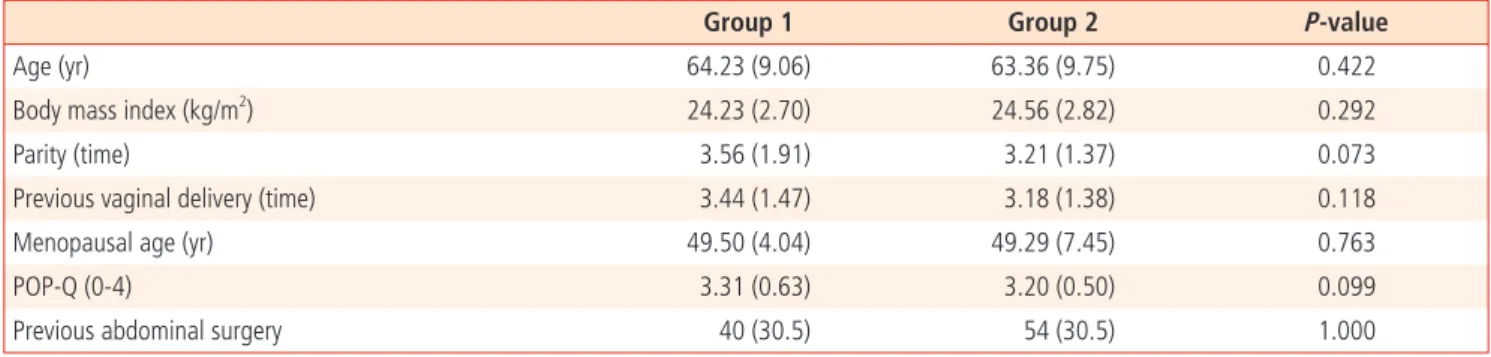
The mean age of the patients was 63.85 years (standard devia-
tion, 9.36). There was no signifi cant difference of basal character
istics between the two groups (Table 1).
1) Group 1
Group 1 was composed of 177 patients who were diagnosed with SUI by positive result of preoperative UDS and underwent anti‐
incontinence surgery at the time of POP surgery. The de novo rate of SUI was 1.7% (n = 3), the rate of UUI was 3.4% (n=6) and the rate of OAB was 9.6% (n = 17) (Table 2).
There were 2 patients (1.3%) that had postoperative urinary re- tention and only 1 patient had revision operation. There were 29 patients (16.8%) in group 1 who had immediate postoperative voiding diffi culty, but it was not statistically signifi cant compared with the 20 patients (15.4%) in group 2 ( P = 0.938). They recov- ered completely by foley catheter reinsertion, foley catheter train- ing, and medications and did not complain of any voiding diffi culty at discharge.
2) Group 2
Group 2 was composed of 131 patients who were not diagnosed with SUI by negative result of preoperative UDS and underwent POP surgery alone. The de novo rate of SUI was 3.1% (n = 4), the rate of UUI was 3.1% (n = 4) and the rate of OAB was 9.2%
(n = 12). The prevalence rate of de novo SUI was higher than that
of group 1, but there was no statistically significant difference compared with the result of group 1 (Table 2).
Also, there was no statistically signifi cant difference of UUI, OAB between the two groups. We compared 5 parameters of preopera- tive UDS (VLPP, MUCP, Qmax, PdetMax, MCC) to prove whether there was any significant difference between the two groups.
PdetMax was a statistically signifi cant parameter in postoperative de novo SUI (odds ratio [OR], 1.020; 95% confi dence interval [CI], 1.001-1.038; P = 0.034). And MUCP was a statistically signifi cant parameter in postoperative de novo UUI (OR, 0.969; 95% CI, 0.942-0.996; P = 0.023). The other parameters did not show any statistically signifi cant deference between the two groups (Table 3).
Discussion
In this study, the prevalence rate of postoperative de novo SUI in group 2 patients who had POP surgery alone was higher than that of group 1 patients who had concomitant surgery, but there was no statistically signifi cant difference. However, higher prevalence rate suggested that concomitant surgery could be related with postoperative de novo SUI.
Yuan et al. [12] reported that POP and SUI shared common patho- Table 1. Basal characteristics between group 1 and group 2
Group 1 Group 2 P-value
Age (yr) 64.23 (9.06) 63.36 (9.75) 0.422
Body mass index (kg/m
2) 24.23 (2.70) 24.56 (2.82) 0.292
Parity (time) 3.56 (1.91) 3.21 (1.37) 0.073
Previous vaginal delivery (time) 3.44 (1.47) 3.18 (1.38) 0.118
Menopausal age (yr) 49.50 (4.04) 49.29 (7.45) 0.763
POP-Q (0-4) 3.31 (0.63) 3.20 (0.50) 0.099
Previous abdominal surgery 40 (30.5) 54 (30.5) 1.000
Values are presented as mean ± standard deviation or number (%).
Pearson’s chi-square test or Fisher’s exact test were used.
POP-Q, pelvic organ prolapse quantifi cation.
Table 2. Postoperative de novo SUI, UUI, and OAB
Group 1 Group 2 P-value
SUI 3 (1.7) 4 (3.1) 0.464
UUI 6 (3.4) 4 (3.1) 1.000
OAB 17 (9.6) 12 (9.2) 1.000
Values are presented as number (%).
Pearson’s chi-square test or Fisher’s exact test were used.
SUI, stress urinary incontinence; UUI, urgency urinary incontinence; OAB, overactive bladder.
physiological etiologies and often coexisted with one another.
Then concomitant prophylactic anti‐incontinence measures should be taken at the time of POP repair to prevent the postoperative unmasking SUI. In other previous study, the preliminary results of TVT as a prophylactic procedure in clinically continent women with severe prolapse and occult SUI were encouraging. Long‐term follow‐up was required to confi rm the durability of these results [13]. The majority of the previous studies implied that concomitant prophylactic surgery caused better surgical outcomes.
In contrast, there was no statistically signifi cant difference of con- comitant surgery according to the study of Borstad et al. [14] but the prevalence of postoperative SUI was less in the group who had concomitant surgery than the group who had no concomitant surgery. However 27% (almost one third) of patients were cured of SUI by prolapse surgery alone, which meant that some preop- erative SUI could be corrected by only prolapse surgery.
Some studies showed although concomitant surgery was per- formed to prevent secondary surgery to repair incontinence, it caused postoperative side effects such as voiding diffi culty, blad- der outlet obstruction or OAB, so the effectiveness of concomitant surgery and the time of the surgery have been still controversial.
One study surveyed the literature to evaluate whether SUI surgery should be performed at the time of POP repair and a surgical al- gorithm was possible and reported their discussion on this topic at the Incontinence‐Research Society (ICI‐RS) meeting in 2010. Surgi- cal practice regarding SUI surgery at the time of POP repair varied widely and there was confl icting research articles that supported different approaches. Ongoing trials should provide more informa- tion to help construct better algorithms. And other approaches for designing prediction models for this problems might be useful [15].
According to Serati et al. [16], UDS should be considered manda- tory for women with POP, especially if scheduled for surgery, since misleading counseling could result in unpleasant and unexpected events. Moreover, in order to validate concomitant surgery on uri- nary outcomes, it is necessary to compare patients who was per-
formed concomitant surgery with those who was not, if patients were diagnosed as SUI befor surgery. As stated in the study of Latini and Kreder [4], and Reena et al. [5], since POP could mask SUI, SUI might not turn up on UDS, it was necessary to compare patients who had POP and performed concomitant surgery with those was performed only POP surgery regardless of SUI diagno- sis. However, since it is hard to fi nd out cases with not performing surgery when patients are diagnosed as SUI, we divided into two groups (one with concomitant surgery and the other with only POP surgery), and fi gured out the effectivity of concomitant opera- tion in both groups with and without postoperative complications.
Focused on the prevalence rate in this study, postoperative uri- nary outcomes occurred less frequently after concomitant surgery compared with POP surgery alone. But we have some limitations of this study, it were postoperative urinary outcomes based on only subjective symptoms patients had complained during follow‐
up and POP surgery not assorted. We included all kinds of POP surgery that might affect the surgical outcomes. Therefore we can draw a proper conclusion if we study to build more exact criteria of the postoperative urinary outcomes and with more patients classifi ed by each POP surgery.
Other doctors demonstrated that preoperatively 67.9% of the women in their study were found to have occult SUI in 78 con- secutive women were without any symptoms or signs of SUI. Also 64.2% of the women with a positive result to the preoperative Pyridium pad test after pessary insertion were found to have uri- nary incontinence postoperatively. Therefore preoperative testing is useful to identify women with genitourinary prolapse who have occult SUI and women with a positive result may need a system- atic clinical evaluation and urodynamic studies to characterize the incontinence [6].
Indeed, whether urodynamic evaluation has an impact on the choice of, or outcome of surgery still remains controversial. Many studies were conducted on the effectiveness of preoperative UDS parameters, and the patients who had higher preoperative MUCP Table 3. Postoperative de novo SUI, UUI, and OAB
VLPP MUCP Qmax PdetMax MCC
SUI 0.977 (0.977-1.004) 1.016 (0.994-1.038) 1.006 (0.953-1.063) 1.020 (1.001-1.038)
P<0.034 1.001 (0.993-1.009) UUI 1.001 (0.991-1.010) 0.969 (0.942-0.996)
P<0.023 1.026 (0.983-1.071) 1.006 (0.999-1.013) 1.003 (0.997-1.009) OAB 1.000 (0.994-1.006) 0.991 (0.977-1.005) 1.006 (0.977-1.037) 1.001 (0.993-1.009) 1.003 (0.999-1.006) Expressed as odds ratio (95% confi dence intervals) and P-value (if it was signifi cant).
Logistic regression analysis.
SUI, stress urinary incontinence; UUI, urgency urinary incontinence; OAB, overactive bladder; VLPP, valsalva leak point pressure; MUCP, maximal urethral
closing pressure; Qmax, maximal fl ow rates; PdetMax, detrusor pressure at maximal fl ow; MCC, maximal cystometric capacity.
caused better surgical outcomes. However there was another opinion, they insisted that preoperative UDS parameters were not related with postoperative urinary outcomes [17], and other studies had not shown any difference in surgical outcomes on preoperative UDS parameters [18,19]. And the predictive value of VLPP is inconsistent. Kilicarslan et al. [20] noted that high VLPP was associated with better outcomes, whereas other studies have failed to prove any impacts of preoperative leak point pressures on surgical outcomes [21,22]. Other Korean doctors showed pa- tients with preoperative Qmax<15 mL/sec had a tendency of post- operative voiding dysfunction [23]. Despite confl icting results of many studies, urodynamic study is suggested as the most accurate method for predicting surgical outcomes.
Thus, we compared parameters of preoperative UDS seemed to affect postoperative de novo SUI, UUI, and OAB. The result was that the patients who had postoperative SUI showed statistically higher PdetMax than those who did not and the patients who had postoperative UUI showed statistically lower MUCP than those who did not.
It was diffi cult to compare about this in each group, because pa- tients with postoperative complications were small in number. We compared preoperative parameters of UDS in patients who had postoperative SUI, UUI, OAB in any surgery. It would be signifi cant in that it was possible to see the preoperative parameters of UDS effective on postoperative complications.
This study has some limitations, we evaluated postoperative de novo SUI, UUI, and OAB based on only subjective symptoms of the patients, and we could not classify mixed form of incontinence and the patients who had symptoms of SUI, UUI, and OAB preopera- tively. On the other hand, the strengths of this study were that all surgeries were performed by the same operator and we compared patients with similar POP-quantifi cation stage.
The studies on this topic are ongoing, but still controversial be- cause anatomical defects that cause POP and SUI are so com- plicated and their etiologies are multifactorial. Therefore, it is diffi cult to predict surgical outcomes after repair operations. Even though we have some limitations in this study, the effectiveness of concomitant surgery definitely existed in comparison to the prevalence rate. In conclusion, we think more studies with various aspects, objective indicators are warranted to evaluate postopera- tive urinary outcomes. Also a larger number of patients should be included in future long‐term studies to objectively assess the effectiveness of parameters of preoperative UDS and validate con- comitant surgery.
References
1. Keyock KL, Newman DK. Understanding stress urinary inconti- nence. Nurse Pract 2011;36:24-36.
2. Boyles SH, Weber AM, Meyn L. Procedures for pelvic organ prolapse in the United States, 1979-1997. Am J Obstet Gyne- col 2003;188:108-15.
3. Luber KM, Boero S, Choe JY. The demographics of pelvic fl oor disorders: current observations and future projections. Am J Obstet Gynecol 2001;184:1496-501.
4. Latini JM, Kreder KJ Jr. Associated pelvic organ prolapse in women with stress urinary incontinence: when to operate?
Curr Opin Urol 2005;15:380-5.
5. Reena C, Kekre AN, Kekre N. Occult stress incontinence in women with pelvic organ prolapse. Int J Gynaecol Obstet 2007;97:31-4.
6. Richardson DA, Bent AE, Ostergard DR. The effect of utero- vaginal prolapse on urethrovesical pressure dynamics. Am J Obstet Gynecol 1983;146:901-5.
7. Bump RC, Fantl JA, Hurt WG. The mechanism of urinary conti- nence in women with severe uterovaginal prolapse: results of barrier studies. Obstet Gynecol 1988;72:291-5.
8. Bergman A, Koonings PP, Ballard CA. Predicting postopera- tive urinary incontinence development in women undergoing operation for genitourinary prolapse. Am J Obstet Gynecol 1988;158:1171-5.
9. Rosenzweig BA, Pushkin S, Blumenfeld D, Bhatia NN.
Prevalence of abnormal urodynamic test results in continent women with severe genitourinary prolapse. Obstet Gynecol 1992;79:539-42.
10. Chaikin DC, Groutz A, Blaivas JG. Predicting the need for anti- incontinence surgery in continent women undergoing repair of severe urogenital prolapse. J Urol 2000;163:531-4.
11. Sunwoo JK. Antiincontinence surgery during POP surgery. Ko- rean J Urogynecol 2011;14:147-50.
12. Yuan ZY, Dai Y, Chen Y, Wei Q, Shen H. Clinical study on con- comitant surgery for stress urinary incontinence and pelvic organ prolapse. Zhonghua Wai Ke Za Zhi 2008;46:1533-5.
13. Gordon D, Gold RS, Pauzner D, Lessing JB, Groutz A. Com- bined genitourinary prolapse repair and prophylactic tension- free vaginal tape in women with severe prolapse and occult stress urinary incontinence: preliminary results. Urology 2001;58:547-50.
14. Borstad E, Abdelnoor M, Staff AC, Kulseng-Hanssen S. Surgical
strategies for women with pelvic organ prolapse and urinary stress incontinence. Int Urogynecol J 2010;21:179-86.
15. Goldman HB. SUI surgery at the time of vaginal POP repair: is a surgical algorithm possible or desirable? Neurourol Urodyn 2011;30:758-61.
16. Serati M, Salvatore S, Siesto G, Cattoni E, Braga A, Sorice P, et al. Urinary symptoms and urodynamic fi ndings in women with pelvic organ prolapse: is there a correlation? Results of an artifi cial neural network analysis. Eur Urol 2011;60:253-60.
17. Harris N, Swithinbank L, Hayek SA, Yang Q, Abrams P. Can maximum urethral closure pressure (MUCP) be used to predict outcome of surgical treatment of stress urinary incontinence?
Neurourol Urodyn 2011;30:1609-12.
18. Meschia M, Pifarotti P, Buonaguidi A, Gattei U, Spennacchio M.
Tension-free vaginal tape (TVT) for treatment of stress urinary incontinence in women with low-pressure urethra. Eur J Ob- stet Gynecol Reprod Biol 2005;122:118-21.
19. Spinosa JP, Dubuis PY. Suburethral sling inserted by the tran- sobturator route in the treatment of female stress urinary incontinence: preliminary results in 117 cases. Eur J Obstet
Gynecol Reprod Biol 2005;123:212-7.
20. Kilicarslan H, Gokce G, Ayan S, Guvenal T, Kaya K, Gultekin EY.
Predictors of outcome after in situ anterior vaginal wall sling surgery. Int Urogynecol J Pelvic Floor Dysfunct 2003;14:339-41.
21. Costantini E, Lazzeri M, Giannantoni A, Bini V, Vianello A, Koc- jancic E, et al. Preoperative Valsalva leak point pressure may not predict outcome of mid-urethral slings. Analysis from a randomized controlled trial of retropubic versus transobturator mid-urethral slings. Int Braz J Urol 2008;34:73-81.
22. Kaplan SA, Te AE, Young GP, Andrade A, Cabelin MA, Ikegu- chi EF. Prospective analysis of 373 consecutive women with stress urinary incontinence treated with a vaginal wall sling: the Columbia-Cornell University experience. J Urol 2000;164:1623-7.
23. Cho ST, Song HC, Song HJ, Lee YG, Kim KK. Predictors of Post-
operative Voiding Dysfunction following Transobsturator Sling
Procedures in Patients with Stress Urinary Incontinence. Int
Neurourol J 2010;14:26-33.
골반장기탈출증 수술 전 시행하는 요역동학 검사에서 수술 후 결과에 영향을 미치는 유용한 지표와 동시 수술의 타당성: 후향적 코호트 연구
1연세대학교 의과대학 여성생명의과학연구소 산부인과학교실, 2연세대학교 의과대학 약리학교실 조주현1, 김수림1, 문여정2, 김세광1, 배상욱1
목적
본 연구는 골반장기탈출증을 가진 환자들의 수술 전에 시행하는 요역동학 검사에서 수술 후 결과 및 합병증과 관련된 유용한 지표를 알아 보고, 골반장기탈출증 교정술과 복압성 요실금교정술을 동시에 시행하는 경우 그 타당성을 입증하기 위한 목적으로 시행되었다.
연구방법
2006년 1월부터 2010년 12월까지 연세대학교 세브란스병원에 등록된 수술 전 요역동학 검사 및 골반장기탈출증 수술을 시행한 308명 의 환자를 대상으로 후향적 코호트 연구를 시행하였다.
결과
수술 후 복압성 요실금의 유병률은 수술 전 요역동학 검사상 복압성 요실금을 진단받지 않아 골반장기탈출증 수술만 시행한 그룹 2 (3.1%, 4명)에서 복압성 요실금을 진단받아 요실금교정 수술을 동시에 시행한 그룹 1 (1.7%, 3명)보다 높게 나타났으나 통계적으로 유의한 차이는 없었다. 우리는 valsalva 유발 요누출 시 복압, 최대요도 폐쇄압, 최대요속, 최대요속 시 배뇨근압력, 최대 방광용적의 5가지 요역동 학 검사 지표를 비교하였다. 수술 후 복압성 요실금에서는 최대요속 시 배뇨근압력(교차비, 1.029; 95% 신뢰구간, 1.001-1.038)이, 절박 성 요실금의 경우 최대요도 폐쇄압(교차비, 0.969; 95% 신뢰구간, 0.942-0.996)이 통계적으로 유의한 지표로 나타났다.
결론
수술 후 합병증의 유병률에 중점을 두면, 동시 수술은 골반장기탈출증 수술만 하는 경우보다 더 나은 결과를 나타내며 수술 전 요역동학 검사에서도 의미 있는 지표가 있어 그 시행이 필요하다.
중심단어: 요역동학 검사, 복압성 요실금, 골반장기탈출증, 수술적 치료