저항성 습성연령관련황반변성
Refractory Neovascular Age-related Macular Degeneration
마대중1, 유형곤1,2
Dae Joong Ma
1, Hyeong Gon Yu
1,21서울대학교 의과대학 안과학교실, 2서울대학교병원 의생명연구원 망막변성질환 연구소
1
Department of Ophthalmology, Seoul National University College of Medicine, Seoul, Korea
2
Retinal Degeneration Research Lab, Biomedical Research Institute, Seoul National University Hospital, Seoul, Korea
Refractory neovascular age-related macular degeneration (nAMD) is defined when intravitreal anti-vascular endothelial growth factor injection therapy results in poor response. Treatment of refractory patients determines the success or failure of treatment for nAMD. In this article, we present the definition and mechanism of refractory nAMD, and address various possible therapeutic approaches that can overcome refractoriness, such as switching drugs, increasing injection dosage or frequency, and combination therapy with photodynam- ic therapy or intravitreal steroid injection.
Keywords: Age-related macular degeneration; Choroidal neovascularization; Refractory; Vascular endothelial growth factor
서론
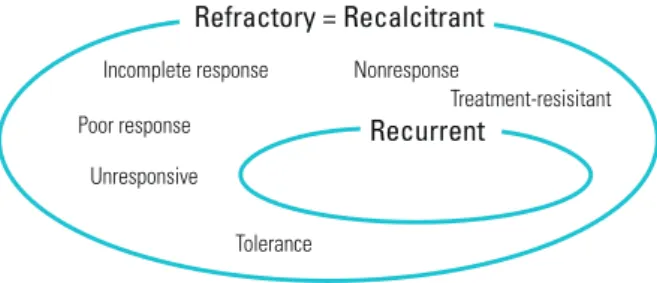
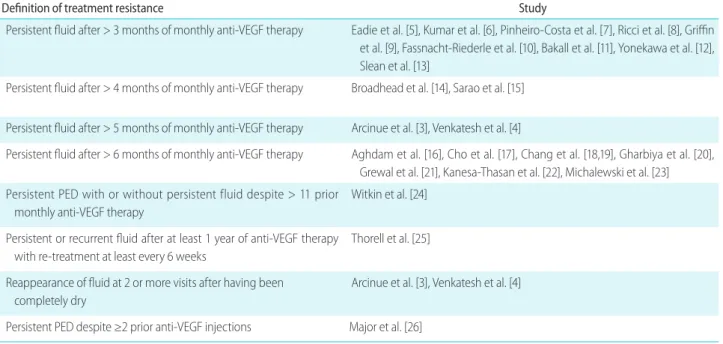
의학 분야에서 저항성(refractory)이라는 용어는 일반적으로 기 존 치료에 대한 반응이 좋지 않은 경우를 의미한다. 저항성 습성 연령관련황반변성이라는 용어는 습성연령관련황반변성의 표준 치료인 유리체강내 항혈관내피성장인자 주사치료에 잘 반응하 지 않은 환자를 식별하기 위하여 사용되고 있다(Fig. 1). 아직 통 일된 기준은 없지만 4주 내지 1개월 간격으로 초기 최소 3-6회 주사치료 후 망막하액 또는 망막내액이 지속될 때 일반적으로 저항성 습성연령관련황반변성이라고 한다(refractory, Table 1) [1- 26]. 또한 초기 최소 3회 주사치료 후 망막내액 및 망막하액이 모 두 소실되었으나, 이후 재발하여 2회 이상 망막내액 또는 망막 하액이 나타나는 경우를 저항성 습성연령관련황반변성에 포함 한다(recurrent) [3,4].
Address reprint requests to Hyeong Gon Yu, MD, PhD
Department of Ophthalmology, Seoul National University College of Medicine, #103 Daehak-ro, Jongno-gu, Seoul 03080, Korea
Tel: 82-2-2072-2438, Fax: 82-2-741-3187 E-mail: [email protected]
Received: 2017. 8. 10 Revised: 2017. 9. 16 Accepted: 2017. 9. 22
Figure 1. Various terms for treament resistance. Various terms are
used indiscriminately. Recurrence is included in the broad definition of treatment resistance.Refractory = Recalcitrant
Incomplete response Poor response
Unresponsive
Tolerance
Treatment-resisitant
Recurrent
Nonresponse
본론
저항성은 치료 과정 중 모든 시점에서 발생할 수 있으며[27], 또 한 다양한 원인에 의해서 발생할 수 있다(Fig. 2).
Age-related macular degeneration genetic risk variants
여러 연구에서 유전적 소인에 따라 항혈관내피성장인자의 치료 효과에 차이가 있음을 보고하였다[28-32]. 일부 유전적 소인은
신생혈관의 발생에 영향을 미칠 수 있는 염증의 정도와 연관이 있으며[33], 이는 신생혈관의 진행 및 재발에 영향을 미쳐 치료 효과의 감소를 유발할 수 있다[30].
Misdiagnosis
다른 습성나이관련황반변성의 아형과 달리 결절맥락막혈관 병증(polypoidal choroidal vasculopathy)의 발생기전에는 혈 관내피성장인자의 역할이 적으며, 이로 인하여 라니비주 맙(LucentisTM, Genentech, Inc., South San Francisco, CA, USA) 또는 베바시주맙(AvastinTM, Genentech, Inc., South San Francisco, CA, USA)에 더욱 저항성을 보인다[34,35]. Efficacy and safety of verteporfin photodynamic therapy in combination with ranibizumab or alone versus ranibizumab monotherapy in patients with symptomatic macular polypoidal choroidal vasculopathy (EVEREST) 연구에서는 라니비주맙으로 단독 치 료할 경우 광역학치료 단독 또는 광역학치료와 병합 치료할 경 우에 비하여 유의하게 결절의 완전 폐쇄율이 낮음이 보고되었 다[36]. 반면 애플리버셉트(EyleaTM, Bayer HealthCare, Berlin, Germany)는 단독치료 하더라도 유의한 장기적 치료효과가 있 음이 보고되었으며[37], 광역학치료와 병합 치료할 경우에 비 하여 시력개선 및 결절 폐쇄율에 차이가 없음이 보고된 바 있 다[38]. 따라서 결절맥락막혈관병증의 경우 1차 치료로 애플리 버셉트 또는 항혈관내피성장인자와 광역학치료의 병합 치료를
Table 1. Various definitions of treament resistance
Definition of treatment resistance Study
Persistent fluid after > 3 months of monthly anti-VEGF therapy Eadie et al. [5], Kumar et al. [6], Pinheiro-Costa et al. [7], Ricci et al. [8], Griffin et al. [9], Fassnacht-Riederle et al. [10], Bakall et al. [11], Yonekawa et al. [12], Slean et al. [13]
Persistent fluid after > 4 months of monthly anti-VEGF therapy Broadhead et al. [14], Sarao et al. [15]
Persistent fluid after > 5 months of monthly anti-VEGF therapy Arcinue et al. [3], Venkatesh et al. [4]
Persistent fluid after > 6 months of monthly anti-VEGF therapy Aghdam et al. [16], Cho et al. [17], Chang et al. [18,19], Gharbiya et al. [20], Grewal et al. [21], Kanesa-Thasan et al. [22], Michalewski et al. [23]
Persistent PED with or without persistent fluid despite > 11 prior monthly anti-VEGF therapy
Witkin et al. [24]
Persistent or recurrent fluid after at least 1 year of anti-VEGF therapy with re-treatment at least every 6 weeks
Thorell et al. [25]
Reappearance of fluid at 2 or more visits after having been completely dry
Arcinue et al. [3], Venkatesh et al. [4]
Persistent PED despite ≥2 prior anti-VEGF injections Major et al. [26]
VEGF = vascular endothelial growth factor; PED = pigment epithelial detachment.
Figure 2. A framework to show the causes of refractory neovascular
age-related macular degeneration (nAMD) and possible therapeutic approaches. A step-wise approach can be helpful in treating refrac- tory nAMD cases, first identify the mechanism of resistance and then try possible therapeutic approach accordingly.Genetic risk variants Misdiagnosis
Combination treatment Switch to other drugs
Increase treatment dosage or shorten treatment intervals Innate resistance
Tachyphylaxis Tolerance Undertreatment Refractory nAMD
선택하는 것이 저항성의 발생 예방에 도움이 될 것이며, 이를 위하여 초기 진단 시 인도시아닌그린 혈관조영술(indocyanine green angiography) 등을 이용하여 적극적으로 결절맥락막혈관 병증을 감별해 내는 것이 필요하다.
Innate resistance/tachyphylaxis/tolerance
선천적 내성(innate resistance)은 약물의 첫 투여부터 치료효과 가 불충분한 경우로 정의된다[39]. 속성내성(tachyphylaxis)은 단 기간 동안 반복적인 약물투여에 의하여 발생하는 치료효과의 감소로 약물의 용량을 증량하여도 치료효과가 증가하지 않으 나, 약물을 일정기간 중단할 경우 약효가 다시 증가할 수 있다 [40]. 반면 저항성(tolerance)은 시간의 경과에 따라 서서히 치료 효과가 감소하는 경우로 약 용량을 증가시키거나 치료 간격을 줄일 경우 약효가 다시 증가할 수 있으나, 약물을 일정기간 중 단한다고 해서 약효가 증가하지 않는다[41]. 하지만 임상적으로 속성내성과 저항성은 구분하기가 쉽지 않으며, 두 용어가 혼용 되어 사용되고 있다.Keane et al. [42]은 습성나이관련황반변성에서 라니비주맙 치 료 초기에 보였던 망막두께 및 망막하액의 감소가 시간경과에 따라 저하되는 것을 보고하였으며, 이는 라니비주맙에 대한 속 성내성에 의한 결과라 주장하였다. Forooghian et al. [43]은 베 바시주맙을 이용한 습성나이관련황반변성의 치료 시 10%에서 속성내성이 발생하였음을 보고하였으며, Eghøj and Sørensen [44]은 재발한 습성나이관련황반변성의 치료 시 약 2%에서 속 성내성이 발생하였다고 보고하였다. 이러한 속성내성은 빠르면 두 번째 유리체강내 항혈관내피성장인자 주사부터 발생하였으 나, 일반적으로 10회의 주사치료 이후에 발생하는 것으로 알려 져 있다[43,45-49].
습성나이관련황반변성에서 시간에 따라 항혈관내피성장인자 의 치료효과가 감소하는 메커니즘으로 ① 섬유화의 증가 및 혈 관벽의 변화를 포함하는 신생혈관막의 변화, ② 광수용체세포 또는 망막색소상피세포 등 인접한 조직의 변화, ③ 맥락막신생 혈관 내 대식세포의 증가로 인한 혈관내피성장인자 발현의 증 가, ④ 혈관내피성장인자 수용체의 증가, ⑤ 맥락막신생혈관의 증식을 유발하는 세포 내 신호전달경로의 변화 및 ⑥ 특정 항 혈관내피성장인자 약물에 대한 중화항체 발생 등이 있다[40].
특히 베바시주맙과 라니비주맙 모두 마우스 유래의 인간화 단 일클론항체이기 때문에 반복적인 치료로 인한 전신면역반응이 발생할 수 있다.
Undertreatment
Comparison of Age-Related Macular Degeneration Treatments Trials (CATT) 연구에서는 as-needed (pro-re-nata) 요법의 치 료효과가 fixed dosing 요법보다 열등하지 않음이 보고되었으나 [50], 일반적으로 as-needed 요법의 경우 저치료(undertreatment) 의 위험성이 높은 것으로 알려져 있다[51]. 여러 임상연구에서 as-needed 요법을 사용하더라도 1개월 간격의 평가를 수행하였 으나, 실제 임상현장에서는 이러한 평가스케줄이 지켜지기 어 려워 적절한 치료 시기를 놓치는 경우가 많다. 2015년 한국망 막학회 회원의 유리체 망막 질환에 대한 설문 조사에 따르면 국내 임상현장에서는 습성나이관련황반변성 치료의 68%에서 as-needed 요법을 사용하고 있었다[52].
저항성을 극복하기 위한 방법
저항성 환자에 습성연령관련황반변성 치료의 성패가 달려있다 고 할 수 있다. 여러 대규모 임상연구에서도 초기 치료에 잘 반
Figure 3. Switching from ranibizumab to other an-
ti-vascular endothelial growth factor drugs. Fundosco- py, fluorescein angiography (FA) and optical coherence tomography (OCT) findings of the right eye of a 67-year- old man. Visual acuity (VA) was 20/50 and choroidal neovascularization was observed in the macular area (A) with late-phase leakage on FA (B), and subretinal fluid (SRF) with pigment epithelial detachment (PED) on OCT (C). After five monthly intravitreal ranibizumab injections, SRF increased and VA decreased to 20/63 (D). Treatment was switched to aflibercept. After two monthly intravitreal aflibercept injections, SRF and PED decreased, and VA improved to 20/32 (E).A
B
C
E
D
응하지 않거나 자주 재발한 경우에 장기적인 시력 상실이 크게 나타나는 경우가 많았다[51]. Kim et al. [53]은 치료를 중단한 저항성 습성연령관련황반변성 환자를 24개월간 경과관찰하였 을 때 80%의 환자에서 3줄 이상의 시력 소실이 발생하였음을 보고하였다. 실제 임상에서도 정해진 치료 프로토콜에 잘 반응 하는 환자보다 이러한 저항성 환자가 문제가 된다.
저항성 습성연령관련황반변성에 대해서는 아직까지 정해진 표준 치료방침이 없는데, 치료반응이 불충분하다는 사유로 의 료보험 급여가 제한될 수도 있어서 환자와 의사 모두 괴로운 상 황이 된다. 다행히 저항성 습성연령관련황반변성의 치료에 대
해서 다양한 접근 방법이 시도되고 있으며, 긍정적인 연구 결과 가 최근 발표되고 있다. 저항성의 발생 기전을 파악하고, 그 기 전에 따른 치료 방법을 선택하는 것이 도움이 저항성의 극복에 도움이 될 것이다(Fig. 2)
Switch to other anti-vascular endothelial growth factor (anti-VEGF) drugs
먼저 특정 항혈관내피세포성장인자에 저항성을 보이는 습성연 령관련황반변성 환자에서 다른 항혈관내피세포성장인자 약제 로 전환을 고려할 수 있다. 애플리버셉트는 수용성 재조합 데코
Table 2. Clinical studies reported the outcome of switching to other anti-VEGF medication
Medication switch Study
Bevacizumab to ranibizumab Forooghian et al. [43], Kent et al. [55], Kaiser et al. [56], Ehlken et al. [57], Aslankurt et al. [58]
Ranibizumab to bevacizumab Gasperini et al. [49], Almony et al. [48], Kaiser et al. [56], Ehlken et al. [57], Aslankurt et al. [58]
Bevacizumab/ranibizumab to aflibercept Gharbiya et al. [20], Chang et al. [19], Yonekawa et al. [12], Grewal et al. [21], Bakall et al. [11], Kumar et al. [6], Fassnacht-Riederle et al. [10], Singh el al. [59], Ferrone et al. [60], Hall et al. [61], Messenger et al.
[62], Ho et al. [63], Heussen et al. [64], Cho et al. [17], Kim et al. [54]
VEGF = vascular endothelial growth factor.
Figure 4. Combination bevacizumab injection and photodynamic therapy. Fundoscopy, fluorescein angiography (FA), indocyanine green angi-
ography (ICGA) and optical coherence tomography (OCT) findings of the left eye of a 52-year-old woman. Visual acuity (VA) was 20/50 and sub- retinal fluid (SRF), hard exudates, and a reddish-orange nodule were observed in the temporal area from the fovea (A, D). FA and ICGA revealed typical polypoidal choroidal vasculopathy findings of a branching vascular network and polypoidal lesions (B, C). Despite six monthly intravitreal bevacizumab injections and three monthly ranibizumab injections, SRF and pigment epithelial detachment (PED) increased and VA decreased to 20/300 (E). Treatment was switched to a photodynamic therapy combined with intravitreal bevacizumab injection. After 1 month, SRF and PED had disappeared and VA was improved to 20/50 (F).A
D E F
B C
이(decoy) 혈관내피성장인자 수용체이다. 혈관내피세포성장인 자-A만 억제하는 베바시주맙 및 라니비주맙과는 달리 혈관내 피세포성장인자-B와 태반성장인자(placental growth factor)에 도 결합하여 더 높은 결합친화도를 보이므로, 베바시주맙과 라 니비주맙에 저항성을 보이는 습성연령관련황반변성에서 그 효 과를 기대해 볼 만하다(Fig. 3) [54].
Gasperini et al. [49]은 베바시주맙 또는 라니비주맙에 대한 속 성내성으로 인한 저항성을 보인 환자에서 라니비주맙과 베바시 주맙으로 각각 약제를 변경하였을 때 81%의 환자에서 치료에 반응하였음을 보고하였다. 이후 여러 연구에서도 저항성 습성 연령관련황반변성에서 약제 변경 후 시력과 망막두께 등이 개선 되었음이 보고되었다(Table 2) [6,10-12,17,19-21,43,48,49,54-64].
Increasing the concentration of the drug or the frequency of the injections
다음으로 항혈관내피세포성장인자의 용량을 늘리거나 주사간 격을 짧게 할 수 있다. Ricci et al. [8]은 습성연령관련황반변성 에서 애플리버셉트를 이용하여 as-needed 또는 fixed dosing 요 법을 시행한 결과를 비교하였을 때, fixed dosing 군에서 주사 횟수가 유의하게 많았으며 치료 12개월 후 시력 및 중심망막두 께가 우월함을 보고하였다. 또한 Kvannli and Krohn [65]은 베 바시주맙, 라니비주맙 또는 애플리버셉트의 as-needed 요법을 시행하였던 환자에서 treat-and-extend로 치료스케줄을 변경한 결과 유의한 시력개선 효과가 관찰되었음을 보고하였다. 따라서 as-needed 요법에 저항성을 보이는 습성연령관련황반변성 환자 의 경우 fixed dosing 또는 treat-and-extend로 치료스케줄을 변 경할 경우 유의한 치료효과를 기대해 볼 수 있겠다.
Super-dose anti-VEGF (SAVE) 연구는 라니비주맙 저항성 습 성연령관련황반변성 환자에서 라니비주맙의 용량을 0.5 mg에 서 2 mg으로 증가시켰을 때 유의한 시력 및 해부학적 개선이 나 타났다고 보고하였다[66]. 또한 Witkin et al. [24]은 라니비주맙 과 베바시주맙을 교대로 2주마다 주사함으로써 라니비주맙 또 는 베바시주맙의 1개월 간격 주사에 저항성을 보이는 습성연령 관련황반변성 환자에서 시력호전과 황반두께의 감소를 얻을 수 있었다. You et al. [67]은 4주 간격의 베바시주맙 또는 라니비 주맙 치료에 저항성을 보이는 습성연령관련황반변성 환자에서 애플리버셉트 2 mg을 8주 간격으로 주사, 이후 저항성을 보일 때 애플리버셉트 2 mg을 4주 간격으로 주사, 또한 저항성을 보 일 때 애플리버셉트 4 mg을 4주 간격으로 주사하는 단계적 치 료를 시행하였을 때 해부학적 호전 및 시력의 안정이 관찰되었 음을 보고하였다
Combination therapy
충분한 유리체강내 항혈관내피세포성장인자 주사에도 치료가 잘 안 되는 경우 광역학치료나 국소스테로이드 주사치료 등 다
른 치료 방법을 항혈관내피세포성장인자 주사와 병합하여 시 행할 수 있다.
Verteporfin (VisudyneTM, Novartis AG, Basel, Switzerland) 을 이용한 광역학치료는 몇 년 전까지 나이관련황반변성에 동 반된 맥락막신생혈관의 표준치료방법이었다[68]. 광역학치료는 verteporfin을 이용하여 광독성 효과로 맥락막혈관의 투과성 감소 및 구조변화를 일으켜 삼출을 막아 감각신경망막의 안정 화에 기여하는 것으로 알려져 있어[69], 항혈관내피세포성장인 자와 다른 작용기전을 통해 추가적인 치료효과를 기대해 볼 수 있다. 여러 연구에서 결절맥락막혈관병증에서 항혈관내피세포 성장인자 단독치료보다 광역학치료와 병합하여 치료하였을 때 치료효과가 뛰어남이 보고되었으며[70], 저항성 결절맥락막혈 관병증에서 구조요법으로 광역학치료를 사용하였을 때 유의한 치료 반응이 나타났다(Fig. 4) [35,71]. Tozer et al. [72]은 저항 성 습성연령관련황반변성에서 베바시주맙 또는 라니비주맙 유 리체강내주사 후 7일 이내에 광역학치료를 하여 유의한 시력호 전과 황반두께의 감소, 재치료 횟수의 감소를 얻을 수 있었다 고 보고하였다.
코르티코스테로이드(corticosteroid)는 항염증, 항신생혈관형성 (antiangiogenic) 그리고 항투과성(antipermeability)을 가지는 물 질로, 혈관-망막장벽(blood-retinal barrier)을 안정시키고 삼출 을 감소시키며 염증자극을 경감하는 것으로 알려져 있다. 또 한 염증 매개체의 유전자 발현 조절을 통하여 혈관내피성장 인자의 발현에도 영향을 미친다[73]. 이에 더하여 나이관련황 반변성의 신생혈관 발생에서 염증과 병행하는 대체 보체 연쇄 반응경로(alternative complement cascade)의 비정상적인 활성화 가 연관이 있는 것으로 알려지면서, 습성나이관련황반변성에 서 코르티코스테로이드의 활용에 대한 이론적인 근거가 확립 되었다[74]. 즉, 코르티코스테로이드는 항혈관내피세포성장인자 와 다른 기전을 통해 작용하므로 항혈관내피세포성장인자에 저항성을 보이는 습성나이관련황반변성에서도 효과를 기대해 볼 수 있다. Calvo et al. [75]은 라니비주맙에 대한 저항성 습성 연령관련황반변성 환자에서 유리체강내 덱사메타존 임플란트 (OzurdexTM, Allergan, Irvine, CA, USA) 삽입술을 함께 시행함 으로써 이후 라니비주맙 단독 주사에 더 좋은 해부학적 결과가 나타났음을 보고하였다. Sakai et al. [76]은 애플리버셉트에 저 항성을 보이는 결절맥락막혈관병증에서 테논낭하 트리암시놀 론 주입술을 시행하고 일주일 뒤 애플리버셉트와 광역학치료 의 병합치료를 시행하였을 때 시력 및 해부학적 개선효과가 있 었음을 보고하였다.
결론
현재 저항성 습성연령관련황반변성은 망막의사에게 큰 도전이
다. 저항성이라는 말 자체가 현재 치료의 한계를 의미한다고 할 수 있다. 아직까지 저항성 습성연령관련황반변성 환자에 대한 표준 치료방침이 없는 것도 의사와 환자 모두를 당황하게 한다.
하지만 최근의 연구들은 이러한 경우에도 좀 더 좋은 결과를 얻 을 수 있다는 희망을 준다. 따라서 일차 치료에 만족스럽지 못 한 결과가 나온 습성연령관련황반변성 환자에서도 여러 상황을 고려하면서 지속적인 치료를 하여야 한다. 앞으로 저항성 습성 연령관련황반변성에 대한 표준화된 치료 방법이 나와서 망막의 사와 환자 모두 당황하는 일이 없기를 기대해 본다.
Conflicts of interest
The authors have no conflicts to disclose.
References
1. Spooner K, Hong T, Wijeyakumar W, Chang AA. Switching to aflibercept among patients with treatment-resistant neovascu- lar age-related macular degeneration: a systematic review with meta-analysis. Clinical Ophthalmol 2017;11:161-77.
2. Lazzeri S, Ripandelli G, Sartini MS, et al. Aflibercept administra- tion in neovascular age-related macular degeneration refractory to previous anti-vascular endothelial growth factor drugs: a critical review and new possible approaches to move forward.
Angiogenesis 2015;18:397-432.
3. Arcinue CA, Ma F, Barteselli G, et al. One-year outcomes of aflibercept in recurrent or persistent neovascular age-related macular degeneration. Am J Ophthalmol 2015;159:426-36.e2.
4. Venkatesh R, Dave PA, Singh S, et al. Long-term results of pro re nata regimen of aflibercept treatment in persistent neovas- cular age-related macular degeneration. Am J Ophthalmol 2016;170:246-47.
5. Eadie JA, Gottlieb JL, Ip MS, et al. Response to aflibercept in patients with persistent exudation despite prior treatment with bevacizumab or ranibizumab for age-related macular degener- ation. Ophthalmic Surg Lasers Imaging Retina 2014;45:394-7.
6. Kumar N, Marsiglia M, Mrejen S, et al. Visual and anatomical outcomes of intravitreal aflibercept in eyes with persistent sub- foveal fluid despite previous treatments with ranibizumab in patients with neovascular age-related macular degeneration.
Retina 2013;33:1605-12.
7. Pinheiro-Costa J, Costa JM, Beato JN, et al. Switch to aflibercept in the treatment of neovascular AMD: one-year results in clinical practice. Ophthalmologica 2015;233:155-61.
8. Ricci F, Parravano M, Regine F, et al. Aflibercept in persistent neo-
vascular AMD: comparison of different treatment strategies in switching therapy. Eye (Lond) 2016;30:1077-83.
9. Griffin DR, Richmond PP, Olson JC. Intravitreal aflibercept outcomes in patients with persistent macular exudate pre- viously treated with bevacizumab and/or ranibizumab for neovascular age-related macular degeneration. J Ophthalmol 2014;2014:497178. doi: 10.1155/2014/497178. Epub 2014 Nov 20.
10. Fassnacht-Riederle H, Becker M, Graf N, Michels S. Effect of aflibercept in insufficient responders to prior anti-VEGF ther- apy in neovascular AMD. Graefes Arch Clin Exp Ophthalmol 2014;252:1705-9.
11. Bakall B, Folk JC, Boldt HC, et al. Aflibercept therapy for exuda- tive age-related macular degeneration resistant to bevacizumab and ranibizumab. Am J Ophthalmol 2013;156:15-22.e1.
12. Yonekawa Y, Andreoli C, Miller JB, et al. Conversion to aflibercept for chronic refractory or recurrent neovascular age-related mac- ular degeneration. Am J Ophthalmol 2013;156:29-35.e2.
13. Slean GR, Hemarat K, Khurana RN, Stewart JM. Conversion back to bevacizumab or ranibizumab for recurrent neovascular activ- ity with aflibercept in age-related macular degeneration: a case series. Int J Retina Vitreous 2016;2:2. doi: 10.1186/s40942-016- 0028-9. eCollection 2016.
14. Broadhead GK, Hong T, Zhu M, et al. Response of pigment ep- ithelial detachments to intravitreal aflibercept among patients with treatment-resistant neovascular age-related macular de- generation. Retina 2015;35:975-81.
15. Sarao V, Parravano M, Veritti D, et al. Intravitreal aflibercept for choroidal neovascularization due to age-related macular degeneration unresponsive to ranibizumab therapy. Retina 2016;36:770-7.
16. Aghdam KA, Pielen A, Framme C, Junker B. Visual and anatomic outcomes after conversion to aflibercept in neovascular age-re- lated macular degeneration: 12-month results. Eur J Ophthalmol 2016;26:473-8.
17. Cho H, Shah CP, Weber M, Heier JS. Aflibercept for exudative AMD with persistent fluid on ranibizumab and/or bevacizumab.
Br J Ophthalmol 2013;97:1032-5.
18. Chang AA, Broadhead GK, Hong T, et al. Intravitreal aflibercept for treatment-resistant neovascular age-related macular degen- eration: 12-month safety and efficacy outcomes. Ophthalmic Res 2015;55:84-90.
19. Chang AA, Li H, Broadhead GK, et al. Intravitreal aflibercept for treatment-resistant neovascular age-related macular degenera- tion. Ophthalmology 2014;121:188-92.
20. Gharbiya M, Iannetti L, Parisi F, et al. Visual and anatomical
outcomes of intravitreal aflibercept for treatment-resistant neovascular age-related macular degeneration. Biomed Res Int 2014;2014:273754. doi: 10.1155/2014/273754. Epub 2014 May 7.
21. Grewal DS, Gill MK, Sarezky D, et al. Visual and anatomical out- comes following intravitreal aflibercept in eyes with recalcitrant neovascular age-related macular degeneration: 12-month re- sults. Eye (Lond) 2014;28:895-9.
22. Kanesa-Thasan A, Grewal DS, Gill MK, et al. Quantification of change in pigment epithelial detachment volume and mor- phology after transition to intravitreal aflibercept in eyes with recalcitrant neovascular AMD: 18-month results. Ophthalmic Surg Lasers Imaging Retina 2015;46:638-41.
23. Michalewski J, Nawrocki J, Trębińska M, Michalewska Z. Switch to a single dose of aflibercept in bevacizumab nonresponders with AMD. Can J Ophthalmol 2014;49:431-5.
24. Witkin AJ, Rayess N, Garg SJ, et al. Alternating bi-weekly intrav- itreal ranibizumab and bevacizumab for refractory neovascular age-related macular degeneration with pigment epithelial de- tachment. Semin Ophthalmol 2017;32:309-15.
25. Thorell MR, Nunes RP, Chen GW, et al. Response to aflibercept after frequent re-treatment with bevacizumab or ranibizumab in eyes with neovascular AMD. Ophthalmic Surg Lasers Imaging Retina 2014;45:526-33.
26. Major JC Jr, Wykoff CC, Croft DE, et al. Aflibercept for pigment epithelial detachment for previously treated neovascular age-re- lated macular degeneration. Can J Ophthalmol 2015;50:373-7.
27. Broadhead GK, Hong T, Chang AA. Treating the untreatable patient: current options for the management of treatment‐
resistant neovascular age‐related macular degeneration. Acta Ophthalmol 2014;92:713-23.
28. Park UC, Shin JY, McCarthy LC, et al. Pharmacogenetic associ- ations with long-term response to anti-vascular endothelial growth factor treatment in neovascular AMD patients. Mol Vis 2014;20:1680-94. eCollection 2014.
29. Chen H, Yu KD, Xu GZ. Association between variant Y402H in age-related macular degeneration (AMD) susceptibility gene CFH and treatment response of AMD: a meta-analysis. PLoS One 2012;7:e42464. doi: 10.1371/journal.pone.0042464. Epub 2012 Aug 14.
30. Lee AY, Raya AK, Kymes SM, et al. Pharmacogenetics of comple- ment factor H (Y402H) and treatment of exudative age-related macular degeneration with ranibizumab. Br J Ophthalmol 2009;93:610-3.
31. Abedi F, Wickremasinghe S, Richardson AJ, et al. Genetic influ- ences on the outcome of anti-vascular endothelial growth fac-
tor treatment in neovascular age-related macular degeneration.
Ophthalmology 2013;120:1641-8.
32. Hu Z, Xie P, Ding Y, et al. Association between variants A69S in ARMS2 gene and response to treatment of exudative AMD: a meta-analysis. Br J Ophthalmol 2015;99:593-8. doi: 10.1136/bjop- hthalmol-2014-305488. Epub 2014 Sep 2.
33. Campa C, Costagliola C, Incorvaia C, et al. Inflammatory medi- ators and angiogenic factors in choroidal neovascularization:
pathogenetic interactions and therapeutic implications. Medi- ators Inflamm 2010;2010. pii: 546826. doi: 10.1155/2010/546826.
Epub 2010 Aug 25.
34. Wong CW, Wong TY, Cheung CM. Polypoidal choroidal vascu- lopathy in Asians. J Clin Med 2015;4:782-821.
35. Cho M, Barbazetto IA, Freund KB. Refractory neovascular age-re- lated macular degeneration secondary to polypoidal choroidal vasculopathy. Am J Ophthalmol 2009;148:70-8.e1.
36. Koh A, Lee WK, Chen LJ, et al. EVEREST study: efficacy and safety of verteporfin photodynamic therapy in combination with ran- ibizumab or alone versus ranibizumab monotherapy in patients with symptomatic macular polypoidal choroidal vasculopathy.
Retina 2012;32:1453-64.
37. Maruyama-Inoue M, Sato S, Yamane S, Kadonosono K. Intravit- real injection of aflibercept in patients with polypoidal choroi- dal vasculopathy: a 3-year follow-up. Retina 2017 Aug 14. doi:
10.1097/IAE.0000000000001818. [Epub ahead of print]
38. Kikushima W, Sakurada Y, Sugiyama A, et al. Comparison of ini- tial treatment between 3-monthly intravitreal aflibercept mono- therapy and combined photodynamic therapy with single intravitreal aflibercept for polypoidal choroidal vasculopathy.
Graefes Arch Clin Exp Ophthalmol 2017;255:311-6.
39. Tranos P, Vacalis A, Asteriadis S, et al. Resistance to antivascular endothelial growth factor treatment in age-related macular de- generation. Drug Des Devel Ther 2013;7:485-90.
40. Binder S. Loss of reactivity in intravitreal anti-VEGF therapy:
tachyphylaxis or tolerance?. Br J Ophthalmol 2012;96:1-2.
41. Westfall TC, Westfall DP. Neurotransmission: The Autonomic and Somatic Motor Nervous Systems. In: Brunton LL, Chabner BA, Knollman B, eds. Goodman and Gilman’s The Pharmacological Basis of Therapeutics, 12th ed. New York: McGraw-Hill Educa- tion, 2011; chap. 8.
42. Keane PA, Liakopoulos S, Ongchin SC, et al. Quantitative sub- analysis of optical coherence tomography after treatment with ranibizumab for neovascular age-related macular degeneration.
Invest Ophthalmol Vis Sci 2008;49:3115-20.
43. Forooghian F, Cukras C, Meyerle CB, et al. Tachyphylaxis after
intravitreal bevacizumab for exudative age-related macular de- generation. Retina 2009;29:723-31.
44. Eghøj MS, Sørensen TL. Tachyphylaxis during treatment of exu- dative age-related macular degeneration with ranibizumab. Br J Ophthalmol 2012;96:21-3.
45. Schaal S, Kaplan HJ, Tezel TH. Is there tachyphylaxis to intrav- itreal anti-vascular endothelial growth factor pharmacother- apy in age-related macular degeneration? Ophthalmology 2008;115:2199-205.
46. Falavarjani KG, Modarres M. Bevacizumab tachyphylaxis. Oph- thalmology 2009;116:1016-7; author reply 1017. doi: 10.1016/
j.ophtha.2009.01.029.
47. Avgikos KN, Horgan SE, Sivaraj RR, Hu K. Tachyphylaxis and bev- acizumab. Ophthalmology 2009;116:1831-2; author reply 1832.
doi: 10.1016/j.ophtha.2009.03.040.
48. Almony A, Mansouri A, Shah GK, Blinder KJ. Efficacy of intravit- real bevacizumab after unresponsive treatment with intravitreal ranibizumab. Can J Ophthalmol 2011;46:182-5.
49. Gasperini JL, Fawzi AA, Khondkaryan A, et al. Bevacizumab and ranibizumab tachyphylaxis in the treatment of choroidal neo- vascularisation. Br J Ophthalmol 2012;96:14-20.
50. CATT Research Group, Martin DF, Maguire MG, et al. Ranibi- zumab and bevacizumab for neovascular age-related macular degeneration. N Engl J Med 2011;364:1897-908.
51. Amoaku WM, Chakravarthy U, Gale R, et al. Defining response to anti-VEGF therapies in neovascular AMD. Eye (Lond) 2015;29:721- 31.
52. Lee JY, Moon BG, Kim M, et al. Results of the 2015 question- naire survey of the Korean Retina Society: current trends in the treatment of vitreoretinal diseases. J Korean Ophthalmol Soc 2016;57:1071-9.
53. Kim JH, Chang YS, Kim JW. Natural course of patients discon- tinuing treatment for age-related macular degeneration and factors associated with visual prognosis. Retina 2017 Jan 13. doi:
10.1097/IAE.0000000000001494. [Epub ahead of print]
54. Kim JH, Cho NC, Kim WJ. Intravitreal aflibercept for neovascular age-related macular degeneration resistant to bevacizumab and ranibizumab. J Korean Ophthalmol Soc 2015;56:1359-64.
55. Kent JS, Iordanous Y, Mao A, et al. Comparison of outcomes after switching treatment from intravitreal bevacizumab to ranibi- zumab in neovascular age-related macular degeneration. Can J Ophthalmol 2012;47:159-64.
56. Kaiser RS, Gupta OP, Regillo CD, et al. Ranibizumab for eyes previously treated with pegaptanib or bevacizumab without clinical response. Ophthalmic Surg Lasers Imaging 2012;43:13-9.
57. Ehlken C, Jungmann S, Böhringer D, et al. Switch of anti-VEGF agents is an option for nonresponders in the treatment of AMD.
Eye (Lond) 2014;28:538-45.
58. Aslankurt M, Aslan L, Aksoy A, et al. The results of switching be- tween 2 anti-VEGF drugs, bevacizumab and ranibizumab, in the treatment of neovascular age-related macular degeneration.
Eur J Ophthalmol 2013;23:553-7.
59. Singh RP, Srivastava S, Ehlers JP, et al. A single-arm, investiga- tor-initiated study of the efficacy, safety and tolerability of intra- vitreal aflibercept injection in subjects with exudative age-relat- ed macular degeneration, previously treated with ranibizumab or bevacizumab: 6-month interim analysis. Br J Ophthalmol 2014;98 Suppl 1:i22-7. doi: 10.1136/bjophthalmol-2013-304798.
60. Ferrone PJ, Anwar F, Naysan J, et al. Early initial clinical experi- ence with intravitreal aflibercept for wet age-related macular degeneration. Br J Ophthalmol 2014;98 Suppl 1:i17-21. doi:
10.1136/bjophthalmol-2013-304474. Epub 2014 May 2.
61. Hall LB, Zebardast N, Huang JJ, Adelman RA. Aflibercept in the treatment of neovascular age-related macular degeneration in previously treated patients. J Ocul Pharmacol Ther 2014;30:346- 52.
62. Messenger WB, Campbell JP, Faridi A, et al. Injection frequency and anatomic outcomes 1 year following conversion to afliber- cept in patients with neovascular age-related macular degener- ation. Br J Ophthalmol 2014;98:1205-7.
63. Ho VY, Yeh S, Olsen TW, et al. Short-term outcomes of afliber- cept for neovascular age-related macular degeneration in eyes previously treated with other vascular endothelial growth factor inhibitors. Am J Ophthalmol 2013;156:23-8.e2.
64. Heussen FM, Shao Q, Ouyang Y, et al. Clinical outcomes after switching treatment from intravitreal ranibizumab to aflibercept in neovascular age-related macular degeneration. Graefes Arch Clin Exp Ophthalmol 2014;252:909-15.
65. Kvannli L, Krohn J. Switching from pro re nata to treat‐and‐
extend regimen improves visual acuity in patients with neovas- cular age‐related macular degeneration. Acta Ophthalmol 2017 Jan 31. doi: 10.1111/aos.13356. [Epub ahead of print]
66. Brown DM, Chen E, Mariani A, et al. Super-dose anti-VEGF (SAVE) Trial: 2.0 mg intravitreal ranibizumab for recalcitrant neovascular macular degeneration–primary end point. Ophthalmology 2013;120:349-54.
67. You QS, Gaber R, Meshi A, et al. High-dose high-frequency af- libercept for recalcitrant neovascular age-related macular degen- eration. Retina 2017 Jun 9. doi: 10.1097/IAE.0000000000001726.
[Epub ahead of print]
68. Verteporfin In Photodynamic Therapy Study Group. Verteporfin therapy of subfoveal choroidal neovascularization in age-re- lated macular degeneration: two-year results of a randomized clinical trial including lesions with occult with no classic choroi- dal neovascularization—verteporfin in photodynamic therapy report 2. Am J Ophthalmol 2001;131:541-60.
69. Kawczyk-Krupka A, Bugaj A, Potempa M, et al. Vascular-targeted photodynamic therapy in the treatment of neovascular age-re- lated macular degeneration: clinical perspectives. Photodiagno- sis Photodyn Ther 2015;12:161-75.
70. Han LH, Yuan LF, Liang X, et al. Combined therapy versus an- ti-vascular endothelial growth factor monotherapy for polyp- oidal choroidal vasculopathy: a Meta-analysis. Int J Ophthalmol 2017;10:1280-9.
71. Lee JH, Lee WK. Anti-vascular endothelial growth factor mono- therapy for polypoidal choroidal vasculopathy with polyps resembling grape clusters. Graefes Arch Clin Exp Ophthalmol 2016;254:645-51.
72. Tozer K, Roller AB, Chong LP, et al. Combination therapy for neovascular age-related macular degeneration refractory to
anti-vascular endothelial growth factor agents. Ophthalmology 2013;120:2029-34.
73. Sarao V, Veritti D, Boscia F, Lanzetta P. Intravitreal steroids for the treatment of retinal diseases. ScientificWorldJournal 2014;2014:989501. doi: 10.1155/2014/989501. eCollection 2014.
74. Charbel Issa P, Chong NV, Scholl HP. The significance of the complement system for the pathogenesis of age-related macu- lar degeneration - current evidence and translation into clinical application. Graefes Arch Clin Exp Ophthalmol 2011;249:163-74.
75. Calvo P, Ferreras A, Al Adel F, et al. Dexamethasone intravitreal implant as adjunct therapy for patients with wet age-related macular degeneration with incomplete response to ranibi- zumab. Br J Ophthalmol 2015;99:723-6. doi: 10.1136/bjophthal- mol-2014-305684. Epub 2014 Nov 25.
76. Sakai T, Kato N, Kubota M, Tsuneoka H. Effects of photodynamic therapy plus intravitreal aflibercept with subtenon triamcino- lone injections for aflibercept-resistant polypoidal choroidal vasculopathy. Graefes Arch Clin Exp Ophthalmol 2017;255:1565- 71.
저항성 습성연령관련황반변성
저항성 습성연령관련황반변성은 유리체강내 항혈관내피성장인자 주사치료에 잘 반응하지 않은 경우를 말하는데, 이러한 저항성 환자에 따라서 습성연령관련황반변성 치료의 성패가 달려있다. 본 논문에서는 저항성 습성연령관련황반변성의 정의와 원인 그리고 현재 시도되 고 있는 여러 치료방법에 대해서 고찰하고자 한다. 치료약물의 변경, 약물용량 또는 치료빈도의 증가, 광역학치료 또는 유리체강내 스테 로이드 주사와 항혈관내피성장인자 주입술을 병합하는 방법 등 저항성 습성연령관련황반변성을 극복할 수 있는 다양한 방법을 소개한다.
국문초록