• 검색 결과가 없습니다.

Public perception of risk-reducing salpingectomy for preventing ovarian cancer

N/A
N/A
Protected

Academic year: 2022

Share "Public perception of risk-reducing salpingectomy for preventing ovarian cancer"

Copied!
5
0
0

로드 중.... (전체 텍스트 보기)

전체 글

(1)

http://dx.doi.org/10.5468/ogs.2015.58.4.284 pISSN 2287-8572 · eISSN 2287-8580

Introduction

Ovarian cancer is the most fatal gynecologic malignancy, and it is the eighth leading cause of cancer death among Korean women [1,2]. More than two-thirds of ovarian cancers are detected at an advanced stage, when the ovarian cancer cells have spread far away from the ovarian surface and metastasized without specific symptoms in the patient [3].

Consequently, ovarian cancer is usually treated when it is at an advanced stage and the treatment outcome is very poor [4,5]. Therefore, prevention of ovarian cancer is very impor- tant. However, unfortunately, a reliable method for preventing ovarian cancer has not yet been developed [6,7].

Many theories have been proposed with respect to the cells of origin and mechanisms of carcinogenesis of ovarian cancer [8-12]. Recently, evidences from various studies suggest that the fallopian tube contributes to the development of ovarian

cancer [13,14]. Many gynecologic oncologists recommend pro- phylactic salpingectomy or risk-reducing salpingectomy (RRS), as a novel prevention strategy, at the time of intra-abdominal surgeries such as hysterectomy or tubal ligation in women at average risk for ovarian cancer. Considering that RRS can pre-

Public perception of risk-reducing salpingectomy for preventing ovarian cancer

Jun Hyeok Kang, Se Hyun Nam, Taejong Song, Woo Young Kim, Kyo Won Lee, Kye Hyun Kim

Department of Obstetrics and Gynecology, Kangbuk Samsung Hospital, Sungkyunkwan University School of Medicine, Seoul, Korea

Objective

The fallopian tube is considered as the site of origin of serous ovarian cancer, and risk-reducing salpingectomy (RRS) has been proposed as a new and safe strategy for preventing ovarian cancer. However, little is known about the public perception of RRS.

Methods

We performed a questionnaire survey of 100 healthy female volunteers in November 2014. Questionnaire for this survey included questions on demographics, medical history, knowledge of and belief about RRS, and barrier to its application.

Results

Among 100 respondents, 71% did not realize the seriousness of ovarian cancer, 79% were unaware of the fact that salpinx was the origin of ovarian cancer, and 87% stated that they had never heard of RRS as a preventive method for ovarian cancer. Also, 98% of respondents replied that they had the right to be informed about RRS and the choice given. The respondents’ fears about RRS included increased risk of surgical complications (68%), no benefit (8%), and increased surgical costs (3%).

Conclusion

Most general women were unaware of RRS as a method for preventing ovarian cancer in women at average risk.

Therefore, physicians should discuss RRS with patients and consider this procedure at the time of abdominal or pelvic surgery.

Keywords: Data collection; Ovarian neoplasms; Public perception; Risk-reducing salpingectomy

Received: 2014.12.13. Revised: 2015.1.11. Accepted: 2015.1.13.

Corresponding author: Kye Hyun Kim

Department of Obstetrics and Gynecology, Kangbuk Samsung Hospital, Sungkyunkwan University School of Medicine, 29 Saemunan-ro, Jongno-gu, Seoul 110-746, Korea Tel: +82-2-2001-2457 Fax: +82-2-2001-2187 E-mail: [email protected]

Articles published in Obstet Gynecol Sci are open-access, distributed under the terms of the Creative Commons Attribution Non-Commercial License (http://creativecommons.

org/licenses/by-nc/3.0/) which permits unrestricted non-commercial use, distribution, and reproduction in any medium, provided the original work is properly cited.

Copyright © 2015 Korean Society of Obstetrics and Gynecology

(2)

vent ovarian cancer, it is very important to inform the general female population that ovarian cancer is very fatal and RRS is the best way to prevent ovarian cancer. However, to the best of our knowledge, there is no study assessing the perception of the general female population about RRS.

Therefore, we performed a survey to determine the public per- ception and preference for RRS, to identify barriers to performing RRS among women, and to assess the need for providing informa- tion about RRS to the patients with average risk for ovarian cancer.

Materials and methods

After receiving approval from the institutional review board of Kangbuk Samsung Hospital (Seoul, Korea), we conducted a questionnaire survey of 100 general women who visited our center for a health check-up for evaluating the public per- ception about RRS in November 2014. Survey questionnaire included questions on respondent demographics, medical history, knowledge of and belief about RRS, and barriers to its application. Each question in the survey had a high content validity (content validity index, 0.8 to 1.0)

The sample size was calculated on the basis of a pilot survey of 20 guardians of patients who visited our center, in which the perception rate of RRS as a preventive method for ovarian cancer was 20% (4 out of 20 women). We assumed that the public perception rate was similar to the result of the pilot sur- vey. After setting the type 1 error and tolerance at 5% and 8%, respectively, and allowing a 3% dropout rate, the sample size required was 100 respondents.

Data retrieved from survey responses were analyzed using descriptive statistics. SPSS ver. 13.0 (SPSS Inc., Chicago, IL, USA) was used for all statistical analyses. Qualitative data are presented as frequency (percentage). In cases of quantita- tive variables, after the normality of the data was checked, mean±standard deviation and median (range) were used to describe normal and non-normal distribution, respectively.

Results

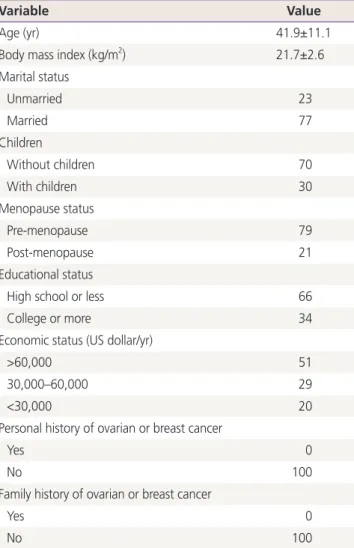
Of the total 100 women who were enrolled in this study, all of the women completed the questionnaire. The demo- graphics of respondents are shown in Table 1. The mean age of patients was 41.9 years (standard deviation, 11.1 years)

and the mean body mass index was 21.7±2.6. None of the respondents had a personal or familial history of ovarian or breast cancer. Therefore, our study population compromised of women at average risk of ovarian cancer.

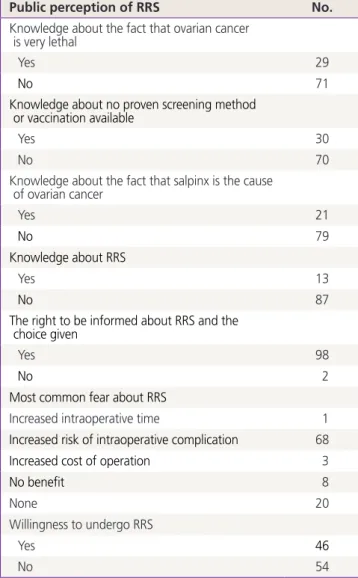
Table 2 presents the public perception of RRS. A consider- able number of females (71%) had no knowledge about risk of ovarian cancer. Seventy respondents (70%) did not know that there was no proven screening method or vaccination available for women at average risk of ovarian cancer to date.

Seventy-nine respondents (79%) did not know that salpinx was the origin of ovarian cancer. Also, eighty-seven respon- dents stated that they had never heard of RRS as a preventive method for ovarian cancer. When asked whether they had the right to be informed about RRS and choice given, 98% of re- spondents replied ‘yes.’ The questionnaire included a question

Table 1. Baseline demographics

Variable Value

Age (yr) 41.9±11.1

Body mass index (kg/m

2

) 21.7±2.6

Marital status

Unmarried 23

Married 77

Children

Without children 70

With children 30

Menopause status

Pre-menopause 79

Post-menopause 21

Educational status

High school or less 66

College or more 34

Economic status (US dollar/yr)

>60,000 51

30,000–60,000 29

<30,000 20

Personal history of ovarian or breast cancer

Yes 0

No 100

Family history of ovarian or breast cancer

Yes 0

No 100

Data are presented as means±standard deviation for continuous

variables or fre quencies (percentages) for categorical variables.

(3)

on the most common fear about RRS among participants, to which most women answered ‘increased risk of intraopera- tive complications’ (68%), ‘no benefit from RRS’ (8%), or ‘in- creased cost of operation’ (3%). With respect to willingness to undergo RRS at the time of intra-abdominal surgeries, 46% of respondents replied ‘yes’ and 54% of respondents replied ‘no.’

Discussion

In this study, we found that majority of respondents (87%) had no information about RRS as a preventive method for ovarian cancer. We also found that 98% of respondents wanted to be informed about the need and efficacy of RRS by

the physicians if they received gynecologic surgeries. There- fore, physicians should inform the patients about RRS and should provide them their right of choice at the time of intra- abdominal or pelvic surgeries such as hysterectomy, myomec- tomy or appendectomy. To the best of our knowledge, this is the first study to assess the public perception of RRS.

Serous carcinomas are the most common histologic subtype accounting for 75% to 80% of epithelial ovarian cancers, and they are also found in the fallopian tube and primary peritoneal carcinoma [15-17]. Recent studies suggest that the fimbriae of the fallopian tube, not the ovary as believed previously, may play a critical role in the origin of serous ovar- ian cancer [13,14,17]. Therefore, prophylactic salpingectomy, performed at the time of intra-abdominal surgery with ovary preservation, has been proposed as a new and safe strategy to prevent ovarian cancer. Falconer conducted a retrospective, population-based cohort study of women who had previ- ously undergone sterilization; salpingectomy; hysterectomy and bilateral salpingo-oophorectomy; or hysterectomy for a benign indication between 1972 and 2010 in Sweden [18].

They found that women who had undergone unilateral sal- pingectomy had a 28% lower risk of ovarian cancer, while those who had undergone bilateral salpingectomy had a 65%

lower risk, compared with the general population. Moreover, the Society of Gynecologic Oncology (November 2013) an- nounced that in women at average risk of ovarian cancer, RRS should also be discussed and considered with patients at the time of abdominal or pelvic surgery such as hysterectomy or tubal ligation [19]. Although we are not suggesting RRS to be performed alone without concomitant surgery for preventing the future ovarian cancer in general population with average risk for ovarian cancer, we now recommend performing RRS in all of the patients who undergo any gynecologic surgeries if they do not have a plan for further pregnancy.

In this study, most of the respondents (88%) understood the importance of RRS, but only half of them (46%) wanted to receive RRS when they would undergo abdominal or pelvic surgery, hysterectomy or in lieu of tubal ligation. The reasons for this discrepancy were thought to be that they had a little insight into ovarian cancer; more than two-thirds of ovarian cancers are detected at an advanced stage, and it is the most fatal gynecologic malignancy. Moreover, they had a fear of intraoperative complications due to the additional operation and concern regarding the increased cost of operation. A fur- ther study is needed to determine the complications of RRS.

Table 2. Public perception of RRS

Public perception of RRS No.

Knowledge about the fact that ovarian cancer is very lethal

Yes 29

No 71

Knowledge about no proven screening method or vaccination available

Yes 30

No 70

Knowledge about the fact that salpinx is the cause of ovarian cancer

Yes 21

No 79

Knowledge about RRS

Yes 13

No 87

The right to be informed about RRS and the choice given

Yes 98

No 2

Most common fear about RRS

Increased intraoperative time 1

Increased risk of intraoperative complication 68

Increased cost of operation 3

No benefit 8

None 20

Willingness to undergo RRS

Yes 46

No 54

RRS, risk-reducing surgery

(4)

All of the respondents replied that they want to receive complete information on how dangerous the ovarian cancer is and what RRS is. This result suggests that physicians should inform the patients about this new strategy and should pro- vide them their right of choice. In cases of risk-reducing mas- tectomy, clinical recommendation by physicians was successful in approximately 60% of at risk-women undergoing surgery by 60 years of age [20,21]. Likewise, we believe that the per- ception of RRS will be increase by imparting education to the patients.

Limitations of this study include the following. First, we had a relatively small number of study participants, although it was based on the sample size calculation. Second, our study popu- lation included Korean women who were living in an urban area, and the results may not be applicable to other popula- tions. Finally, there was lack of objective tools for assessing public perception of RRS.

In conclusion, although surgical removal of the fallopian tubes could be a viable option for reducing the risk of ovar- ian cancer, most respondents (87%) were not aware of RRS.

This study suggests that physicians should discuss RRS with patients and consider this procedure at the time of abdominal or pelvic surgery, hysterectomy or in lieu of tubal ligation. A further study is needed to assess the true impact of this proce- dure on the incidence of ovarian cancer in a large population, as well as its incremental impact on surgical morbidity, opera- tive time, and cost, because these issues have been identified as significant barriers to performing RRS in this study.

Conflict of interest

No potential conflict of interest relevant to this article was reported.

References

1. Jung KW, Won YJ, Kong HJ, Oh CM, Lee DH, Lee JS. Can- cer statistics in Korea: incidence, mortality, survival, and prevalence in 2011. Cancer Res Treat 2014;46:109-23.

2. Yun JH, Lee HY, Park HW, Shin JW, Lee JM, Park CY. The analysis of prognostic factors in patients with epithelial ovarian cancer. Korean J Obstet Gynecol 2006;49:566-71.

3. Goff BA, Mandel L, Muntz HG, Melancon CH. Ovarian

carcinoma diagnosis. Cancer 2000;89:2068-75.

4. Lurie G, Wilkens LR, Thompson PJ, Matsuno RK, Carney ME, Goodman MT. Symptom presentation in invasive ovarian carcinoma by tumor histological type and grade in a multiethnic population: a case analysis. Gynecol Oncol 2010;119:278-84.

5. Friedlander ML. Prognostic factors in ovarian cancer. Se- min Oncol 1998;25:305-14.

6. Rodriguez-Ayala G, Romaguera J, Lopez M, Ortiz AP. Ovarian cancer screening practices of obstetri- cians and gynecologists in puerto rico. Biomed Res Int 2014;2014:920915.

7. Buys SS, Partridge E, Black A, Johnson CC, Lamerato L, Isaacs C, et al. Effect of screening on ovarian cancer mor- tality: the Prostate, Lung, Colorectal and Ovarian (PLCO) Cancer Screening Randomized Controlled Trial. JAMA 2011;305:2295-303.

8. Jayson GC, Kohn EC, Kitchener HC, Ledermann JA. Ovar- ian cancer. Lancet 2014;384:1376-88.

9. Landen CN Jr, Birrer MJ, Sood AK. Early events in the pathogenesis of epithelial ovarian cancer. J Clin Oncol 2008;26:995-1005.

10. Rosenblatt KA, Thomas DB. Lactation and the risk of epithelial ovarian cancer. The WHO Collaborative Study of Neoplasia and Steroid Contraceptives. Int J Epidemiol 1993;22:192-7.

11. Casagrande JT, Louie EW, Pike MC, Roy S, Ross RK, Hen- derson BE. “Incessant ovulation” and ovarian cancer. Lan- cet 1979;2:170-3.

12. Cramer DW, Hutchison GB, Welch WR, Scully RE, Knapp RC. Factors affecting the association of oral contraceptives and ovarian cancer. N Engl J Med 1982;307:1047-51.

13. Dubeau L. The cell of origin of ovarian epithelial tumours.

Lancet Oncol 2008;9:1191-7.

14. Erickson BK, Conner MG, Landen CN Jr. The role of the fallopian tube in the origin of ovarian cancer. Am J Obstet Gynecol 2013;209:409-14.

15. Selvaggi SM. Tumors of the ovary, maldeveloped gonads, fallopian tube, and broad ligament. Arch Pathol Lab Med 2000;124:477.

16. Chan A, Gilks B, Kwon J, Tinker AV. New insights into the pathogenesis of ovarian carcinoma: time to rethink ovar- ian cancer screening. Obstet Gynecol 2012;120:935-40.

17. Salvador S, Gilks B, Kobel M, Huntsman D, Rosen B,

Miller D. The fallopian tube: primary site of most pel-

(5)

vic high-grade serous carcinomas. Int J Gynecol Cancer 2009;19:58-64.

18. Frontline Medical News. Salpingectomy associated with reduced ovarian cancer risk [Internet]. Forest Hills (NY):

Frontline Medical News; c2014 [cited 2015 May 29].

Available from: http://www.pm360online.com/salpingec- tomy-associated-with-reduced-ovarian-cancer-risk.

19. Society of Gynecologic Oncology. SGO clinical practice statement: salpingectomy for ovarian cancer prevention [Internet]. Chicago (IL): Society of Gynecologic Oncology;

c2013 [cited 2015 May 29]. Available from: http://www.

sgo.org/clinical-practice/guidelines/sgo-clinical-practice- statement-salpingectomy-for-ovarian-cancer-prevention.

20. Skytte AB, Gerdes AM, Andersen MK, Sunde L, Brondum- Nielsen K, Waldstrom M, et al. Risk-reducing mastectomy and salpingo-oophorectomy in unaffected BRCA mutation carriers: uptake and timing. Clin Genet 2010;77:342-9.

21. Metcalfe KA, Birenbaum-Carmeli D, Lubinski J, Gronwald J,

Lynch H, Moller P, et al. International variation in rates of

uptake of preventive options in BRCA1 and BRCA2 muta-

tion carriers. Int J Cancer 2008;122:2017-22.

수치

Table 2 presents the public perception of RRS. A consider- consider-able number of females (71%) had no knowledge about risk  of ovarian cancer
Table 2. Public perception of RRS

참조

관련 문서

Given the unclear causal relevance of previously reported observational associations of risk factors in the aetiology of epithelial ovarian cancer, and limited exploration of

Also, a collaborative reanalysis of 45 epidemiologic studies on the role of oral contraceptives and the risk of ovarian cancer reported a significant reduction in serous

LN, lymph node; OV, ovary; SGOG, Shanghai Gynecologic Oncology Group; SOTO, searching an optimal chemo/anti-angiogenic therapy in platinum resistant ovarian cancer; SUNNY, study

Gynecologic Oncology, MD Anderson Cancer Center Orlando, 105 West Miller Street, Orlando, FL 32806, USA.. surgery, and vascular wall distortion from tumor compression. Perhaps

In the Table listing sister organizations in gynecologic oncology and their leaders, the International Gynecologic Cancer Society (President,

This paper aimed to investigate the level of knowledge of hereditary ovarian cancer and anxiety in women diagnosed with serous ovarian cancer in Korea and determine differences

In the Gynecologic Oncology Group (GOG) 172 trial [5], a milestone study investigating the survival between the two groups, patients with stage III ovarian or primary

This paper aimed to investigate the level of knowledge of hereditary ovarian cancer and anxiety in women diagnosed with serous ovarian cancer in Korea and determine differences in