This is an Open Access article distributed under the terms of the Creative Commons Attribution License (http://creativecommons.org/licenses/by/4.0) which permits unrestricted use, distribution, and reproduction in any medium, provided the original work is properly cited.
Copyright © 2020 Korean Society of Women Health Nursing
Introduction
Hereditary breast and ovarian cancer (HBOC) is a syndrome that is associated with an increased incidence of breast and ovar- ian cancers [1]. Approximately 12% of breast cancer and 1% to
Received: October 12, 2020 Revised: November 18, 2020 Accepted: November 19, 2020 Corresponding author:
Sue Kim
College of Nursing, Yonsei University, 50-1 Yonsei-ro, Seodaemun-gu, Seoul 03722, Korea Tel: +82-2228-3276
E-mail: [email protected] Purpose: This systematic review aims to identify factors associated with risk-reducing salpingo-oo-
phorectomy (RRSO), including the uptake rate and decision timing, among women at high risk for hereditary breast and ovarian cancer (HBOC).
Methods: We found 4,935 relevant studies using MEDLINE, Embase, CINAHL, and PsycINFO on July 6, 2020. Two authors screened the articles and extracted data. Twenty-four studies met the inclusion criteria. Quality assessment of articles was conducted using the Risk of Bias for Nonran- domized Studies tool.
Results: Five types of factors were identified (demographic factors, clinical factors, family history of cancer, psychological factors, and objective cancer risk). The specific significant factors were older age, having child(ren), being a BRCA1/2 carrier, mastectomy history, perceived risk for ovarian can- cer, and perceived advantages of RRSO, whereas objective cancer risk was not significant. The up- take rate of RRSO was 23.4% to 87.2% (mean, 45.2%) among high-risk women for HBOC. The mean time to decide whether to undergo RRSO after BRCA testing was 4 to 34 months.
Conclusion: RRSO decisions are affected by demographic, clinical, and psychological factors, rath- er than objective cancer risk. Nonetheless, women seeking RRSO should be offered information about objective cancer risk. Even though decision-making for RRSO is a complex and multifaceted process, the psychosocial factors that may influence decisions have not been comprehensively exam- ined, including family attitudes toward RRSO, cultural norms, social values, and health care provid- ers’ attitudes.
Keywords: Decision making; Hereditary breast and ovarian cancer syndrome; Salpingo-oophorec- tomy; Systematic review
Factors associated with the decision to undergo risk-reducing salpingo-oophorectomy among women at high risk for hereditary breast and ovarian cancer: a systematic review
Sun-young Park
1,2, Youlim Kim
3, Sue Kim
31Doctoral student, Graduate School, Yonsei University, Seoul, Korea
2National Evidence-based Healthcare Collaborating Agency, Seoul, Korea
3Mo-Im Kim Nursing Research Institute and College of Nursing, Yonsei University, Seoul, Korea pISSN 2287-1640 · eISSN 2093-7695
Korean J Women Health Nurs 2020;26(4):285-299 https://doi.org/10.4069/kjwhn.2020.11.19
2% of ovarian cancer cases occur in women with HBOC [2].
The most common causes of HBOC are mutations in the breast cancer susceptibility 1 and 2 genes (BRCA1 and BRCA2, re- spectively) [1,2]. BRCA mutations are found in 15.7% of wom- en with a personal or family history of breast/ovarian cancer in
Korea [3]. Among BRCA1 carriers, the average lifetime cancer risks are 67% for breast cancer and 45% for ovarian cancer.
Among BRCA2 carriers, these risks are 66% and 12% for breast and ovarian cancer, respectively. Therefore, clinical prevention options, such as risk-reducing salpingo-oophorectomy (RRSO), risk-reducing mastectomy (RRM), intensive surveillance for early detection of ovarian/breast cancer, and chemoprevention with tamoxifen, are offered to women at high risk for HBOC [1,2].
Among these preventive strategies, the most frequently of- fered option is RRSO because it reduces the risk of cancer inci- dence by more than 95% for ovarian cancer and 50% for breast cancer [4]. The National Comprehensive Cancer Network rec- ommends that RRSO should be considered for women with BRCA mutations aged 35 to 40 years who have completed child- birth [5]. However, deciding to undergo RRSO is not an easy process and is affected by multifaceted factors [1,5,6]. Because RRSO not only causes postoperative menopause [1,5], but also negatively affects quality of life and psychological health, and can also alter one’s identity as a woman [5,7]. Previous studies have shown that women tend to overestimate their own cancer risk [8], to perceive information about cancer risk and preven- tive surgery as lacking [9], and to feel that there is pressure from clinical specialists to choose certain preventive options [10].
Therefore, genetic counseling should be improved to provide helpful decision-making support, and to do so, it is necessary to understand the current process of making decisions about RRSO [5,7].
After disclosure of the results of the BRCA test, it takes a long time for some women to select a preventive option [7], and RRSO rates have been reported to range from 13% in the USA to 75% in the Netherlands [11]. Therefore, a comprehensive ex-
Summary statement
• What is already known about this topic?
Decision-making for risk-reducing salpingo-oophorectomy (RRSO) in women at high risk for hereditary breast ovarian cancer (HBOC) is a complex process influenced by demographic, clinical, psychological factors, and family history of cancer.
• What this paper adds
Significant factors for RRSO were older age, having child(ren), being a BRCA carrier, mastectomy history, perceived risk of ovarian can- cer, and perceived advantages of RRSO. Objective cancer risk, however, was not significant.
• Implications for practice, education, and/or policy
Psychosocial factors should be comprehensively examined for women at high risk for HBOC contemplating RRSO, including family attitudes, cultural/social values, and health care providers’ attitudes. Women seeking RRSO should be offered information about their objective cancer risk.
ploration of the rate and timing of decision-making regarding RRSO is needed.
Although previous studies have shown that RRSO deci- sion-making is influenced by demographic, clinical, psychologi- cal, and social factors [7,11-13], only one systematic review has integrated and explored various factors, and it did not identify significant factors [7]. Furthermore, perceptions of HBOC and RRSO, as well as healthcare infrastructure and culture, have changed since that systematic review was published in 2009 [7].
In Korea, the Health Insurance Review and Assessment Service approved BRCA1/2 tests and RRSO for high-risk populations for HBOC in 2012 and 2013, respectively [14]. In addition, in- ternational interest in BRCA and preventive surgery has in- creased since the actress Angelina Jolie, who is a BRCA1 carrier, received RRM in 2013 [13,14]. Despite prior research, there are gaps in explaining the process and factors associated with cur- rent RRSO decision-making.
This systematic review sought to identify the factors that influ- ence the decision to undergo RRSO based on the existing litera- ture. In addition, we explored the uptake rate of RRSO and the time interval between BRCA testing and RRSO among women at high risk for HBOC.
Methods
Ethics statement: This study is a literature review of previously published studies and was therefore exempt from institutional review board approval.
This systematic review was conducted in accordance with the guidelines proposed by the Preferred Reporting Items of Sys-
tematic Review and Meta-Analysis (PRISMA) [15]. The study protocol was registered prospectively at the National Institute for Health Research (registration number: CRD42020188202).
Literature search
To decide on the search terms, we reviewed 100 abstracts from relevant studies retrieved from MEDLINE. We combined key- words, such as “hereditary breast ovarian cancer,” “BRCA,”
“risk-reducing surgery,” and “decision-making,” using “OR” for similar concepts and using “AND” for differing clusters. On July 6, 2020, the MEDLINE, Embase, CINAHL, and PsycINFO data- bases were searched, without any limitations on publication date (Supplementary Table 1).
Study selection criteria
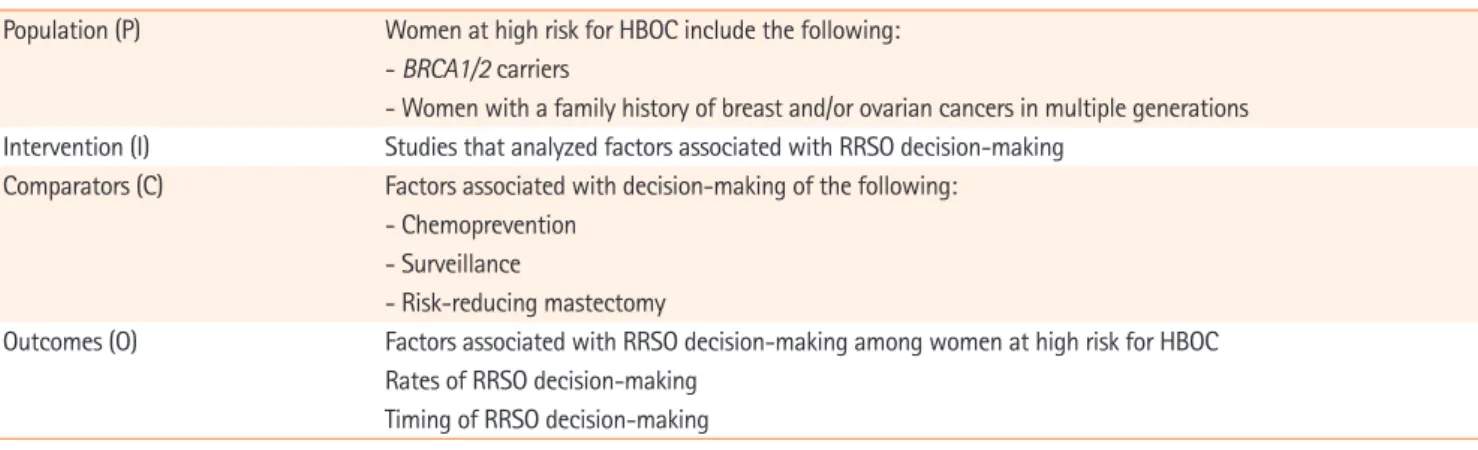
To identify suitable studies for this study purpose, PICO (popu- lation, intervention, comparison, outcome) criteria were defined and listed (Table 1). Based on PICO, the inclusion criteria were determined as follows: studies that (1) were about women at high risk for HBOC (e.g., BRCA1/2 carriers, women with a family history of breast and/or ovarian cancers in multiple gen- erations, and women who received genetic counseling for [risk of] breast and/or ovarian cancers); (2) reported on the factors influencing RRSO decision-making; and (3) were written in Korean or English. The exclusion criteria were as follows: (1) gray literature without peer review (e.g., conference abstracts, dissertations, and white reports); (2) animal experiments or preclinical experiments; (3) reviews, letters, and editorials; and (4) qualitative research.
Duplicate studies and gray literature were removed using a bibliography management program (EndNote X7, Clarivate, London, UK). Two authors (SYP and YLK) independently re- viewed the titles and abstracts of identified studies, and selected
studies according to the selection criteria.
Risk-of-bias assessment
Two authors (SYP and YLK) independently assessed the quali- ty of selected articles using the Risk of Bias for Nonrandomized Studies tool (RoBANS, version 2.0) [16]. RoBANS is a risk-of- bias tool for non-randomized trials (e.g., cohort studies, case-control, and before-and-after studies) that evaluates the se- lection of populations, confounding variables, measurement ex- posure, outcome blinding, incomplete data, and selective re- porting. RoBANS has moderate reliability, acceptable validity, and is compatible with domains of the Cochrane risk-of-bias tool [16]. The results of evaluating these domains were present- ed as “low,” “high,” and “unclear” with Revman (version 5.0, Co- chrane Community, Oxford, UK).
Data analysis
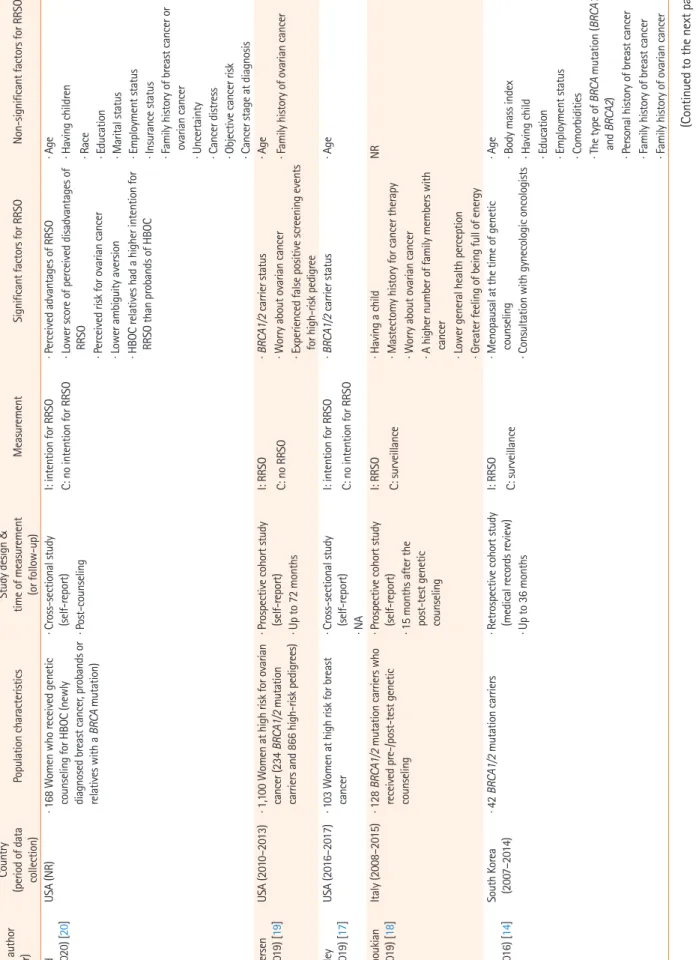
One author (SYP) extracted the data from the selected literature using a predesigned form (first author and publication year, re- search country, population characteristics, study design and time of measurement, measurement, and significant or insignifi- cant factors influencing RRSO), and another author (YLK) cross-checked the accuracy of data extraction. To show the over- all significance of the reported factors, we synthesized data if the relevant factors were reported in two or more studies, and pre- sented the ratio of the number of papers between significant and non-significant factors. The factors affecting decisions about RRSO were categorized into (1) demographic factors, (2) clini- cal factors, (3) family history of ovarian/breast cancer, (4) psy- chological factors, and (5) the objective risk of developing ovar- ian or breast cancer. To analyze the RRSO uptake rate, the intent and rate of RRSO were presented separately.
Table 1. PICO framework
Population (P) Women at high risk for HBOC include the following:
- BRCA1/2 carriers
- Women with a family history of breast and/or ovarian cancers in multiple generations Intervention (I) Studies that analyzed factors associated with RRSO decision-making
Comparators (C) Factors associated with decision-making of the following:
- Chemoprevention - Surveillance
- Risk-reducing mastectomy
Outcomes (O) Factors associated with RRSO decision-making among women at high risk for HBOC Rates of RRSO decision-making
Timing of RRSO decision-making
BRCA: Breast cancer susceptibility gene; HBOC: hereditary breast and ovarian cancer; RRSO: risk‐reducing salpingo‐oophorectomy.
Results
Characteristics of the selected studies
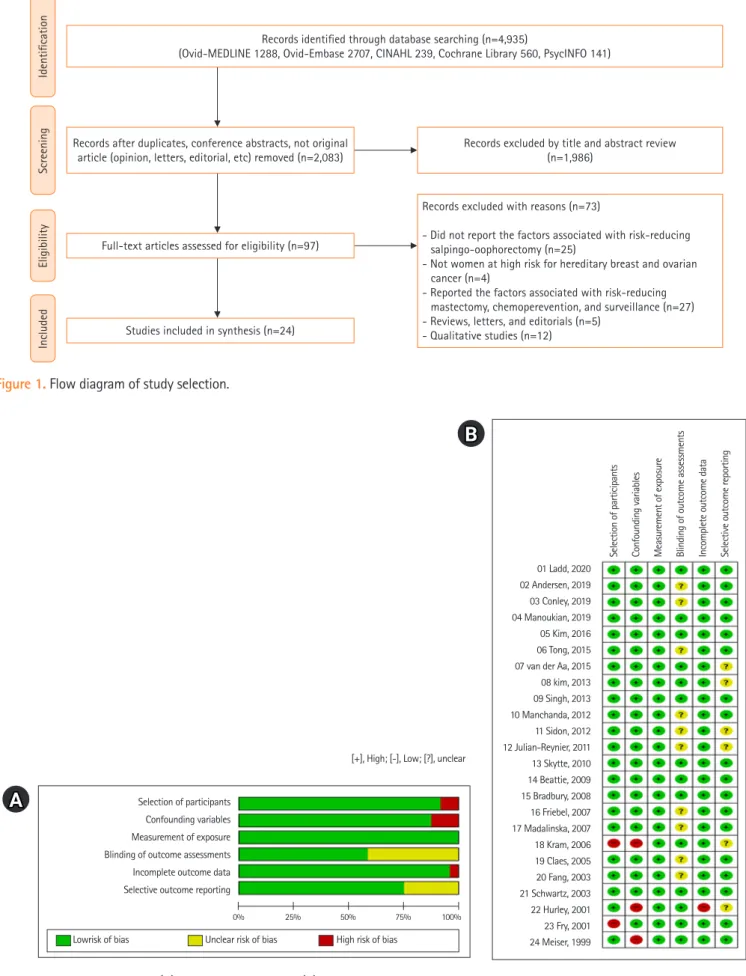
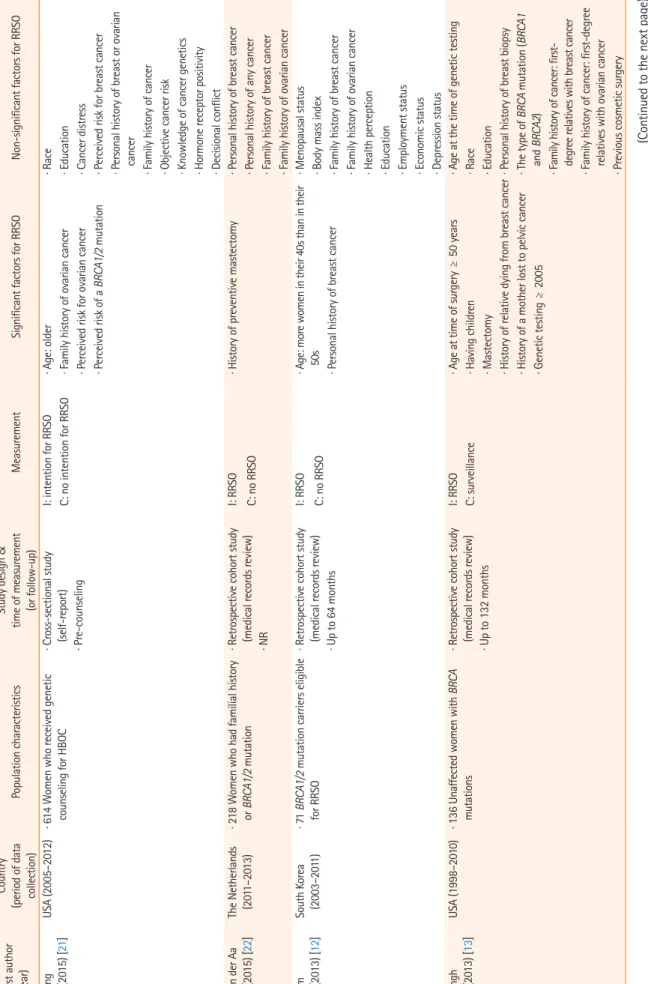
The chosen search strategies identified a total of 4,935 studies, from which 24 studies were finally included in the systematic re- view [11-14,17-36] (Table 2, Figure 1). The 24 studies included a total of 6,793 women (range, 42–1,241), and 10 were con- ducted in the United States, nine in Europe, two in Korea, and one each in Australia, Israel, and the United States/Canada/Eu- rope together. Five studies (20.8%) were cross-sectional, 9 (37.5%) were prospective cohorts, and 10 (41.7%) used a retro- spective cohort design. The selected literature were published between 1999 and 2019.
Risk-of-bias assessment
The risk of bias in the selected literature was moderately low (Figure 2). In particular, four domains were assessed as having a low risk of bias: selection of the population (91.7%), confound- ing variables (87.5%), measurement of exposure (100%), and incomplete data reporting (95.8%). For the blinding of the out- come evaluation, the risk of bias was unclear in 41.7% of articles, and for the section of selective reporting, 25% of articles were evaluated as unclear because they did not report whether the in- stitutional review board had approved their research protocol or whether the researchers prospectively conducted their study af- ter the protocol was registered. Although it was difficult to de- termine the level of bias of these two domains, we assumed that these two domains did not significantly affect the overall quality of the selected articles. Thus, all selected studies were included in the data analysis (Figure 2).
Factors associated with RRSO decision-making Demographic factors
Among the 19 studies that explored the effect of age on RRSO, 13 (68.4%) reported that older age was associated with a higher uptake of RRSO [11-13,21,23-26,28,30,31,33,35]. A Korean study [12] showed more instances of RRSO in women in their 40s than in their 50s, but the RRSO rate was higher in those over 50 years old in the United States [13] and France [25].
In 60.0% of the articles [11,23,26], more women chose RRSO if they had a child(ren). Marital status (80.0%) [20,29,32,33], em- ployment status (100%) [12,14,20,32], education level (88.9%) [12-14,20,21,30,32,33], and race (80.0%) [13,20,21,32] were consistently non-significant factors for RRSO.
Clinical factors
All of the articles (100%) found that BRCA1/2 gene mutations were a significant factor in decision-making about RRSO [5,19,23,30]; however, the type of BRCA mutation was not a sig- nificant factor in the articles (83.3%) that reported it [11,13, 14,26,28]. A personal history of mastectomy was a significant fac- tor in 80.0% of articles [13,18,22,27], while only 40.0% [12,23,27]
and 33.3% of articles [14,23] reported that a personal history of breast cancer and menopausal status were significant factors for RRSO.
Family history of cancer
The vast majority of articles (81.8%) [12-14,20-22,28,32,36]
reported that a family history of breast cancer influenced RRSO decision-making; however, a family history of ovarian cancer was not a significant factor in 66.6% of articles [12-14,19,20, 22,33,36] (Tables 2, 3). Singh et al. [13] particularly suggested that although a family history of ovarian cancer was not a signifi- cant factor, the death of a mother or relative from pelvic or breast cancer affected RRSO decisions.
Psychological factors
The perceived risk/anxiety/concern for ovarian cancer was a significant factor in determining RRSO in most studies (91.7%, 11 of 12) that reported it [18-21,29,31-36]. Meanwhile, the per- ceived risk for breast cancer was not significant in two articles [21,32]. Four articles [20,29,33,34] consistently reported that positive perceptions of RRSO were related to the decision to undergo surgery. With regard to negative perceptions of RRSO, two studies [20,34] reported conflicting results. Cancer-related distress [20,21], anxiety [33,34], and depression [12,33] were not significant factors for RRSO in the two articles that reported those factors. The significance of health perceptions differed be- tween the two studies [12,29].
Objective cancer risk
As a possible factor influencing RSSO decision-making, the re- ported objective cancer risk was the risk level evaluated by fami- ly cancer/genetic specialists based on a person’s family cancer history [34,36], and breast cancer risk assessment tool accord- ing to the person’s cancer status and family cancer history such as the BRCAPRO statistical model [20,21]. The objective can- cer risk did not influence women’s RRSO decision-making in four articles [20,21,34,36].
Rate and timing of RRSO decision-making
The RRSO rate was 11% to 87.2% across the 21 articles. In six stud-
Table 2. Main characteristics of selected studies (N=24) First author (year)
Country (period of data collection)Population characteristicsStudy design & time of measurement (or follow-up)MeasurementSignificant factors for RRSONon-significant factors for RRSO Ladd (2020) [20]USA (NR)· 168 Women who received genetic counseling for HBOC (newly diagnosed breast cancer, probands or relatives with a BRCA mutation)
· Cross-sectional study (self-report)I: intention for RRSO C: no intention for RRSO· Perceived advantages of RRSO · Lower score of perceived disadvantages of RRSO · Perceived risk for ovarian cancer · Lower ambiguity aversion · HBOC relatives had a higher intention for RRSO than probands of HBOC
· Age · Having children · Post-counseling· Race · Education · Marital status · Employment status · Insurance status · Family history of breast cancer or ovarian cancer · Uncertainty · Cancer distress · Objective cancer risk · Cancer stage at diagnosis Andersen (2019) [19]USA (2010–2013)· 1,100 Women at high risk for ovarian cancer (234 BRCA1/2 mutation carriers and 866 high-risk pedigrees)
· Prospective cohort study (self-report)I: RRSO C: no RRSO· BRCA1/2 carrier status · Worry about ovarian cancer · Experienced false positive screening events for high-risk pedigree
· Age · Family history of ovarian cancer · Up to 72 months Conley (2019) [17]USA (2016–2017)· 103 Women at high risk for breast cancer· Cross-sectional study (self-report)I: intention for RRSO C: no intention for RRSO· BRCA1/2 carrier status· Age · NA Manoukian (2019) [18]Italy (2008–2015)· 128 BRCA1/2 mutation carriers who received pre-/post-test genetic counseling
· Prospective cohort study (self-report)I: RRSO C: surveillance· Having a child · Mastectomy history for cancer therapy · Worry about ovarian cancer · A higher number of family members with cancer · Lower general health perception · Greater feeling of being full of energy
NR · 15 months after the post-test genetic counseling Kim (2016) [14]South Korea (2007–2014)· 42 BRCA1/2 mutation carriers· Retrospective cohort study (medical records review)I: RRSO C: surveillance· Menopausal at the time of genetic counseling· Age · Body mass index · Having child · Education · Employment status · Comorbidities · The type of BRCA mutation (BRCA1 and BRCA2) · Personal history of breast cancer · Family history of breast cancer · Family history of ovarian cancer
· Up to 36 months· Consultation with gynecologic oncologists (Continued to the next page)
Tong (2015) [21]USA (2005–2012)· 614 Women who received genetic counseling for HBOC· Cross-sectional study (self-report)I: intention for RRSO C: no intention for RRSO· Age: older · Family history of ovarian cancer · Perceived risk for ovarian cancer · Perceived risk of a BRCA1/2 mutation
· Race · Education · Cancer distress · Perceived risk for breast cancer · Personal history of breast or ovarian cancer · Family history of cancer · Objective cancer risk · Knowledge of cancer genetics · Hormone receptor positivity · Decisional conflict
· Pre-counseling van der Aa (2015) [22]The Netherlands (2011–2013)· 218 Women who had familial history or BRCA1/2 mutation· Retrospective cohort study (medical records review)I: RRSO C: no RRSO· History of preventive mastectomy· Personal history of breast cancer · Personal history of any cancer · Family history of breast cancer · Family history of ovarian cancer· NR Kim (2013) [12]South Korea (2003–2011)· 71 BRCA1/2 mutation carriers eligible for RRSO· Retrospective cohort study (medical records review)I: RRSO C: no RRSO· Age: more women in their 40s than in their 50s · Personal history of breast cancer
· Menopausal status · Body mass index · Family history of breast cancer · Family history of ovarian cancer · Health perception · Education · Employment status · Economic status · Depression status
· Up to 64 months Singh (2013) [13]USA (1998–2010)· 136 Unaffected women with BRCA mutations· Retrospective cohort study (medical records review)I: RRSO C: surveillance· Age at time of surgery ≥ 50 years · Having children · Mastectomy · History of relative dying from breast cancer · History of a mother lost to pelvic cancer · Genetic testing ≥ 2005
· Age at the time of genetic testing · Race · Education · Personal history of breast biopsy · The type of BRCA mutation (BRCA1 and BRCA2) · Family history of cancer: first- degree relatives with breast cancer · Family history of cancer: first-degree relatives with ovarian cancer · Previous cosmetic surgery
· Up to 132 months
Table 2. Continued (Continued to the next page)
First author (year) Country (period of data collection)Population characteristicsStudy design & time of measurement (or follow-up)MeasurementSignificant factors for RRSONon-significant factors for RRSO
Table 2. Continued Manchanda (2012) [23]UK (2004–2009)· 1,241 Women who received genetic counseling for HBOC (287 BRCA1/2 mutation carriers and 866 with high-risk pedigrees)
· Prospective cohort study (medical records review)I: cumulative incidence function of RRSO· Age: older · Having children · BRCA1/2 carrier status · Menopausal status: postmenopausal · Personal history of breast cancer · Family history of breast cancer
NR · Up to 80 monthsC: surveillance Sidon (2012) [24]UK (1996–2011)· 700 BRCA1/2 mutation carriers· Prospective cohort study (medical records review)I: RRSO C: no RRSO· Age: 40–59 years than over the 60s · The type of BRCA mutation (more BRCA1 mutation carriers had RRSO than BRCA2)NR · 60 months post-BRCA testing Julian-Reynier (2011) [25]France (2000–2006)· 101 BRCA1/2 mutation carriers· Prospective cohort study (self-report)I: RRSO C: no RRSO· Age: over 50 years old (30s: 18.4%, 40s: 55.6%, 50s: 76.2%)NR · Up to 60 months Skytte (2010) [26]Denmark (1998–2008)· 306 Women (BRCA1/2 mutation carriers) with no personal history of ovarian or breast cancer
· Retrospective cohort study (medical records review)I: RRSO C: no RRSO· Age: 35–60 years than <35 years · Having children· The type of BRCA mutation (BRCA1 and BRCA2) · 6–120 months post-BRCA testing Beattie (2009) [27]USA (1996–2006)· 240 Women (BRCA1/2 mutation carriers)· Retrospective cohort study (medical records review) · 44.4 months (median) I: RRSO C: no RRSO· Age was positively associated with surgery uptake until age 60 years, with women 50–59 years old most likely to undergo RRSO
NR · Personal history of breast cancer · Mastectomy history for prevention Bradbury (2008) [11]USA (1996–2003)· 88 Women (BRCA1/2 mutation carriers)· Retrospective cohort study (medical records review)I: RRSO C: no RRSO· Age: older than 40 years · Race: white · Having children · Family history of ovarian cancer · Family history of breast cancer: within one or two relatives
· The type of BRCA mutation (BRCA1 and BRCA2) · Personal history of breast cancer · Mastectomy· Up to 84 months Friebel (2007) [28]USA, Canada, and Europe (1994–2006)
· 537 Women (BRCA1/2 mutation carriers)· Prospective cohort study (self-report, medical records review) I: RRSO C: no RRSO· Age ≥ 40 years compared with aged < 40 years (68% vs. 43%) · Having a child for BRCA1 carriers · Family history of ovarian cancer for BRCA2 carriers
· The type of BRCA mutation (BRCA1 and BRCA2) · Family history of breast cancer · More than 6 months post- disclosure of BRCA testing Madalinska (2007) [29]The Netherlands (2002–2004)·160 Women (BRCA1/2 mutation carriers)· Prospective cohort study (self-report) · Up to 12 months
I: RRSO C: surveillance· Education: under high school reported higher RRSO than advanced vocational/university · Perceived incurability of ovarian cancer · Perceived benefits of RRSO · Lower general health perceptions
· Age · Marital status · Menopausal status · Worry about ovarian cancer · Perceived risk for ovarian cancer Kram (2006) [30]Israel (1995–2001)· 99 Women who had BRCA tests· Retrospective cohort study (mail, self-report)I: intention for RRSO C: no intention for RRSO· BRCA1/2 carrier status · Age: older than 50 years· Personal history of breast cancer · Education · Having children· 12–48 months after receiving BRCA test (Continued to the next page)
First author (year) Country (period of data collection)Population characteristicsStudy design & time of measurement (or follow-up)MeasurementSignificant factors for RRSONon-significant factors for RRSO
Table 2. Continued Claes (2005) [31]Belgium (1999–2003)· 68 Women who received genetic counseling for HBOC (34 BRCA1/2 mutation carriers and 34 non-carriers)
· Prospective cohort study (self-report)I: RRSO C: no RRSO· Age: older · Perceived risk for ovarian cancer · 12 months after receiving BRCA test Schwartz (2003) [32]USA· 289 High-risk women who underwent genetic counseling and testing for BRCA1/2
· Prospective cohort study (self-report) · 12 months after receiving BRCA test
I: RRSO C: surveillance· Family history of cancer: first-degree relatives with ovarian cancer· Age (standard: 35 years) · Education · Race · Marital status · Employment status · Menopausal status · Personal history of breast cancer · Family history of cancer: first- degree relatives with breast cancer · Perceived risk for breast cancer
(1995–2000)· Perceived risk for ovarian cancer Fang (2003) [33]USA (NR)· 76 Women enrolled in a familial cancer risk assessment program· Cross-sectional study (self-report)I: intention for RRSO in 12 months· Age: older · Perceived risk of ovarian cancer · Perceived benefits of RRSO
· Education · Marital status · Family history of ovarian cancer · Anxiety · Depression status
· Following familial cancer education and genetic coun- seling
C: no intention for RRSO Hurley (2001) [34]USA (1997)· 94 Women who received genetic counseling for family history of ovarian cancer
· Retrospective cohort study (telephone interview, self-report) I: interest in RRSO in the future C: no interest to RRSO in the future
· Perceived benefits of RRSO · Reducing anxiety/uncertainty · Stress-related ideation
· Anxiety of cancer · Perceived efficacy of RRSO · Risks of RRSO · Objective cancer risk· 12 months after genetic counseling Fry (2001) [35]UK (1999)·58 Women (30 had RRSO, 28 attended a screening program for HBOC)· Retrospective cohort study (self-report) · 12–60 months
I: important factors for RRSO· Age: older · Reducing cancer worry · Reducing risk of ovarian cancer · Worry about effectiveness of ovarian screening · The importance of recovery time · The importance of loss of periods
· Other family members choosing prophylactic surgery · Partner’s attitude · Desire to have children · Fear of menopausal symptoms · Need to feel like a woman · Dislike of ovarian screening methods Meiser (1999) [36]Australia (1996–1999)· 95 High-risk women who attended familial cancer clinics· Retrospective cohort study (mail, self-report) · Prior to attendance at a familial cancer clinic
I: interest in RRSO· Anxiety of breast/ovarian cancer· Age · Number of first- and second-degree relatives with breast or ovarian cancer · Objective cancer risk BRCA: Breast cancer susceptibility gene; C: comparator; HBOC: hereditary breast and ovarian cancer; I: intervention; NA: not available; NR: not reported; RRSO: risk‐reducing salpingo‐oophorectomy.
First author (year) Country (period of data collection)Population characteristicsStudy design & time of measurement (or follow-up)MeasurementSignificant factors for RRSONon-significant factors for RRSO
IdentificationScreeningEligibilityIncluded
Records identified through database searching (n=4,935)
(Ovid-MEDLINE 1288, Ovid-Embase 2707, CINAHL 239, Cochrane Library 560, PsycINFO 141)
Records after duplicates, conference abstracts, not original article (opinion, letters, editorial, etc) removed (n=2,083)
Full-text articles assessed for eligibility (n=97)
Studies included in synthesis (n=24)
Records excluded by title and abstract review (n=1,986)
Records excluded with reasons (n=73)
- Did not report the factors associated with risk-reducing salpingo-oophorectomy (n=25)
- Not women at high risk for hereditary breast and ovarian cancer (n=4)
- Reported the factors associated with risk-reducing mastectomy, chemoperevention, and surveillance (n=27) - Reviews, letters, and editorials (n=5)
- Qualitative studies (n=12)
Figure 1. Flow diagram of study selection.
01 Ladd, 2020 02 Andersen, 2019 03 Conley, 2019 04 Manoukian, 2019
05 Kim, 2016 06 Tong, 2015 07 van der Aa, 2015 08 kim, 2013 09 Singh, 2013 10 Manchanda, 2012 11 Sidon, 2012 12 Julian-Reynier, 2011 13 Skytte, 2010 14 Beattie, 2009 15 Bradbury, 2008 16 Friebel, 2007 17 Madalinska, 2007 18 Kram, 2006 19 Claes, 2005 20 Fang, 2003 21 Schwartz, 2003 22 Hurley, 2001 23 Fry, 2001 24 Meiser, 1999
Selection of participants Confounding variables Measurement of exposure Blinding of outcome assessments Incomplete outcome data Selective outcome reporting
[+], High; [-], Low; [?], unclear
Selection of participants Confounding variables Measurement of exposure Blinding of outcome assessments Incomplete outcome data Selective outcome reporting
Lowrisk of bias Unclear risk of bias
0% 25% 50% 75% 100%
High risk of bias
Figure 2. Risk-of-bias graph. (A) Risk of bias summary. (B) Risk of bias for selected studies.
B
A
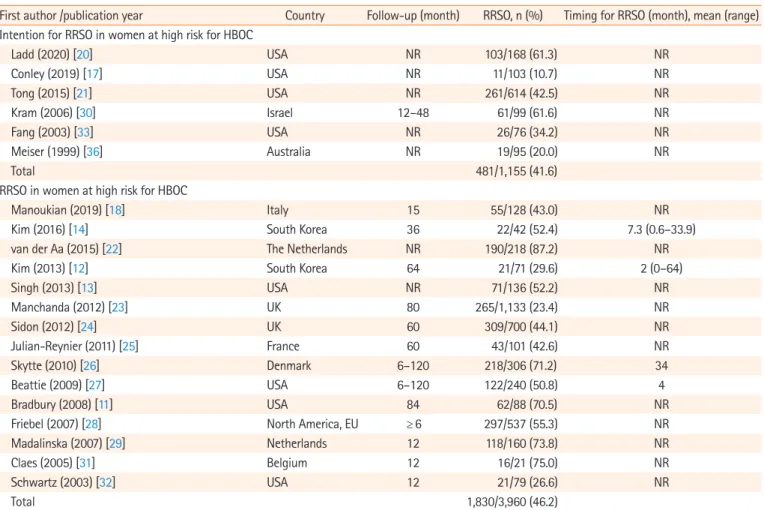
ies [17,20,21,30,33,36], 11% to 61.6% of women at high risk for HBOC intended to undergo RRSO in the future (mean, 41.6%;
481 of 1,155 women). In 15 studies [11-14,18,22-29,31,32], 46.2%
of women received RRSO (range, 23.4%–87.2%; 1,830 of 3,960 women (Table 4).
Four articles [14,12,26,27] reported the length of time that elapsed between the BRCA test and RRSO (Table 4). Of the three articles that studied Koreans [12,14] and Americans [27], the mean time to decide was 2 to 7.3 months. Meanwhile, a Danish article [26] reported that it took 34 months to decide, and a Korean article [12] reported that the maximum time to decide was 64 months. In two Korean articles on BRCA carriers [12,14], the proportion of patients who received RRSO within 1 year after receiving a genetic consultation was reported to be high, at 85.7% [12] and 86.4% [14], respectively.
Discussion
The goal of this study was to identify significant factors affecting RRSO decision-making among women at high risk of HBOC and to explore the uptake rate and decision timing for RRSO.
Among the reviewed articles, 13 [11-13,21,23-26,28,30,31,33,35]
suggested that older age was associated with the decision to un- dergo RRSO. Although six studies [17,19,20,29,32,36] did not find that age was significant, those studies analyzed age as a con- tinuous variable; therefore, they failed to determine which age group received RRSO more. In this review, women in their 40s and 50s were more likely to undergo RRSO than other age groups in four studies [12,13,24,25], and the studies that ana- lyzed age groups were more reliable than those that examined age as a continuous variable. Therefore, age is considered to Table 3. Factors associated with the decision to undergo RRSO among women at high risk for hereditary breast and ovarian cancer
Factor Significant factors for RRSO Non-significant factors for RRSO
No. of articles† References No. of articles† References
Demographic factors · Age 13/19 [11-13,21,23-26,28,30,31,33,35] 6/19 [17,19,20,29,32,36]
· Marital status 1/5 [11] 4/5 [20,29,32,33]
· Having child(ren) 3/5 [11,23,26] 2/5 [20,30]
· Employment status 0/4 Not reported 4/4 [12,14,20,32]
· Education level 1/9 [29] 8/9 [12-14,20,21,30,32,33]
· Race 1/5 [11] 4/5 [13,20,21,32]
Clinical factors · BRCA1/2 carrier status 4/4 [17,19,23,30] 0/4 Not reported
· The type of BRCA (BRCA1 vs.
BRCA2) 1/6 [24] 5/6 [11,13,14,26,28]
· Menopausal status 2/5 [14,23] 3/5 [12,29,32]
· Mastectomy 4/5 [13,18,22,27] 1/5 [11]
· Personal history of breast
cancer 3/9 [12,23,27] 6/9 [11,12,21,22,30,32]
Family history of cancer · Family history of breast
cancer 2/11 [11,23] 9/11 [12-14,20-22,28,32,36]
· Family history of ovarian
cancer 4/12 [11,21,28,32] 8/12 [12-14,19,20,22,33,36]
Psychological factors · Perceived risk/worry/anxiety
for ovarian cancer 11/12 [18-21,29,31-36] 1/12 [29]
· Perceived risk for breast
cancer 0/2 Not reported 2/2 [21,32]
· Perceived advantages of
RRSO 4/4 [20,29,33,34] 0/4 Not reported
· Perceived disadvantages of
RRSO 1/2 [20] 1/2 [34]
· General health perceptions 1/2 [29] 1/2 [12]
· Cancer distress 0/2 Not reported 2/2 [20,21]
· Anxiety 0/2 Not reported 2/2 [32,34]
· Depression 0/2 Not reported 2/2 [12,33]
Objective cancer risk 0/4 4/4 [20,21,34,36]
BRCA: Breast cancer susceptibility gene; RRSO: risk-reducing salpingo-oophorectomy.
†Reported in articles/total articles.
Table 4. RRSO rate and timing among women at high risk for HBOC
First author /publication year Country Follow-up (month) RRSO, n (%) Timing for RRSO (month), mean (range) Intention for RRSO in women at high risk for HBOC
Ladd (2020) [20] USA NR 103/168 (61.3) NR
Conley (2019) [17] USA NR 11/103 (10.7) NR
Tong (2015) [21] USA NR 261/614 (42.5) NR
Kram (2006) [30] Israel 12–48 61/99 (61.6) NR
Fang (2003) [33] USA NR 26/76 (34.2) NR
Meiser (1999) [36] Australia NR 19/95 (20.0) NR
Total 481/1,155 (41.6)
RRSO in women at high risk for HBOC
Manoukian (2019) [18] Italy 15 55/128 (43.0) NR
Kim (2016) [14] South Korea 36 22/42 (52.4) 7.3 (0.6–33.9)
van der Aa (2015) [22] The Netherlands NR 190/218 (87.2) NR
Kim (2013) [12] South Korea 64 21/71 (29.6) 2 (0–64)
Singh (2013) [13] USA NR 71/136 (52.2) NR
Manchanda (2012) [23] UK 80 265/1,133 (23.4) NR
Sidon (2012) [24] UK 60 309/700 (44.1) NR
Julian-Reynier (2011) [25] France 60 43/101 (42.6) NR
Skytte (2010) [26] Denmark 6–120 218/306 (71.2) 34
Beattie (2009) [27] USA 6–120 122/240 (50.8) 4
Bradbury (2008) [11] USA 84 62/88 (70.5) NR
Friebel (2007) [28] North America, EU ≥ 6 297/537 (55.3) NR
Madalinska (2007) [29] Netherlands 12 118/160 (73.8) NR
Claes (2005) [31] Belgium 12 16/21 (75.0) NR
Schwartz (2003) [32] USA 12 21/79 (26.6) NR
Total 1,830/3,960 (46.2)
HBOC: Hereditary breast and ovarian cancer; NR: not reported; RRSO: risk-reducing salpingo-oophorectomy.
have a significant influence on decision-making about RRSO.
Although our study and the previous systematic review [7]
did not confirm whether having child(ren) [11,20,23,26,30] or menopause [12,14,23,29,33] affected RRSO decisions, child- birth and menopause status are important variables in the deci- sion-making process for RRSO [7]. This is because women at high risk for HBOC fear surgical-related menopause [7], and fertility is important for women who want to become pregnant.
Therefore, qualitative studies that explore how fertility and menopause affect decision-making through in-depth interviews would facilitate a deeper understanding of this issue.
In this review, a personal history of mastectomy was a signifi- cant factor affecting RRSO in 80.0% of the articles, but a history of breast cancer was not a significant factor in 40.0% of the stud- ies. A previous systematic review also showed that women with breast cancer tended to select RRM more frequently than RRSO [7]. Further research is needed to examine whether breast cancer history is associated with RRM, and if having a mastectomy affects decision-making about RRSO.
Most of the selected studies showed that a family history of
breast cancer (81.8%) and ovarian cancer (66.7%) were not as- sociated with having RRSO. This result is supported by a sys- tematic review reporting that RRM was more strongly affected than RSSO by family cancer history [7]. Therefore, a family his- tory of ovarian/or breast cancer is assumed to be a more im- portant factor in determining RRM than RRSO. In one article [13], RRSO was more likely to be chosen if a mother or relative had died from breast or ovarian cancer than simply having a family cancer history. Furthermore, Howard et al. [7] reported that RRM was more likely to be chosen based on experiences of first-degree relatives, especially mothers and sisters, rather than of having a family history of ovarian/breast cancer. Therefore, future studies should analyze the death of a close family mem- ber from cancer, as distinct from a family history of cancer.
Perceived risk of cancer is a well-known factor contributing to the choice to undergo risk-reducing surgery among women at high risk for HBOC [5,7,37]. Our study found that the per- ceived risk of ovarian cancer was the main motivation for choos- ing to undergo RRSO. However, the mechanism underlying cancer risk perception is still unknown [38]. Four articles
[5,19,23,30] reported that BRCA carriers chose RRSO more frequently than non-carriers, which was an expected result. Al- though Padamsee et al. [5] suggested that the perception of RRSO could vary depending on the type of BRCA mutation, in this study there was no evidence that the type of BRCA muta- tion affected decision-making about RRSO [11,13,14,26,28].
Therefore, in-depth studies are needed to determine whether there are differences in the RRSO decision-making process de- pending on the BRCA mutation type [5].
A systematic review [7] found that psychological factors af- fected decisions about RRM, but we could not confirm whether psychological stability (e.g., cancer-related distress, anxiety, and depression) affected RRSO decision-making in this study.
Therefore, further studies are needed to identify differences in psychological motivations for decisions about RRSO and RRM.
Previous qualitative studies showed that family factors were related to RRSO [7,39], and a systematic review found that spouses, family/friends, and doctors’ recommendations influ- enced the choice to undergo RRM [38]. However, we could not determine whether these factors were explored in quantitative studies related to RRSO. These gaps may suggest that family and interpersonal factors in RRSO decision-making have not been explored. However, family, friends, and communities influ- ence the information obtained and the decision-making process.
Therefore, further research is needed to identify the impact of these factors and to integrate the factors reported in qualitative studies.
In this review, objective cancer risk was not related to the de- cision to undergo RRSO. This result implies that women decide to undergo RRSO to reduce anxiety based on the perceived risk of ovarian cancer [40], rather than on objective information. In addition, the effect of genetic testing on RRSO decisions has not been reported to a sufficient extent. Therefore, it is neces- sary to confirm whether fully-informed decision-making is hap- pening in the clinical setting.
The uptake rate of RRSO varied from 11% to 87.2% across the selected articles in this review. Among those who opted for RRSO, Koreans were younger than Europeans [12,13,25], and 71.2% to 87.2% of Danish [26] and Dutch [22,29] women chose RRSO, which was a higher rate than that of women in other countries. This study also showed that Danish women took a longer time to make decisions than Koreans and Ameri- cans. These results imply that socio-cultural factors and national health care systems may affect RRSO decisions. This is support- ed by Padamsee et al. [5], who suggested that geographical dif- ferences, which may be a proxy for differences in health care in- frastructure and cultural contexts, influence RRSO decisions.
Therefore, further research is needed to examine how sociocul- tural factors and health care delivery systems affect RRSO deci- sion-making and surgical timing.
The generalizability of the results of this systematic review is limited because we did not review the factors associated with RRSO from qualitative research. Nevertheless, this study is meaningful in that it provides fundamental information regard- ing factors affecting RRSO decisions based on current evidence.
In particular, we found that the perceived risk of ovarian cancer, older age, and being a BRCA carrier are major factors affecting RRSO decision-making.
Based on the results of this study, we suggest the following:
(1) considering that the decision process of RRSO is complex and involves various factors, it is necessary to identify how fami- ly factors, socio-cultural characteristics, and healthcare systems affect the decision process; (2) further studies are needed to confirm the significance of factors that have been reported in a few studies or have shown contradictory results across articles;
and (3) interventions should be developed based on informa- tion about objective cancer risk.
ORCID
Sun-young Park, https://orcid.org/0000-0003-3560-8369 Youlim Kim, https://orcid.org/0000-0002-4477-2489 Sue Kim, https://orcid.org/0000-0003-3785-2445
Authors’ contributions
Conceived and designed the research: Park S, Kim S; Searched the data: Park S; Contributed selection and quality assessment of the literature, Analyzed the data: Park S, Kim Y; Writing–
original draft: all authors; Writing–review & editing: all authors.
Conflict of interest
Sue Kim has been editor of the Korean Journal of Women Health Nursing since January 2020. She was not involved in the review process of this manuscript. Otherwise, there was no conflict of in- terest.
Funding
None.
Data availability
The datasets are available from the corresponding author on reasonable request.
Acknowledgments
We thank Gayoung Shin, MS for contributing to the selection of the articles.
Supplementary materials
Further details on supplementary materials are presented online (available at: https://doi.org/10.4069/kjwhn.2020.11.19).
References
1. Hartmann LC, Lindor NM. The role of risk-reducing surgery in hereditary breast and ovarian cancer. N Engl J Med.
2016;374(5):454-468. https://doi.org/10.1056/NEJMra1 503523
2. Petrucelli N, Daly MB, Feldman GL. Hereditary breast and ovarian cancer due to mutations in BRCA1 and BRCA2.
Genet Med. 2010;12(5):245-259. https://doi.org/10.1097/
GIM.0b013e3181d38f2f
3. Kang E, Seong MW, Park SK, Lee JW, Lee J, Kim LS, et al.
The prevalence and spectrum of BRCA1 and BRCA2 muta- tions in Korean population: recent update of the Korean He- reditary Breast Cancer (KOHBRA) study. Breast Cancer Res Treat. 2015;151(1):157-168. https://doi.org/10.1007/s10549- 015-3377-4
4. Rebbeck TR, Kauff ND, Domchek SM. Meta-analysis of risk reduction estimates associated with risk-reducing salpin- go-oophorectomy in BRCA1 or BRCA2 mutation carriers. J Natl Cancer Inst. 2009;101(2):80-87. https://doi.org/10.1093/
jnci/djn442
5. Padamsee TJ, Wills CE, Yee LD, Paskett ED. Decision making for breast cancer prevention among women at elevated risk. Breast Cancer Res. 2017;19(1):34. https://doi.org/10.1186/s13058-017- 0826-5
6. Meadows R, Padamsee TJ, Paskett ED. Distinctive psycho- logical and social experiences of women choosing prophylac- tic oophorectomy for cancer prevention. Health Care Wom- en Int. 2018;39(5):595-616. https://doi.org/10.1080/07399332 .2018.1424855
7. Howard AF, Balneaves LG, Bottorff JL. Women’s decision making about risk-reducing strategies in the context of he-
reditary breast and ovarian cancer: a systematic review. J Genet Couns. 2009;18(6):578-597. https://doi.org/10.1007/
s10897-009-9245-9
8. Hickey M, Rio I, Trainer A, Marino JL, Wrede CD, Peate M.
What information do healthcare professionals need to inform premenopausal women about risk-reducing salpingo-oopho- rectomy? Menopause. 2020;27(1):20-25. https://doi.org/10.
1097/GME.0000000000001421
9. Cherry C, Ropka M, Lyle J, Napolitano L, Daly MB. Under- standing the needs of women considering risk-reducing salpin- go-oophorectomy. Cancer Nurs. 2013;36(3):E33-E38. https://
doi.org/10.1097/NCC.0b013e3182642cb5
10. Rosenberg SM, Greaney ML, Patenaude AF, Sepucha KR, Meyer ME, Partridge AH. “I don’t want to take chances.”: a qualitative exploration of surgical decision making in young breast cancer survivors. Psychooncology. 2018;27(6):1524- 1529. https://doi.org/10.1002/pon.4683
11. Bradbury AR, Ibe CN, Dignam JJ, Cummings SA, Verp M, White MA, et al. Uptake and timing of bilateral prophylactic salpingo-oophorectomy among BRCA1 and BRCA2 muta- tion carriers. Genet Med. 2008;10(3):161-166. https://doi.
org/10.1097/GIM.0b013e318163487d
12. Kim D, Kang E, Hwang E, Sun Y, Hwang Y, Yom CK, et al.
Factors affecting the decision to undergo risk-reducing salp- ingo-oophorectomy among women with BRCA gene muta- tion. Fam Cancer. 2013;12(4):621-628. https://doi.org/10.
1007/s10689-013-9625-z
13. Singh K, Lester J, Karlan B, Bresee C, Geva T, Gordon O. Im- pact of family history on choosing risk-reducing surgery among BRCA mutation carriers. Am J Obstet Gynecol.
2013;208(4):329.e1-329.e3296. https://doi.org/10.1016/j.ajog.
2013.01.026
14. Kim SI, Lim MC, Lee DO, Kong SY, Seo SS, Kang S, et al. Up- take of risk-reducing salpingo-oophorectomy among female BRCA mutation carriers: experience at the National Cancer Center of Korea. J Cancer Res Clin Oncol. 2016;142(1):333- 340. https://doi.org/10.1007/s00432-015-2051-x
15. Moher D, Liberati A, Tetzlaff J, Altman DG; PRISMA Group.
Preferred reporting items for systematic reviews and meta-anal- yses: the PRISMA statement. PLoS Med. 2009;6(7):e1000097.
https://doi.org/10.1371/journal.pmed.1000097
16. Kim SY, Park JE, Lee YJ, Seo HJ, Sheen SS, Hahn S, et al. Test- ing a tool for assessing the risk of bias for nonrandomized studies showed moderate reliability and promising validity. J Clin Epidemiol. 2013;66(4):408-414. https://doi.org/10.1016/
j.jclinepi.2012.09.016
17. Conley CC, Agnese DM, Vadaparampil ST, Andersen BL.
Factors associated with intentions for breast cancer risk man- agement: does risk group matter? Psychooncology. 2019;
28(5):1119-1126. https://doi.org/10.1002/pon.5066
18. Manoukian S, Alfieri S, Bianchi E, Peissel B, Azzollini J, Bor- reani C. Risk-reducing surgery in BRCA1/BRCA2 mutation carriers: are there factors associated with the choice? Psy- chooncology. 2019;28(9):1871-1878. https://doi.org/10.1002/
pon.5166
19. Andersen MR, Karlan BY, Drescher CW, Paley P, Hawley S, Palomares M, et al. False-positive screening events and worry influence decisions about surgery among high-risk women.
Health Psychol. 2019;38(1):43-52. https://doi.org/10.1037/
hea0000647
20. Ladd MK, Peshkin BN, Senter L, Baldinger S, Isaacs C, Segal H, et al. Predictors of risk-reducing surgery intentions fol- lowing genetic counseling for hereditary breast and ovarian cancer. Transl Behav Med. 2020;10(2):337-346. https://doi.
org/10.1093/tbm/iby101
21. Tong A, Kelly S, Nusbaum R, Graves K, Peshkin BN, Valdi- marsdottir HB, et al. Intentions for risk-reducing surgery among high-risk women referred for BRCA1/BRCA2 genetic counseling. Psychooncology. 2015;24(1):33-39. https://doi.
org/10.1002/pon.3560
22. van der Aa JE, Hoogendam JP, Butter ES, Ausems MG, Ver- heijen RH, Zweemer RP. The effect of personal medical his- tory and family history of cancer on the uptake of risk-reduc- ing salpingo-oophorectomy. Fam Cancer. 2015;14(4):539- 544. https://doi.org/10.1007/s10689-015-9827-7
23. Manchanda R, Burnell M, Abdelraheim A, Johnson M, Shar- ma A, Benjamin E, et al. Factors influencing uptake and tim- ing of risk reducing salpingo-oophorectomy in women at risk of familial ovarian cancer: a competing risk time to event analysis. BJOG. 2012;119(5):527-536. https://doi.org/10.
1111/j.1471-0528.2011.03257.x
24. Sidon L, Ingham S, Clancy T, Clayton R, Clarke A, Jones EA, et al. Uptake of risk-reducing salpingo-oophorectomy in women carrying a BRCA1 or BRCA2 mutation: evidence for lower uptake in women affected by breast cancer and older women. Br J Cancer. 2012;106(4):775-779. https://doi.org/
10.1038/bjc.2011.573
25. Julian-Reynier C, Mancini J, Mouret-Fourme E, Gauthi- er-Villars M, Bonadona V, Berthet P, et al. Cancer risk man- agement strategies and perceptions of unaffected women 5 years after predictive genetic testing for BRCA1/2 mutations.
Eur J Hum Genet. 2011;19(5):500-506. https://doi.org/10.
1038/ejhg.2010.241
26. Skytte AB, Gerdes AM, Andersen MK, Sunde L, Brøn-
dum-Nielsen K, Waldstrøm M, et al. Risk-reducing mastecto- my and salpingo-oophorectomy in unaffected BRCA muta- tion carriers: uptake and timing. Clin Genet. 2010;77(4):342- 349. https://doi.org/10.1111/j.1399-0004.2009.01329.x 27. Beattie MS, Crawford B, Lin F, Vittinghoff E, Ziegler J. Up-
take, time course, and predictors of risk-reducing surgeries in BRCA carriers. Genet Test Mol Biomarkers. 2009;13(1):51- 56. https://doi.org/10.1089/gtmb.2008.0067
28. Friebel TM, Domchek SM, Neuhausen SL, Wagner T, Evans DG, Isaacs C, et al. Bilateral prophylactic oophorectomy and bilateral prophylactic mastectomy in a prospective cohort of unaffected BRCA1 and BRCA2 mutation carriers. Clin Breast Cancer. 2007;7(11):875-882. https://doi.org/10.3816/
CBC.2007.n.053
29. Madalinska JB, van Beurden M, Bleiker EM, Valdimarsdottir HB, Lubsen-Brandsma L, Massuger LF, et al. Predictors of prophylactic bilateral salpingo-oophorectomy compared with gynecologic screening use in BRCA1/2 mutation carriers. J Clin Oncol. 2007;25(3):301-307. https://doi.org/10.1200/
JCO.2006.07.4922
30. Kram V, Peretz T, Sagi M. Acceptance of preventive surgeries by Israeli women who had undergone BRCA testing. Fam Cancer. 2006;5(4):327-335. https://doi.org/10.1007/s10689- 006-0002-z
31. Claes E, Evers-Kiebooms G, Decruyenaere M, Denayer L, Boogaerts A, Philippe K, et al. Surveillance behavior and pro- phylactic surgery after predictive testing for hereditary breast/
ovarian cancer. Behav Med. 2005;31(3):93-105. https://doi.
org/10.3200/BMED.31.3.93-106
32. Schwartz MD, Kaufman E, Peshkin BN, Isaacs C, Hughes C, DeMarco T, et al. Bilateral prophylactic oophorectomy and ovarian cancer screening following BRCA1/BRCA2 muta- tion testing. J Clin Oncol. 2003;21(21):4034-4041. https://doi.
org/10.1200/JCO.2003.01.088
33. Fang CY, Miller SM, Malick J, Babb J, Hurley KE, Engstrom PF, et al. Psychosocial correlates of intention to undergo pro- phylactic oophorectomy among women with a family history of ovarian cancer. Prev Med. 2003;37(5):424-431. https://doi.
org/10.1016/s0091-7435(03)00163-4
34. Hurley KE, Miller SM, Costalas JW, Gillespie D, Daly MB. Anxi- ety/uncertainty reduction as a motivation for interest in prophy- lactic oophorectomy in women with a family history of ovarian cancer. J Womens Health Gend Based Med. 2001;10(2):189-199.
https://doi.org/10.1089/152460901300039566
35. Fry A, Rush R, Busby-Earle C, Cull A. Deciding about pro- phylactic oophorectomy: what is important to women at in- creased risk of ovarian cancer? Prev Med. 2001;33(6):578-
585. https://doi.org/10.1006/pmed.2001.0924
36. Meiser B, Butow P, Barratt A, Friedlander M, Gattas M, Kirk J, et al. Attitudes toward prophylactic oophorectomy and screening utilization in women at increased risk of develop- ing hereditary breast/ovarian cancer. Gynecol Oncol. 1999;
75(1):122-129. https://doi.org/10.1006/gyno.1999.5544 37. Glassey R, Ives A, Saunders C, Musiello T. Decision making,
psychological wellbeing and psychosocial outcomes for high risk women who choose to undergo bilateral prophylactic mastectomy - a review of the literature. Breast. 2016;28:130- 135. https://doi.org/10.1016/j.breast.2016.05.012
38. Ager B, Butow P, Jansen J, Phillips KA, Porter D; CPM DA Advisory Group. Contralateral prophylactic mastectomy
(CPM): a systematic review of patient reported factors and psychological predictors influencing choice and satisfaction.
Breast. 2016;28:107-120. https://doi.org/10.1016/j.breast.
2016.04.005
39. Sun S, Li ST, Ngeow J. Factors shaping at-risk individuals’ de- cisions to undergo genetic testing for cancer in Asia. Health Soc Care Community. 2020;28(5):1569-1577. https://doi.org/
10.1111/hsc.12981
40. Haroun I, Graham T, Poll A, Sun P, Hill K, Weitzner E, et al.
Reasons for risk-reducing mastectomy versus MRI-screening in a cohort of women at high hereditary risk of breast cancer.
Breast. 2011;20(3):254-258. https://doi.org/10.1016/j.breast.
2011.01.006
![Table 2. Continued Manchanda (2012) [23]UK (2004–2009)· 1,241 Women who received genetic counseling for HBOC (287 BRCA1/2 mutation carriers and 866 with high-risk pedigrees)](https://thumb-ap.123doks.com/thumbv2/123dokinfo/5363399.402731/7.892.83.821.95.1109/continued-manchanda-received-genetic-counseling-mutation-carriers-pedigrees.webp)
![Table 2. Continued Claes (2005) [31]Belgium (1999–2003)· 68 Women who received genetic counseling for HBOC (34 BRCA1/2 mutation carriers and 34 non-carriers)](https://thumb-ap.123doks.com/thumbv2/123dokinfo/5363399.402731/8.892.87.725.102.1111/continued-belgium-received-genetic-counseling-mutation-carriers-carriers.webp)