Introduction
Clamping of the portal pedicle along with the inferior vena cava below was useful methods on the clinical and/or experimental liver-related disease model. These tools were conventional protocols for resection of tumorous liver by close the hepatic veins or the vena cava (Serracino-Inglott et al., 2001; Huguet et al., 1992; Garden, 1994). A period of ischemia is required for a many surgical procedures on the liver such as transplantation, dealing with extensive hepatic trauma, and resecting large intrahepatic lesions (Huguet et al., 1992; Delva et al., 1989). Restoration of blood after liver ischemia, the liver subjected to a further insult, accelerating the cellular injury by
ischemia. This is termed ischemia-reperfusion (IR) injury, and in the field of hepatic transplantation, it covers a various problems with the common clinical phenomenon of a poorly functioning graft (Henderson, 1999; Serracino-Inglott et al., 2001).
Ginko biloba, has various advanced properties as antioxidant as well as clinical benefits in several conditions such as ischemia, epilepsy, and peripheral nerve damage (Brondino et al., 2013). These resources has been used in almost country to treat circulatory disorders, asthma, tinnitus, vertigo, and cognitive problems (Kleijnen and Knipschild, 1992). In extract of leaves of Ginko biloba, terpenoids, flavonol glycosides and proanthocyanidins were main effective molecules and its properties were proposed by in vitro and in vivo experiments (Brondino et al., 2013). Indeed, injection of similar extracts in previous reports shows that low dosages given only partial
Ameliorative Effects of Combinative Injection of Ginko biloba Leaves Extract and Vitamin C on Ischemia/Reperfusion Liver Damages Model
Guang-Hua Xie
1, Sun Eun Choi
2, Myung-Jae Mun
3,4, Jae-Hun Jeong
5and Kwang-Hyun Park
6,7*
1
Department of General Surgery, YanBian University Hospital, JiLin 133-000, China
2
Department of Cosmetology Science, Nambu University, Gwangju 62271, Korea
3
Department of Biochemical & Polymer Engineering, Chosun University, Gwangju 61452, Korea
4
Nano Bio Research Center, JBF, Jangseong 57248, Korea
5
Department of Food Science & Bio-Technology, Jeonnam State University, Damyang 57337, Korea
6
Department of Oriental Pharmaceutical and Development, Nambu University, Gwangju 62271, Korea
7
Department of Emergency Medical Rescue, Nambu University, Gwangju 62271, Korea
Abstract - Hepatic ischemia-reperfusion injury (HIRI) is linked with high mortality rate. Several agents have been developed so far to reduce the risk of HIRI. In this study, we investigated the effects of combined treatment of Ginko biloba leaves extract and vitamin C (GLEVC) on hepatic ischemia-reperfusion injury. To explore the protective effects of GLEVC on HIRI rats model were tested. After the development of HIRI by using clamping method rats were then randomly divided into four groups. Different doses of GLEVC were administered in HIRI rat model. The level of ALT, AST, SOD and MDA content in serum were detected in HIRI groups. Moreover, the activity of SOD, content of MDA, and GSH in hepatic tissue were also examined. Bcl-2 and Bax protein expression were detected by immunohistochemical staining method. Compared with sham group, GLEVC has the protective effect on the HIRI-induced model. Level of ALT, AST, and MDA in blood were significantly lower in GLEVC group compared with HIRI-induced group. Moreover, SOD activity and GSH were increased in GLEVC group whereas MDA content was reduced by GLEVC treatment.
Furthermore, HIRI-induced Bax protein was reduced upon GLEVC treatment, whereas Bcl-2 protein expression was enhanced. These results demonstrate that GLEVC treatment may provide potential ameliorative therapy by reducing damaged signaling mechanism in hepatic ischemia/reperfusion injury model.
Key words – Apoptosis, Combinative injection, Ginko biloba leaves extract, Hepatic ischemia-reperfusion injury, Vitamin C
*Corresponding author. E-mail : [email protected] Tel. +82-62-970-0220
ⓒ 2018 by The Plant Resources Society of Korea
Original Research Article
ameliorative effects on HIRI-induced hapatic injury (Huang, 2011). Therefore, these protocols were requested novel trial like combinative therapies with other effective molecules such as vitamin C for application to medical purposes.
Vitamin C, identified as L-ascorbic acid, is a found in various fresh plant resources and used as an essential dietary supplement, and then required for the functioning of several enzymes and/or many functional system of body as antioxidants (Mandl et al., 2009). In other reports, described the effect of ascorbic acid (AA) as alterations resources in hepatic secretory and microsomal functions during hepatic ischemia and reperfusion (Seo and Lee, 2002).
In this study, we investigated the advanced protective effects of both GLEVC in HIRI model. Specifically, we examined the abilities of each to regulate hepatic-related enzymes activities in blood and inflammatory molecules expression, using a rat model of ischemia/reperfusion injury induced by vascular clamping.
Materials and Methods
Materials
The Ginko biloba leaves extract was obtained from Zhongho International Co Ltd (Cat. # HC20140019, Taiwan). Ascorbic acid (vitamin C) and other reagents were obtained from Sigma-Aldrich (MO, USA). Both specimens were aliquots and stored in deep freezer until use. To injection, GLE (as 17.5 ㎎ /ml stock solution) was mixed with vitamin C-saline (as ×10 stock) or same volume of saline before use. The final dosage of GLE and vitamin C were 31.5 ㎎/㎏ (Huang, 2011) and 300 ㎎/
㎏ (Mandl et al., 2009), respectively.
Animal experiments
The 40 male Wistar rats (270-300 g) were purchased from Charles River (Shanghai, China). The experiments were performed in accordance with the principles and with the approval of the Ethics Committee of the YanBian University, China (Approval No. Z23021162). All animals maintained in a temperature/humidity-controlled room with a light/dark (12 h/12 h) cycle, and acclimatized to the laboratory environment while housed in individual cages for 1 week before the experiments. Animals were randomly divided into four groups:
sham operation group (normal group): Only open without occlusion of blood vessels; ischemia-reperfusion group (control group); treatment group (experimental group). Sham group and ischemia-reperfusion group calculated according to the weight given saline.
Preparation of hepatic ischemia-reperfusion model Male Wistar rats weighing 270-300 g of fasting before surgery 12 h, After weighing accuracy with 10% chloral hydrate 4 ㎖/
㎏ intraperitoneal injection to anesthetized rats. After induction of anesthesia with intramuscular ketamine hydrochloride (100
㎎/㎏), The GLEVC injected slow intravenously with indicated dose (2 ㎖ per rat) to experimental groups during 15 min.
Normal and control group were also injected equal volume of saline by same procedures. After 30 minute of injection with GLEVC or saline, an indwelling intravenous line was placed via the right external jugular vein for serial blood sampling and administration of intravenous fluids and medications. By positioning the catheter tip in the suprahepatic vena cava just above the dome of the liver, immediately posthepatic blood samples were obtained; correct catheter position was confirmed at laparotomy. After intravenous heparinization with 100 U/100 g of body weight, midline laparotomy was performed.
Hepatic ischemia was initiated by application of a Heifitz clip, ischemia was maintained for 60 min, and the Heifitz clip was then removed at a second laparotomy. Intravenous lactated Ringer's solution in a dose of 0.75 ㎖ was administered to replace operative fluid and blood losses. Sham-operated control animals were treated in an identical fashion with the omission of vascular occlusion (Colletti et al., 1990).
Specimen collection and testing
Animals after reperfusion 2h, inferior vena cava blood 2 ㎖
and centrifuged at 3,000 rpm for 10 min for separation of
serum. Detectable levels ALT, AST, SOD activity and MDA
were measured. The left lobe of liver tissue were obtained and
moved to 0.85% ice-cold saline. The serially diluted liver
homogenate were used for detecting protein content, SOD
activity, MDA, GSH content. Another portion of liver lobe
were fixed with 10% neutral formalin for 48h at 4°C, embedded
in paraffin for immunohistochemistry and measured Bcl-2 and
Bax protein.
Measurement of biochemical parameters
To assess hepatic function and injury after liver ischemia, we measured serum ALT and AST levels were measured using a clinical chemistry system (Bayer Co. Tarrytown, NY). SOD activity was measured through the inhibition of nitroblue tetrazolium (NBT) reduction by O
2.-generated by the xanthine/
xanthine oxidase system. One SOD activity unit was defined as the enzyme amount causing 50% inhibition in 1 ㎖ reaction solution per milligram tissue protein and the result expressed as Units/㎎ protein. MDA levels of serum and liver tissues were assayed by the measurement of thiobarbituric acid-reactive substances (TBARS) levels at 532 ㎚. Results were expressed as μmol/L serum and nmol/㎎ protein, respectively.
Immunohistochemistry
For immunohistochemistry, skin tissues were fixed in 10%
formaldehyde, embedded in paraffin and sectioned at 4 ㎛ thickness. The sections were deparaffinized and antigen- retrieval was performed in sodium-citrate buffer (10 mM, pH 6.0) for 10 minutes at 90°C. Sections were blocked in 1% BSA in PBS for 30 minute and incubated 2 hours with a polyclonal mouse antibody against indicated antibodies. After 4 times washes for 5 minutes each with PBS, sections were incubated with horseradish peroxidase-conjugated secondary antibodies.
Stained sections were mounted and visualized with a Leica microscope with digital camera (DC200, Germany) (Park et al., 2015).
Statistical analysis
All data were expressed as mean ± SD, and differences between groups were analyzed using student t-test. All analyses were performed using SPSS 10.0 (SPSS Inc. USA). Each value was the mean of at least 3 separate experiments in each group, and data with different superscript letters are significantly different when p value is less than 0.05.
Results
Effects of GLEVC injection on ALT and AST level in serum To investigate the therapeutic potential of GLEVC on HIRI-induced liver damages, we first measured only showing serum ALT and AST levels compared with normal and HIRI
processed rats. GLEVC has been shown to reduce serum ALT and AST levels increases on HIRI rats (Table 1). HIRI rat shown increase of ALT and AST levels in serum however GLEVC reduced levels significantly compared than GLE group. Thus, these results suggest that GLEVC was more effective than GLE treatment on HIRI mediated liver cells damages.
Effects of GLEVC on activities of serum SOD, MDA in HIRI rat
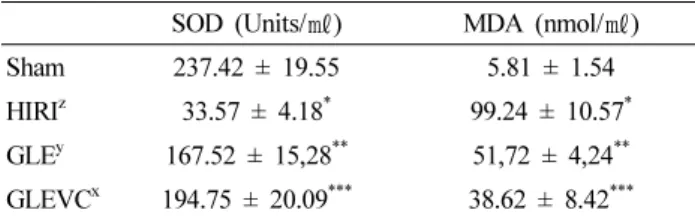
To examine the effects of GLEVC on HIRI-mediated liver damage, we measured serum SOD and MDA levels. In Table 2, significant reduces of SOD levels were detected in HIRI control group compared with the normal group. However, those were markedly reduced by GLEVC compared than GLE group.
Whereas the MDA levels was significantly increased by HIRI processes. In contrast, GLEVC administration were reduced serum MDA levels compared with HIRI processed rats in a dose dependent manner. Although GLEVC shown significant results but GLE also shown recovering effects against the HIRI-mediated increase in MDA level. These results suggest
Table 1. The ameliorative effect of GLE and GLEVEC on ALT, AST level in serum (Mean ± SD)
ALT (Units/L) AST (Units/L)
Sham 31.72 ± 9.54 17.09 ± 8.89
HIRI
z299.37 ± 51.26
*255.28 ± 72.64
*GLE
y164.24 ± 37.81
**183.28 ± 66.24
**GLEVC
x107.19 ± 33.56
***98.76 ± 54.68
****
P<0.005 vs sham (negative control) group,
**P<0.05 and
***P<0.01 vs HIRI (positive control) group.
zHIRI: hepatic ischemia reperfusion injury,
yGLE: Ginko biloba leaves extract,
xGLEVC: GLE + vitamin C.
Table 2. The ameliorative effect of GLE and GLEVEC on SOD activity and MDA content in serum (Mean ± SD)
SOD (Units/ ㎖) MDA (nmol/ ㎖)
Sham 237.42 ± 19.55 5.81 ± 1.54
HIRI
z33.57 ± 4.18
*99.24 ± 10.57
*GLE
y167.52 ± 15,28
**51,72 ± 4,24
**GLEVC
x194.75 ± 20.09
***38.62 ± 8.42
***P<0.005 vs sham (negative control) group,
**P<0.05 and
***P<0.01
vs HIRI (positive control) group.
zHIRI: hepatic ischemia reperfusion
injury,
yGLE: Ginko biloba leaves extract,
xGLEVC: GLE +
vitamin C.
that improving effects of GLEVC donated as more potent antioxidant against oxidative stress by HIRI-induced liver damages.
Effects of GLEVC on SOD activity and MDA content in tissue of HIRI rats
Similarly, serum SOD activity, SOD activity in HIRI- processed liver tissue was also reduced. In Table 3, SOD activity in liver tissue of HIRI group was reduced than normal group but these activities were significantly recovered by GLEVC process and GLE administration. Indeed, HIRI-mediated increases of MDA contents in liver tissue were significantly reduced in GLEVC and even shows significant changes GLE treated group also. Thus, these results suggest that GLEVC was effective to HIRI-mediated liver damage via anti-oxidative
mechanisms and parallel cellular signaling.
Effects of GLEVC on expression of Bax and Bcl-2 in liver tissue of HIRI rats
The experimental results show Bax expression (Fig. 1) and Bcl-2 (Fig. 2). In HIRI group, Bax protein expression was significantly increased in liver tissue compared with normal group. GLE administration could slightly reduce the expression of Bax protein, compared with HIRI group was statistically significant but GLEVC treatment was markedly reduced Bax expression in liver tissue (Fig. 1). Whereas, HIRI processes were reduces Bcl-2 expression, compared with normal group.
These increases of Bcl-2 were partially reversed by GLE administration, but GLEVC treatment shown potent effects on Bcl-2 rescue in liver tissue.
Table 3. The ameliorative effect of GLE and GLEVEC on SOD activity, MDA content and GSH level in tissues (Mean ± SD)
SOD (U/ ㎎ protein) MDA (nmol/ ㎎ protein) GSH ( ㎎/g protein)
Sham 281.94 ± 77.74 1.02 ± 0.27 11 57 ± 1 43
HIRI
z159.73 ± 9 98
*4.07 ± 0.68
*4.91 ± 0.67
*GLE
y191.47 ± 9.17
**2.09 ± 0.51
**7.98 ± 2.07
**GLEVC
x234.18 ± 10.24
***1.33 ± 0.49
***11.24 ± 1.41
***