Introduction
Hyper-adiposity inhibits penetration into tissues of blood glucose, and directly affects energy metabolism. Likewise, it causes abnormal lipid metabolism and therefore produces a high concentration of lipid peroxide (Takayama et al., 1988;
Arner et al., 1987; Kolterman et al., 1980). Also the high concentration of lipid peroxide causes bio-functional abnormalities such as degenerative problems, cancer, senescence, membranous change and injury, and as a result various diseases may occur (Saito, 1988; Vergroeson,1997; Bidlack at al.,1973). As high-calorie foods have been recently increased, the prevalence rate of adult diseases has been increased and so a social problem has reared up. Subsequently, many researchers have focused on developing functional substances in order to inactivate intra-corporeal lipid synthesis as well as to inhibit the production of peroxide (Lee et al.,200; Lee,2003; Kang et al.,1996; Ishikawa et al.,1997; Ueda et al.,2000; Langanier et al.,1987). In result, it was found that natural foods abundantly contain functional substances. In particular, Gal-Geun (Puerariae Radix) is widely used for food as well as medicinally. In Korea’s traditional medicine, it has been used to prescribe hypertension, coronary sclerosis, angina pectoris,
senile diabetes and otherwise (Huh,1984). A recent study reported that its water-soluble extract has biological functions such as antihypertensive effect, anti-inflammatory effect, antioxidant effect, hangover relief, liver protection and others (Huh et al,.1987; Oh et al.,1995; Lee et al.,1995; Lee et al.,1999; Fan et al.,1982). In addition, it was reported that its main ingredient, pueraria glycoside, decreases the serum cholesterol level and inhibits lipid oxidation (Oh at al.,1990;
Keung at al.,1998; Guerra et al.,2000). Lee and Shin (2007) in this laboratory reported that the extract decreases the plasma lipid concentration and inhibits lipid oxidation in rats fed a lipid peroxide for a long time. Park et al (2007) reported that its distillate, injected into the muscles of rats fed a high fat diet, decreases the plasma lipid concentration and inhibits accumulating of fats at around the liver and the heart. Such results heighten the possibility that Gal-Geun contains functional substances that have superior lowering lipid and antioxidant effects. In this study, as a part of basic research for developing functional foods based on Gal-Geun, the extract of Gal-Geun was long given to rats fed a high fat diet, Afterward, blood lipid composition, liver-TBARS concentration, blood-TBARS concentration, and antioxidase activities were analytically compared to each treatment groups.
Effects of Gal geun (Puerariae Radix) on lowering lipid and antioxidant
Eun Lee* and Jin-ho Kang
College of life science and natural resources, Sangji University, Won-ju 220-702, Korea
Abstract - Effects of Gal geun (Puerariae Radix) EtOH ext. on lipid lowering and antioxidant were investigated in hyperlipidemic rat. Concentration of FFA and triglyceride in plasma showed a tendency to decrease in Gal geun ext. groups.
Concentration of plasma total cholesterol and LDL-cholesterol decreased in Gal geun ext. groups. However the concentration of HDL-cholesterol showed no significantly different in all treatment groups. Concentration of liver total cholesterol and triglyceride showed a tendence to decrease in Gal geun ext. groups. Concentration of plasma and liver TBARS showed a low values in Gal geun ext. groups. The values of GSH-Px and SOD activity showed no significantly different among all the treatment groups. However the values of SOD and CAT activity showed a high value in the Gal geun ext. groups.
Key words -Gal geun (Puerariae Radix), cholesterol, triglyceride, FFA, thiobarbituric acid, GSH-Px, SOD, CAT
*
Corresponding author. E-mail : [email protected]Materials and Methods
Experimental animals and Hyperlipidemic rat
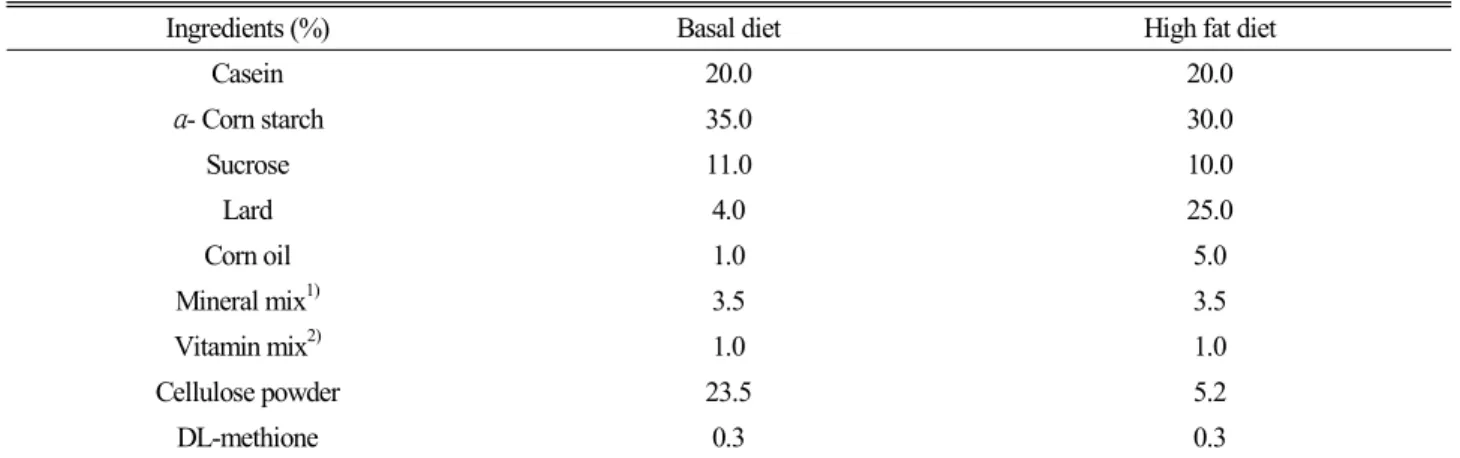
Forty male rats (Sprague-Dawely) of 185.25±5.71g average body weight, fed on a high fat diet (Table 1) for eight weeks.
Afterward, thirty rats that weighed at least 400g respectively were separately selected, and randomly assigned to the control group (100 mg/Kg of saline), the treatment I group (100 mg/Kg of Gal-Geun extract) and the treatment II group (200 mg/Kg of Gal-Geun extract) by ten rats.
Diet
All of animals fed the basic diet (Table 1), and the quantitative difference of intake was within 5% among treatment groups, and all mice were allowed to drink water freely for 4 weeks of experimental period.
Gal-Geun Extract and administration
500 g of dried Gal-geun, purchased from the market, was extracted for 5 hours at a time, 3 times in all, with the reflux of cooling water. After that, it was filtered and decompressive concentrated so that 90 g of EtOH extract could be produced.
Administration was placed orally using Jones tube, at 17:00 every day.
sampling and analysis
Feeding was stopped 12 hours before the completion of the experiment, and rats were blood sampled in ether anesthesia with cardiac puncture method. Plasma was separated by blood treated with EDTA, and was cultured at 37℃for 120 minutes. Afterward, TBARS concentration was quantified by Buedge and Aust’s method (Buege et al., 1978). Hepatic TBARS concentration was measured by the method of Ohkawa et al (1979), and the activity of glutathione peroxidase (GHS-Px) was measured by the method of Levander et al.
(Levander et al., 1983). The activity of liver SOD was measured by the method of Flohe et al. (Flohe et al., 1992).
The activity of liver catalase was measured in accordance with Johnson and Hkan Borg’s method (Johnson et al., 1988).
Total plasma cholesterol, total hepatic cholesterol, HDL cholesterol and triglyceride were qualified by using the kit (Wako Co., Japan). The concentration of plasma free fatty acid was measured by the enzyme technique based on V-NEFA kit (Nitsui, Japan).
Statistical Analysis
Results were one-way ANOVA examined by using SPSS package, and each group's significance examination was done in the level of P<0.05 by Duncan's multiple range test.
Table 1. Composition of experimental diets
Ingredients (%) Basal diet High fat diet
Casein 20.0 20.0
α- Corn starch 35.0 30.0
Sucrose 11.0 10.0
Lard 4.0 25.0
Corn oil 1.0 5.0
Mineral mix1) 3.5 3.5
Vitamin mix2) 1.0 1.0
Cellulose powder 23.5 5.2
DL-methione 0.3 0.3
1) Mineral mix.(g/kg diet): CaCO3, 29.29 ; CaHPO4・2H2O, 0.43; KH2PO4, 34.30; NaCl, 25.06; MgSO4・7H2O, 9.98; Feric citrate hexahydrate, 0.623; CuSO4․5H2O, 0.516; MnSO4・H2O, 0.121; ZnCl2, 0.02; KI, 0.005; (NH4)6MO7O24・4H2O, 0.0025.
2) Vitamin mix(mg/kg diet): Thiamine-HCl, 12; Riboflavin, 40; Pyridoxin-HCl, 8; Vitamin-B12, 0.005; Ascorbic acid, 300; D-biotin, 0.2;
Menadione, 52; Folic acid, 2; D-calcium pantothenate, 50; P-aminobenzoic acid, 50; Nicotinic acid, 60; Cholin choloride, 2000(IU/kg diet); Rethinyl acetae, 5000(IU/kg diet); Cholecalciferol, 250(IU/kg diet).
Results and Discussion
With regard to the concentrations of plasma free fatty acid and triglyceride (Table 2), Gal-geun treatment groups indicated lower concentrations compared to the control group. But significant differences were not observed between experimental groups. The concentrations of total plasma cholesterol and LDL cholesterol (Table 3) were also decreased in inverse proportion to the groups of Gal-Geun extract, similarly to the concentrations of plasma free fatty acid and triglyceride. The concentrations of blood free fatty acid, total cholesterol and triglyceride are closely related to the degree of intra- corporeal lipid accumulation (Kissebah et al., 1976) and can function as biological indexes for adult diseases such as diabetes and circulatory diseases (Nielsen et al., 1997).
Resultantly, this study proved that Gal-Geun’s functional substances have superior biological functions in that they are effective to decrease the lipid level, to prevent adult diseases, and to ideally inhibit intra-corporeal lipid accumulation. It was reported that Gal-Geun has been applied to hypertension, coronary sclerosis, angina pectoris, senile diabetes, antimicrobial
therapy and anticancer therapy and also its daidzein has anti-spasmodic and anti-themolytic effects (Shibata et al., 1959; Nakamoto et al., 1977). Miura et al. (Miura et al., 1971) reported about the antihypertensive effect of Gal-Geun, and reported that its main ingredient ‘pueraria glycoside’
decreases the serum cholesterol level and inhibits lipid peroxidation (Oh et al., 1990; Keung et al., 1998; Guerra et al., 2000). To sum up, Gal-Geun positively acts on intra- corporeal lipid metabolism and is effective to prevent adult diseases. In the case of HDL-cholesterol concentration, significant differences were not observed not only in the control group but treatment groups. The reason is might be due to the interaction among factors related to the production of HDL cholesterol, and the result was consistent with that of similar studies (Lee et al., 2000). In the case of total hepatic cholesterol and triglyceride (Table 4), experimental groups significantly indicated lower levels compared to the control group. As lipid is synthesized as well as analyzed in the liver, hepatic lipid concentration is usually kept within quantum satis. But in some cases, it may be different according to diets or enzyme activity-related factors. In this study, as all the
Table 2. Effects of Puerariae Radix ext. on plasma FFA and triglyceride concentration
Treatment FFA (uEql) Triglyceride (mg/ )㎗
Control 923.55±32.17b 201.33±18.44b
100 mg/kg Puerariae Radix 711.48±27.66a 129.50±20.51a
200mg/kg Puerariae Radix 730.51±30.49a 114.75±15.65a
a,b: Means in the same row with different superscripts are significantly different (P<0.05).
Table 3. Effects of Puerariae Radix ext. on plasma total cholesterol, HDL-cholesterol and LDL-cholesterol concentration
Treatment Total Cholesterol (mg/ )㎗ HDL-cholesterol (mg/ )㎗ LDL-cholesterol (mg/ )㎗
Control 184.00± 8.89b 40.50±2.12NS 16.50±2.12b
100mg/kg Puerariae Radix 124.00±12.73a 34.33±1.53NS 13.25±2.22ab
200mg/kg Puerariae Radix 112.25±14.77a 30.25±3.20NS 10.67±2.52a
a,b: Means in the same row with different superscripts are significantly different (P<0.05).
NS: Not significantly different (P>0.05).
Table 4. Effects of Puerariae Radix ext. on liver total cholesterol and triglyceride concentration
Treatment Total cholesterol (mg/g) Triglyceride (mg/g)
Control 16.12±1.01b 18.54±0.91b
100mg/kg Puerariae Radix 10.75±0.94a 13.29±1.05a
200mg/kg Puerariae Radix 10.14±0.83a 12.55±0.98a
a,b: Means in the same row with different superscripts are significantly different (P<0.05).
animals fed on the same intake with the same diet, these results suggested that Gal-Geun extract might exert influence on hepatic lipid synthesis or lipolysis. Table 5 shows plasma TBARS concentration and hepatic TBARS concentration, these values were decreased in the groups of Gal-Geun extract. But in the case of plasma, the significant differences were not observed among the groups of Gal-Geun extract.
This result proved that Gal-Geun has functional substance that decreases the concentration of intra-corporeal peroxide, and is well consistent with the report about the antioxidant ingredient of Gal-Geun (Oh et al., 1990). Table 6 shows the activities of GSH-Px, SOD and CAT. In the activities of GSH-Px and SOD, the significant differences were not observed between experimental groups. But in the case of CAT activity, the groups of Gal-Geun extract indicated higher values compared to the control group. Ordinarily, intra-corporeal peroxide accumulation is closely interrelated with the activities of antioxidant enzymes. In this study, however, just CAT activities correspond to the changes of TBARS concentrations. This result suggests that Gal-Geun’s functional substances might act on other factors in addition to the activities of antioxidant enzymes in view of the fact that intra-corporeal peroxide accumulation is caused by two biologic responses, that is, production and lysis. In addition, the antioxidant effect of Gal-Geun should be studied more concretely.
Literature Cited
Arner P, Pollare T, Lithell H, Livingston JN. 1987. Defective insulin receptor kinase in human skeletal muscle in obesity and type 2 (non-insulin-dependent) diabetes mellitus.
Diabetologia 30:437.
Bidlack WR, Tappel AL. 1973. Damage to microsomal membrane by lipid peroxidation. Lipids 8: 177-178.
Buege JA, Aust SD. 1978. Microsomal lipid peroxidation. In:
Fleischer S, Packer Leds Methods in enzymelogy (London, Academic press) 52: 302-309.
Fan L, Zeng L, Zeng GY, Zhou YP, Zhang LY, Cheng Y. 1982.
Pharmacological studies on radix purariae, Chin. Med. J., 95:145.
Flohe L, Becker R, Brigelius R, Lengfelder E, Otting F. 1992.
Convenient assays for superoxide dismutase. CRC Handbook of free radicals and antioxidants in Biomedicine pp. 287-293.
Guerra MC, Speroni E, Broccoli M, Cangini M, Pasini P, Minghett A, Crespi-Perellino N, Mirasoli M, Cantelli G, Paolini M. 2000. Comparisons between chinese medical herb Pueraria lobata crude extract and its main isoflavone puerarin antioxidant properties and effects on rat liver CYT-catalvzed drug metabolism. Life Sci 67(24): 2997-3006.
Huh J. 1984. Donguibokam, Mansandong Seoul, 3: 726.
Huh LH, Kim HC, Lee SJ. 1987. Studies on anti-inflammatory activity and its mechanism of daidzein. J pharmaceut Soc Kor 31(1): 154-163.
Table 5. Effect of Puerariae Radix ext. on plasma and liver TBARS concentration
Treatment Plasma TBARS
(nmoles MDA/ml)
Liver TBARS (nmoles MDA/g)
Control 16.33±3.24b 27.35±2.46c
100mg/kg Puerariae Radix 9.30±2.46a 14.30±2.45b
200mg/kg Puerariae Radix 5.17±2.56a 6.04±2.30a
a,b,c
: Means in the same row with different superscripts are significantly different (P<0.05).
Table 6. Effect of Puerariae Radix ext. on antioxidase (GSH-Px , SOD, CAT) activity
Treatment GSH-Px
(nmoles/min/mg protein)
SOD (unit/mg protein)
CAT
( moles(Hμ 2O2)/min/mg protein)
Control 150.17±1.51NS 12.49±1.81NS 61.89±1.90a
100mg/kg Puerariae Radix 149.39±0.12NS 13.26±1.49NS 68.03±6.83b
200mg/kg Puerariae Radix 150.78±8.34NS 12.36±2.99NS 76.84±1.03b
a,b: Means in the same row with different superscripts are significantly different (P<0.05).
NS: Not significantly different (P>0.05).
Ishikawa T, Suzukawa M. 1997. Effect of tea flavonoid supplementation on the susceptibility of low-density lipo- protein to oxidative modification. Am J Clin Nutr. 66(2):
261-266.
Johnson LH, Hakan Borg LA. 1988. A spectro phtometric method for determination of catalase activity in small tissue samples. Analytical Biochemistry pp. 331-336.
Kang YH, Ha TY, Moon KD. 1996. Effects of pine needle extracts on serum and liver lipid contents in rats fed high fat diet. J. Korean Soc. Food Nutr. 25: 367-373.
Keung WM, Vallee BL, Kudzu R. 1998. an ancient chinese source of modern antidipsotropic agents. Phytochemist교 47(4): 499-506.
Kissebah AH, Alfarsi S, Adams PW, Wynn V. 1976. Role of insulin resistance in adipose tissue and liver in the pathogenesis of endogenous hypertriglyceridemia in man. Diabetologia.
12:563-571.
Kolterman OG, Insel J, Saekow M, Olefsky JM. 1980.
Mechanism of insulin resistance in human obesity. J Clin Invest 65:1272-1284.
Langanier S, Yu BP. 1987. Anti-lipoperoxidation action of food restriction. Biochem. Biophys Res. Comm. 145: 1185- 1202.
Lee CH, Han SH, Min SG. 1995. The effects of Puerariae radix catechins administration on liver function in carbon tetrachloride treat rats. J Korean Sci Nutr 24(5): 713-719.
Lee E, Choi MY, Oh HS. 2000. Effects of Powdered Siho (Bupleuri Radix) on serum and liver lipid composition and Antioxidative capacity in rat fed high oxidized fat. Korean J.
Nutrition 33: 502-506.
Lee E. 2003. Effects of powdered pine needle (Pinus densiflora seib et Zucc.) on serum and Liver Lipid Composition and Antioxidative, J. Korean Soc. Food Sci. Nutr. 32(6): 926- 930.
Lee E, Shin CO. 2007. Effects of Galgeun (Pueraria radix) extracts on plasma and liver lipid composition, liver function and antioxidative capacity in rats fed high oxidized fat.
Korean J. Plant Res. 20(5):475-480.
Lee JS, Kim ES, Kim SW. 1999. Effects of extract of Puerariae
radix on lipid peroxidation in ethanol-administered rats. J Korean Soc Food Sci Nutr 28(4):901-906.
Levander OA, PDeLoach D, Morris C, Moser PB. 1983.
Platelet glutathione peroxidase activity as an index of selenium status in rats. J. Nutr. 113: 55-63.
Miura K, Takeda R, Nakamoto H, Saito H. 1971. The chemical and pharmacological stuy of puerariae radix , Oyouyakuri, 5:247.
Nakamoto H, Iwasaki Y, Kizu H. 1977. The study of aqueous extract of puerariae radix IV, Yakugaku Zasshi, 97:103.
Nielsen S, Jensen MD. 1997. Obesity and cardivascular disease is body structure a factor. Curr. Opin. Lipidol. 8:200-204.
Oh MJ, Lee KS, Son HY, Kim SY. 1990. Antioxidative components of pueraria root. J Kor Soc Food Sci Tech 22(7): 793-792.
Ohkawa H, Ohishi N, Yagi K. 1979. Assay for lipid peroxide in animal tissues by thiobarbituric acid reaction. Anal Biochem 95: 351-358.
Park CH, Kim NY, Nam EJ, Kim SH, Lee JH, Lee E. 2007. Effects of Hagocho(Prunella vulgaris L.), Gamgook (Chrysanthemum indicum L.) and Galgeun (Pueraria Radix) on plasma lipid composition and histological consideration in hyperlipidemic rat. Korean J. Plant Res. 20:22-27.
Saito M. 1988. Interaction between lipid peroxide formation and nutritional status. J. JPN Soc. Nutr. Food Sci. 41:
343-349.
Shibata S, Harada M, Murakami T. 1959. Constituents of japanese and chinese crude drugs II: Anti-spasmodic action of the constituents of puerariae Root, Yakugaku Zasshi, 79:863.
Takayama S, Kahn CR, Kubo K, Foley JE. 1988. Alterations in insulin receptor autophosphorylation in insulin resistance:
correlation with altered sensitivity to glucose transport and antilipolysis to insulin. J Clin Endocrinol Metab 66:992-999.
Ueda H, Tanoue K. 2000. Growth-depressing and cholesterol- lowering effects of quillaja and tea saponins in chicks as influenced by diet composition. Anim. Sci. J. 71(4): 393-399.
Vergroeson AT. 1997. Physiological effects of dietary linoleic acid. Nutr. Rev. 35: 1-9.
(Received 5 November 2008 ; Accepted 17 December 2008)